


Quick Answer: Men with large foreheads (8cm+ hairline-to-brow height) get the best results from fringe-forward cuts: textured crops, Caesar cuts, French crops, and curtain hairstyles. These styles use forward direction and layering to break up forehead height. Slick-backs and wet-look gel do the opposite and should be avoided.
A large, wide forehead changes one thing about your haircut: the front section needs more thought than it would on a balanced face. The cut itself doesn’t have to be complex some of the cleanest, most requested styles in barbershops right now work precisely because they direct hair forward rather than back. The forehead becomes a non-issue when the fringe sits right. For the full face shape identification guide, see the face shape haircuts guide.
How Do You Know If You Have a Large Forehead?
Place four fingers horizontally across your forehead between your eyebrow line and your hairline. If all four fit comfortably, that’s a large forehead sometimes described as a high hairline — by the standard barbers use. A clinical guideline often cited is 8 cm or more in forehead height most men fall between 5 and 7 cm.
One distinction worth making before choosing a cut: a large forehead and a receding hairline are not the same thing, and they need different approaches.
| High Forehead | Receding Hairline | |
|---|---|---|
| What it is | Genetic — hairline was always high | Progressive — hairline moving back |
| Visual sign | Stable, proportionally large forehead | Temples or front hairline thinning/retreating |
| Best strategy | Forward fringe, coverage, forward-styled cuts | Work with hairline direction, textured fringe over blunt fringe |
| Avoid | Straight-back styles | Cuts that draw attention to the retreating line |
Your hairline type also changes which coverage style works:
- Straight or rounded hairline — blunt fringe and side parts both sit cleanly
- M-shaped hairline or widow’s peak — textured or side-swept fringe works better than a blunt horizontal fringe, which can look odd against the M-shape
- High temples — part from the fuller side to keep asymmetry working in your favour
What Are the Best Hairstyles for Men with Large Foreheads?
Every style below uses fringe, forward direction, layers, or coverage to soften a prominent hairline — the 2026 barbershop data confirms these are what men are actually requesting.
1. Textured Crop with Fringe 🔥 2026
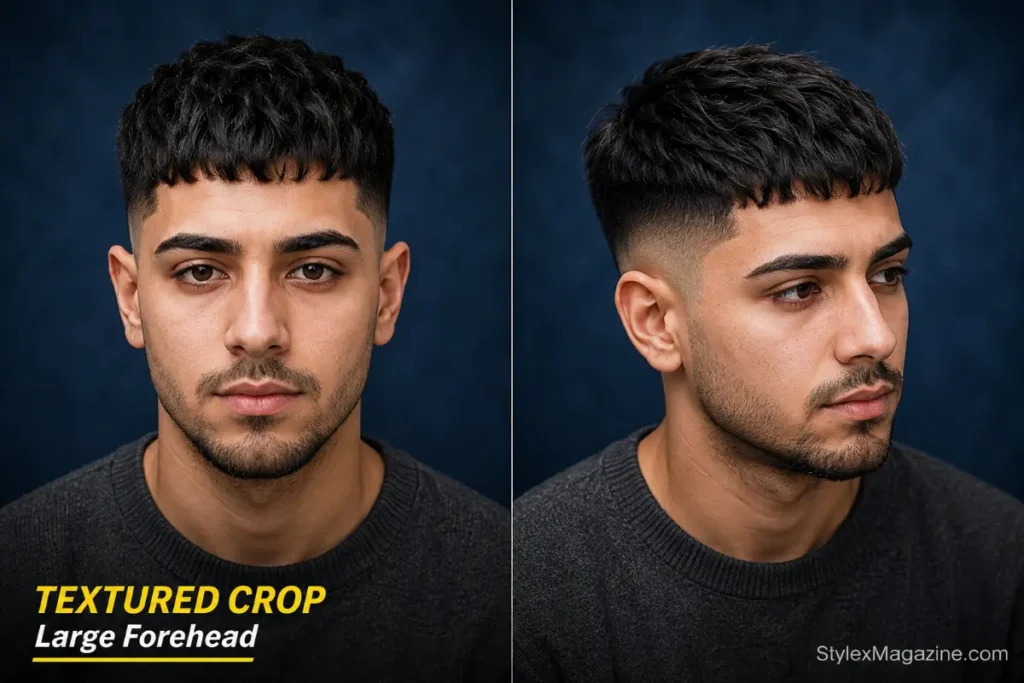
The most requested haircut in barbershops in 2026 and the strongest single option for a large forehead. Short faded sides, choppy layered texture on top, and a slight fringe pushed forward the fringe sits just above the eyebrows and creates an immediate horizontal interruption across the forehead. The key instruction from Blumaan’s 2026 guide: ask for the fringe to sit at mid-forehead, not too short and not covering the eyes. Matte clay separates the texture and keeps the fringe in place without adding shine.
Works on straight to wavy hair. Trim every 3 to 4 weeks — the fringe loses its position fastest.
2. Caesar Cut 🔥 2026
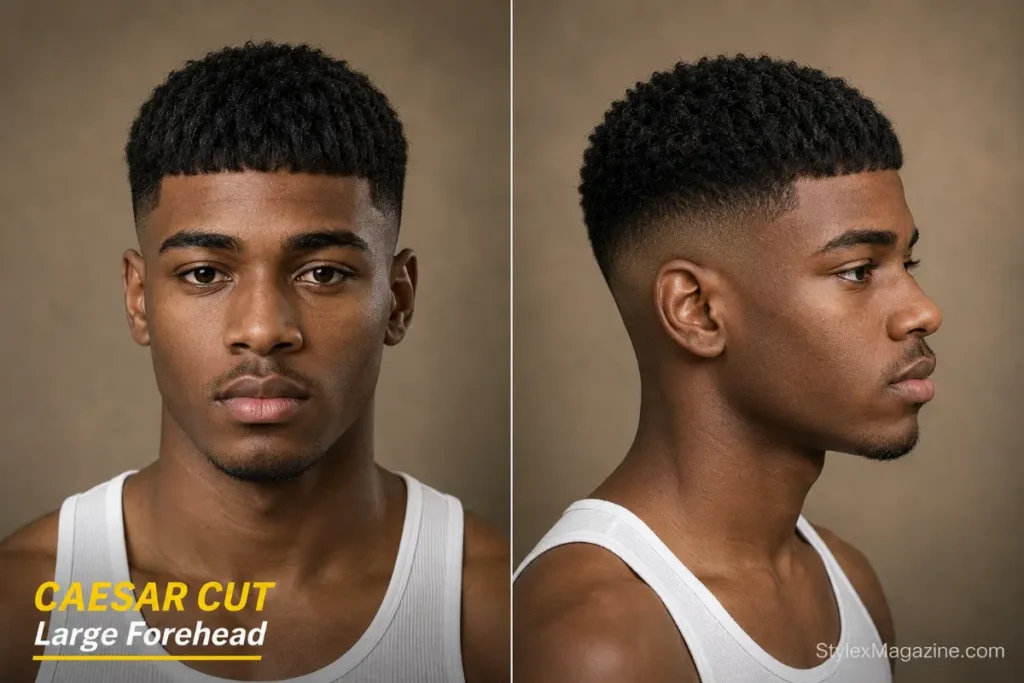
Nick Hall of Man of Many a licensed barber with 7 years of experience calls this “an obvious choice for men with big foreheads.” The horizontal fringe sits forward across the forehead, and its length and angle can be adjusted for any hairline type. The 2026 version uses a textured rather than blunt fringe slightly broken up and choppy rather than a hard straight line, which suits M-shaped hairlines better.
Ask for a Caesar with a short textured fringe, mid-forehead length, and a low fade on the sides. Trim every 3 weeks before the fringe loses its horizontal direction.
3. French Crop 🔥 2026
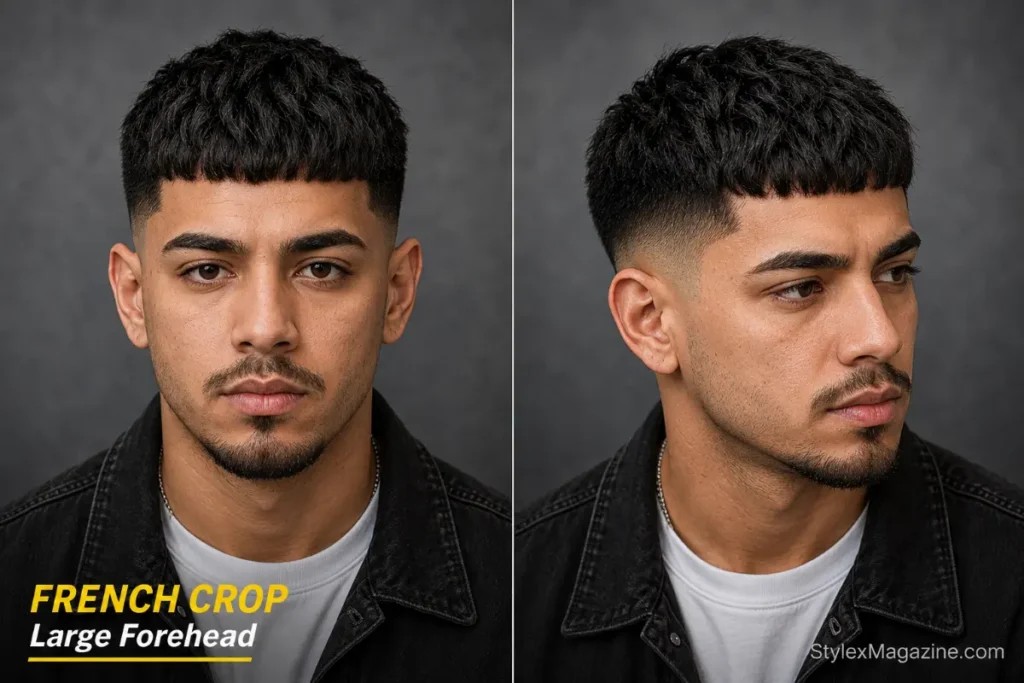
The French crop pushes everything forward the fringe is the focal point. The 2026 version has a heavier, more blunt fringe than the textured crop, sitting across the forehead to draw the eye to the eyes rather than the hairline above. According to the MensHairstyleEmpire 2026 guide, mid-forehead is the fringe sweet spot too short and it looks like a bowl cut error, too long and it loses the clean effect. Works on straight and slightly wavy hair where the fringe holds its horizontal direction.
Ask for a French crop with the fringe hitting mid-forehead, scissor-cut texture on top, and mid fade on sides. Trim every 3 to 4 weeks.
4. Crew Cut (Forward Styled)
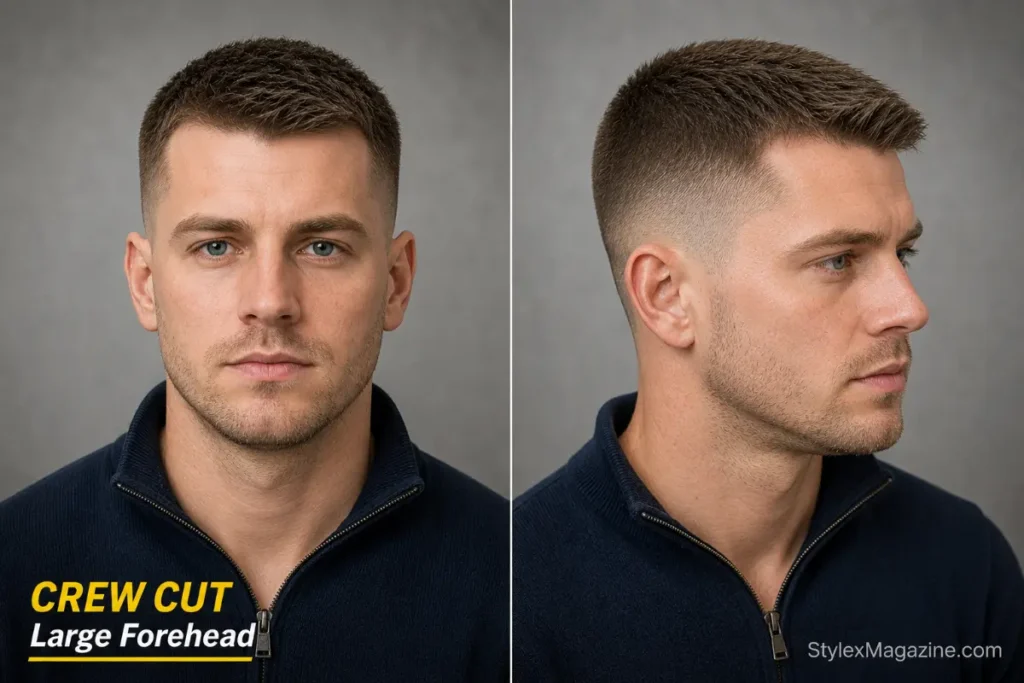
A standard crew cut doesn’t automatically work for a large forehead what makes it work is blow-drying the top forward rather than leaving it flat or pushing it backward. The slight forward angle on top creates a minimal fringe effect without requiring dedicated fringe length. Nick Hall recommends blowing the top forward and to the side for light forehead coverage without a full curtain of hair.
Ask for a crew cut at 1.5 to 2 inches on top, low to mid fade I’ll style the top forward. Trim every 2 to 3 weeks.
5. Temple Fade with Forward Fringe
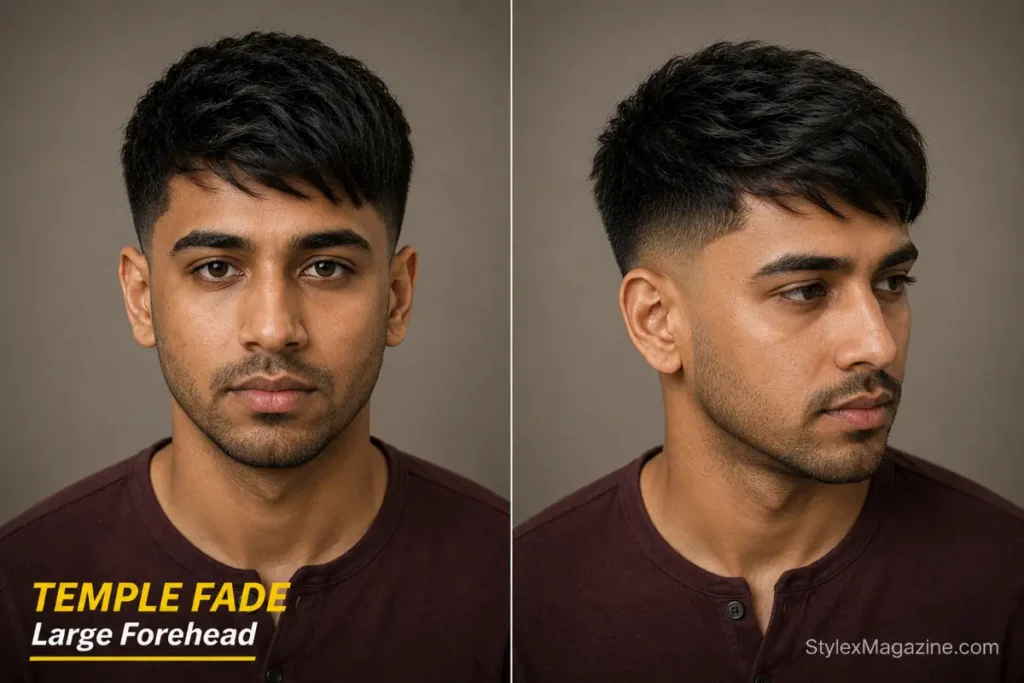
The temple fade keeps the sides fuller than a standard mid fade it only tightens around the temples and hairline — while the longer top is styled forward with a sweeping fringe. The cleaner temple definition draws the eye to the hairline perimeter rather than the forehead, and the forward fringe covers the upper portion. Works on thick hair where the fringe holds without heavy product.
Ask for a temple fade tight at the hairline, leave sides fuller and a forward-swept fringe on top. Trim every 2 to 3 weeks for the temple lines.
6. Buzz Cut with Beard
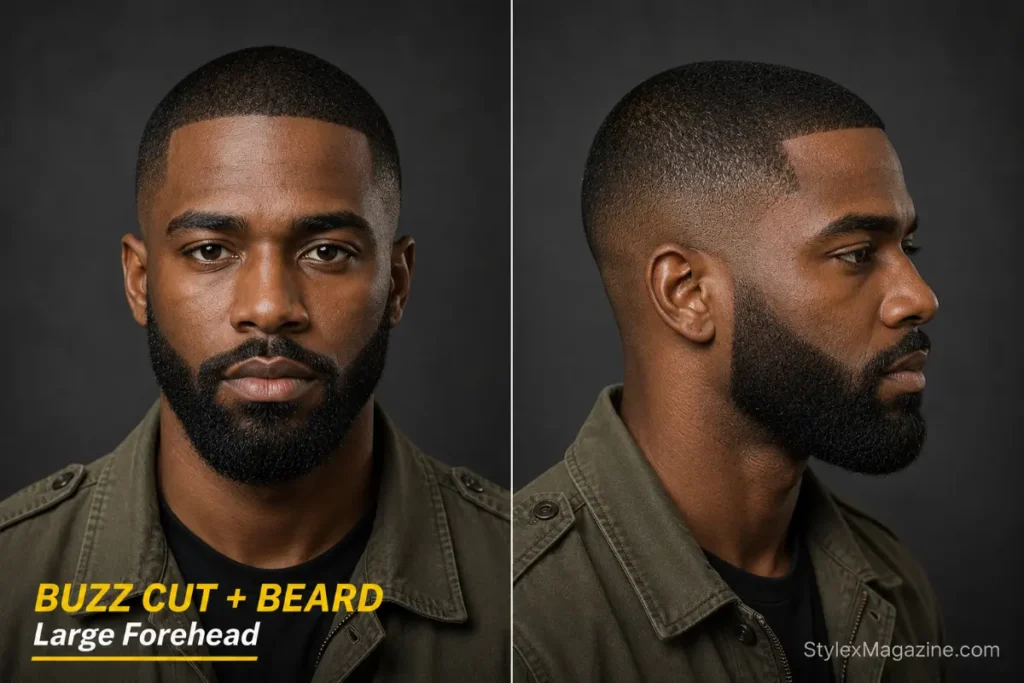
The buzz cut alone is one of the least flattering choices for a large forehead it removes all fringe coverage and leaves the full forehead visible. With a beard the dynamic changes: the beard adds visual weight to the lower face and shifts proportion away from the forehead. Even 5 days of stubble makes a difference; a fuller beard does more. The 2026 version uses slightly varied guard lengths across the top and a crisp lineup rather than a uniform all-over buzz.
Ask for a grade 2 or 3 buzz cut with a natural lineup, and shape the beard fuller at the chin. Trim every 2 to 3 weeks.
7. Curtain Hairstyle 🔥 2026
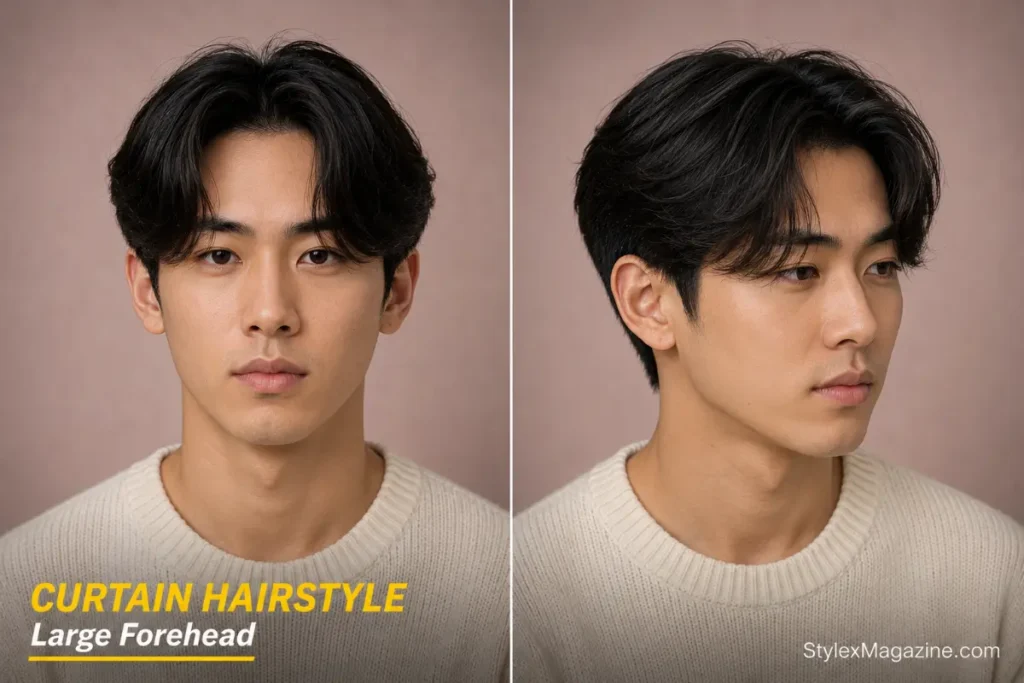
Center or slightly off-center part with hair falling forward on both sides the bilateral forward movement works from two directions at once instead of one. The curtain hairstyle works for every hairline type, including the M-shape and widow’s peak, because the center part adapts to however the hair naturally falls forward. DIDA NYC’s 2026 guide lists curtain and fringe shapes among the biggest 2026 trends. Medium length, minimal product, natural fall.
Ask for a curtain hairstyle center or slightly off-center part, falls forward on both sides, medium length. Trim every 4 to 5 weeks.
8. Side-Swept Fringe
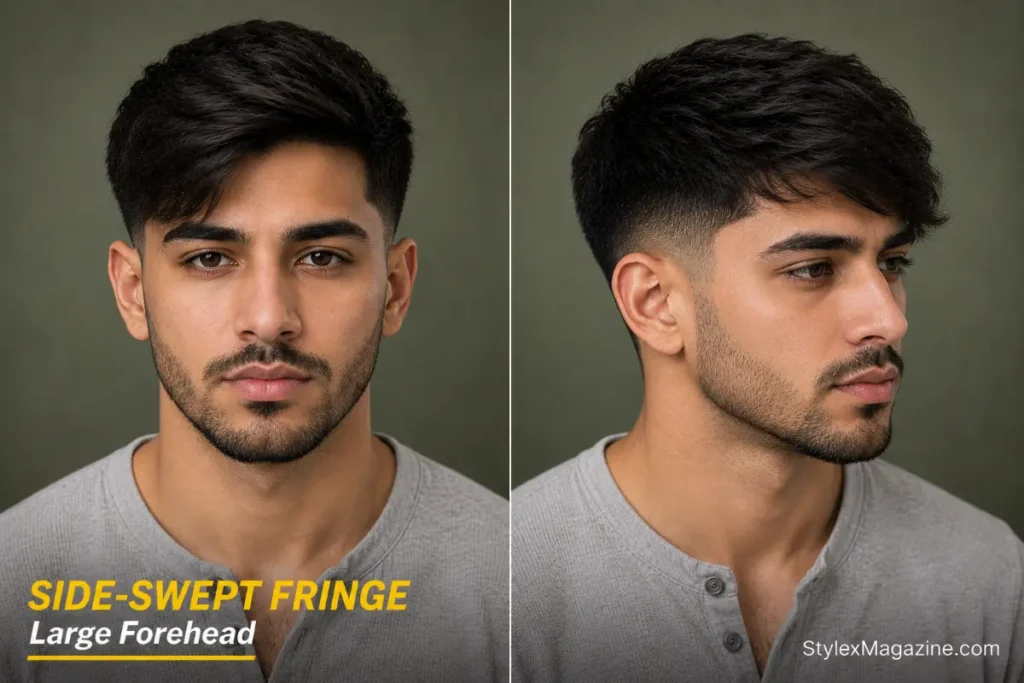
Longer hair at the front swept diagonally across the forehead the diagonal direction creates both coverage and asymmetry, which draws the eye laterally rather than upward to the hairline. Works on all hair types and sits cleanly on both straight and wavy hair where the sweep holds its direction. ForteSeries identifies this as one of the most consistently effective styles for large foreheads across all face shapes. The fringe length is adjustable longer for more coverage, shorter for a subtler effect.
Ask for a side-swept fringe with a low to mid fade, enough front length to sweep across the forehead. Trim every 3 to 4 weeks.
9. Mod Cut 🔥 2026
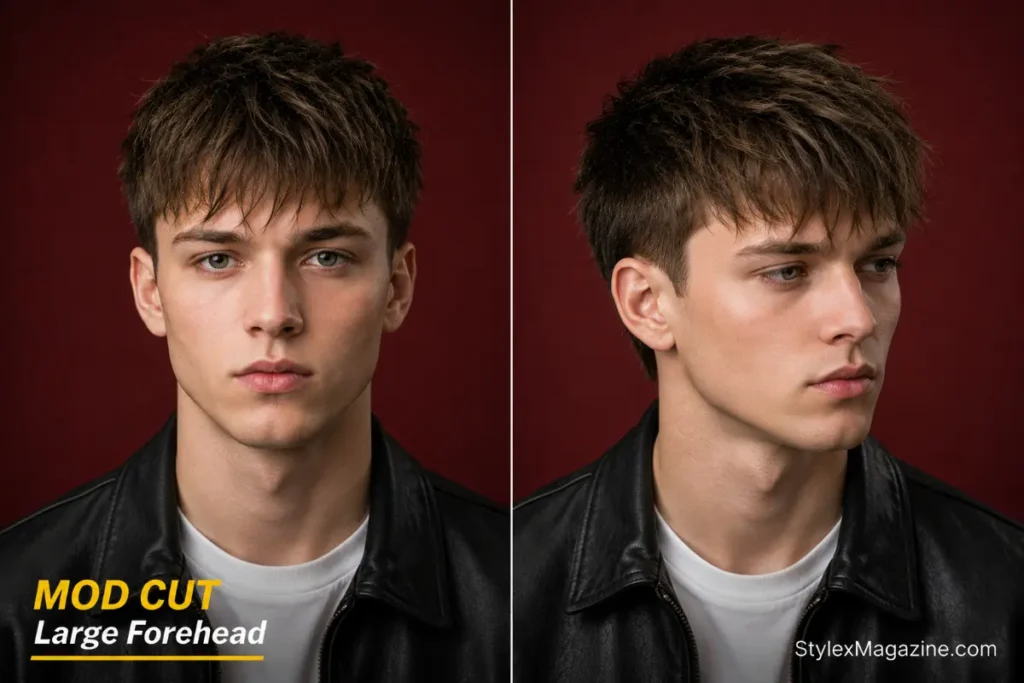
Andrew Zumbo, American Crew style ambassador, credits TikTok and Instagram Reels for the mod cut’s revival — and specifically recommends it for men with big foreheads who don’t have receding hairlines. Short to medium hair around the sides with more volume on top and a straight or textured fringe that falls forward. Jacob Elordi wears a version of this. The top is point-cut and feather-bladed for texture and movement.
Ask for a mod cut forward-falling fringe, textured not flat on top, medium sides. Trim every 3 to 4 weeks — the shape needs maintaining to stay mod rather than growing shapeless.
10. Messy / Tousled Fringe 🔥 2026
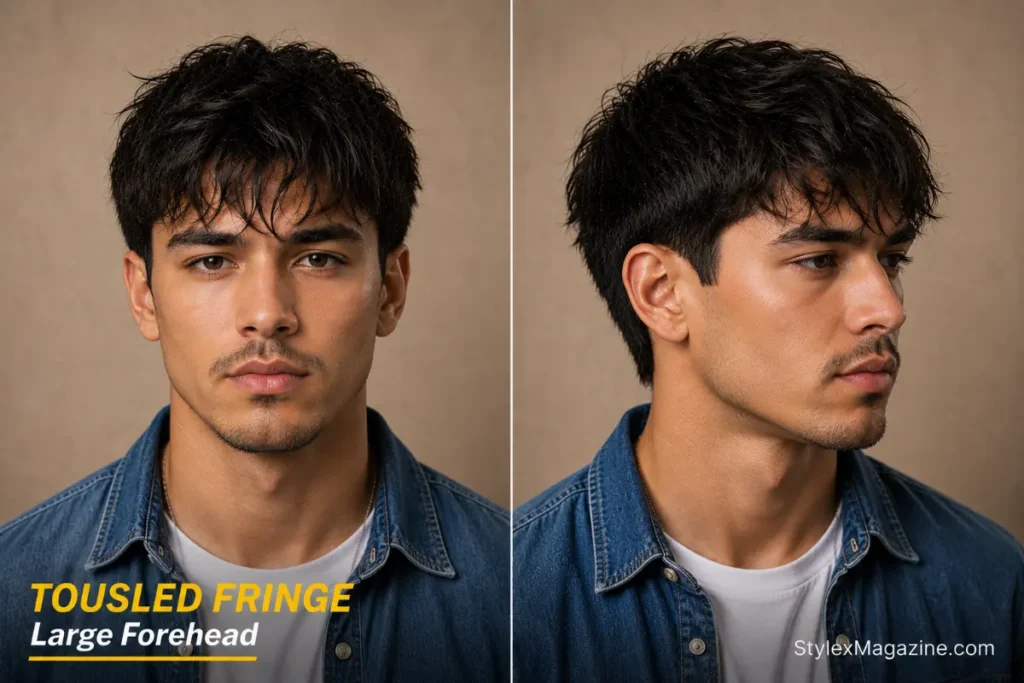
Blumaan’s 2026 guide describes this as longer layers on top that fall forward into a loose, undone fringe, with short tapered sides and minimal styling on top. Sea salt spray on damp hair, scrunch, air dry. The undone quality is the point: the hair falls where it wants, and where it wants is forward across the forehead. Works on wavy and medium-density hair where the natural fall creates movement. Ask for a tousled fringe longer layers on top, tapered sides, I’ll style it with sea salt spray and let it fall naturally. Trim every 4 to 5 weeks.
11. Shag Cut
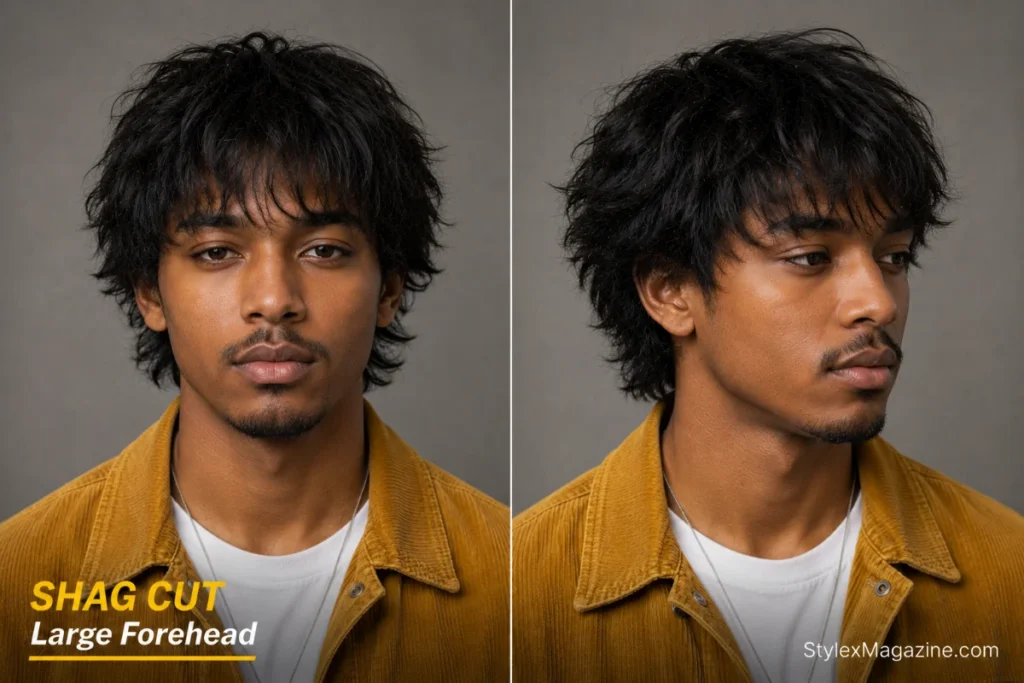
Choppy layers throughout with a soft fringe the shag distributes volume and texture across the whole head rather than concentrating it at one point, which makes the forehead look proportionate rather than prominent. ForteSeries and SkinFadeBarbers both confirm this as a strong option for large foreheads. The sides are feathered rather than faded for a lighter overall silhouette. Works on wavy and thick hair where the layers develop natural movement.
Ask for a shag cut — choppy layers throughout, soft fringe, feathered sides. Trim every 4 to 5 weeks — layers grow out into a relaxed shape rather than looking overgrown.
12. Two-Block Cut 🔥 2026
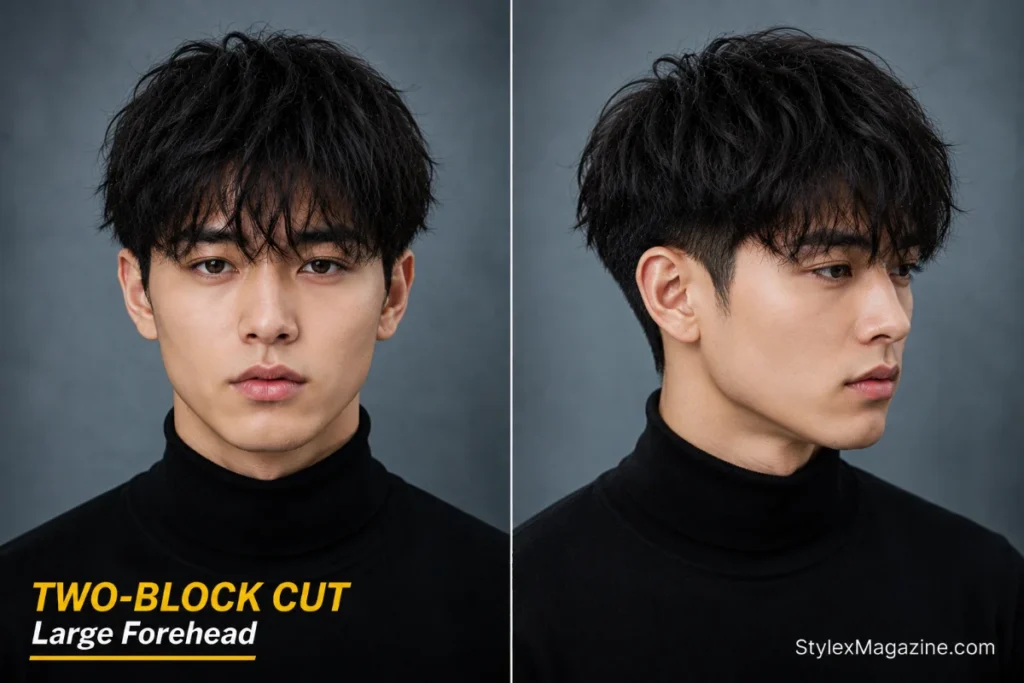
Korean-influenced cut that’s moved into mainstream barbershops longer, layered top with shorter sides and back, with a fringe that falls forward. Hinsdale Barbershop’s 2026 guide attributes its rise to K-Pop’s influence on global men’s grooming, noting that soft, wispy fringes fall effortlessly over the forehead in this style. The weight distribution is smart length through the front and crown covers the forehead while the tight sides keep it structured. Works in professional settings despite its fashion-forward origin.
Ask for a two-block cut — longer layered top with fringe falling forward, shorter back and sides. Trim every 4 weeks.
13. Deep Side Part
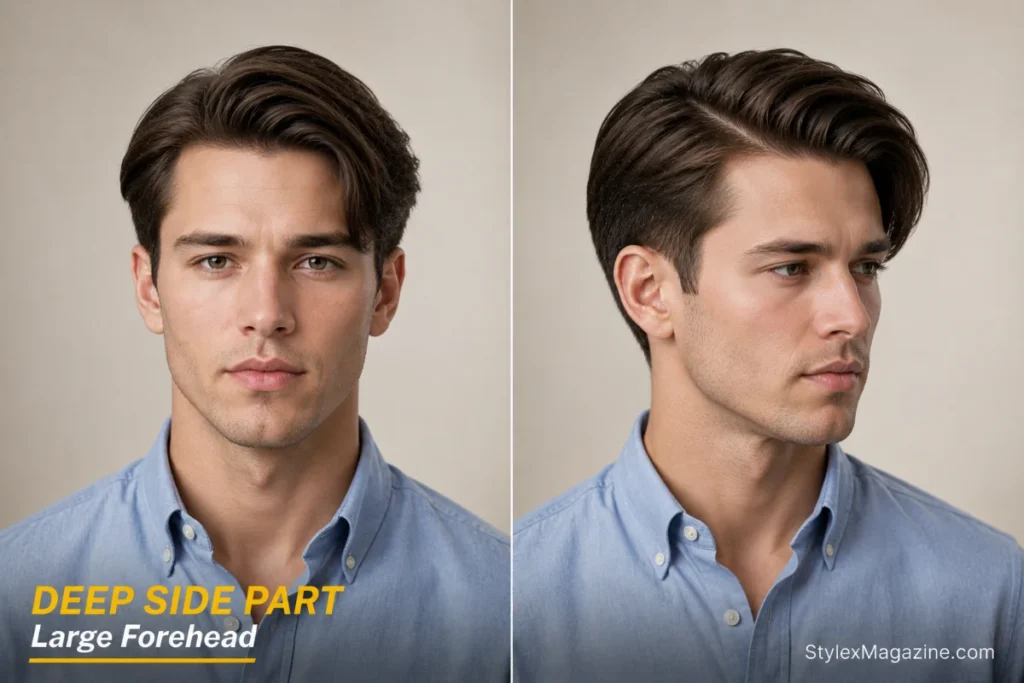
The part positioned significantly further from the natural hairline than a standard side part a wider sweep of hair crosses the forehead, adding horizontal coverage and creating a stronger asymmetry that breaks up the forehead more effectively than a standard part. Works on straight to wavy hair where the sweep holds direction. ForteSeries notes this as particularly effective for men with straight or fine hair where the part line stays precise.
Ask for a deep side part part positioned further from the hairline than usual, medium length on top, taper or low fade. Trim every 3 to 4 weeks.
14. Modern Mullet 🔥 2026
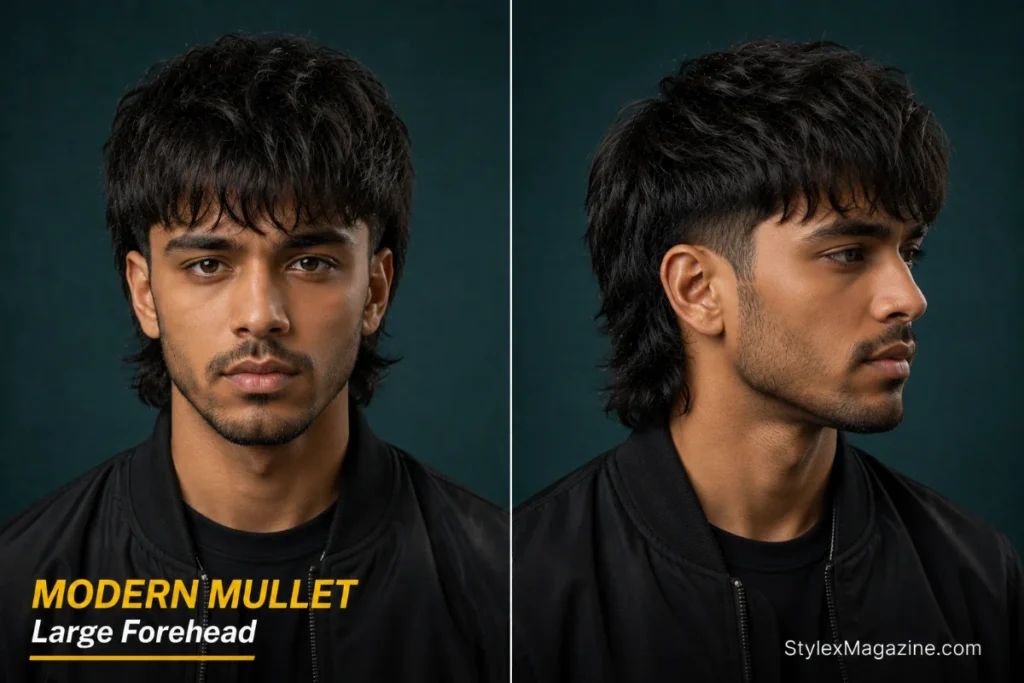
Fringe at the front combined with longer layers at the back the fringe covers the forehead and the extended back length draws the eye downward and backward rather than upward to the hairline. HairTrendsForMen confirms the soft mullet as one of the most requested men’s cuts right now. The tapered sides rather than a skin fade keep the sides soft. Works best on wavy hair where the back layers flow naturally.
Ask for a modern mullet fringe in front, tapered sides, longer layers at the back, textured finish. Trim every 3 to 4 weeks.
15. Layered Fringe 🔥 2026
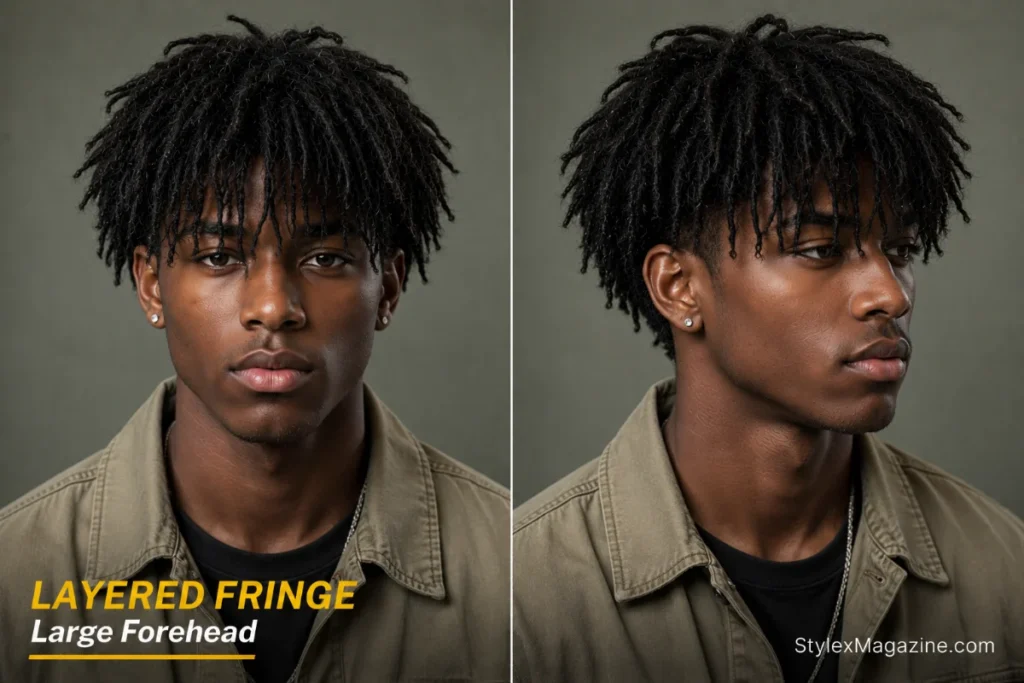
TheFashionisto’s May 2026 guide describes four to six inches of layered, textured length on top with a fringe that falls at or past the brow line for a relaxed, slightly undone look. The layering removes bulk and adds movement, and the fringe falls forward past the brow — more coverage than a textured crop fringe, less structured than a French crop. The fringe falls to one side naturally rather than being swept deliberately. Works on straight to wavy hair.
Ask for layered length on top 4 to 6 inches with a fringe that falls forward past the brow line, tapered sides. Trim every 5 to 6 weeks requires regular trims to stop layers growing shapeless.
16. Big Forehead + Curly Hair
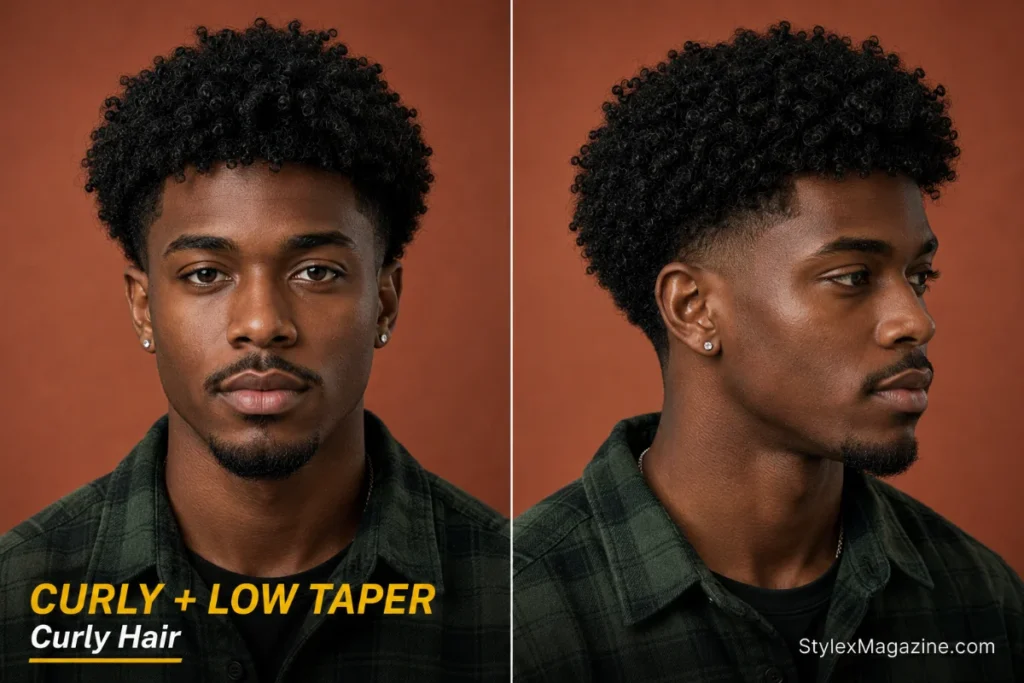
Curly hair solves a significant part of the problem naturally the curls create volume and texture at the front that softens the hairline without needing a dedicated fringe. As WimpoleClinic puts it, curls naturally add coverage and personality at the front without requiring a styled fringe. A low taper rather than a mid or high fade keeps the sides full. Leave-in conditioner or curl cream maintains definition. Ask for a low taper, leave the curl volume on top — the natural texture does the forehead work. Trim every 3 to 4 weeks.
17. Big Forehead + Wavy Hair
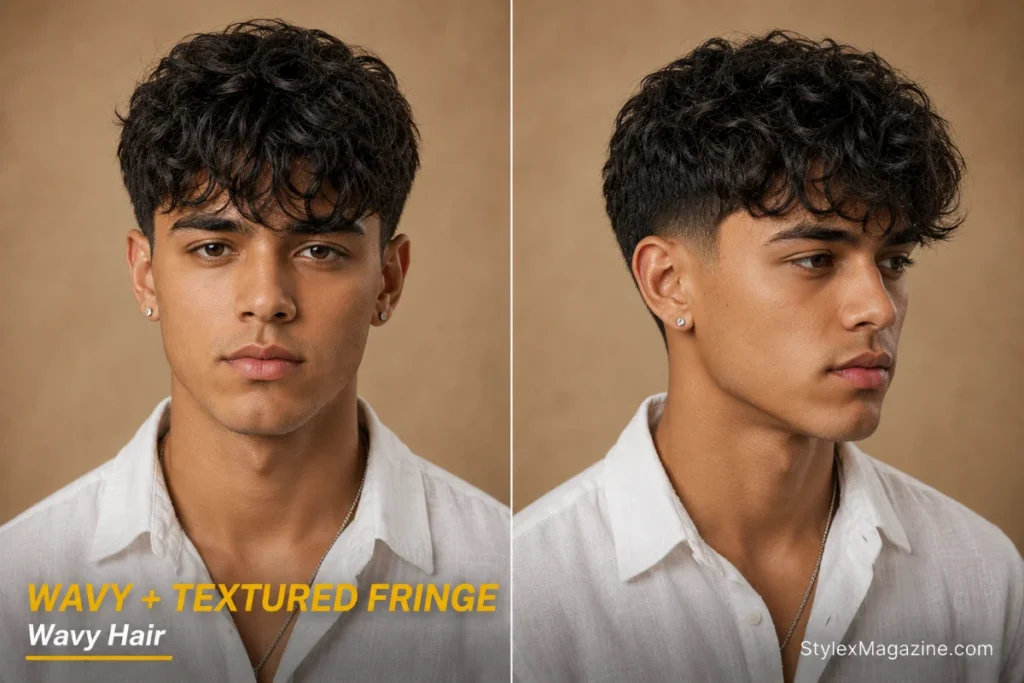
Natural waves add forward movement and texture that works in the same direction as fringe coverage the wave pushes toward the face rather than lying flat. Any of the styles above work on wavy hair, but the messy fringe, shag cut, and curtain hairstyle benefit most from the natural wave pattern. Sea salt spray before drying enhances the wave without product build-up. Ask the barber to work with the natural wave — textured finish, nothing that flattens it. Trim every 3 to 4 weeks.
18. Big Forehead + Straight Hair
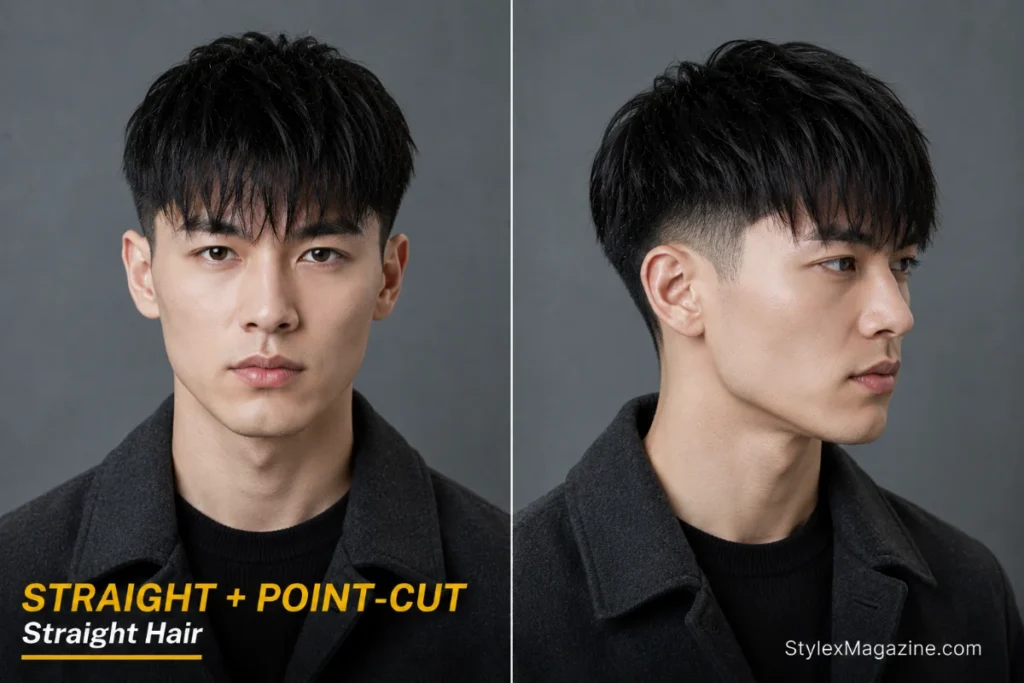
Straight hair shows fringe and part lines with maximum precision the fringe sits flat and clean, which is both the advantage and the challenge. Without texture added through point-cutting, straight hair lies flat and loses the forward movement that makes fringe work.
Ask for point-cut or razor-cut ends rather than blunt-cut this adds separation and prevents the fringe from lying flat against the forehead in a single heavy sheet. Matte clay holds direction without adding shine that draws more attention to the forehead. Trim every 3 weeks — straight hair shows grow-out faster than other textures.
19. Big Forehead + Receding Hairline
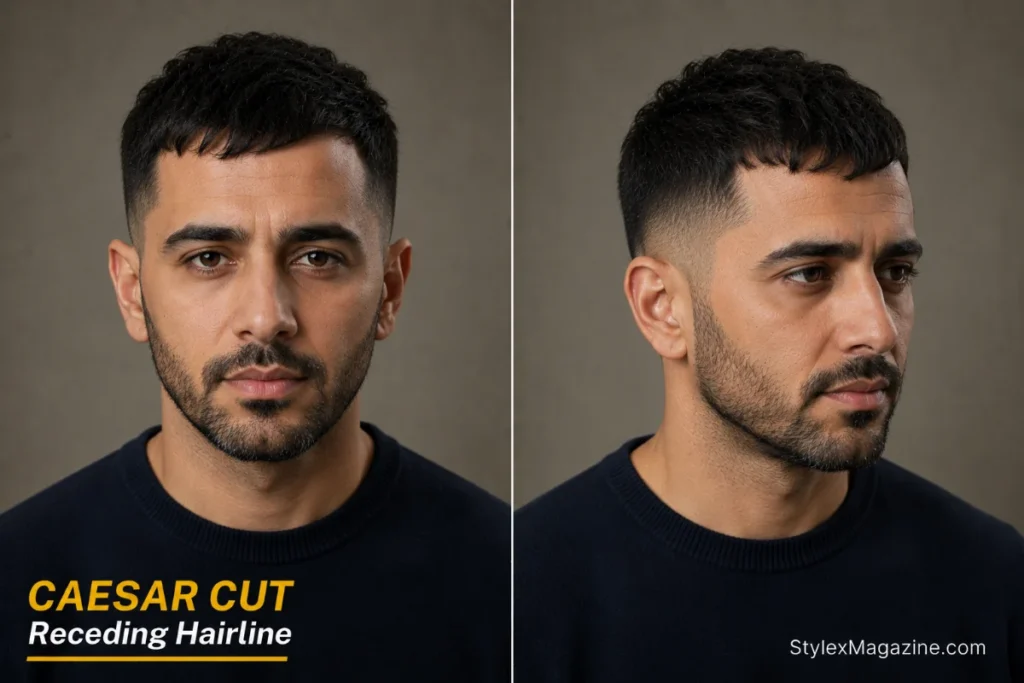
Different problem, different approach. A man with a receding hairline needs cuts that work with the hairline direction rather than against it. A blunt fringe on a receding hairline looks forced the hair doesn’t naturally fall that way and requires constant maintenance to hold. The Caesar cut is an exception worth trying first: the textured forward fringe doesn’t need to be symmetrical, so it adapts to a thinning hairline better than most cuts.
The curtain hairstyle also works well the center or off-center part adapts to wherever the natural hair falls. Avoid cuts that expose the temples, and avoid straight-back combed styles that maximize the visible forehead area.
20. Buzz Cut (Embracing the Forehead)
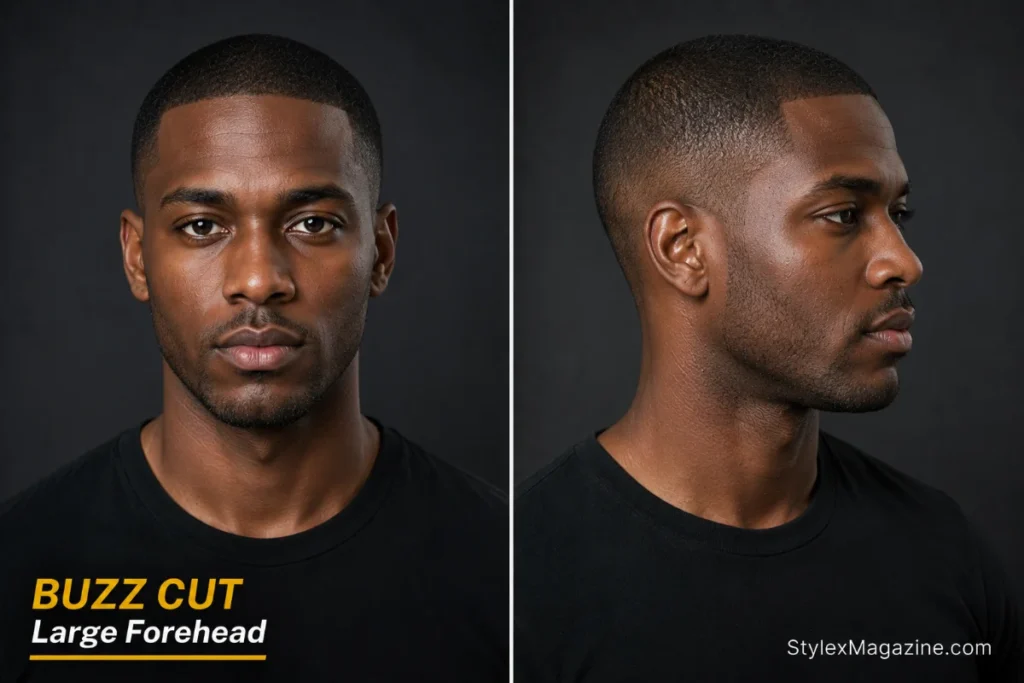
Not a coverage strategy — a confidence strategy. A clean shave or very short buzz removes the hairline-forehead contrast entirely, which makes the forehead less visually distinct rather than more. WimpoleClinic references Jason Statham as the reference point: the shaved head works because there’s no hairline to define where the forehead ends. The 2026 version uses slightly varied lengths and a crisp lineup rather than a uniform shave.
This works if you have a strong jaw or good facial structure to carry a maximalist forehead exposure — paired with glasses or a beard, it works on a wider range of face shapes. Ask for a grade 1 or 2 all-over with a natural lineup.
Does Face Shape Change the Best Cut for a Large Forehead?
Yes — the forehead is only part of the equation. Combine it with your overall face shape and a few of the styles above become clear front-runners.
Long face + large forehead — Length on top adds more height to an already long face, so this combination benefits most from styles that add width rather than height: the shag cut, temple fade with forward fringe, or a curtain hairstyle with fuller sides. Avoid tall, spiked, or heavily layered crowns they stretch the face further.
Oval face + large forehead — Oval faces have the most flexibility, since the proportions are already balanced. The textured crop, French crop, and Caesar cut all work cleanly here without needing to correct for a stronger jaw or wider cheekbones.
Square face + large forehead — A square jaw already adds structure at the bottom of the face, so the goal up top is softness rather than more sharp lines. Textured, choppy fringes the messy fringe, mod cut, or layered fringe — soften the transition between the strong jawline and the forehead better than a blunt, straight-edged fringe would.
Round face + large forehead — Height and angles help a round face read as more defined. A deep side part or a two-block cut with volume at the crown adds the vertical structure a round face benefits from, while the fringe still handles the forehead.
What Should You Avoid with a Large Forehead?
Slick-back styles, straight-back combing, and wet-look products are the three things that consistently make a large forehead more prominent — not less.
A slick back removes every piece of forward coverage and leaves the full forehead exposed with a shiny surface that catches light. Nick Hall at Man of Many lists this explicitly as one of the two things men with big foreheads should avoid. Wet-look gel or pomade has the same effect even on forward-styled cuts — the shine adds visual prominence to the forehead area.
Very high skin fades with no fringe strip the upper face of any texture or coverage the combination of bare sides and an exposed forehead with nothing forward to break it is the worst combination for this face structure. A blunt straight-back center part combed down flat is similarly problematic it emphasises the forehead’s height without offering any horizontal interruption.
The principle is consistent: whatever takes the hair away from the forehead makes the forehead more visible. Whatever brings it forward or creates horizontal movement reduces it.
FAQ
Does hair length affect how big a forehead looks?
Yes — very short hair exposes the forehead fully, while very long, heavy hair on top pushes visual weight upward and can make it look busier, not smaller. Medium-length, layered styles usually strike the best balance.
Do glasses change which haircut works best?
Yes — thick or dark frames add a second horizontal line on the upper face that can compete with a fringe. If you wear glasses regularly, a shorter, less blunt fringe reads cleaner than a heavy one.
Does hair type matter more than the haircut itself?
Both matter, but hair type sets the ceiling — a fine, thin-haired man will struggle to hold a heavy fringe forward no matter how it’s cut, while thick or wavy hair holds direction with far less product. This is why the same style photo can look different on two men.
Can hair color or highlights help disguise a large forehead?
Slightly darker lowlights at the front hairline soften the contrast between skin and hair. It’s a minor supporting effect, not a substitute for the right cut.
Is a “big head” the same thing as a large forehead?
Not technically — head size is overall skull proportion, forehead size is the brow-to-hairline distance. Most men who say “big head” actually mean a prominent forehead, and the same fringe-forward styles work for both.

Other Articles
30 Best Round Face Shape Haircuts For Men In 2026.
Triangle Face Shape Hairstyles For Men: 25 Best Styles
No Comment! Be the first one.