
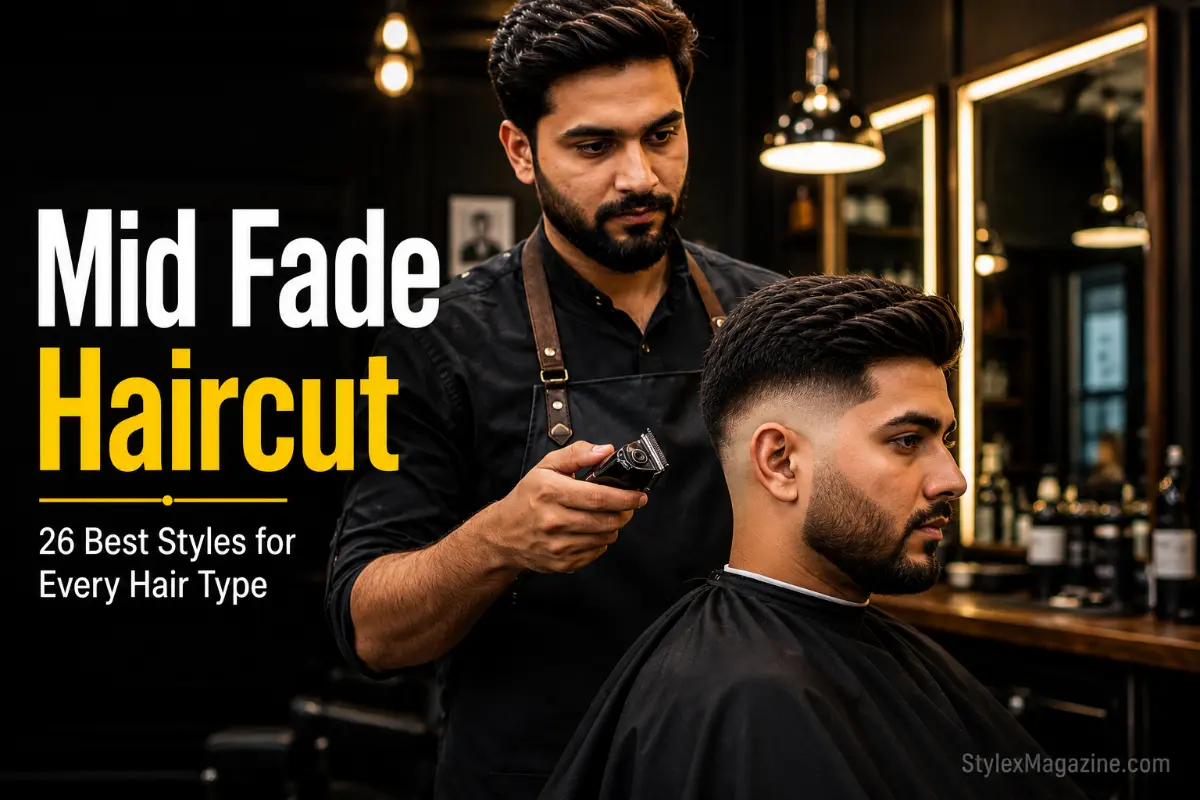

Quick Answer A mid fade — also called a medium fade — starts at temple level, roughly the middle of the ear, and blends shorter toward the neckline. It sits between the subtle low fade and the bold high fade. Most barbers cut more mid fades than any other variation. Works on every face shape and hair type.
Ask any working barber what fade they cut most often and the answer is the mid fade. It creates real contrast without going bold, grows out predictably, and adapts to whatever you’re wearing on top — from a boardroom comb over to a textured crop on a Friday.
What Are the Best 26 Mid Fade Haircut Styles?
1. Classic Mid Fade

Hair blends from full length on top down to a #1 or #2 guard at the base, fade starting at temple level. Straight line, even all the way around. Works on every hair type — the go-to if you want a fade that fits every setting.
Best for: All face shapes. Office and casual settings.
Tell your barber: “Classic mid fade, starting at the temple, blended clean — number one at the base.”
Maintenance: Every 2–3 weeks.
2. Mid Skin Fade

Starts at temple level but taken to bare skin at the base — #0 guard, straight razor finish. The sharpest result at this height. Growth shows at the skin line within a week.
On fine or thin hair, bare skin at temple height overexposes the scalp on the sides. Drop to a taper or shadow fade if your density is below medium.
Best for: Thick, dense hair. Men who want maximum sharpness.
Tell your barber: “Mid skin fade — bald at the base, starting at the temple, straight razor finish.”
Maintenance: Every 1–2 weeks.
3. Mid Taper Fade

Starts at temple level but always keeps some hair at the base — #1 or #1.5, never reaches skin. New growth absorbs into the existing length — no visible line as it grows out.
Best for: Fine or thin hair. Conservative environments.
Tell your barber: “Mid taper fade — start at the temple, keep some hair at the base, don’t go to skin.”
Maintenance: Every 3 weeks.
4. Mid Drop Fade

From the sides it looks like a standard mid fade. From the back, the fade line curves downward behind the ear — adds shape to the silhouette without going higher up. Can be finished to skin or kept with hair at the base.
Best for: Curly and wavy hair. Men who want more visual interest without a bolder cut.
Tell your barber: “Mid drop fade — temple level on the sides, let the line curve down behind the ear at the back.”
Maintenance: Every 2–3 weeks.
5. Mid Burst Fade

The fade arcs around the ear in a semi-circular pattern at mid height. The back stays longer. Built for mohawks, faux hawks, and natural curly styles where the arc shape frames the top section.
Best for: Curly and coily hair. Men wearing mohawks or faux hawk styles on top.
Tell your barber: “Mid burst fade — arc around the ear at temple level, leave more length at the back.”
Maintenance: Every 2–3 weeks.
6. Mid Temp Fade

Focuses the fade around the temples and hairline at mid height — sharp at the front, longer at the back. The front stays defined without touching the back profile. Common with textured afros and lined-up styles.
Best for: Black men with short cuts or textured afros. Men who want a sharp front without a full fade all around.
Tell your barber: “Mid temp fade — sharp around the temples and hairline, keep the back longer.”
Maintenance: Every 2–3 weeks.
7. Mid Fade with Curly Hair

Every mid fade variation works with curly hair — but execution changes. Curly hair shrinks once dry. A fade sitting at temple level when freshly washed can ride noticeably higher once the curls contract. Tell your barber the height you want based on your hair dry, not wet.
Scissor-over-comb gives more precision at the curl-to-fade transition than clippers alone — ask for it specifically.
Best variations: Mid drop fade and mid burst fade both follow the head’s natural curl direction.
Tell your barber: “Set the fade height based on how my hair looks dry — not wet.”
Maintenance: Every 2–3 weeks.
8. Mid Fade with Wavy Hair

Wavy hair and a mid fade balance each other naturally — waves give the top section movement while the fade keeps the sides structured. A mid drop fade follows the natural wave direction rather than cutting against it.
Tell your barber: “Mid fade, leave at least 2.5 to 3 inches on top — I want the waves to move.”
Maintenance: Every 3 weeks.
9. Mid Fade with Straight Hair

Straight hair gives the sharpest mid fade lines — the blend from short sides to flat hair on top is precise. Grow-out shows faster though, because there’s no texture to absorb it. Without point cutting on top, the cut reads flat.
Tell your barber: “Mid fade on the sides — point cut the top, I want texture not a blunt finish.”
Maintenance: Every 2–3 weeks.
10. Mid Fade Textured Crop

Choppy layers on top, fringe pushed forward, mid fade sides. Strong on thick hair — the crop removes weight on top while the tighter mid fade keeps the sides from looking heavy.
Best for: Round and square face shapes. Thick to medium hair.
Tell your barber: “Mid fade on the sides, textured crop on top — point cut the fringe, not blunt.”
Maintenance: Fade every 2–3 weeks. Top trim every 5–6 weeks.
11. Mid Fade French Crop

Straight blunt fringe across the forehead, short top, mid fade sides. More structured than the textured crop — the fringe is cut straight across. The horizontal fringe adds width, which suits round and square face shapes.
Tell your barber: “Mid fade on the sides, French crop on top — blunt fringe, just above the eyebrows.”
Maintenance: Every 2–3 weeks.
12. Mid Fade Pompadour

Volume swept back on top, mid fade on the sides. The higher starting point of the mid fade creates stronger contrast against the pompadour height — more dramatic than the low fade version, still manageable. David Beckham has worn versions of this combination throughout his career.
Best for: Rectangular and diamond face shapes. Thick hair on top.
Tell your barber: “Mid fade on the sides — leave at least 3 to 4 inches on top for the pompadour.”
Maintenance: Every 2–3 weeks.
13. Mid Fade Quiff

Volume pushed forward and up at the front, mid fade on the sides. The mid fade at temple level gives the quiff more visual separation between top and sides. Andrew Garfield has worn this combination well.
Best for: Oval, square, and round face shapes.
Tell your barber: “Mid fade on the sides — leave 2.5 to 3 inches at the front for the quiff, shorter toward the crown.”
Maintenance: Every 2–3 weeks.
14. Mid Fade Side Part

Hair parted naturally on one side, clean mid fade on both sides. No hard part shaved in — a softer split than the comb over. The fade at temple level adds definition without overpowering the parted look.
Best for: Oval, square, and heart-shaped faces. Straight to wavy hair.
Tell your barber: “Mid fade on the sides — side part on top, follow my natural growth direction, no hard part.”
Maintenance: Every 2–3 weeks.
15. Mid Fade Comb Over

Hair parted to one side with a shaved hard part, combed across, mid fade on both sides. The hard part adds precision. The fade at temple level gives this classic combination a sharper edge.
Best for: Oval, square, and heart-shaped faces.
Tell your barber: “Mid fade on the sides, comb over on top — hard part on the left side at the temple.”
Maintenance: Every 2–3 weeks.
16. Mid Fade Slick Back

Hair combed straight back on top, mid fade on the sides. The smooth combed top against tight faded sides reads clean and precise. Works with a high-shine finish or a matte version.
Best for: Oval and rectangular face shapes. Straight to slightly wavy hair.
Tell your barber: “Mid fade on the sides — leave 3 to 4 inches on top, I’ll slick it back.”
Maintenance: Every 2–3 weeks.
17. Mid Fade Brush Back

Hair blow-dried back and upward rather than combed flat — more volume, more texture. The mid fade keeps the sides tight while the brushed top gives movement and lift.
Best for: Oval and rectangular face shapes. Thick to medium hair.
Tell your barber: “Mid fade on the sides — leave enough length on top to blow dry back, I want volume not slick.”
Maintenance: Every 2–3 weeks.
18. Mid Fade Hard Part

A razor line cut precisely into the side of the head, with mid fade on both sides. The hard part is a design element as much as a parting — it sharpens any top style, from comb overs to textured crops.
Tell your barber: “Mid fade on the sides — razor hard part on the left, about an inch back from the hairline.”
Maintenance: Every 2 weeks. The hard part loses definition faster than the fade.
19. Mid Fade Crew Cut

Short even top — slightly longer at the front, tapering toward the crown — with a mid fade on the sides. Minimal daily styling. The mid fade at temple level gives the crew cut a sharper edge than a low fade version.
Best for: All face shapes. Office and professional settings.
Tell your barber: “Mid fade on the sides, crew cut on top — slightly longer at the front, tapered toward the crown.”
Maintenance: Every 2–3 weeks.
20. Mid Fade Buzz Cut

All-over short cut with a mid fade on the sides. The mid fade at temple level creates a more defined silhouette than a low fade buzz — higher contrast, sharper shape. Zayn Malik has worn this combination. Zero daily styling.
Tell your barber: “Mid fade on the sides — number two or three on top, blended into the fade.”
Maintenance: Every 2 weeks.
21. Mid Fade with Beard

A mid fade starts higher than a low fade — there’s more distance between the fade line and the beard. The barber needs to bridge this gap at the sideburn with a careful blend. Without asking for it specifically, most barbers leave a hard stop between the two.
Tell your barber: “Blend the mid fade down into my beard at the sideburn — no hard gap between the fade and the beard line.”
Works best with: Full beards and short boxed beards.
22. Mid Fade Faux Hawk

Hair styled upward along the center without the sides being fully shaved — the faux hawk effect. The mid fade adds enough contrast to make the center strip stand out without the full commitment of a mohawk.
Best for: Oval and square face shapes. Men who want edge without going full mohawk.
Tell your barber: “Mid fade on the sides — leave a strip down the center long enough to push up, blend the edges into the fade.”
Maintenance: Every 2–3 weeks.
23. Mid Fade Mohawk

Strip of longer hair down the center, mid fade on both sides. The mid fade at temple level creates tighter sides and a more prominent central strip than a low fade mohawk.
Best for: Oval and oblong face shapes. Men with thick hair on top.
Tell your barber: “Mid fade on the sides — leave a strip of length down the center, blend the edges into the fade.”
Maintenance: Every 2 weeks.
24. Mid Fade Modern Mullet

Short on top, longer at the back, mid fade on the sides. The fade gives the modern mullet a clean, structured look on the sides while the length at the back stays deliberate rather than grown-out.
Best for: Oval face shapes. Men comfortable with a statement cut.
Tell your barber: “Mid fade on the sides — keep length at the back, shorter on top, blend the fade into the longer back section.”
Maintenance: Every 2–3 weeks.
25. Mid Fade Executive Cut

Also called the Ivy League — short, polished top slightly longer than a crew cut, natural side part, mid fade on the sides. The most office-appropriate mid fade combination on this list.
Best for: Oval and oblong face shapes. Conservative professional settings.
Tell your barber: “Mid fade on the sides — Ivy League on top, natural side part, keep it clean and polished.”
Maintenance: Every 2–3 weeks.
26. Mid Fade Side Swept Fringe

Hair falls forward and sweeps to one side naturally — not combed flat, not pushed upward. A relaxed finish. The mid fade keeps the sides tight so the soft top doesn’t look unintentional.
Best for: Oval and heart-shaped faces. Straight to wavy hair.
Tell your barber: “Mid fade on the sides — leave enough length on top for the fringe to fall forward and sweep to the side naturally.”
Maintenance: Every 3 weeks.
Who Does a Mid Fade Suit?
The mid fade works on every face shape — which variation changes how it interacts with your features.
| Face Shape | Best Variation | Avoid |
|---|---|---|
| Oval | Any variation | Nothing |
| Round | Mid skin fade + volume on top | Flat tops — adds width |
| Square | Classic or mid taper | Over-sharpening the jaw line |
| Oblong / Long | Mid taper fade | High volume on top — adds more length |
| Diamond | Mid drop fade | Tight skin fade — over-thins the sides |
| Rectangular | Pompadour or slick back | Anything that adds width |
| Heart | Side part or comb over | Very tight skin fade at temples |
| Hair Type | Best Variation | Key Tip |
|---|---|---|
| Straight | Any | Point cut the top — flat finish looks unintentional |
| Wavy | Mid drop fade | Leave length on top for movement |
| Curly | Mid drop or mid burst fade | Fade height based on dry hair, not wet |
| Tight coils / 4C | Mid temp fade or mid taper | Let barber cut dry for accuracy |
| Thick | Mid skin fade | High contrast reads clean on dense hair |
| Fine / Thin | Mid taper fade | Skin fade at temple height overexposes scalp |
How Do You Choose the Right Mid Fade?
Maintenance first:
- Every 1–2 weeks → Mid skin fade
- Every 2 weeks → Buzz cut, mohawk, hard part
- Every 2–3 weeks → Classic, drop, burst, most top styles
- Every 3 weeks → Mid taper fade
Hair density:
- Thick → Mid skin fade
- Fine or thin → Mid taper fade only
What you’re wearing on top:
- Curly or natural → Mid burst or mid drop fade
- Volume styles → Classic mid fade
- Professional setting → Executive cut, comb over, side part
- Everything else → Classic mid fade
What Should You Tell Your Barber?
“Mid fade” leaves three decisions open. Specify all three:
1. Height — “Starting at the temple” — confirms mid, not low or high.
2. Closeness — “Skin at the base” or “keep some hair at the base.”
3. Shape — “Straight all around” or “drop it behind the ear.”
Full phrase: “Mid fade, starting at the temple, skin at the base, straight line all the way around.”
Curly hair: “Set the height based on how my hair looks dry — not wet.”
Beard: “Blend the fade down into my beard at the sideburn — no hard gap.”
How Often Should You Get a Mid Fade?
| Variation | Frequency |
|---|---|
| Mid skin fade | Every 1–2 weeks |
| Mid fade buzz cut | Every 2 weeks |
| Mid fade mohawk | Every 2 weeks |
| Mid fade hard part | Every 2 weeks |
| Classic mid fade | Every 2–3 weeks |
| Mid drop fade | Every 2–3 weeks |
| Mid burst fade | Every 2–3 weeks |
| Mid temp fade | Every 2–3 weeks |
| Mid taper fade | Every 3 weeks |
Between visits: trim the neckline at home. The mid fade sits at temple level — growth shows faster on the sides than a low fade.
What Is the Biggest Mistake Men Make with a Mid Fade?
Underestimating how much higher it sits than a low fade. Men used to a low fade often find the contrast more noticeable than expected in the first week. If you want to step up gradually, ask for a mid taper fade first — same height, no skin at the base, gentler transition.
For a full comparison of all fade heights, see all fade types.
FAQ
What is a mid fade haircut?
A fade that starts at temple level and blends shorter toward the neckline. Sits between the subtle low fade and the bolder high fade. Also called a medium fade.
Is a mid fade the same as a medium fade?
Yes — same cut, different term. Most barbers understand both.
How long does a mid fade last?
Mid taper fade: 3 weeks. Classic, drop, or burst mid fade: 2–3 weeks. Mid skin fade: 1–2 weeks.
Can curly hair get a mid fade?
Yes. Tell your barber to cut based on how your hair looks dry — curls shrink when dry and can push the fade line higher than intended.
What’s the difference between a mid fade and a low fade?
Starting height. A low fade begins just above the ear. A mid fade begins at the temple — more contrast, more noticeable from day one.
What clipper guard is used for a mid fade?
A #1 or #2 at the base for a classic mid fade. A #0 with straight razor for a skin fade. The barber works upward with progressively longer guards to build the blend.

Other Articles
Fade Haircuts for Men: Every Type Explained

No Comment! Be the first one.