
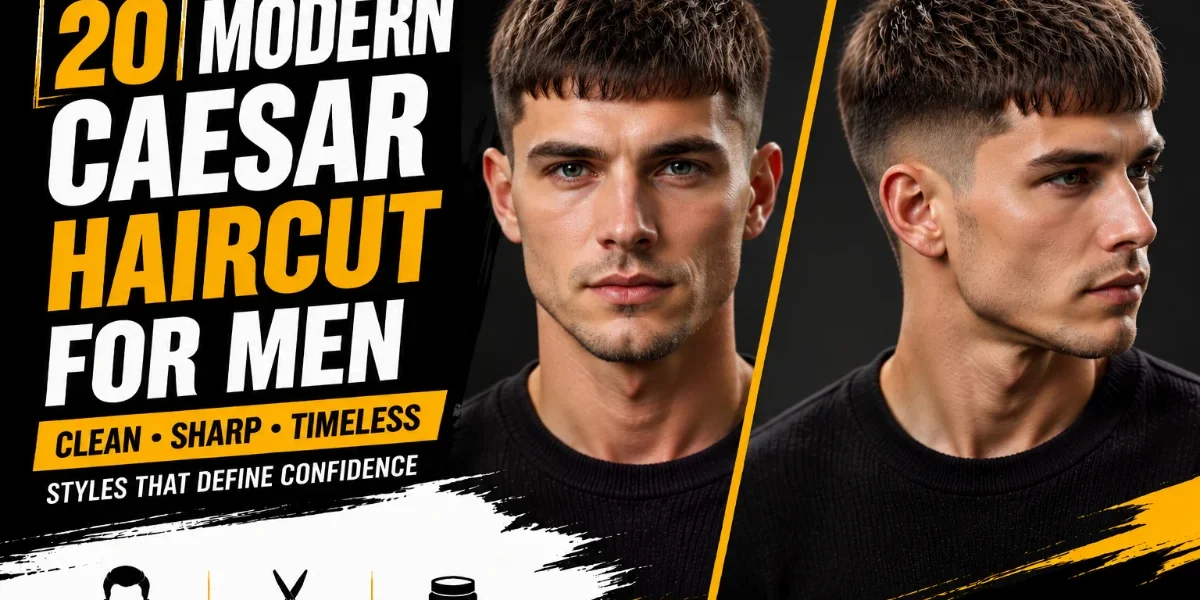

Quick Answer: The Caesar haircut is a short men’s cut with a straight horizontal fringe brushed forward and even length across the top, usually 0.5 to 2 inches. It pairs with tapers, fades, or uniform sides, works on every hair texture, and remains the strongest short cut for men with thinning hairlines. Expect to visit your barber every 2 to 3 weeks.
The Caesar is the rare men’s haircut that looks intentional at every stage, fresh from the chair or two weeks grown out. The forward fringe frames the forehead without requiring styling commitment, the short length keeps morning routines under two minutes, and the geometry works around receding hairlines better than any other cut in the short-hair category. I cut more Caesars in 2026 than any single style, split evenly between men chasing the low-maintenance routine and men managing early hair loss.
Below: 20 modern Caesar variations worth requesting, followed by face shape matching, exact barber scripts, cost expectations, and product picks.
What Is a Caesar Haircut?
A Caesar haircut features a short, blunt fringe cut straight across the forehead with uniform length on top and closely trimmed sides. Named after Julius Caesar, who reportedly wore the forward fringe to conceal thinning at the crown, the cut moved into modern culture through Russell Crowe in Gladiator and George Clooney’s ER run in the mid-90s.
The defining feature is the fringe: blunt, horizontal, brushed forward. The top sits at 0.5 to 2 inches depending on the variation. Sides range from uniform length (classic) to skin-faded (modern). Length gets measured in clipper guards, typically a #2 through #4 on top.
What separates the Caesar from the French crop: the Caesar keeps its fringe shorter and blunter with more structure. The French crop runs longer and choppier at the fringe with visible separation. Both are forward-facing, but the Caesar feels disciplined where the crop feels relaxed.
[IMAGE: Side-by-side. Caesar (blunt short fringe, uniform top) vs French Crop (longer textured fringe, more movement)]
20 Best Caesar Haircut Styles for Men
1. Classic Caesar Cut
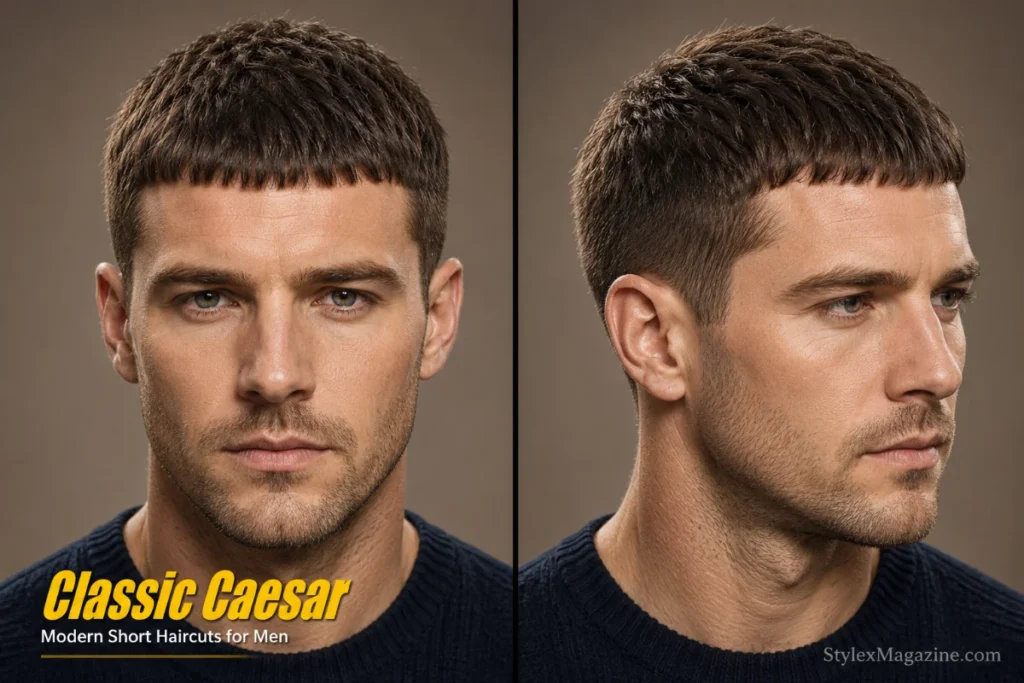
The original. Even length all over. Top, sides, and back kept the same, with a blunt fringe sitting at the top of the forehead. No fade, no dramatic contrast. This is what George Clooney wore on ER and what Mark Zuckerberg still wears today. The uniform silhouette grows out evenly, buying an extra week between cuts compared to faded variations.
Best for: Oval and square face shapes. Straight or wavy hair.
Tell your barber: “Classic Caesar. #3 guard all over, straight fringe at the hairline, tapered neckline, no fade.” Trim schedule: Every 3 to 4 weeks.
2. Modern Caesar with Low Fade
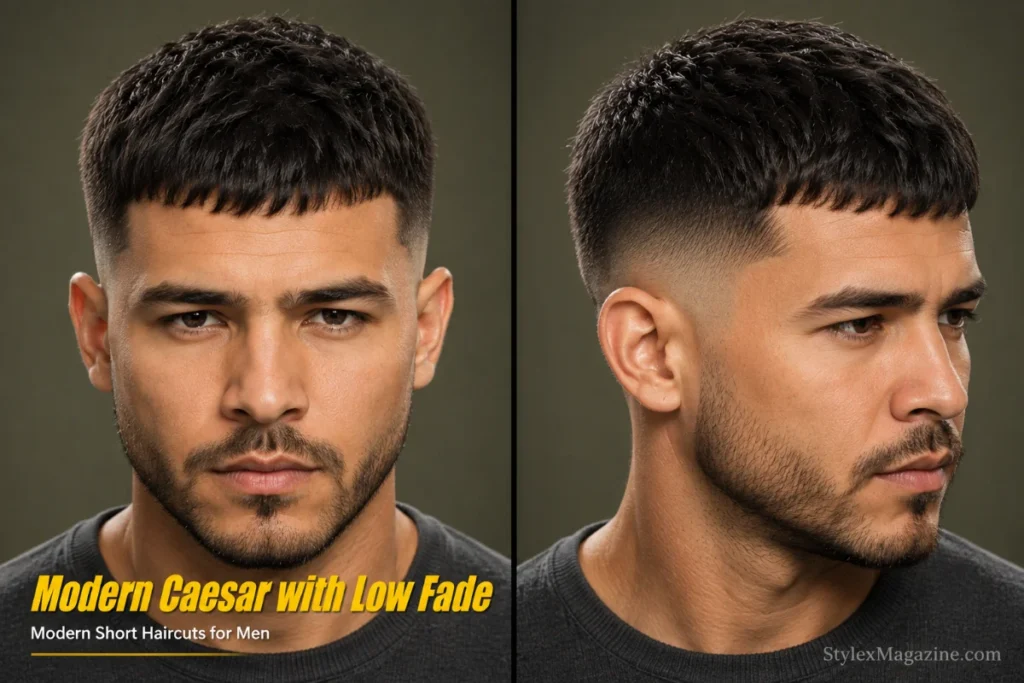
The modern Caesar fade keeps the forward fringe but adds contrast with a low fade on the sides. The top carries slightly more texture than the classic, enough movement to catch light without losing the structured feel. This is the version I cut most often. It bridges classic simplicity with what men now expect from a barbershop finish.
Best for: All face shapes. Works across every hair texture.
Tell your barber: “Modern Caesar. Textured top with a low fade starting above the ear, blunt fringe, blend the sides clean.”
Trim schedule: Every 2 to 3 weeks.
3. Textured Caesar Cut
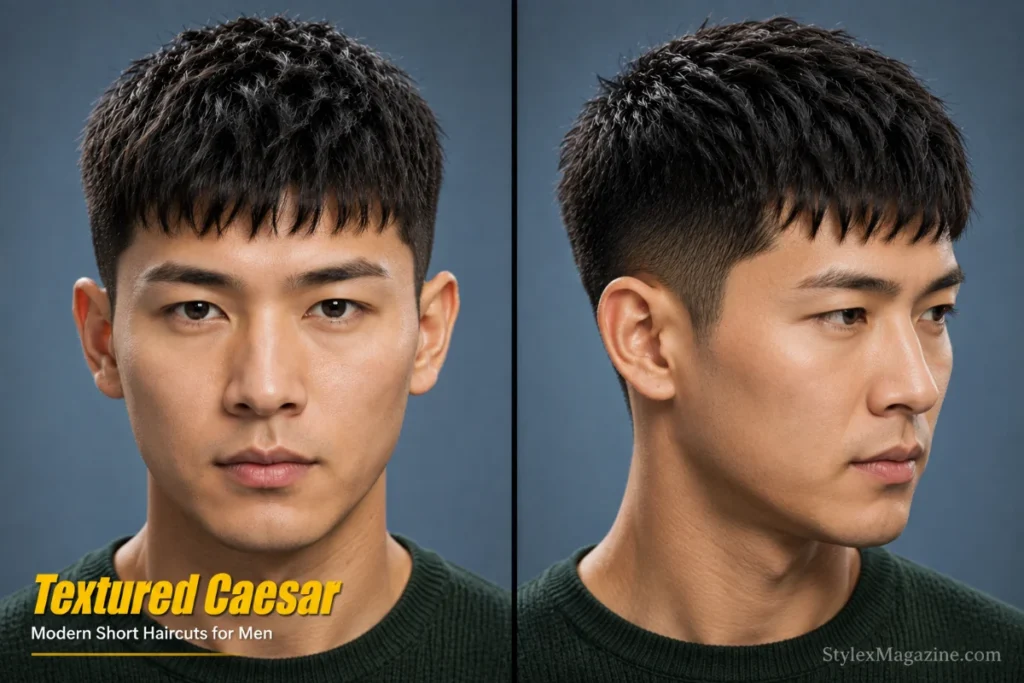
Point cutting the top creates small notches at varied angles. The effect: visible separation and dimension that the flat classic doesn’t produce. The fringe still sits forward but with softer, less uniform edges. Thick hair benefits the most, the texturing removes bulk without losing coverage or fringe definition.
Best for: Square and round face shapes. Thick or coarse hair.
Tell your barber: “Textured Caesar. Point cut the top for separation, keep the fringe forward but softer at the edges, mid fade on the sides.”
Trim schedule: Every 2 to 3 weeks.
4. Short Caesar Cut
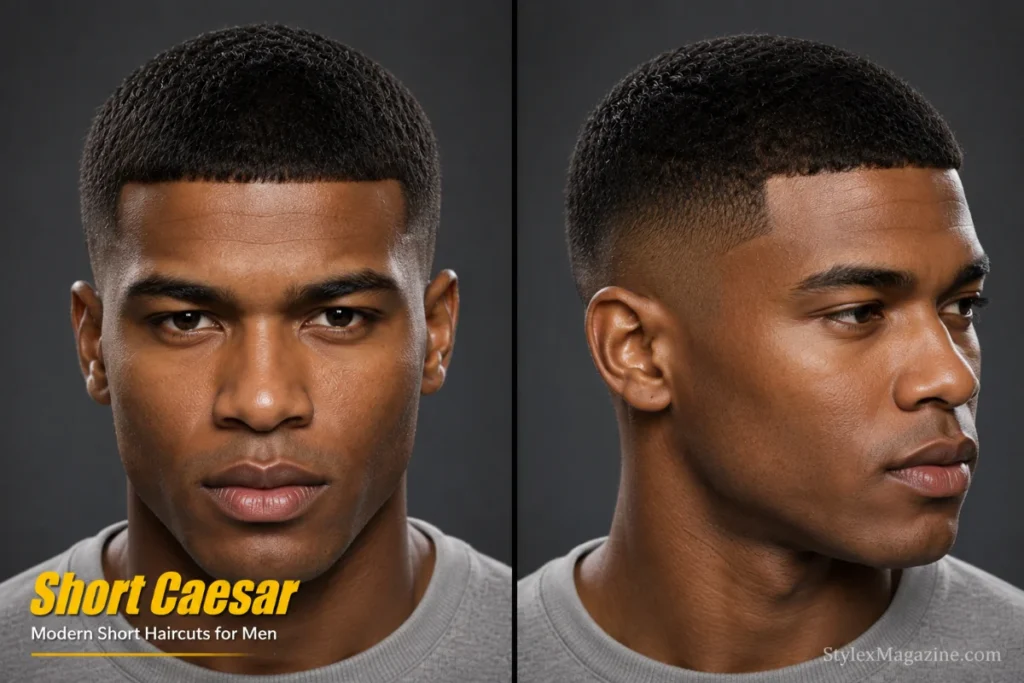
Taken down to a #1 or #2 on top, just enough length to show fringe direction without much actual movement. The lowest-maintenance Caesar variation. Head shape matters more here than face shape because the cut sits close to the scalp. Works well when you want the Caesar’s structure but not the fringe as a focal point.
Best for: Oval, diamond, and heart face shapes. Fine or thin hair.
Tell your barber: “Short Caesar. #1 or #2 on top, fringe shaped at the hairline, skin fade or tight taper on the sides.”
Trim schedule: Every 2 weeks.
5. Long Caesar Cut
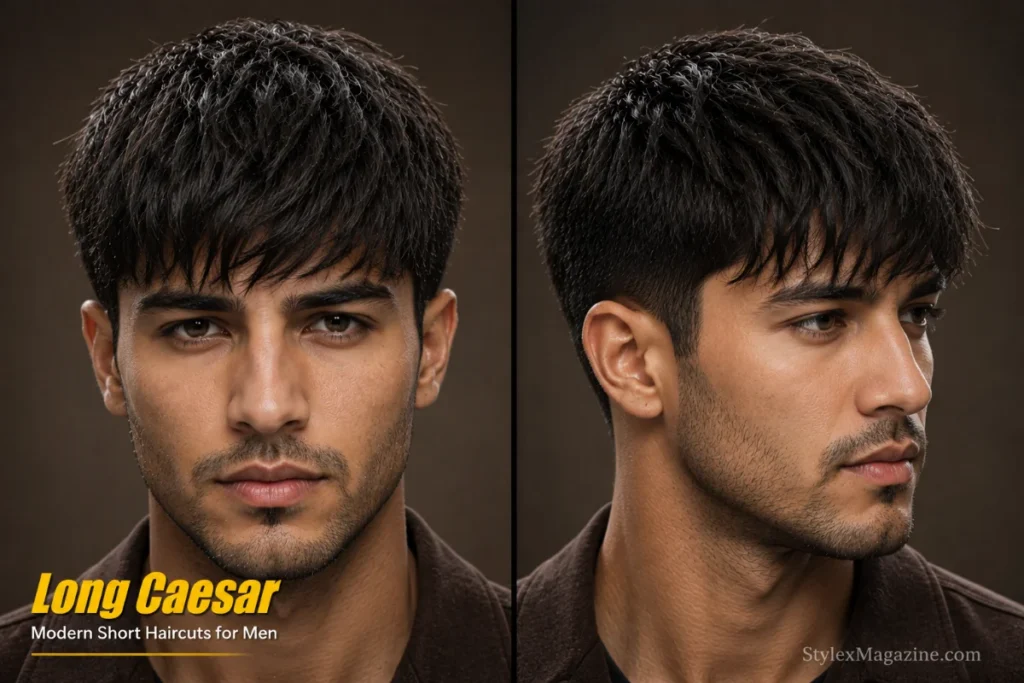
Pushes the top length to 2 to 3 inches, enough for the fringe to move, fall, and carry genuine texture. Sides stay short to maintain the Caesar silhouette, but the top has enough weight to hold a blow-dry. The entry point if you want the Caesar framework with more styling flexibility.
Best for: Oblong and rectangular face shapes (added length doesn’t add height). Wavy or straight hair with medium density.
Tell your barber: “Long Caesar. Leave 2 to 3 inches on top, fringe falls past the hairline, mid or low fade on the sides.”
Trim schedule: Every 3 weeks.
6. Caesar Mid Fade
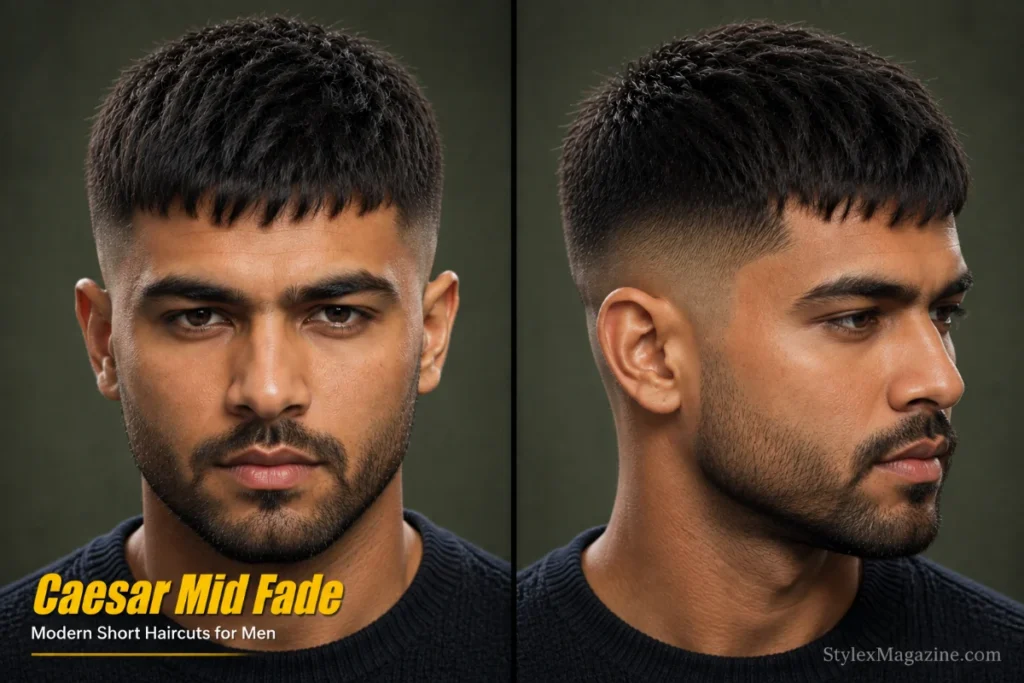
The Caesar fade at mid-level starts at temple height, higher than a low fade, more visual contrast, more statement. The Caesar fringe looks bolder against the shorter sides because the transition sits where the eye naturally travels. Photographs better than any other fade level, which explains its social media dominance.
Best for: Round, square, and diamond face shapes. Thick hair.
Tell your barber: “Caesar top with a mid fade. Start the fade at the temple, #0.5 at the base, blend into a #3 on top.”
Trim schedule: Every 2 to 3 weeks.
7. Caesar High Fade
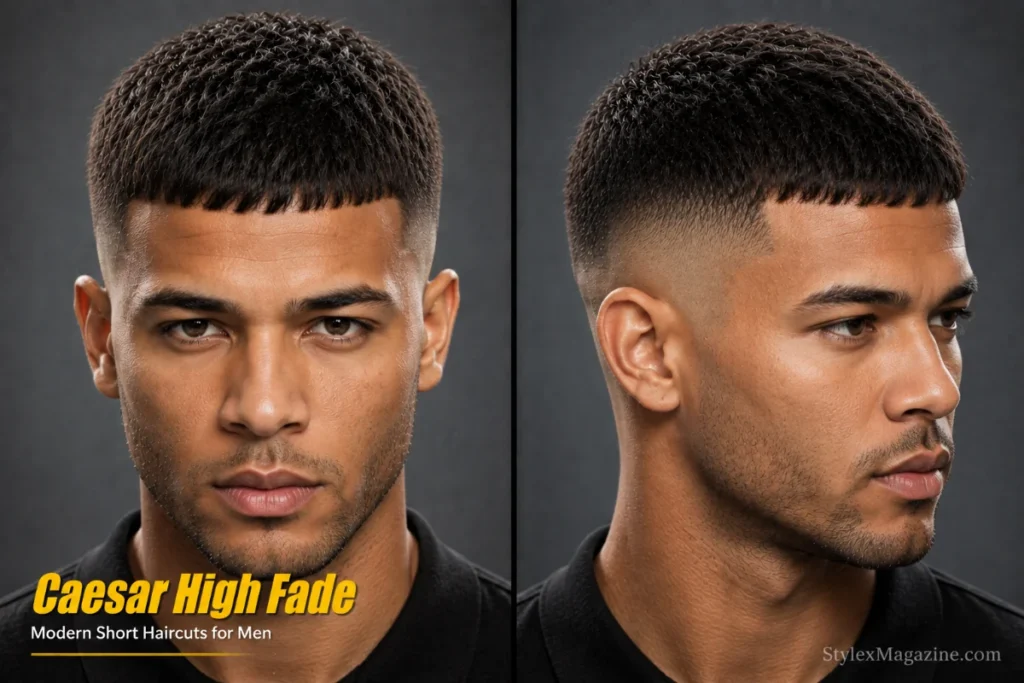
Maximum contrast. The Caesar fade goes highest here, beginning near the crown line and dropping to skin within an inch. The Caesar fringe on top appears taller and more pronounced because there’s almost no hair competing on the sides. A bold cut that announces itself. Avoid it for round faces, the high fade widens the appearance of the head at the crown.
Best for: Square, rectangular, and diamond face shapes. Dense or coarse hair.
Tell your barber: “Caesar with a high fade. Start near the crown, take it down to skin at the temples, keep the fringe sharp.”
Trim schedule: Every 2 weeks.
8. Caesar Skin Fade
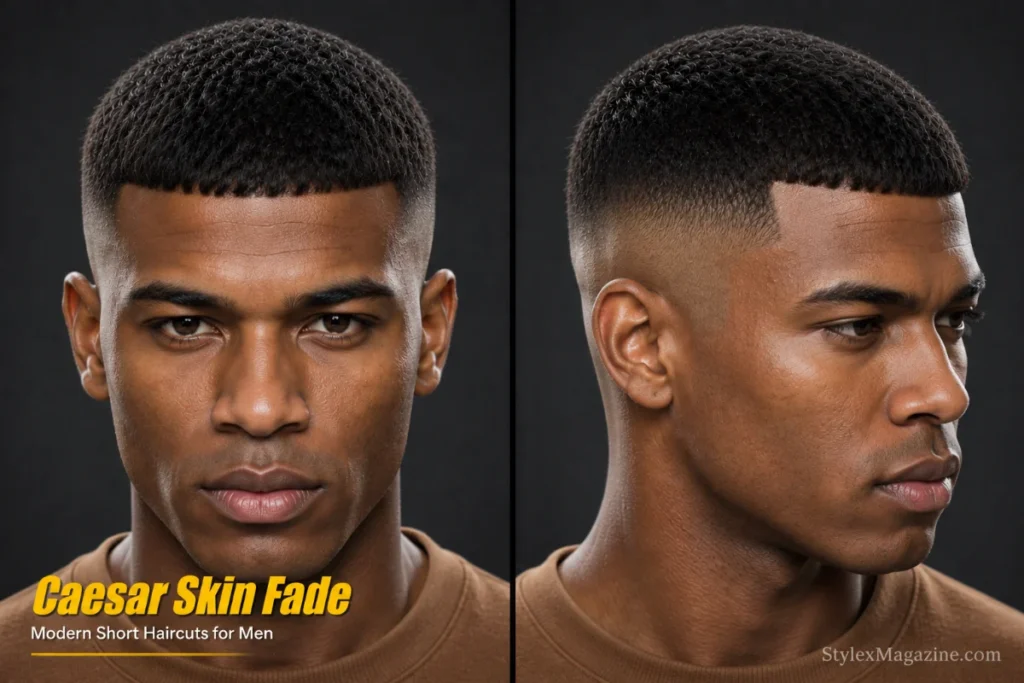
The sides go down to bare skin at the lowest point, no guard, straight razor finish. The transition from skin to Caesar top needs precision; a rushed skin fade shows harsh lines. Done well, the cut looks barbershop-fresh for about 10 days before shadow returns.
Best for: All face shapes, particularly oval and heart. All hair textures.
Tell your barber: “Caesar with a skin fade. Razor the sides down to nothing, blend into the top with no hard line, keep the fringe straight.”
Trim schedule: Every 2 weeks.
9. Caesar Taper
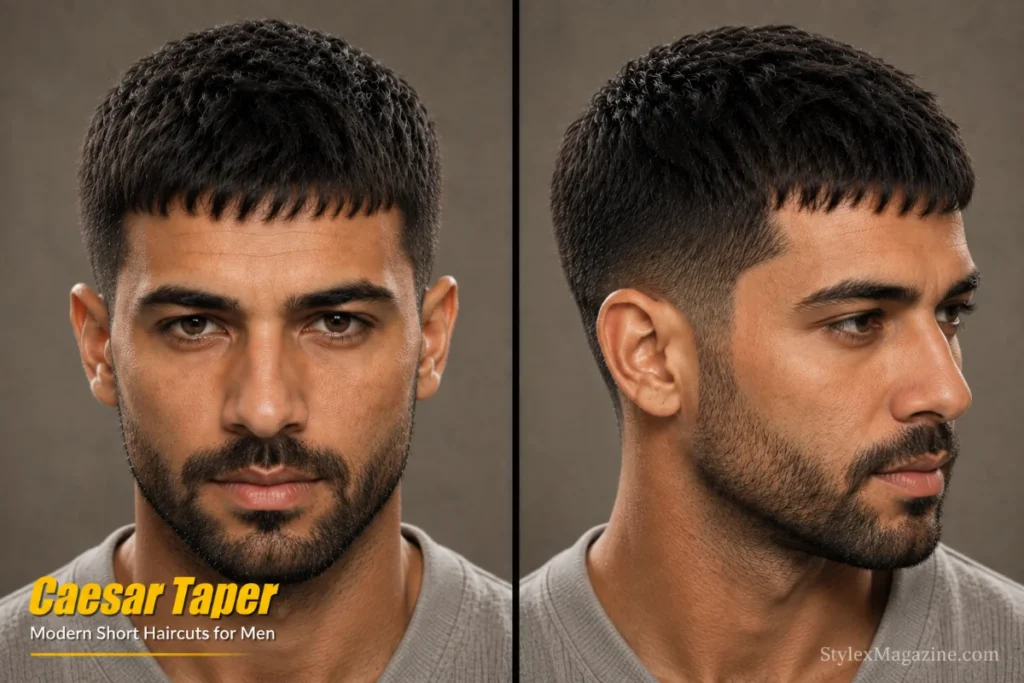
A taper shortens the sides gradually from top to neckline without a fade’s defined gradient. Softer, less urban, more traditional. The Caesar taper is what your father’s barber would have called a “regular haircut”, and that’s not a criticism. It grows out better than any faded version and looks professional in workplaces where skin fades draw the wrong attention.
Best for: Oblong, heart, and oval face shapes. Straight or wavy hair.
Tell your barber: “Caesar with a taper (not a fade). Shorten the sides gradually, natural neckline, blunt fringe.” Trim schedule: Every 3 to 4 weeks.
10. Caesar Drop Fade
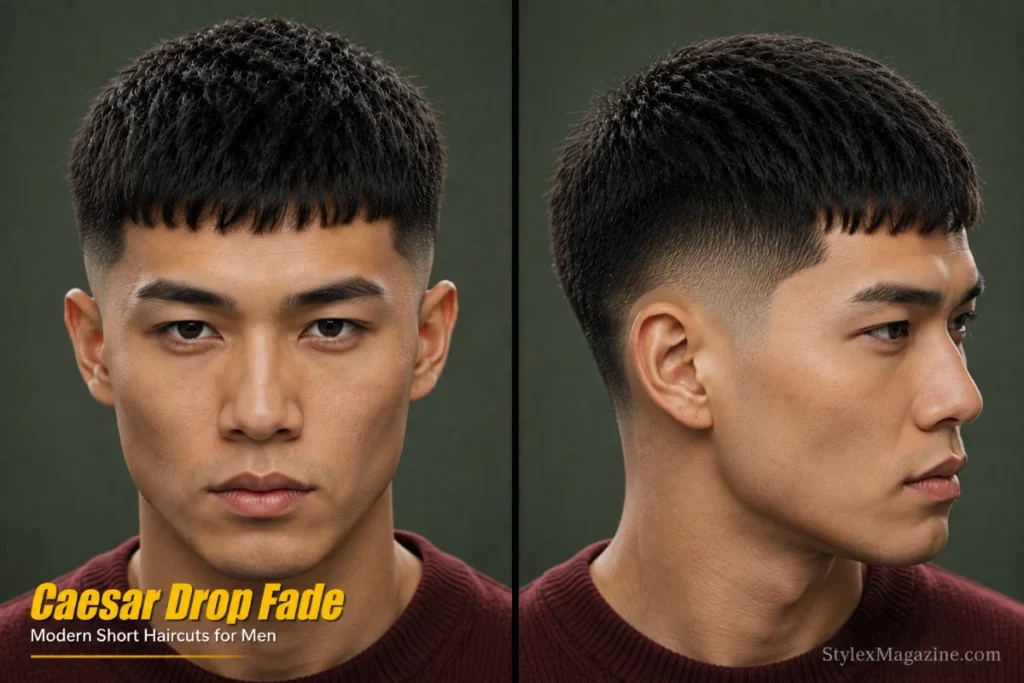
The drop fade follows the ear’s natural curve, higher at the temples, dropping lower behind the ear. Creates a more dynamic side profile than a straight-line fade. The arc behind the ear is the visual signature and photographs well from three-quarter angles.
Best for: Round, oval, and heart face shapes. All hair textures.
Tell your barber: “Caesar on top with a drop fade. Let the fade line curve down behind the ear, not straight across.”
Trim schedule: Every 2 to 3 weeks.
11. Caesar Buzz Cut
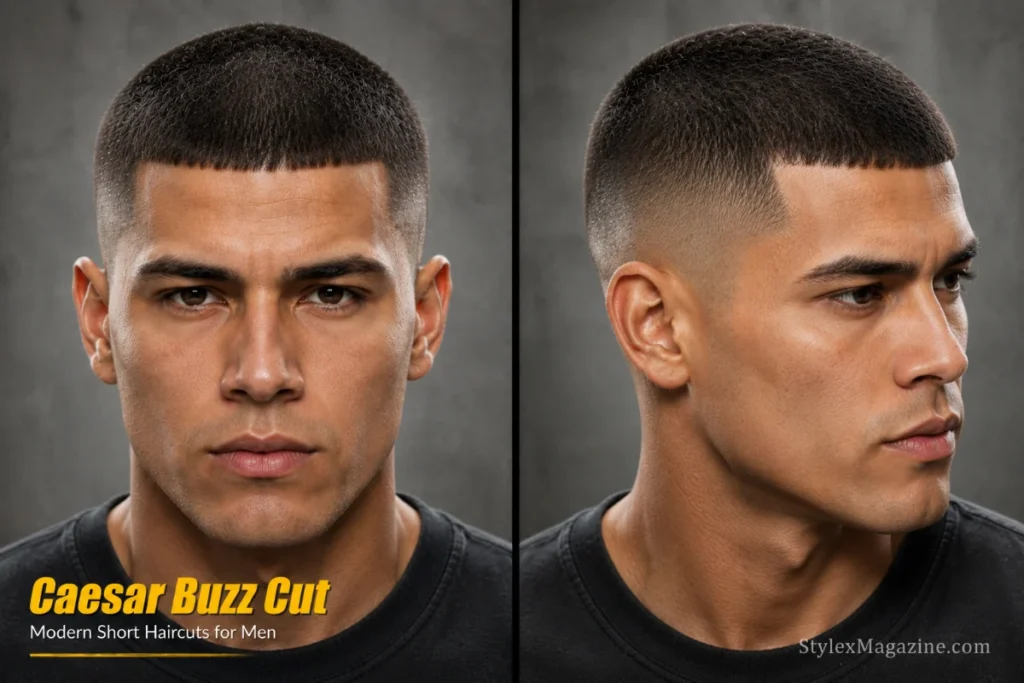
The shortest possible Caesar before it stops being a Caesar. Top sits at a #1 or #0.5 with just enough grain direction to show forward movement. The easiest Caesar to maintain at home between barber visits, a set of clippers, a mirror, and ten minutes.
Best for: All face shapes, especially strong jawlines and angular features. Fine, thin, or coiled hair.
Tell your barber: “Buzz Caesar. #1 on top, #0 on the sides, fringe direction forward, lined up at the hairline.” Trim schedule: Every 2 weeks.
12. Messy Caesar Cut
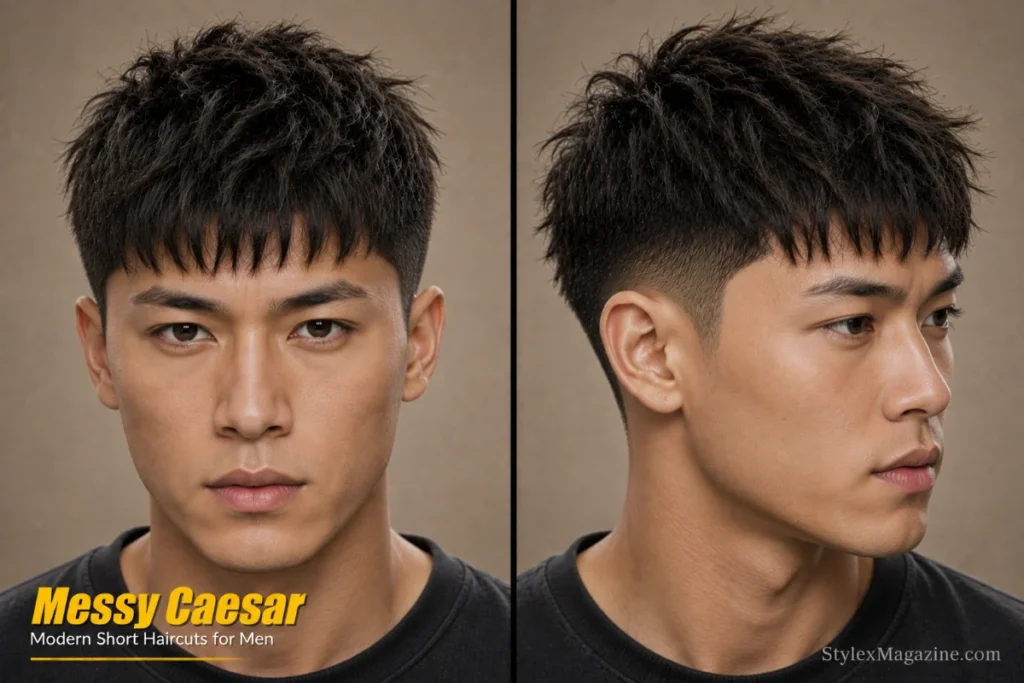
Structure without rigidity. The top is finger-styled rather than combed, the fringe falls forward with intentional unevenness. Sea salt spray is the product here, not pomade. Wavy hair does half the work naturally; straight hair needs more product help.
Best for: Oval, diamond, and heart face shapes. Wavy or naturally textured hair.
Tell your barber: “Messy Caesar. Keep the fringe slightly uneven, point cut the top for texture, low or mid fade.”
Trim schedule: Every 3 weeks.
13. Curly Caesar Cut
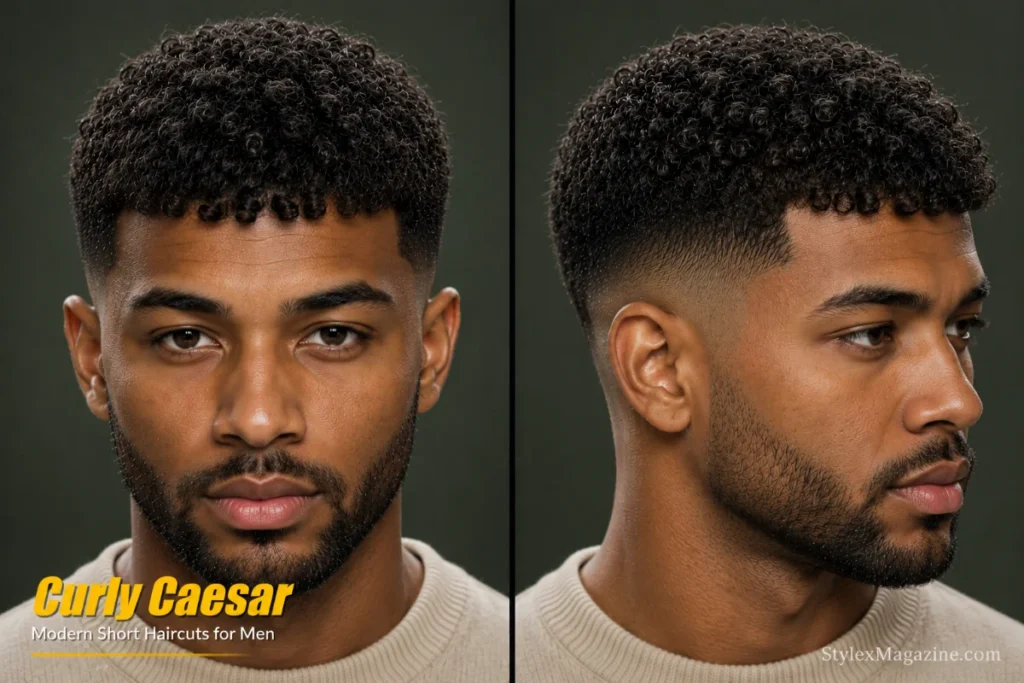
Curly hair and the Caesar are a natural fit, the forward fringe direction works with curl patterns instead of against them. Curls add volume and dimension that straight-haired Caesars manufacture with product. Leave more length than you’d think, curls shrink 30 to 40% when dry, so what looks like 2 inches wet sits at about 1.5 inches dry. Cut dry, not wet.
Best for: Oval, round, and heart face shapes. Curly or wavy hair with medium to thick density.
Tell your barber: “Curly Caesar. Cut dry, not wet. Leave length for curl shrinkage, tight fade on the sides, don’t thin the top out.”
Trim schedule: Every 3 weeks.
14. Wavy Caesar Cut
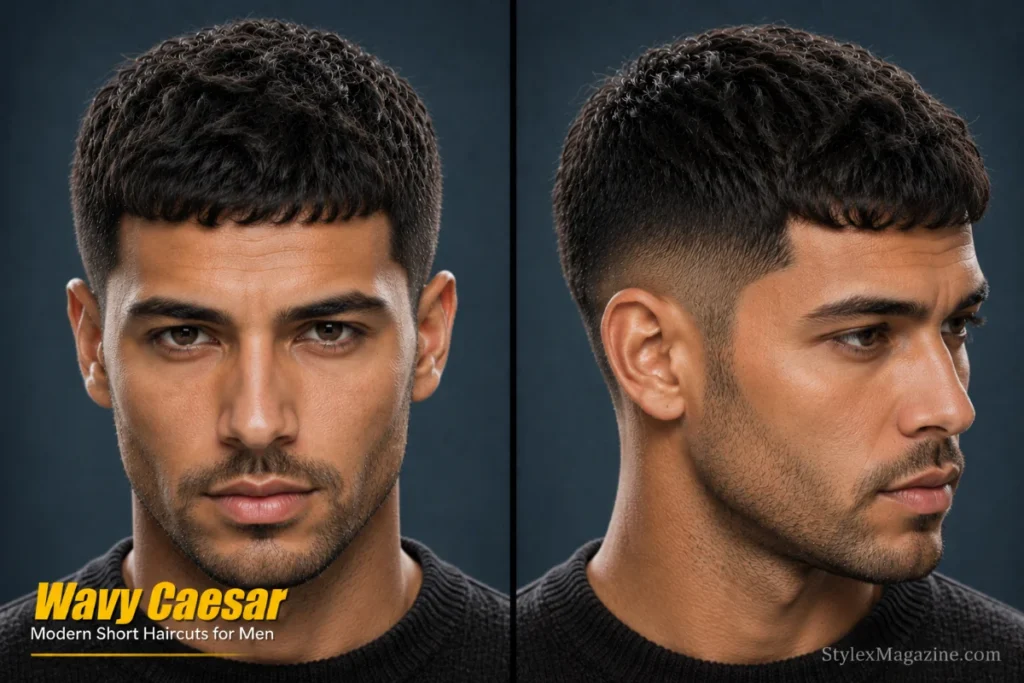
Less defined than the curly version, more textured than the classic. Wavy hair gives the Caesar an editorial quality, the fringe doesn’t sit ruler-straight, and the top has movement without product. Blow-dry forward with your fingers to guide the waves; they’ll hold position most of the day.
Best for: Oval, square, and oblong face shapes. Naturally wavy hair.
Tell your barber: “Wavy Caesar. Don’t fight the wave pattern. Keep 1.5 to 2 inches on top, taper or low fade on the sides.”
Trim schedule: Every 3 weeks.
15. Caesar for Receding Hairline
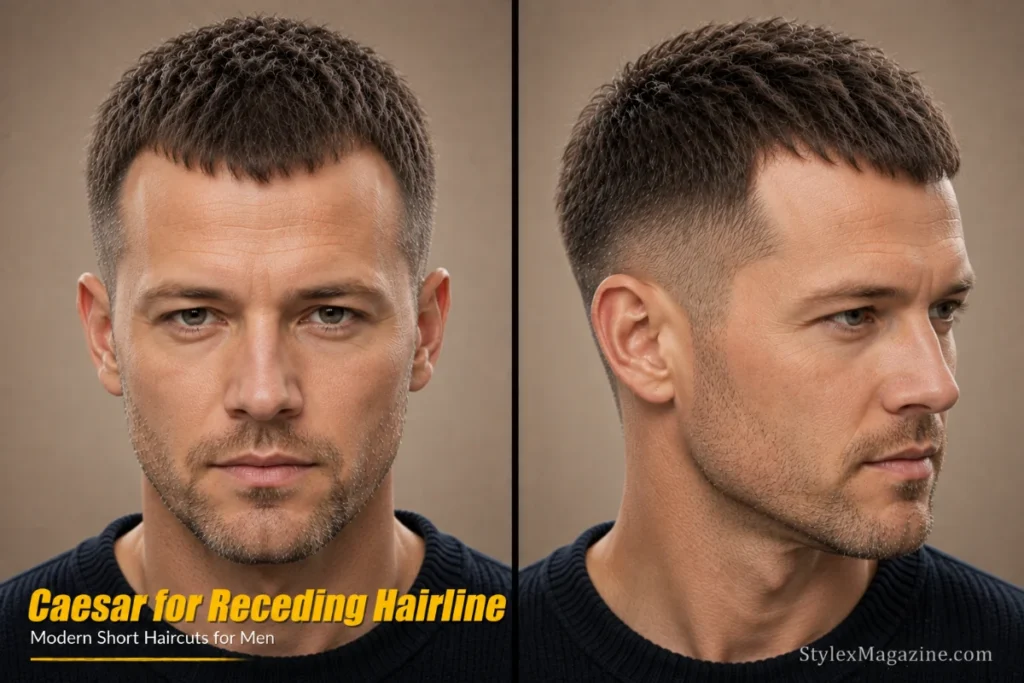
The Caesar’s original purpose, and it still handles this job better than any other short cut. The forward fringe falls over the temples where recession starts, disguising the M-shape without looking like a cover-up. I cut this variation weekly for men in their 30s and 40s. Keep the fringe blunt and forward, the sides tight, and skip any hard part or line-up at the hairline, those draw attention to the recession you’re managing.
Best for: All face shapes. Straight, wavy, or fine hair. Men with temple recession.
Tell your barber: “Caesar for a receding hairline. Bring the fringe forward over the temples, no line-up at the front, tight taper on the sides. Keep it soft.”
Trim schedule: Every 2 to 3 weeks.
For crown thinning or fuller hair loss coverage, see haircuts for men with receding hairlines and haircuts for men with thinning hair.
16. Caesar Undercut
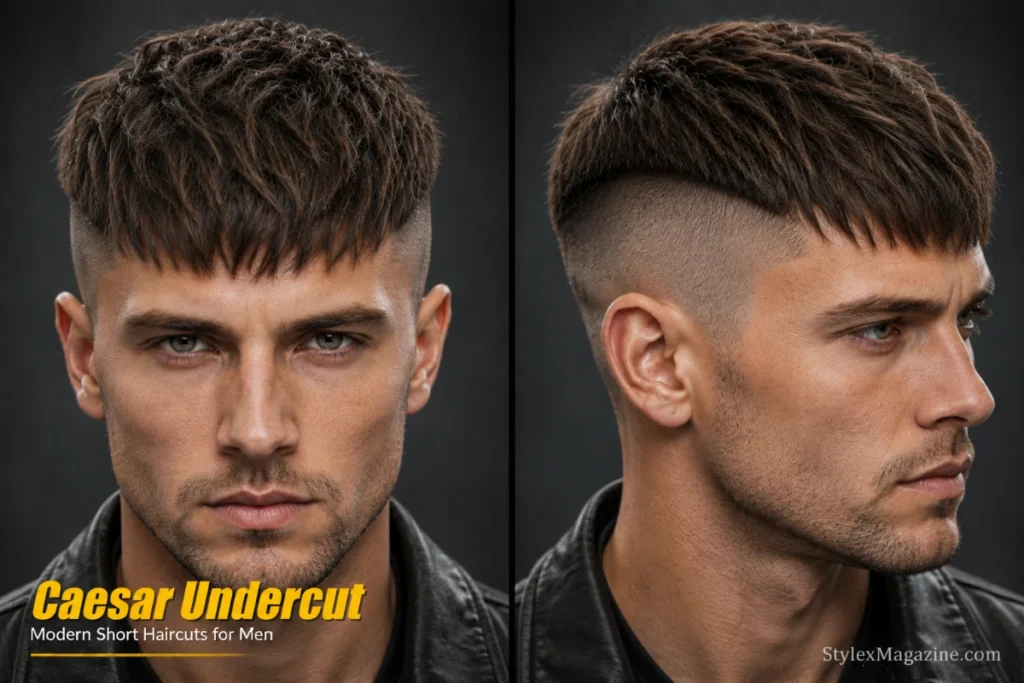
The undercut creates a hard disconnect between top and sides, no fade, no gradual transition, just a clean line where the Caesar top ends and very short sides begin. Bolder than any faded Caesar and requires confidence to carry. The disconnect makes the fringe look heavier and the sides sharper. Works best with sides at a #1 or shorter.
Best for: Square, diamond, and angular face shapes. Thick, straight, or wavy hair.
Tell your barber: “Caesar undercut. Disconnect the top from the sides, no blend. #1 on the sides, leave the fringe blunt and forward.”
Trim schedule: Every 2 to 3 weeks.
17. Caesar Mullet
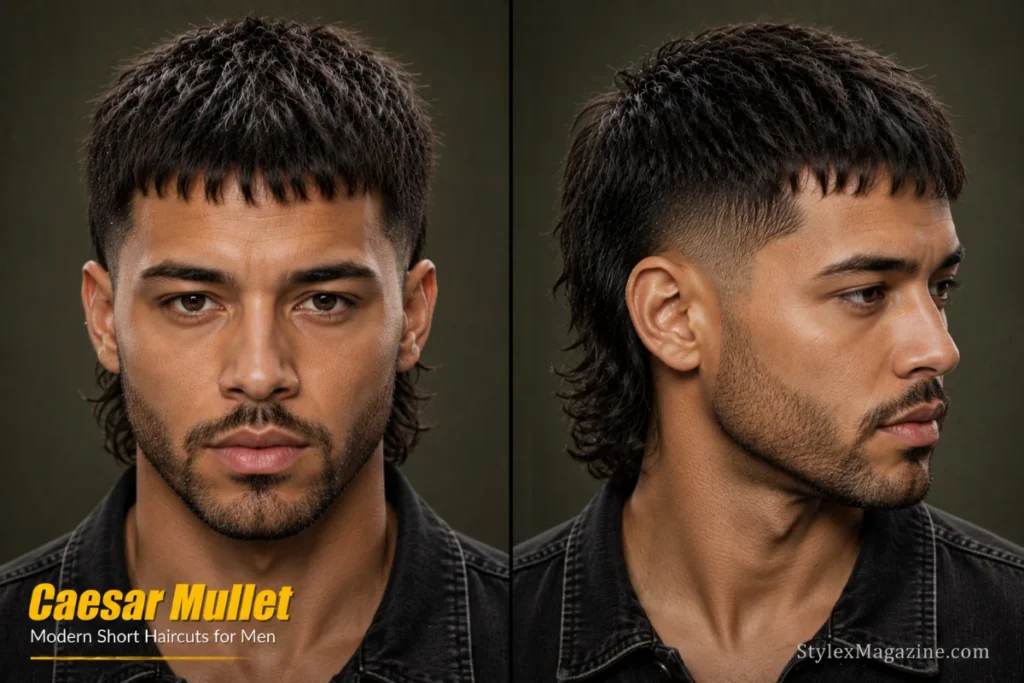
The front says Caesar, the back says something else entirely. Fringe stays short and forward, sides fade, but the back grows past the neckline in textured layers. The hybrid gained real traction through 2025 and hasn’t slowed down. Works because the structured front keeps it from looking unkempt, the back earns its length because the front earns its discipline.
Best for: Oval, heart, and diamond face shapes. Wavy or straight hair with medium density.
Tell your barber: “Caesar mullet. Blunt fringe, mid fade on the sides, let the back grow past the collar. Layer the back for movement.”
Trim schedule: Front every 2 to 3 weeks. Back trimmed every 4 to 6 weeks.
18. Dark Caesar (Black Men)
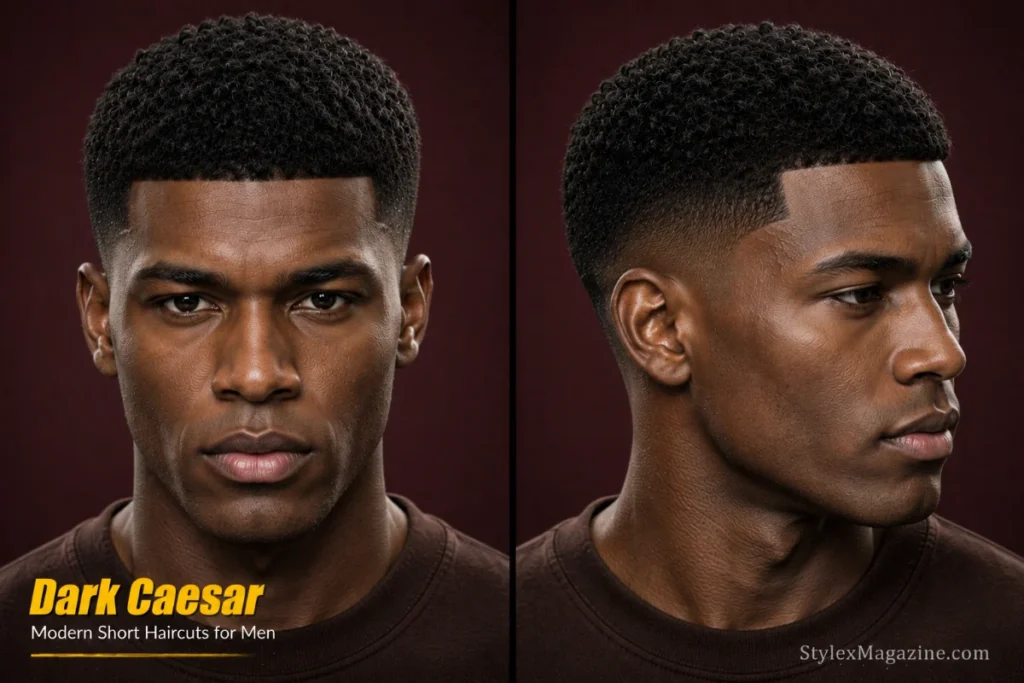
Built for coiled and type 4 hair textures. Top stays at a #1 or #2, shaped with a shaver for smooth uniformity. The line-up at the forehead and temples is the defining detail, it creates a clean geometric frame for the face. Argan oil keeps the scalp healthy under short-cut coiled hair; a boar bristle brush maintains hair direction between visits.
Best for: All face shapes. Coiled and type 4 hair textures.
Tell your barber: “Dark Caesar. #1 or #2 on top, shave smooth, skin fade on the sides, sharp line-up at the forehead and temples.”
Trim schedule: Line-up every 2 weeks. Full cut every 2 to 3 weeks.
19. Caesar with Beard
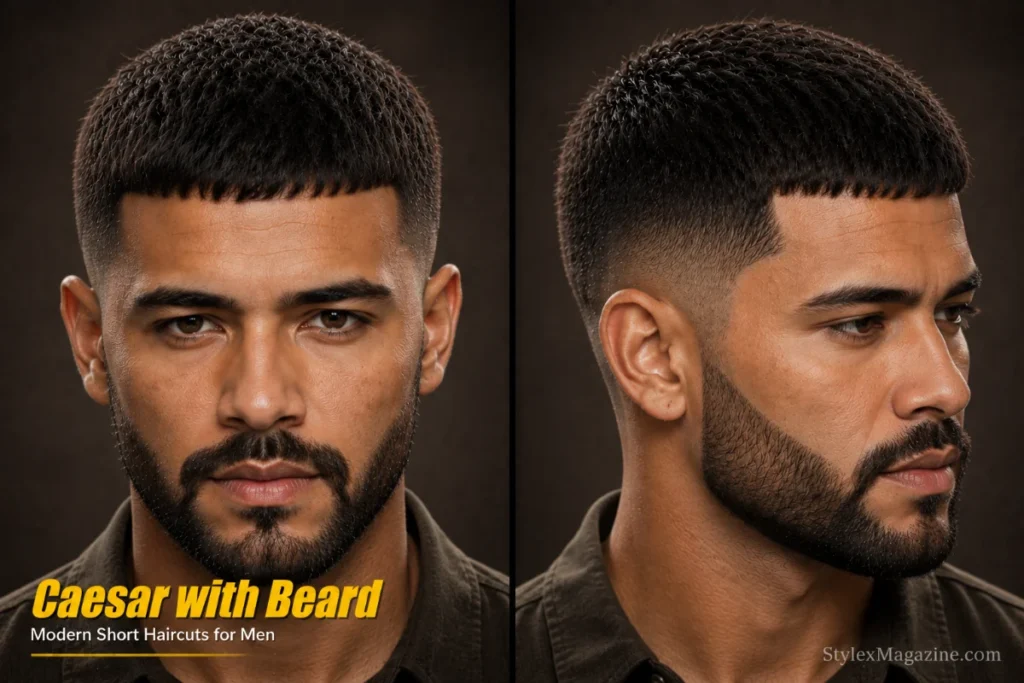
The short fringe on top and beard at the bottom create a frame around the face, two defined lines bookending your features. Proportion matters: a short Caesar with a full beard works because the beard adds the visual weight the haircut strips away. A long Caesar with a long beard starts looking unkempt. Keep both maintained on similar schedules.
Best for: Square, round, and oblong face shapes. All hair textures. Men with full, even beard growth.
Tell your barber: “Caesar on top with a mid fade, blend the fade into the beard line. Keep the fringe blunt. Line up the beard at the cheeks.”
Trim schedule: Haircut every 2 to 3 weeks. Beard trim every 1 to 2 weeks.
20. Layered Caesar Cut
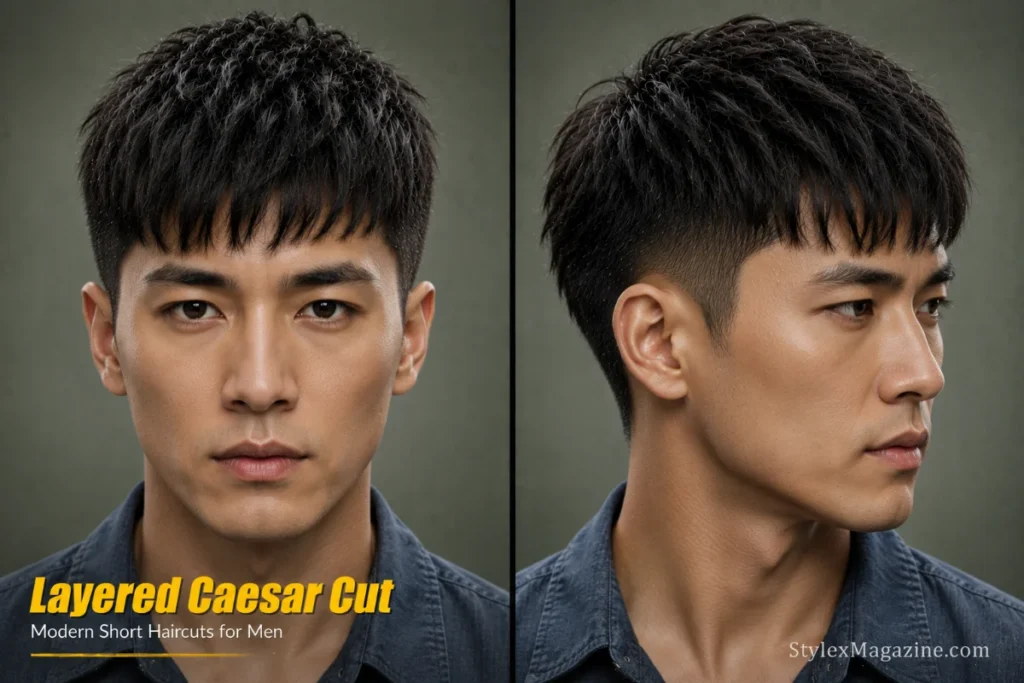
Layers break up the flat uniformity of the classic, the top gains lift and internal movement without adding length. The fringe stays forward and blunt, but the hair behind it sits at slightly different heights, creating visible depth. My go-to recommendation for men with thin or flat-lying hair who want the Caesar silhouette with the illusion of more volume. A light dusting of texture powder at the roots activates the layers.
Best for: Oblong, oval, and heart face shapes. Fine, thin, or flat-lying hair.
Tell your barber: “Layered Caesar. Add soft internal layers through the top for volume, keep the fringe blunt, low fade or taper on the sides.”
Trim schedule: Every 3 weeks.
How Do You Choose the Right Caesar Cut for Your Face Shape?
Match your Caesar variation to your bone structure, the fringe direction stays constant, but fade height, top length, and texture change per shape.
| Face Shape | Best Caesar Variation | Why It Works | Avoid |
|---|---|---|---|
| Oval | Any variation | Balanced proportions handle every length and fade | Nothing, oval suits all |
| Round | High fade Caesar, textured Caesar | Height on top with tight sides elongates the face | Classic Caesar with uniform sides, adds width |
| Square | Classic Caesar, Caesar taper | Blunt fringe complements angular jawline | Very short buzz Caesar, softens strong features too much |
| Oblong | Long Caesar, layered Caesar | Forward fringe visually shortens the face | High fade Caesar, adds vertical length |
| Heart | Caesar low fade, messy Caesar | Soft fringe balances a wider forehead | Caesar undercut, disconnect emphasises forehead width |
| Diamond | Caesar mid fade, textured Caesar | Mid fade balances wide cheekbones | Uniform-length classic, doesn’t address cheekbone width |
| Rectangle | Long Caesar, Caesar taper | Longer top with soft sides avoids elongation | High fade, vertical emphasis lengthens further |
By Hair Type
Straight hair: Classic, taper, or short Caesars fall flat and forward naturally. Use matte clay or light pomade.
Wavy hair: Messy, wavy, or textured Caesars leverage your natural pattern. Use sea salt spray.
Curly hair: Curly Caesar, cut dry, leave extra length for shrinkage. Use curl cream or light styling cream.
Coiled / type 4: Dark Caesar with line-up and skin fade. Use argan oil for scalp health.
Thin or fine hair: Short, layered, or receding-hairline Caesar. Use texture powder for lift. Skip anything shiny.
Caesar vs French Crop vs Crew Cut: What’s the Real Difference?
Three short cuts that men frequently mix up, each has a distinct fringe, side treatment, and maintenance rhythm.
| Feature | Caesar | French Crop | Crew Cut |
|---|---|---|---|
| Fringe | Short, blunt, straight across | Longer, textured, choppier | None, shortest at the front |
| Top length | 0.5 to 2 inches, even | 1 to 3 inches, graduated | 1 to 2 inches, front-to-back taper |
| Side treatment | Uniform, tapered, or faded | Almost always faded | Tapered or faded |
| Direction | Forward | Forward | Upward or back |
| Styling effort | Minimal, brush forward | Low to medium, texture product | Low, finger-style or comb back |
| Best for hair loss | Strongest, covers temple recession | Moderate, longer fringe helps | Weak, short front exposes recession |
| Trim frequency | Every 2 to 3 weeks | Every 2 to 3 weeks | Every 2 to 4 weeks |
What Should You Tell Your Barber for a Caesar Cut?
Give your barber three specific details: top length as a guard number, side treatment as fade level or taper, and fringe style as blunt or textured.
Vague “give me a Caesar” leaves too much to interpretation. Use these instead:
Classic Caesar: “#3 guard on top, even all around, straight fringe at the hairline, tapered neckline, no fade.”
Modern Caesar with fade: “Caesar on top, #3 to #4 guard, blunt fringe forward. Low fade on the sides, #1 at the base, blended clean. Taper the neckline.”
Textured Caesar: “Point cut the top for texture, keep the fringe forward but slightly uneven at the edges. Mid fade, #0.5 at the base.”
Caesar covering recession: “Bring the fringe forward over the temples, no line-up at the front. Keep the sides tight with a taper, not a hard fade. I want it to look natural, not like I’m covering anything.”
Bring reference photos showing the front, side, and back. Fringe angle and fade height are nearly impossible to communicate through words alone.
How Do You Style a Caesar Haircut at Home?
The Caesar is a two-minute style, the shorter the variation, the less time you need.
- For short, classic, or buzz Caesars: towel-dry, run fingertips through with a pea-sized amount of matte clay, brush forward, done. Blow-drying is optional under 1 inch of length.
- For long, wavy, or textured Caesars: towel-dry, spray sea salt spray into damp roots, blow-dry forward with medium heat while finger-shaping the top. Finish with texture clay to lock the fringe in position.
- For curly or dark Caesars: apply curl cream or argan oil to damp hair, air-dry or diffuse. Skip the blow-dry-and-brush method, it flattens curl definition.
- For layered or thin-hair Caesars: tap texture powder at the roots before any other product. Then follow the short-Caesar routine above. Texture powder gives lift without weight.
How Often Should You Trim a Caesar Cut?
Most Caesar variations need a barber visit every 2 to 3 weeks, faded versions on the shorter end, tapered versions on the longer end.
Here’s what happens week by week:
- Week 1 to 2: Freshly cut. Sharpest lines, strongest contrast. The cut looks sharp and defined.
- Week 3: Sides lose definition. Fringe pushes slightly past its intended position. Still presentable, the sweet spot for rebooking.
- Week 4 to 5: Faded sides blur into a soft edge. Fringe falls into your eyes on longer versions. Tapered Caesars still hold shape here.
- Week 6+: No longer a Caesar, grown into something else. Book the next cut.
Skin fades and high fades need the most frequent visits at every 2 weeks. Classic Caesars with tapered sides can stretch to 4 weeks comfortably.
How Much Does a Caesar Haircut Cost?
A Caesar cut runs between $15 and $75 depending on where you sit in the chair.
Standard barbershop pricing in most US cities lands between $20 and $40 for a Caesar with taper or low fade. Adding a skin fade, line-up, or beard trim pushes toward $50. Upmarket barbershops in NYC, LA, London, or similar metros charge $60 to $75 or more, especially for skin-faded variations. Quick-service chains and mall shops run $15 to $25 but skip the fade blending precision.
For the DIY route: a solid pair of clippers with guard set costs $30 to $80 one-time, then the cut is free. Buzz and short Caesars are the most beginner-friendly variations to attempt at home. Anything with a fade, leave to a barber.
What Are the Best Products for a Caesar Cut?
The Caesar works with matte, lightweight products, nothing heavy, nothing high-shine.
- Matte clay or texture clay, the default Caesar product. Medium to strong hold, no shine, holds the fringe without looking wet. Pea-sized amount, worked through damp hair.
- Sea salt spray, for messy, wavy, or textured Caesars. Spray into damp hair before styling for grip and natural separation. Skip for classic or sleek versions.
- Pomade, for polished Caesars where the fringe lays flat with slight sheen. Use sparingly. Too much looks greasy.
- Texture powder, for thin or fine hair. Tap into roots at the crown for instant volume and grip. Invisible after application. My top pick for layered Caesars and thin-hair variations.
- Styling cream, for softer hold with natural movement. Works well on curly and wavy Caesars where definition matters more than hold.
- Argan oil, for dark Caesars and coiled textures. Maintains scalp moisture under very short cuts. A few drops massaged in after styling.
Frequently Asked Questions
Is a Caesar Haircut Professional Enough for the Office?
The Caesar ranks among the strongest office-appropriate short cuts, clean lines and structured fringe signal discipline. Classic and tapered Caesars suit corporate environments. Skin-faded variations lean casual for conservative workplaces.
Can I Cut a Caesar Haircut at Home?
Buzz and short Caesars work as DIY cuts with clippers and a mirror, the uniform length forgives beginner mistakes. Anything with a fade needs a barber. The fade blending and neckline finish are the two details that separate a professional cut from a home attempt.
What’s the Minimum Hair Length Needed for a Caesar?
Half an inch minimum, roughly a #4 clipper guard on top. Anything shorter becomes a buzz cut because the fringe won’t have enough length to lay forward and stay visible.
Can a Caesar Work on Thick, Coarse Hair?
Thick hair is ideal for textured and layered Caesars, density holds shape without product, and point cutting removes bulk while keeping coverage. A mid or high fade on the sides controls temple volume.
How Is a Caesar Different from a Textured Crop?
The Caesar fringe is blunter and cut in a clean horizontal line. A textured crop’s fringe is choppier, longer, and styled with visible separation. Caesar looks structured, crop looks relaxed. Both are short and forward-facing.
Should I Get a Caesar If My Hair Is Thinning at the Crown?
Yes, the forward direction moves hair toward the front, reducing crown visibility. A short, even Caesar with texture powder at the roots is a strong camouflage strategy for early crown loss. Skip long Caesars, the extra length separates and exposes scalp.
Does the Caesar Suit Curly Hair?
Curly hair suits the Caesar well, curls add natural volume and texture straight-haired versions need product to build. Cut dry so your barber sees actual curl length (wet curls hang 30 to 40% longer than dry curls). Curl cream maintains definition without crunch.
By Amir Khan, professional hairstylist, 8 years of barbershop experience. Every article on StyleX Magazine is written from the chair, not the desk.

Other Articles

Shaggy Haircuts for Men: 25 Cool Styles, And Barber Tips
35 Best Korean Hairstyles for Men In 2026.





No Comment! Be the first one.