


Quick Answer: A textured fringe is a forward-falling front section cut with removed weight, so it sits in separated pieces instead of a solid block. The fringe lands anywhere from mid-forehead to the brow line. The sides — a taper, a fade, or scissor work — decide how sharp or soft the finished cut looks.
Below: 25 textured fringe styles, ordered by fade height, cut technique, hair texture, fringe length, and combinations. Each one includes the guard number and fringe length to request.
What Is a Textured Fringe Haircut?
Three things define it.
The front section falls forward over the forehead. The length stops somewhere between the hairline and the eyebrows. Most versions sit from mid-forehead down to the brow, and the shortest clear the hairline by under an inch. And the ends are cut into, whether point-cut, razored, or notched, so the hair breaks into pieces rather than hanging as one flat edge.
Everything else is a variable. Sides can run from a scissor-cut taper to a bald skin fade. Length can sit at an inch or at four. Direction can fall straight down, sweep to one side, or push forward off a cowlick.
That variability is why two men with the same request walk out with different haircuts. The fringe is the constant. The sides and the length are what you have to specify.
Which Textured Fringe Suits You?
| Your situation | Ask for | Entry |
|---|---|---|
| First textured fringe, office job | Low taper, fringe just above the brow | #1 |
| Thick hair that sits heavy | Point-cut fringe, weight removed through the middle | #6 |
| Fine hair, want it to look fuller | Blunt-edge fringe, minimal thinning | #9 |
| Round or full face | Longer fringe with height at the back | #18 |
| Long forehead | Fringe at the brow line, low fade only | #2 |
| Curly or coily hair | Curly textured fringe, scissor-cut sides | #13 |
| Want maximum contrast | Skin fade with a short fringe | #5 |
| Receding at the temples | Side-swept fringe, no high fade | #19 |
| Growing out a buzz cut | Micro fringe now, longer later | #16 |
| Low effort, 30 seconds a morning | Messy textured fringe | #21 |
Not sure which face shape is yours? Measuring it takes a mirror and thirty seconds, and the face shape guide runs through the method.
25 Best Textured Fringe Haircuts for Men
1. Textured Fringe with Low Taper
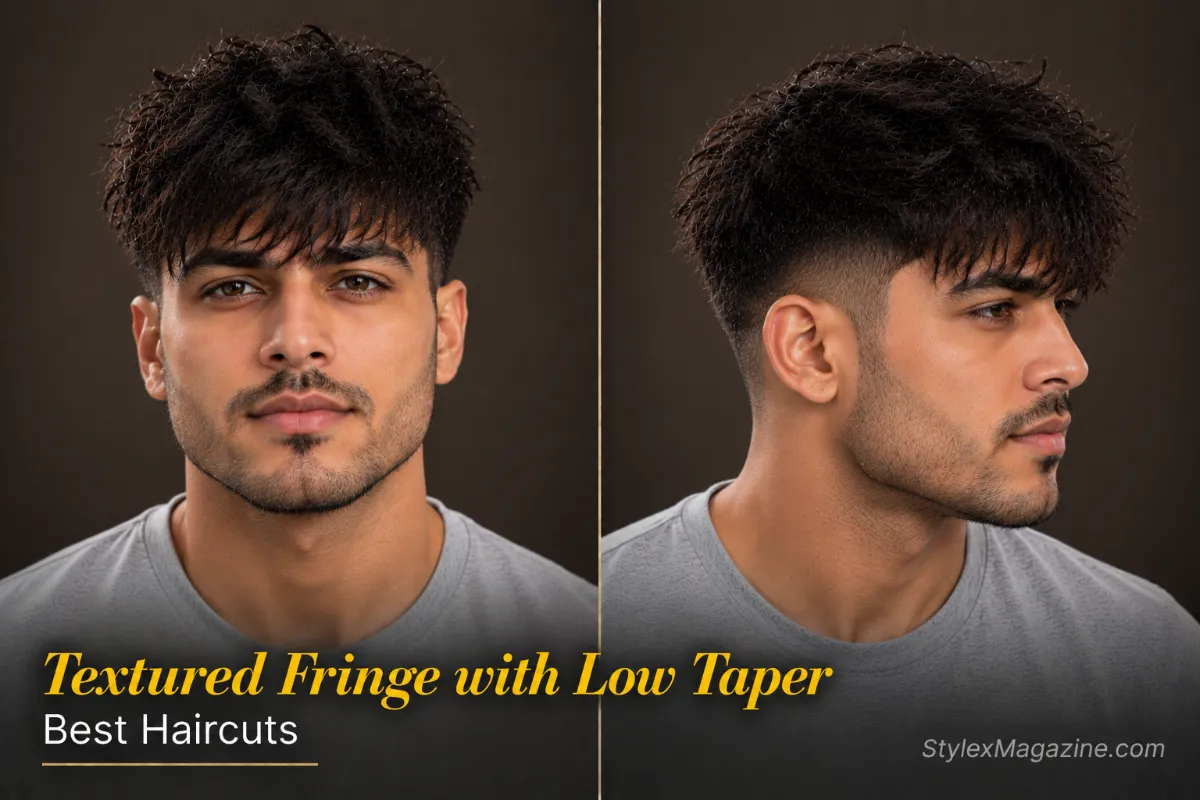
The low taper fringe is the most requested version, and the easiest to live with. The taper starts just above the ear and stays tight to the hairline, so the sides stay dark and the fringe carries the shape. Grows out without a visible line.
Best for: Every face shape. Office and client-facing work.
Tell your barber: “Low taper with a #1 at the bottom, blended up to a #3. Leave the top three inches and point-cut the fringe to just above my brow.”
Product: Matte clay, pea-sized, worked through dry hair from the back forward.
Maintenance: Every 3–4 weeks.
2. Textured Fringe with Low Fade
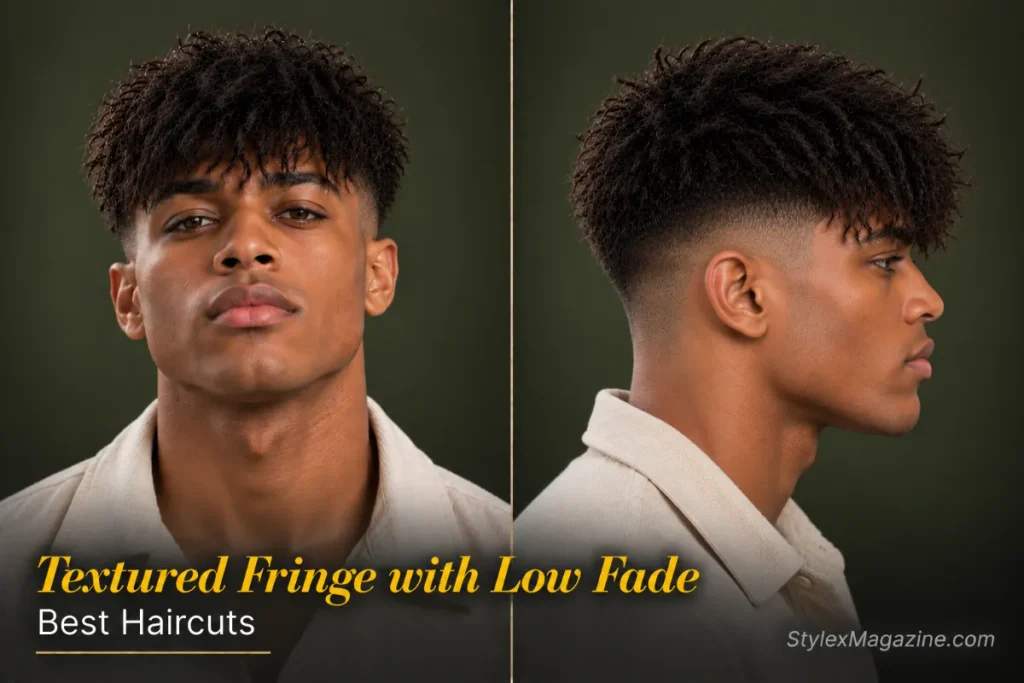
Shorter at the base than a taper, with a cleaner gradient up the side. Sits well under a longer fringe because the contrast pulls the eye down and across, shortening a long forehead. Where the low fade starts on the head decides how much of that contrast you get.
Best for: Oblong and rectangular faces. Straight to wavy hair.
Tell your barber: “Low fade starting at the top of my ear, #0.5 to #3. Keep the fringe long enough to touch my eyebrows.”
Product: Texture paste for separation without stiffness.
Maintenance: Every 2–3 weeks.
3. Textured Fringe with Mid Fade
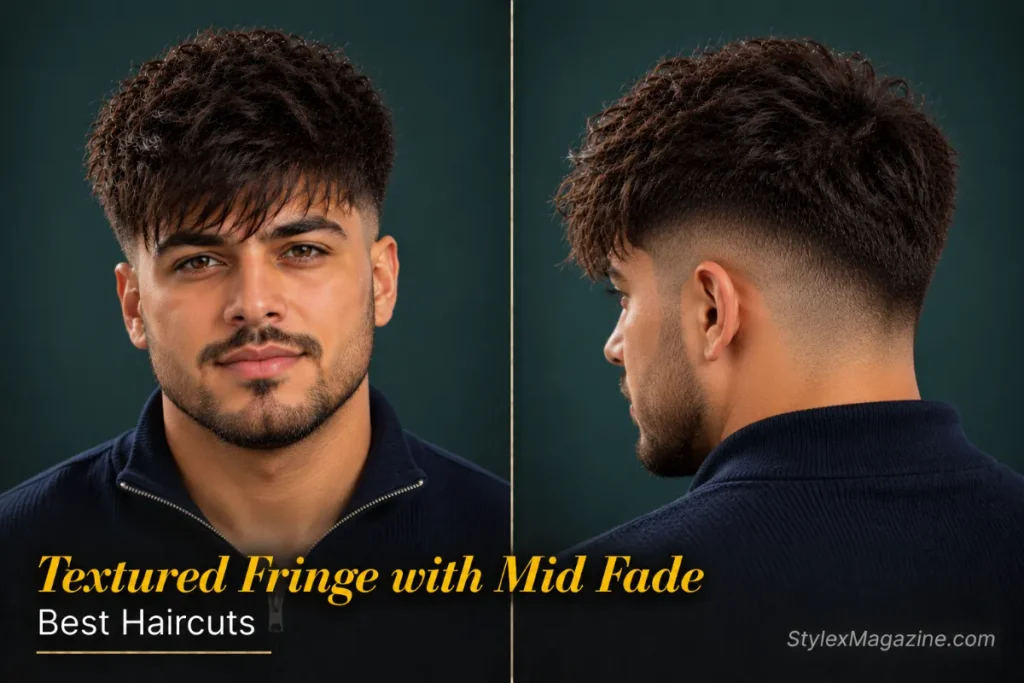
The fade starts at temple level, which narrows the sides at the widest point of the head. Pairs with a medium fringe of around two to three inches, so the top still has mass. A mid fade sits higher than most men expect, so check the placement before you commit.
Best for: Round and square faces. Medium to thick hair.
Tell your barber: “Mid fade from temple level, #0 to #4. Two and a half inches on top, fringe point-cut at mid-forehead.”
Product: Texture powder at the roots, then clay.
Maintenance: Every 2 weeks.
4. Textured Fringe with High Fade
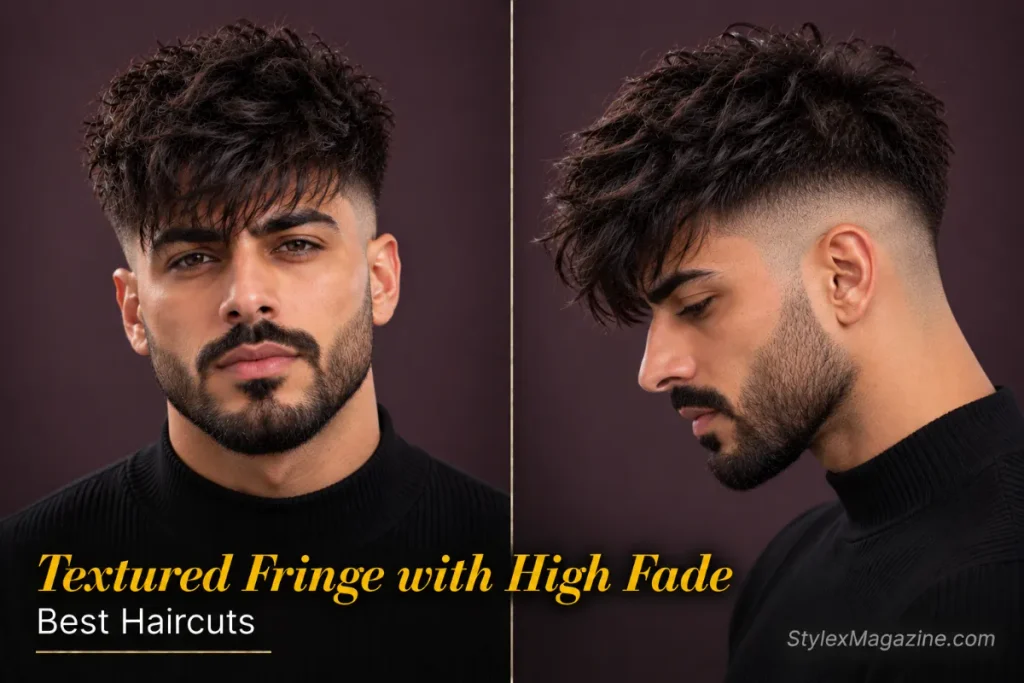
Maximum height on the sides, which makes the fringe the only soft element in the cut. Strong look that needs a fringe with real length on top, or the head starts to look narrow. A high fade strips away more width than any other level here.
Best for: Round and diamond faces. Thick, dense hair.
Tell your barber: “High fade starting above the temple, #0 up to a #4. Leave three to four inches on top so the fringe has weight.”
Product: Firm-hold clay. Blow-dry forward first.
Maintenance: Every 10–14 days.
5. Skin Fade with Textured Fringe
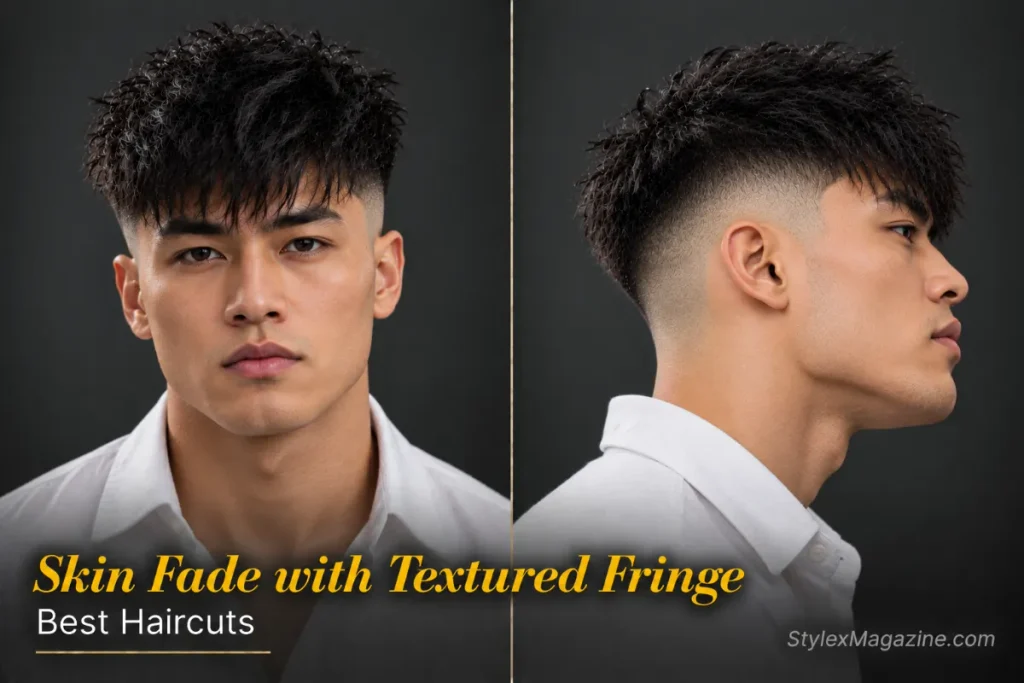
Bare at the base, so the fringe looks like it floats above the sides. The sharpest version and the shortest-lived. The skin grows back in within days. If that upkeep sounds like too much, a taper fade holds its shape far longer.
Best for: Square and oval faces. Dense hair with a clean hairline.
Tell your barber: “Skin fade to bare at the bottom, blended to a #3. Short fringe, about an inch and a half, heavily point-cut.”
Product: Matte paste. Very little, because short fringes clog fast.
Maintenance: Every 7–10 days.
6. Point-Cut Textured Fringe
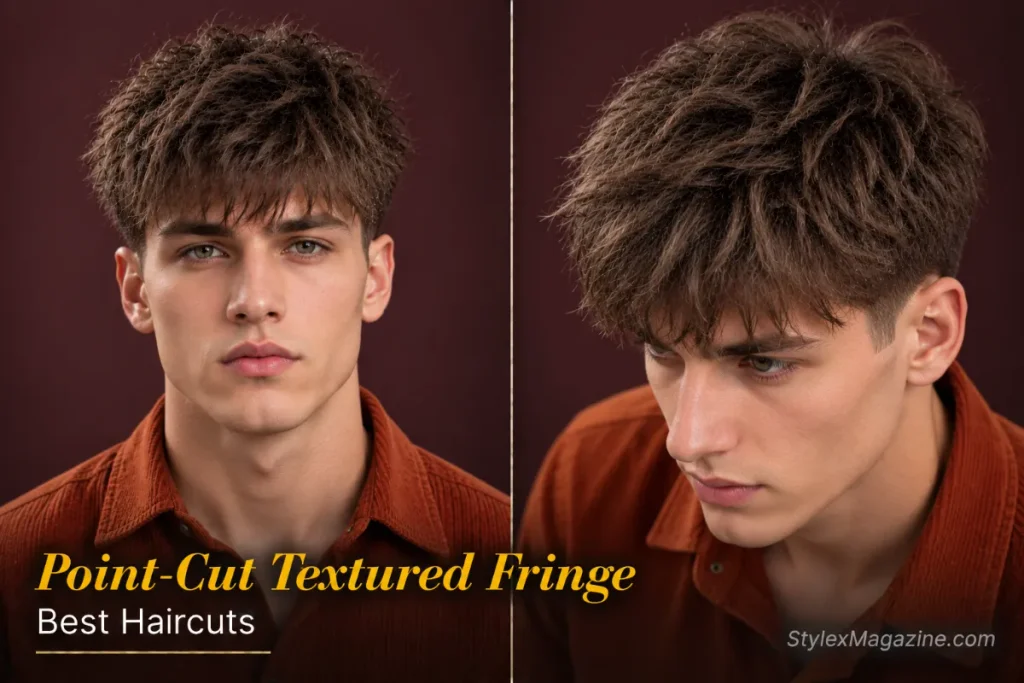
The technique behind most of this list, used on its own. The barber holds the fringe vertically and cuts into the ends with the scissor tips, removing weight from inside rather than shortening the outline. Thick hair stops sitting like a helmet.
Best for: Thick, heavy, straight hair. Any face shape.
Tell your barber: “Keep the fringe length but point-cut into it vertically. Take the weight out of the middle, not the ends.”
Product: Lightweight cream. Clay over-weights a point-cut fringe.
Maintenance: Every 4 weeks.
7. Choppy Textured Fringe
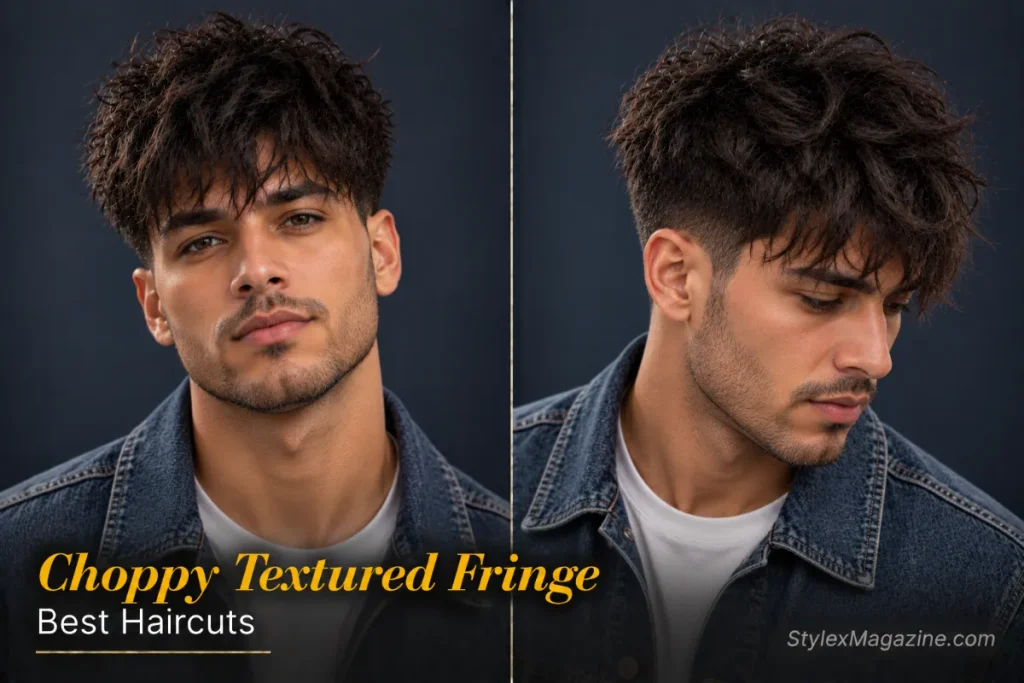
Heavier cutting than a point cut, with deliberate length variation across the fringe. Some pieces hit the brow, others sit half an inch higher. Looks deliberate once it grows past the first week.
Best for: Oval and square faces. Medium-thickness straight hair.
Tell your barber: “Choppy fringe with uneven lengths. Deep notches, biggest gap about half an inch.”
Product: Sea salt spray on damp hair, then dry.
Maintenance: Every 3–4 weeks.
8. Wispy Textured Fringe
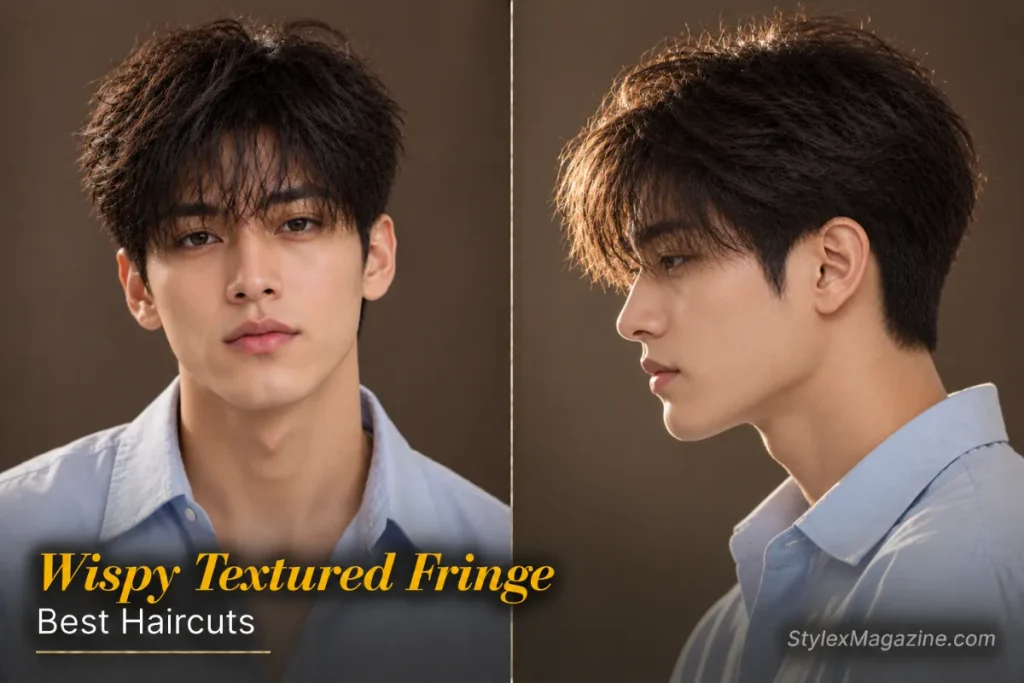
Thinned so far down that light passes through it. Sits flat against the forehead in fine strands. This shape sits at the centre of most Korean hairstyles, where a see-through fringe is standard rather than a variation.
Best for: Fine to medium hair. Heart and diamond faces.
Tell your barber: “Thin the fringe out so it’s see-through. Keep it long, down to the brows, but take most of the density out.”
Product: Nothing, or a drop of light cream on the ends.
Maintenance: Every 4–5 weeks.
9. Blunt-Edge Textured Fringe

The outline stays as a straight line while the texture is built behind it. Fine hair looks thicker because the edge stays solid, the opposite approach to a wispy fringe.
Best for: Fine and thinning hair. Oblong faces.
Tell your barber: “Keep the bottom edge of the fringe blunt and straight. Build the texture behind the edge, not on it.”
Product: Texture powder only. Creams flatten the edge.
Maintenance: Every 3 weeks, because the blunt line goes soft fast.
10. Razored Textured Fringe
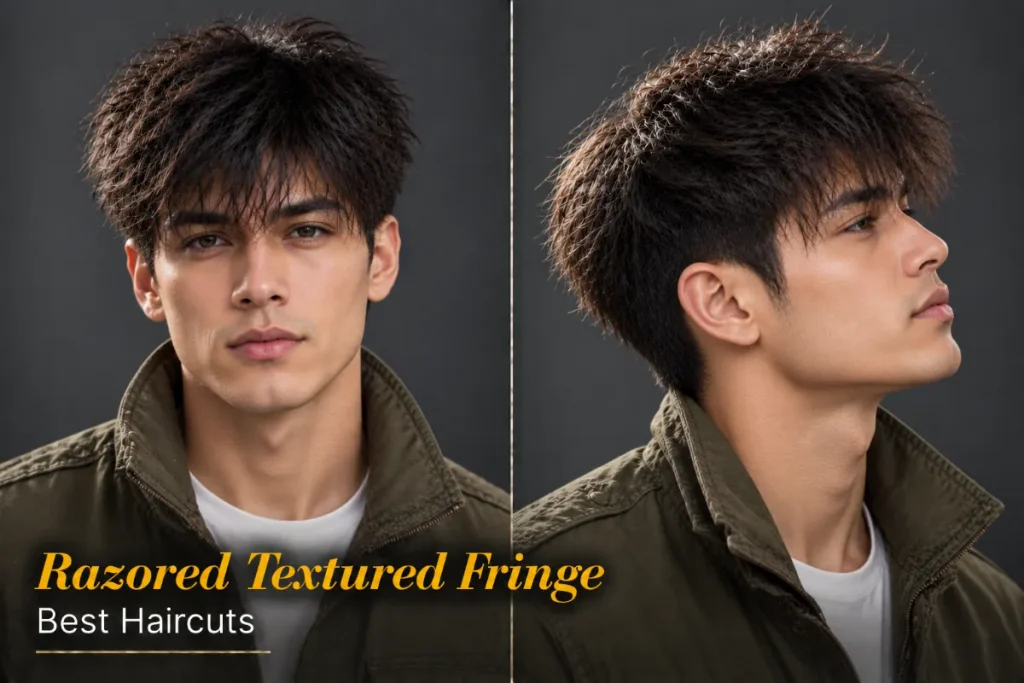
Cut with a straight razor instead of scissors, which leaves a feathered, tapered end on every strand. Softer than any scissor finish. Works on hair that is already fine; on coarse hair it frizzes.
Best for: Fine to medium straight hair. Square faces needing softness.
Tell your barber: “Razor the fringe rather than scissor it. Feather the ends, keep the length at mid-forehead.”
Product: Light cream, applied to damp hair.
Maintenance: Every 4 weeks.
11. Textured Fringe for Straight Hair
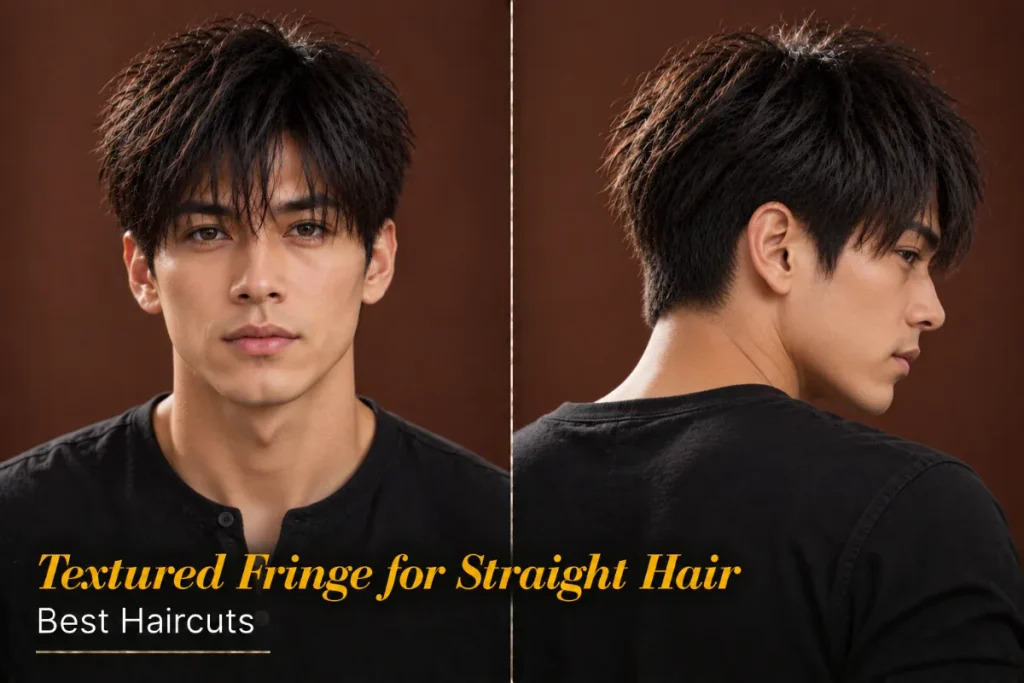
Straight hair holds a cut line precisely, which helps and hurts. Separation has to be cut in, because it will not happen on its own. That same problem shapes every cut on straight hair, not just the fringe.
Best for: All face shapes. Straight, medium-density hair.
Tell your barber: “Straight hair, so cut plenty of separation into the fringe. Point-cut deep or it’ll sit as one piece.”
Product: Texture powder at the roots, matte clay on top.
Maintenance: Every 3 weeks.
12. Textured Fringe for Wavy Hair

The wave does the texturing, so the cut needs less work. The risk is width. Wavy hair expands sideways, and a fringe left too long turns into a wedge. Keep the fringe above the brow.
Best for: Oval and oblong faces. Natural wave or loose curl.
Tell your barber: “Work with the wave. Keep the fringe above my eyebrows and take the bulk out of the sides.”
Product: Sea salt spray, scrunched in while damp.
Maintenance: Every 4 weeks.
13. Curly Textured Fringe
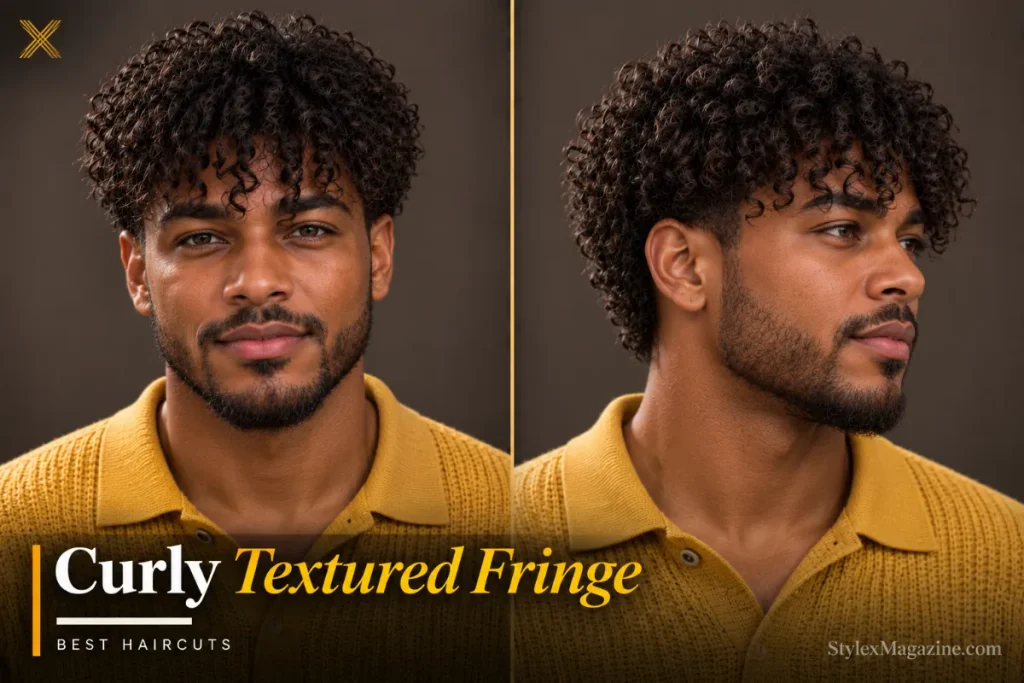
Curls are cut dry, curl by curl, because wet curly hair springs up two inches once it dries. Scissor-cut sides suit it better than a tight fade. Curl pattern decides what the fringe can do, and the range across curly hair is wider than most men realise.
Best for: Curly and coily hair. Square and round faces.
Tell your barber: “Cut it dry. Shape the fringe curl by curl and leave the sides scissor-cut, not faded.”
Product: Curl cream on damp hair, diffuse on low heat.
Maintenance: Every 5–6 weeks.
14. Textured Fringe for Thick Hair

Thick hair needs weight taken from underneath, not off the top. A barber who only shortens the outline leaves a fringe that lifts away from the forehead by midday. The same weight problem runs through every cut for thick straight hair.
Best for: Thick, coarse hair. Round and square faces.
Tell your barber: “Remove weight from underneath the fringe. Keep the surface length, thin out the inside.”
Product: Matte clay, worked in from the roots.
Maintenance: Every 3 weeks.
15. Textured Fringe for Fine Hair
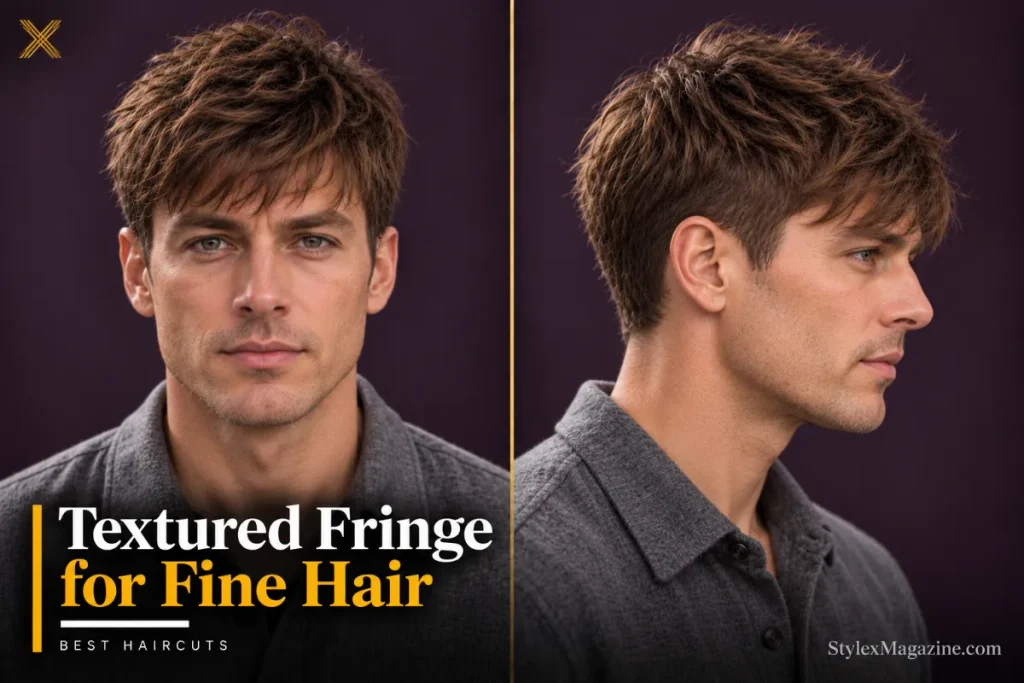
Fine hair cannot afford thinning. The texture comes from the cut angle and from product, not from removing density. Keep the fringe shorter, because a long fringe on fine hair shows scalp.
Best for: Fine and soft hair. Oval and heart faces.
Tell your barber: “Fine hair, so don’t thin it. Keep the fringe at mid-forehead and cut it at an angle for movement.”
Product: Texture powder at the roots. Nothing heavy.
Maintenance: Every 3–4 weeks.
16. Micro Textured Fringe
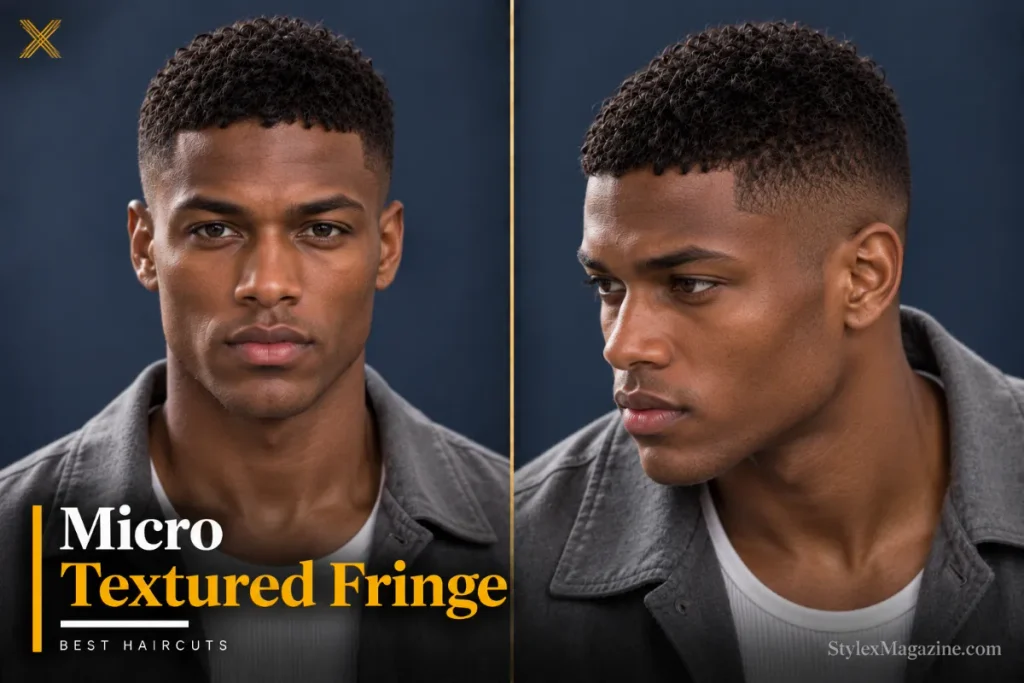
Under an inch, barely clearing the hairline. The shortest fringe that still shows texture. Useful mid-grow-out from a buzz cut, when there is not yet enough length for anything else.
Best for: Strong hairlines. Square and oval faces.
Tell your barber: “Micro fringe, under an inch. Notch the front edge so it isn’t a straight line.”
Product: Matte paste on fingertips, pressed forward.
Maintenance: Every 2 weeks.
17. Short Textured Fringe
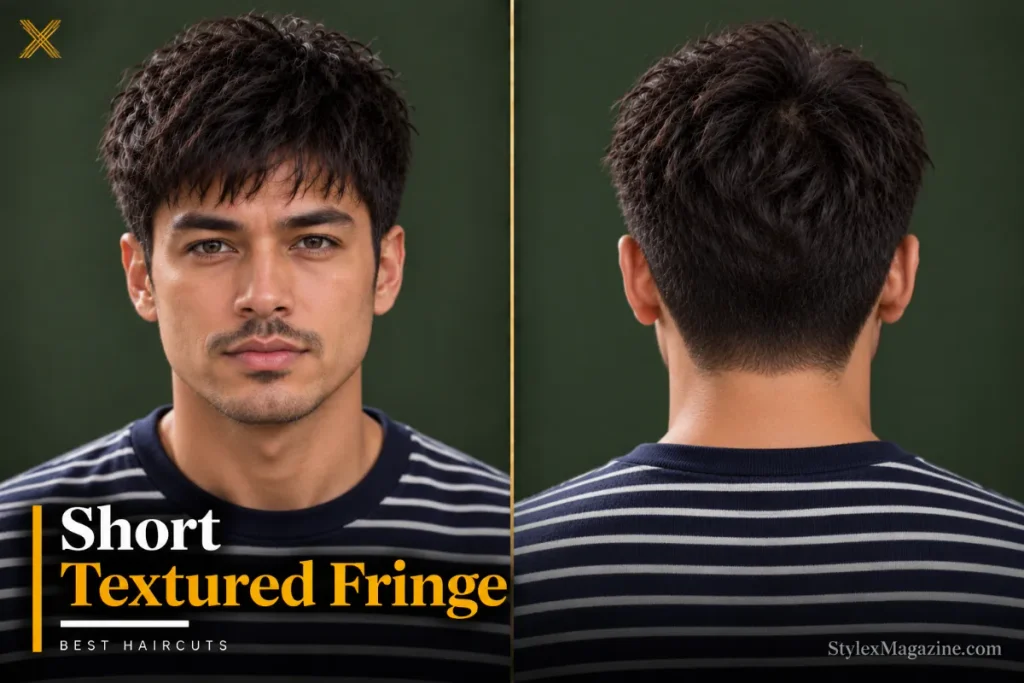
One to two inches, sitting high on the forehead. Dries in a minute and holds through a working day without re-styling. The entry point for most men.
Best for: All face shapes. Any hair type but very curly.
Tell your barber: “Short fringe, about an inch and a half. Point-cut the front so it sits in pieces.”
Product: Clay, small amount, dry hair.
Maintenance: Every 2–3 weeks.
18. Long Textured Fringe
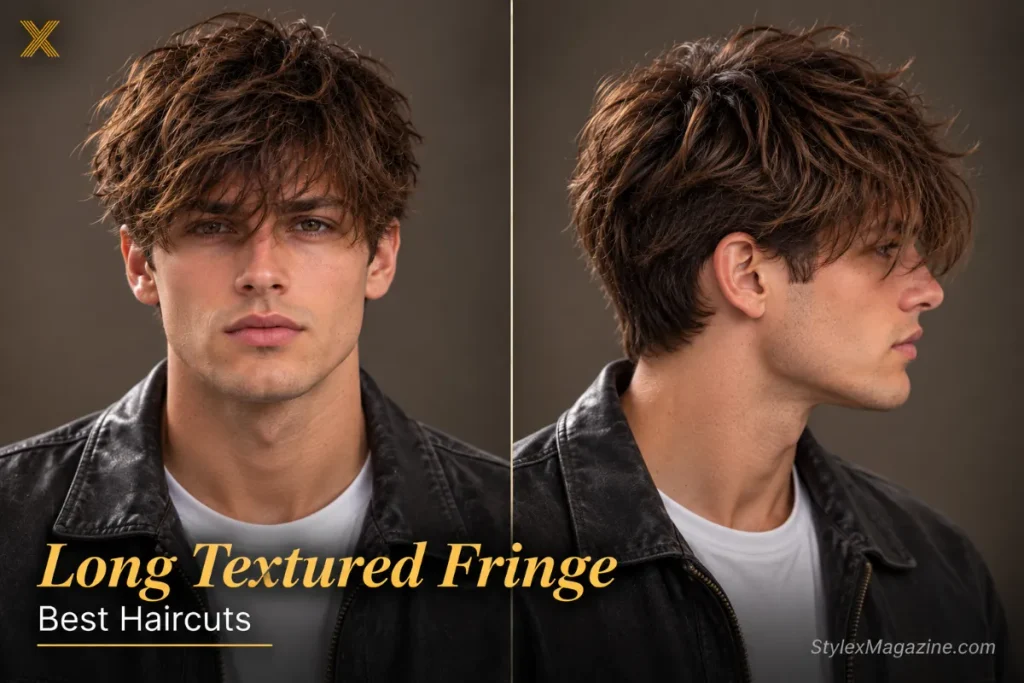
Three inches or more, falling to the brow or below. Adds vertical length at the front, which balances a round or full face. Needs daily drying or it falls flat.
Best for: Round and full faces. Straight to wavy hair.
Tell your barber: “Long fringe, past my eyebrows. Point-cut the ends and keep weight through the middle.”
Product: Sea salt spray, then blow-dry forward and down.
Maintenance: Every 5–6 weeks.
19. Side-Swept Textured Fringe
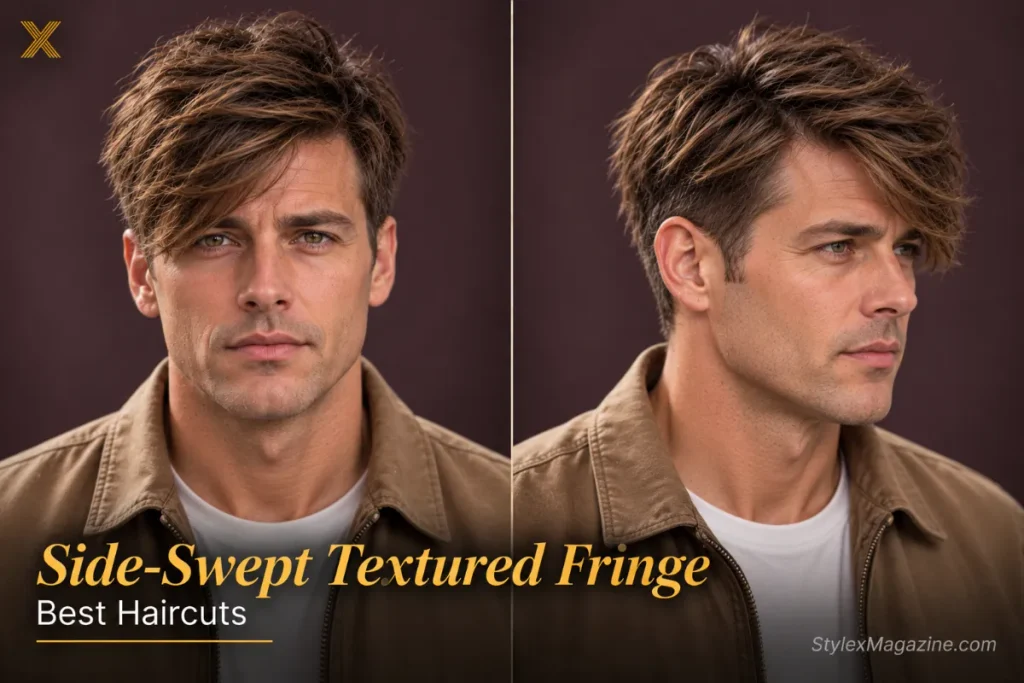
The fringe is cut on a diagonal and pushed across rather than forward. Covers a receding temple without a hard line. Also the better option when a cowlick fights a forward fringe.
Best for: Receding temples. Oval and oblong faces.
Tell your barber: “Cut the fringe on a diagonal, longest on the left. I’m sweeping it across, not forward.”
Product: Light pomade for hold without shine.
Maintenance: Every 4 weeks.
20. Brushed-Forward Textured Fringe
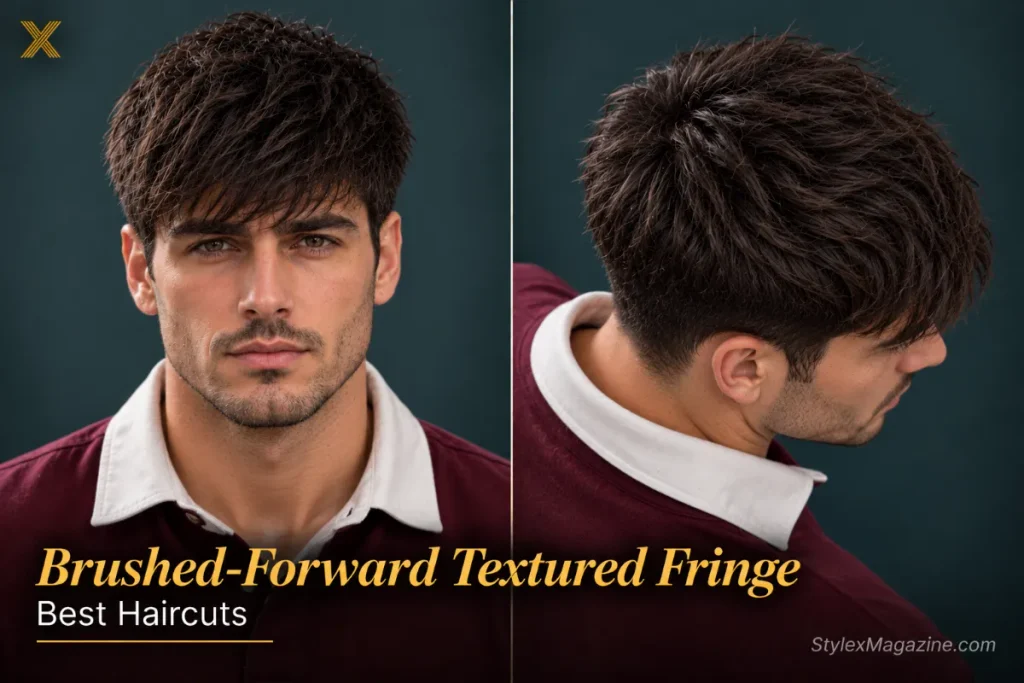
Everything on top is directed forward from the crown, so the fringe gets the full weight of the hair behind it. Best on a dense, even growth pattern. A strong crown whorl disrupts it.
Best for: Dense hair, even growth. Square faces.
Tell your barber: “Cut the whole top to fall forward from the crown. Texture the fringe at mid-forehead.”
Product: Clay from the crown forward, finished with fingers.
Maintenance: Every 3 weeks.
21. Messy Textured Fringe
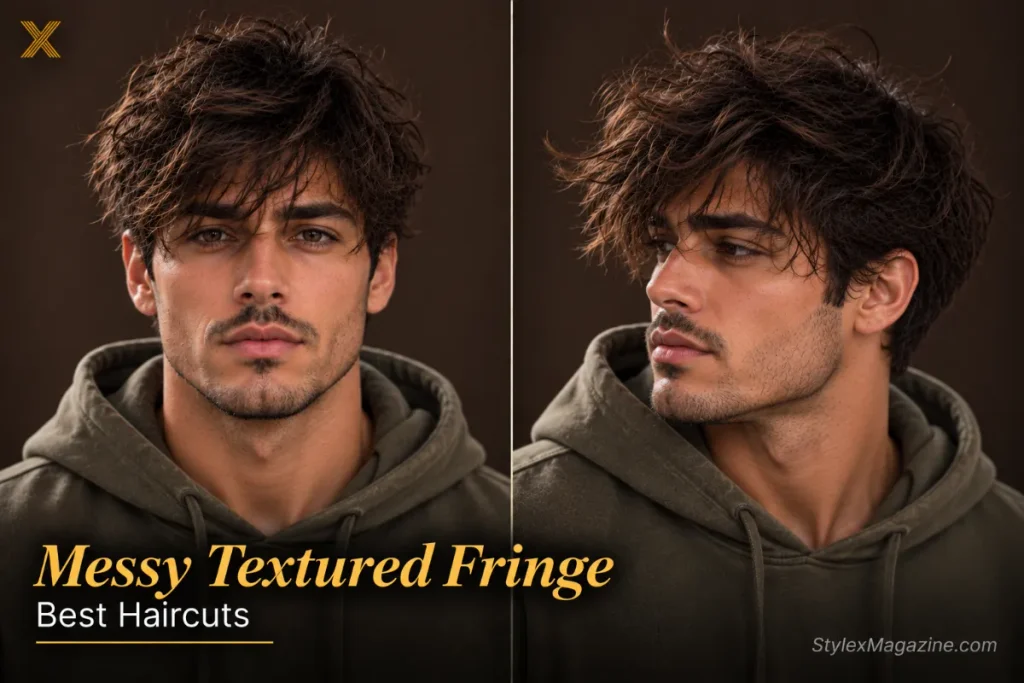
Cut with enough internal weight removed that it holds a disordered shape on its own. The cut carries the look here, not the styling, which is what separates it from the messy finish you can put on any cut, as shown across 25 messy hairstyles for men.
Best for: Wavy and medium-thick hair. Oval and square faces.
Tell your barber: “Take a lot of weight out so it falls messy without product. Uneven fringe, nothing symmetrical.”
Product: Sea salt spray on damp hair, air-dry.
Maintenance: Every 5 weeks.
22. Textured Fringe with Burst Fade
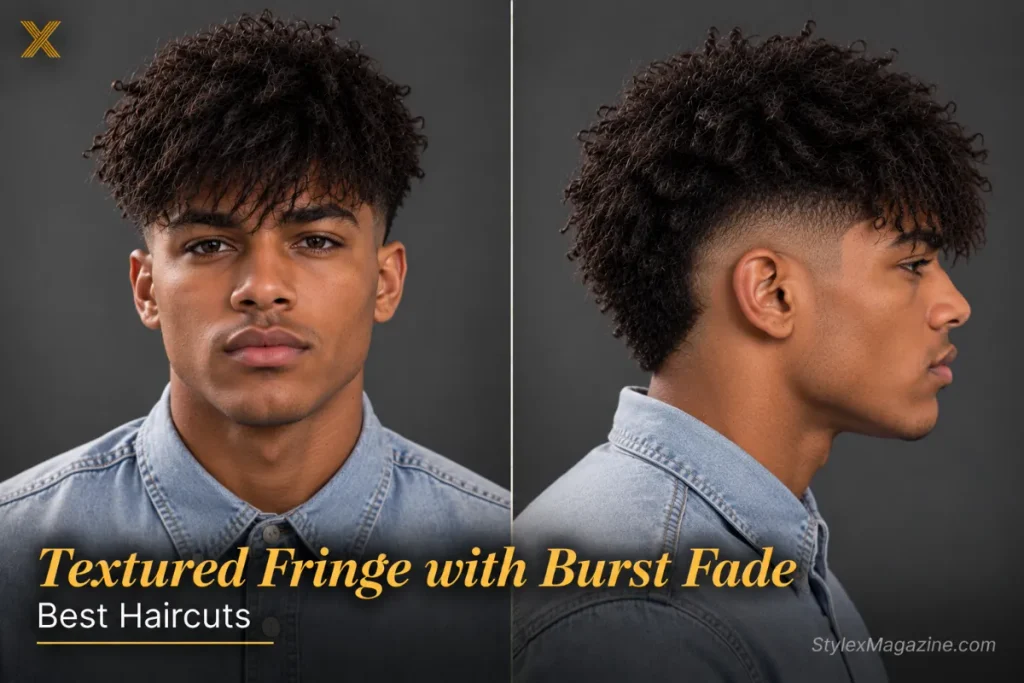
The fade arcs around the ear and leaves the back length intact, so the fringe and the back connect through the middle. How far that arc travels is what separates one burst fade from another.
Best for: Oval and diamond faces. Medium to thick hair.
Tell your barber: “Burst fade around the ears only. Leave the back length and keep the fringe at mid-forehead.”
Product: Texture paste, worked forward.
Maintenance: Every 2 weeks.
23. Textured Fringe with Disconnected Undercut
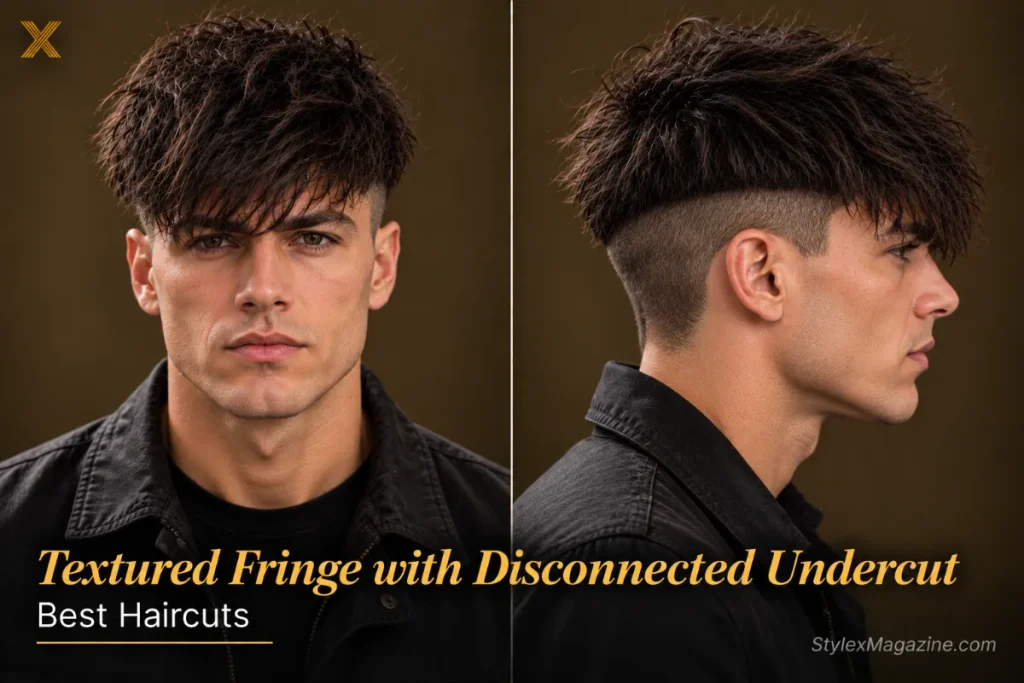
No blend. The sides are cut to one guard length and the top sits over them as a separate shape. Strong contrast, and the hardest version to grow out, because the disconnection line stays visible for weeks.
Best for: Square and oblong faces. Thick, straight hair.
Tell your barber: “Disconnected undercut, #1 all round, no blend. Leave three inches on top with a point-cut fringe.”
Product: Firm clay. Keep the top mass separate from the sides.
Maintenance: Every 2–3 weeks.
24. Textured Fringe with Beard
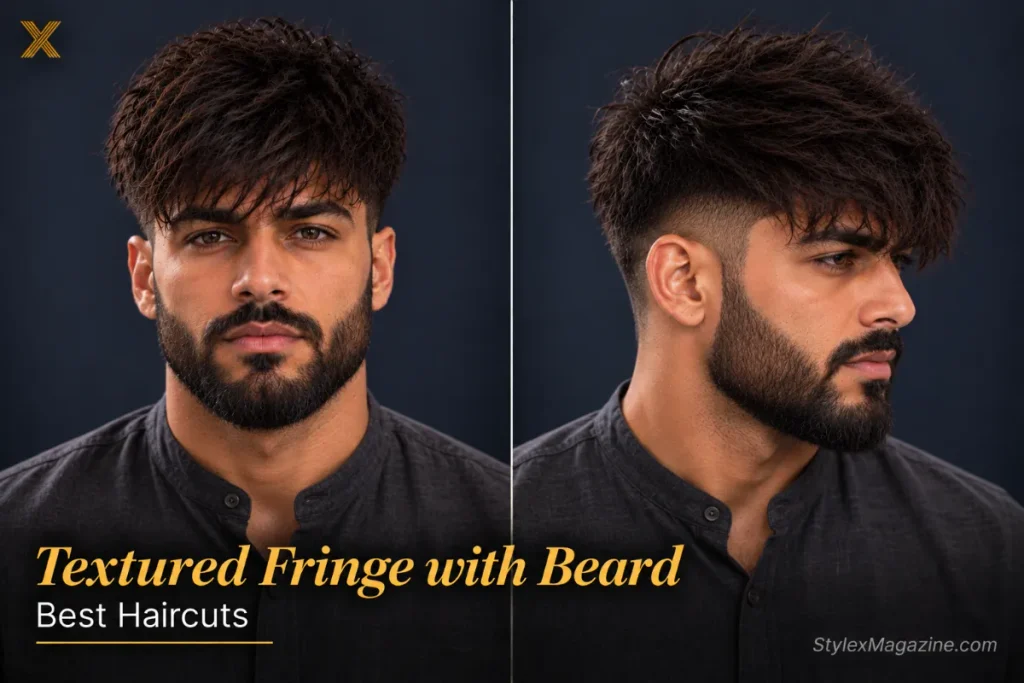
The fringe and the beard frame the face from both ends, so the two need matched weight. A heavy beard under a wispy fringe makes the head look top-light.
Best for: Oblong and square faces. Full beard growth.
Tell your barber: “Match the fringe weight to my beard. Keep the fringe full, taper the sides into the beard line.”
Product: Clay on top, beard oil below.
Maintenance: Every 3 weeks, beard trimmed at the same visit.
25. Textured Fringe Mullet
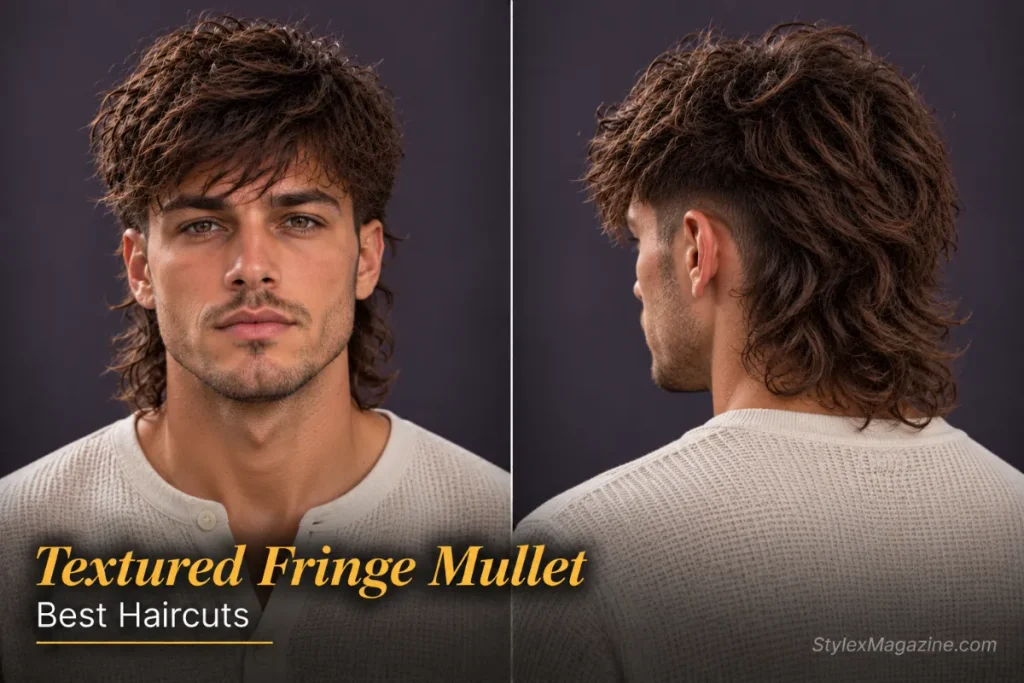
Short and textured at the front, length left at the back. The fringe keeps the front modern while the back carries the shape. The most committed cut here, and the most forgiving to grow.
Best for: Oval faces. Wavy and curly hair.
Tell your barber: “Textured fringe at the front, keep the length at the back past my collar. Taper the sides.”
Product: Sea salt spray throughout, scrunch the back.
Maintenance: Every 6 weeks.
How Do You Ask Your Barber for a Textured Fringe?
Saying “textured fringe” is not a brief. It names the front section and nothing else. Specify three things and you will get the cut you pictured.
Fringe length. Use a landmark, not an adjective. “Just above my eyebrows.” “Mid-forehead.” “An inch and a half.” Those are checkable. “Short” and “medium” are not.
Where the weight comes out. Thick hair needs weight removed from underneath. Fine hair needs the outline kept solid and nothing thinned. Say which one you are.
Side height. Taper, low, mid, high, or skin. Name the guard as well. A #1 at the bottom blended to a #3 is a different haircut from bare skin blended to a #3.
Phrases that work:
“Low taper, #1 to #3, fringe point-cut to just above my brow.” Use for: First textured fringe, or a workplace with a dress code.
“Take the weight out from underneath but keep the surface length.” Use for: Thick or coarse hair that sits heavy.
“Keep the bottom edge blunt, build the texture behind it.” Use for: Fine or thinning hair.
“Cut it dry, curl by curl.” Use for: Curly and coily hair.
“Cut the fringe on a diagonal, I’m sweeping it across, not pushing it forward.” Use for: Receding temples, or a cowlick at the front hairline.
What not to say: “Just texture it.” Every barber interprets that differently, and the usual default is to thin the ends, the one move that ruins fine hair.
Textured Fringe vs Textured Crop vs French Crop
| Textured Fringe | Textured Crop | French Crop | |
|---|---|---|---|
| Fringe length | Mid-forehead to brow | Short, 1–2 inches | Very short, blunt |
| Fringe edge | Point-cut, broken | Point-cut, softer | Straight, blunt line |
| Top length | 2–4 inches | 1.5–2.5 inches | Under 2 inches |
| Sides | Any, taper to skin | Usually faded | Faded, high contrast |
| Face shape | Round, oblong, square | Square, oval | Oval, square |
| Grow-out | Easy, stays wearable | Moderate | Awkward past 3 weeks |
| Daily styling | 1–2 minutes | Under a minute | None |
The fringe is the dividing line. A textured fringe has enough length to fall and move. A textured crop haircut keeps the front short and structured. A French crop low taper fade cuts the front to a blunt line with no movement at all.
If you want the front to move, ask for a fringe. If you want it to hold one shape, ask for a crop.
One more cut sits near this group. The Caesar haircut also carries a short blunt front, but the whole top is cut to a single uniform length rather than left longer than the sides. A textured fringe keeps mass on top; a Caesar removes it.
Which Fade Height Works Best Under a Textured Fringe?
| Fade height | Starts | Effect under a fringe | Grow-out | Best for |
|---|---|---|---|---|
| Low taper | Just above the ear | Softest. Fringe carries the shape. | 4 weeks, no line | Long foreheads, office work |
| Low fade | Top of the ear | Clean contrast, keeps sides dark | 2–3 weeks | Oblong, rectangular faces |
| Mid fade | Temple level | Narrows the widest point | 2 weeks | Round, square faces |
| High fade | Above the temple | Strong. Needs a long fringe to balance | 10–14 days | Thick, dense hair |
| Skin fade | Bare at the base | Sharpest. Fringe appears to float. | 7 days | Clean hairlines, dense hair |
A drop fade is the variant worth asking about if none of the five fit. It follows the same height as a low or mid fade at the front but curves down behind the ear, which keeps the fringe-to-side balance while softening the back.
Low and mid cover most men, and a low taper fade textured fringe is the combination most barbers cut on a given day. High and skin fades demand more fringe length to stay in proportion, and they need a visit every two weeks. Fade height changes the finished cut more than fringe length does, so it is worth taking a minute to see all fade types before you decide.
What Is the Biggest Mistake Men Make with a Textured Fringe?
Thinning hair that should not be thinned.
“Textured” gets heard as “take density out,” and on thick hair that is correct. On fine or thinning hair it is the wrong move. Removing density from a fringe that is already light exposes the scalp underneath, and the fringe separates into visible gaps instead of soft pieces.
The fix is a blunt outline with texture cut behind it, as in entry #9. The edge stays solid, so the fringe still looks dense from the front. If your hairline is already receding, haircuts for men with thinning hair covers the shapes that hold up better.
Second mistake: asking for a high fade with a short fringe. Both elements remove visual width at the same time, and the head ends up looking narrow. Pick one: short fringe with a low taper, or long fringe with a high fade.
How Long Does It Take to Grow a Textured Fringe?
From a buzz cut or a short fade, four to five months to a wearable fringe.
Measured scalp growth varies more than most charts admit. Published figures span roughly 0.6 cm to 3.4 cm a month (Human hair growth, citing Harkey, Forensic Science International). Around a centimetre a month, or just under half an inch, is the realistic planning number. Work from that and the timeline below holds for most men.
Month 1. Under half an inch. Nothing to cut. Leave the sides alone so the top catches up.
Months 2–3. Half an inch to an inch. Enough for a micro fringe (#16). Have the sides tapered and the front edge notched so it stops looking like a grow-out.
Months 4–5. One to two inches. The first real fringe. Switch to a short textured fringe (#17) and have weight cut in.
Months 6–8. Two to three inches. Full range available, including the long version (#18).
If your hair sits at the fast end of that range, subtract a month or two. The order of the stages does not change.
Through the middle stretch, keep the sides tapered rather than faded. A taper grows out without a line, so the sides stay tidy between appointments while the top is still arriving.
How Do You Style a Textured Fringe?
Four steps, under two minutes.
1. Start damp, not wet. Towel-dry to roughly 80 percent. Wet hair takes product unevenly and dries flat.
2. Dry it forward. Point the dryer at the roots and push the hair toward your forehead with your fingers. Direction set at the root is what holds all day.
3. Product on dry hair. A pea-sized amount of matte clay, warmed between the palms, worked from the back of the top section forward. Applying from the front loads the fringe and weighs it down. Loading the front is the commonest styling error, and how to use hair clay goes through the fix.
4. Separate with fingertips. Pinch and pull a few pieces apart. Do not comb, because a comb puts the fringe back into a single block.
Fine hair: swap the clay for texture powder at the roots. Curly hair: skip the dryer, use a diffuser on low.
Clay, paste, powder and salt spray each behave differently on a fringe, and the men’s hair products guide covers which finish suits which hair type.
How Often Should You Trim a Textured Fringe?
Two clocks run at once, and the shorter one decides your appointment.
The fringe needs attention every 4–6 weeks. Half an inch of growth drops a brow-length fringe into your eyes.
The sides run faster the higher the fade sits: 7 days for a skin fade, 4 weeks for a low taper.
So a skin fade with a long fringe means a visit every week or two for the sides, with the fringe touched up every third visit. A low taper with a short fringe can go a clean month. If you want the longest gap between appointments, pair a long fringe with a low taper.
A fringe-only trim is a five-minute job. Ask for it between full cuts rather than waiting and letting the whole shape go.
FAQ
What is the difference between a fringe and bangs?
Nothing. “Fringe” is the British term and “bangs” is American. Both describe hair falling forward over the forehead.
Can you wear a cap with a textured fringe?
Yes, but it flattens the root lift and leaves a crease where the band sits. Pull the fringe out from under the brim before you put the cap on, and re-separate it with your fingertips afterwards. A longer fringe recovers better than a micro one.
Does a textured fringe cause forehead breakouts?
It can, through the product rather than the hair. Styling product sitting on a fringe transfers onto the forehead and blocks pores there — the American Academy of Dermatology notes that shampoos, conditioners and styling products can cause acne along the hairline and forehead. Keep product on the mid-lengths and roots rather than the front edge, and wash it out before bed rather than sleeping in it.
What happens if your barber cuts the fringe too short?
You lose four to six weeks. There is no way to add length back, so the recovery is to re-balance instead: have the sides taken shorter so the proportion still works, and switch to the micro or short fringe styling until the length returns. Taking the sides down is the only lever you have.
Can you trim your own fringe between appointments?
A small tidy, yes. Comb it down dry, pinch a section between two fingers, and snip into the ends vertically with the scissor points — never straight across, which leaves a blunt line. Cut less than you think, and never when the hair is wet, because it dries shorter than it looks.
Do textured fringes suit men over 40?
The shape is age-neutral; the length and the sides are what date it. A fringe at mid-forehead with a low taper works at any age. A disconnected undercut with a long fringe pushes younger, and a heavily thinned wispy fringe draws attention to a softening hairline rather than away from it.
Does a textured fringe make you look younger?
It lowers the hairline and softens the forehead, which tends to look younger. The effect reverses if the fringe is thinned too far, because gaps show more scalp than a clean hairline would.
Is the textured fringe still in style in 2026?
It holds. The shape has been in rotation since the late 2010s and keeps absorbing whatever fade is current underneath it, so the fringe stays while the sides change.

Other Articles

25 Best Skin Fade Haircuts for Men (2026)
25 Best Blowout Taper Fade Haircuts For Men (2026)
[…] cleanly. Round and heart-shaped faces benefit. Ask your barber: “Mid fade, French crop with a textured fringe, short beard, blend the […]