


Quick Answer A skin fade takes the sides and back down to bare skin at the lowest point, then blends up through the guards into the length on top. The height where that blend starts, plus whatever is left on top, is what makes each version below different.
Below: 25 skin fade styles, grouped by fade height, short tops, longer tops, hair texture, and statement cuts. Each one lists the guard sequence to ask for.
Which Skin Fade Suits You?
| Your situation | Ask for | Entry |
|---|---|---|
| First skin fade, office job | Low skin fade, soft blend | #1 |
| Want the sharpest possible look | High skin fade | #3 |
| Round or full face | Mid skin fade with height on top | #2 |
| Barber visit once a month only | A taper instead, not a skin fade | see note below |
| Thick coarse hair that grows fast | Mid skin fade, booked fortnightly | #2 |
| Curly or coily hair | Skin fade with scissor-shaped top | #16 |
| Thinning on top | Skin fade with a short top, not a long one | #6 |
| Want it to grow out gracefully | Drop skin fade | #4 |
| Scars or uneven pigmentation at the sides | Low skin fade, or a taper | see scalp section |
| Beard wearer | Skin fade blended into the beard line | #24 |
Bare skin regrows visibly inside a week, so if a monthly barber visit is your limit, a taper fade is the one that still looks right in week three.
Not sure which face shape is yours? Measuring it takes a mirror and thirty seconds, and the face shape guide runs through the method.
25 Best Skin Fade Haircuts for Men
1. Low Skin Fade
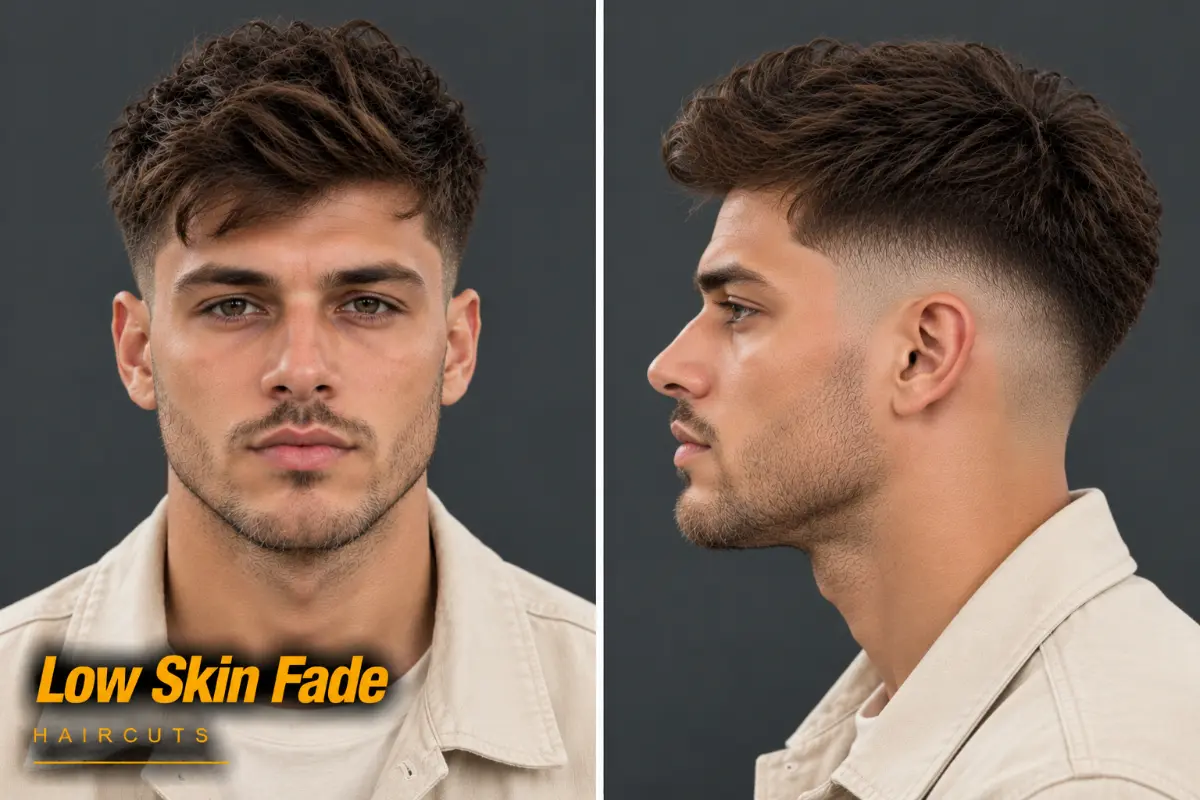
Bare skin sits just above the ear and blends up quickly, so the sides stay mostly dark. The softest version here, and the one that survives a dress code. Where the low fade begins on the head is what keeps the contrast this gentle.
Best for: Every face shape. First-time skin fades.
Tell your barber: “Low skin fade. Bare at the bottom, blend through a #0.5 and #1, up to a #3 by the parietal ridge.”
Product: Matte clay, pea-sized, on dry hair.
Maintenance: Every 10 to 14 days.
2. Mid Skin Fade
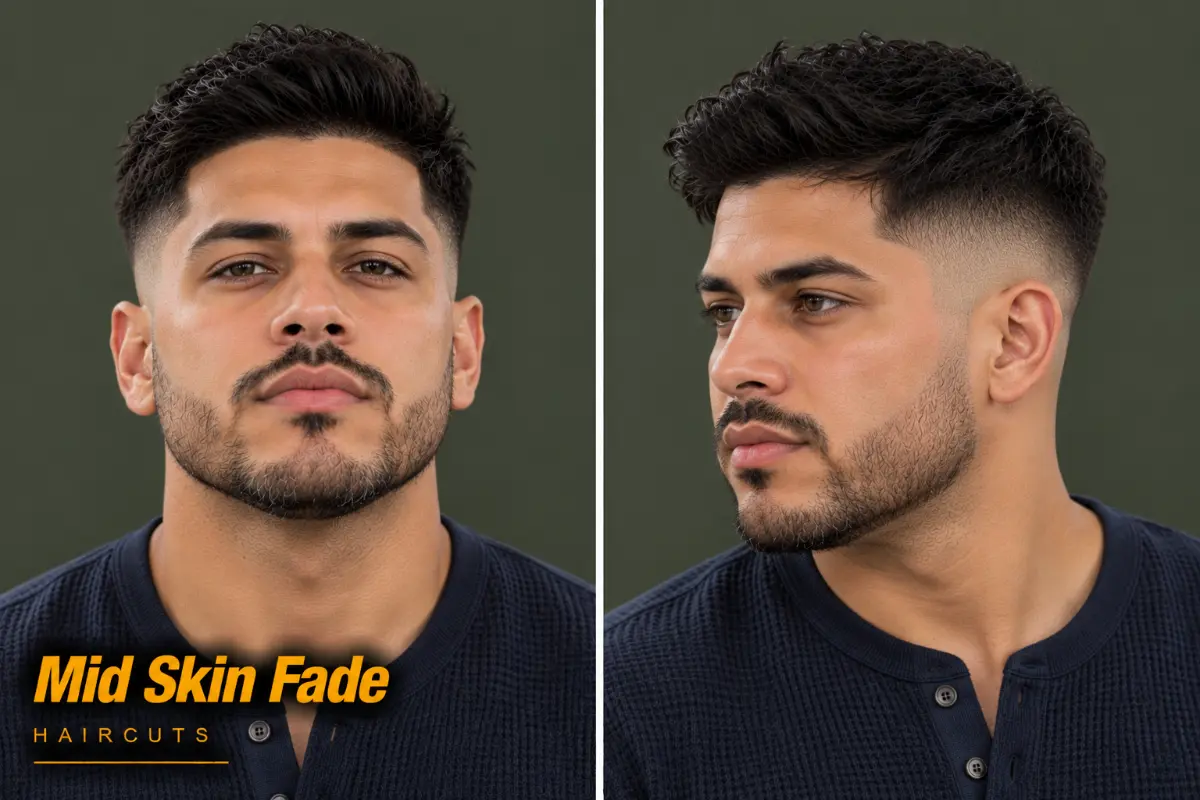
The blend starts at temple level, which takes width out at the widest point of the head. The most balanced of the three heights and the one most barbers default to when you do not specify. A mid fade sits higher than most men picture, so check the placement first.
Best for: Round and square faces. Medium to thick hair.
Tell your barber: “Mid skin fade starting at my temple. Bare to a #0.5, blended to a #3 on top of the ridge.”
Product: Texture powder at the roots, then clay.
Maintenance: Every 10 days.
3. High Skin Fade
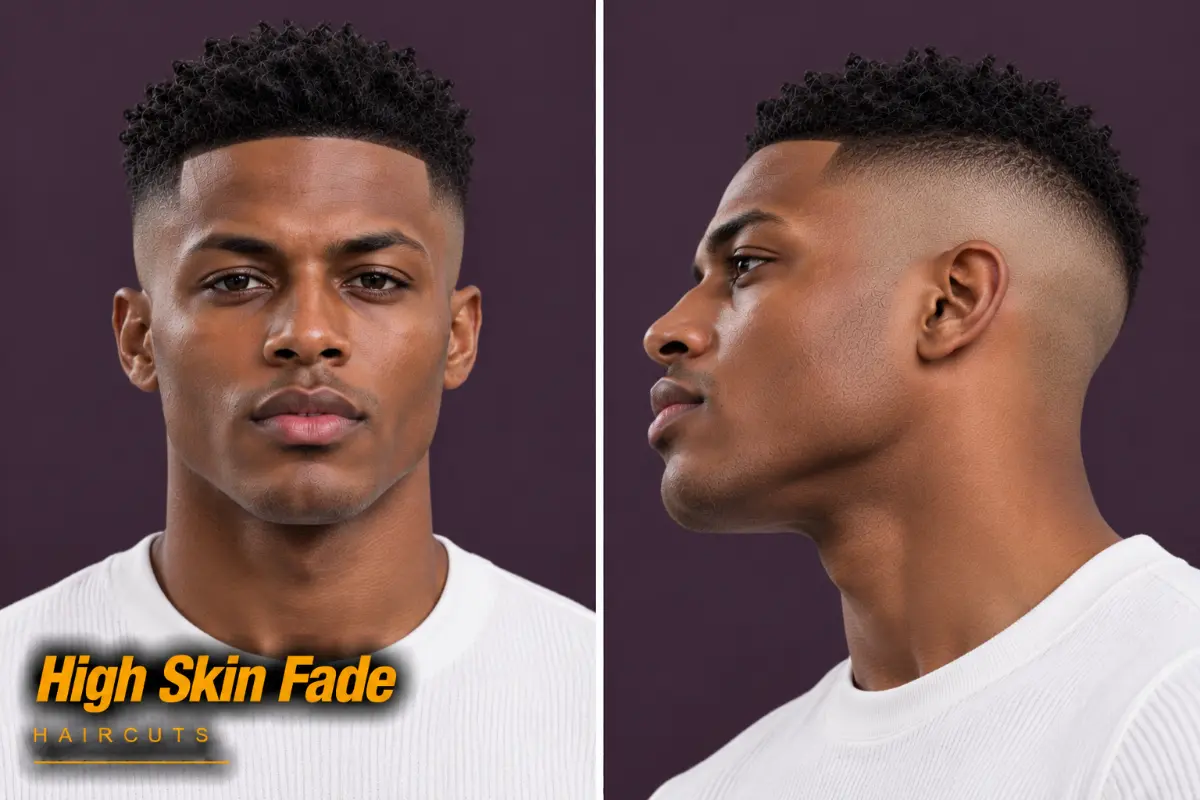
Bare skin carries almost to the parietal ridge, leaving a narrow band of length on top. The strongest contrast in men’s hair and the least forgiving of an uneven head shape. The full range of placements sits in the high fade breakdown.
Best for: Oval and diamond faces. Dense hair, even scalp tone.
Tell your barber: “High skin fade. Take it bare up to just below the ridge, then straight into the top length.”
Product: Firm clay. The top needs to hold its shape on its own.
Maintenance: Every 7 days.
4. Drop Skin Fade
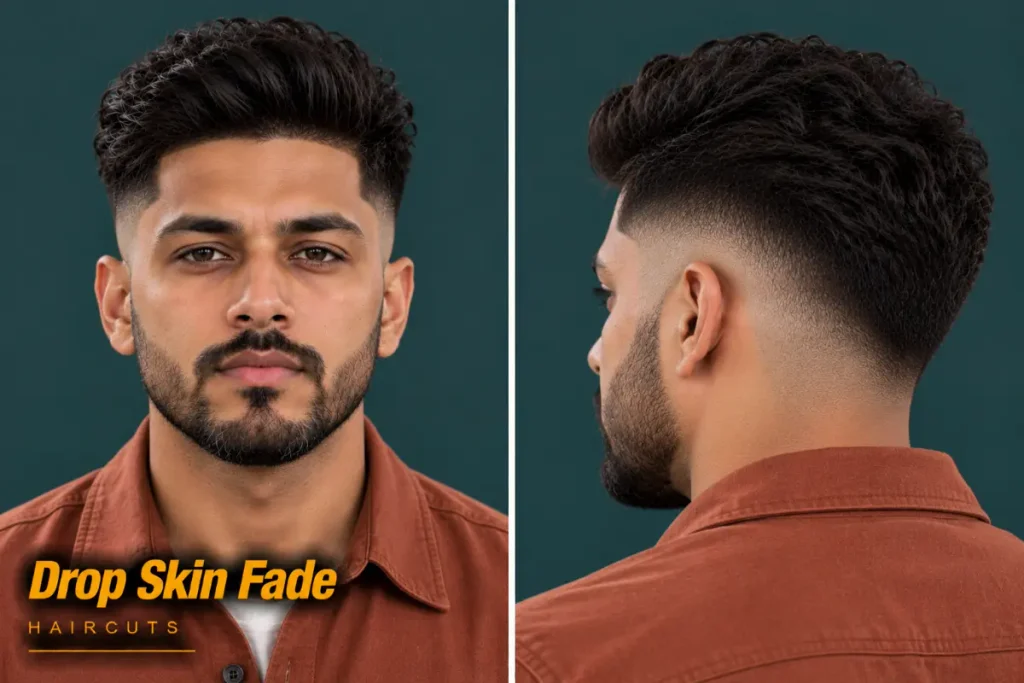
The fade line curves downward behind the ear instead of running level, following the shape of the skull. Softer at the back, so it grows out more gracefully than a straight fade at the same height.
Best for: Flat-backed heads. Oval and oblong faces.
Tell your barber: “Drop skin fade. Keep it low at the front and let the line curve down behind my ear.”
Product: Light paste.
Maintenance: Every 12 to 14 days.
5. Burst Skin Fade
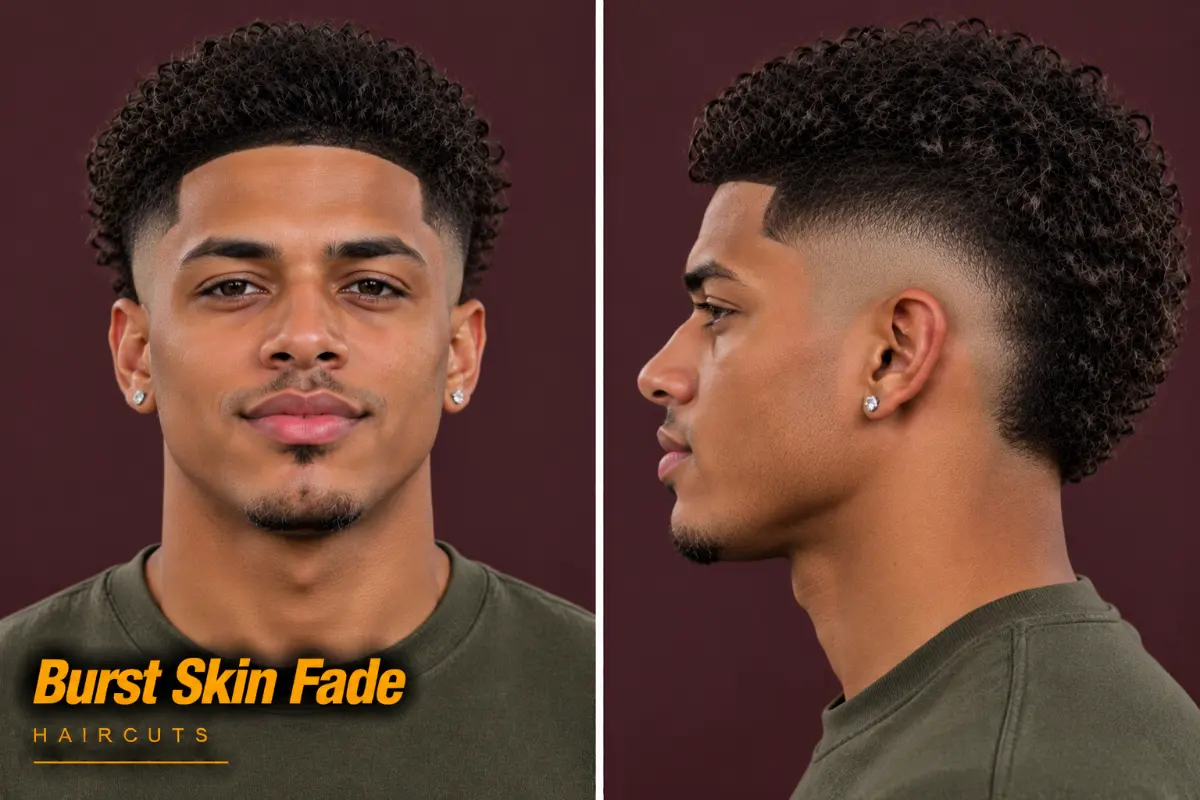
The fade arcs around the ear in a semicircle and leaves the back length untouched, so the shape connects through the middle rather than all the way round. How far that arc travels is what separates one burst fade from another.
Best for: Oval and diamond faces. Curly and wavy hair.
Tell your barber: “Burst skin fade around the ears only. Bare at the centre of the arc, leave the back long.”
Product: Texture paste through the top and back.
Maintenance: Every 10 days.
6. Skin Fade Buzz Cut
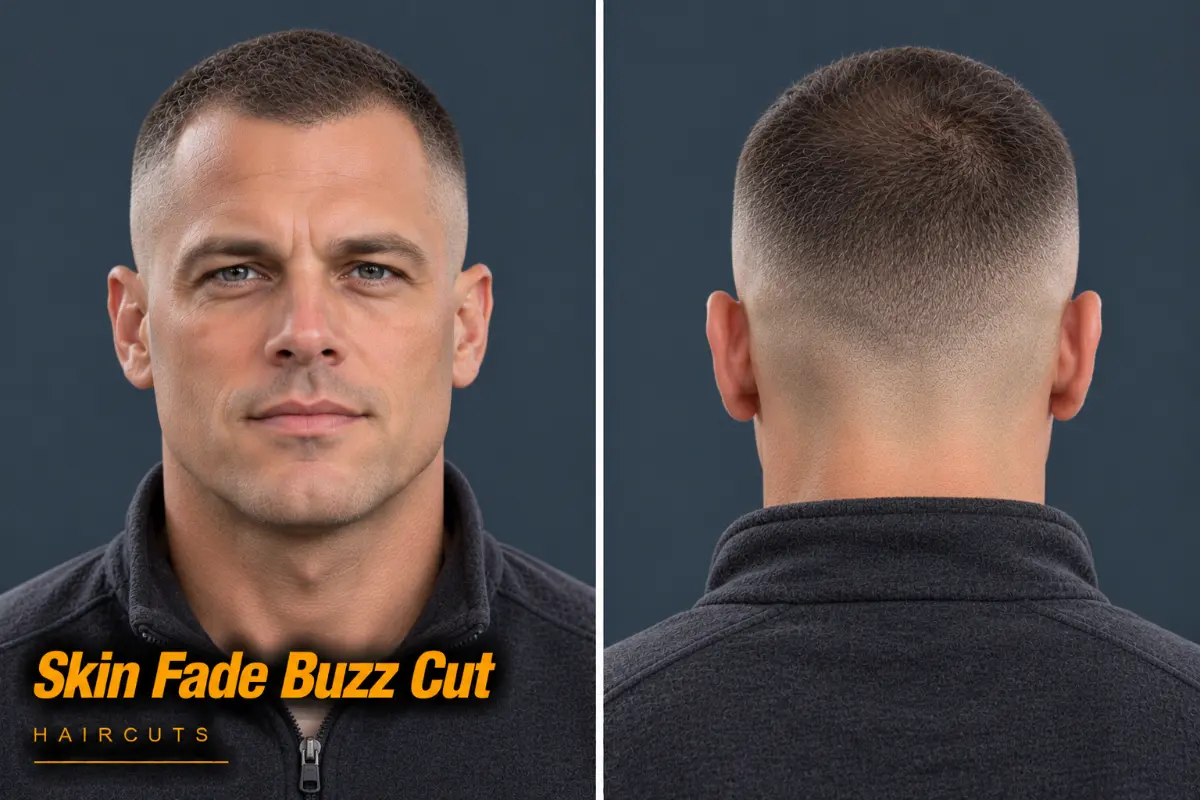
A #1 or #2 across the whole top with a skin fade underneath. Almost no styling, no product, and five minutes of upkeep a week. The fade is what stops it looking like a home clipper job, and a short top like this holds up better on receding hair than anything with length, a point the other shapes in haircuts for balding men also turn on.
Best for: Strong head shape. Thinning or receding hair.
Tell your barber: “#1 all over the top, skin fade on the sides from bare up to meet it.”
Product: None. Scalp moisturiser instead.
Maintenance: Every 7 to 10 days.
7. Crew Cut with Skin Fade
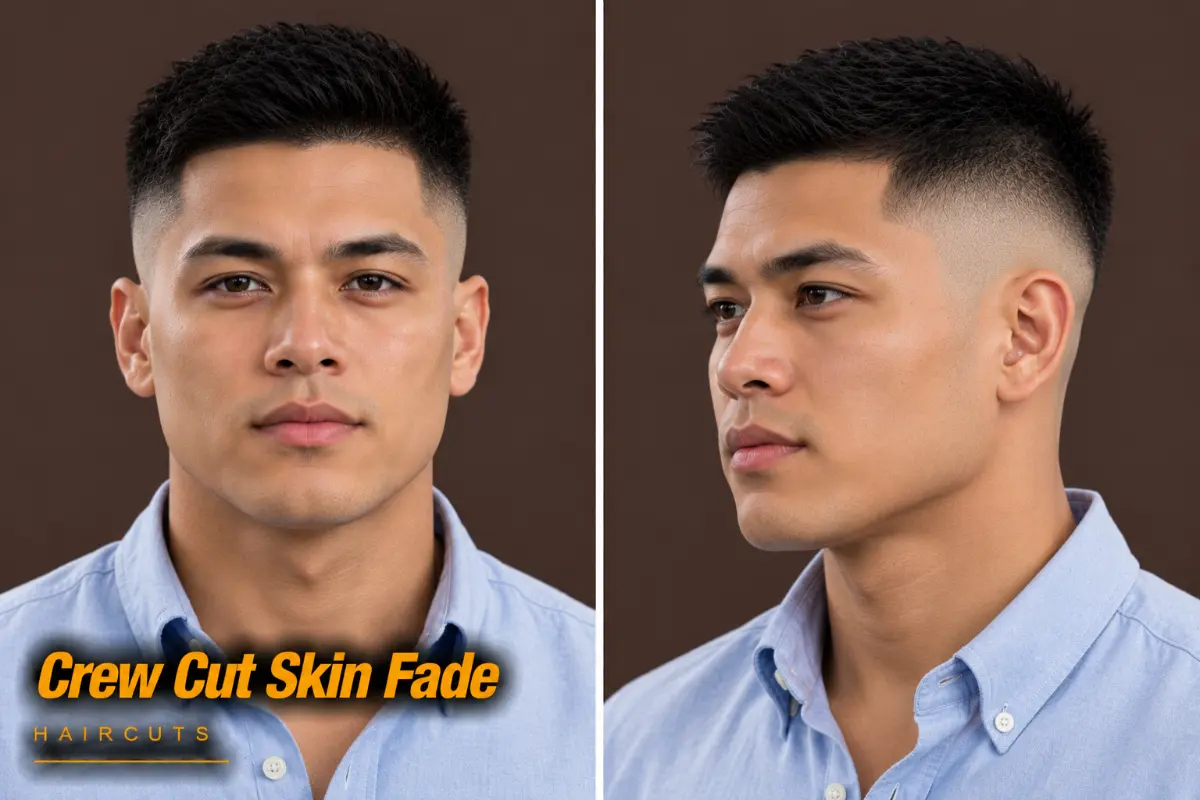
Short on top but graduated, longer at the front than the crown, so there is a little shape to style forward. The step up from a buzz cut without committing to daily styling.
Best for: Square and oval faces. Straight to wavy hair.
Tell your barber: “Crew cut on top, longer at the front. Skin fade on the sides, bare to a #2.”
Product: A small amount of matte paste, pushed forward.
Maintenance: Every 10 days.
8. High and Tight Skin Fade
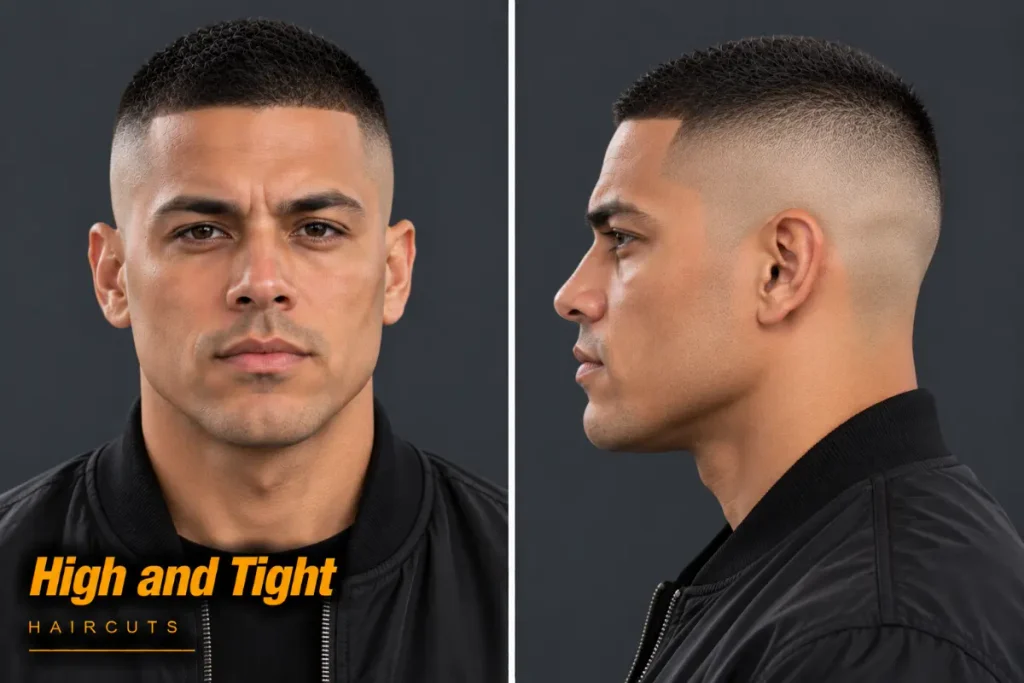
Military-derived, with the top cut very short and the sides taken to skin high on the head. Sharper and more severe than a crew cut. The civilian variations sit in the high and tight guide.
Best for: Oval faces, strong jaw. Dense straight hair.
Tell your barber: “High and tight. #1 on top, skin fade high on the sides with a hard edge where they meet.”
Product: None needed.
Maintenance: Every 7 days.
9. Textured Crop with Skin Fade
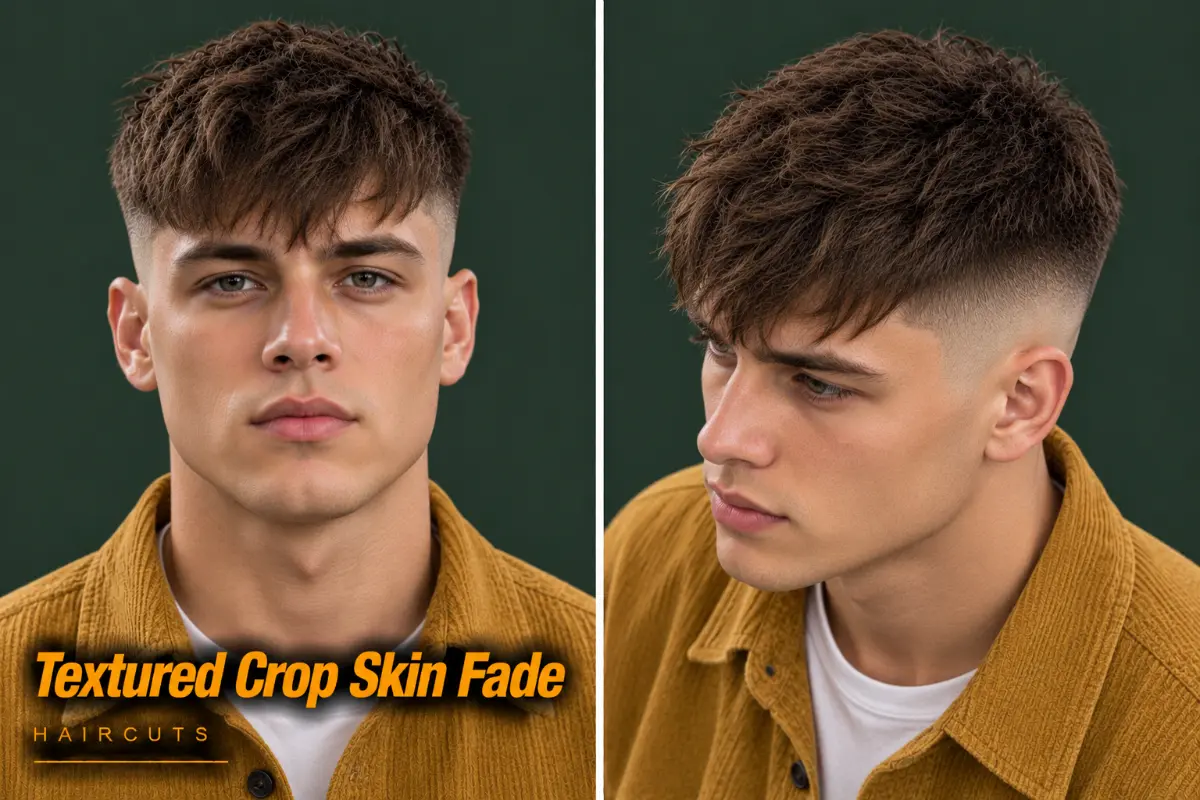
A short forward-falling top with the weight cut out of it, over a skin fade. The contrast between the broken texture above and the bare skin below is the whole point of the cut.
Best for: Square and oval faces. Thick straight hair.
Tell your barber: “Textured crop, point-cut, falling forward. Skin fade underneath from bare to a #2.”
Product: Matte clay worked back to front.
Maintenance: Every 10 days.
10. Skin Fade with Line-Up
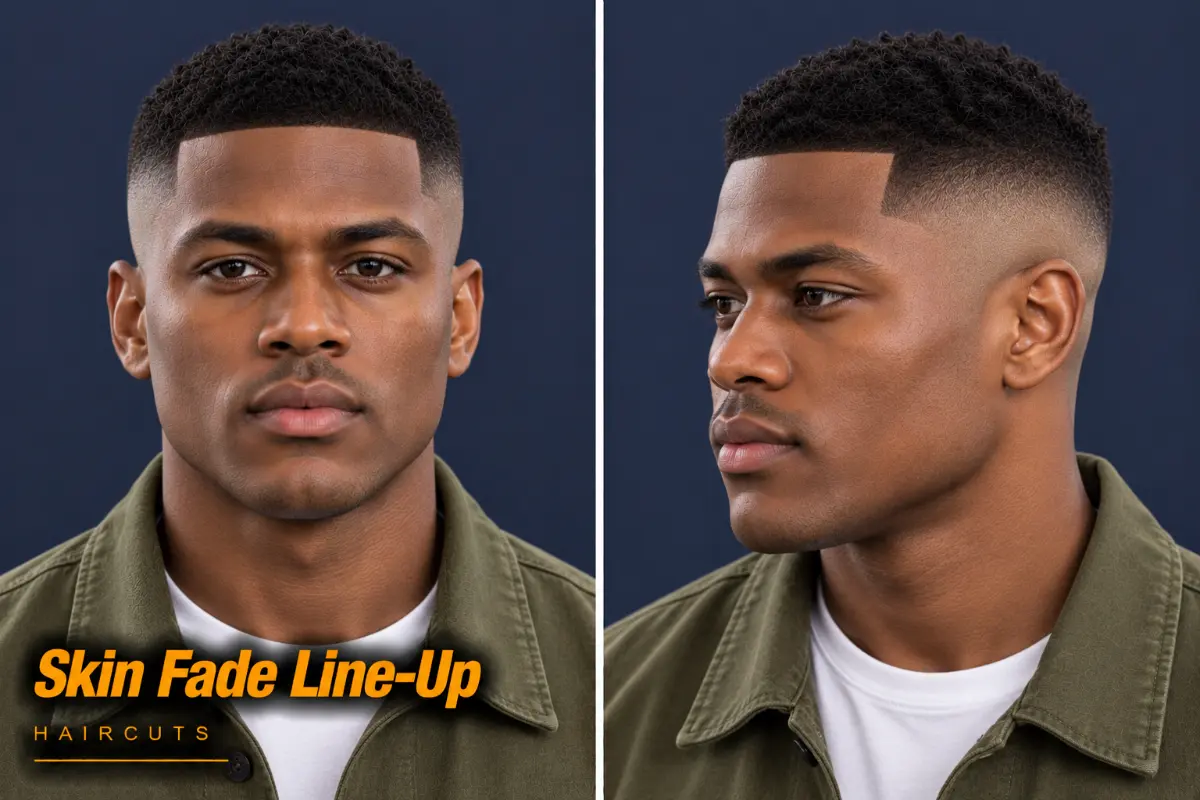
The hairline at the forehead and temples is squared off with a trimmer, giving a hard edge where hair meets skin. Pairs with any fade height and transforms how sharp the whole cut looks.
Best for: Strong, even hairlines. All face shapes.
Tell your barber: “Skin fade with a line-up. Square the front hairline and the temples, but stay off my natural line.”
Product: Whatever the top needs.
Maintenance: Every 7 to 10 days.
11. Quiff with Skin Fade
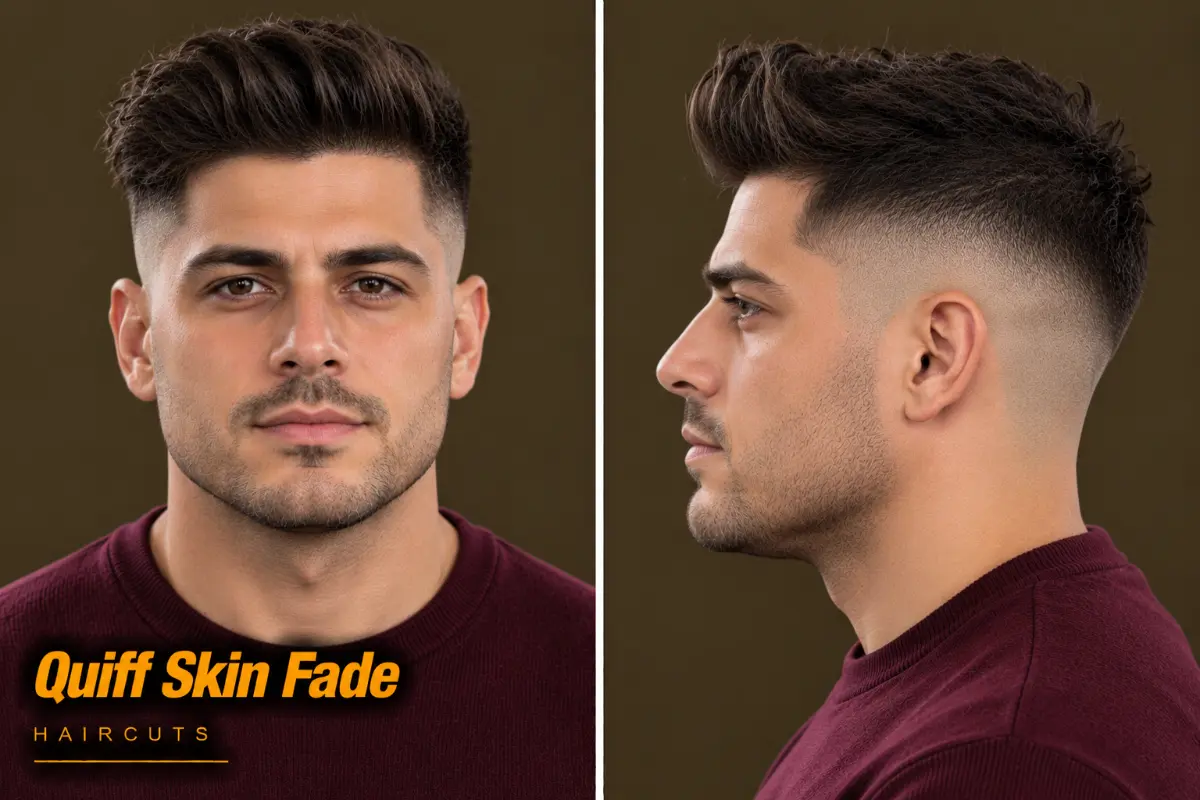
Three to four inches at the front swept up and back, with bare skin at the sides removing all the bulk. The height on top is what keeps a high fade from narrowing the head.
Best for: Round and square faces. Thick hair with body.
Tell your barber: “Keep four inches at the front for a quiff. Mid skin fade on the sides, bare to a #2.”
Product: Sea salt spray, blow-dry back, then clay.
Maintenance: Every 10 to 14 days.
12. Pompadour with Skin Fade
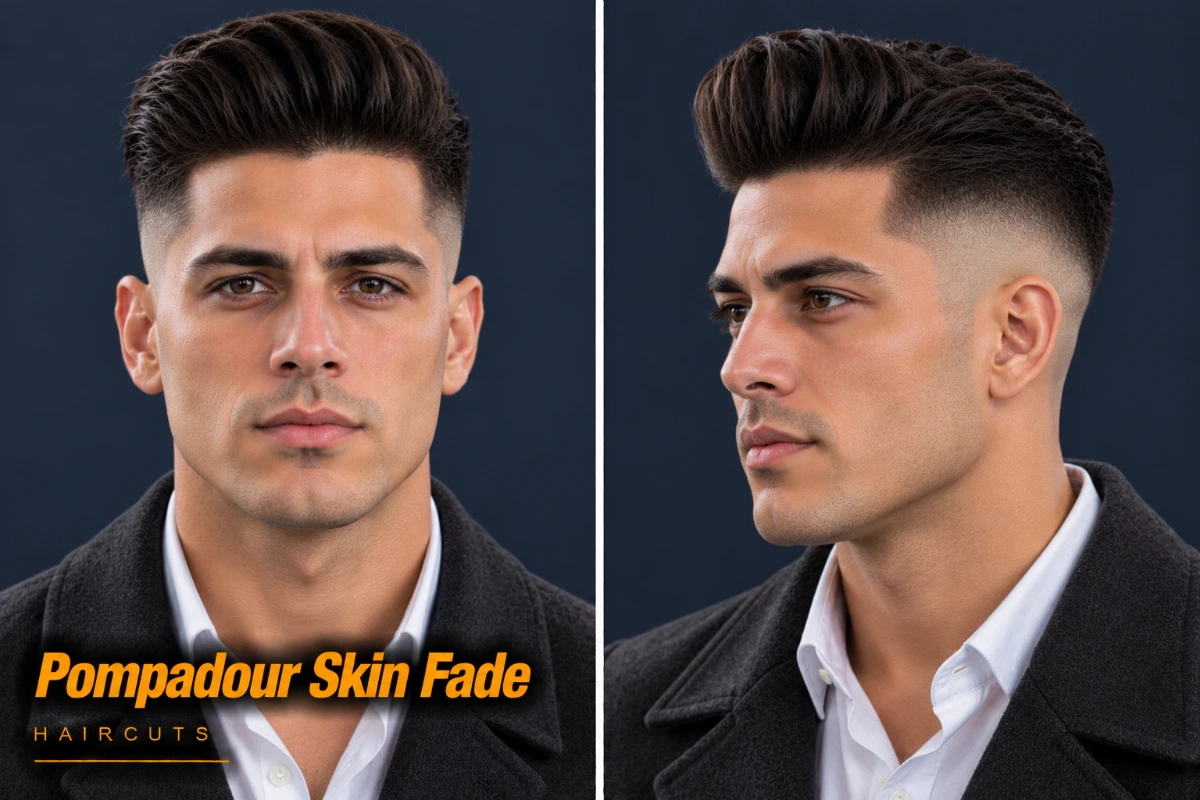
Longer and more structured than a quiff, with the volume set further back and combed rather than finger-styled. A formal shape sitting over the sharpest possible sides.
Best for: Oval and oblong faces. Thick straight hair.
Tell your barber: “Pompadour length on top, five inches at the front. Mid skin fade, bare to a #2.”
Product: Pre-styler, blow-dry, then a shine pomade.
Maintenance: Every 12 days.
13. Slick Back with Skin Fade
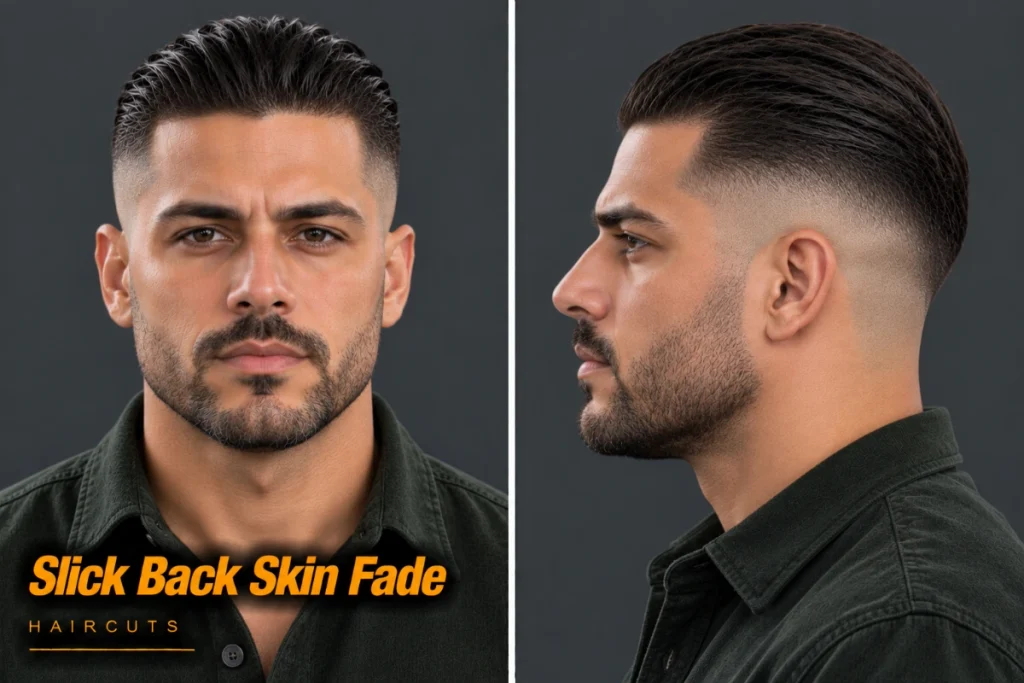
Everything on top combed straight back, no parting, with the sides taken to skin so nothing breaks the line. The range of lengths that work sits in the slick back guide.
Best for: Oval and square faces. Straight hair with weight.
Tell your barber: “Slick back length on top, four inches minimum. Low or mid skin fade, no disconnection.”
Product: Strong-hold pomade on damp hair.
Maintenance: Every 12 days.
14. Comb Over with Skin Fade
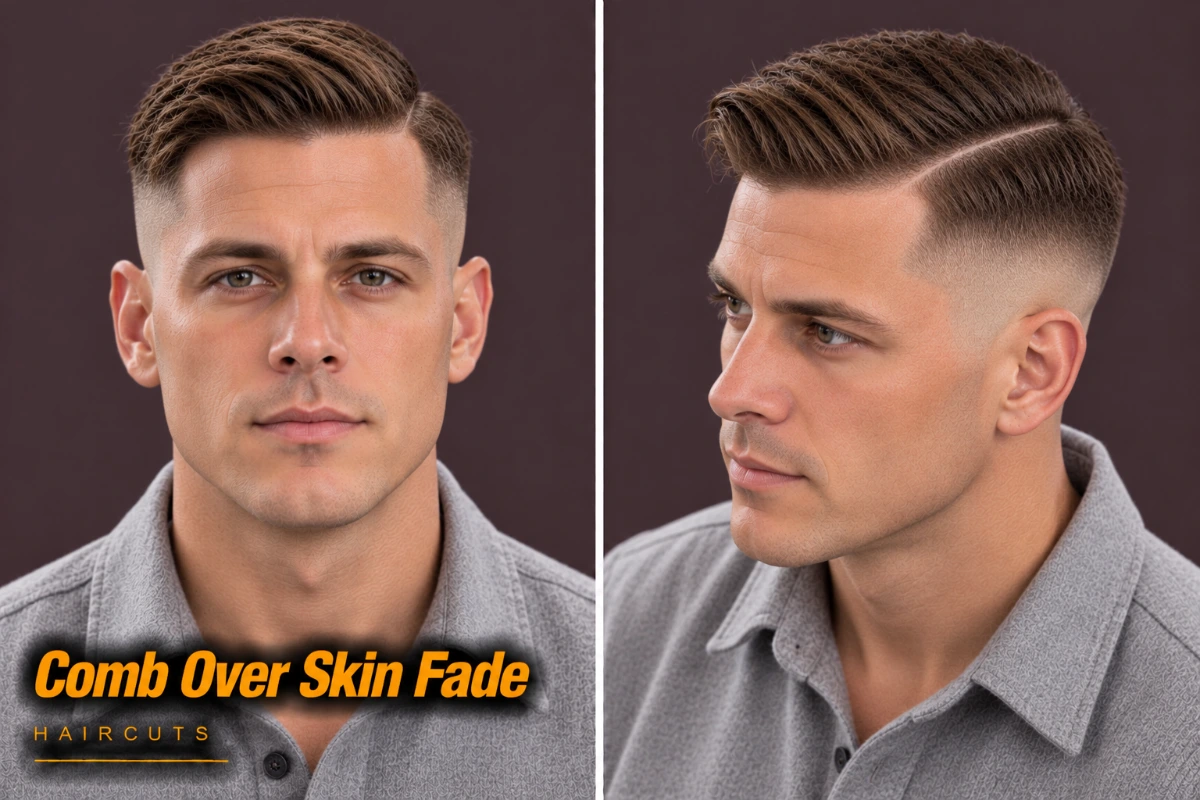
A side parting with the top combed across, over a skin fade. The parting gives a clean line that the fade then echoes. More variations sit in the comb over fade breakdown.
Best for: Oblong and heart faces. Fine to medium hair.
Tell your barber: “Comb over with a side part. Low skin fade on the sides, bare to a #1.”
Product: Light pomade, combed while damp.
Maintenance: Every 12 days.
15. Hard Part with Skin Fade
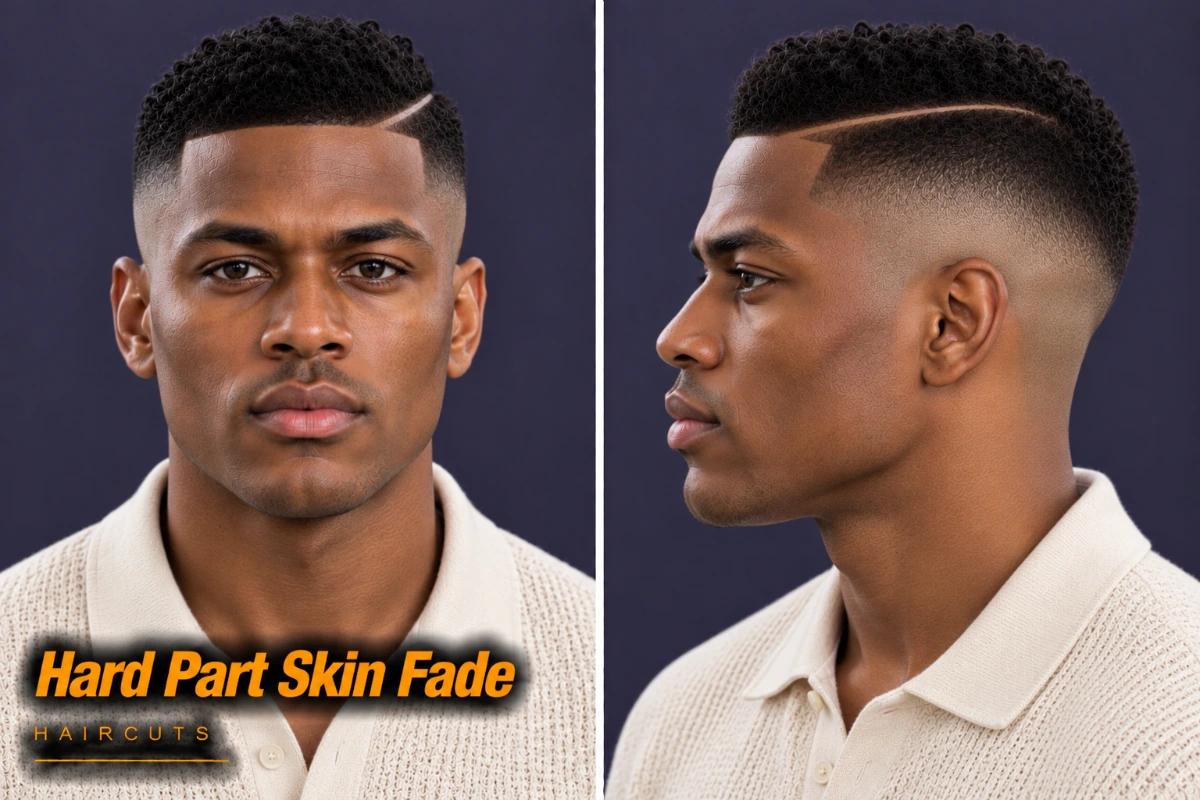
A parting shaved in with the trimmer rather than combed, so it holds all day and through weather. Sits best over a mid or high fade where the line has somewhere to travel.
Best for: Square and oval faces. Dense dark hair.
Tell your barber: “Shave a hard part on my left side, about a quarter inch deep. Mid skin fade underneath.”
Product: Pomade either side of the line.
Maintenance: Every 10 days.
16. Curly Hair with Skin Fade
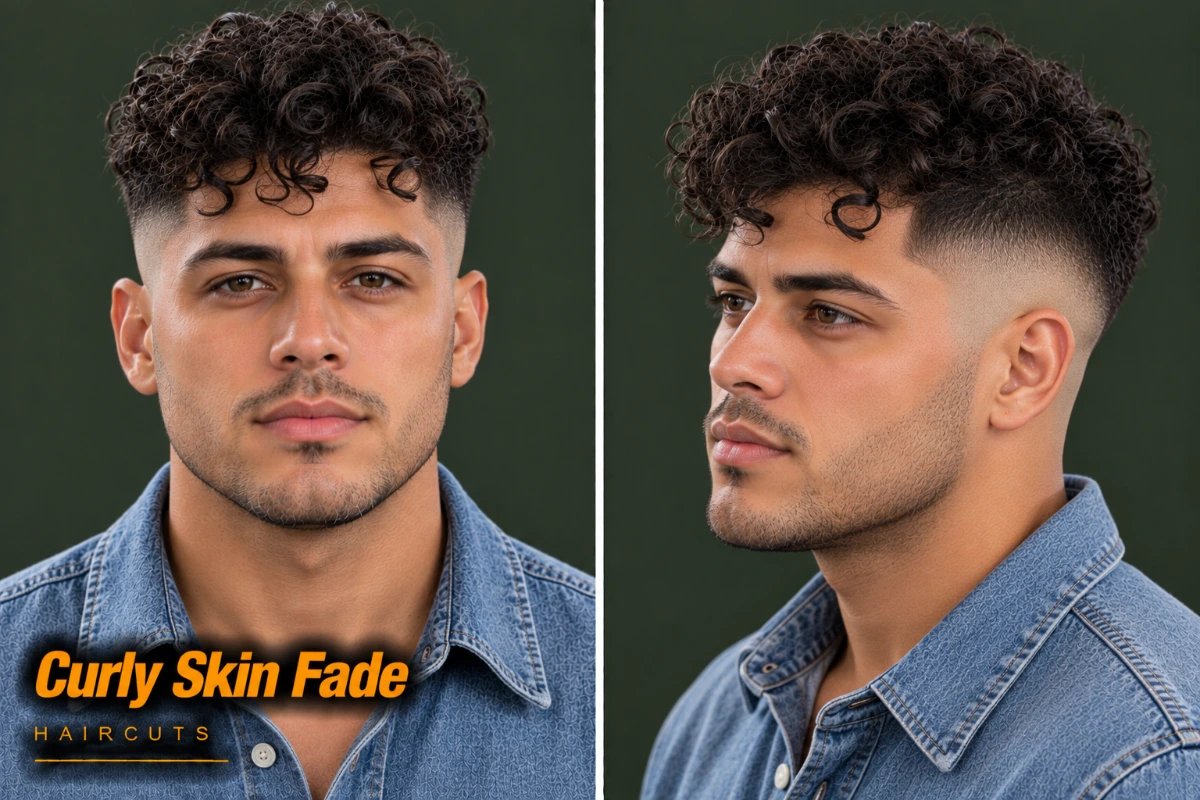
Curls cut dry and shaped with scissors on top, with clipper work only on the sides. The contrast between the bare skin and the curl pattern above is the sharpest in this list. Curl type changes what the top can do, and the range across curly hair is wider than most men expect.
Best for: Square and round faces. Curly and coily hair.
Tell your barber: “Cut the top dry, curl by curl. Mid skin fade on the sides, bare to a #1.”
Product: Curl cream, diffused on low heat.
Maintenance: Every 12 to 14 days.
17. Waves with Skin Fade
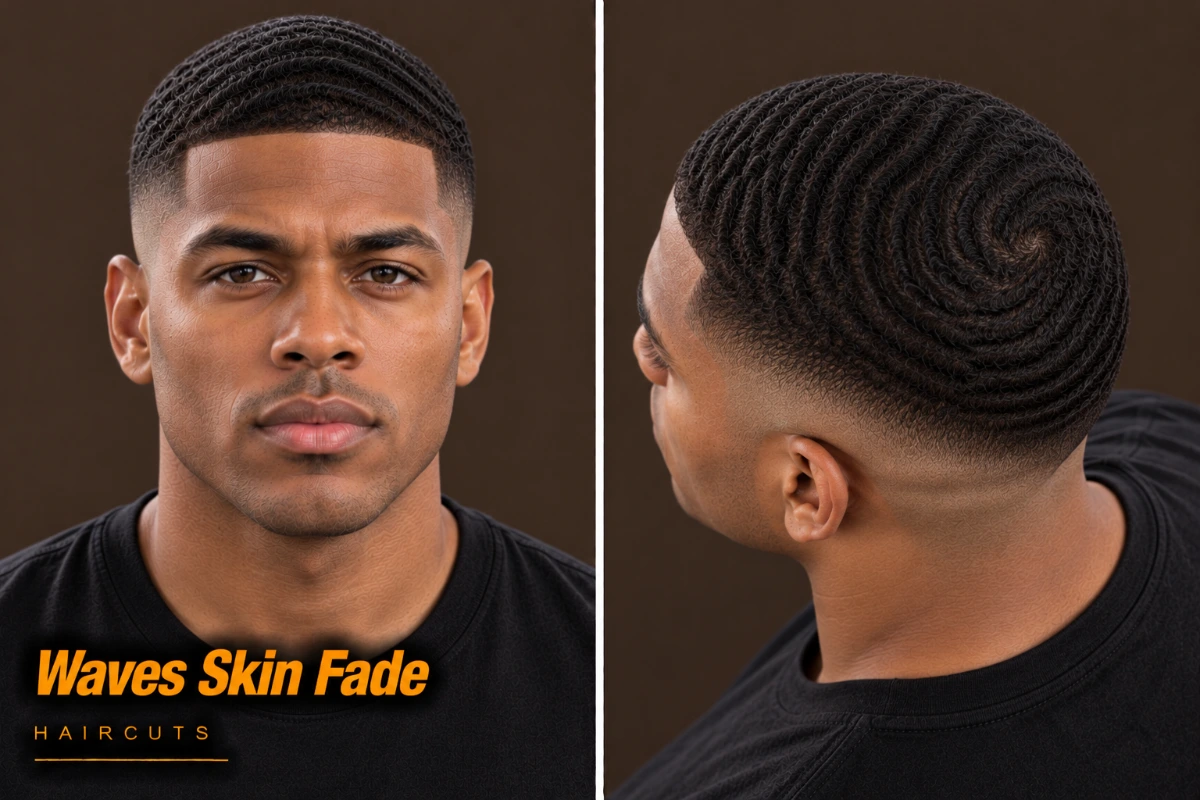
A short brushed wave pattern on top over bare sides. The pattern needs daily brushing and a durag to set, so this is the highest-effort cut here despite looking the simplest.
Best for: Coarse, tightly curled hair. Oval and square faces.
Tell your barber: “Keep the top short enough to brush waves, around a #2. Low skin fade on the sides.”
Product: Wave pomade, brushed in, durag overnight.
Maintenance: Every 10 days.
18. Afro with Skin Fade
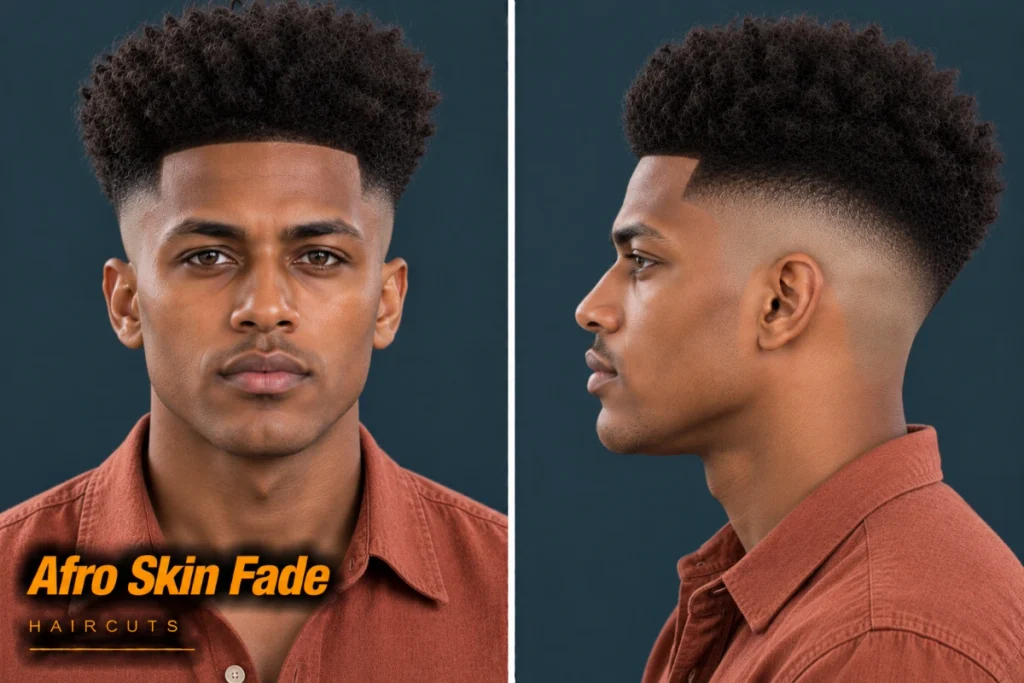
Natural height on top with the sides taken to bare skin, giving a clean vertical line from scalp to crown. Fade placement on textured hair follows its own rules, covered in fade haircuts for Black men.
Best for: Afro-textured hair. Oval and oblong faces.
Tell your barber: “Keep the afro height on top. High skin fade with a sharp line where the two meet.”
Product: Leave-in moisturiser, pick out daily.
Maintenance: Every 14 days.
19. Thick Straight Hair with Skin Fade
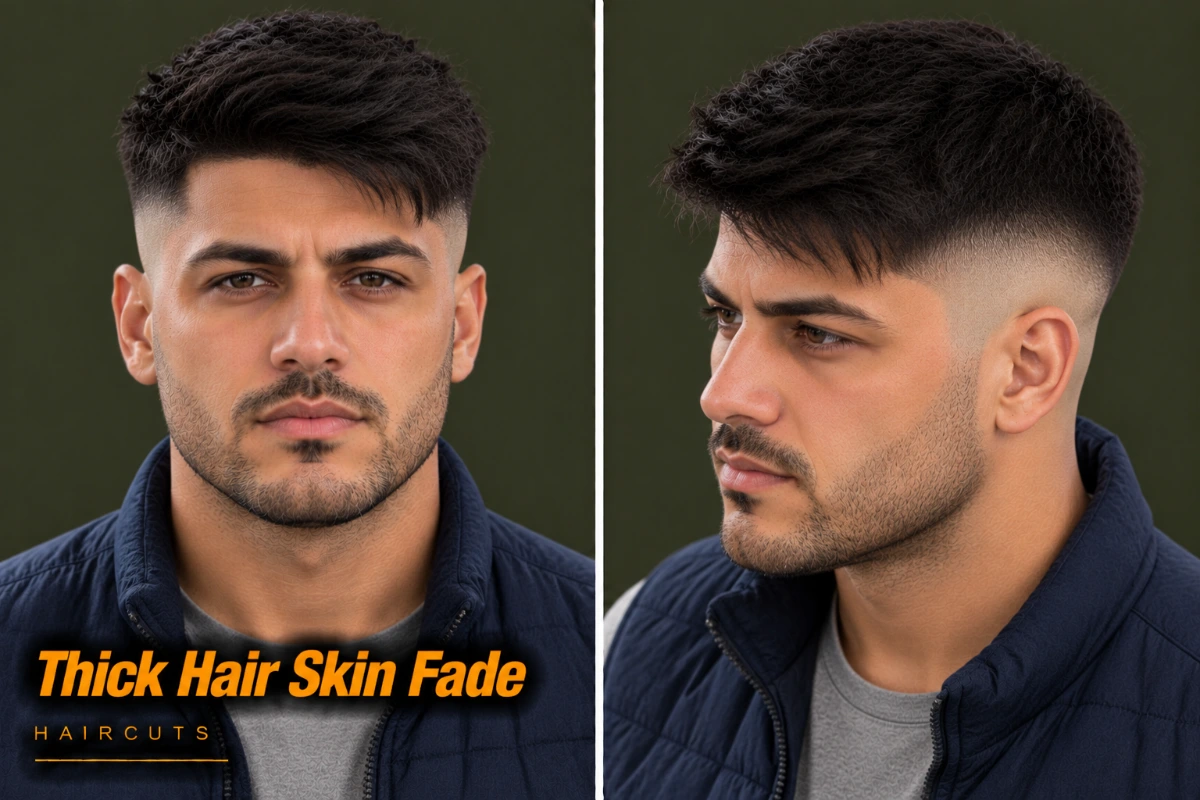
Thick hair needs weight taken from underneath the top section as well as a fade on the sides, or the whole cut sits like a block. The fade alone will not solve density.
Best for: Thick coarse hair. Round and square faces.
Tell your barber: “Thick hair. Take weight out from under the top as well as the skin fade on the sides.”
Product: Matte clay, worked from the roots.
Maintenance: Every 10 days.
20. Wavy Hair with Skin Fade
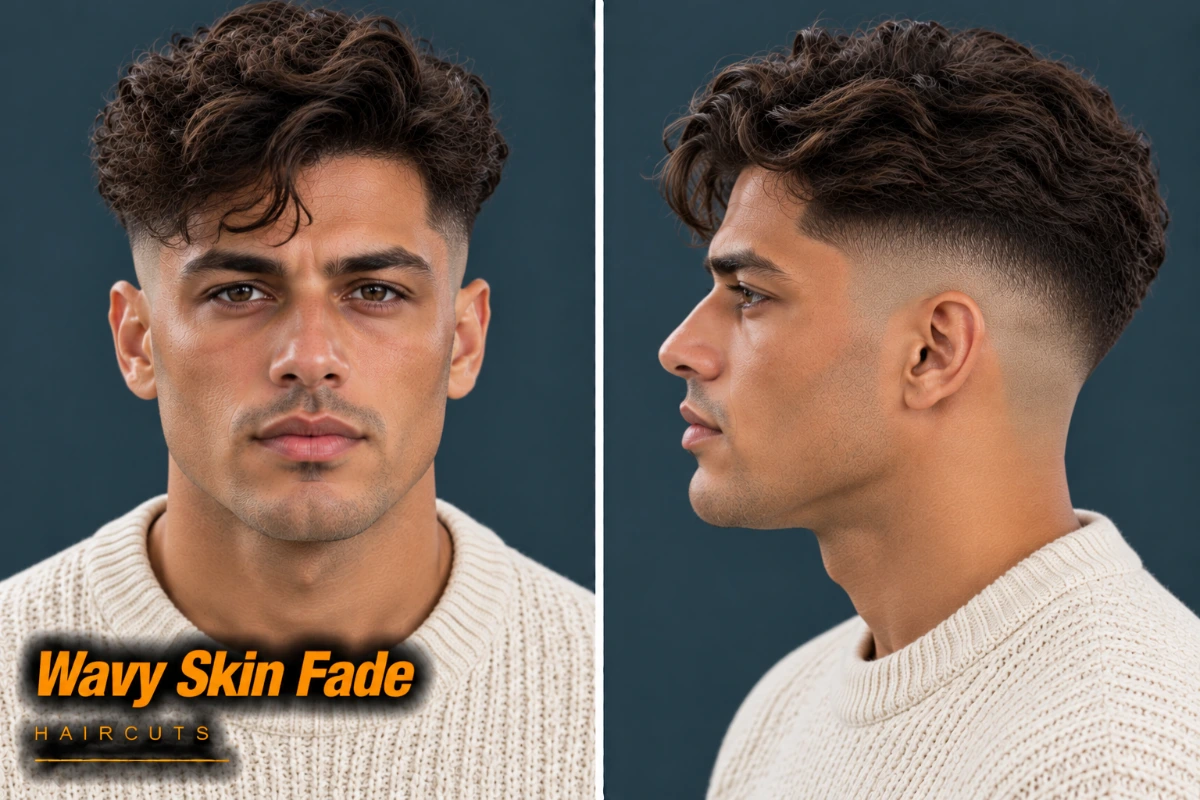
Natural wave left on top, bare sides underneath. The wave handles the texture so the top needs no cutting in, only length control to stop it expanding sideways.
Best for: Oval and oblong faces. Natural wave.
Tell your barber: “Keep the wave on top, around three inches. Low skin fade on the sides.”
Product: Sea salt spray, scrunched while damp.
Maintenance: Every 12 days.
21. Faux Hawk with Skin Fade
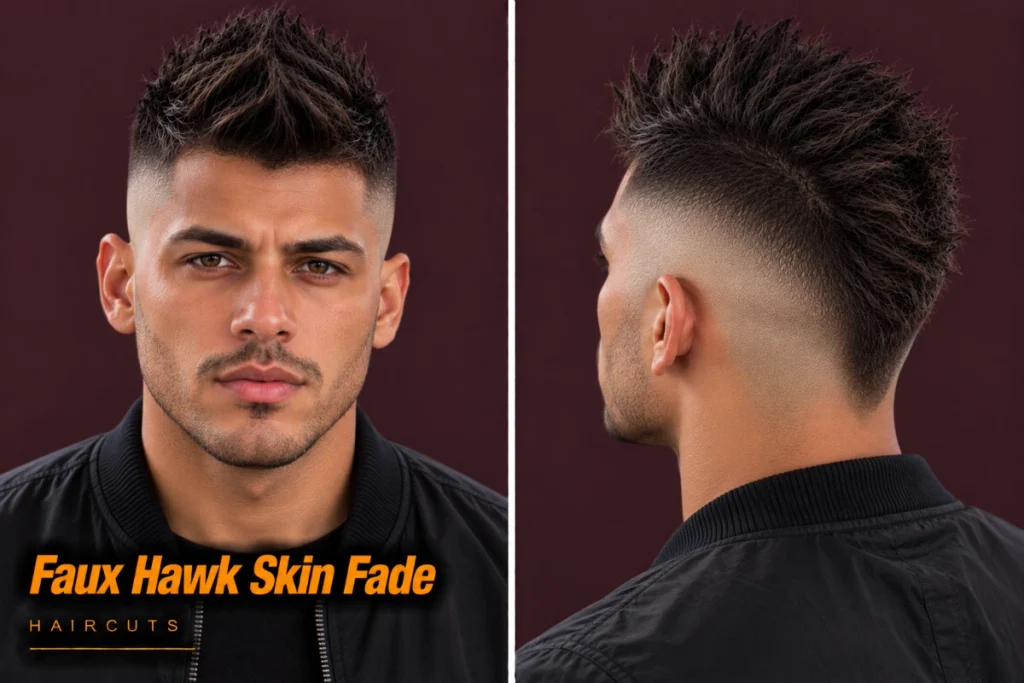
Length concentrated in a central strip and pushed up, with bare skin either side. Looks bolder than a quiff because the shape is narrow rather than full.
Best for: Oval and diamond faces. Medium to thick hair.
Tell your barber: “Faux hawk. Leave a strip of length down the centre, high skin fade either side.”
Product: Firm clay, pinched upward.
Maintenance: Every 7 to 10 days.
22. Mullet with Skin Fade
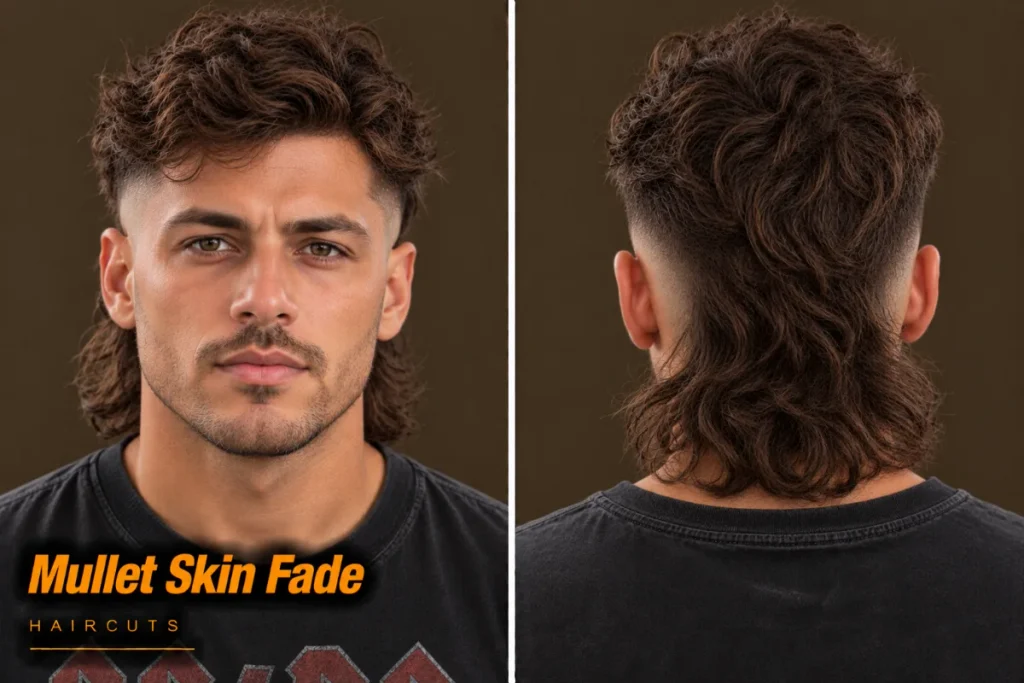
Short and faded at the sides with the length kept at the back past the collar. The skin fade is what stops the shape looking dated.
Best for: Oval faces. Wavy and curly hair.
Tell your barber: “Skin fade on the sides, leave the back long past my collar. Blend the two at the corner.”
Product: Sea salt spray through the back.
Maintenance: Every 14 days.
23. Skin Fade with Hair Design
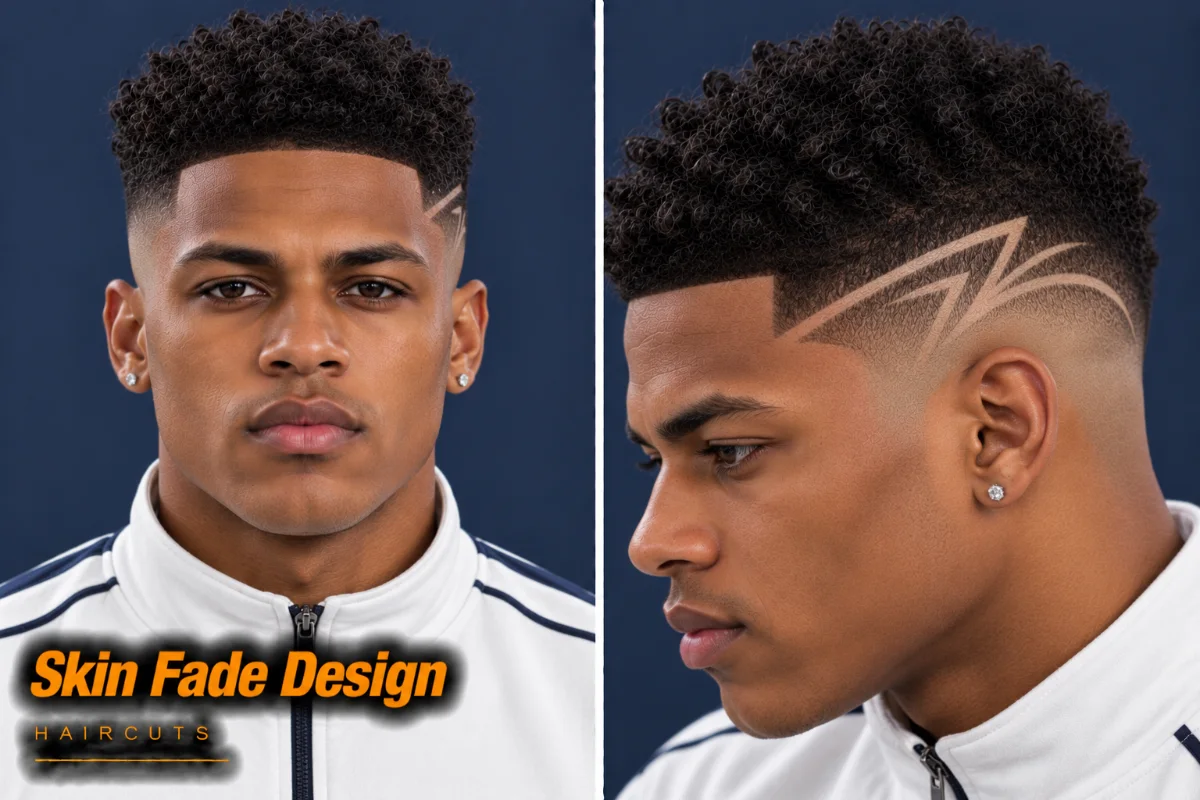
A pattern cut into the faded area with a trimmer, from a single line to a full geometric panel. The bare skin is the canvas, so designs only work on a skin fade and not a taper.
Best for: Even scalp tone, no scarring. All face shapes.
Tell your barber: “Skin fade, then a design on my left side. Keep it simple enough to redraw next visit.”
Product: Whatever the top needs.
Maintenance: Every 7 days. The design blurs first.
24. Skin Fade with Beard
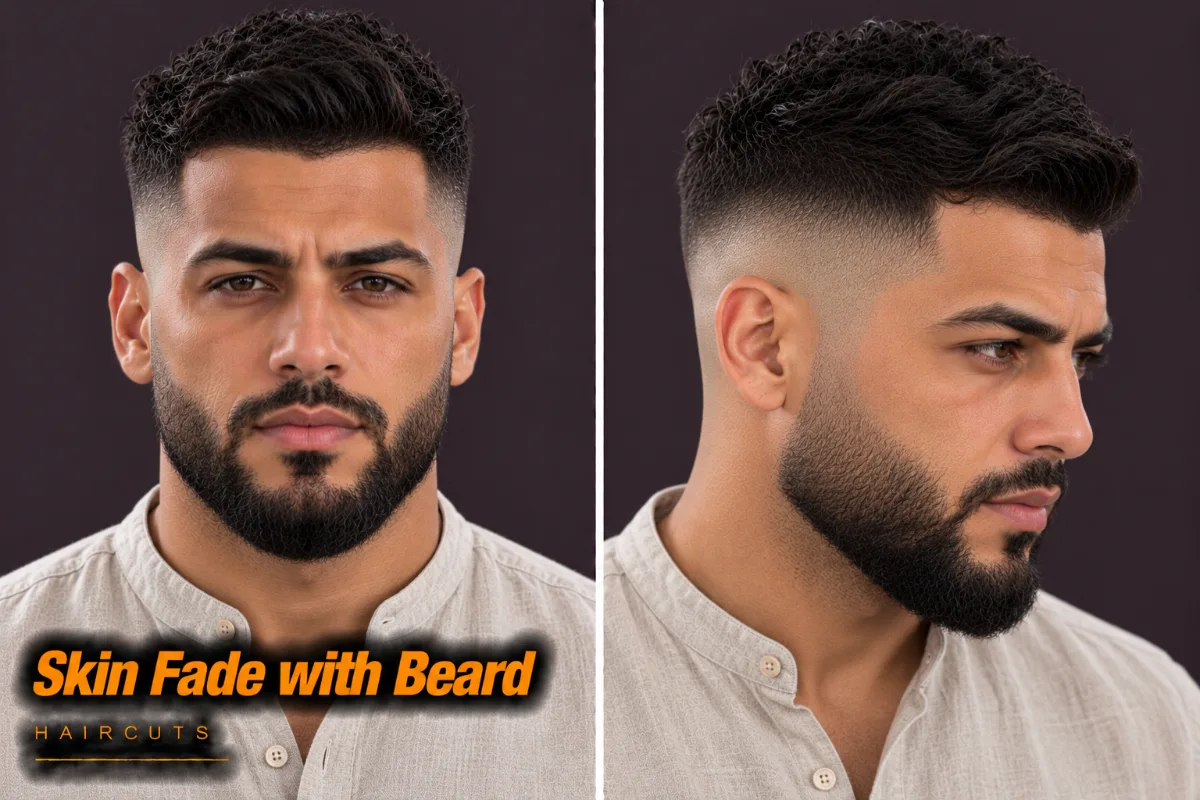
The fade runs down and merges into the beard line rather than stopping at the jaw, so hair and beard become one gradient. The hardest blend in barbering to get right.
Best for: Square and oblong faces. Full even beard growth.
Tell your barber: “Connect the skin fade into my beard. No hard line at the jaw, blend it through.”
Product: Clay on top, beard oil below.
Maintenance: Every 10 days, beard trimmed the same visit.
25. Long Top with Skin Fade
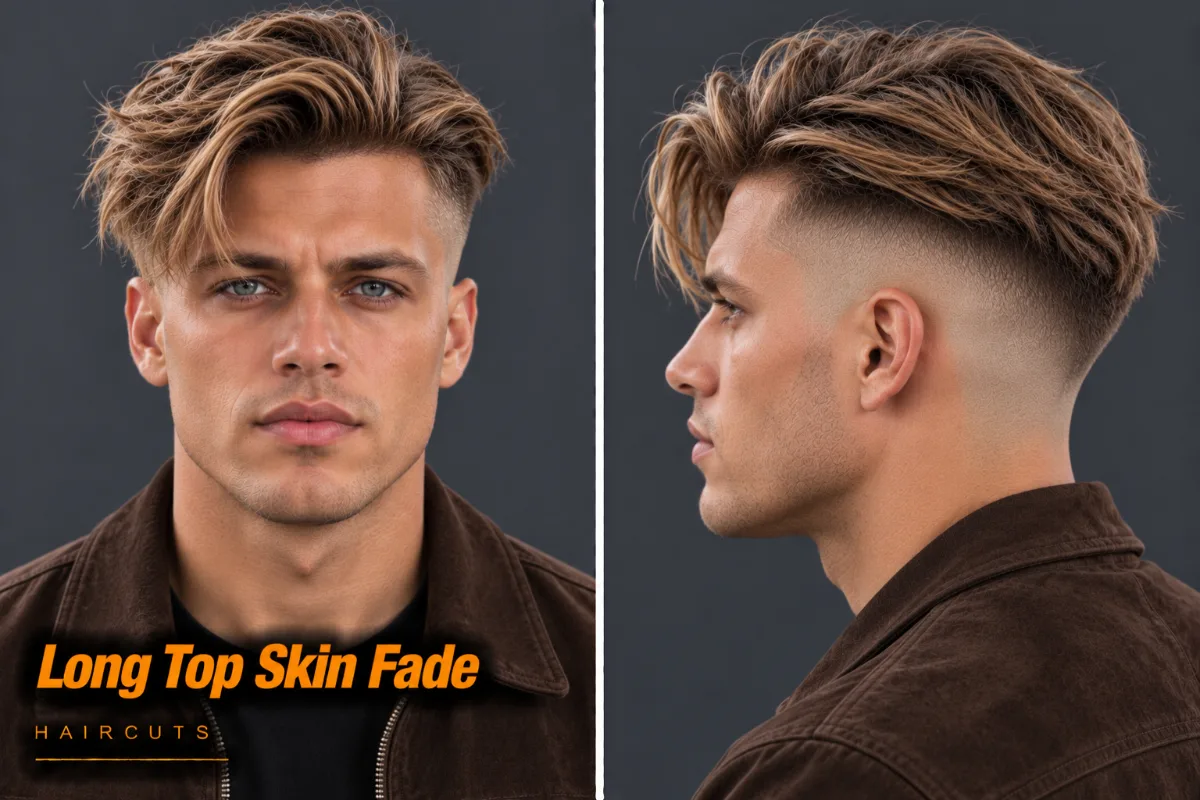
Five inches or more left on top over bare sides, often worn loose or tied. The widest contrast available, and the version that needs the most commitment to styling.
Best for: Oval faces. Straight to wavy hair with weight. Tell your barber: “Keep all the length on top, five inches plus. Mid skin fade on the sides, no disconnection.” Product: Light cream, air-dried. Maintenance: Every 12 to 14 days.
How Do You Ask Your Barber for a Skin Fade?
Saying “skin fade” tells your barber one thing: that the bottom goes to bare skin. Everything else is still open. Three details close it.
Where the bare skin stops. Name a landmark on your own head, not an adjective. “Just above my ear.” “Temple level.” “Just below the ridge.” Low, mid and high mean different heights to different barbers.
The guard sequence. A skin fade is not one length, it is a ladder. Bare at the bottom, then #0.5, #1, #2, #3 as it climbs. Saying the ladder out loud stops a barber guessing where to end it.
| Guard | Length | Where it sits in a skin fade |
|---|---|---|
| No guard | Bare | The lowest band, at the neckline and above the ear |
| #0.5 | 1.5 mm | First step up from skin |
| #1 | 3 mm | The main blending band |
| #2 | 6 mm | Upper blend, just under the ridge |
| #3 | 10 mm | Where the fade meets the top |
| #4 | 13 mm | Only on a low fade with length left on the sides |
Where the fade meets the top. Either blended into the top length or disconnected with a visible step. These look nothing alike and the word “skin fade” covers both.
Phrases that work:
“Low skin fade. Bare at the bottom, blend through a #0.5 and #1, up to a #3.” Use for: A first skin fade, or a workplace with a dress code.
“Take it bare to temple level, then blend straight into the top.” Use for: A mid fade with no disconnection.
“Keep the fade low at the front and let the line drop behind my ear.” Use for: A drop fade on a flat-backed head.
“Blend it, do not disconnect it.” Use for: Any time you want a gradient rather than a step.
What not to say: “Just skin fade it.” That leaves height, guard sequence and the top join all to the barber, and you will get their default rather than yours.
Fade height changes the finished cut more than the top does, so it is worth taking a minute to see all fade types before you decide.
What a Skin Fade Reveals About Your Scalp
This decides whether a skin fade suits you more than face shape does, and most men only find out once they are in the chair.
A taper leaves a short layer of hair over the skin. A skin fade does not. Taking the sides to bare means everything on the scalp becomes visible, and most men have not seen their own scalp since childhood.
What shows up:
Scars. Childhood stitches, old sports injuries, surgical lines. Hair hides them; bare skin does not. A scar running through the faded area will show as a pale line with no stubble in it.
Moles and skin tags. A clipper over bare skin catches anything raised, which is both a nicking risk and a visible feature once the hair is gone.
Uneven pigmentation. Patches of lighter or darker skin that were never visible under hair. Common and harmless, but a high fade puts them on display.
Dents and ridges. Every skull has them. A bare fade follows the bone precisely, so a flat spot at the back or a ridge above the ear becomes part of the haircut’s silhouette.
Ingrown hairs and bumps. Clippers taken to skin cut the hair below the surface, and on tightly curled hair those shafts can curve back into the skin. The American Academy of Dermatology notes that razor bumps develop when the razor cuts hairs short, which is the same mechanism at work here.
What to do about it. None of this rules out a skin fade. It changes which one.
A low skin fade exposes a narrow band above the ear only. A high fade exposes most of the side of the head. If you have scarring, uneven tone or a pronounced dent, keep the fade low and the exposure small. If the issue sits specifically where a design would go, skip the design rather than the fade.
Ask your barber to look before the first cut rather than discovering it halfway through. They see scalps all day and will tell you in ten seconds.
How Fast Does a Skin Fade Grow Out?
Faster than any other men’s cut, because it starts at zero.
Days 1 to 3. Sharp. The bare section still looks like bare skin.
Days 4 to 7. Shadow appears. The bare area turns grey or blue depending on hair colour. Most men still consider the cut fresh.
Days 8 to 14. The gradient closes. The difference between the bare section and the guard above it narrows, and the fade stops looking like a fade. This is the point most skin fades need rebooking.
Weeks 3 to 4. The shape is gone. What remains is short sides with no gradient, which is a different haircut and not a flattering one.
Compare that with a taper fade, which holds its shape for three to four weeks because it never went to skin in the first place.
Two things speed it up: coarse hair, and a high fade. Coarse hair casts a shadow sooner, and a high fade has more area to lose definition across. Fine hair on a low fade is the slowest combination here, and still rarely lasts past two weeks.
Looking After the Shaved Skin
Bare scalp is skin that has never been exposed, and it behaves like it.
Sunburn is the immediate risk. The faded area has no hair protecting it and no tan built up. The Skin Cancer Foundation makes the point that hats are often the best way to protect against sun damage on the scalp, and that applies most in the first week after a fade when the skin is barest.
Moisturise the faded area. A light unscented moisturiser, once a day. Skip anything with alcohol, which stings freshly clippered skin and dries it out further.
Do not pick at bumps. Small raised spots in the day or two after a fade are usually irritated follicles and settle on their own. Picking turns them into something that scars.
If bumps keep coming back, the fade is cutting below the skin surface on hair that curls. Ask your barber to leave a #0.5 rather than going fully bare, which keeps the shape and stops the shaft retracting under the skin.
Wash the scalp, not just the hair. Product applied to the top runs down onto the faded area through the day and sits there. A clarifying wash twice a week clears it, and heavier products travel further than light ones, which the men’s hair products guide breaks down by finish and hold.
What Is the Biggest Mistake Men Make with a Skin Fade?
Booking it on a monthly schedule.
A skin fade is a two-week haircut at best and a one-week haircut at a high fade. Men book it once a month because that is their usual cycle, then spend the back half of every month wearing a cut that has lost its shape entirely.
The honest choice is to pick the upkeep first and the cut second. If a fortnightly barber visit is not happening, the right answer is a taper, not a skin fade you let grow out.
Second mistake: pairing a high skin fade with a short top. Both remove width at the same time and the head ends up looking narrow and tall. Keep one of the two generous. High fade with length on top, or a low fade with a short top.
Third: a hard disconnection when you wanted a blend. Ask for one explicitly, because barbers default differently and the two cuts look nothing alike.
FAQ
Does a skin fade hurt?
No, though it can feel strange. Clippers taken flat to the skin pull slightly on coarse hair, and a foil shaver over the lowest section can sting a little on sensitive skin. Nothing beyond mild discomfort.
Why does a skin fade look patchy a few days later?
Hair grows at slightly different rates across the scalp, and on a bare fade those small differences are visible as soon as the shadow returns. It is normal, it is not a bad cut, and it disappears again after the next visit.
Can you cut a skin fade at home with clippers?
The guard section, yes with practice. The bare section is the problem, because the lowest part is done by feel on an area you cannot see. Most men who try end up with a visible step. A home touch-up of the neckline between visits is realistic; the full fade is not.
What happens to the back of your neck in a skin fade?
Your barber picks one of three finishes and most men never get asked. A natural neckline follows your own hairline and grows out invisibly. A squared or rounded neckline is cut into a shape, which looks sharper for a week then grows out as a visible block. Say which one you want, because the squared version needs a fortnightly tidy to stay clean.
Can you wear a helmet or swim right after a skin fade?
Wait a day for both. Freshly clippered skin is mildly abraded, so chlorine stings and a helmet liner rubs. After twenty-four hours neither is an issue.
Does a skin fade take longer in the chair?
Yes, usually fifteen to twenty minutes more than a standard cut. The blend at the bottom is done in several passes with different guards and then checked from multiple angles, and a barber rushing that stage is where visible lines come from. Book accordingly rather than squeezing it into a lunch break.
Does a skin fade look different on grey hair?
It holds its shape for longer visually. Grey and white hair casts almost no shadow against the scalp, so the gradient that makes a fade visible is far subtler. The trade-off is that the fade looks softer from day one, and a higher fade is often needed to get the same definition a dark-haired man gets from a mid.
Does a skin fade work in cold weather?
It is colder than it looks, because bare scalp loses heat quickly and there is nothing to insulate it. Not a reason to avoid one, but the reason most men switch to a taper through winter and back in spring.

Other Articles
25 Best Textured Fringe Haircuts for Men (2026)


[…] and a low taper fade textured fringe is the combination most barbers cut on a given day. High and skin fades demand more fringe length to stay in proportion, and they need a visit every two weeks. Fade height […]
[…] skin fade goes down to bare skin on the sides, similar in effect to a disconnected undercut but with a […]