
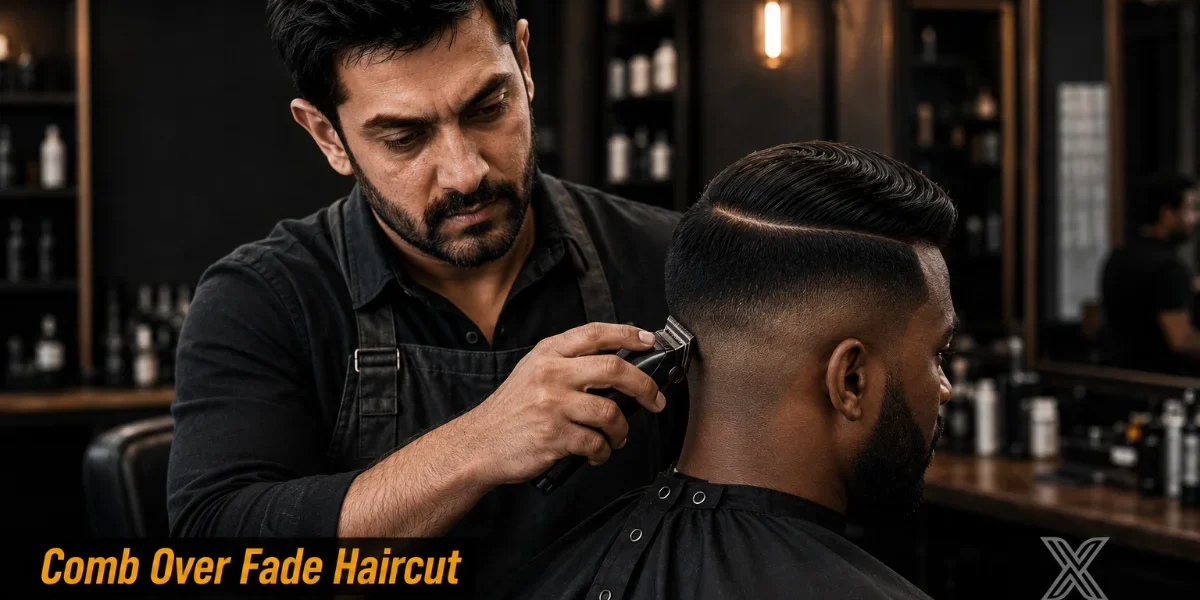

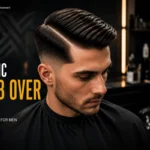
Quick Answer: A comb over fade combines longer hair on top combed laterally to one side with faded shorter sides. The fade level — low, mid, high, skin, taper, or burst — changes the contrast and maintenance. Minimum 2 inches on top required. Works on straight, wavy, curly, and thick hair.
The comb over fade is the most requested version of the comb over haircut in most barbershops — and for good reason. Faded sides sharpen the comb over direction on top, adding contrast to a classic shape without altering its structure. Every style below includes what makes it distinct, who it suits, and the exact phrase to use at the barber.
What Are the Best Comb Over Fade Styles?
The 31 best comb over fade styles cover every fade level, length, hair type, and combination — each with specific guidance on face shape, barber language, and maintenance.
1. Low Fade Comb Over
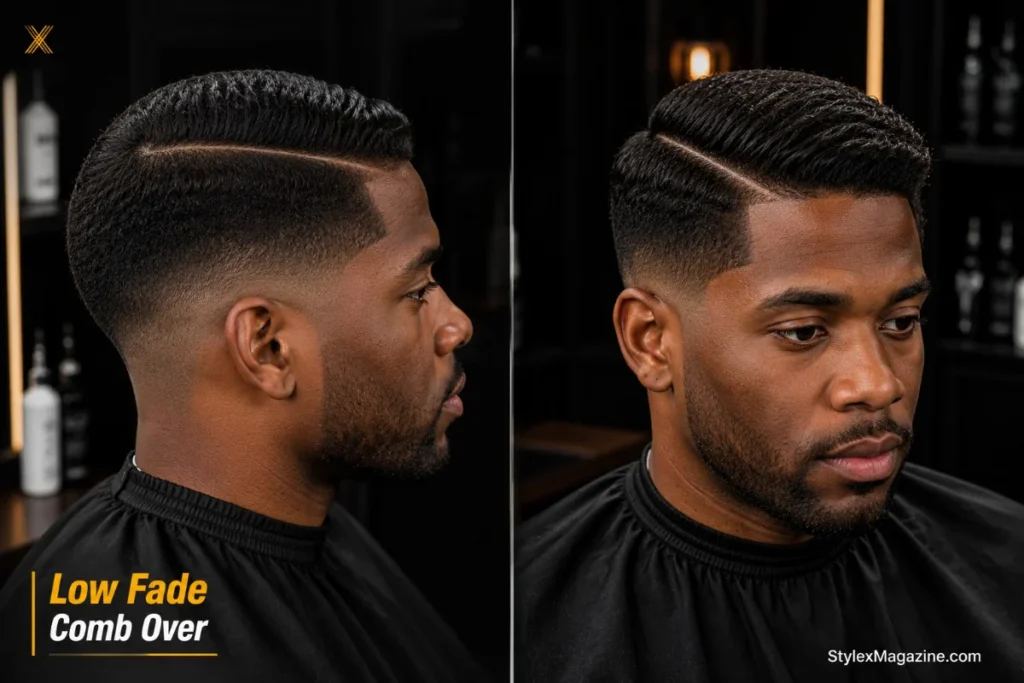
The fade starts just above the ear — sides stay relatively full, the contrast is subtle. Professional enough for any office environment, modern enough to hold shape between cuts. The most common starting point for men getting their first comb over fade. For all low fade variations, the low fade haircut guide covers every option in detail.
Best for: All face shapes. Oblong and long faces especially.
Tell your barber: “Low fade comb over — start just above the ear, natural side part, blended clean.”
Maintenance: Every 3–4 weeks.
2. Mid Fade Comb Over
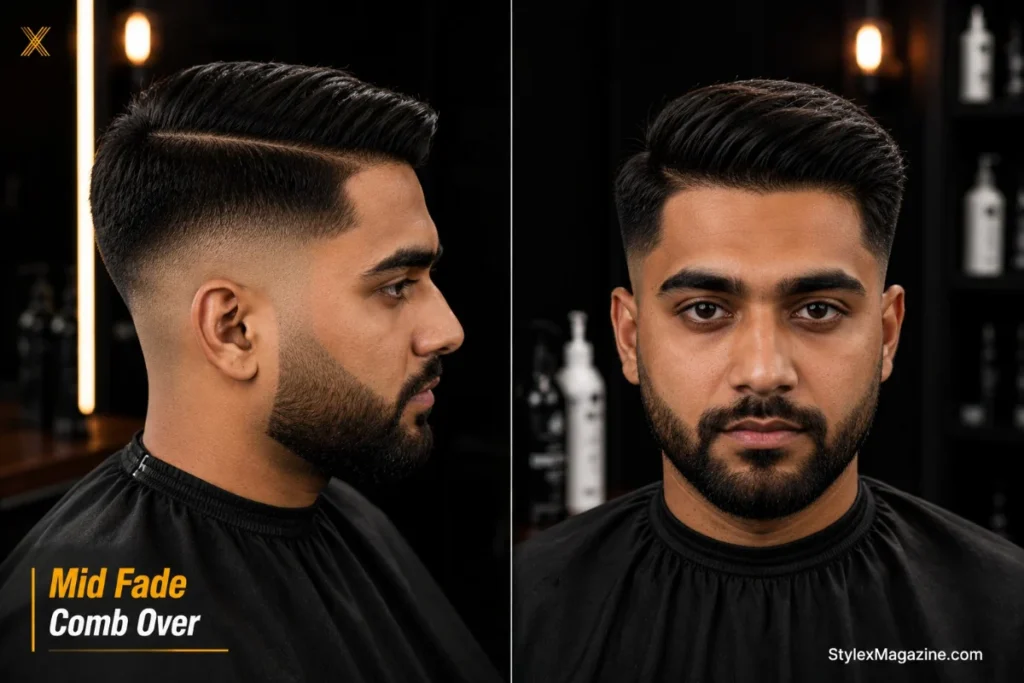
Fade starts at temple level — balanced contrast between the tight sides and the swept top. Works on every face shape and every setting. The mid fade comb over is what most men picture when they say “comb over fade.” For every mid fade variation, the mid fade haircut guide covers all 26 styles.
Best for: All face shapes.
Tell your barber: “Mid fade comb over — temple level, natural or hard part, blended clean.”
Maintenance: Every 2–3 weeks.
3. High Fade Comb Over
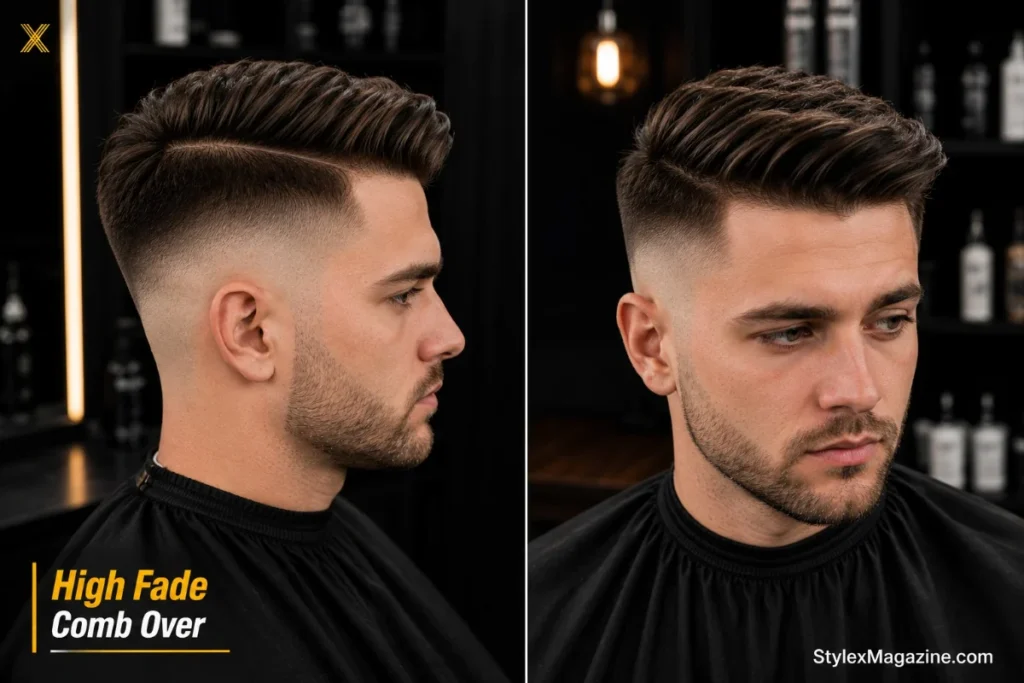
Fade starts above the temples — maximum contrast between the skin-close sides and the full swept top. The high fade comb over suits thick hair best: the density on top earns the aggressive side contrast. Not suited for conservative workplaces. The high fade haircut guide covers 28 styles across all hair types.
Best for: Round and square face shapes. Thick hair.
Tell your barber: “High fade comb over — above the temples, tight on the sides.”
Maintenance: Every 1–2 weeks.
4. Skin Fade Comb Over
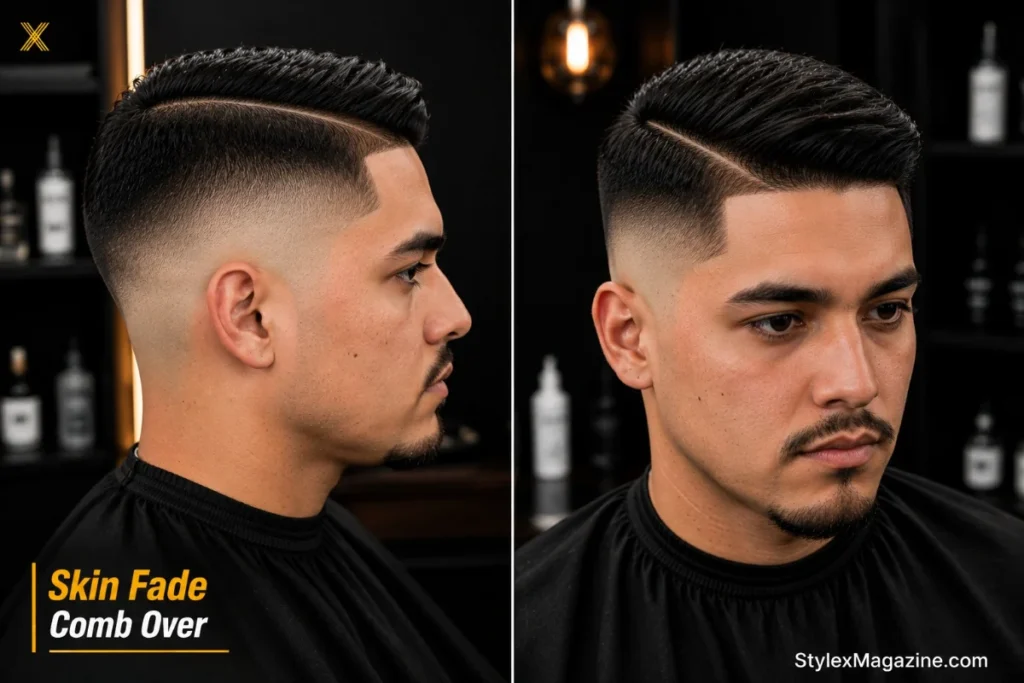
The base goes completely to bare skin — #0 guard, straight razor finish. Can sit at any height: low, mid, or high. The contrast between the bare skin sides and the full comb over top is the sharpest finish available. Barber skill matters more with a skin fade than any other variation — trimmer detailing and the razor line are what separate a clean result from a poor one.
Best for: All face shapes. Thick and dense hair.
Tell your barber: “Skin fade comb over — bald at the base, straight razor finish. Specify low, mid, or high.”
Maintenance: Every 1–2 weeks.
5. Comb Over Taper Fade
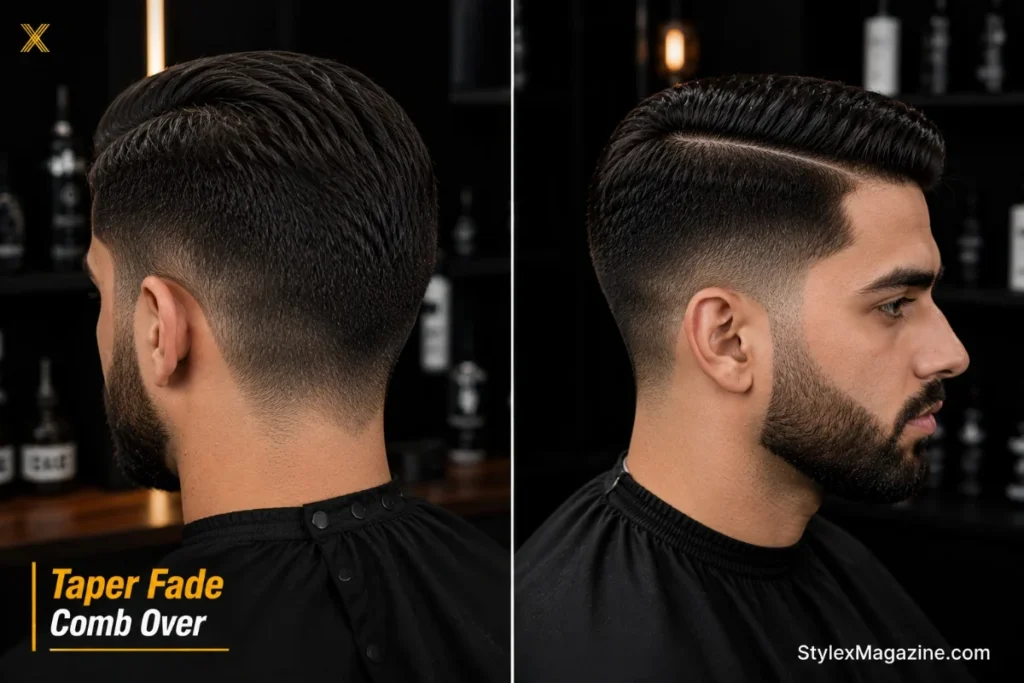
Hair shortens toward the neckline but never reaches bare skin — always some hair remaining at the base. The most conservative option. Grows out more gracefully than a skin fade because the hair at the base absorbs new growth rather than exposing a skin line. A monthly barber schedule works comfortably with a taper.
Best for: Oblong and long face shapes. Fine and thin hair.
Tell your barber: “Comb over taper fade — keep some hair at the base, don’t go to skin.”
Maintenance: Every 4–5 weeks.
6. Drop Fade Comb Over
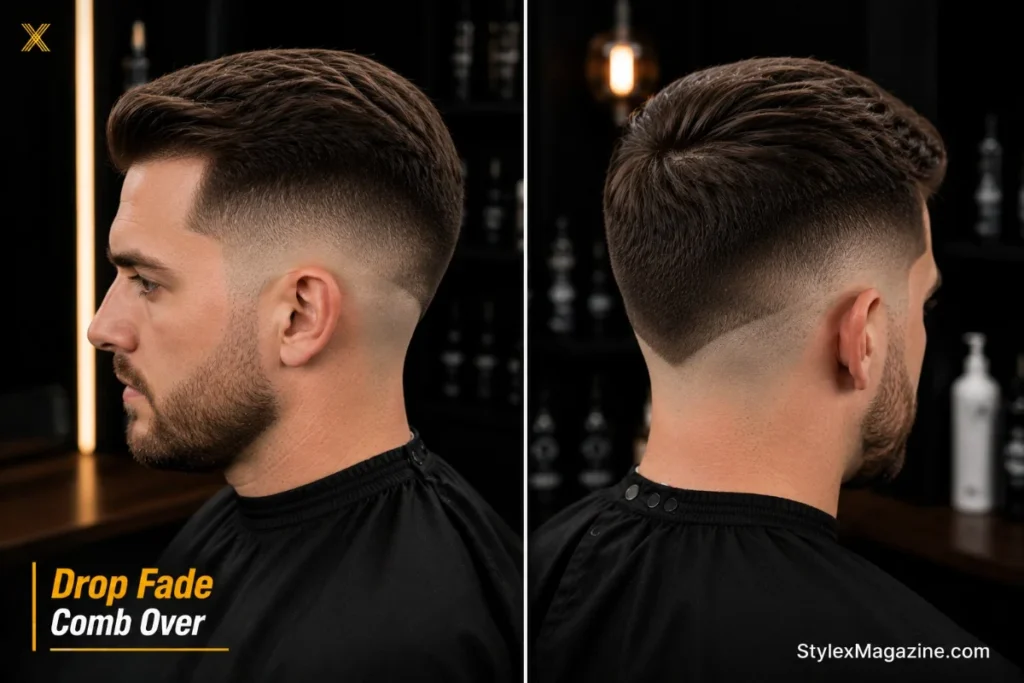
Fade sits straight on the sides but curves and drops lower behind the ear at the back — adding a sculpted silhouette to the back of the head. From the front it looks like a standard comb over fade; from the back, the curved drop line gives it shape and dimension. Works at any height.
Best for: Oval and round face shapes.
Tell your barber: “Drop fade comb over — let the fade line curve and drop lower at the back.”
Maintenance: Every 2–3 weeks.
7. Comb Over Burst Fade
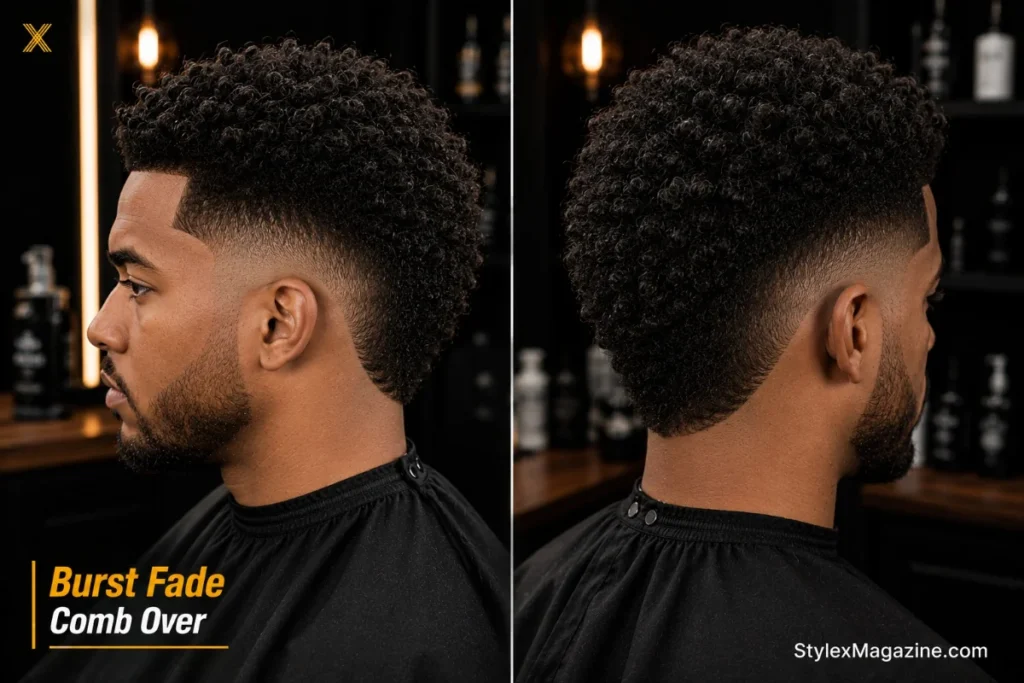
The fade curves in a semi-circular arc around the ear rather than following a straight horizontal line. The back stays longer than a standard fade. The burst fade’s arc follows the natural head shape — curly and wavy hair takes to it better than a straight fade line because the arc moves with the hair’s growth pattern rather than against it. For every burst fade combination, the burst fade haircut guide has 32 styles.
Best for: Oval and round face shapes. Curly and wavy hair.
Tell your barber: “Burst fade comb over — curved arc around the ear, leave more length at the back.”
Maintenance: Every 2–3 weeks.
8. Comb Over Temple Fade
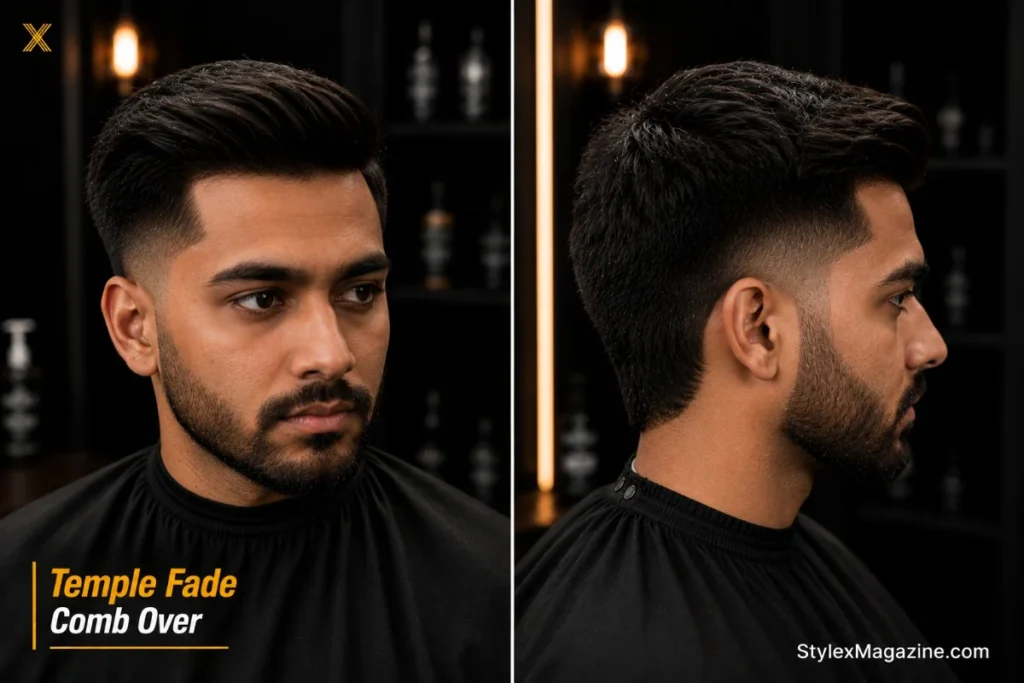
The fade focuses tightly around the temples and frontal hairline — sharp at the front, longer at the back. The sides above the temples stay fuller than a standard fade. Often paired with a lineup for maximum front definition. Shorter top styles benefit most — the front definition does the work.
Best for: All face shapes. Short top styles.
Tell your barber: “Temple fade comb over — tight around the temples and hairline, keep the back fuller, add a lineup.”
Maintenance: Every 2–3 weeks.
9. Short Comb Over Fade
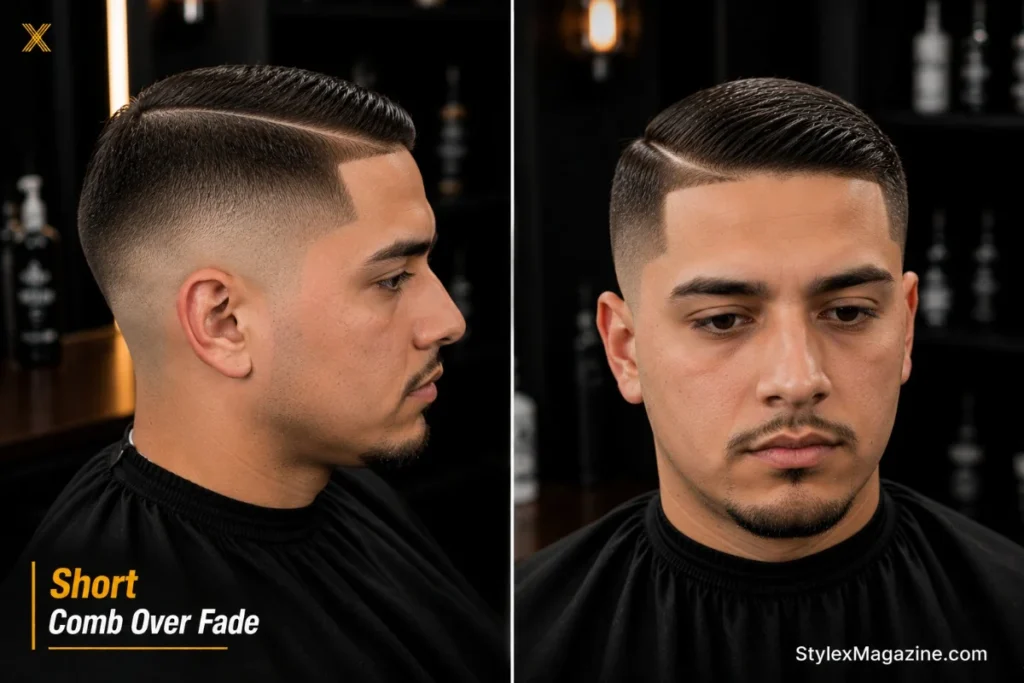
Top at 1 to 1.5 inches — the shortest comb over fade that still holds a side direction. No volume at this length. Clean, structured, minimal daily styling. Works on every hair type. A small amount of pomade or clay holds the direction without weight. Low maintenance in terms of styling time; the fade itself still needs regular upkeep.
Best for: All face shapes. All hair types.
Tell your barber: “Short comb over fade — top at about an inch, low or mid fade, side part.”
Maintenance: Every 2–3 weeks.
10. Medium Comb Over Fade
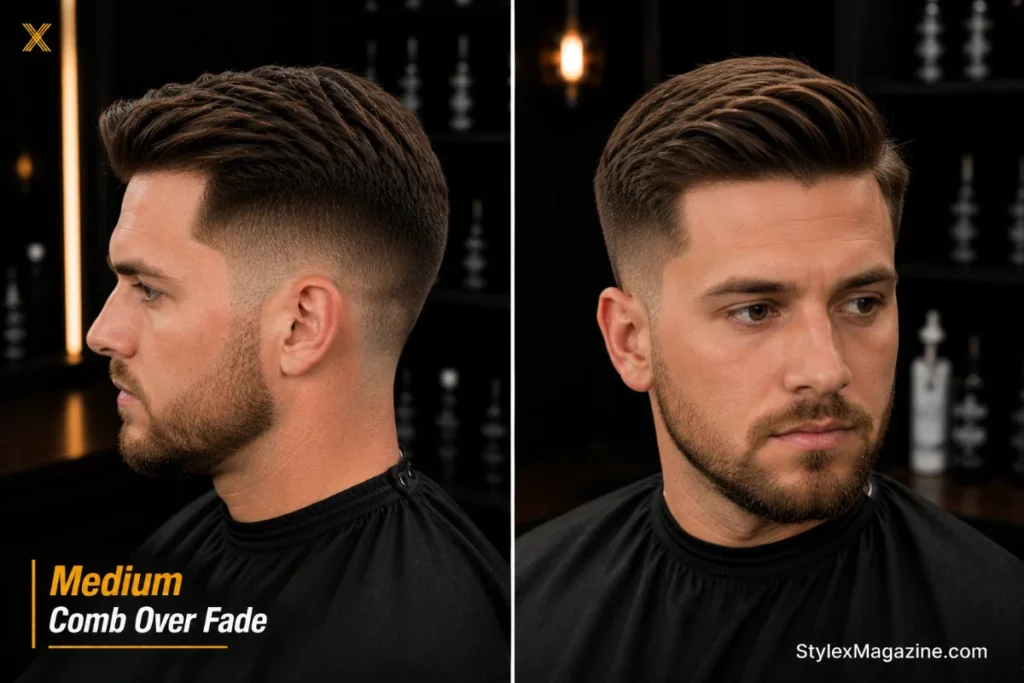
Top at 2 to 3 inches — enough length for texture, volume, and a visible sweep. The most common comb over fade length. Works with most products depending on the desired finish. At this length with a mid fade, the cut balances contrast and wearability across most face shapes and hair types.
Best for: All face shapes. Straight and wavy hair.
Tell your barber: “Comb over fade — keep the top at 2 to 3 inches, mid fade on the sides.”
Maintenance: Every 2–3 weeks.
11. Long Comb Over Fade
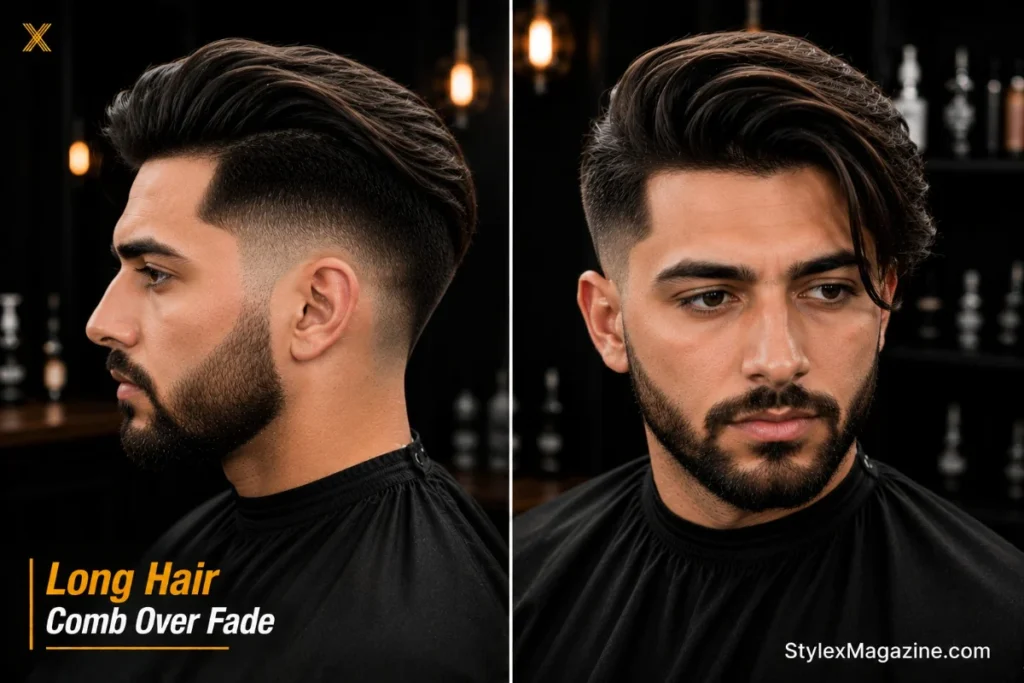
Top at 4 or more inches sweeping dramatically to one side. The length creates visible volume and flow. A strong-hold product keeps the direction through the day. Mid or high fade on the sides prevents the long top from looking top-heavy. On wavy or thick hair, the long comb over fade carries more natural movement than on straight hair.
Best for: Oval and rectangular face shapes. Wavy and thick hair.
Tell your barber: “Long comb over fade — leave the top long, mid fade on the sides to balance the length.”
Maintenance: Every 3–4 weeks for the sides. Top trim every 6–8 weeks.
12. Classic Comb Over Fade
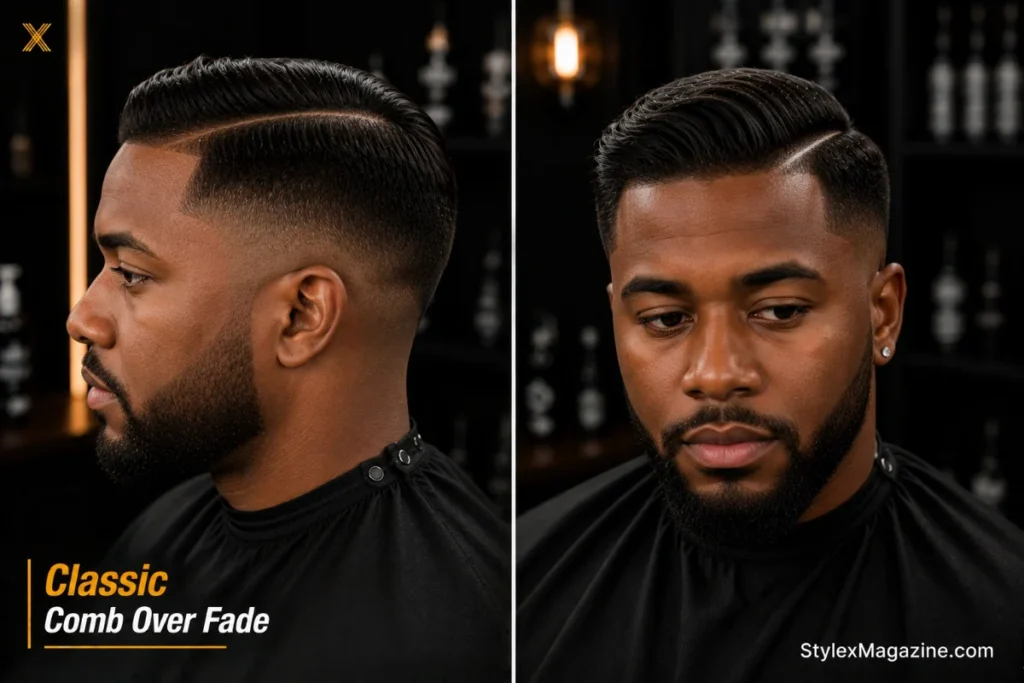
Natural side part, hair combed smooth across the top, tapered or low-faded sides. The finish sits between slick and textured — medium hold, no heavy gloss, no choppy movement. The default version a barber produces when asked for a comb over fade without further detail. Works at any top length from 2 to 4 inches.
Best for: All face shapes. Straight and wavy hair.
Tell your barber: “Classic comb over fade — natural side part, medium hold, blended sides.”
Maintenance: Every 3 weeks.
13. Textured Comb Over Fade
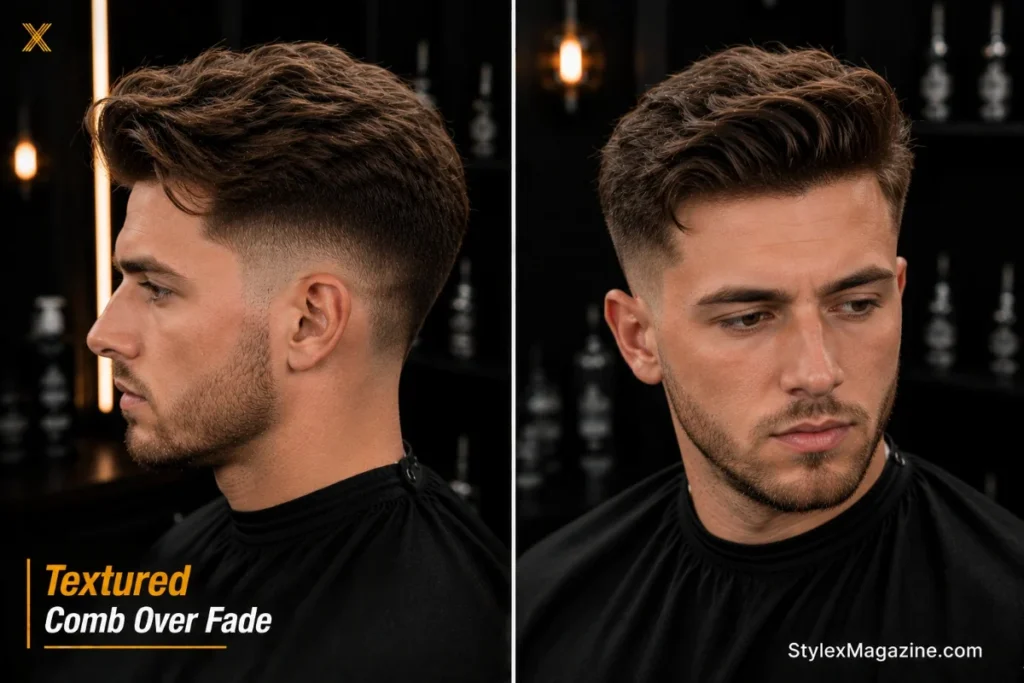
Matte clay finish with visible movement and choppy point-cut ends — the opposite of the slick version. Hair swept to one side with deliberate texture rather than lying flat. Works well on wavy and thick hair where a flat finish is difficult to maintain. Ryan Gosling has worn this version consistently.
Best for: Oval and square face shapes. Wavy and thick hair.
Tell your barber: “Comb over fade — textured finish on top, point cut the ends, matte product.”
Maintenance: Every 3 weeks.
14. Slick Comb Over Fade
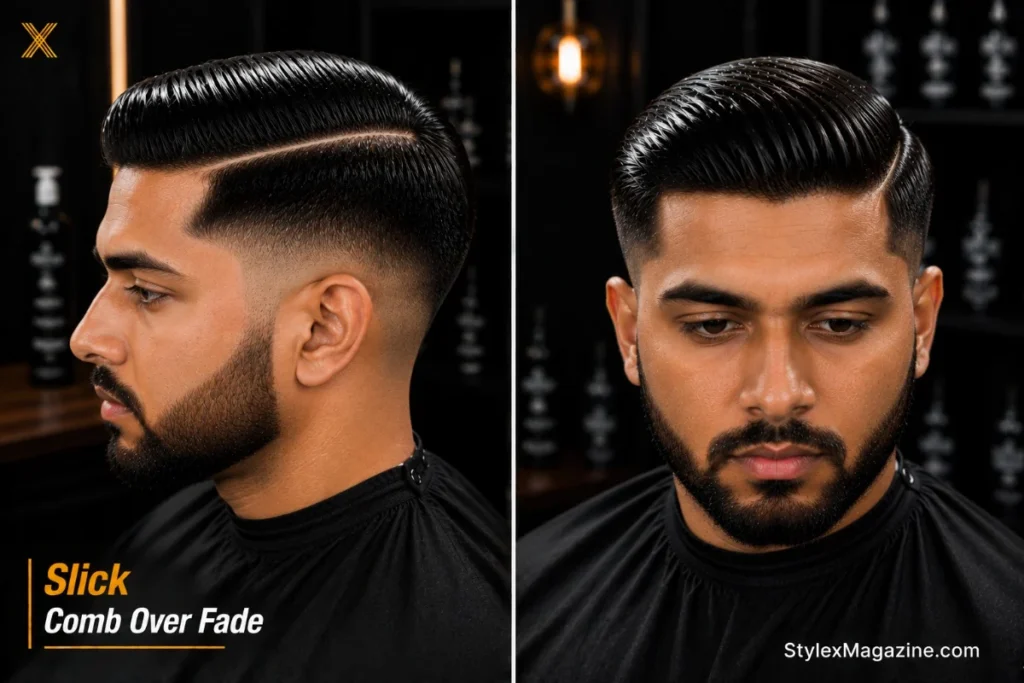
Every strand pressed flat against the scalp with heavy pomade — mirror-level shine, no volume, individual comb lines visible in the hair. The most formal version. Straight hair only: wavy or thick hair fights the flat finish without repeated product reapplication through the day.
Best for: Oval and rectangular face shapes. Straight hair only.
Tell your barber: “Comb over fade — slick finish on top, I’ll style it flat with pomade.”
Maintenance: Every 3–4 weeks.
15. Hard Part Comb Over Fade
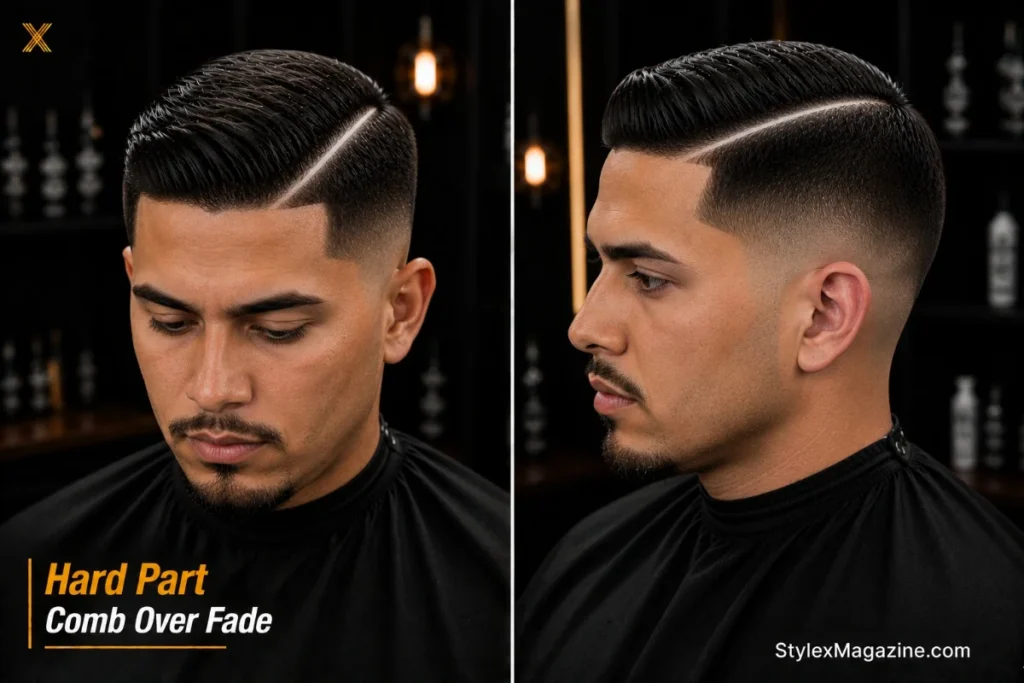
A razor-shaved line at the parting — a clean white line of bare scalp cutting precisely through the hair. Adds definition and holds the part consistent between washes. Works at any fade height. The hard part grows out within 2 weeks and needs barber maintenance more often than the fade itself.
Best for: Oval and square face shapes. Straight and wavy hair.
Tell your barber: “Comb over fade — razor hard part on the left side, about an inch back from the hairline.”
Maintenance: Every 2 weeks for the hard part. Fade every 2–3 weeks.
16. Comb Over Fade with Design
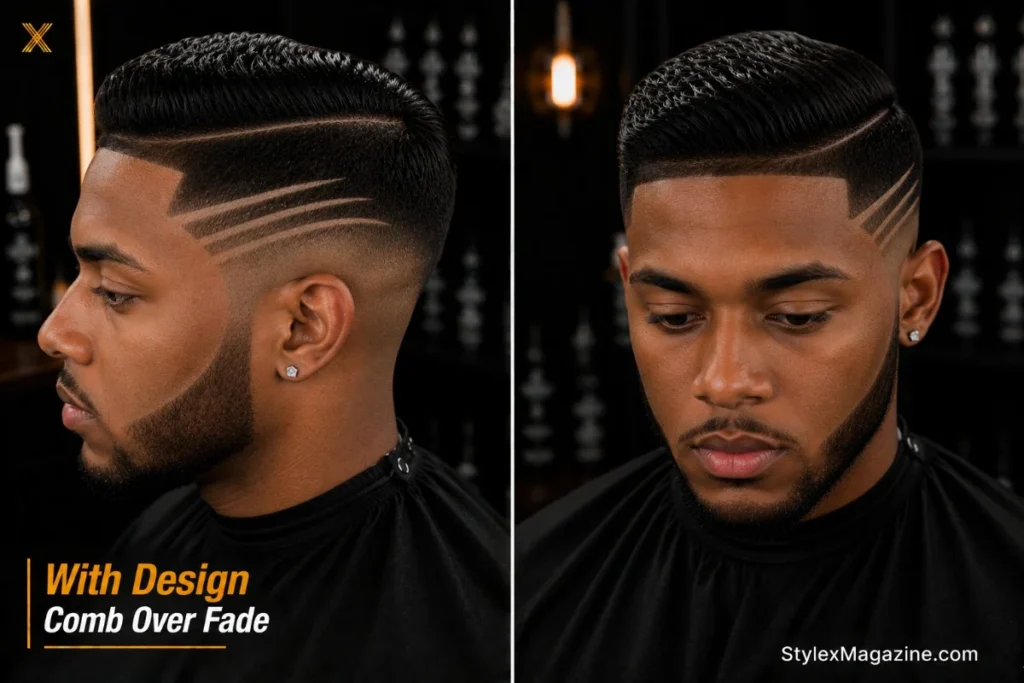
Geometric lines, curves, or patterns shaved into the faded area alongside the comb over. The design sits in the faded side section — the comb over stays intact on top. A mid or high fade gives the barber a large enough canvas to work with. Designs need a barber who specializes in razor work.
Best for: All face shapes. All hair types.
Tell your barber: “Comb over fade — mid or high fade, add [describe design] in the faded area.”
Maintenance: Every 1–2 weeks. Designs lose definition faster than the fade.
17. Disconnected Comb Over Fade
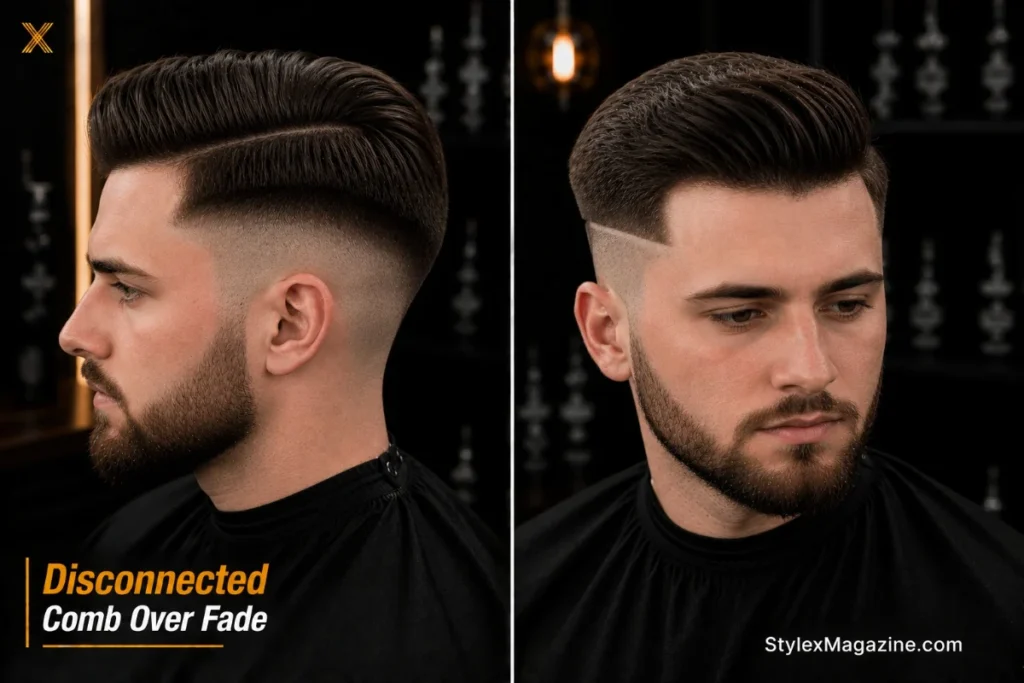
A hard visible line between the longer top and the short sides — no blending, no graduation. The gap between the two lengths is the deliberate style choice rather than a byproduct. Needs at least 3 to 4 inches on top for the disconnection to show clearly. Straight hair produces the cleanest disconnection line.
Best for: Square and oval face shapes. Straight and thick hair.
Tell your barber: “Disconnected comb over — hard line between the top and sides, no blending at the transition.”
Maintenance: Every 2–3 weeks.
18. Deep Side Part Comb Over Fade
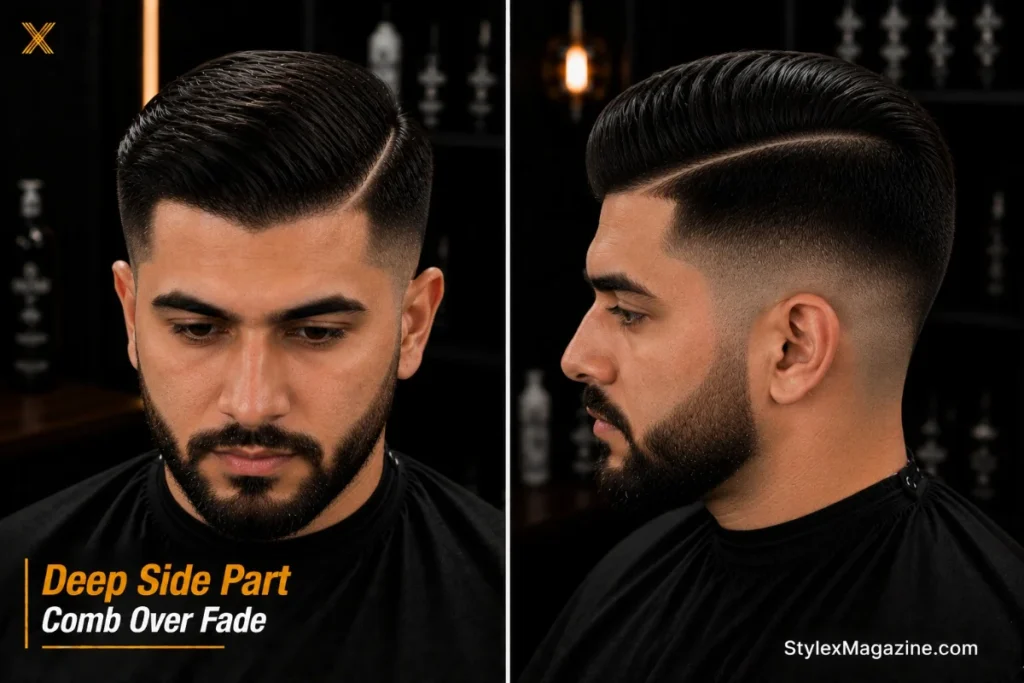
Part positioned dramatically further from the natural hairline than a standard comb over — a wider sweep of hair crossing the top. More hair moves from one side to the other. Adds width where the part sits, which suits long and oblong face shapes by making the face look shorter and wider. David Beckham has worn this variation.
Best for: Oblong and long face shapes. Straight and wavy hair.
Tell your barber: “Deep side part comb over fade — part further from the hairline than usual, mid fade on the sides.”
Maintenance: Every 2–3 weeks.
19. Comb Over Fade Pompadour
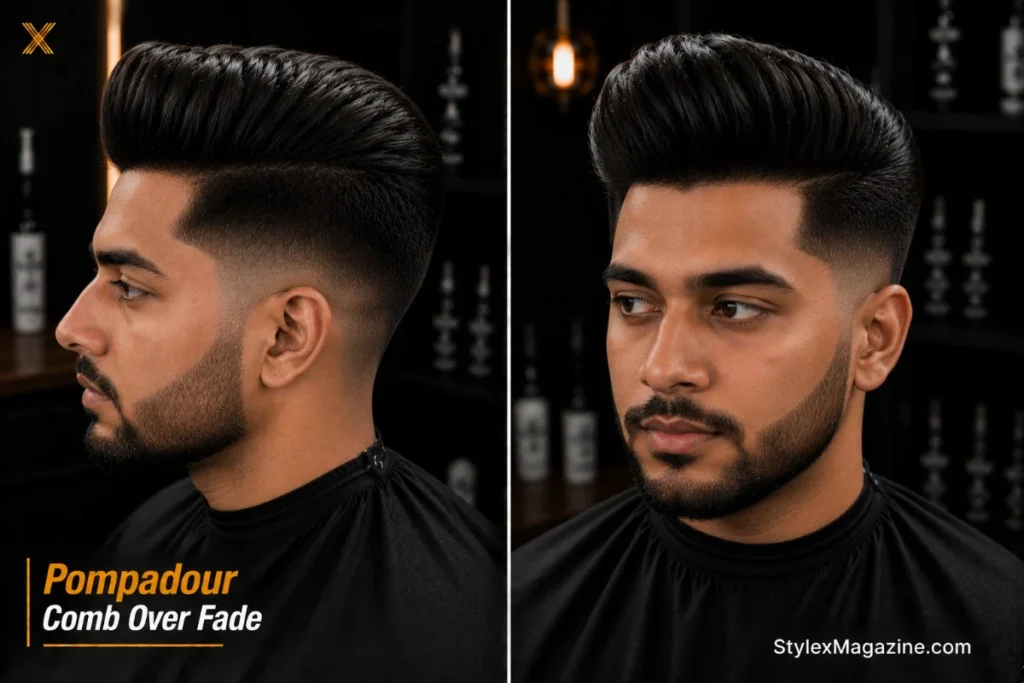
Volume swept back and upward from the forehead then directed to one side — the pompadour lift combined with the lateral comb over direction. The height is clearly visible from the side as a raised ridge above the forehead. Requires at least 3 inches on top and a strong-hold product to maintain the lift through the day.
Best for: Round and square face shapes. Thick and wavy hair.
Tell your barber: “Comb over pompadour fade — volume on top swept back and to the side, mid or high fade.”
Maintenance: Every 2–3 weeks.
20. Comb Over Fade Quiff
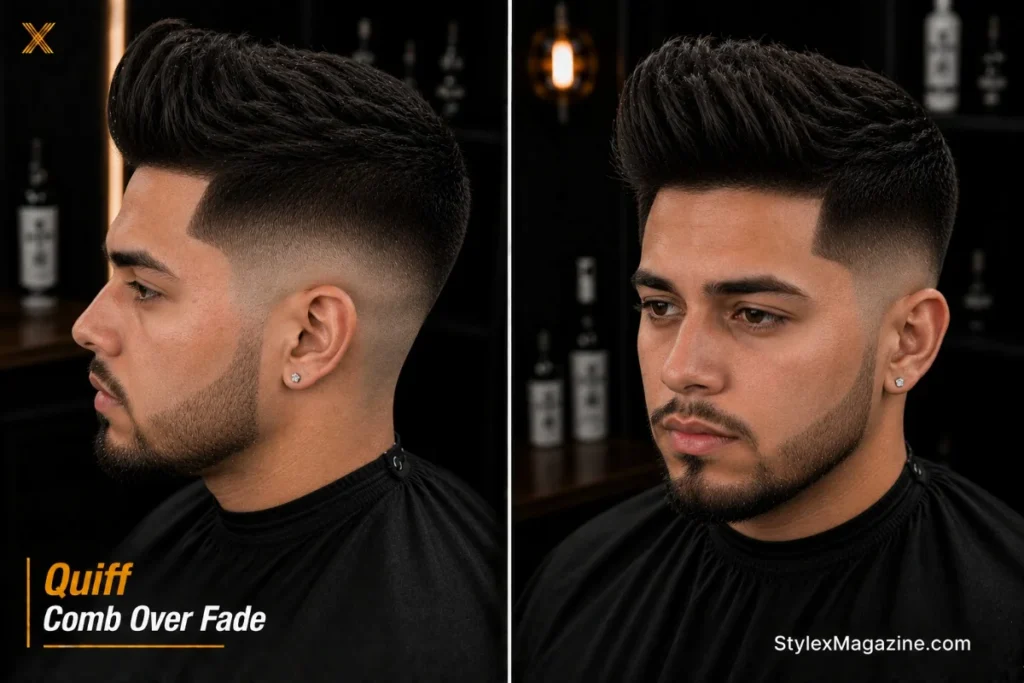
Volume concentrated at the front pushed forward and slightly upward then sweeping to one side — forward direction rather than backward like the pompadour. Front-heavy volume. Works on oval and round face shapes where forward height adds structure without elongating the face further.
Best for: Oval and round face shapes. Thick and wavy hair.
Tell your barber: “Comb over quiff fade — volume at the front pushed forward and to the side, not swept back.”
Maintenance: Every 2–3 weeks.
21. Comb Over Fade for Straight Hair
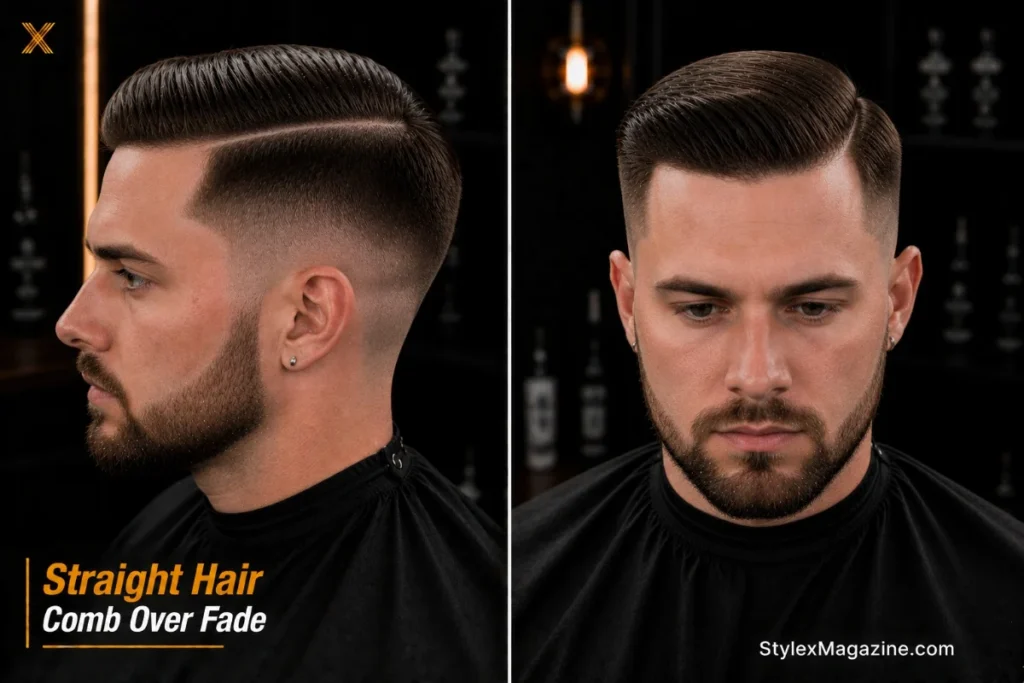
Straight hair produces the sharpest, most precise fade and part lines of any texture — the hair lies flat and cuts cleanly. Hard part and skin fade read clearest on straight hair. The one issue with straight hair: without texture on top the cut can look flat. Ask for point-cut ends rather than blunt-cut to add movement.
Best for: All face shapes.
Tell your barber: “Comb over fade — point cut the top, not blunt. I have straight hair.”
Maintenance: Every 2–3 weeks.
22. Comb Over Fade for Curly Hair
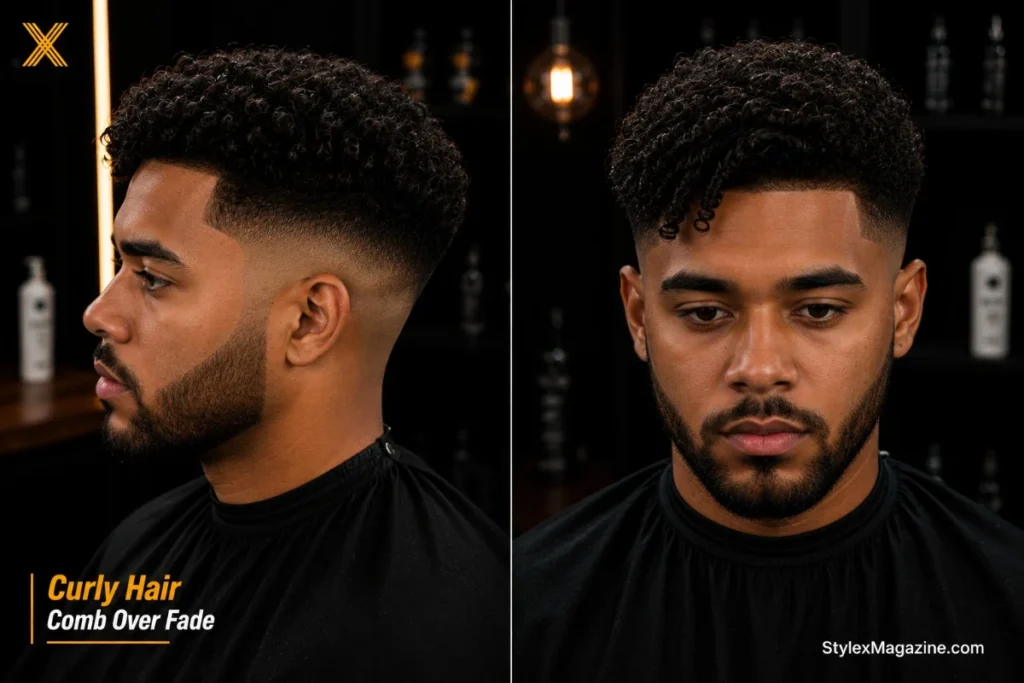
Curly hair needs a looser interpretation — the curl pattern fights a flat slicked finish. Allow the curls to stay present on top while directed toward one side. Scissor-over-comb at the sides creates a natural blend rather than a hard line between the curly top and the shorter faded sides. Leave-in conditioner maintains curl definition between washes.
Best for: Oval and round face shapes.
Tell your barber: “Comb over fade — loose direction on top, scissor-over-comb on the sides, keep the curl definition.”
Maintenance: Every 3 weeks.
23. Comb Over Fade for Wavy Hair
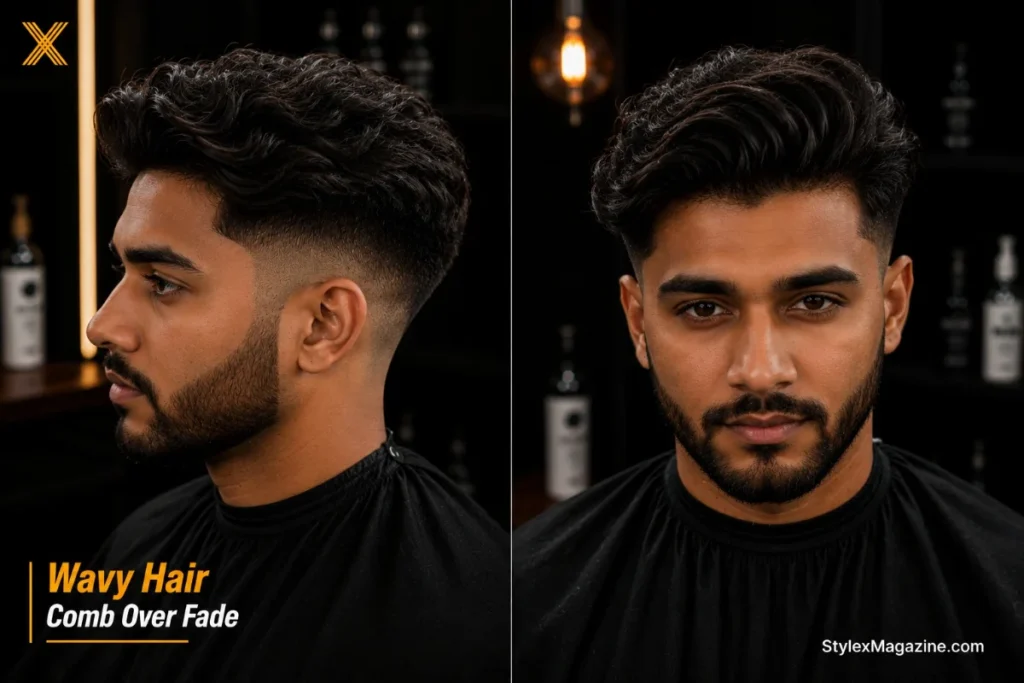
Natural wave adds volume and movement to the comb over direction without effort. The textured version suits wavy hair better than the slick — the wave pattern fights a flat finish. Sea salt spray before styling enhances the natural wave movement rather than fighting it. The wave itself becomes part of the style.
Best for: All face shapes.
Tell your barber: “Comb over fade — textured finish to work with my natural wave.”
Maintenance: Every 3 weeks.
24. Comb Over Fade for Thick Hair
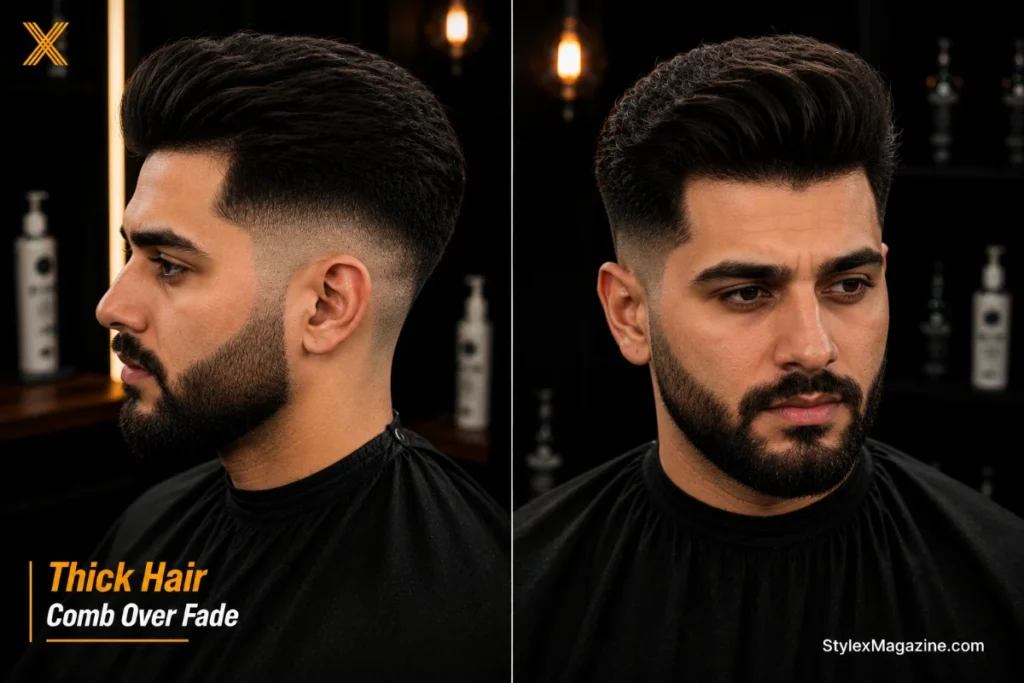
Thick hair holds the comb over direction well but adds bulk on the sides. A mid or high fade removes side bulk and lets the top take the focal point. Point-cutting or texturizing the top section reduces weight and prevents thick hair from sitting too heavy. Clay holds thick hair in place better than pomade.
Best for: Round and square face shapes.
Tell your barber: “Comb over fade — point cut or texturize the top to reduce weight, mid fade on the sides.”
Maintenance: Every 2–3 weeks.
25. Comb Over Fade for Thin Hair
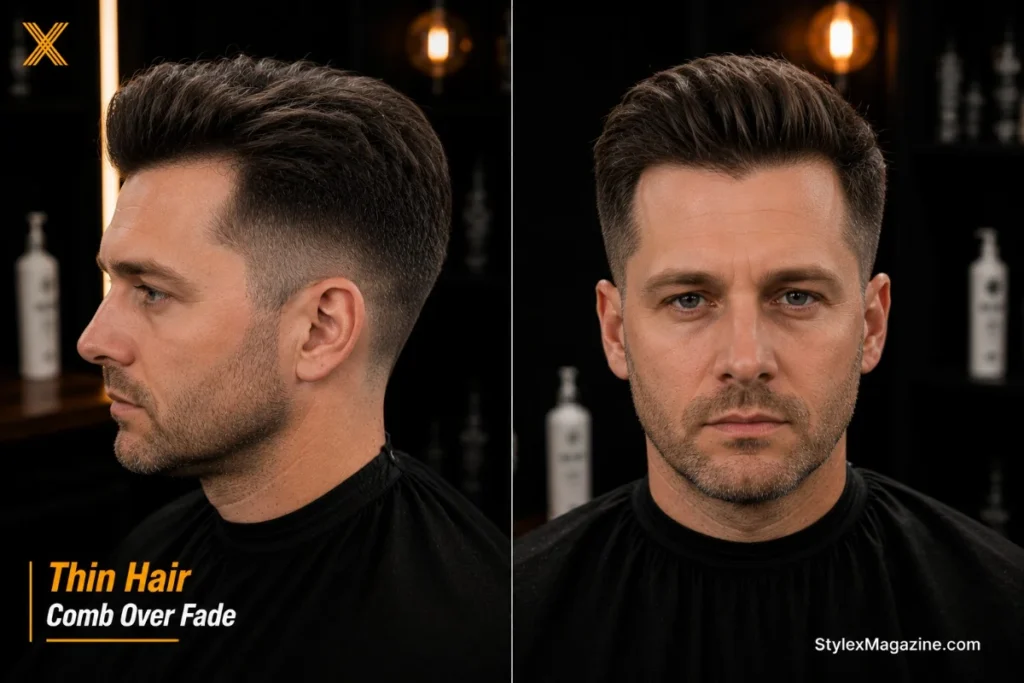
Thin hair and a comb over fade can work — but the fade height matters significantly. A mid or high fade on thin hair exposes too much scalp on the sides, drawing attention to the density rather than the cut. A low fade or taper keeps the sides looking full. Mousse applied to damp hair before blow drying adds volume without weight on the top section.
Best for: Oblong and oval face shapes.
Tell your barber: “Comb over low fade — keep the sides full, I have thin hair, don’t go too high with the fade.”
Maintenance: Every 4 weeks.
26. Comb Over Fade with Beard
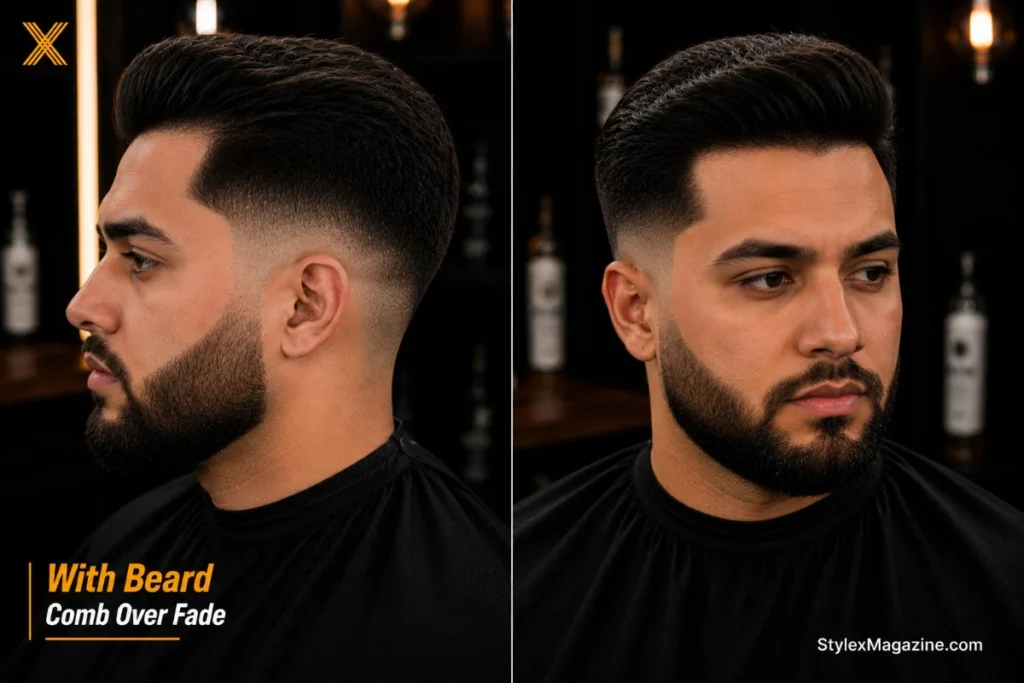
Mid fade starting at the temple blends down into the beard at the sideburn — a connected fade rather than a disconnected finish. On coarse beard texture, the blend between faded hair and beard needs specific attention. Most barbers default to a disconnected finish unless asked specifically. The sideburn is the transition zone — get it wrong and the whole combination falls apart.
Best for: All face shapes.
Tell your barber: “Comb over mid fade — connect the fade into my beard at the sideburn, no hard gap, the beard is coarse so take your time at that transition.”
Maintenance: Fade every 2–3 weeks. Beard trim alongside.
27. Comb Over Fade with Stubble
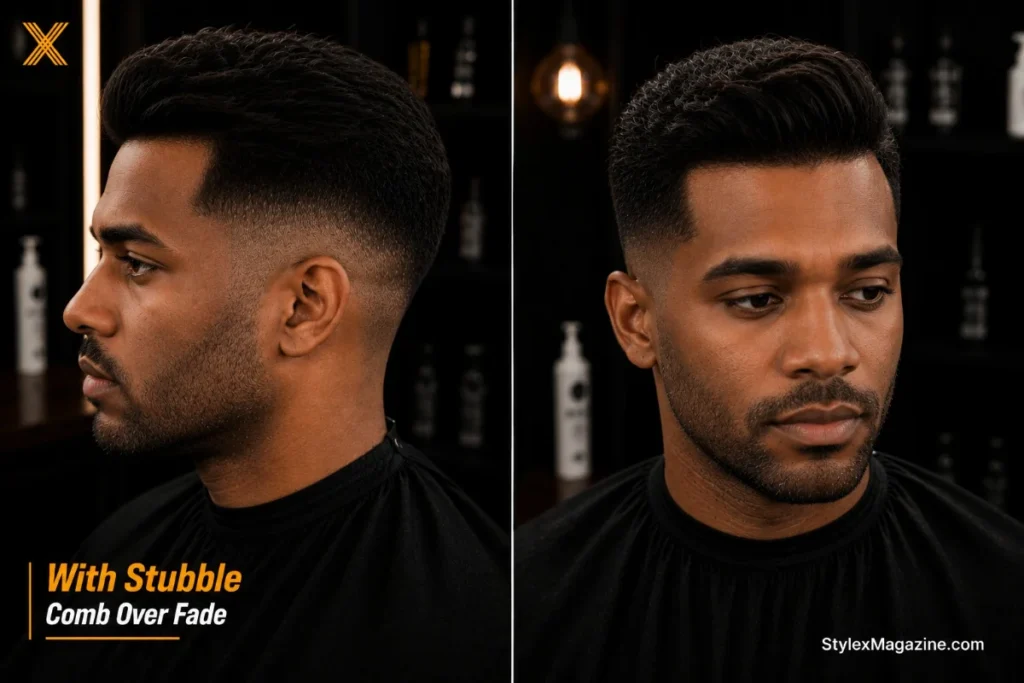
3 to 5 days of stubble alongside a comb over fade — the stubble adds jaw structure without the maintenance commitment of a full beard. A low or mid fade transitions naturally into the stubble at the sideburn level. Works in most settings from office to casual.
Best for: All face shapes.
Tell your barber: “Comb over fade — low or mid fade that transitions into stubble, keep the stubble edges clean.”
Maintenance: Every 3 weeks.
28. Comb Over Burst Fade Mullet
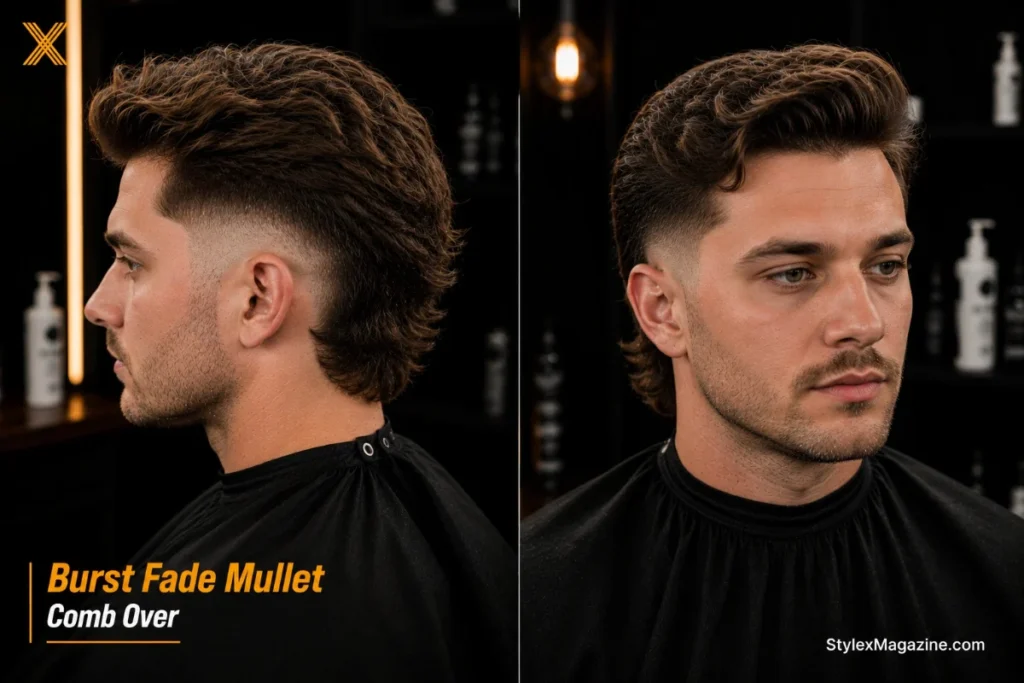
Comb over direction on top, burst fade on the sides, longer length preserved at the back — the mullet silhouette with a comb over on top rather than a standard mohawk strip. The burst fade’s arc naturally preserves the back length that a standard high fade would cut away. Textured top and tight sides keep it contemporary rather than retro.
Best for: Oval and oblong face shapes. Straight and wavy hair.
Tell your barber: “Comb over on top, burst fade on the sides, leave the back long for the mullet — don’t fade the back.”
Maintenance: Every 3 weeks.
29. Asian Comb Over Fade
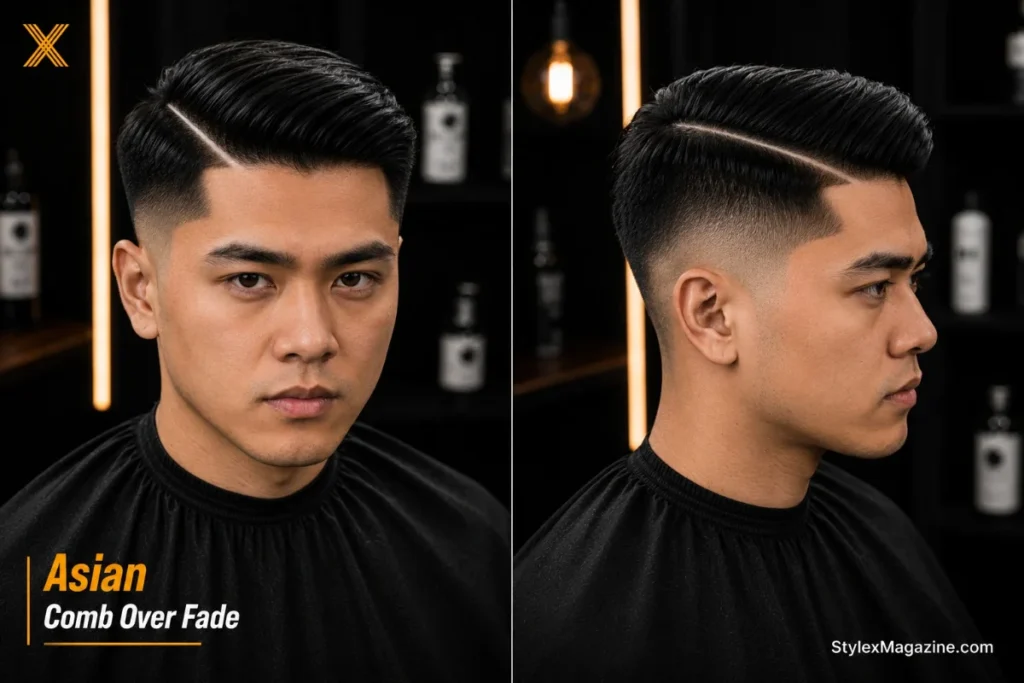
East Asian hair — typically straight and thick — produces the sharpest comb over fade lines of any hair type. The flat texture takes a hard part cleanly and holds a slick or textured finish with minimal product. A mid fade or undercut on the sides balances the thick top. The precision of the part line and fade on straight thick hair is the visual identifier.
Best for: Oval and square face shapes.
Tell your barber: “Comb over fade — hard part, mid fade or undercut on the sides. I have thick straight hair.”
Maintenance: Every 2–3 weeks.
30. Teen Comb Over Fade
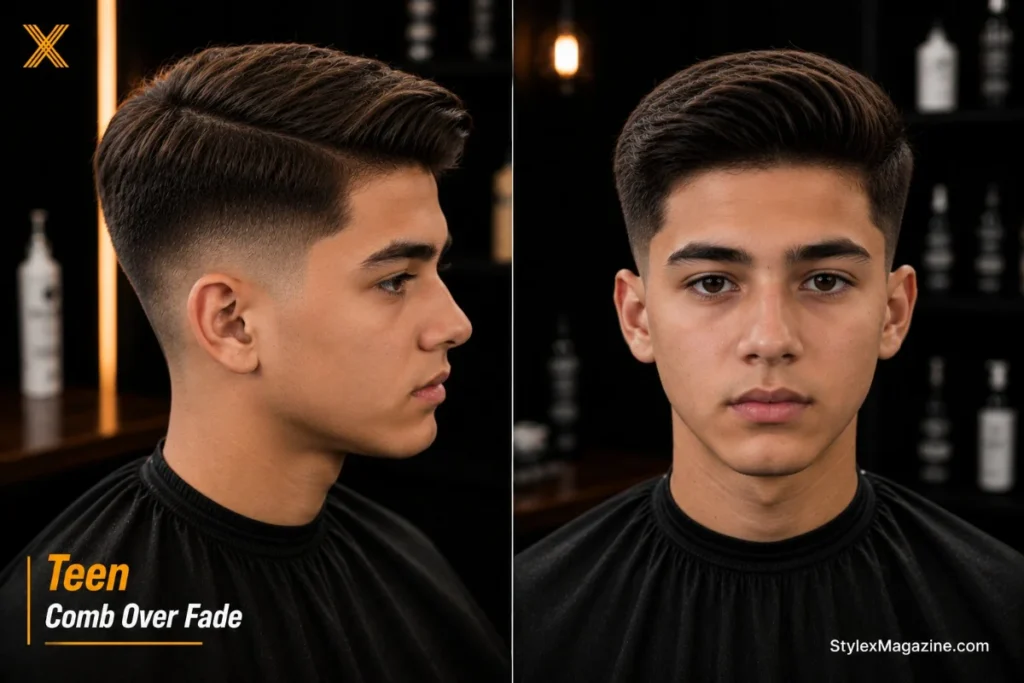
The comb over fade works well for teen boys across all hair types — the mid fade comb over is the most requested version for this age group. For school or formal settings, a low fade with a natural part keeps it appropriate. For more casual wear, a high fade with a hard part and textured top adds personality without going over the top. A barber experienced with younger clients can adjust proportions to suit the face.
Best for: All face shapes.
Tell your barber: “Mid fade comb over — natural part, blended clean.” For more style: “High fade comb over — hard part, textured top.”
Maintenance: Every 2–3 weeks.
31. Toddler Comb Over Fade
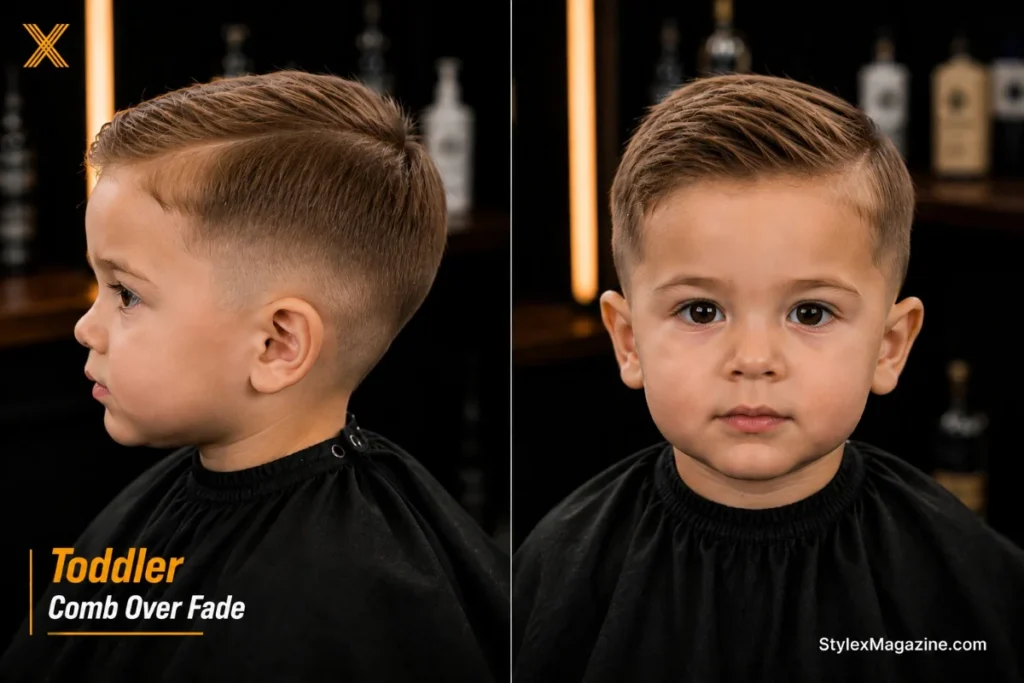
The toddler comb over fade follows the same principle — longer top combed to one side, shorter faded sides — scaled to suit a young child’s proportions. A low or very subtle fade keeps it age-appropriate. The natural side part rather than a hard-shaved part is the right approach for very young children. A barber used to cutting children’s hair will know to use scissors over clippers for the top section.
Best for: All face shapes.
Tell your barber: “Low fade comb over for a toddler — natural soft part, keep it subtle, no hard part.”
Maintenance: Every 4–6 weeks.
Which Comb Over Fade Suits Your Face Shape?
The fade height and the comb over direction together determine how the face reads — height adds length, fuller sides add width.
| Face Shape | Best Fade Level | Why |
|---|---|---|
| Oval | Any | Balanced proportions — all levels work |
| Round | Mid or high fade | Adds visual height, makes face appear longer |
| Square | Low or mid fade | Softens the jawline |
| Oblong / Long | Low fade or taper | Avoids adding more length |
| Rectangular | Low or mid fade with deep side part | Adds width |
| Heart | Low or mid fade | Avoids sharpening the temples |
| Diamond | Mid fade | Keeps side width balanced |
Which Comb Over Fade Suits Your Hair Type?
Hair type determines which finish works and how often you need to visit the barber.
| Hair Type | Best Version | Key Note |
|---|---|---|
| Straight | Any — slick or classic best | Sharpest lines of any texture |
| Wavy | Textured or modern | Wave adds volume naturally |
| Curly | Loose direction, burst fade | Scissor-over-comb at sides |
| Thick | Mid or high fade | Fade removes side bulk |
| Thin / Fine | Low fade or taper only | Avoid mid or high — exposes scalp |
| Thinning / Receding | Low taper | Work with the hairline, not against it |
What Should You Tell Your Barber?
Specify the fade height and the top finish — those two details cover everything.
- Low fade comb over: “Low fade, just above the ear — natural side part, blended clean.”
- Mid fade comb over: “Mid fade at the temple — side part, blended clean.”
- High fade comb over: “High fade above the temples — tight on the sides.”
- Skin fade comb over: “Skin fade comb over — bald at the base, straight razor finish. Mid height.”
- Taper comb over: “Comb over taper — keep some hair at the base, don’t go to skin.”
- Hard part: “Add a razor hard part on the left side, about an inch from the hairline.”
- Curly hair: “Set the fade height based on dry hair — not wet.”
How Often Should You Get a Comb Over Fade?
Maintenance depends on the fade level — the higher the fade, the faster it loses definition.
| Variation | Frequency |
|---|---|
| High skin fade comb over | Every 1–2 weeks |
| Comb over with design | Every 1–2 weeks |
| Hard part comb over fade | Every 2 weeks |
| Mid skin fade comb over | Every 2 weeks |
| Mid fade comb over | Every 2–3 weeks |
| Burst fade comb over | Every 2–3 weeks |
| Low fade comb over | Every 3 weeks |
| Comb over taper fade | Every 4–5 weeks |
| Toddler comb over fade | Every 4–6 weeks |
FAQ
What is a comb over fade haircut?
Longer hair on top combed laterally to one side with faded shorter sides. The fade level — low, mid, high, skin, taper, or burst — changes the contrast and maintenance frequency.
What is the difference between a comb over fade and a taper?
A taper always keeps hair at the base — never reaches bare skin. A fade can go to skin. The taper grows out more gracefully; the skin fade is sharper but needs more frequent visits.
Can a comb over fade work on curly hair?
Yes — as a loose directional sweep rather than a flat slicked finish. Scissor-over-comb at the sides keeps the blend natural. Tell the barber to set the fade height based on dry hair, not wet.
Which comb over fade is best for thin hair?
Low fade or taper only. A mid or high fade on thin hair exposes too much scalp on the sides. A low fade keeps the sides looking full and the cut looking intentional.
What is a comb over temple fade?
A fade focused tightly around the temples and frontal hairline — the back stays longer. Often paired with a lineup. Common with shorter top styles where the front definition is the focus.
How long does hair need to be for a comb over fade?
Minimum 2 inches on top. Below that there is not enough length to hold a visible side direction. 3 to 4 inches gives more flexibility in styling and finish.

Other Articles


No Comment! Be the first one.