
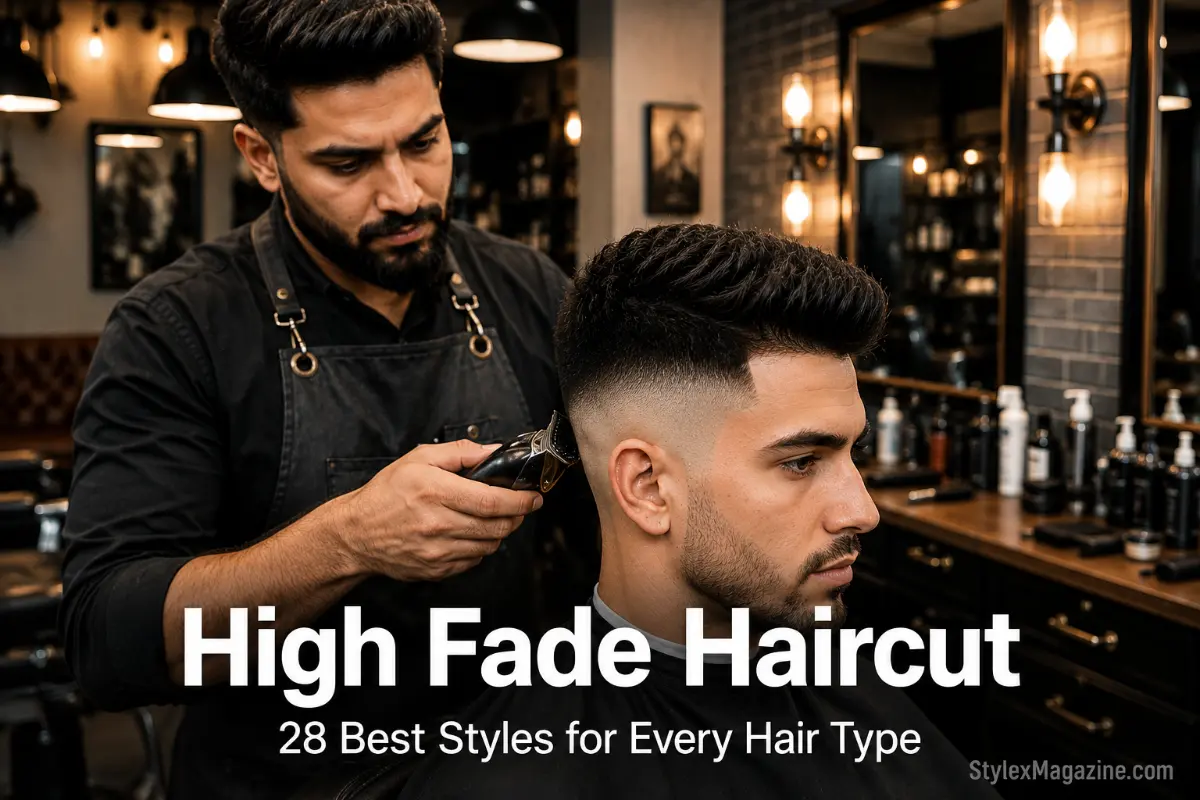

Quick Answer: A high fade starts above the temples the highest starting point of all fade types and blends down to bare skin or a very short length at the base. It creates the strongest contrast available. Bold, modern, and high-maintenance. Works best on oval, round, and square face shapes.
The high fade is not a subtle cut. The sides go short fast, which puts everything on top front and center. David Beckham, Michael B. Jordan, and Ryan Reynolds have all worn variations of it. If you want a cut that makes a statement and you can commit to a 1–2 week maintenance schedule this is it.
What Are the Best 28 High Fade Haircut Styles?
1. Classic High Fade

Hair fades from full length on top down to a #1 or #2 guard at the base, starting above the temples. The transition is fast — significantly more skin visible on the sides than any lower fade.
Every hair type works. The starting point if you want the high fade look without going all the way to skin.
Best for: Oval, round, and square face shapes. Men who want bold contrast without a full bald fade.
Tell your barber: “Classic high fade, starting above the temples, blended clean — number one at the base.”
Maintenance: Every 2 weeks.
2. High Skin Fade

Starts above the temples and faded completely to bare skin #0 guard, straight razor finish. No hair at the base, no stubble. Brad Pitt and Zayn Malik have both worn this combination.
On fine or thin hair, skin at this height exposes a large area of scalp on the sides. Drop to a shadow fade if density is low.
Best for: Thick, dense hair. Men who want the sharpest possible finish.
Tell your barber: “High skin fade bald at the base, starting above the temples, straight razor finish.”
Maintenance: Every 1–2 weeks. Growth shows within days at the skin line.
3. High Shadow Fade

Stops at stubble rather than skin a gradient from dark at the base to lighter further up. Less aggressive than the skin fade, more defined than a taper.
The gradual blend sits well on tight curls and coily hair where a hard skin line can look disconnected from the texture above.
Best for: Tight curls, coily hair (Type 3B–4C). Men who want the high fade height without a 1-week schedule.
Tell your barber: “High shadow fade — gradual blend, stop at stubble, don’t go to skin.”
Maintenance: Every 2–3 weeks.
4. High Drop Fade

Starts above the temples on the sides, then the fade line curves downward behind the ear at the back. From the front it looks like a standard high fade. From the back, the curved drop creates a sculpted silhouette. Can be finished to skin or kept at stubble.
Best for: Curly and wavy hair. Men who want a more distinctive back profile.
Tell your barber: “High drop fade — above the temples on the sides, let the line curve down behind the ear at the back.”
Maintenance: Every 2 weeks.
5. High Burst Fade

The fade arcs around the ear in a semi-circular pattern at high height. The back stays longer. Pairs with mohawks, faux hawks, and natural curly styles where the arc frames the top section.
Best for: Curly and coily hair. Men wearing mohawks or faux hawks on top.
Tell your barber: “High burst fade arc around the ear above temple level, leave more length at the back.”
Maintenance: Every 2 weeks.
6. High Temp Fade

The fade focuses around the temples and hairline at high height sharp and defined at the front, longer at the back. The front stays crisp without fading the entire side. Common with textured afros and lineup styles.
Best for: Black men with short cuts, textured afros, or lineup styles. Men who want maximum front definition.
Tell your barber: “High temp fade sharp around the temples and hairline, keep the back longer.”
Maintenance: Every 1–2 weeks.
7. Disconnected High Fade

A visible hard line where the longer hair on top meets the shaved sides — no gradual blend. The contrast is intentional and dramatic rather than seamless.
Best for: Men who want a statement cut. Thick hair where the line reads clean and sharp.
Tell your barber: “Disconnected high fade — I want a hard line between the top and the sides, no blending.”
Maintenance: Every 2 weeks. The hard line loses definition faster than a blended fade.
8. High Top Fade

The sides fade to skin at high height while the top is left long and shaped into a boxy, rectangular, or rounded structure. A modern update on the classic hi-top from 1980s and 90s barbershop culture. Works with textured afros, dreadlocks shaped upward, or defined curl structures.
Best for: Black men with coily or 4C hair who want a structured top.
Tell your barber: “High top fade skin on the sides, leave the top long enough to shape into a flat top or high structure.”
Maintenance: Every 1–2 weeks.
9. High Fade Curly Hair

Every high fade variation works with curly hair but the execution changes. Curly hair shrinks significantly once dry. A fade sitting above the temples when freshly washed can sit even higher once the curls contract. Tell your barber the height you want based on dry hair, not wet.
Scissor-over-comb gives more control at the curl-to-fade transition than clippers alone.
Best variations: High drop fade and high burst fade both follow the natural curl direction.
Tell your barber: “Set the fade height based on how my hair looks dry not wet.”
Maintenance: Every 2 weeks.
10. High Fade Wavy Hair

Wavy hair and a high fade work together cleanly the waves on top stand out clearly against the tight faded sides. A high drop fade follows the natural wave direction rather than cutting against it.
Best for: Oval and square face shapes. Men with natural wave movement on top.
Tell your barber: “High fade, leave at least 2.5 to 3 inches on top I want the waves to show.”
Maintenance: Every 2 weeks.
11. High Fade Straight Hair

Straight hair gives the sharpest, most defined high fade lines — the blend from skin to flat hair on top is precise. Grow-out shows fast because there’s no texture to absorb it. At this height, even a week’s growth is noticeable.
Without texture on top the cut can look flat. Point cutting is essential.
Tell your barber: “High fade on the sides — point cut the top, I want texture not a blunt finish.”
Maintenance: Every 1–2 weeks.
12. High Fade Short Quiff

Volume pushed forward and up at the front, high fade on the sides. The tight sides at high height make the front volume stand out clearly. Shorter quiff height keeps it wearable across settings.
Best for: Oval, round, and square face shapes.
Tell your barber: “High fade on the sides leave 2 to 2.5 inches at the front for a short quiff, shorter toward the crown.”
Maintenance: Every 2 weeks.
13. High Fade Pompadour

Volume swept back on top, high fade on the sides. David Beckham has worn this combination throughout his career modern fade precision applied to one of the most classic men’s hairstyles.
Best for: Oval, round, and rectangular face shapes. Thick hair on top.
Tell your barber: “High fade on the sides leave at least 3 to 4 inches on top for the pompadour.”
Maintenance: Every 2 weeks.
14. High Fade Textured Crop

Choppy layers on top, fringe pushed forward, high fade on the sides. The tight sides at this height give the textured crop its sharpest version. Strong on thick hair.
Best for: Round and square face shapes. Thick to medium hair.
Tell your barber: “High fade on the sides, textured crop on top point cut the fringe, not blunt.”
Maintenance: Fade every 2 weeks. Top trim every 5–6 weeks.
15. High Fade French Crop

Straight blunt fringe across the forehead, short top, high fade on the sides. The horizontal fringe adds width while the tight sides give a clean, sharp frame.
Best for: Round and square face shapes.
Tell your barber: “High fade on the sides, French crop on top — blunt fringe, just above the eyebrows.”
Maintenance: Every 2 weeks.
16. High Fade Crew Cut

Short even top slightly longer at the front, tapering toward the crown with a high fade on the sides. Justin Timberlake has worn this combination.
Best for: Square and oval face shapes. Professional and athletic settings.
Tell your barber: “High fade on the sides, crew cut on top slightly longer at the front, tapered toward the crown.”
Maintenance: Every 2 weeks.
17. High Fade Buzz Cut

All-over short cut with a high fade on the sides. Significant skin visible on the sides against the short buzz on top. Zero daily styling.
Best for: All face shapes. Men who want maximum simplicity with a defined shape.
Tell your barber: “High fade on the sides — number two or three on top, blended into the fade.”
Maintenance: Every 1–2 weeks.
18. High and Tight

Military-origin cut. Very short or shaved sides with a slightly longer flat top. The high fade replaces the old hard disconnect between shaved sides and flat top with a blended transition.
Best for: Square and oval face shapes. Conservative and athletic settings.
Tell your barber: “High fade on the sides high and tight on top, keep the top flat and short.”
Maintenance: Every 1–2 weeks.
19. High Fade Slick Back

Hair combed straight back on top, high fade on the sides. The smooth combed top against tight skin-close sides reads clean and precise.
Best for: Oval and rectangular face shapes. Straight to slightly wavy hair.
Tell your barber: “High fade on the sides — leave 3 to 4 inches on top, I’ll slick it back.”
Maintenance: Every 2 weeks.
20. High Fade Comb Over

Hair parted to one side with a hard part, combed across, high fade on both sides. The hard part adds precision. The fade at this height gives the comb over a bolder edge.
Best for: Oval, square, and heart-shaped faces.
Tell your barber: “High fade on the sides, comb over on top hard part on the left side above the temple.”
Maintenance: Every 2 weeks.
21. High Fade Side Part

Hair naturally parted on one side, high fade on both sides. No hard part shaved in — softer than the comb over. The high fade adds modern sharpness to the classic parted style.
Best for: Oval and square face shapes. Straight to wavy hair.
Tell your barber: “High fade on the sides — natural side part on top, follow my growth direction, no hard part.”
Maintenance: Every 2 weeks.
22. High Fade Mohawk

Strip of longer hair down the center, high fade on both sides. The central strip stands out against almost entirely shaved sides the most dramatic mohawk variation available.
Best for: Oval and oblong face shapes. Men with thick hair on top.
Tell your barber: “High fade on the sides leave a strip of length down the center, blend the edges into the fade.”
Maintenance: Every 2 weeks.
23. High Fade Faux Hawk

Hair styled upward along the center without the sides being fully shaved. The high fade adds enough contrast to make the center strip stand out without committing to a full mohawk.
Best for: Oval and square face shapes.
Tell your barber: “High fade on the sides — leave a strip down the center long enough to push up, blend the edges into the fade.”
Maintenance: Every 2 weeks.
24. High Fade with Beard

A high fade starts significantly higher than a low or mid fade — there’s a larger gap between the fade line and the beard. Bridging this gap at the sideburn requires a specific blend. Without asking for it, most barbers leave a hard disconnection between the fade and the beard line.
Tell your barber: “Blend the high fade down into my beard at the sideburn — fill the gap between the fade and the beard line, no hard stop.”
Works best with: Full beards and short boxed beards.
25. High Fade Modern Mullet

Short on top, longer at the back, high fade on the sides. The tight sides contrast sharply with the length at the back — a clean modern mullet rather than a grown-out one.
Best for: Oval face shapes. Men comfortable with a statement cut.
Tell your barber: “High fade on the sides — keep length at the back, shorter on top, blend the fade into the longer back section.”
Maintenance: Every 2 weeks.
26. High Fade Brush Up

Hair blow-dried upward and back for height and volume, high fade on the sides. The tight sides amplify the upward volume on top the contrast between the two is immediate.
Best for: Oval and rectangular face shapes. Thick to medium hair.
Tell your barber: “High fade on the sides — leave enough length on top to blow dry upward, I want volume and lift.”
Maintenance: Every 2 weeks.
27. High Fade Ivy League

Also called the Executive Cut. Short, polished top slightly longer than a crew cut longer at the front, natural side part, high fade on both sides. The crew cut keeps everything at the same short length; the Ivy League keeps more length at the front for a parted, structured finish.
Best for: Oval and oblong face shapes. Professional settings.
Tell your barber: “High fade on the sides — Ivy League on top, natural side part, keep it clean and polished.”
Maintenance: Every 2 weeks.
28. High Fade for Balding Men

Men with thinning hair or a receding hairline often avoid fades but a high skin fade can work in their favor. Taking the sides down to skin makes the distinction between thinning hair on top and shaved sides less obvious. The result looks intentional rather than sparse.
Keep the top very short a buzz cut or short textured crop at #2 to #3 with a high skin fade removes the contrast between where hair is and where it isn’t.
Best for: Men with diffuse thinning or receding hairlines.
Tell your barber: “High skin fade on the sides — keep the top short at a two or three, I want it to look intentional not sparse.”
Maintenance: Every 1–2 weeks.
Who Does a High Fade Suit?
The high fade is the most face shape-sensitive of all fade types — the strong contrast amplifies both good and unflattering proportions.
Oval faces suit any high fade variation. Round and square faces benefit most from a high skin fade or classic high fade, since the height elongates. Diamond faces work well with a high drop fade. Heart-shaped faces pair with a shadow fade that avoids thinning the temples further. The exception is oblong or long faces: a high fade adds more vertical length, so keep the top short and skip volume styles like the pompadour or quiff if your face is already long.
Straight hair gives the sharpest high fade lines but shows grow-out fastest. Wavy hair pairs well with a high drop fade that follows the natural wave direction. Curly hair suits the high burst and high drop fade. Tight coils and 4C hair work best with a gradual blend (shadow fade or temp fade) rather than a hard skin line, which can look disconnected on dense texture.
Thick hair handles a high skin fade cleanly. Fine or thin hair should stay with a high shadow fade, since skin at this height on low-density hair exposes too much scalp.
How Do You Choose the Right High Fade?
For a cross-type comparison of which fade height fits your maintenance schedule, workplace, and hair density, the full framework is on the fade haircuts for men pillar guide.
What Should You Tell Your Barber?
1. Height — “Above the temples” — confirms high, not mid.
2. Closeness — “Skin at the base” or “stop at stubble.”
3. Shape — “ Straight all around” or “drop behind the ear” or “arc around the ear.“
Full phrase: “High fade, starting above the temples, skin at the base, straight line all the way around.”
Curly hair: “Set the height based on how my hair looks dry — not wet.”
Beard: “Blend the high fade down into my beard at the sideburn — fill the gap, no hard stop.”
Balding: “High skin fade on the sides, keep the top at a two or three — I want it to look intentional.”
How Often Should You Get a High Fade?
| Variation | Frequency |
|---|---|
| High skin fade | Every 1–2 weeks |
| High temp fade | Every 1–2 weeks |
| High fade buzz cut | Every 1–2 weeks |
| High and tight | Every 1–2 weeks |
| High top fade | Every 1–2 weeks |
| Classic high fade | Every 2 weeks |
| High drop fade | Every 2 weeks |
| High burst fade | Every 2 weeks |
| High shadow fade | Every 2–3 weeks |
If fortnightly visits are not realistic, a lower fade height holds its shape longer between cuts.
What Is the Biggest Mistake Men Make with a High Fade?
Two mistakes come up repeatedly. First getting one on the wrong face shape. A high fade on an oblong or long face makes it look longer. In a conservative office, a high skin fade can read as too aggressive drop to a mid fade or ask for the shadow fade instead.
Second not specifying the closeness at the base. “High fade” alone can mean very different things to different barbers. Skin, stubble, or taper say it clearly.
For a full comparison of all fade heights, see all fade types.
FAQ
What is a high fade haircut?
A fade that starts above the temples and blends shorter toward the neckline. The highest starting point of all fade types — creates strong contrast between the short sides and the longer hair on top.
Is a high fade good for professional settings?
Depends on the variation. A classic high fade or shadow fade with a comb over or side part works in most offices. A high skin fade or high top fade is better suited to creative or casual settings.
How long does a high fade last?
High shadow fade: 2–3 weeks. Classic high fade: 2 weeks. High skin fade, temp fade, or buzz cut: 1–2 weeks.
Can curly hair get a high fade?
Yes. Tell your barber to cut based on how your hair looks dry — curls shrink and can push the fade line even higher once dry.
Is a high fade good for balding men?
Yes, when kept short. A high skin fade with a #2 or #3 buzz on top creates a uniform look that reads as intentional rather than sparse.
What is a high fade without a beard?
A high fade on a clean-shaven face. Without a beard, the jawline and cheekbones become the visual anchor — the high fade draws attention upward while the clean jaw frames the face sharply. Works best on oval and square face shapes with strong jaw definition.
What clipper guard is used for a high fade?
A #0 with a straight razor for a skin fade. A #1 or #2 at the base for a classic high fade. The barber works upward with progressively longer guards from above the temples down.

Other Articles
25 Low Fade Haircuts For Men In 2026.
[…] both work toward the same proportional goal, the effect compounds. A round face benefits from a high fade (adds height) paired with a goatee (adds chin length). Both push the face toward oval from […]
[…] The high fade starts near the top of the head. Maximum contrast with minimal side hair. Pairs best with stubble and short beards, sharpening the jawline and drawing attention upward. For the complete high fade guide, see high fade haircut. […]