

Quick Answer: The best haircuts for balding men depend on where the hair loss is. A textured crop or crew cut works for crown thinning. A buzz cut or skin fade handles a bald spot on top. For advanced loss, a clean shave paired with a beard delivers the strongest result.
Balding and a receding hairline are not the same problem. A receding hairline pulls back at the temples. Balding thins the crown, opens a bare patch on top, or forms the horseshoe pattern where only a band of hair remains around the sides. If the issue is still limited to the temples, our receding hairline guide covers that territory. This page picks up where that one stops.
The right haircut for a balding head depends entirely on where the loss is concentrated. Crown thinning, a bald spot on the vertex, a receding front merging with crown loss, and the full horseshoe each need a different approach. A buzz cut solves one problem and worsens another if the balding zone does not match.
The cultural conversation around male baldness has changed. The bald-and-beard combination has moved from fallback to deliberate style statement. Barbers on TikTok and Instagram are building entire followings around balding transformations, and the stigma is dissolving year by year. But the styling principles still matter a poor cut on a balding head stands out more than a poor cut on a full one.
According to the American Academy of Dermatology, male pattern hair loss androgenetic alopecia affects roughly half of all men by age 50 (source: AAD). The driving force behind it is DHT (dihydrotestosterone), a hormone that shrinks hair follicles at the crown and temples over time.
The Hamilton-Norwood scale classifies this progression into seven stages, with stages 4 through 7 falling into the balding territory this article covers. Finasteride and minoxidil can slow that progression, but both take months to show results the right haircut is the immediate fix while those treatments work in the background.
What Are the 20 Best Haircuts for Balding Men?
These are grouped by where your hair loss sits because a thinning crown needs a different cut than a bald spot on top.
Best Haircuts for a Balding Crown
Crown thinning is where most male pattern baldness shows up after the hairline starts moving. The vertex patch widens, the scalp starts catching light, and suddenly every overhead photo tells the story. These four cuts manage that specific zone.
1. Textured Crop
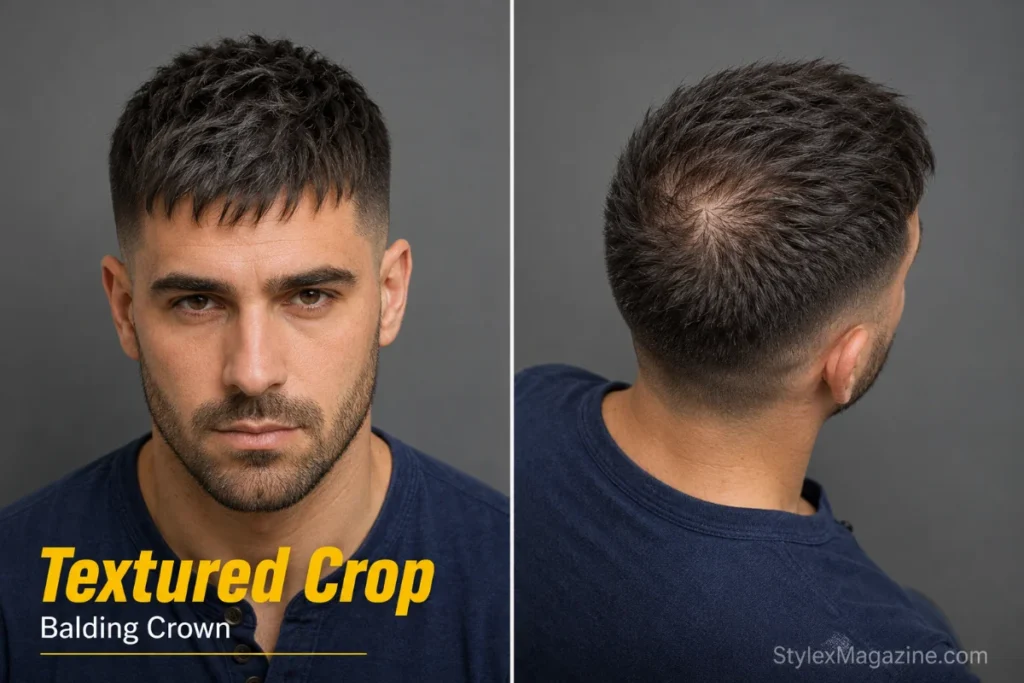
Short choppy layers across the top, low fade on the sides. The rough texture spreads across the crown and creates enough visual noise to break up the thinning patch. Unlike the textured crop for a receding hairline where the fringe does the heavy lifting this version focuses all its energy on crown coverage. Cillian Murphy’s Peaky Blinders crop demonstrates how a short, textured top disguises thinning at the vertex without looking like it is trying.
Styling tip: Texture powder at the crown for root lift, matte clay through the front. Beard pairing: Medium stubble. Every 3-4 weeks.
2. Crew Cut
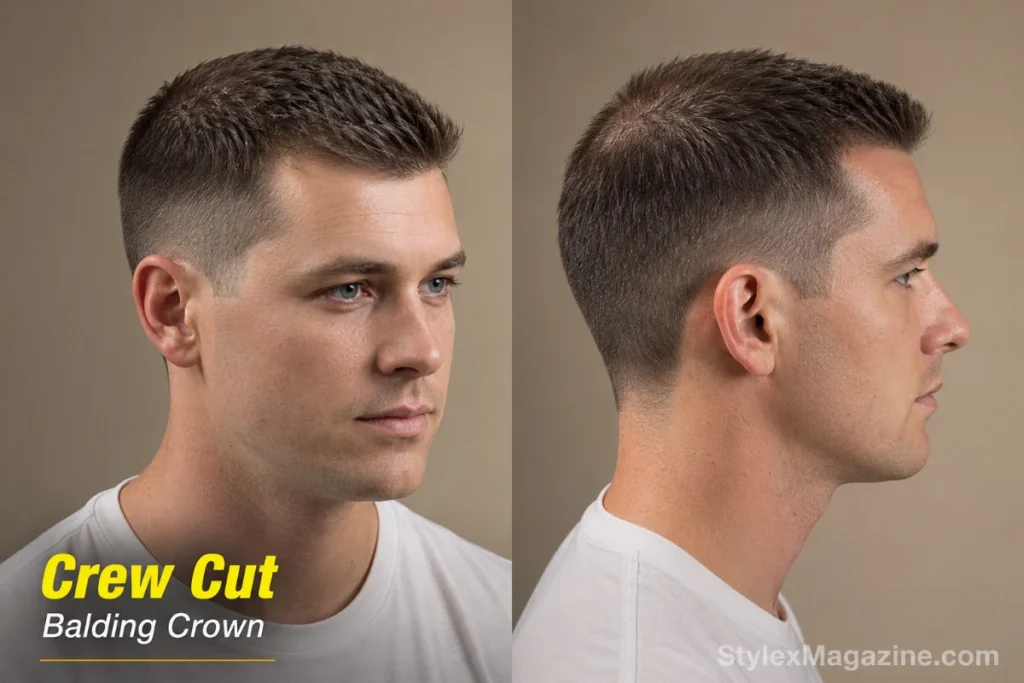
Longer at the front, gradually shorter toward the crown. The taper means the crown sits at its shortest point, which compresses the visible thinning into the surrounding hair. Ryan Reynolds keeps clean crew variations that hold the crown tight and never look overworked.
Styling tip: Light matte paste through the front only leave the crown alone. Beard pairing: Clean shaven or light stubble. Every 3-4 weeks.
3. Caesar Cut
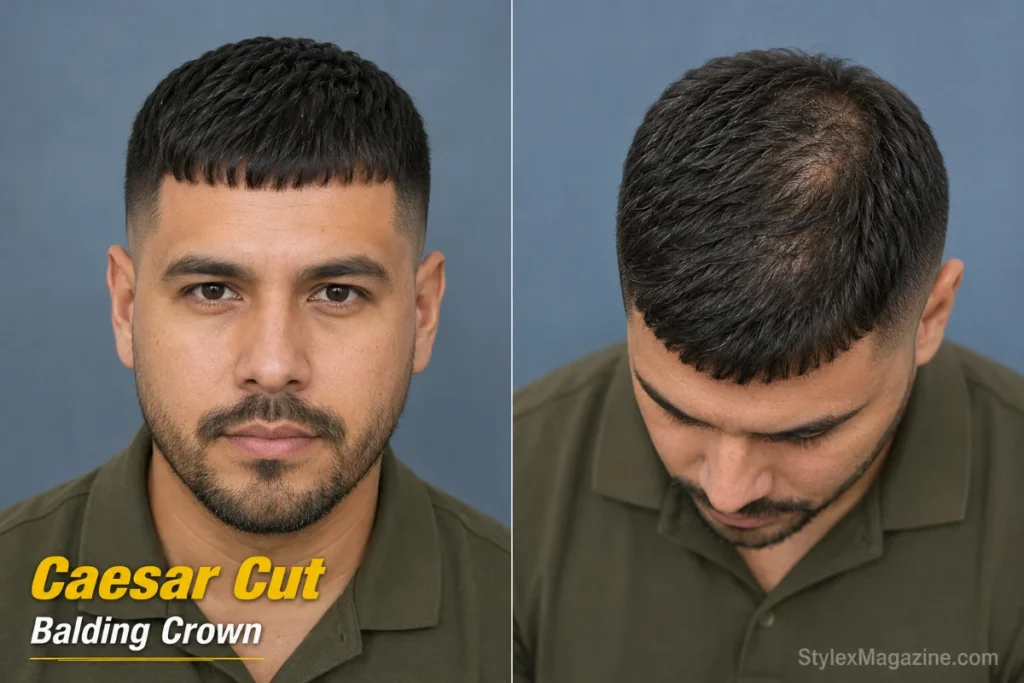
Short blunt fringe pushed forward, low fade on the sides. The forward direction of the top hair naturally drapes toward the crown from front to back, filling the thinning zone without any comb-over mechanics. George Clooney wore the Caesar through his ER years and gave it permanent credibility for men managing early crown loss.
Styling tip: Styling cream pushed forward gravity does the work. Beard pairing: Medium stubble. Every 3-4 weeks.
4. Low Fade with Textured Top
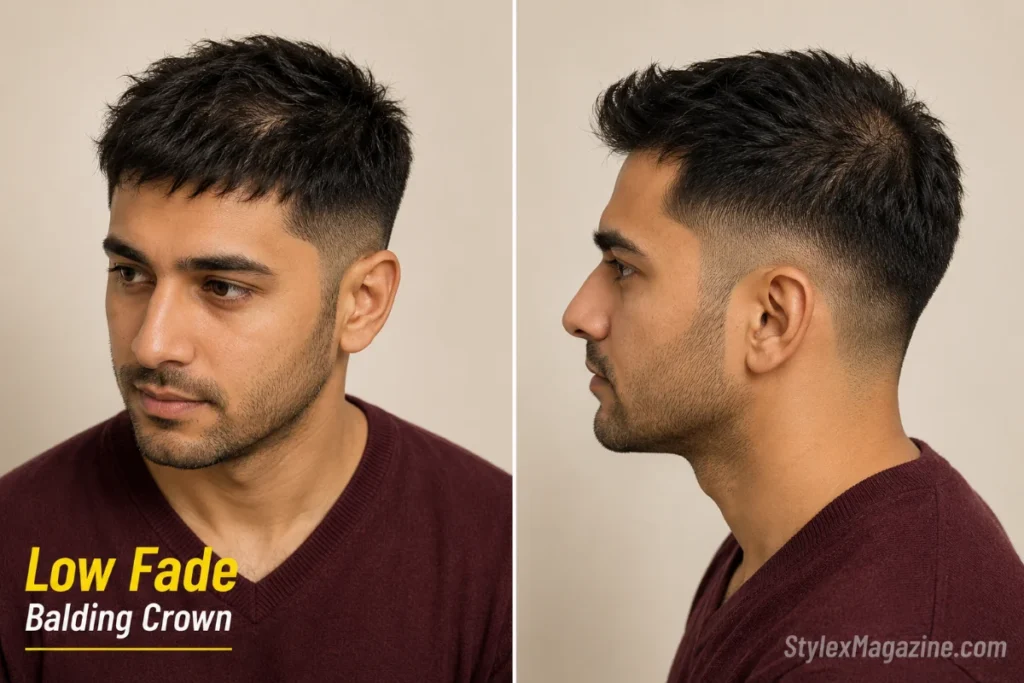
A fade for balding men that starts just above the ear. The low placement keeps the sides understated while the textured top creates enough movement to break up the thinning crown area. The fade blends the density difference between sides and top gradually instead of sharply.
Styling tip: Matte clay worked through the top in all directions for maximum spread. Beard pairing: Stubble to short beard. Every 2-3 weeks.
Best Haircuts for a Bald Spot on Top
A bald spot is more localised than general crown thinning a distinct bare patch surrounded by denser hair. The styling challenge moves from “disguise the thinning” to “erase the boundary between the patch and everything around it.”
5. Buzz Cut
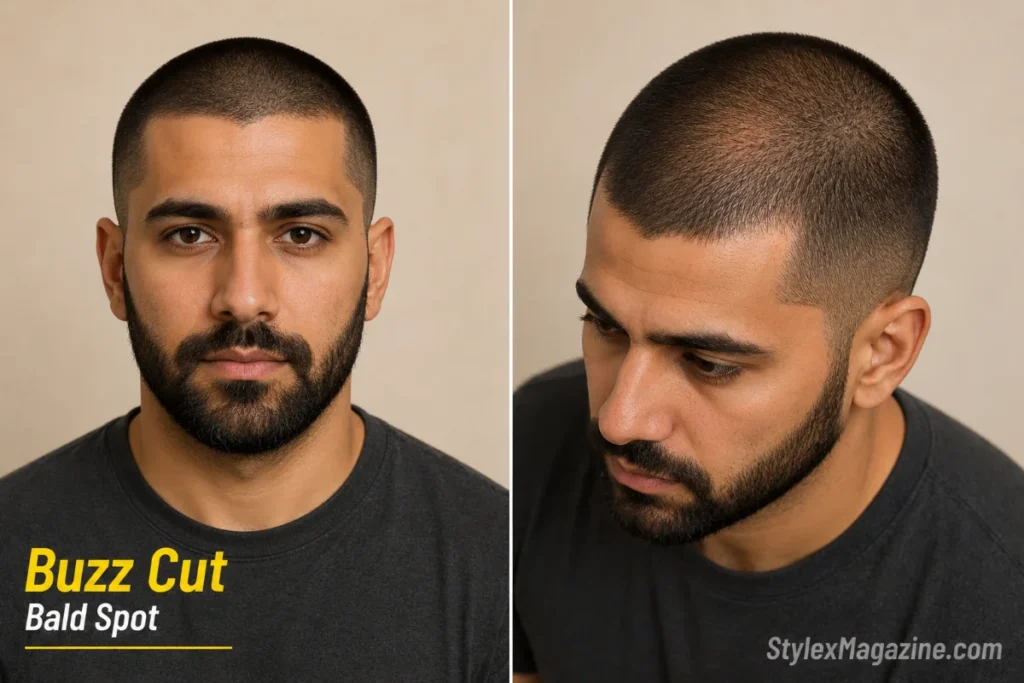
Even length all over, #1 or #2 guard. The uniform length absorbs the bald spot into the surrounding hair — the patch disappears because nothing around it is longer enough to expose the gap. The single most reliable and lowest maintenance haircut for balding men no product, no styling, no barber dependency. Jason Statham turned this into a signature and proved that owning the loss carries more weight than fighting it (source: Man For Himself).
Styling tip: No product needed. Beard pairing: Full beard or heavy stubble adds structure to the lower face. Every 1-2 weeks.
6. Skin Fade (Bald Fade)
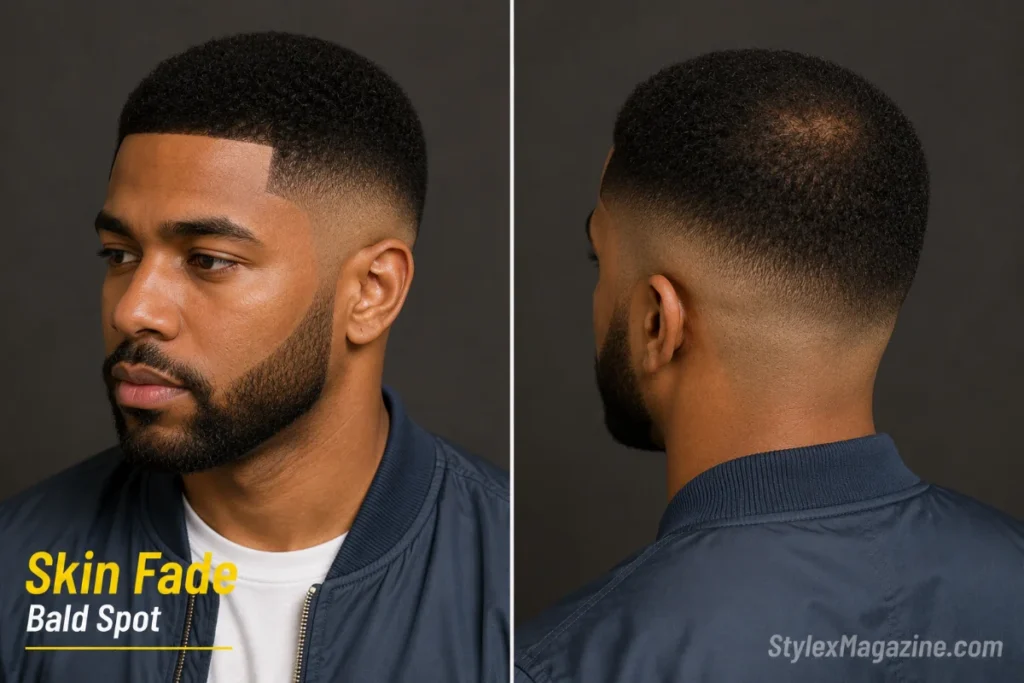
Fades from bare skin at the neckline up through the sides, blending into whatever length remains on top. The gradient normalises the transition between bare scalp and hair, so the bald spot looks like part of the architecture rather than a gap. This cut has become one of the most-watched grooming categories on social media before-and-after bald fade clips routinely pull millions of views because the transformation is dramatic and immediate.
Styling tip: Keep the top as short as the fade allows length on top next to a skin fade highlights the spot rather than hiding it. Beard pairing: Short beard. Every 2 weeks.
7. High Fade
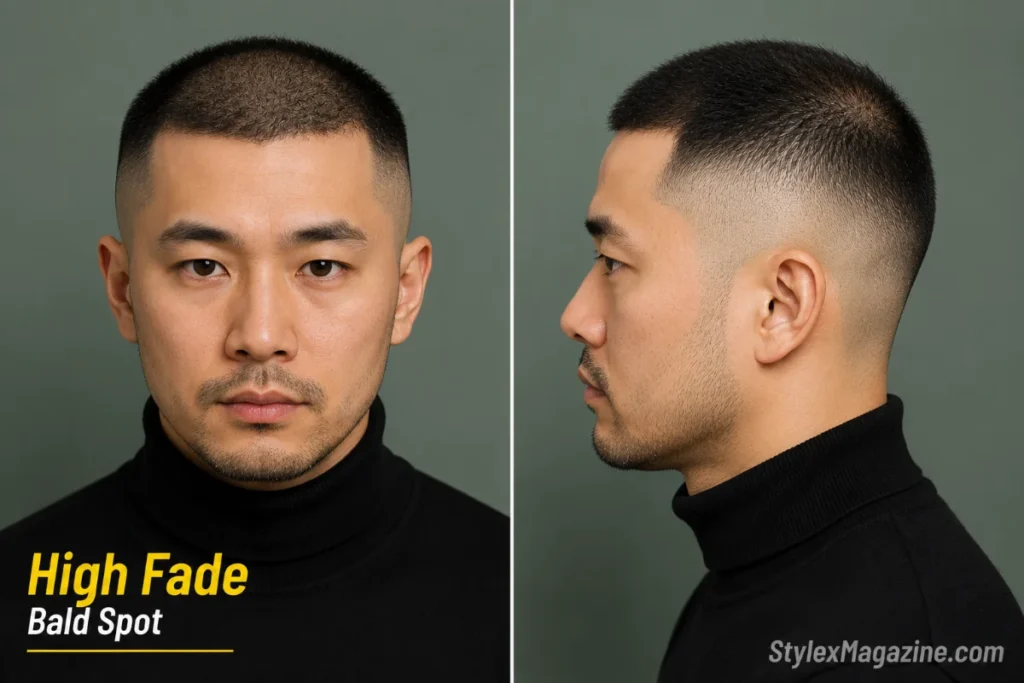
The fade starts high on the temples and sides, meeting the top hair near the crown. This pulls the “short zone” up close to where the bald spot sits, so the transition between bare scalp and faded sides feels like one continuous gradient. Michael B. Jordan maintains high fades tight enough that any scalp visibility on top looks intentional.
Styling tip: No product on the sides, light texture on whatever top length exists. Beard pairing: Sharp stubble. Every 2 weeks.
8. Induction Cut
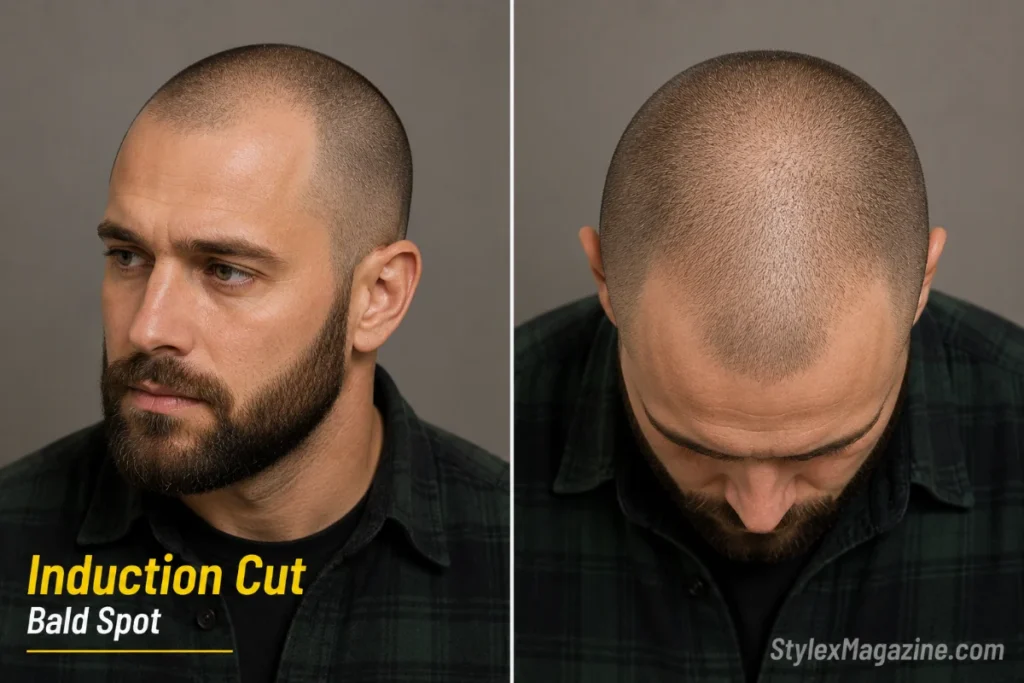
The shortest clipper cut before a full razor shave no guard or a #0.5 guard. Shadow-length across the entire head. When the bald spot is large enough that a #2 buzz still shows it, the induction cut compresses everything one step further without the commitment of daily razor shaving.
Styling tip: None this is zero maintenance. Beard pairing: Full beard anchors the lower face and completes the silhouette. Every 1-2 weeks.
Best Haircuts When Recession Meets Crown Loss
This is Norwood 4-5 territory. The receding front and the thinning crown are moving toward each other. The strip of hair connecting them the “bridge” narrows, and the window for styling shrinks with it. These cuts serve both zones simultaneously.
9. French Crop
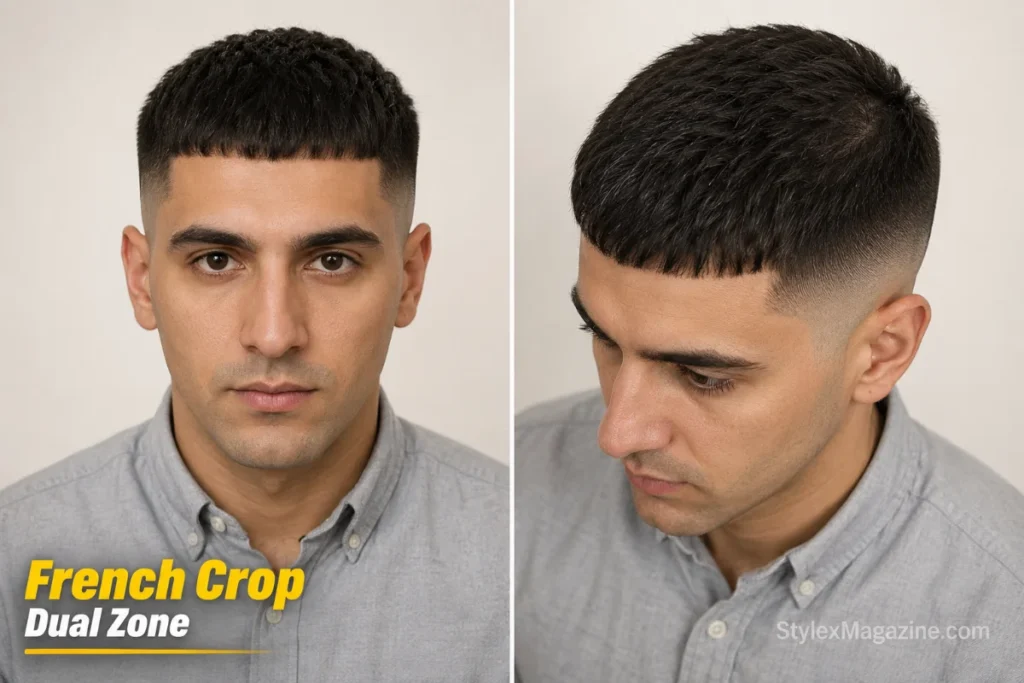
Blunt forward fringe with a tight fade. The forward direction handles the receding front AND pushes hair toward the crown, pulling double duty. Only works while the bridge still holds enough density to support the forward fall. Zayn Malik’s cropped versions show how much a short forward fringe conceals even when the hairline has moved back.
Styling tip: Blow-dry forward on low heat, finish with a light cream. Beard pairing: Medium stubble. Every 3-4 weeks.
10. Ivy League
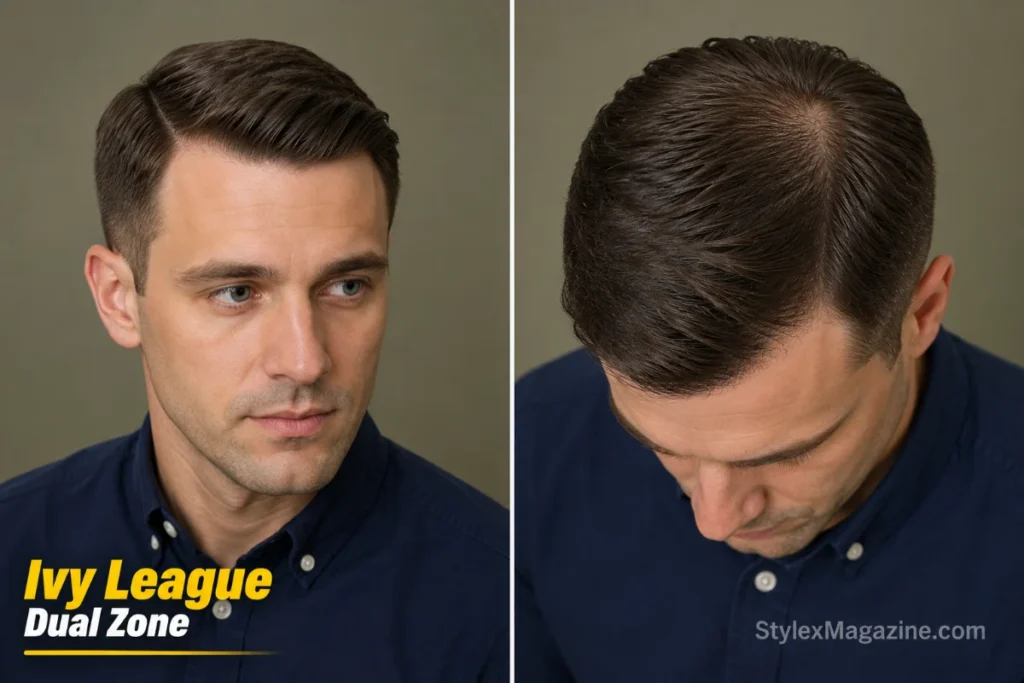
Short enough to avoid exposing the thinning bridge, long enough to sweep to one side and draw the eye laterally. The side part pulls attention across the head rather than along the front-to-back path where the bridge is narrowing. Chris Evans keeps this structure through most of his appearances always clean, always age-appropriate.
Styling tip: Light pomade, natural side part — no blow-drying required. Beard pairing: Clean shaven or light stubble. Every 3-4 weeks.
11. Modern Comb Over
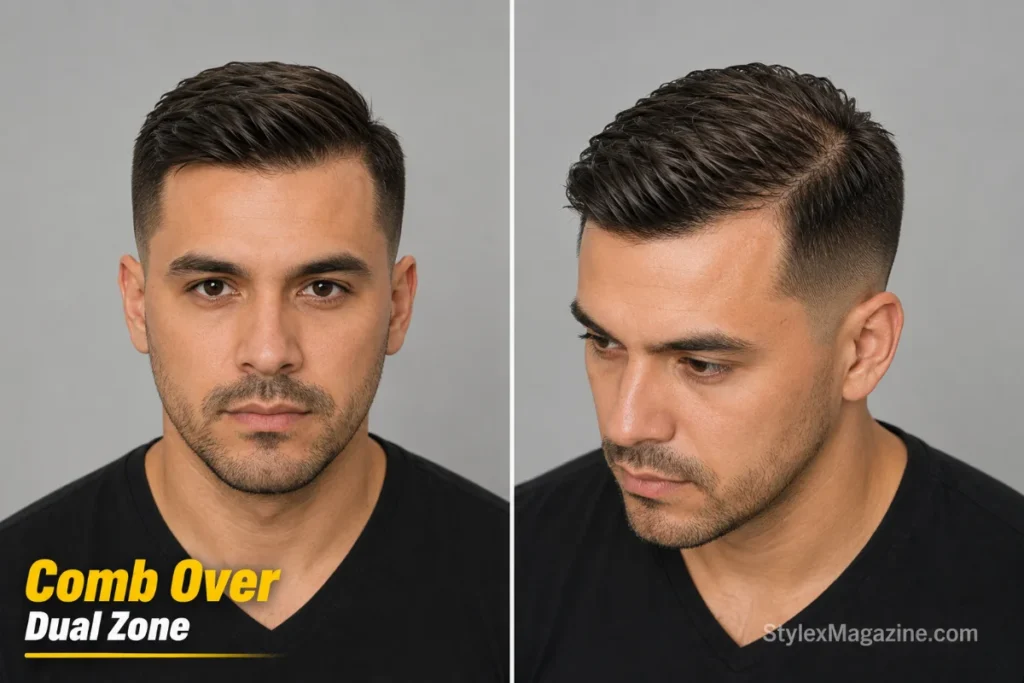
Short, textured, swept to one side. The modern comb over balding men version uses the remaining bridge hair directionally sweeping it across the thinning path rather than trying to cover it head-on. David Beckham’s recent variations use a soft sweep with a taper that looks structured without looking like a rescue operation.
Styling tip: Lightweight cream on towel-dried hair, swept to your natural fall side. Beard pairing: Light to medium stubble. Every 3-4 weeks.
12. Mid Fade with Short Top
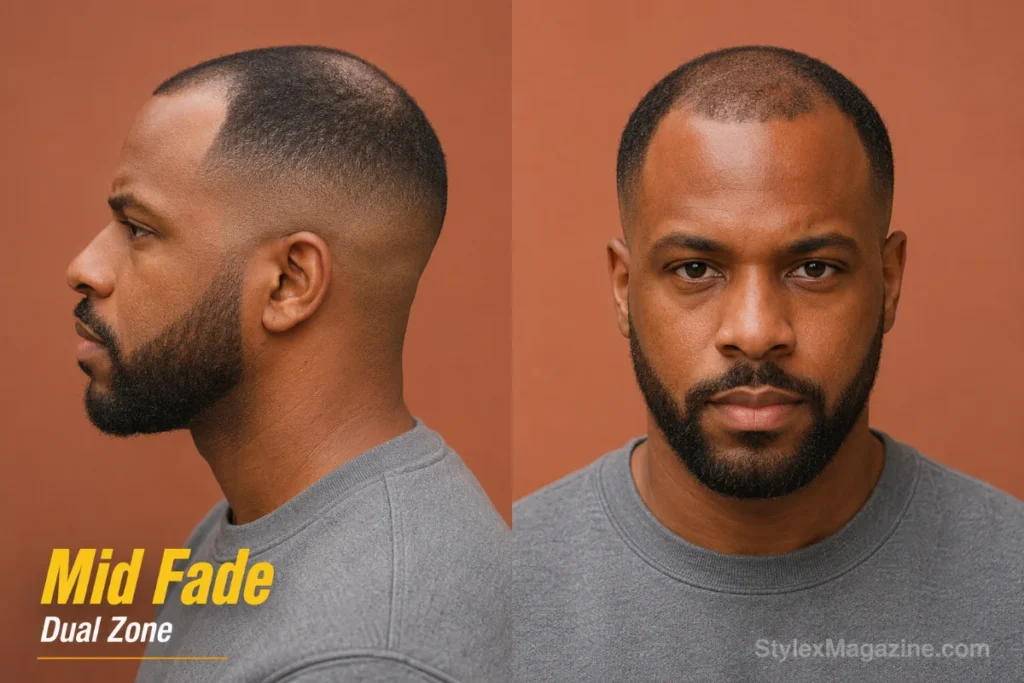
The fade starts midway up the sides, blending the density transition between the thicker perimeter hair and the thinning top. Keeps the top short enough that the bridge area does not look see-through. Idris Elba wears clean mid fades that keep everything proportional without drawing attention to any single area.
Styling tip: Matte clay on the top only, minimal amount. Beard pairing: Short beard. Every 2-3 weeks.
Best Haircuts for Advanced Balding
At Norwood 6-7, the top is bare or nearly bare. Only a band of hair remains around the sides and back — the horseshoe pattern. The goal shifts entirely: stop styling what is not there. Work with what IS there.
13. Clean Shave
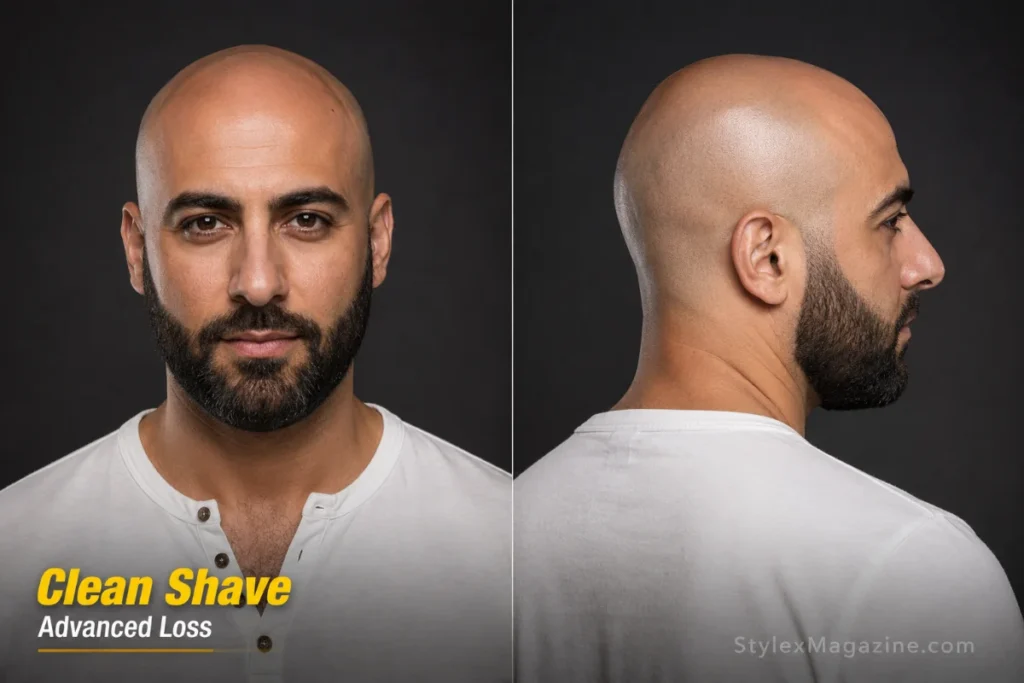
Razor shave, no clipper. Removes the horseshoe pattern entirely. A bare scalp with a groomed beard has become one of the strongest combinations in men’s grooming and for many men, the clean shave looks objectively better than the best short cut they were holding onto. Dwayne Johnson, Vin Diesel, and Stanley Tucci each chose the clean shave when other options still existed. That is the point — it works as a choice, not a surrender.
Styling tip: Moisturise the scalp daily, shave every 2-3 days. Beard pairing: Full beard transforms the profile.
14. Bald with Designer Stubble
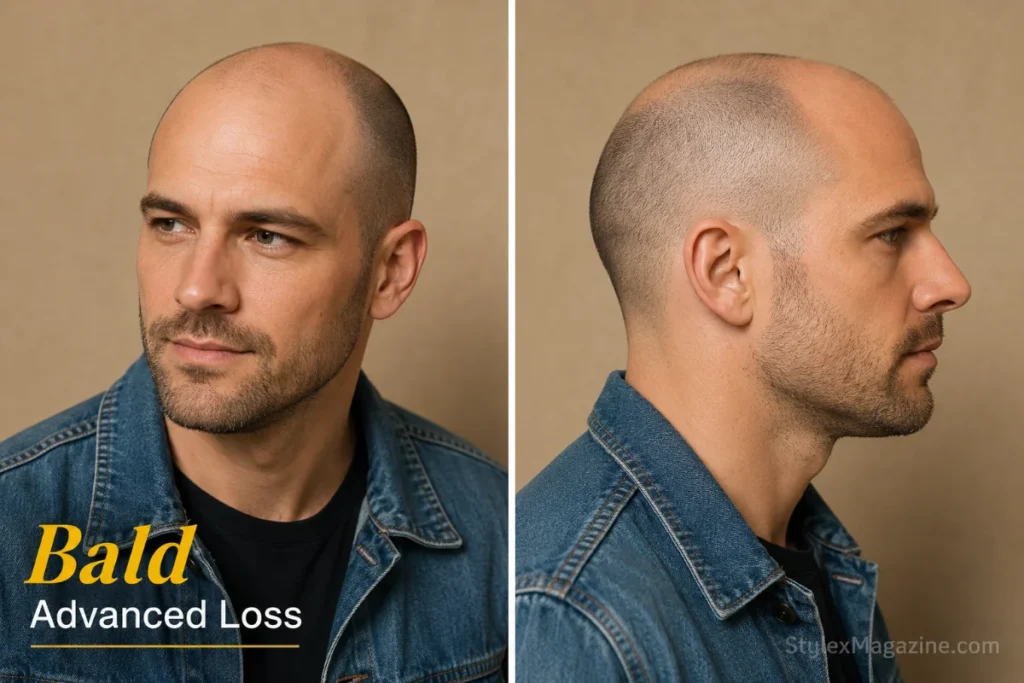
Razor or #0 guard on the head, 3-4mm stubble on the face. Less grooming commitment than a full beard, more structure than a bare face. The stubble adds just enough facial texture to anchor the look. Jason Statham built his entire public image on this exact combination close-cropped scalp, permanent 5 o’clock shadow.
Styling tip: Trim the stubble every 2-3 days with a detail trimmer for clean edges. Beard pairing: This IS the beard pairing.
15. Horseshoe Buzz
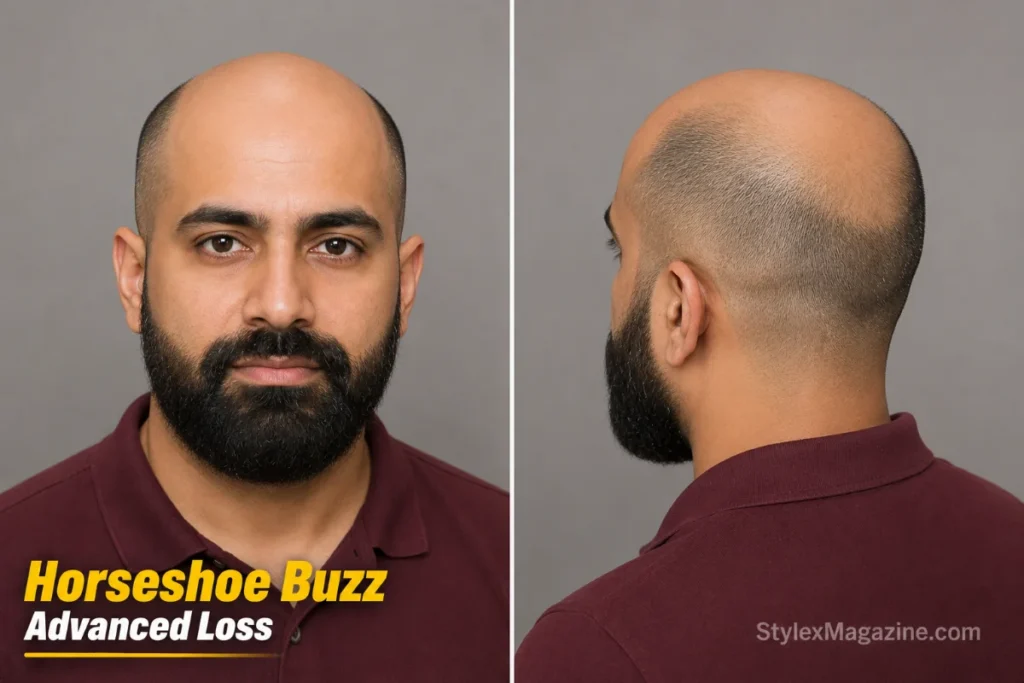
Instead of a full razor shave, buzz the remaining side and back hair to a #0.5 or #1 guard. The short length on the sides minimises the “ring of hair” effect without the daily commitment of razor shaving. For men who want the benefits of a shaved look with the ease of a weekly clipper pass.
Styling tip: Maintain the uniform short length every 1-2 weeks at home. Beard pairing: Full beard or heavy stubble. Avoid a clean-shaven face with the horseshoe the combination looks unfinished.
16. Shaved Head with Full Beard
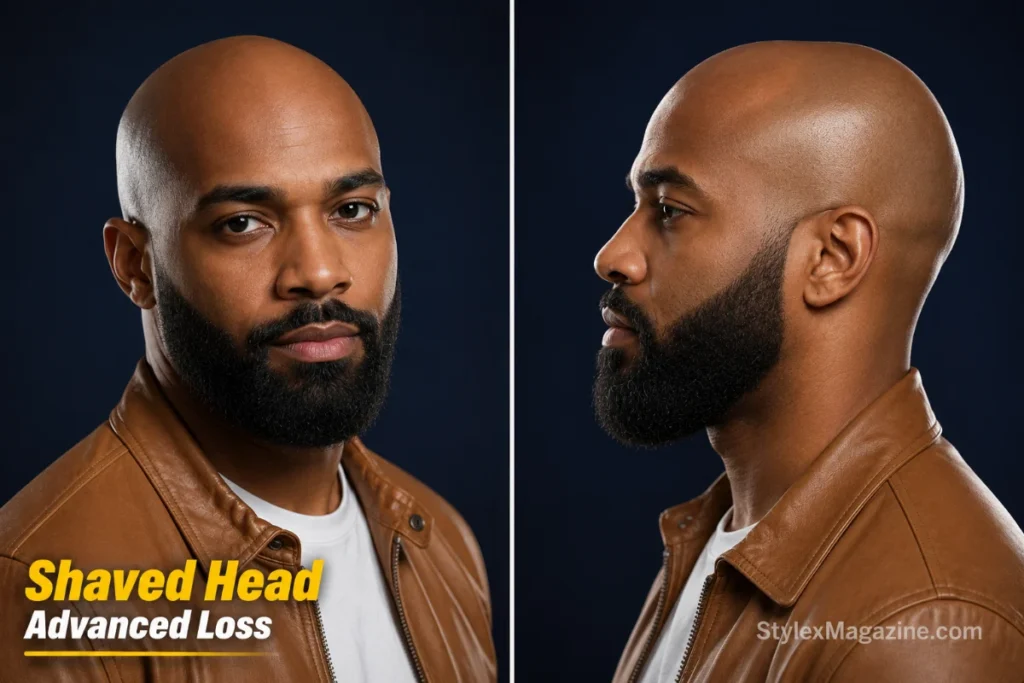
This combination has become its own category. The bare scalp creates a clean canvas on top. The full beard fills in the bottom half of the face with texture and structure. Together they produce a balanced, masculine silhouette.
Here is the part no competitor mentions: the DHT paradox works in your favour. The same hormone — dihydrotestosterone that thins scalp hair often promotes facial hair growth (source: Wimpole Clinic). Many balding men grow stronger, denser beards than men with full heads of hair. If you have been fighting scalp loss while ignoring a strong jaw full of potential, the math has been wrong.
Styling tip: Beard oil and regular professional shaping are non-negotiable at this level. Beard pairing: Full beard, shaped at the barber every 2 weeks. The beard is not optional here it IS the style.
Fades and Tapers That Work Across All Balding Stages
A fade is a modifier, not a standalone cut. It pairs with any style above. But the fade level changes everything for a balding head and choosing wrong makes the loss more visible than it needs to be.
17. Taper Fade
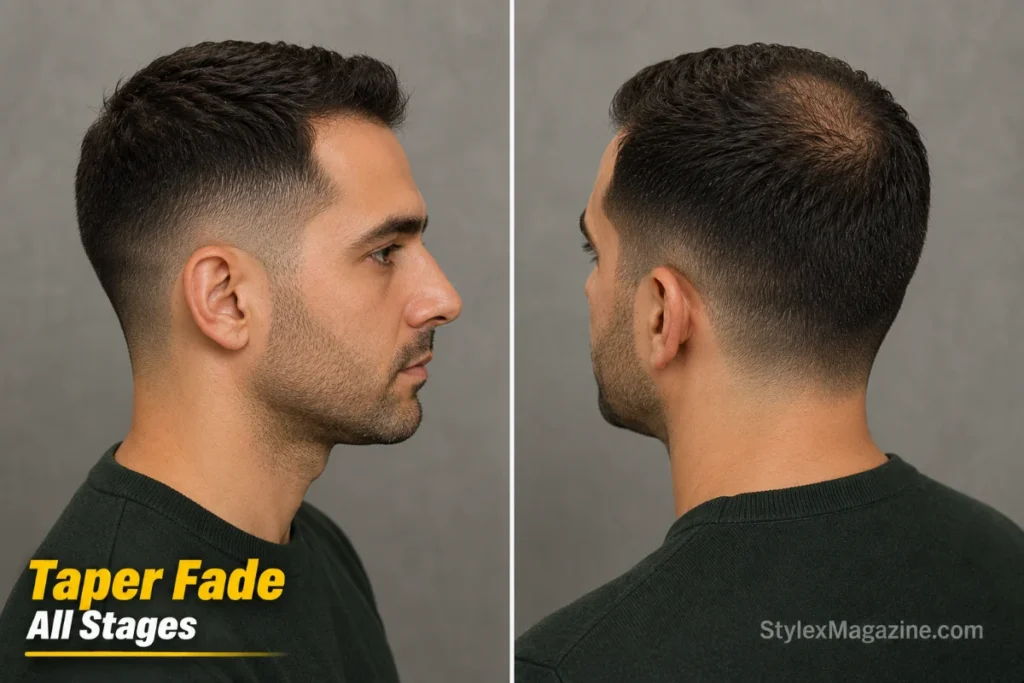
Gradual reduction from top to neckline, no skin showing. The softest option. Works across all stages because it never creates a harsh line that highlights where the density drops. Ryan Reynolds keeps a clean taper on nearly every appearance tight enough to look sharp, soft enough to grow out gracefully.
Styling tip: Let the taper do the blending — minimal product. Beard pairing: Any. Every 3-4 weeks.
18. Drop Fade
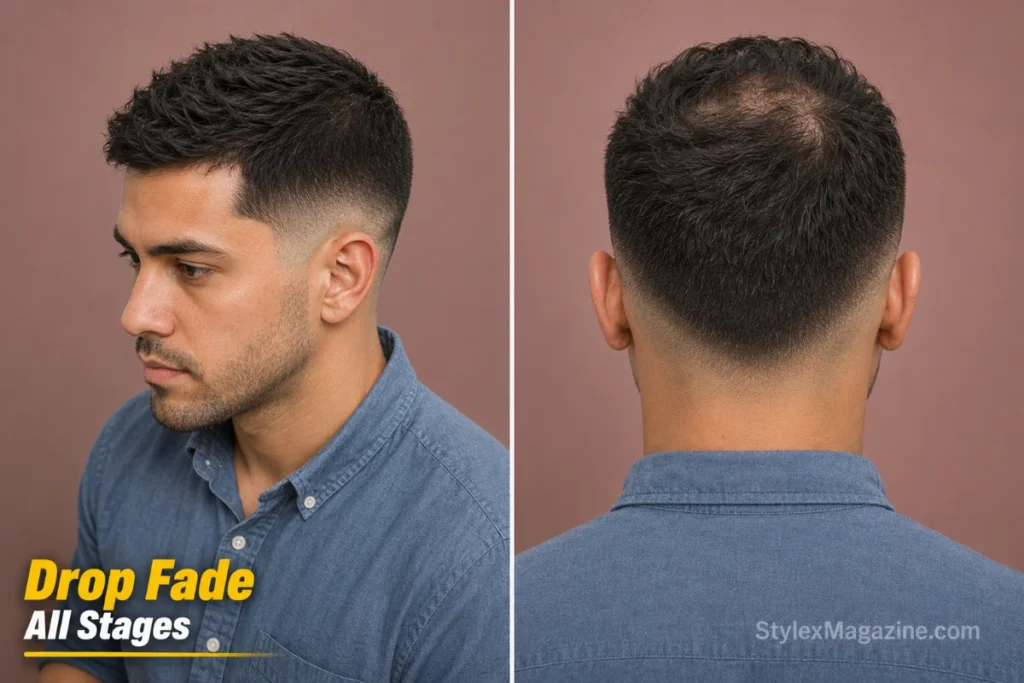
The fade line curves downward behind the ear instead of following a straight horizontal path. The arc follows the natural head shape and creates a smoother transition around the crown area exactly where most balding men need the most help. Travis Kelce wears drop fade variations that keep the sides interesting without competing with whatever is happening on top.
Styling tip: Pair with a textured top for the crown area. Beard pairing: Stubble. Every 2-3 weeks.
19. Shadow Fade
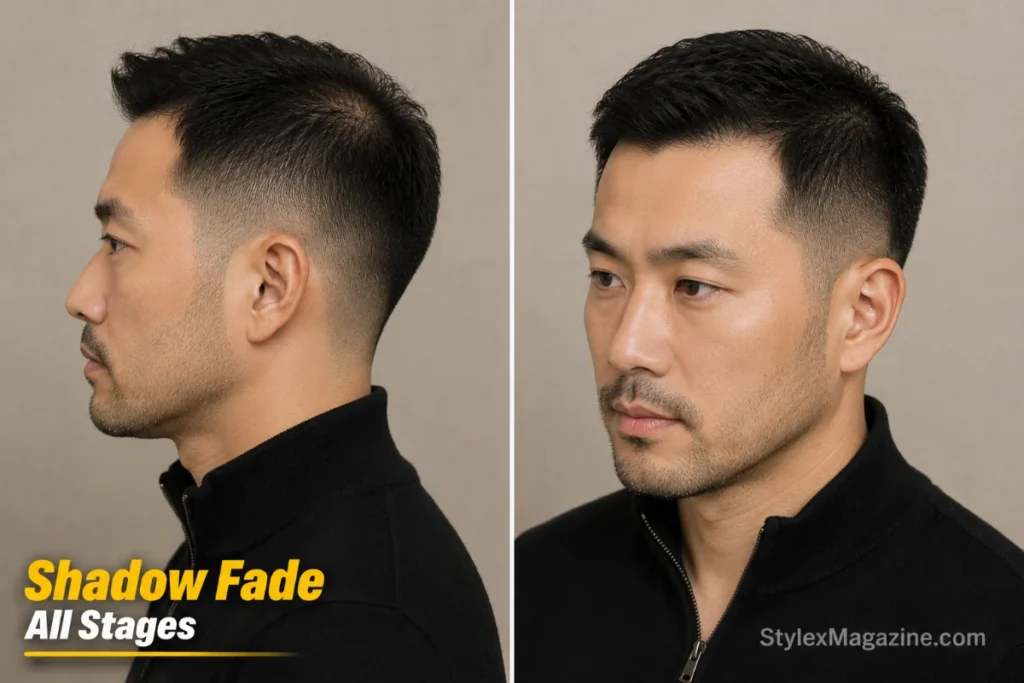
A very gradual fade that never reaches bare skin. The shortest point is a shadow of stubble rather than a clean line. This softens the density transition without the dramatic skin exposure of a bald fade. Good for men who want a clean look without the maintenance commitment of a skin fade refresh every two weeks.
Styling tip: The subtlety IS the style no product needed. Beard pairing: Shadow stubble on the face to mirror the fade. Every 2-3 weeks.
20. High and Tight
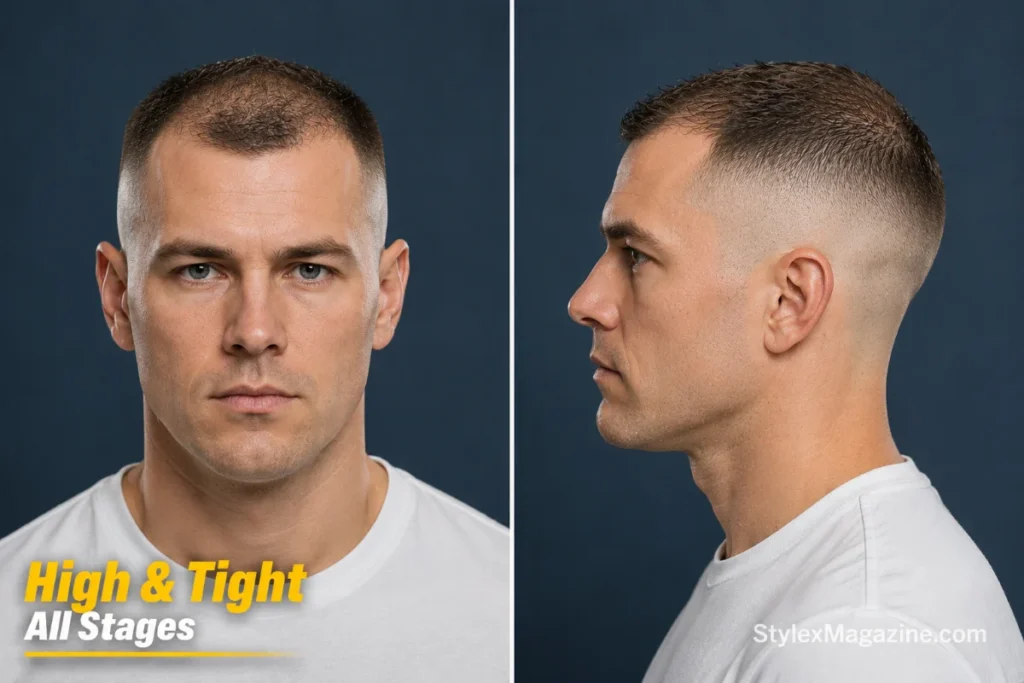
Skin fade on the sides and back, short on top. The military structure makes the entire head look shaped rather than thinning the sharp perimeter creates the impression of intentional architecture regardless of what is happening at the crown. Jake Gyllenhaal’s Jarhead cut defined this for a generation.
Styling tip: No product. Beard pairing: Clean shaven for military precision, stubble for edge. Every 2-3 weeks.
Which Cut Matches Your Face Shape?
Balding removes the frame at the top of the face. The right cut compensates for what the hair loss takes away.
| Face Shape | What Balding Does | Best Cuts | Avoid |
|---|---|---|---|
| Oval | Stays balanced — easiest to work with | Most styles: buzz, crew, clean shave, any fade | Nothing specific — oval faces tolerate almost everything |
| Round | Face looks wider and shorter without top hair | High fade, high and tight — anything adding vertical emphasis | Buzz cut alone without facial hair — removes all vertical structure |
| Square | Strong jaw holds the look, balding can suit angular features | Buzz cut, clean shave, skin fade — clean lines suit sharp bone structure | Long textured tops that fight the angular geometry |
| Oblong / Rectangle | Already long — losing top hair adds more vertical length | Caesar, French crop (horizontal fringe shortens the face), low fade | Clean shave without a beard — elongates further |
| Diamond / Heart | Narrow chin exposed without top hair creates imbalance | Textured crop, taper fade with some top length, styles with facial hair | Skin fade with bare face — maximises top-heavy look |
What Haircuts Should Balding Men Avoid?
Four styles consistently make balding more visible. The mistake behind all four is identical: they widen the gap between where hair exists and where it does not.
The Power Donut. Bald on top with a thick ring of hair around the sides the George Costanza. This is the default if you do nothing, and it ages you a decade. Buzz the sides short or shave entirely. Never leave the perimeter thick when the top is bare.
Long Combover Across a Bald Spot. Stretching long strands from one side over a bare crown fools nobody. In wind, under bright light, or wet, the scalp shows through and the attempt to hide becomes the most visible thing about the head.
Tight Braids or Man Buns on Thinning Hair. Both pull on weakened follicles and can accelerate loss through traction alopecia — hair loss caused by sustained tension on the hair root (source: Cleveland Clinic). The style damages the hair you are trying to save.
High-Shine Product on Sparse Hair. Gel, pomade, or any wet-look finish separates thinning strands and reflects light off the scalp between them. Matte clay, texture powder, or dry paste close the visual gaps. For extra density, hair building fibres (keratin-based products like Toppik) attach to existing strands and simulate fullness for several hours, and sea salt spray adds grit and volume to fine hair. This single product category swap matte over shine — matters more than the cut itself.
What Should You Tell Your Barber?
Point to where the thinning is, name a guard number for the sides, and state how much length you want on top. That gives your barber everything they need.
Crown thinning: “My crown is thinning. I want a textured crop with enough length on top to add some coverage. Keep the sides at a 1 guard, blend into the top.”
Bald spot on top: “I have a bald patch on top. Take the whole thing down to a 1 or 2 guard so it blends in. Fade the sides.”
Advanced — ready to let go: “Full shave. Clean it up with a razor. Shape my beard while you are at it.”
Bring a reference photo. It removes ambiguity faster than any verbal description. And state your maintenance window — if you visit every six weeks, a style that needs a two-week fade refresh will never look right past the first appointment.
FAQ
Does hair texture affect which cut works best for balding?
Curly and wavy hair fills gaps naturally and holds volume better on a thinning crown. Balding men with textured hair can keep slightly more length on top. Straight fine hair performs best at shorter lengths — buzz or crew — where the flat lay does not expose scalp.
Will wearing hats make balding worse?
No. Hats do not cause or accelerate hair loss. The myth comes from the association between hat-wearing and noticing hair on the hat brim, but that hair was already in the shedding phase. Wear hats freely just avoid extremely tight-fitting caps worn for extended hours, which can cause temporary traction on the hairline.
What is scalp micropigmentation and can it replace a haircut?
Scalp micropigmentation (SMP) tattoos tiny dots on the scalp to simulate the appearance of closely-cropped hair follicles. It works best paired with a buzz cut or clean shave the dots create the look of a full head of very short hair. SMP is a cosmetic procedure, not a haircut, but it changes what styles look realistic at advanced stages of loss.
How does sun exposure affect a balding scalp?
A thinning or bare scalp burns faster than skin covered by hair. UV damage on the scalp increases the risk of sunburn, premature aging of the skin, and long-term sun damage. Apply SPF 30+ sunscreen to exposed scalp daily or wear a hat outdoors. This applies to buzz cuts and clean shaves equally — any area where scalp is visible needs protection.
Should I cut my own hair if I am balding?
For buzz cuts and induction cuts, yes a quality home clipper with guard attachments handles both cleanly. Run the clipper against the grain in all directions for an even finish. For anything with a fade, taper, or textured top, a barber is non-negotiable — the precision those cuts need is nearly impossible to replicate on your own head with limited visibility at the crown and back.

Other Articles
[…] you are still in the thinning stage and not ready to shave, the guides for haircuts for balding men and thinning hair haircuts cover options that buy time. This page is about what to grow on your […]
[…] The buzz cut is the strongest haircut for thinning or receding hair because uniform short length reduces contrast between thick and thin areas. Adding a beard shifts visual weight downward and compensates. For more options, see haircuts for receding hairline and haircuts for balding men. […]