
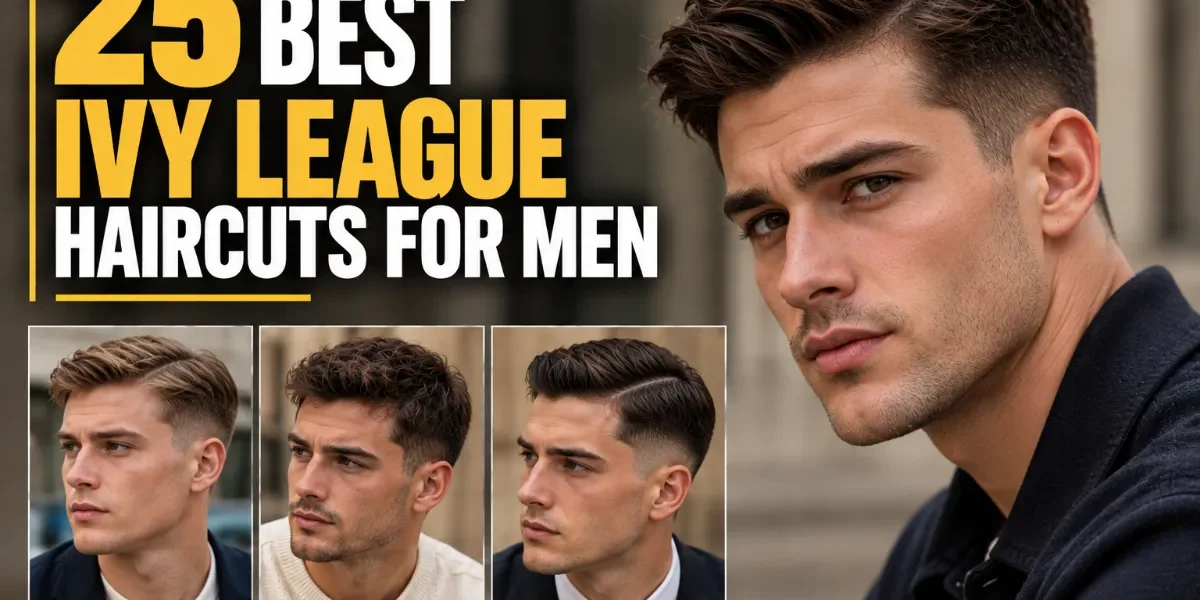

Quick Answer: The ivy league haircut is a tapered short cut with 1–2.5 inches on top and graduated sides — long enough to part or brush to one side. Also called the Princeton or Harvard Clip, it sits between a crew cut and a side part in length and formality.
What Is an Ivy League Haircut?
The ivy league haircut originated on American Ivy League campuses during the 1950s. Barber trade textbooks from that era — including L. Sherman Trusty’s The Art and Science of Barbering (1971), define it as a tapered cut with enough length on top to part to one side, shorter at the crown, and progressively shorter through the sides and back. Other names include the Princeton and the Harvard Clip. All three refer to the same structure.
What separates it from similar short cuts is what barbers call a “convertible” haircut, one base cut that can be styled multiple ways. Part it for a board meeting, brush it forward for a weekend, or add texture with matte clay. That range from a single cut is why it has outlasted every trend cycle since the Eisenhower era.
For the full rundown of timeless cuts in this category, see classic men’s haircuts.
25 Best Ivy League Haircut Styles
1. Classic Ivy League
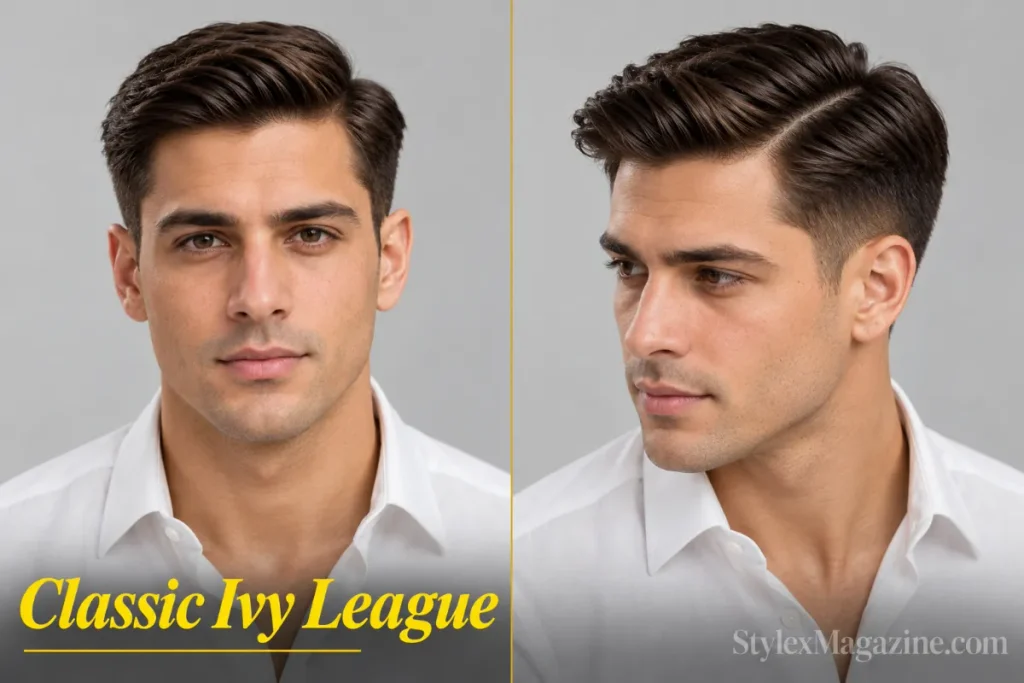
- Lengths: 1.5–2″ on top, #2–3 guard on sides, scissor-blended taper
- Best for: Oval and square faces | Straight to slightly wavy hair
The original. A clean side part, tapered sides, and just enough length on top to comb into place. No fade, no hard lines, just a well-executed scissor cut with clippers on the lower sides.
This is the version to start with if you’ve never had an ivy league before. It suits most face shapes without modification, and it grows out cleanly between cuts.
2. Ivy League with Low Fade
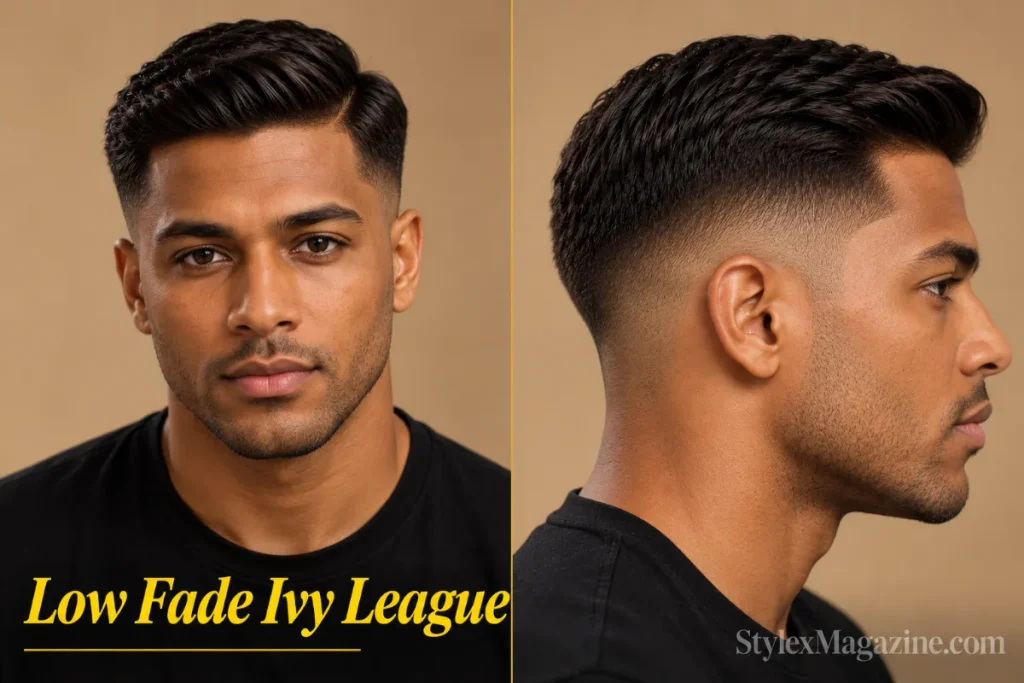
- Lengths: 2″ on top, low fade from #0 around the ears to #2 at the temples
- Best for: Oval and heart faces | All hair textures
The low fade haircut starts just above the ear and blends upward into the longer top. It adds a sharper edge to the classic ivy league without making it look aggressive.
I recommend this for men who want the traditional shape up top but prefer a cleaner perimeter. The fade does the work the taper does in the classic version, just with more contrast.
3. Ivy League with Mid Fade
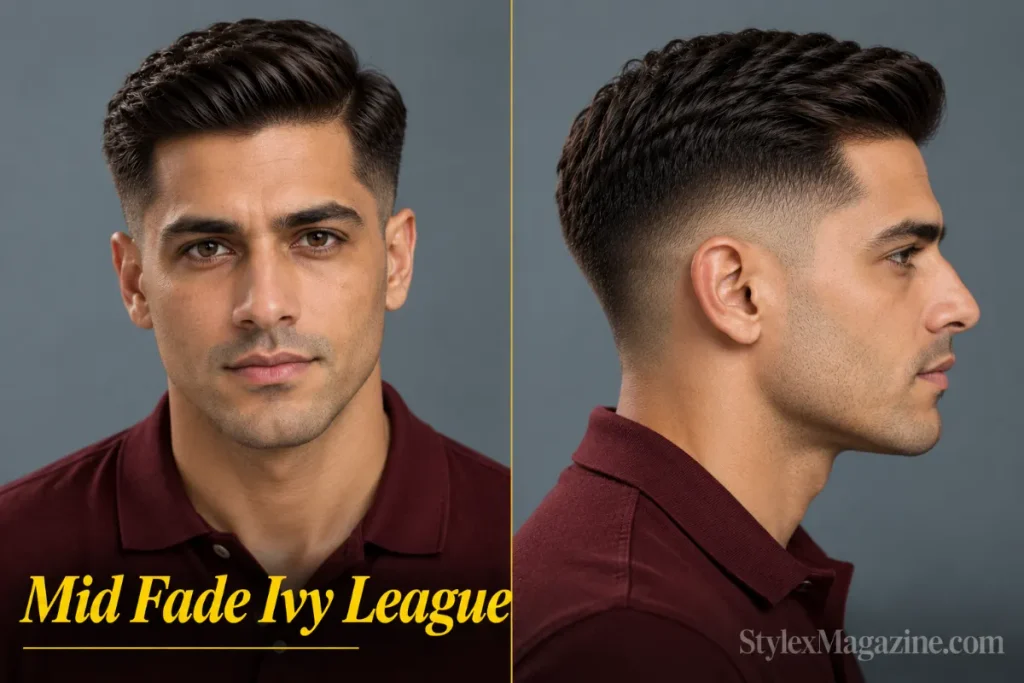
- Lengths: 1.5–2″ on top, mid fade haircut starting at the temple line
- Best for: Square and diamond faces | Straight and wavy hair
The mid fade hits the balance point — more contrast than a low fade, less dramatic than a high fade. The fade line sits at the temples, which draws attention to the jawline.
On square and diamond face shapes, this placement highlights the angles. If your face is round, a mid fade alone won’t add enough vertical length, go with a high fade instead.
4. Ivy League with High Fade
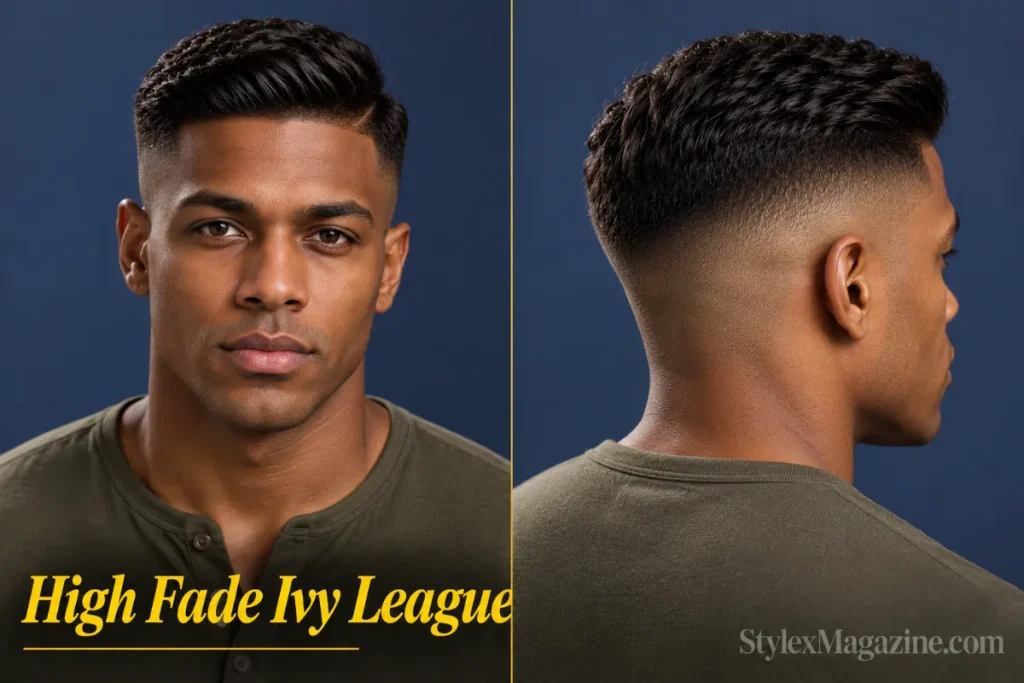
- Lengths: 1.5–2″ on top, high fade haircut starting above the temple
- Best for: Round and oval faces | All hair textures
A high fade clears most of the side hair, leaving the weight concentrated on top. That height-to-width ratio stretches a round face vertically — the single most effective structural adjustment for rounder features.
The trade-off: more barber visits. A high fade loses shape faster than a taper or low fade, so expect to book every 2–3 weeks instead of 3–4.
5. Ivy League with Skin Fade
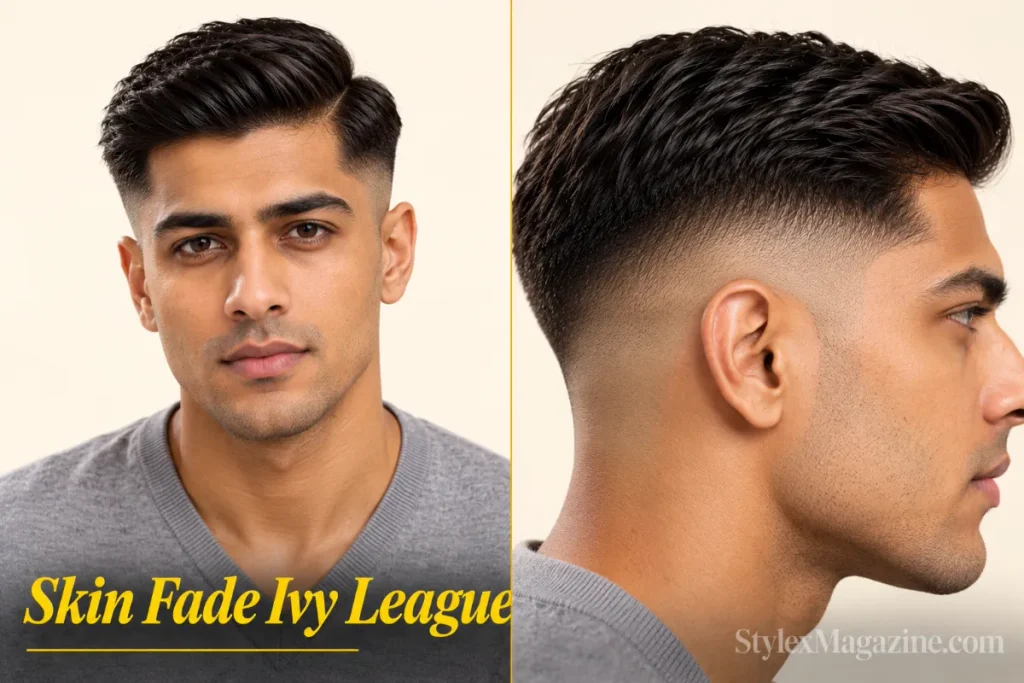
- Lengths: 2″ on top, skin fade (#0 to skin) from neckline to temple
- Best for: Oval, square, and diamond faces | Straight and coarse hair
The skin fade takes the contrast to its maximum, bare skin at the lowest point, blending into a full-length top. It’s editorial-level sharpness. The kind of cut that looks intentional from every angle.
Not ideal if your scalp shows irritation easily. The #0 blade cuts close enough that razor bumps and ingrown hairs become a factor, especially on sensitive skin. Ask your barber to finish with a balm, not aftershave.
6. Textured Ivy League
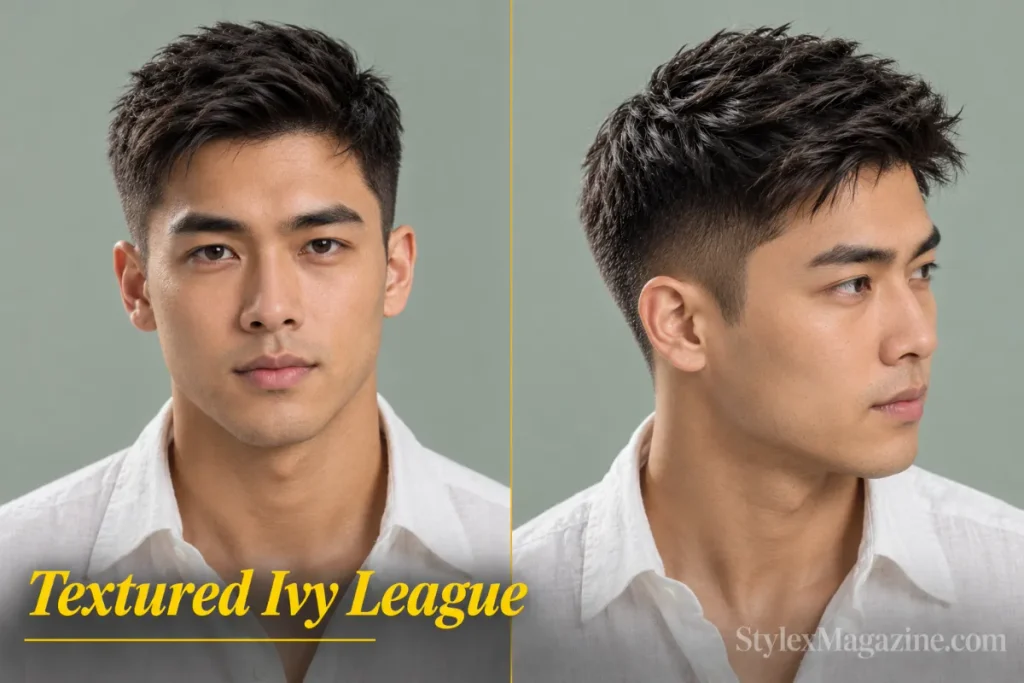
- Lengths: 1.5–2″ on top (point-cut for texture), #2–3 tapered sides
- Best for: Oval and oblong faces | Thick and wavy hair
Point cutting the top instead of blunt cutting creates natural movement — pieces fall at different lengths, catching light differently. Finish with matte clay, not pomade. Shine kills the effect.
This variation works particularly well on thick hair that tends to sit flat. The layered texture breaks up the bulk without thinning it out, and it requires less daily styling than a slicked or parted version.
7. Ivy League with Side Part
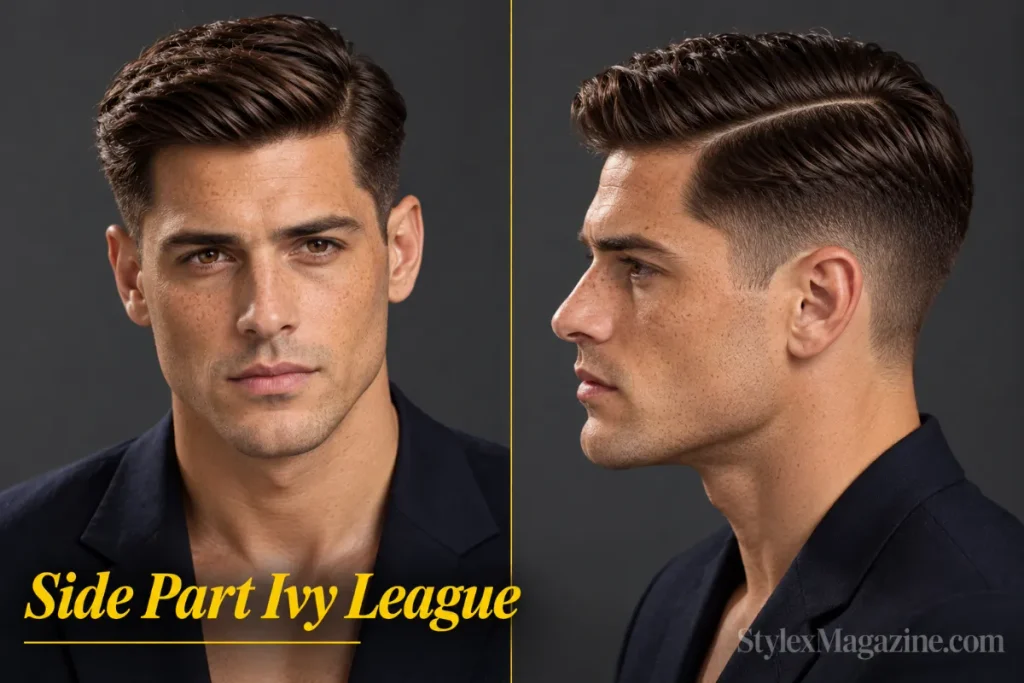
- Lengths: 2–2.5″ on top (longer on the parting side), #2 tapered sides
- Best for: Oval, square, and heart faces | Straight and wavy hair
A hard part (razored line) gives a sharper look. A soft part (combed, no razor) keeps it more natural. Both are valid, hard parts photograph better; soft parts age better as the cut grows out.
Place the part along the natural growth line. Force it to the wrong side and you’ll fight the hair every morning. Not sure where your natural part falls? Towel-dry your hair and push it back, it’ll split where it wants to.
8. Slicked-Back Ivy League
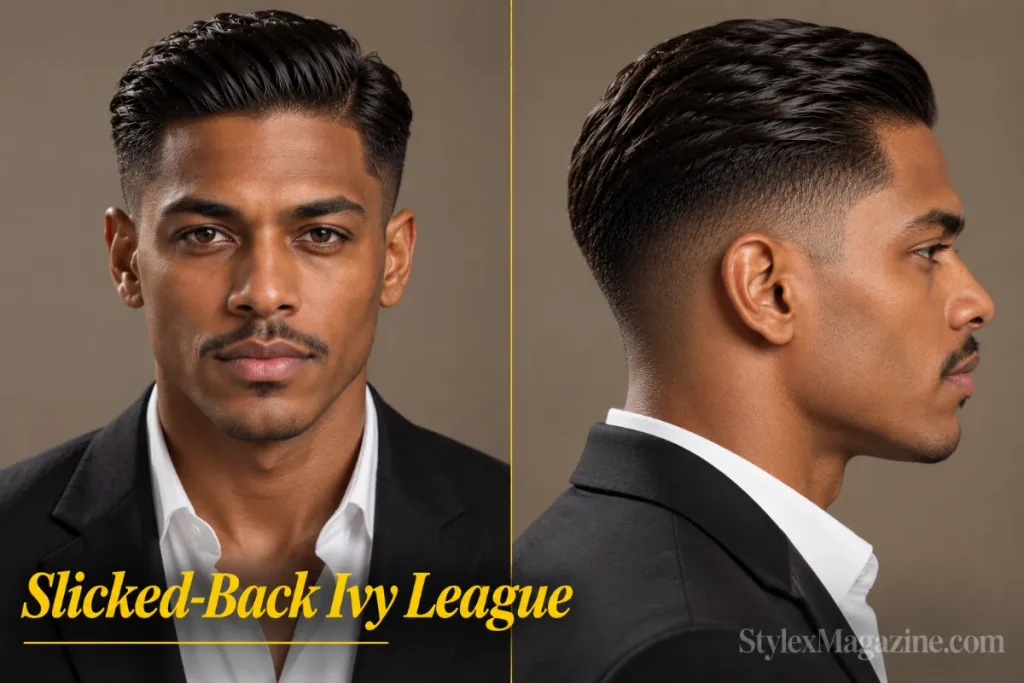
- Lengths: 2–2.5″ on top (minimum for slick-back hold), #2 tapered sides
- Best for: Oval and square faces | Straight hair
The slicked-back variation needs enough length for the product to grip, anything under 2 inches on top won’t stay back. Use a medium-hold pomade for shine, or a matte paste if you want the direction without the gloss.
Reserve this for formal settings or events. Daily wear with heavy pomade builds product residue that dulls the hair over time. If you’re wearing this version daily, clarifying shampoo once a week becomes non-negotiable.
For more on this direction, see slick back hairstyles.
9. Ivy League for Curly Hair
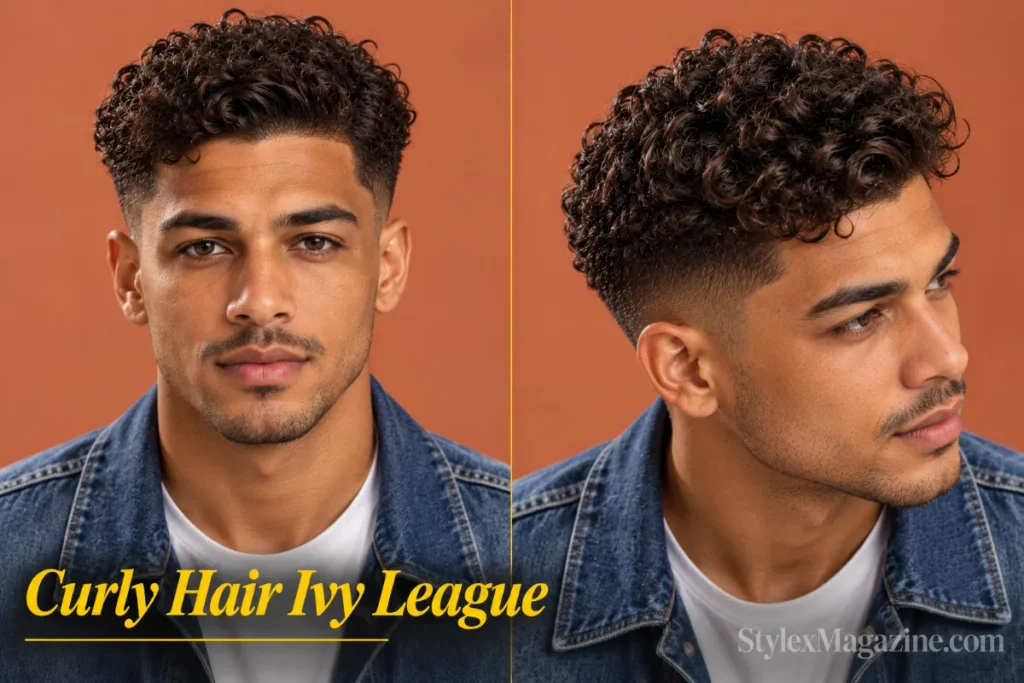
- Lengths: 2–2.5″ on top (to let curls form fully), #2–3 tapered sides
- Best for: Oval, diamond, and heart faces | Type 2C–3B curls
Curly hair needs more length than straight hair to achieve the same visual result. A curl that measures 2.5 inches stretched might only show 1.5 inches of length when dry. Cut too short, and the curls can’t form, you end up with frizz, not definition.
Diffuse on low heat instead of blow-drying straight. A light curl cream replaces pomade or clay here. Avoid thinning shears — they create flyaways in curly textures that are nearly impossible to control.
For more curl-specific cuts, see curly hairstyles for men.
10. Ivy League for Wavy Hair
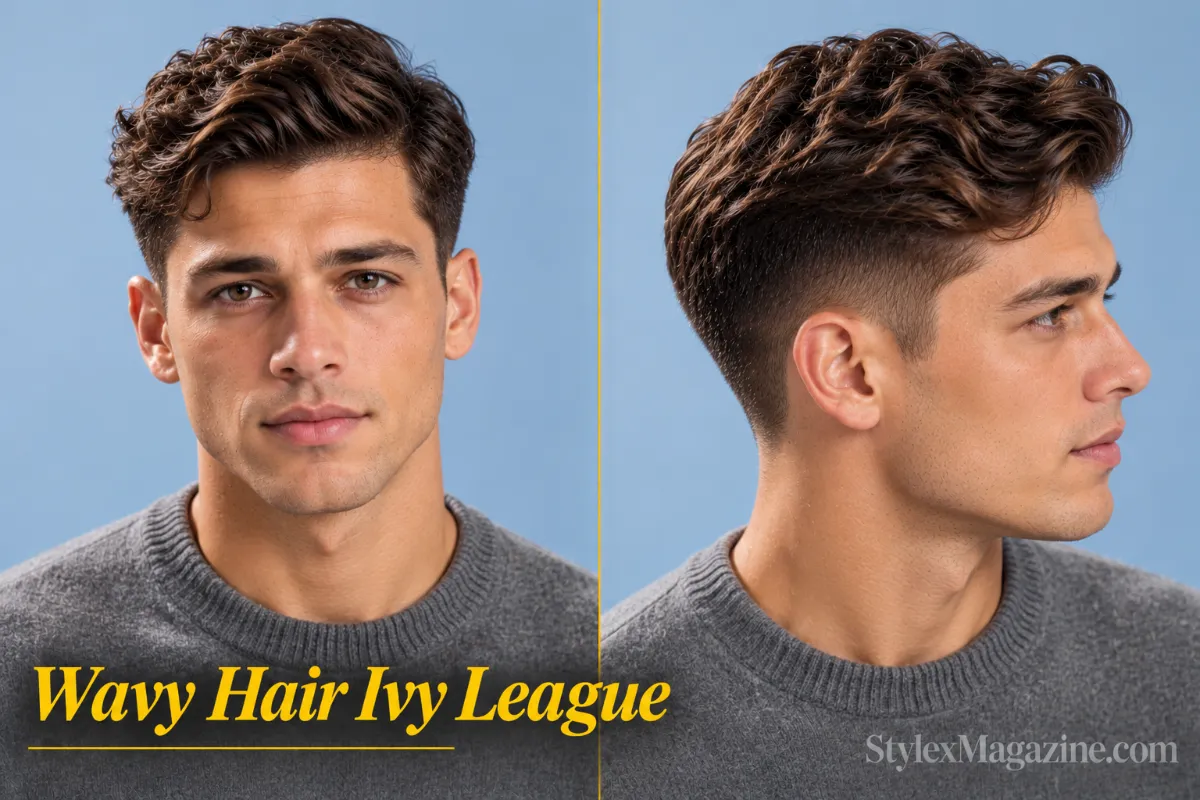
- Lengths: 1.5–2″ on top, #2 tapered sides
- Best for: Oval and rectangle faces | Type 2A–2B waves
Wavy hair has a natural advantage here — the wave adds movement and volume without product. A sea salt spray enhances what’s already there. No blow-dryer needed on most days.
Keep the crown slightly shorter (1–1.5″) so the wave doesn’t push upward and create uneven height. The front can go longer to let the wave fall across the forehead naturally.
11. Ivy League for Thick Hair
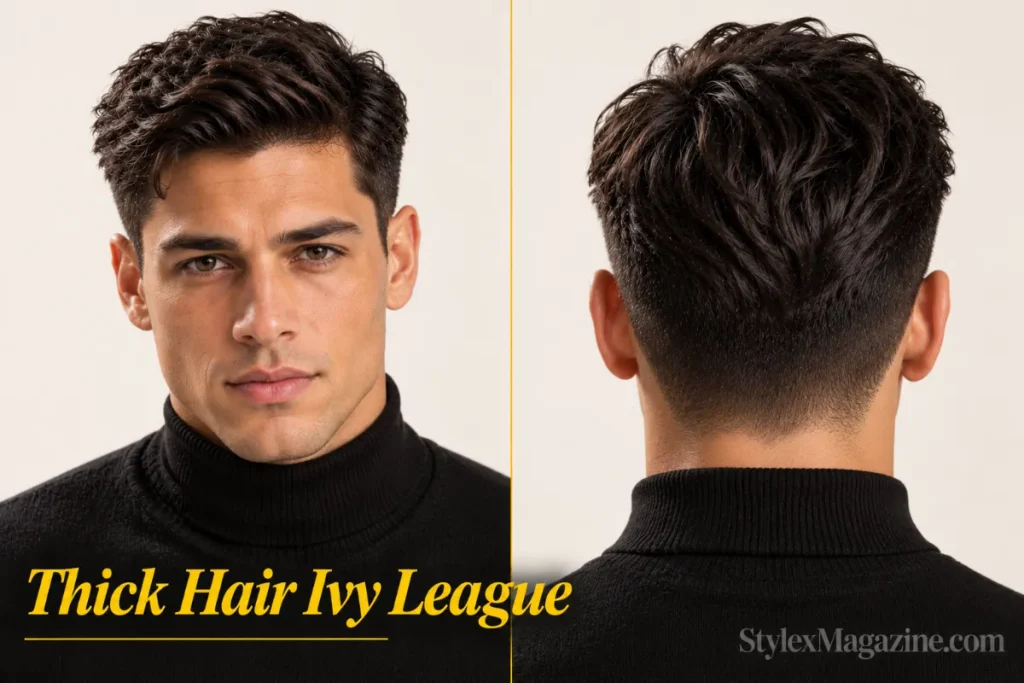
- Lengths: 1.5–2″ on top (thinned with point cutting), #2 tapered sides
- Best for: All face shapes | Dense, coarse textures
Thick hair holds the ivy league shape well but can balloon at the sides between cuts. Ask your barber to point-cut the top for weight removal and blend the sides with thinning shears at the connection point.
The mistake most barbers make with thick hair: cutting it too short on the first visit. Thick hair needs room to lay flat. Start at 2 inches on top, you can always go shorter next time.
12. Ivy League for Fine or Thin Hair
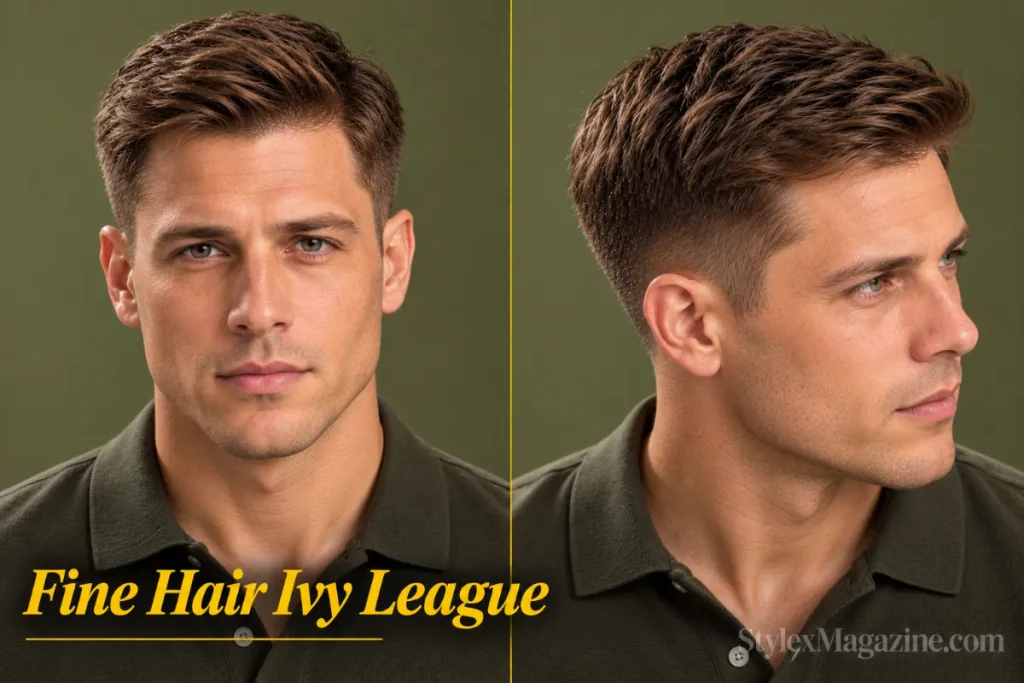
- Lengths: 1.5–2″ on top (blunt-cut ends only), #3 tapered sides
- Best for: Oval and square faces | Fine, low-density hair
Blunt-cut the ends — no thinning shears, no razoring, no point cutting. Fine hair already lacks volume; removing more weight makes it look thinner. The blunt edge stacks the hair and creates the illusion of density.
Matte clay or texturizing powder works better than pomade here. Shine-based products flatten fine hair against the scalp and expose the thinning. Keep the sides slightly longer (#3 guard) so the contrast with the top isn’t too harsh.
13. Ivy League for Receding Hairline
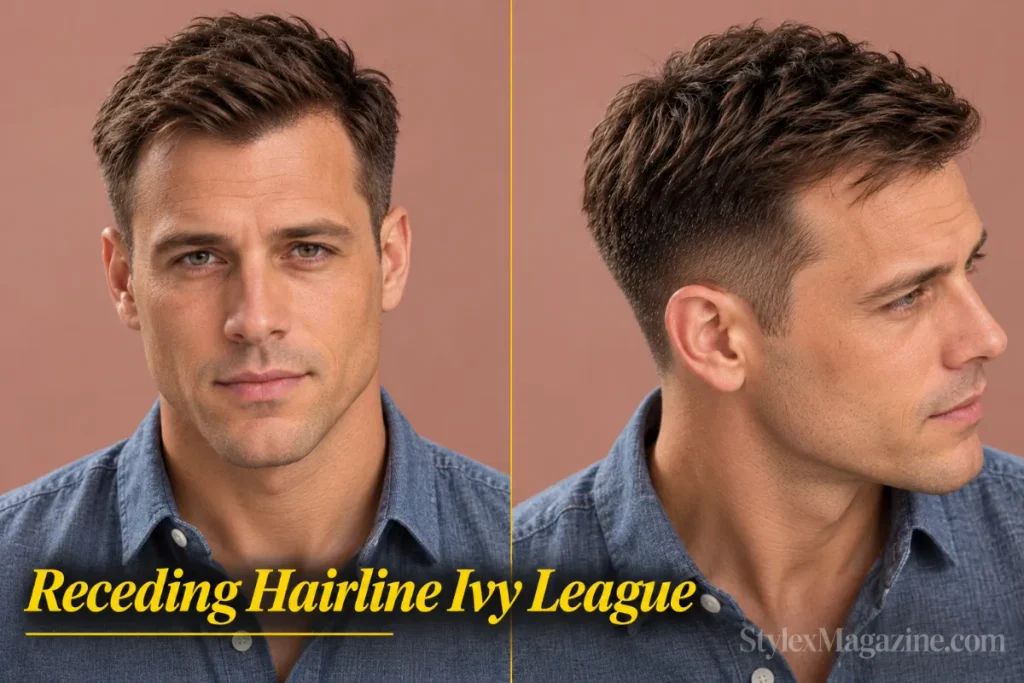
- Lengths: 1.5–2″ on top, textured forward or across, #2 tapered sides
- Best for: All face shapes | All textures with frontal recession
Forward-brushing the front distributes hair across the hairline instead of pulling away from it. A textured finish breaks up the line so the recession doesn’t announce itself with a clean, sharp border.
Avoid hard parts if you’re receding at the temples — a razored line draws a straight edge right next to the thinning zone, which highlights it. A soft, finger-styled part works better.
For more options, see haircuts for receding hairlines.
14. Short Ivy League
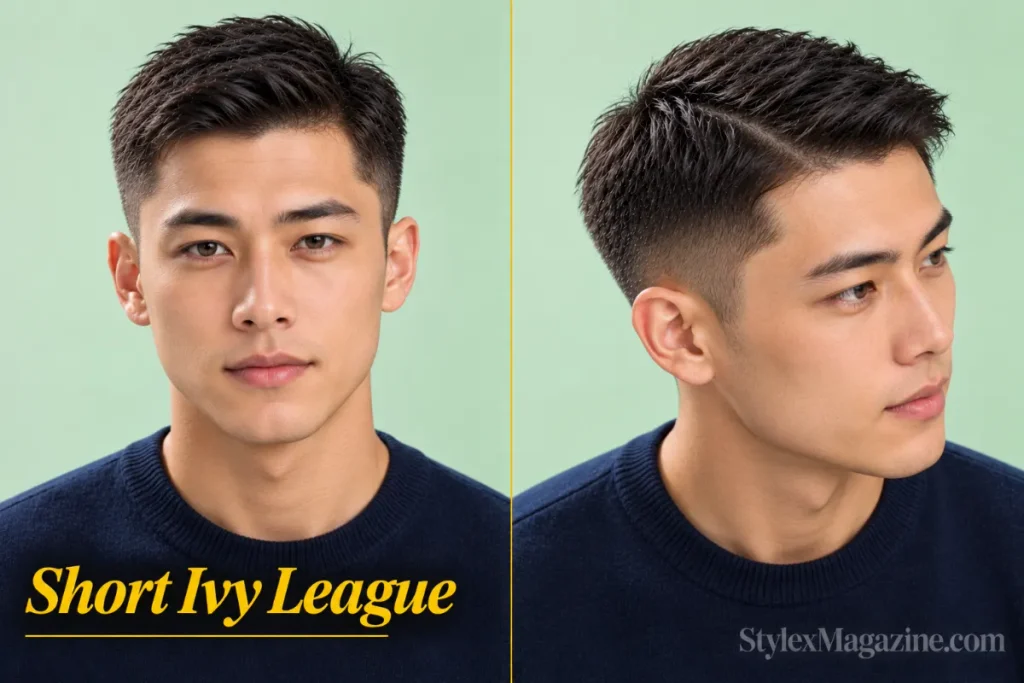
- Lengths: 1–1.5″ on top, #1–2 tapered sides
- Best for: Oval and square faces | All hair textures
The lowest-maintenance version. Enough length to see the direction and a slight part, but not enough to require daily styling. Towel-dry, run your fingers through it, and go.
The trade-off: fewer styling options. At 1 inch on top, you can’t slick it back, and curls won’t form fully. What you gain is a cut that looks the same whether you spent 30 seconds or 5 minutes on it.
15. Long Ivy League
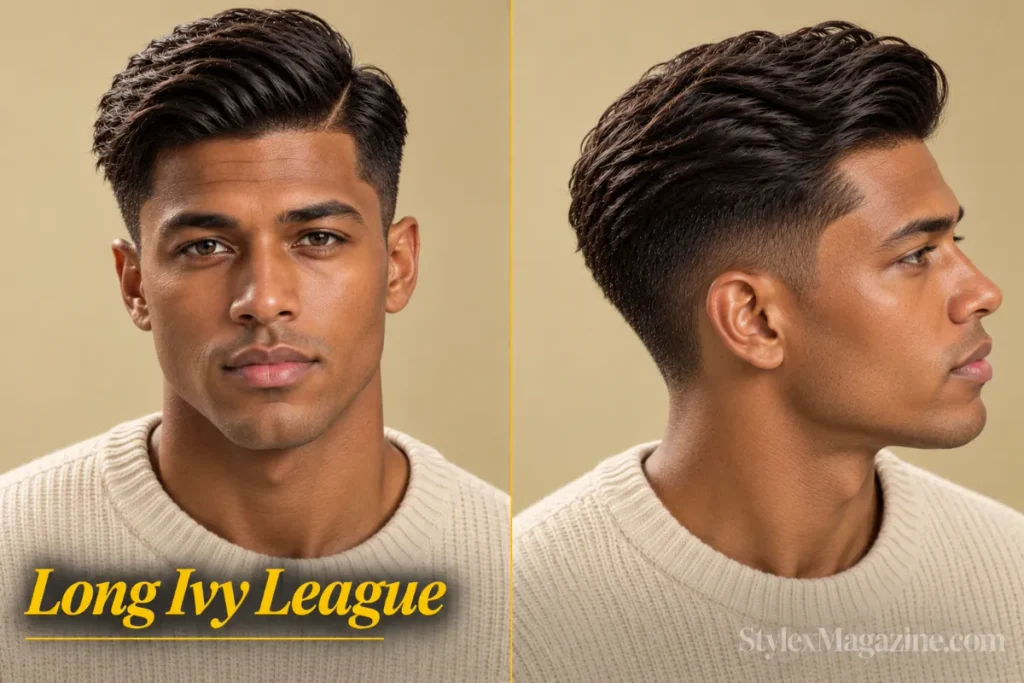
- Lengths: 2–2.5″ on top, #2–3 tapered sides
- Best for: Oval and heart faces | Straight and wavy hair
This pushes the ivy league toward Princeton territory — the longer top allows for deeper parts, more pronounced sweeps, and visible texture. If you’re considering a Princeton but don’t want to commit to 3+ inches, this is the transition.
Blow-drying becomes more important at this length. Without directional drying, 2.5 inches of hair on top falls forward instead of holding a part. Medium-hold pomade gives enough structure without the crunch.
16. Ivy League with Beard
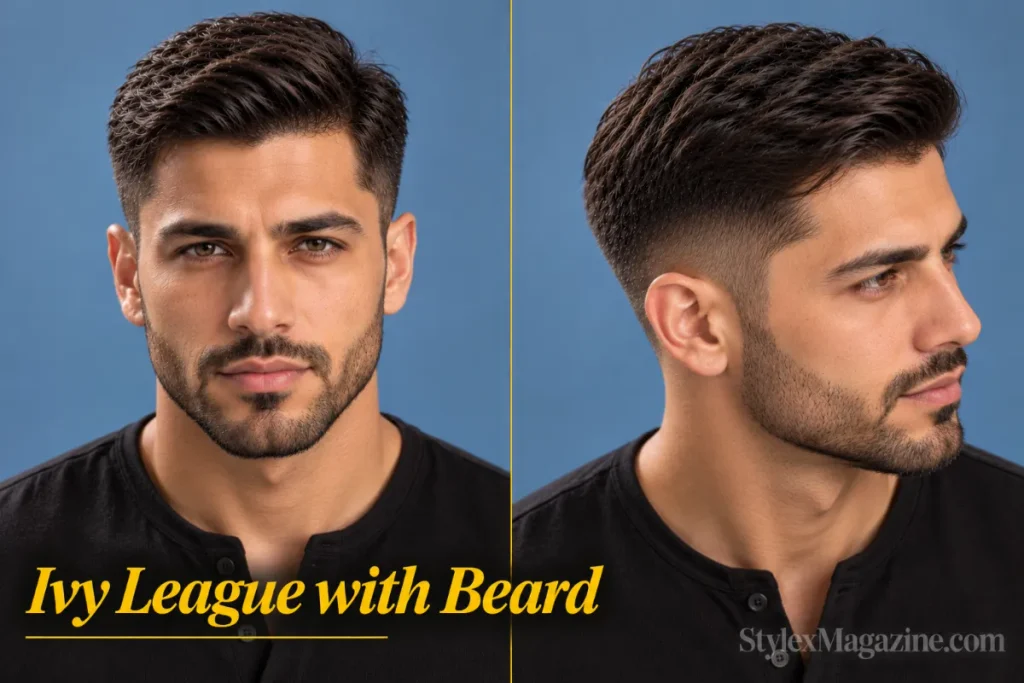
- Lengths: 1.5–2″ on top, #2 tapered sides blending into beard line
- Best for: Oval, oblong, and diamond faces | All hair textures
The connection point between sideburns and beard determines whether this looks intentional or accidental. The taper should blend seamlessly into the beard — no gap, no hard line where one ends and the other begins.
Short to medium stubble (3–10mm) pairs best. A full, long beard with a tight ivy league creates a bottom-heavy proportion that fights the cut’s balanced structure. Keep the beard trimmed if the haircut is short.
17. Ivy League with Taper
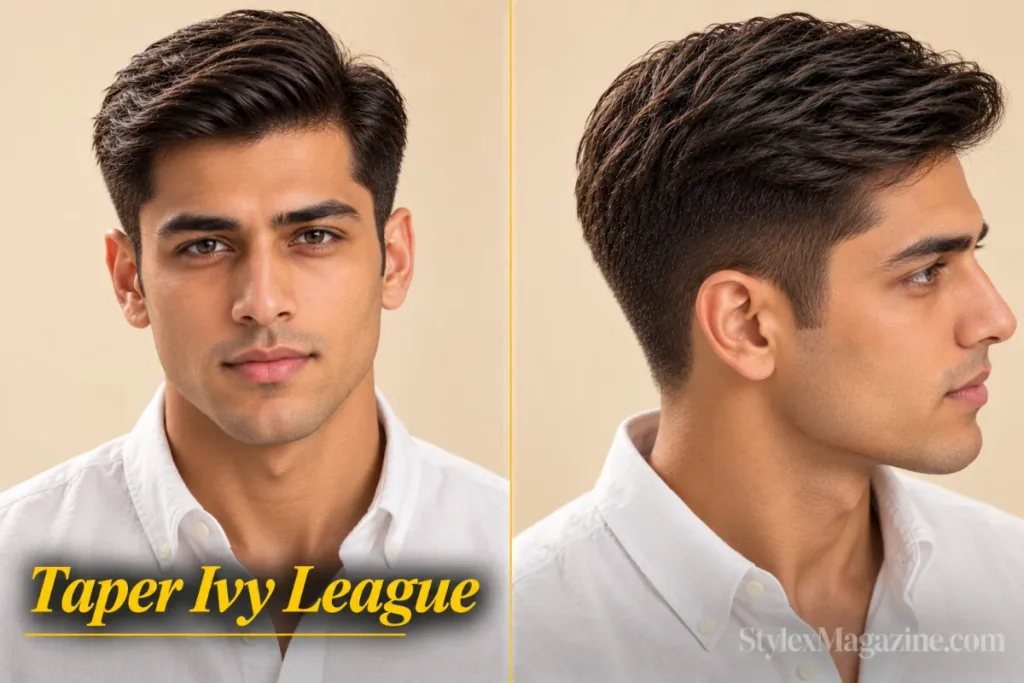
- Lengths: 2″ on top, scissor-tapered sides (no clipper)
- Best for: All face shapes | Fine to medium hair
An all-scissor ivy league. No clipper guards, no fade lines, the sides are cut entirely with scissors and comb, creating the softest possible transition. This is how the cut was done before electric clippers became standard in barbershops.
An all-scissor taper is subtler than any clipper-based version. It grows out more gracefully too — you can stretch the time between cuts to 4–5 weeks without looking unkempt.
18. Ivy League Comb Over
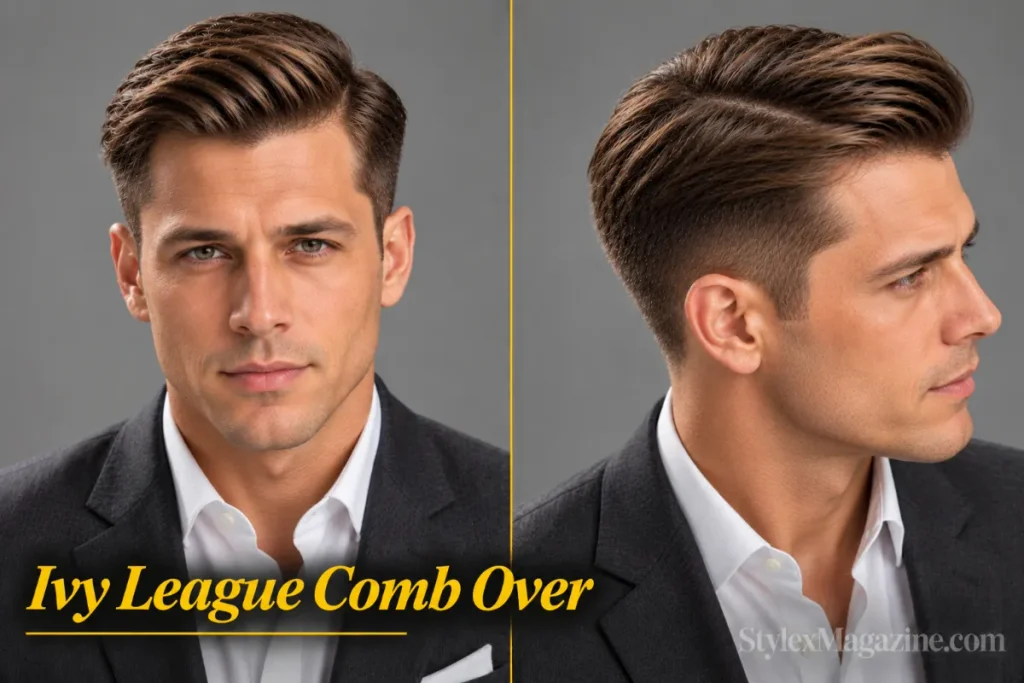
- Lengths: 2–2.5″ on top (heavily directed to one side), #2 tapered sides
- Best for: Oval, square, and heart faces | Straight hair
A deeper part and more volume swept to one side separates this from a standard side-parted ivy league. The comb over variation is the most formal version — suited for events, professional headshots, or any setting where polished matters more than casual.
Use a fine-tooth comb and medium-hold pomade. A wide-tooth comb won’t create the clean directional lines this style needs.
For the full breakdown, see comb over haircut.
19. Messy Ivy League
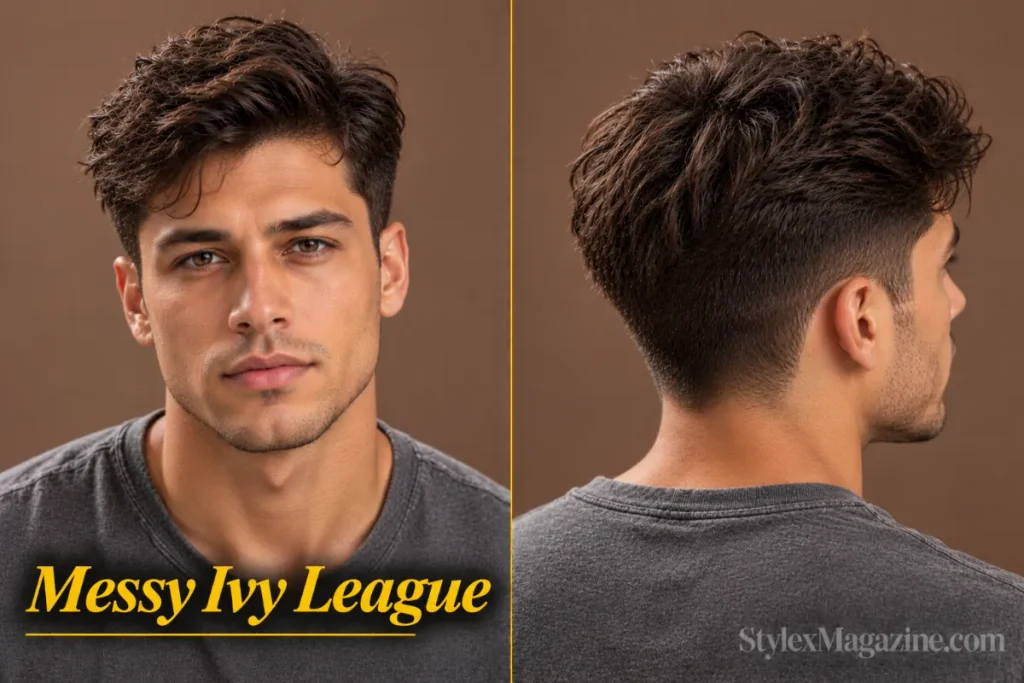
- Lengths: 1.5–2″ on top (left unstyled or lightly finger-styled), #2–3 tapered sides
- Best for: Oval and diamond faces | Wavy and textured hair
Towel-dry, apply a small amount of texturizing paste, and leave it. The messy ivy league works because the base cut is already structured — the “mess” sits on top of clean proportions, not chaos.
This only works if the underlying cut is well-executed. A bad haircut made messy looks neglected. A good haircut made messy looks intentional. The structure beneath it is what carries this variation.
20. Ivy League with Line Up
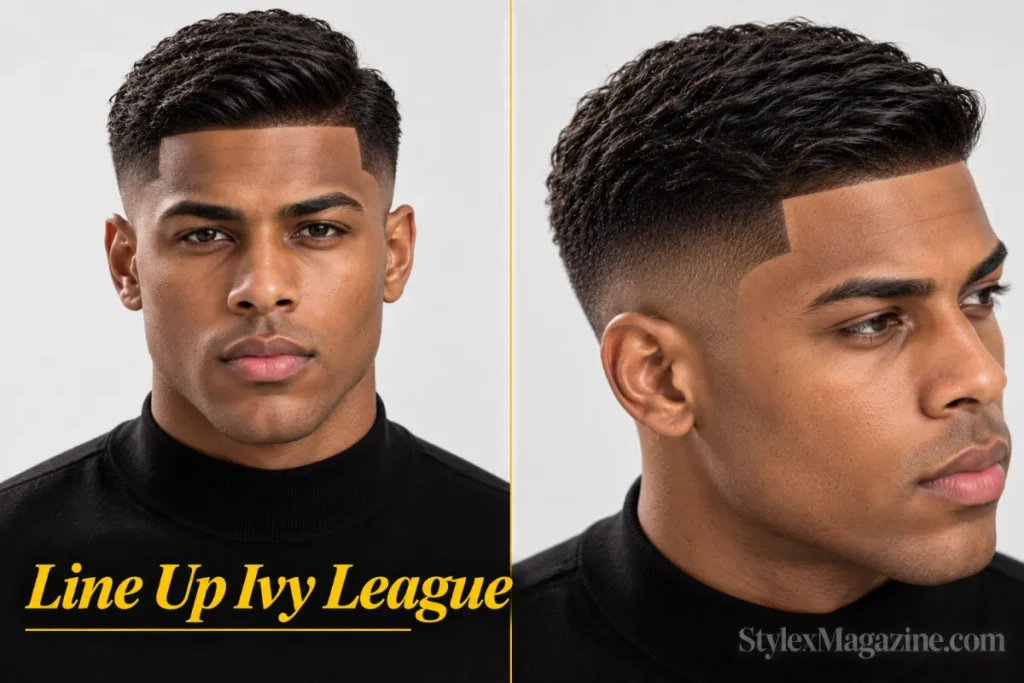
- Lengths: 1.5–2″ on top, #1–2 fade or taper, sharp line up at hairline
- Best for: Oval, square, and diamond faces | All hair textures
A straight-edge razor defines the hairline — forehead, temples, and sideburns — into a clean geometric frame. The line up adds precision that a natural hairline doesn’t have.
The downside: line ups grow out fast. Within 7–10 days, the natural hairline pushes through. If you’re maintaining a line up, you’ll need touch-ups between full haircuts or learn to edge it yourself with a trimmer.
21. Ivy League for Black Men
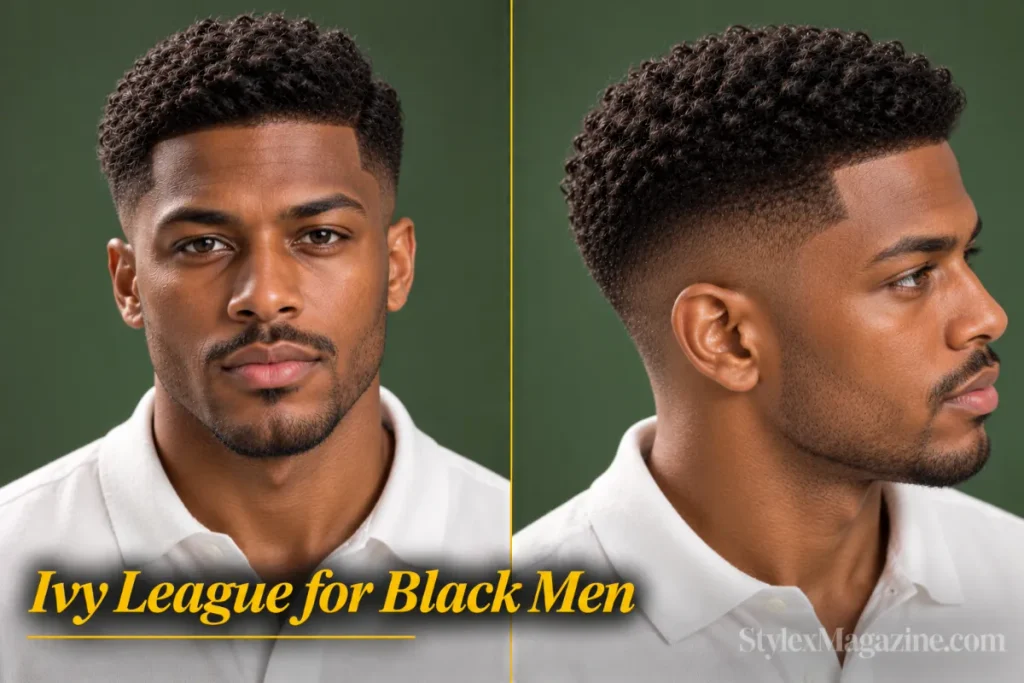
- Lengths: 1–2″ on top depending on curl pattern, temple fade or taper
- Best for: All face shapes | Type 3C–4C hair textures
Coarser textures change the approach. The top length needs to account for shrinkage, 4C hair at 2 inches stretched might show only 0.75 inches of visible length. A temple fade cleans the perimeter without requiring a full fade.
Moisturize daily with a light leave-in conditioner. Dry, coarse hair at this length catches and breaks if you’re combing through it without moisture. A wide-tooth comb or pick works better than a fine-tooth comb for this texture range.
For more texture-specific options, see fade haircuts for Black men.
22. Ivy League for Asian Hair
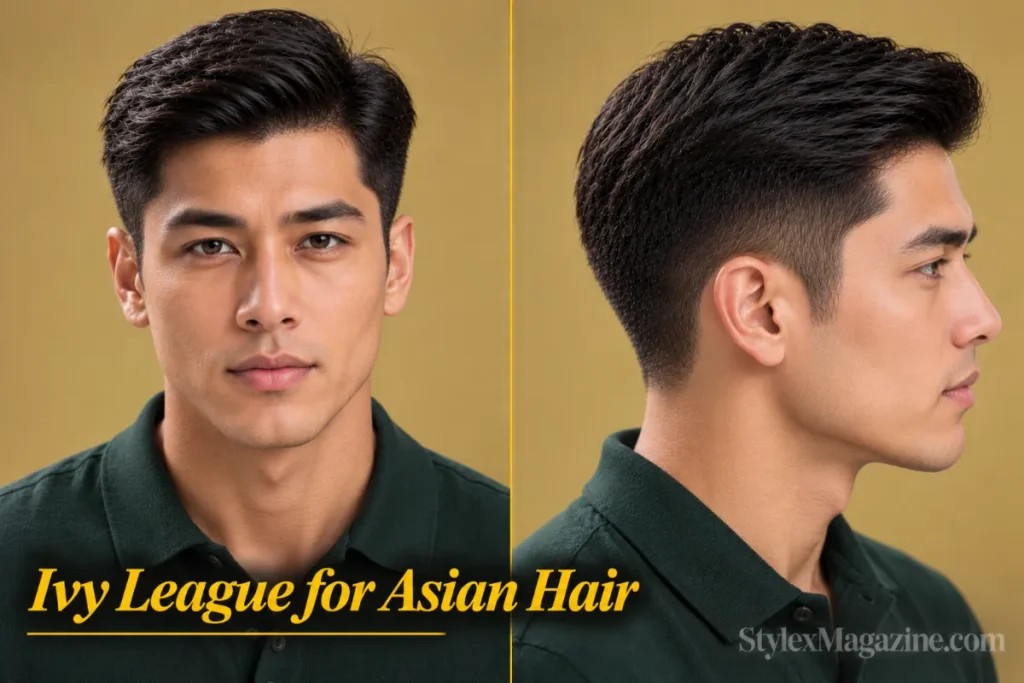
- Lengths: 1.5–2″ on top, #2 tapered sides (blended carefully at the parietal ridge)
- Best for: Oval, round, and diamond faces | Thick, straight, coarse hair
Thick, straight Asian hair tends to stick outward at the sides rather than lay flat. The parietal ridge, the widest point of the skull, is where this problem is most visible. Your barber needs to thin or texturize this zone specifically.
Stronger-hold products are non-negotiable here. A light paste that holds fine or wavy hair won’t hold straight, coarse hair in a side part. Use a firm clay or wax-based pomade.
23. Ivy League for Older Men
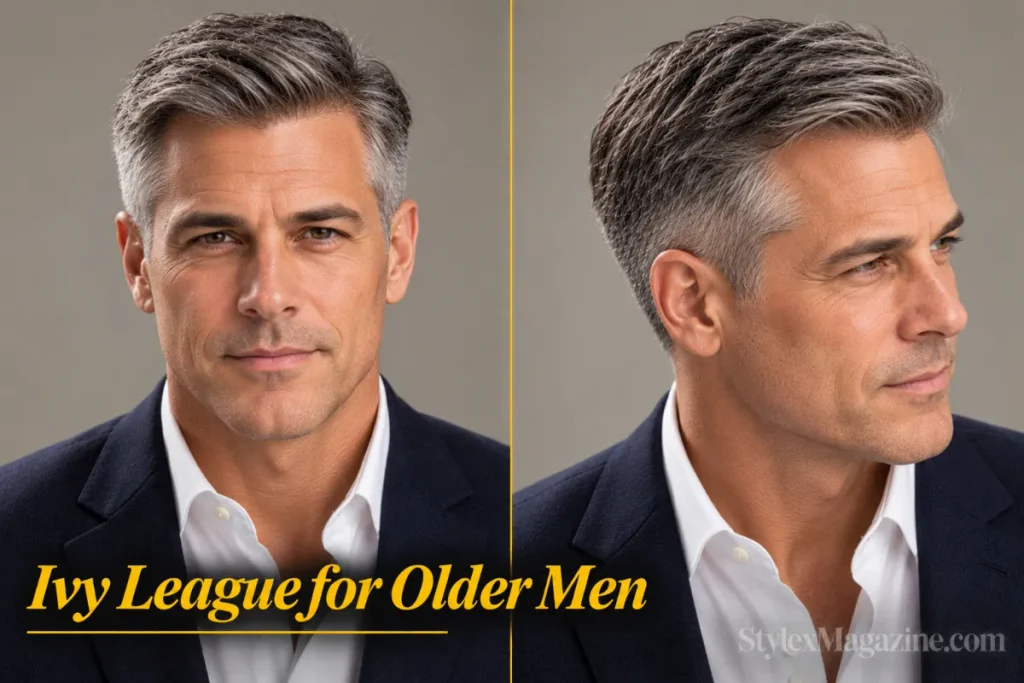
- Lengths: 1–1.5″ on top, #2 tapered sides, conservative proportions
- Best for: All face shapes | Thinning, greying, or fine hair
Keep the proportions conservative, slightly shorter top, slightly longer sides. This avoids the “trying too hard” effect that comes from pairing a skin fade with grey hair. The ivy league should look distinguished, not desperate.
Grey hair is coarser in texture than pigmented hair and holds product differently. Use a light matte clay instead of pomade — greying hair with a high-shine finish tends to look wiry rather than polished.
24. Ivy League with Fringe
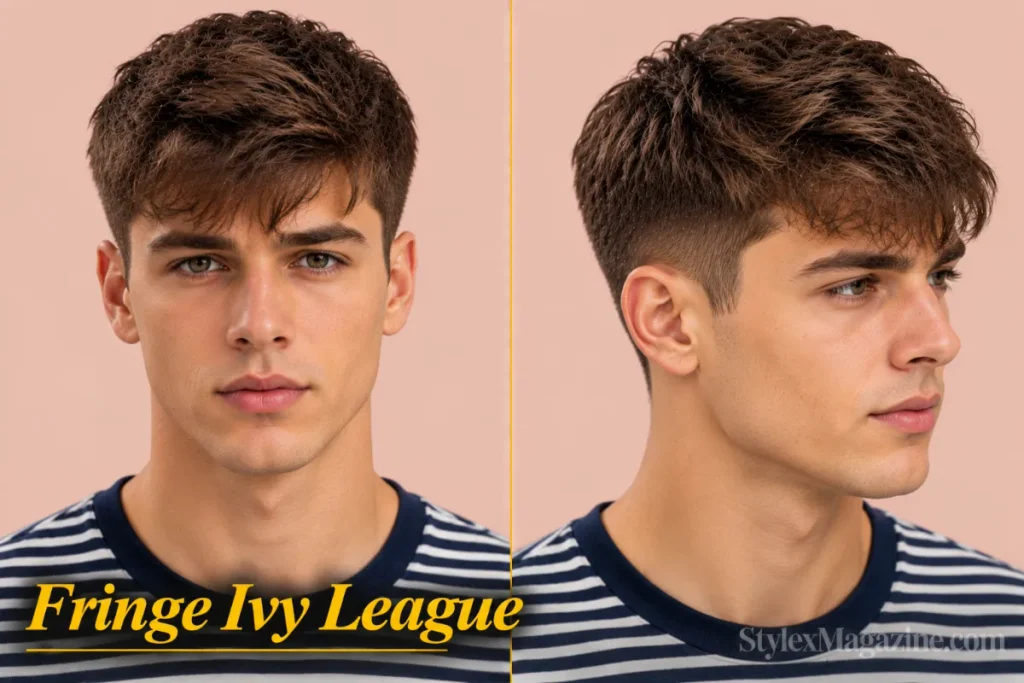
- Lengths: 2–2.5″ at the front (swept forward), 1.5″ at crown, #2 tapered sides
- Best for: Oval, heart, and oblong faces | Straight and wavy hair
Instead of parting to the side, the front falls forward across the forehead. This variation skews younger and works well for men who want to cover a high forehead or soften a strong hairline.
The fringe needs to be cut at an angle — shorter at the center, slightly longer toward the temples — so it doesn’t sit across the forehead like a straight line. Texturize the ends to keep it from looking like a bowl cut.
25. Modern Ivy League (2026)
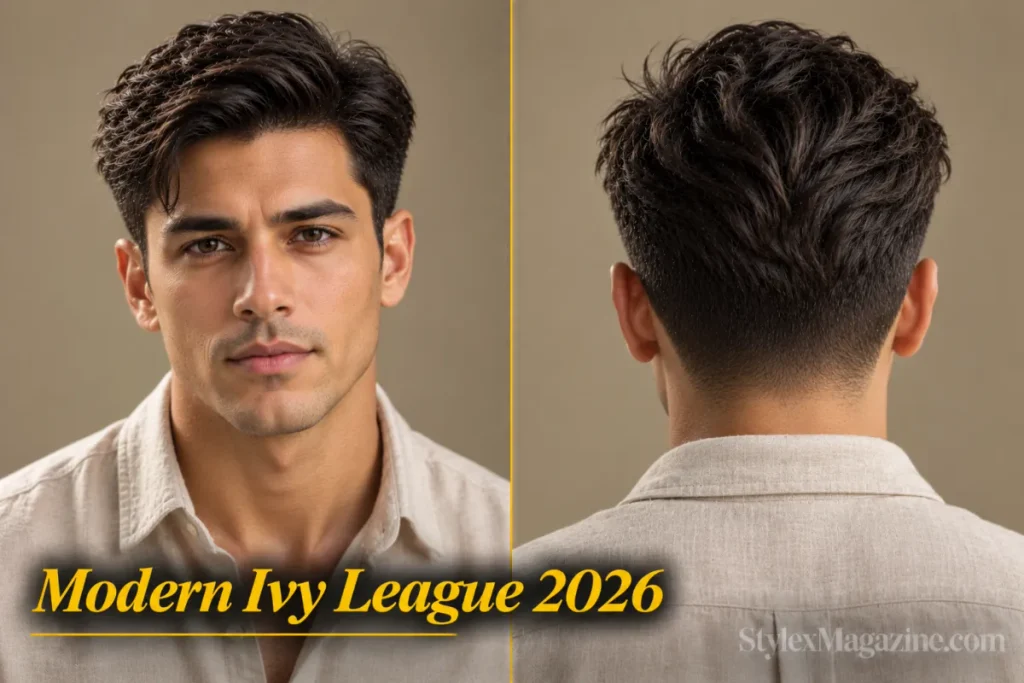
- Lengths: 2″ on top (heavily textured), low taper, matte finish
- Best for: Oval, square, and diamond faces | All hair textures
The current version. A low taper instead of a fade, textured top styled with matte clay, and a relaxed side part or no part at all. This is the ivy league filtered through the “old money” aesthetic that’s dominated men’s fashion since 2023 — clean without being rigid, polished without being overdone.
The difference between this and the classic (#1) is the finish. Classic uses pomade and a comb for structure. Modern uses matte clay and fingers for movement. Same cut, different philosophy.
Ivy League vs Crew Cut vs Princeton
Three cuts from the same family, separated by length and styling options.
| Feature | Ivy League | Crew Cut | Princeton |
|---|---|---|---|
| Top length | 1–2.5″ | 0.5–1.5″ | 2–3″ |
| Side length | #1–3 guard, tapered | #0–2 guard, uniform | #2–4 guard, tapered |
| Can you part it? | Yes | No | Yes |
| Formality | High | Medium | High |
| Maintenance cycle | Every 3–4 weeks | Every 2–3 weeks | Every 3–4 weeks |
| Styling time | 3–5 minutes | Under 1 minute | 5–10 minutes |
| Best for | Daily wear, office | Low-maintenance, athletic | Preppy, editorial |
The ivy league is the middle ground. A crew cut is the shorter, no-styling-needed version. A Princeton is the longer, more deliberate version. If you’re unsure which you want, start with a standard ivy league — it’s easy to cut shorter into a crew cut at the next visit, or grow out toward a Princeton if you want more length.
Which Face Shape Suits an Ivy League Haircut?
The ivy league works on every face shape — but each shape benefits from different adjustments.
- Oval — Any variation works without modification. The balanced proportions match the cut’s balanced structure.
- Square — Tight sides (#1–2 guard) to expose the jawline. Add texture on top to keep the look from feeling too angular.
- Round — Add height on top with a blow-dried lift. Keep sides as short as possible. Avoid wide, flat side parts that add horizontal width.
- Oblong — Keep it flat or forward-brushed. Skip volume on top — the face is already long. Slightly fuller sides balance the proportions.
- Heart — A side part works well, shifting visual weight below the wider forehead. Avoid excessive height that makes the forehead appear larger.
- Diamond — Textured top with a medium taper. Ultra-short sides widen the cheekbone zone, so keep the contrast moderate.
- Rectangle — Top length under 1.5″ to avoid adding vertical length. Similar adjustments to oblong, with extra attention to keeping the overall silhouette compact.
What to Tell Your Barber?
A step-by-step script — bring this to your appointment:
- Open with: “I want an ivy league — tapered sides, enough length on top to part.”
- Specify the top: “Keep the front at [your chosen length, e.g., 2 inches] and blend shorter toward the crown.”
- Specify the sides: “Take the sides down to a [#2 or #3] and taper into the top.”
- Specify the neckline: “Tapered neckline — no blocked edge.”
- Show a photo. Pick one from the 25 styles above that matches what you want.
Measurement Cheat Sheet
| Zone | Length | Tool | Notes |
|---|---|---|---|
| Front / fringe | 1.5–2.5″ | Scissors | Longest point — determines whether you can part it |
| Crown | 1–1.5″ | Scissors | Shorter than front so the hair falls naturally |
| Upper sides | #2–3 guard | Clipper + blend | Taper zone — the blend between top and sides |
| Lower sides | #1–2 guard | Clipper | Shortest visible point, just above the ears |
| Neckline | Tapered | Trimmer | Natural taper — not a hard blocked edge |
| Sideburns | Match sides | Trimmer | Clean, not pointed |
How to Style an Ivy League Haircut?
- Towel-dry to damp — not soaking, not fully dry. The hair should feel cool to the touch.
- Apply product — a dime-sized amount. Work it between your palms before touching your hair.
- Comb or finger-style into position — part it if that’s your variation, push forward if it’s a fringe, or leave it textured.
- Blow-dry on medium heat — direct the airflow in the direction you styled it. This locks the shape.
- Finish with light hairspray — only if your hair tends to drop its shape by midday.
Match the product to the finish:
| Finish | Product | When to use |
|---|---|---|
| Matte, textured | Matte clay | Daily, casual, modern styles (#6, #19, #25) |
| High shine, slick | Pomade | Formal events, slicked-back (#8, #18) |
| Wavy, relaxed | Sea salt spray | Off-duty, weekend, wavy variations (#10, #19) |
| Natural, medium hold | Paste | Everyday middle ground, most variations |
Common Mistakes to Avoid
- Saying “short back and sides” without specifying a taper type. That instruction gives your barber zero information about fade level, blend point, or neckline. You’ll get whatever their default is — not an ivy league.
- Cutting the top under 1 inch. Below 1 inch, there isn’t enough length to part or direct. That’s a crew cut, not an ivy league. The definitions overlap in some barbershop conversations, but the cuts don’t.
- Skipping the blend between top and sides. A hard line where the clipper stops and the scissor starts creates an undercut silhouette, not an ivy league. The blend is what makes this cut.
- Using high-shine gel on a textured variation. Gel hardens, clumps, and flattens. If you chose a textured ivy league for its movement, a stiff gel eliminates the entire point. Use matte clay or paste.
- Waiting 6 or more weeks between cuts. The taper loses definition by week 4. By week 6, the sides have grown into the top, and the ivy league structure is gone. Budget for cuts every 3–4 weeks.
FAQ
Is the ivy league haircut professional?
Yes. The clean taper and controlled proportions make it widely accepted in corporate, legal, and finance settings. It signals formality without looking military — a mid-point most dress codes don’t question.
How often should I get an ivy league trimmed?
Every 3–4 weeks. The tapered sides grow out fastest. By week 4, the blend between top and sides starts to disappear. If you’re wearing a fade variation, expect every 2–3 weeks.
Can I get an ivy league with curly hair?
Yes — ask for 2–2.5 inches on top so curls form fully. Curly hair shrinks when dry, so what measures 2.5 inches stretched may only show 1.5 inches of visible length. Diffuse on low heat and use curl cream instead of pomade.
What’s the difference between an ivy league and a side part?
An ivy league is a specific haircut with set proportions — tapered sides, 1–2.5 inches on top. A side part is a styling technique. You can part a pompadour, a comb over, or an ivy league. The ivy league pairs well with a part, but the part alone doesn’t make it an ivy league.
Does an ivy league work on a round face?
With adjustments. Keep sides tight (#1–2 guard) and add volume on top to create vertical length. A high fade (Style #4) works better than a taper for round faces because it removes more width from the sides.

Other Articles
25 Best Skin Fade Haircuts for Men (2026)
[…] Ivy League gives thick-haired men the polish of a side part without the maintenance of longer styles. The top […]
[…] Ivy League / military […]