
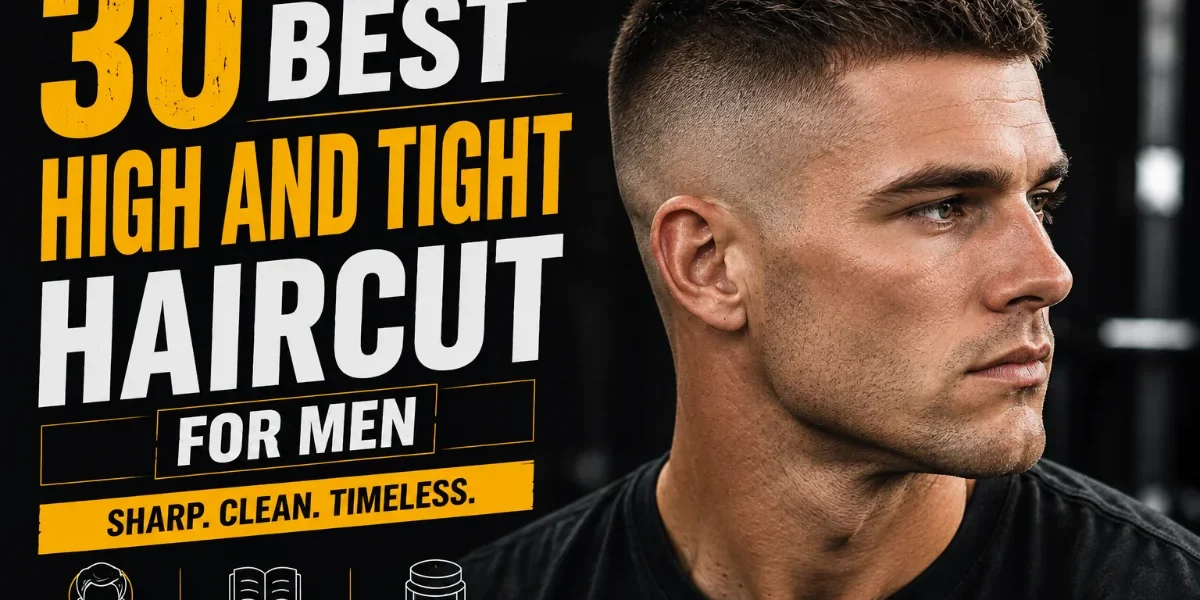

Quick Answer: The high and tight keeps the sides shaved close to the skin while leaving a short strip of hair on top. It started as a U.S. military standard and now sits comfortably in barbershops everywhere, from the original recon cut to textured modern fades.
The high and tight is built on contrast. The sides go to skin or near-skin, the top stays short but present, and the line between the two is sharp. That contrast is what separates it from a buzz cut (which is uniform all over) or a crew cut (which blends gradually). Military barbers created it for function. Civilian barbers adopted it because the proportions work on nearly every head shape. Below are 30 ways to wear it in 2026.
What Is a High and Tight Haircut?
The sides and back are clipped to skin or stubble from the temples down, and the top is left at 1 to 2 inches maximum. The transition between the two is sharp, not blended. That hard contrast is what defines the cut.
The name refers to the fade height (high) and the closeness of the sides (tight). It originated in the U.S. armed forces, where it’s sometimes called a “jarhead,” and remains standard across military branches and law enforcement. In the 1980s, young Black men in the U.S. adapted the high and tight through hip-hop and B-boy culture, adding sharp edges, skin fades, and volume with the high-top fade. That era brought the cut off the base and into civilian barbershops, where it has stayed since.
| Feature | High and Tight | Crew Cut | Buzz Cut |
|---|---|---|---|
| Sides | Skin or #0 | Tapered, blended | Uniform length |
| Top | 1–2 inches, defined edge | Longer at front, gradual blend | Same guard all over |
| Transition | Hard line or sharp fade | Gradual | None |
| Maintenance | Every 1–2 weeks | Every 2–3 weeks | Every 2–3 weeks |
| Origin | U.S. military | Ivy League / military | Military / athletic |
For a full breakdown of every fade height and how it changes the silhouette, the fade haircuts for men guide covers the complete range.
What Are the Best High and Tight Haircut Styles?
Every variation below changes either what happens on top, how the sides transition, or how the cut adapts to a specific hair type. The core structure stays the same: short sides, defined top.
Classic & Military
1. Classic High and Tight
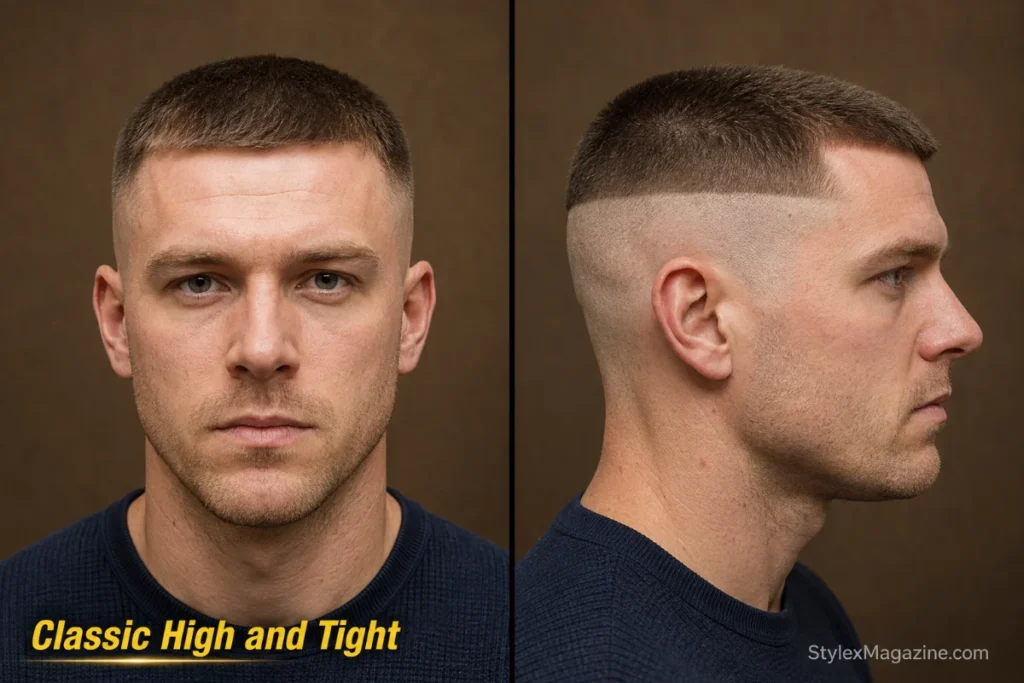
Sides taken to skin from the temples down. Top left at a uniform 1 inch. No fade, no blend, just a clean hard line where the top meets the sides.
Hair type: Works on all textures. Straight hair shows the sharpest edge.
Styling tip: No product needed. Towel dry and go.
Tell your barber: “Classic high and tight. Skin on the sides, one inch on top, hard line, no fade.”
Maintenance: Every 1–2 weeks.
2. Recon High and Tight
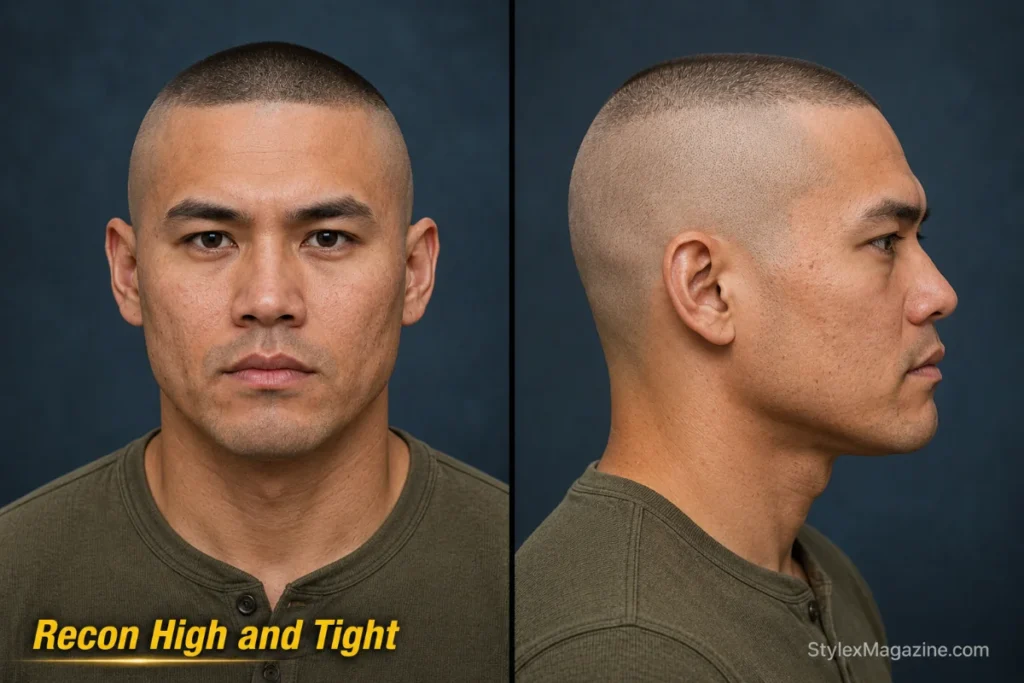
The most extreme version. Sides and top are both nearly shaved, leaving only a faint strip of stubble on the crown. Named after Marine Force Recon units where practical minimalism is standard.
Hair type: Suited to all types. Hair texture is irrelevant at this length.
Styling tip: Zero styling required. SPF on the scalp in summer.
Tell your barber: “Recon cut. Skin on the sides, #0 or bare on top, just leave a shadow of hair on the crown.”
Maintenance: Every week.
3. Modern High and Tight
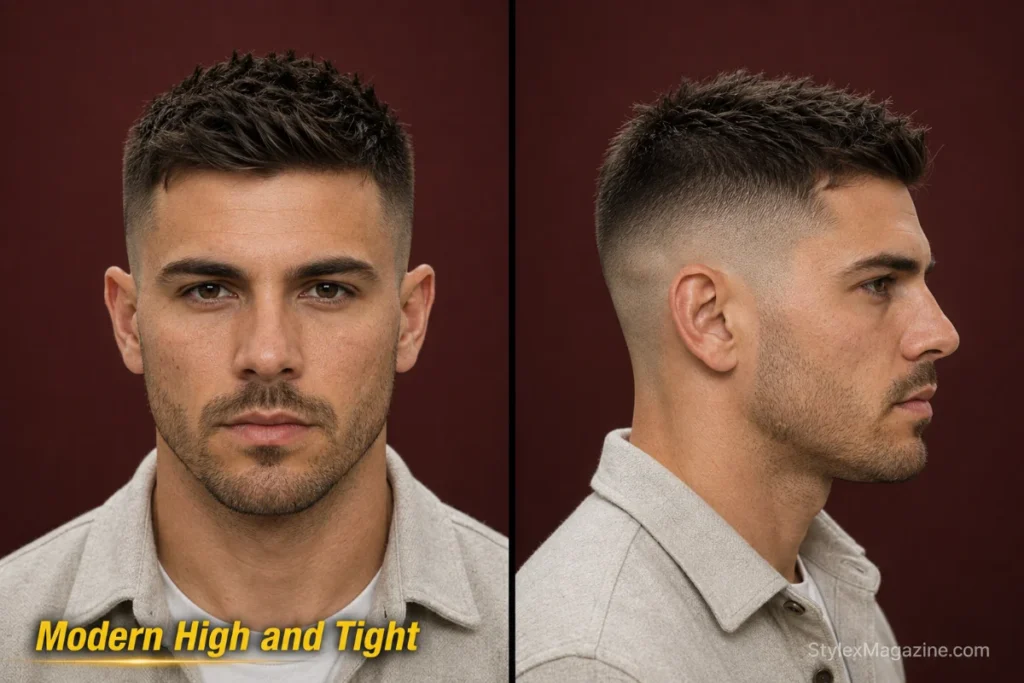
The civilian adaptation. Sides still go short, but the top runs 1.5 to 2 inches with texture added through point cutting. Ryan Reynolds wore this version for Deadpool, and it remains a top request in non-military barbershops.
Celebrity: Ryan Reynolds (Deadpool).
Hair type: Straight and wavy hair show the texture best.
Tell your barber: “Modern high and tight. Skin fade on the sides, leave about two inches on top, add texture with point cutting.”
Maintenance: Every 2 weeks.
4. Military Regulation High and Tight
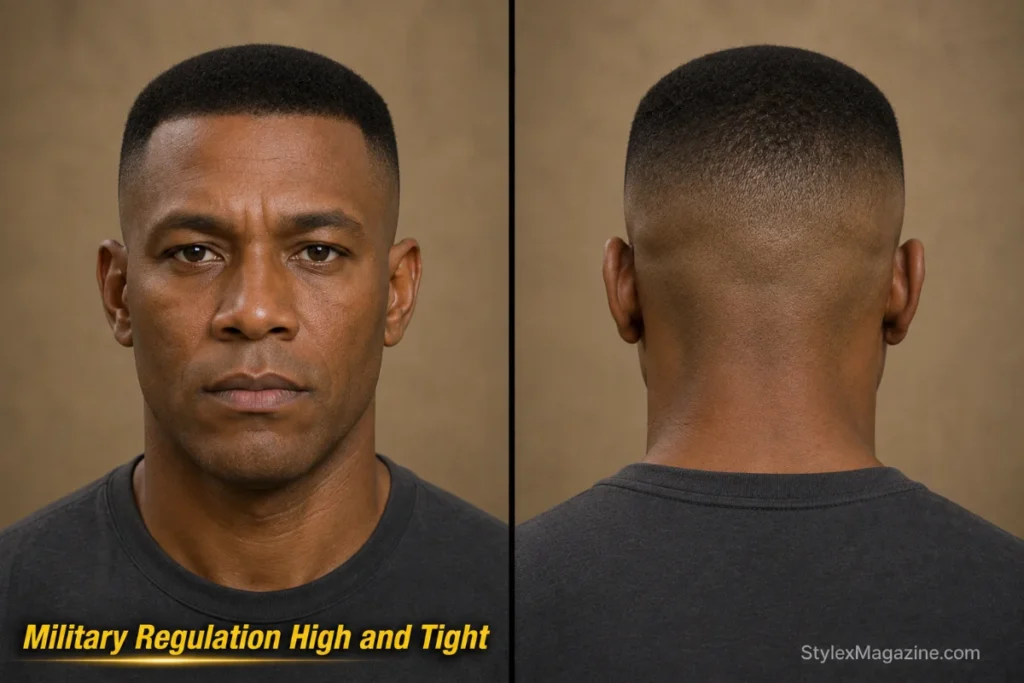
Meets U.S. armed forces grooming standards. The top sits at three-quarters of an inch to one inch. Sides are taken to a #0 or skin. No styling product, no texture, no creative interpretation.
Styling tip: Regulation means uniform. No product, no variation.
Hair type: All types. The length is too short for texture to matter.
Tell your barber: “Military regulation high and tight. Three-quarter inch on top, skin on sides, squared neckline.”
Maintenance: Weekly.
5. High and Tight with No Fade (Hard Disconnect)
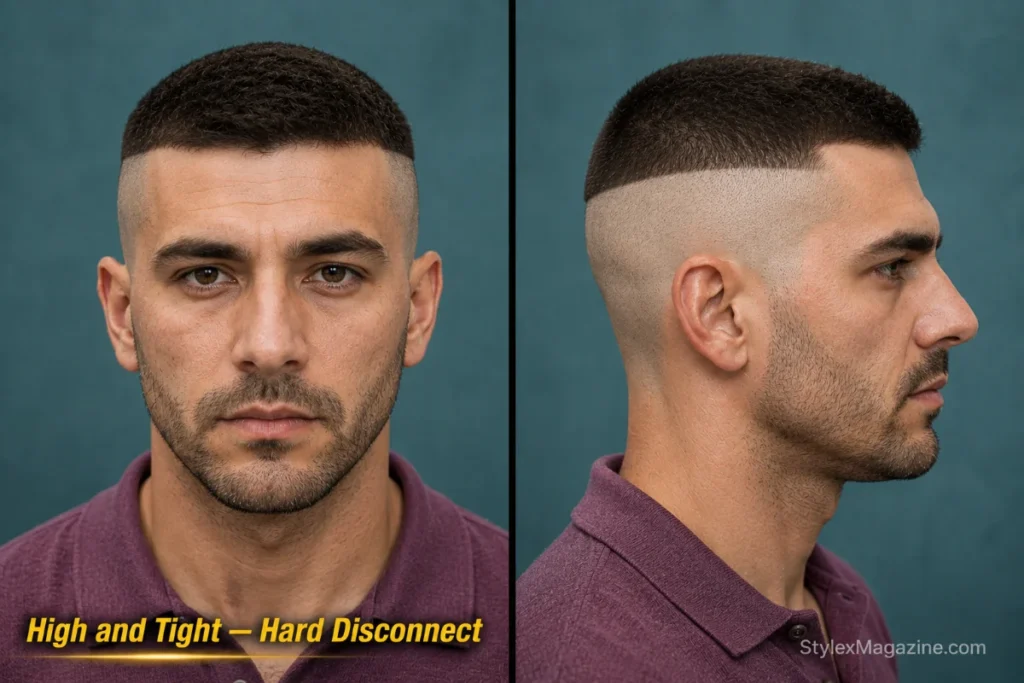
No blend between top and sides. The transition is a sharp, visible line. I’ve cut this version for men who want maximum contrast and don’t mind the boldness of a hard edge. It’s polarizing, but it photographs well and has a strong graphic quality.
Styling tip: The hard line is the focal point. Keep the top simple.
Hair type: Thick hair holds the disconnect line cleanest.
Tell your barber: “High and tight, no fade, hard disconnect. I want a visible line between top and sides.”
Maintenance: Every 1–2 weeks. The line loses definition quickly.
Fade Variations
6. High and Tight with Low Fade
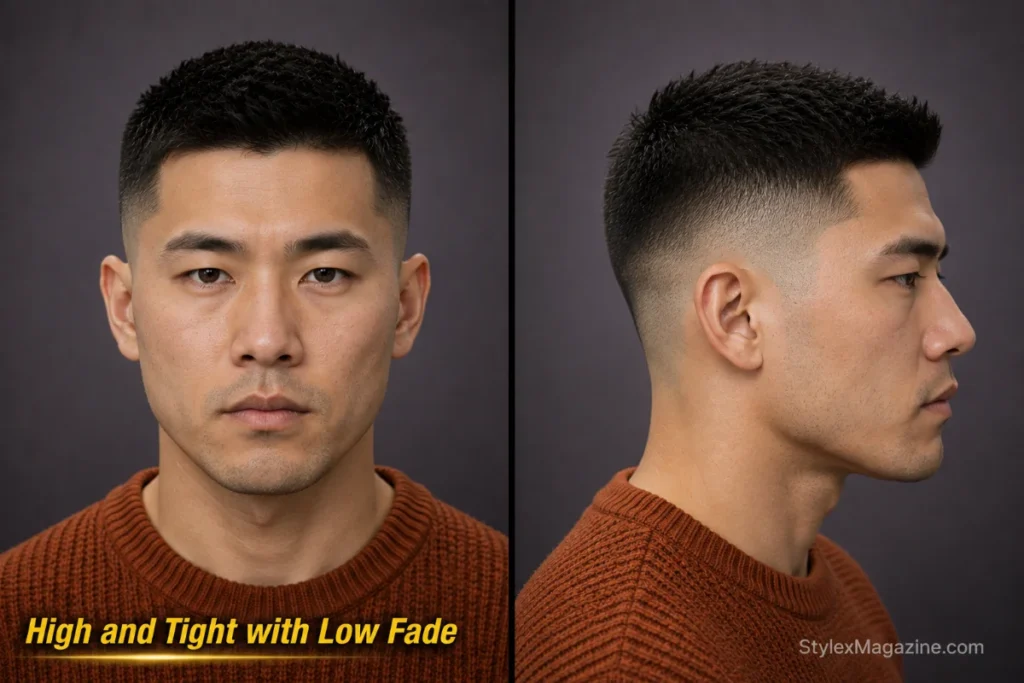
The fade starts just above the ear and blends upward into the short top. The lowest, most conservative fade option for a high and tight. Suitable for office settings where a skin-shaved hard line draws too much attention.
Hair type: All types. Fine hair benefits from the subtle contrast.
Styling tip: A matte clay on top adds grip without shine.
Tell your barber: “High and tight with a low fade starting just above the ear. Skin at the base, blend into one and a half inches on top.”
Maintenance: Every 2 weeks.
7. High and Tight with Mid Fade
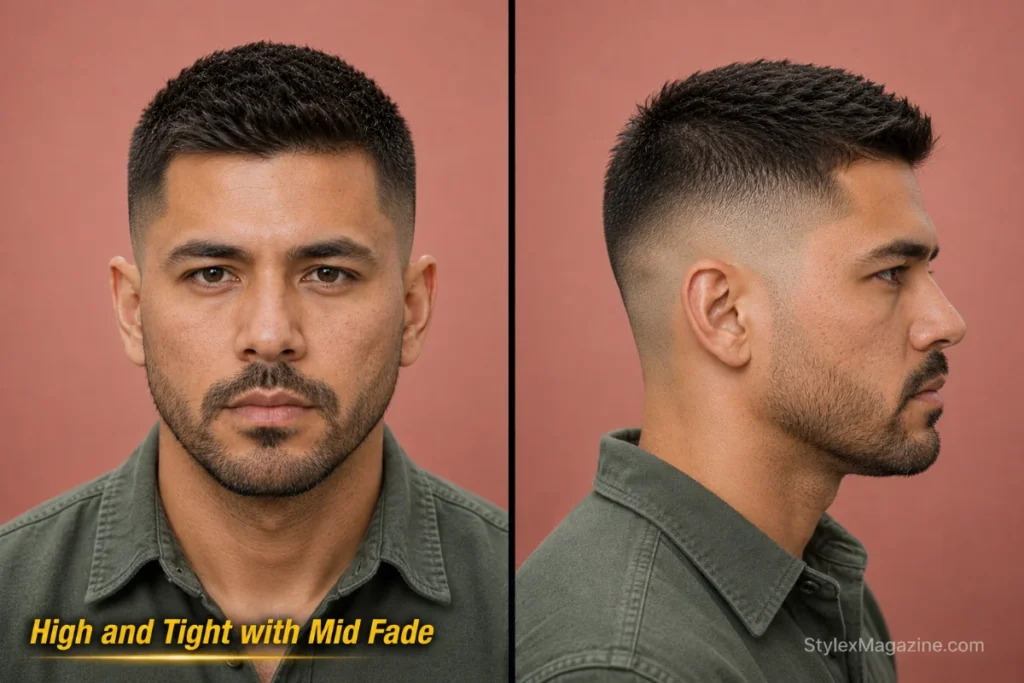
Fade begins at temple level. Balanced contrast between the short top and the faded sides. The mid fade sits in the middle ground: more visible than a low fade, less aggressive than a high fade.
Hair type: All types.
Styling tip: Works with or without product. Textured top reads more modern.
Tell your barber: “High and tight, mid fade starting at the temples, skin at the base, one to two inches on top.”
Maintenance: Every 2 weeks.
8. High and Tight with High Fade
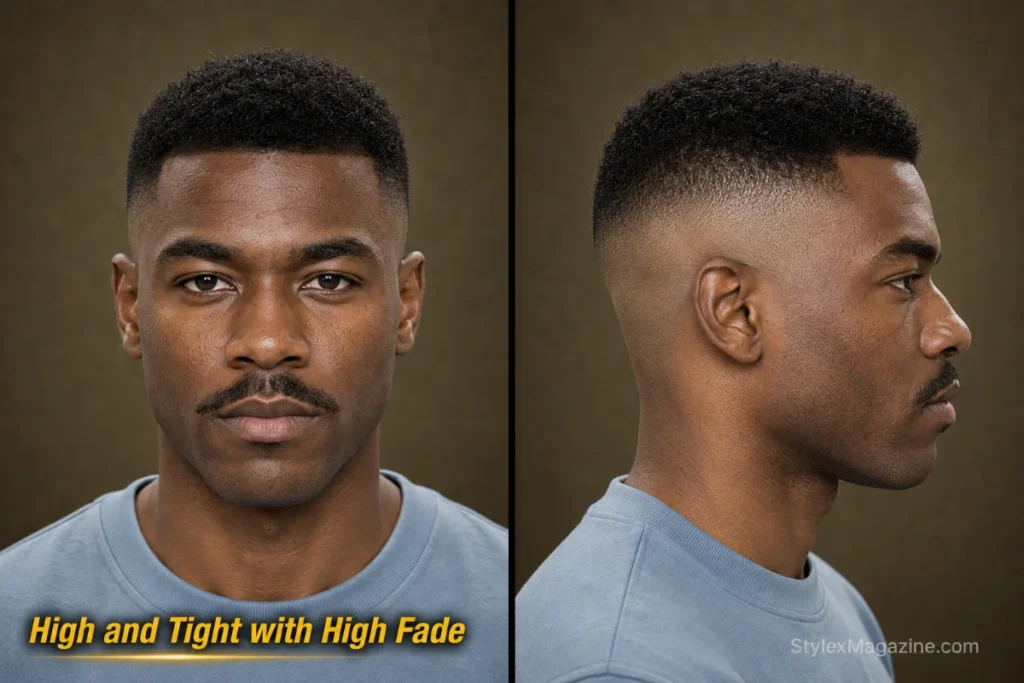
The fade starts above the temples, matching the cut’s name literally. Maximum skin exposure on the sides. The high fade amplifies the contrast that defines the high and tight.
Celebrity: Common in military film roles and professional athletes.
Hair type: Thick hair on top creates the strongest contrast.
Tell your barber: “High and tight with a high fade, starting well above the temples, skin at the base.”
Maintenance: Every 1–2 weeks.
9. High and Tight with Skin Fade
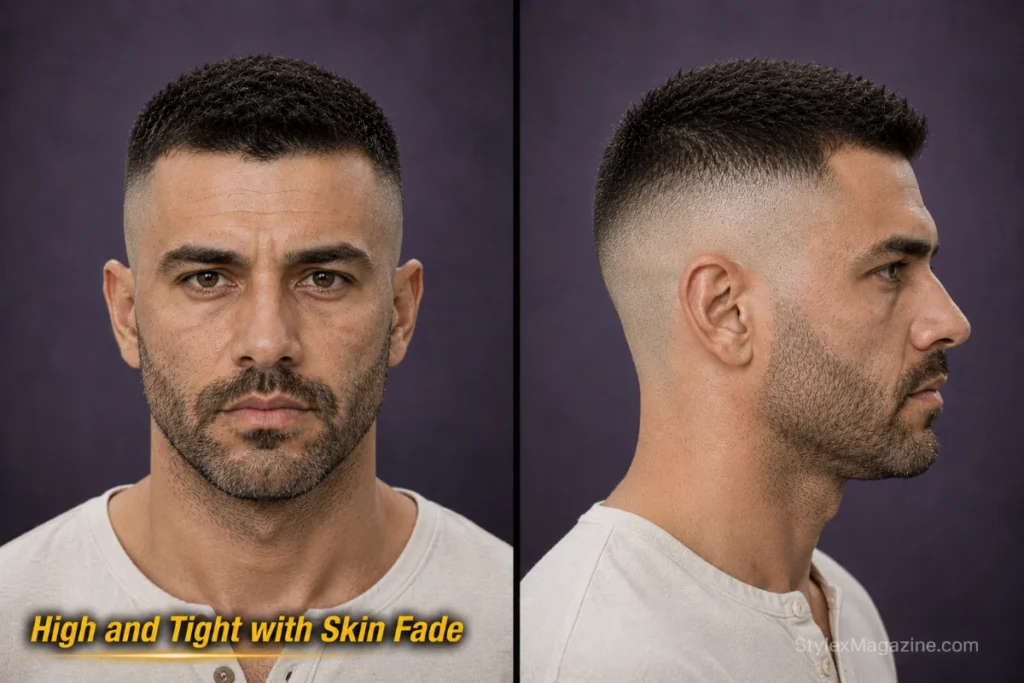
Sides taken to bare skin with a straight razor. The smoothest possible transition from nothing to hair. This is the sharpest version of the high and tight, and it needs the most frequent maintenance to hold its edge.
Styling tip: Moisturize the faded skin daily. Bare scalp dries out.
Hair type: All types. Coarser hair shows a more visible transition.
Tell your barber: “High and tight, skin fade. Razor the sides to bare skin, blend into the top.”
Maintenance: Every week to 10 days.
10. High and Tight with Taper Fade
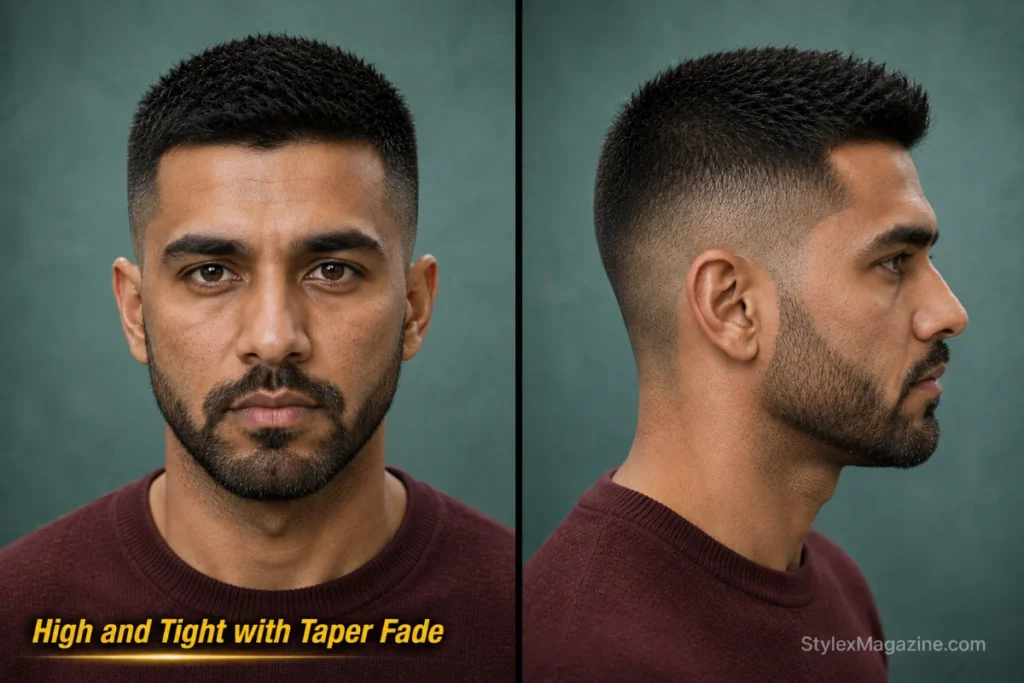
The sides taper gradually rather than going to skin. Some hair always remains at the base. This is the right option for men who want the high and tight silhouette without the full skin exposure.
Hair type: Fine or thin hair. The taper prevents the scalp from showing through.
Styling tip: The softer transition works better in conservative workplaces.
Tell your barber: “High and tight with a taper. Don’t go to skin. Keep some hair at the base, blend it up.”
Maintenance: Every 2–3 weeks. Tapers hold shape longer than skin fades.
11. High and Tight with Drop Fade
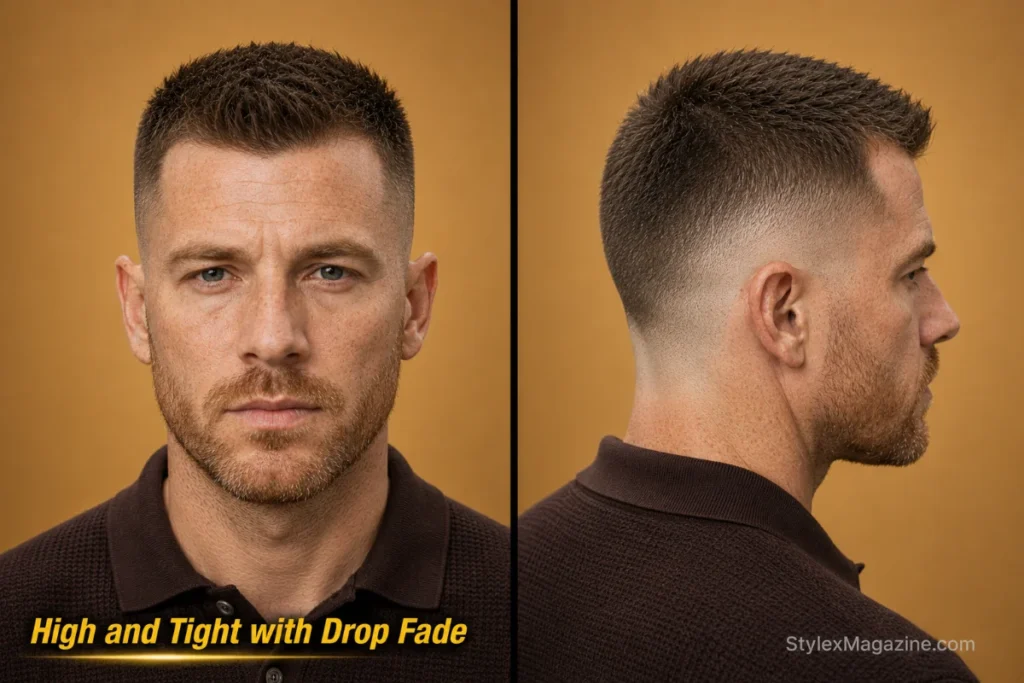
The fade line drops behind the ear, following the natural curve of the head. The front sits higher, the back sits lower. This is an aesthetic choice: the drop follows the head shape more naturally than a straight-line fade.
Hair type: All types. Curly hair hides the drop line slightly.
Styling tip: The drop is visible from the side profile. Keep sideburns clean.
Tell your barber: “High and tight with a drop fade. The line drops behind the ear, skin at the base.”
Maintenance: Every 2 weeks.
Styled Tops
12. High and Tight with Textured Top
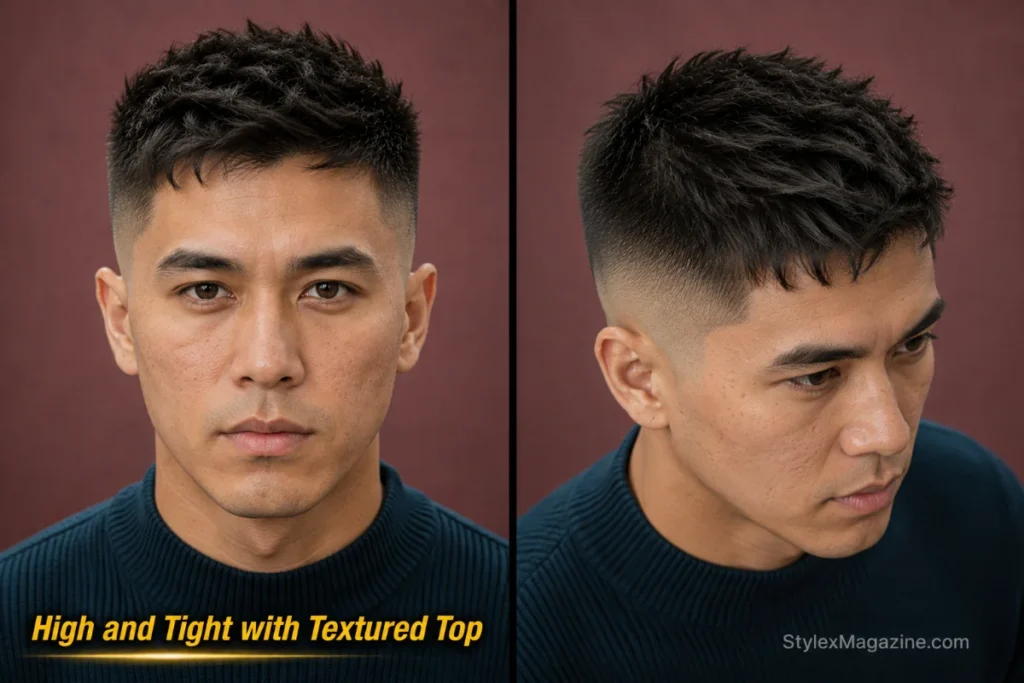
Point-cut layers on top create movement against the clean sides. This is what most civilian barbershops mean when a client asks for a “modern high and tight.” The texture breaks up what would otherwise be a flat, uniform top.
Hair type: Straight and wavy hair benefit most from added texture.
Styling tip: Work a pea-sized amount of matte paste through damp hair, then let it air dry.
Tell your barber: “High and tight, point cut the top for texture, skin fade on sides.”
Maintenance: Every 2 weeks for the fade, 4–5 weeks for the top.
13. High and Tight with Side Part
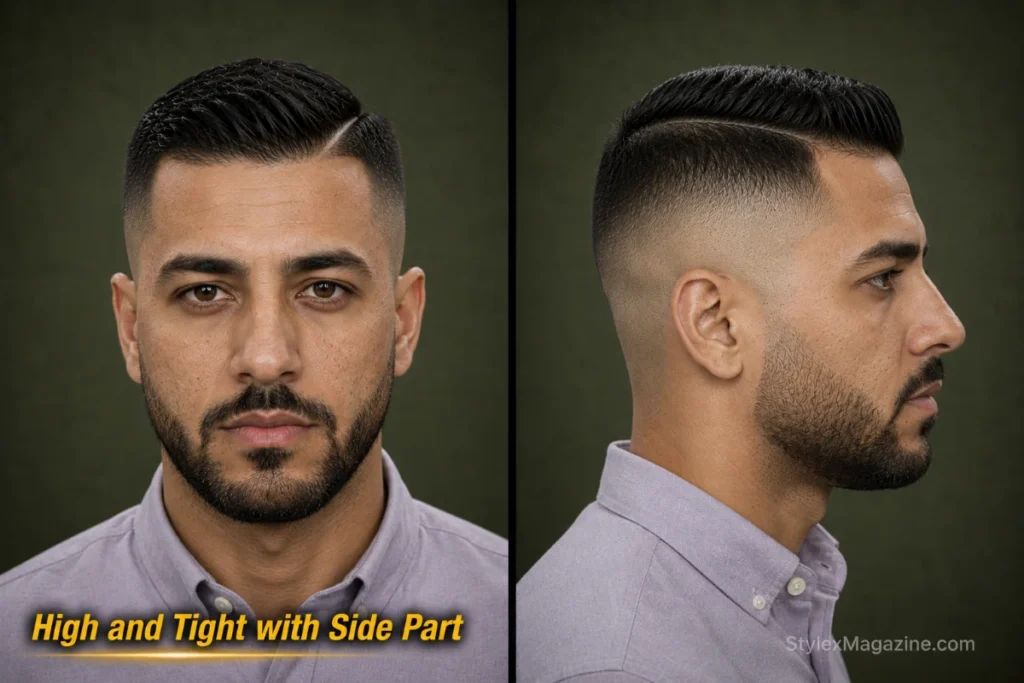
A natural or razor part on top, faded sides. The side part adds a classic element to the military base. The top needs at least 1.5 inches for the part to hold. Conor McGregor wears a version of this: high skin fade with a hard side part swept to one side.
Celebrity: Conor McGregor.
Hair type: Straight to wavy. Curly hair fights the part line.
Tell your barber: “High and tight with a natural side part. Keep one and a half to two inches on top, skin fade sides.”
Maintenance: Every 2 weeks.
14. High and Tight with Comb Over
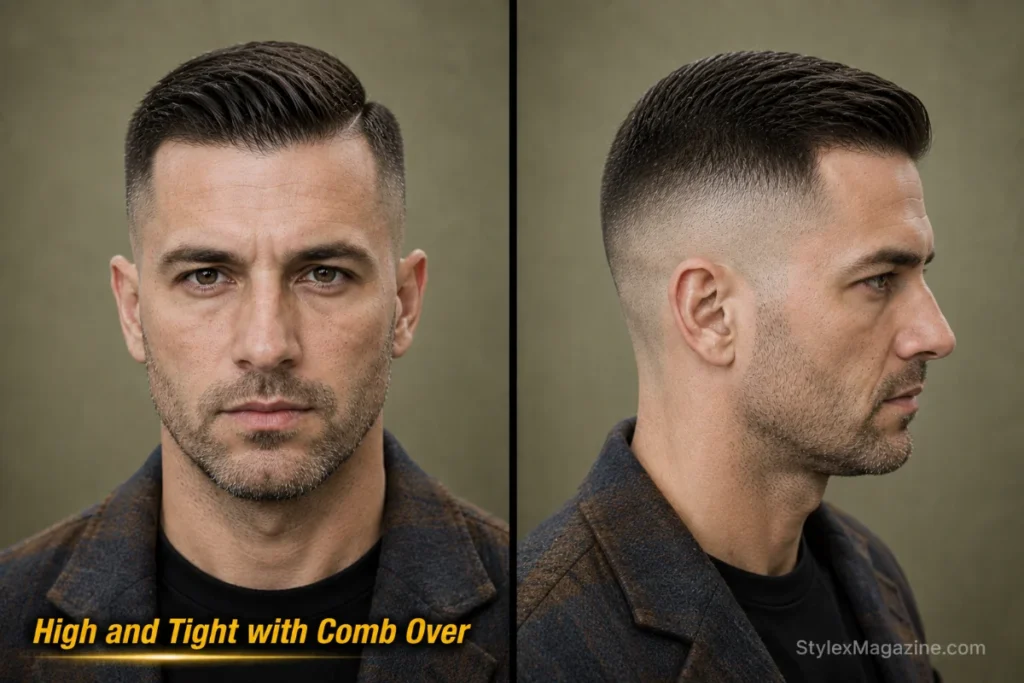
Hair on top combed to one side, faded sides. More polished than the textured version, more modern than the military original. For a full guide on the comb over and its variations, the comb over haircut article covers every angle.
Celebrity: Jake Gyllenhaal has worn similar combinations.
Hair type: Straight to slightly wavy. 2 inches minimum on top.
Tell your barber: “High and tight, comb over on top. Leave two to two and a half inches, fade the sides to skin.”
Maintenance: Every 2 weeks.
15. High and Tight with Pompadour
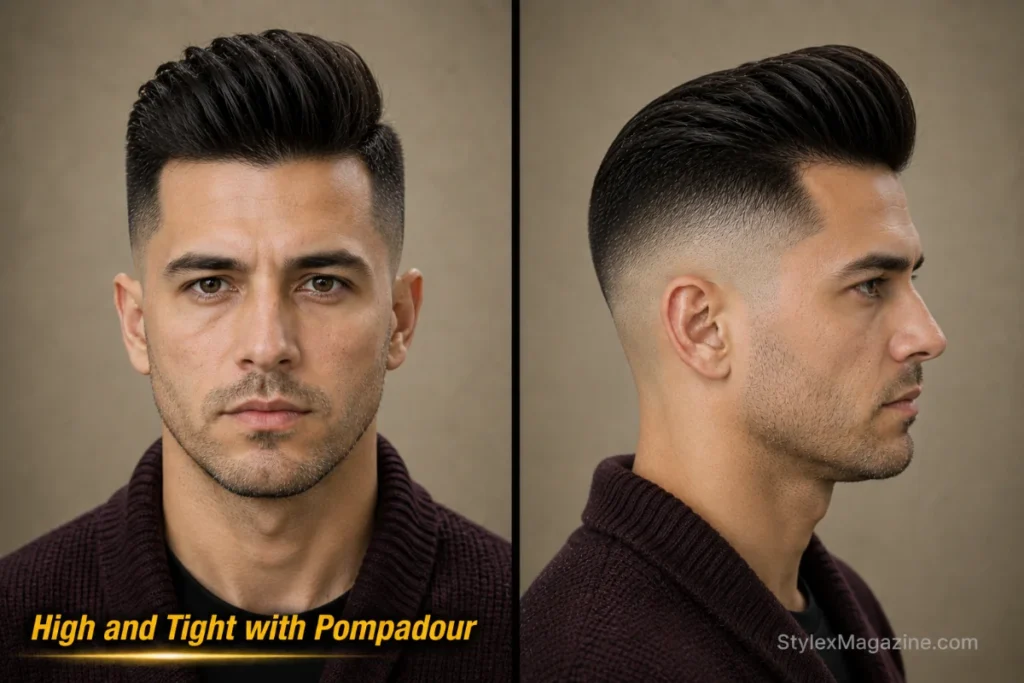
Volume swept back on top, sides taken to skin. The pompadour needs at least 3 inches on top, which pushes this toward the longer end of a high and tight. The extreme side contrast makes the volume on top the entire focal point.
Hair type: Thick straight or wavy hair. Fine hair struggles to hold pompadour height.
Styling tip: Blow dry backward for volume, then set with a medium-hold pomade.
Tell your barber: “High and tight, pompadour on top. Three inches minimum up front, taper shorter toward the crown, skin on sides.”
Maintenance: Every 2 weeks for the fade. Top trim every 5–6 weeks.
16. High and Tight with Slick Back
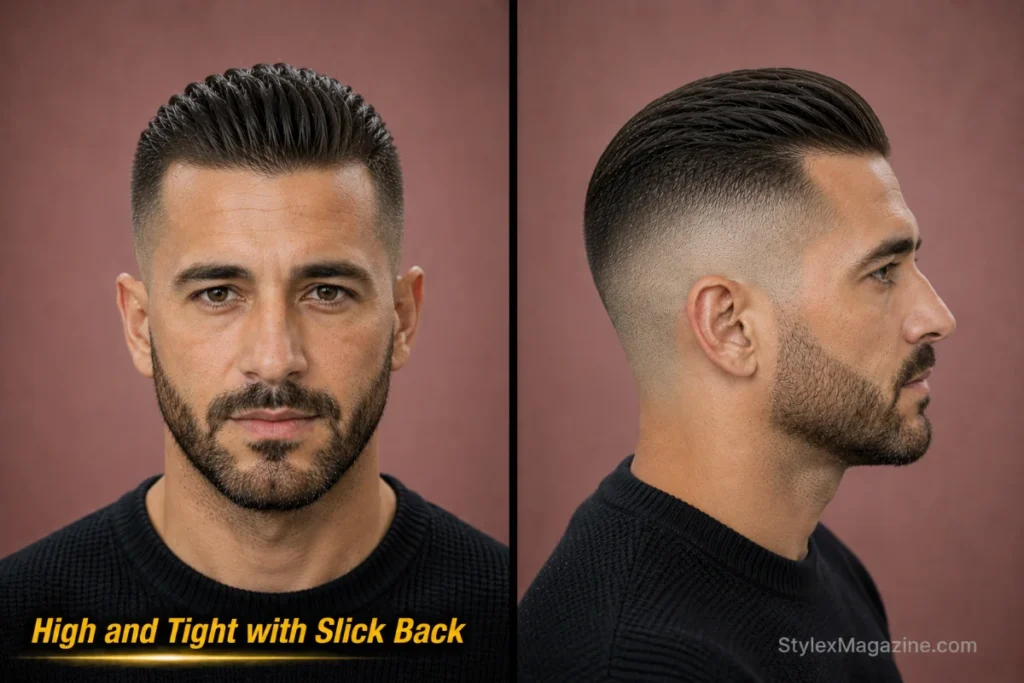
Hair combed straight back on top, high skin fade. The slick back paired with a high and tight base creates a sharper, more structured profile than a standard slick back. Two to three inches on top is enough.
Styling tip: Apply a water-based pomade to damp hair, comb straight back.
Hair type: Straight to slightly wavy.
Tell your barber: “High and tight, slick back on top. Two to three inches, skin fade on sides.”
Maintenance: Every 2 weeks.
17. High and Tight with Quiff
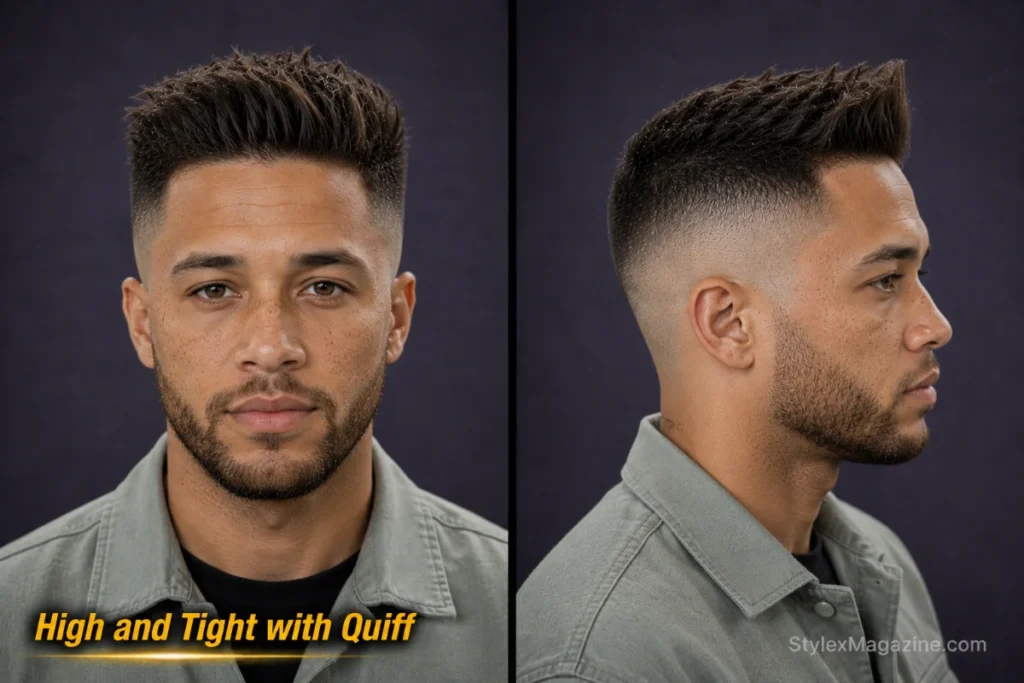
Volume pushed forward and upward at the front, tight faded sides. The quiff adds height at the front which elongates the face. In my experience, this combination suits round and square face shapes particularly well because the upward lift counterbalances width.
Hair type: Thick to medium. Needs at least 2.5 inches at the front.
Styling tip: Blow dry the front section upward, set with a flexible-hold spray.
Tell your barber: “High and tight, quiff at the front. Leave two and a half to three inches up front, shorter at the crown, skin fade sides.”
Maintenance: Every 2 weeks.
Bold & Statement
18. High and Tight with Hard Part
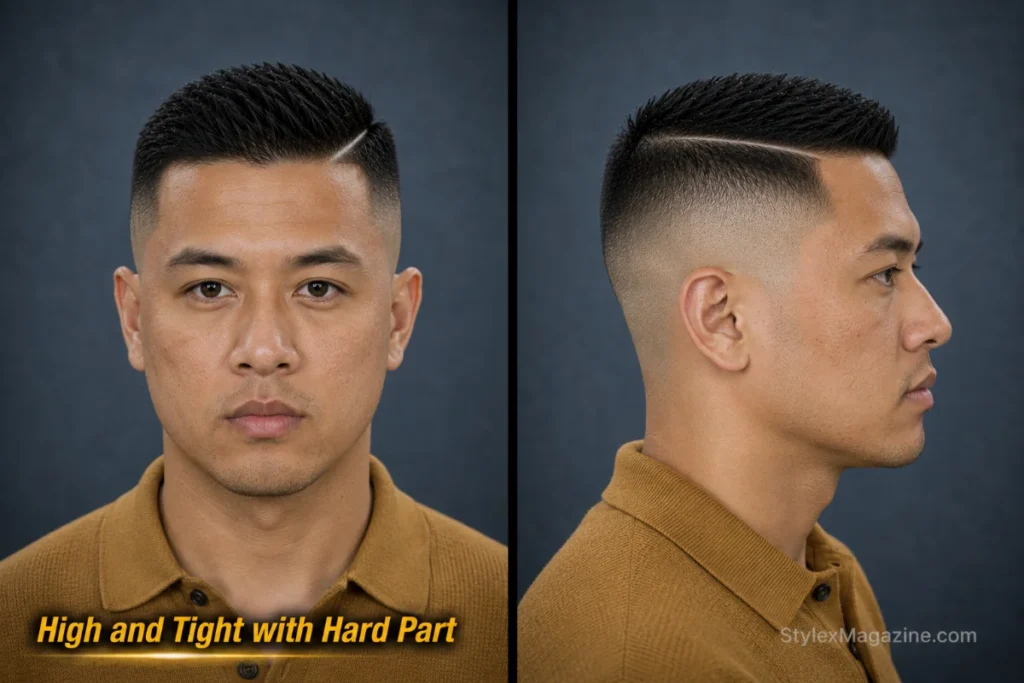
A razor line shaved into one side, separating the top from the fade. The hard part adds a geometric element to the cut. The line needs touching up every 7–10 days because regrowth fills it in quickly.
Styling tip: The hard part is the statement. Keep the top styling simple.
Hair type: All types. The razor line shows on every texture.
Tell your barber: “High and tight with a razor hard part on the left side, about an inch back from the hairline.”
Maintenance: Every 7–10 days for the part line. Every 2 weeks for the full cut.
19. High and Tight with Design
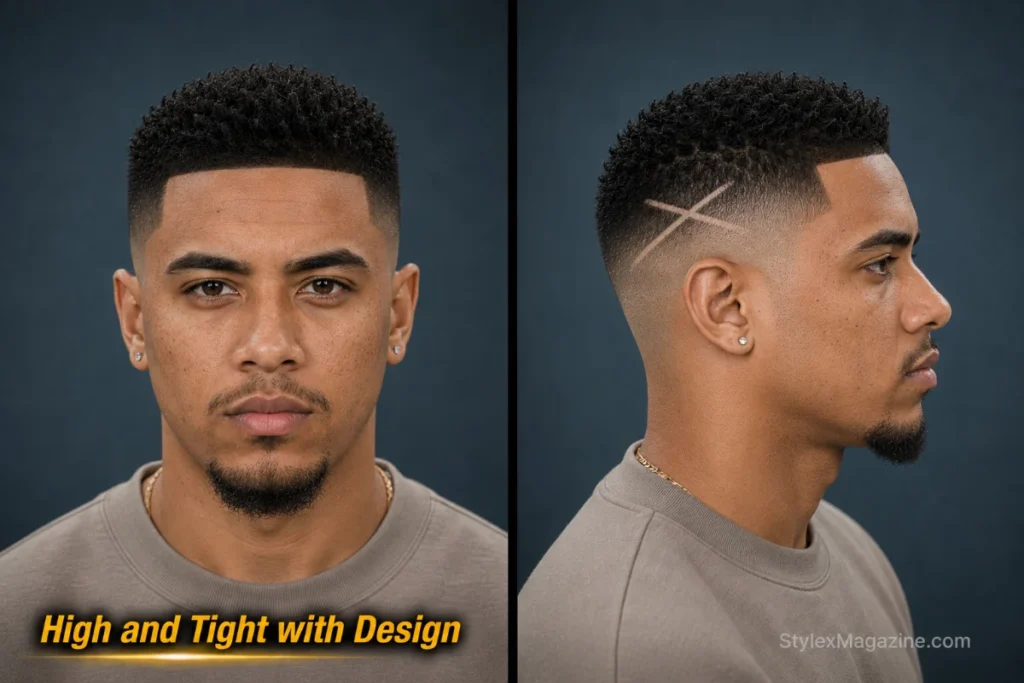
Geometric lines, patterns, or shapes shaved into the faded area. The high and tight gives the barber a large canvas of skin or near-skin to work with. Designs are artistic and temporary: they grow out within a week.
Styling tip: Pick a design that matches the head shape. Straight lines suit angular heads, curves suit rounder ones.
Hair type: All types. The design sits in the shaved area, not the hair.
Tell your barber: “High and tight with a design in the fade area. [Describe your specific design or bring a reference photo.]”
Maintenance: Weekly for the design. Every 2 weeks for the base cut.
20. High and Tight with Flat Top
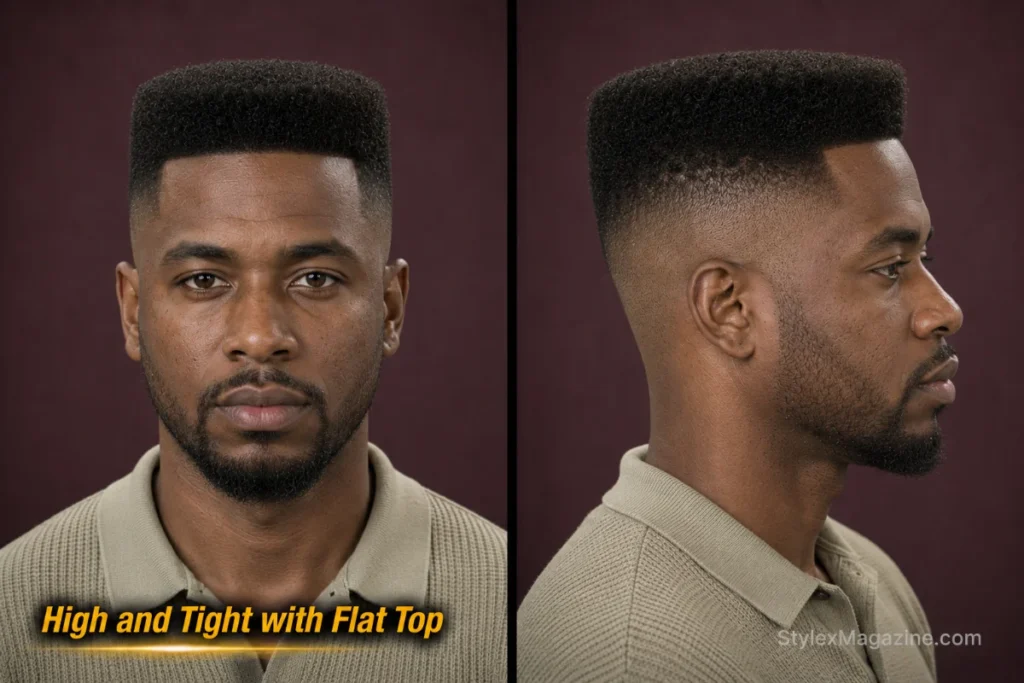
The top is cut level, creating a flat horizontal surface. The flat top high and tight has roots in 1980s and 1990s military culture. Type 4 hair (coily, Afro-textured) holds the flat shape best because the density supports the structure. Straight hair needs product and daily reshaping.
Hair type: Type 3C–4C hair holds the flat shape naturally.
Styling tip: A wide-tooth pick and holding spray maintain the flat surface between cuts.
Tell your barber: “High and tight, flat top on top. Level the top flat, skin on the sides.”
Maintenance: Every 2 weeks.
21. High and Tight with Mohawk
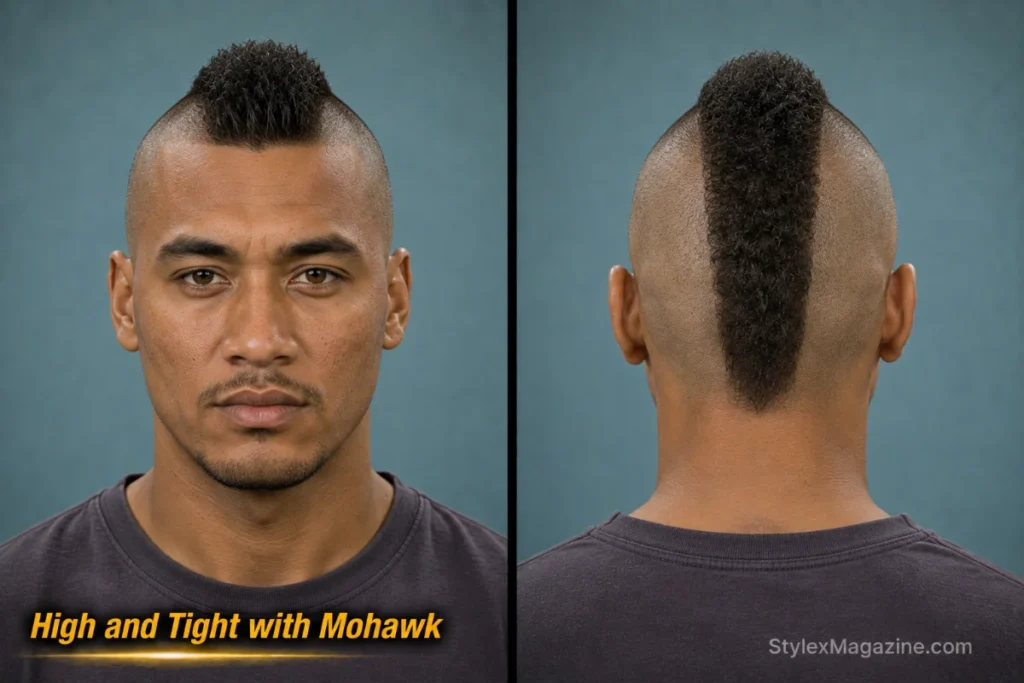
A strip of hair down the center, sides taken to skin. The high and tight base gives the mohawk its sharpest possible frame. The width of the strip determines how bold or subtle the mohawk reads.
Hair type: Thick hair stands up better. Fine hair needs product support.
Styling tip: A strong-hold gel or wax to push the center strip upward.
Tell your barber: “High and tight mohawk. Skin on the sides, leave a strip down the center about two inches wide.”
Maintenance: Every 2 weeks.
Hair Type Specific
22. High and Tight for Curly Hair
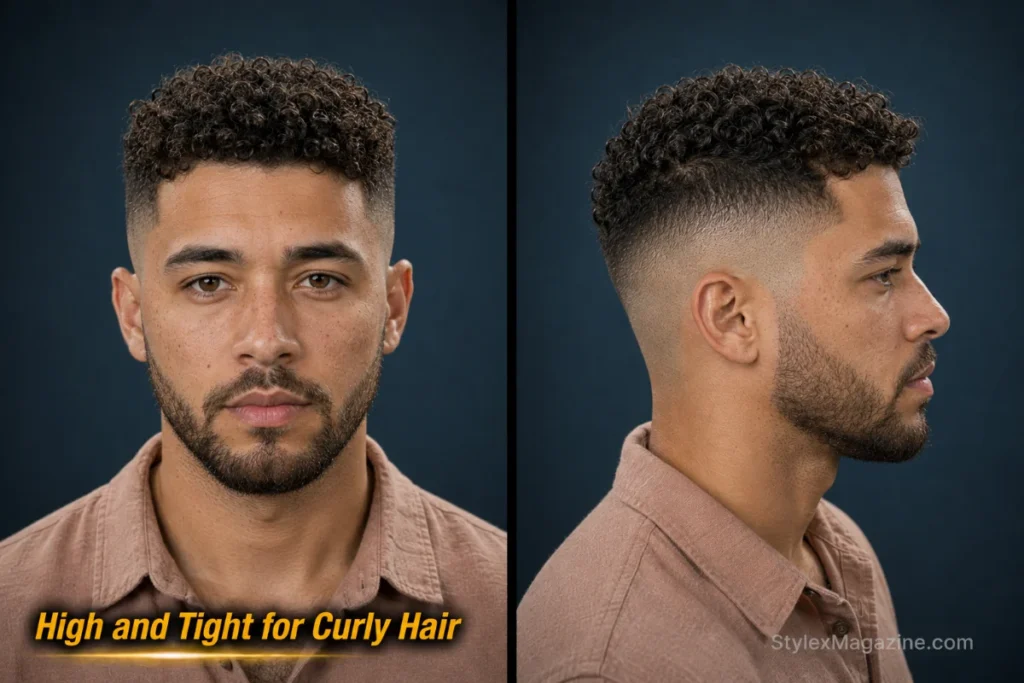
Curly hair on top, skin fade on the sides. The curls add natural texture and volume that straight-haired versions need product to achieve. The key adjustment: ask your barber to cut the top dry. Wet curls stretch longer, and the top will end up shorter than intended once the curls spring back.
Hair type: Type 2C–3C curls.
Styling tip: A curl cream on damp hair, then air dry. No blow drying.
Tell your barber: “High and tight, skin fade on sides. Cut the top dry so the curls sit where I want them.”
Maintenance: Every 2 weeks for the fade. Top trim every 4–5 weeks.
23. High and Tight for Wavy Hair
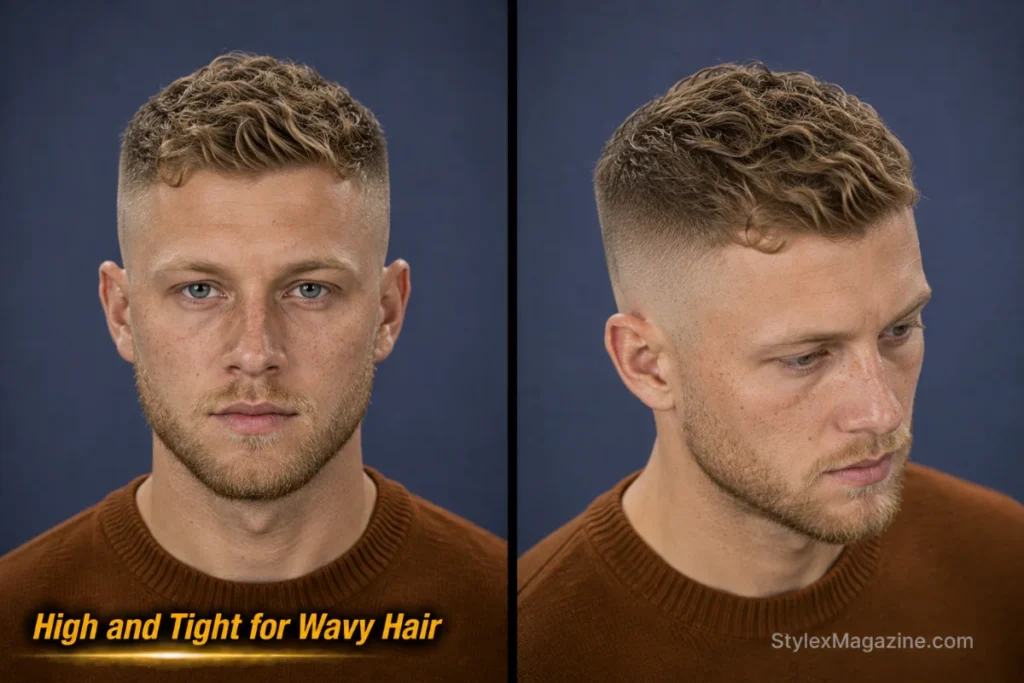
Waves on top, faded sides. The natural wave pattern gives the top movement without product. Wavy hair sits between the flatness of straight and the volume of curly, so it reads relaxed without looking unstructured.
Hair type: Type 2A–2C waves.
Styling tip: A sea salt spray brings out the wave pattern. Apply to damp hair.
Tell your barber: “High and tight, fade on sides. Leave enough on top for the wave to show, about one and a half to two inches.”
Maintenance: Every 2 weeks.
24. High and Tight for Thick Hair
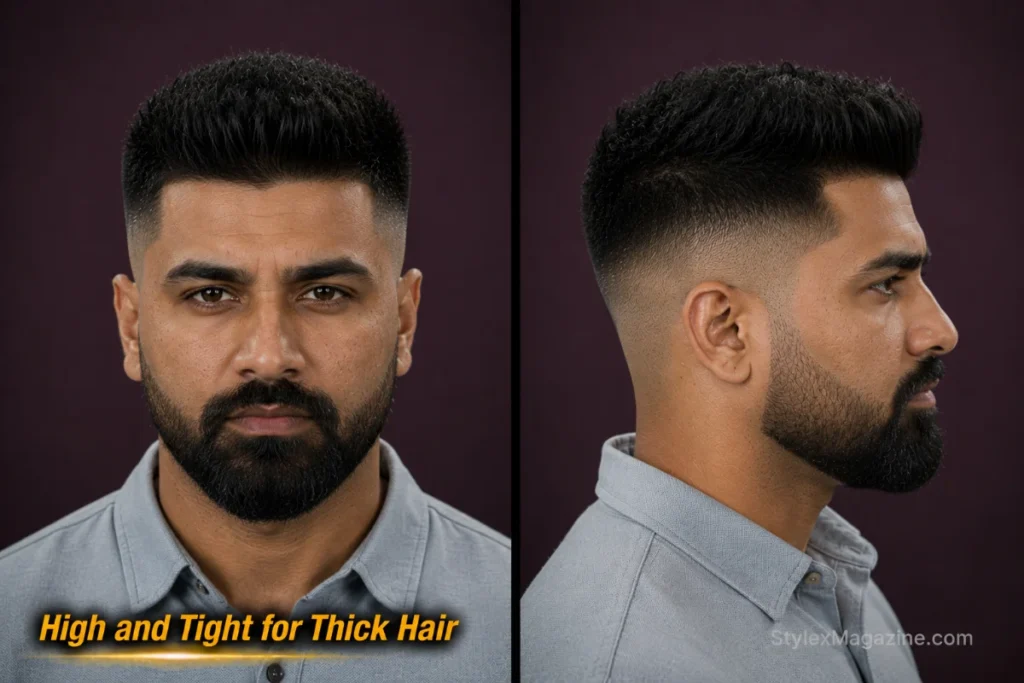
Thick hair creates the strongest contrast in a high and tight because the density on top against bare skin looks like intentional volume. The risk: too much bulk on top without thinning makes the shape look mushroom-like. I always thin the top edges on thick-haired clients to keep the silhouette clean.
Hair type: Thick, any texture.
Styling tip: A lightweight matte clay controls bulk without adding weight.
Tell your barber: “High and tight, skin fade. Thin the top edges so it doesn’t mushroom, keep one to two inches on top.”
Maintenance: Every 2 weeks.
25. High and Tight for Fine or Thin Hair
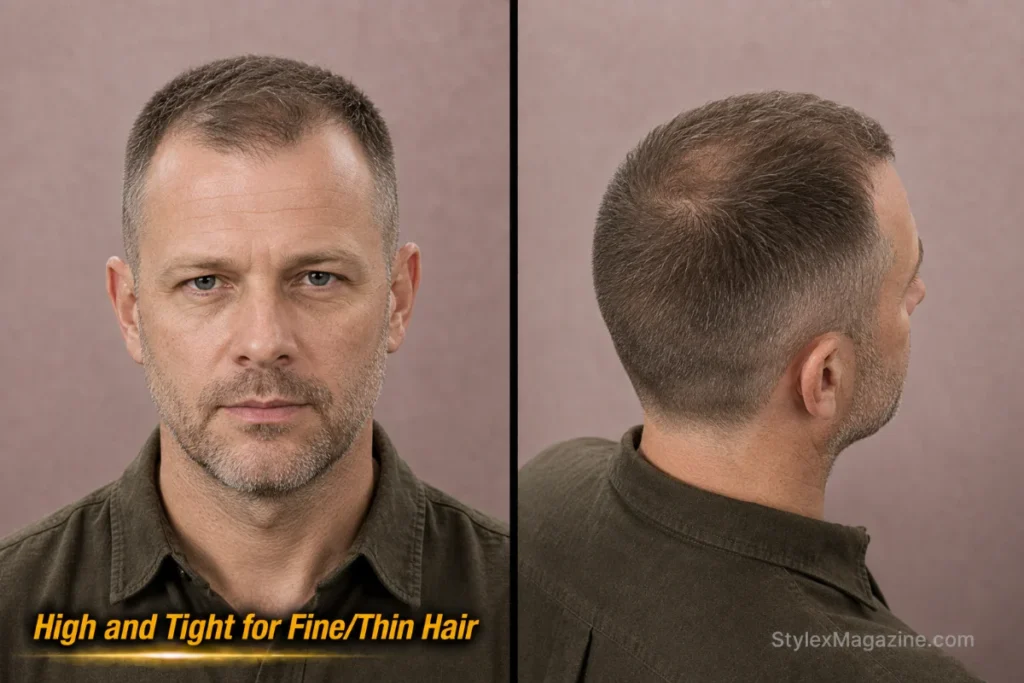
Fine or thinning hair benefits from the high and tight because the short top length means density issues are less visible. The sides being short makes the top look fuller by comparison. For men with thinning at the crown, this cut works better than most longer styles that expose sparse areas. See the full haircuts for men with thinning hair guide for more options.
Hair type: Fine, thin, or thinning hair.
Styling tip: Skip heavy products. A volumizing powder at the roots adds lift without weight.
Tell your barber: “High and tight with a taper rather than skin fade. Keep some hair on the sides so the top doesn’t look isolated.”
Maintenance: Every 2–3 weeks.
Pairings
26. High and Tight with Beard
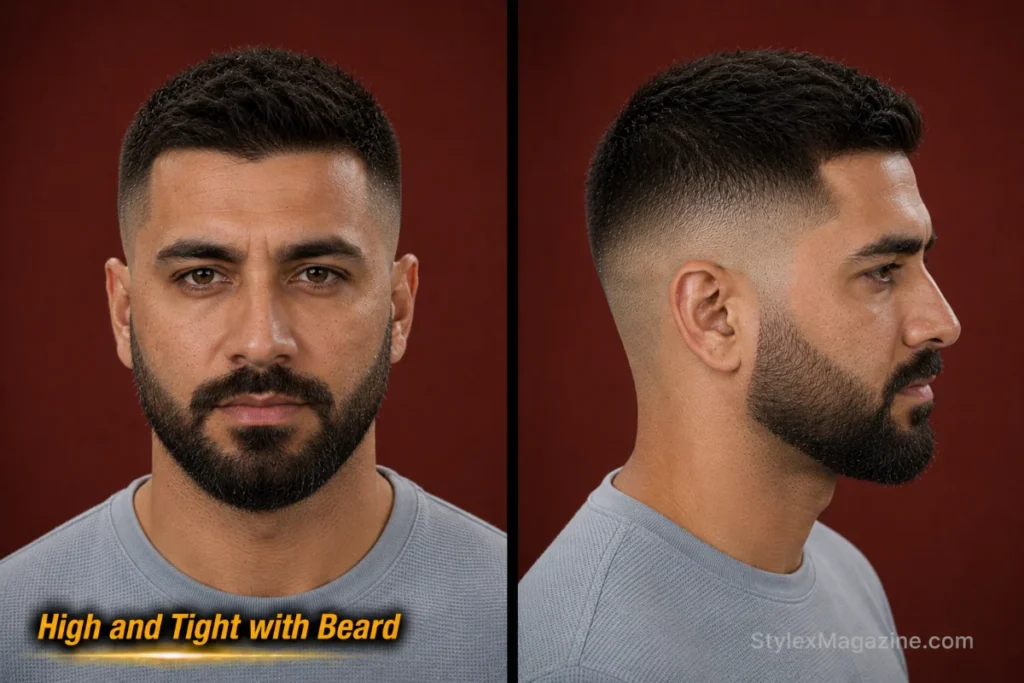
The beard adds length below while the cut removes it above. The sideburn blend is where this combination succeeds or fails. Without specifying, most barbers will leave a hard gap between the fade and the beard line.
Styling tip: Keep the beard neckline defined. A messy neckline undercuts the precision of the high and tight. Hair type: All types. The beard is the variable.
Tell your barber: “High and tight, blend the sideburns into my beard. No gap between fade and beard line.”
Maintenance: Every 2 weeks for the cut. Beard trimmed to match.
27. High and Tight with Undercut
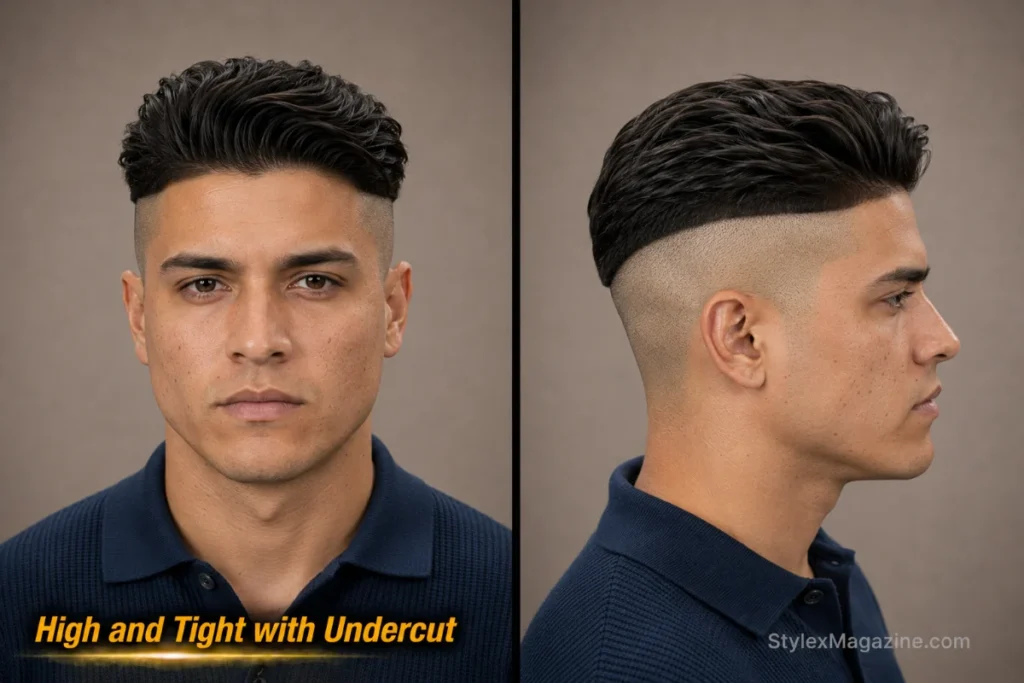
The top section is disconnected from the sides with no blending at all. Unlike the no-fade version (style #5), the undercut version typically has a longer top (2+ inches) that can be styled, pushed back, or swept to one side. The sides are shaved, creating a shelf-like edge.
Styling tip: The disconnection is the point. Style the top boldly.
Hair type: Thick straight or wavy. Fine hair lacks the weight to hold the disconnect.
Tell your barber: “High and tight undercut. Shave the sides, leave two to three inches on top, hard disconnect, no blending.”
Maintenance: Every 2 weeks.
28. High and Tight for Receding Hairline
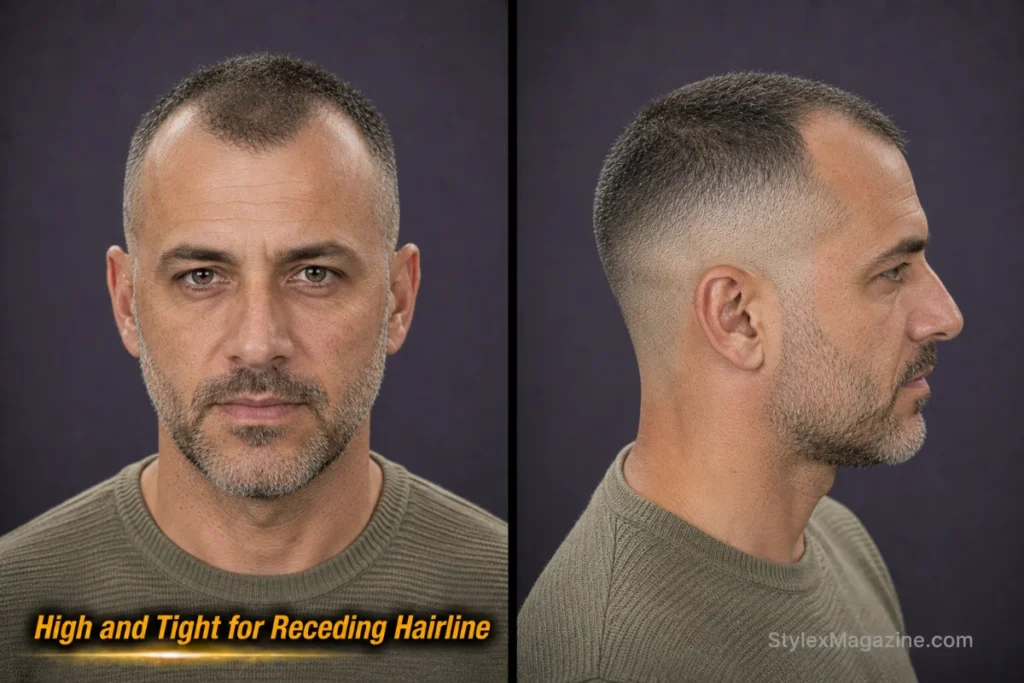
The high and tight works with a receding hairline rather than against it. The short sides eliminate the contrast between thinning temples and fuller areas. Keeping the top at one inch or less means the recession blends into the overall shape. Jason Statham has built his entire look around this principle. For more options, see the haircuts for receding hairline guide.
Celebrity: Jason Statham.
Hair type: Any type with hairline recession.
Styling tip: Avoid products with shine. Matte finish prevents the scalp from reflecting light.
Tell your barber: “High and tight, keep the top short, one inch max. I want the hairline to blend in, not stand out.”
Maintenance: Every 2 weeks.
29. High and Tight with Faux Hawk
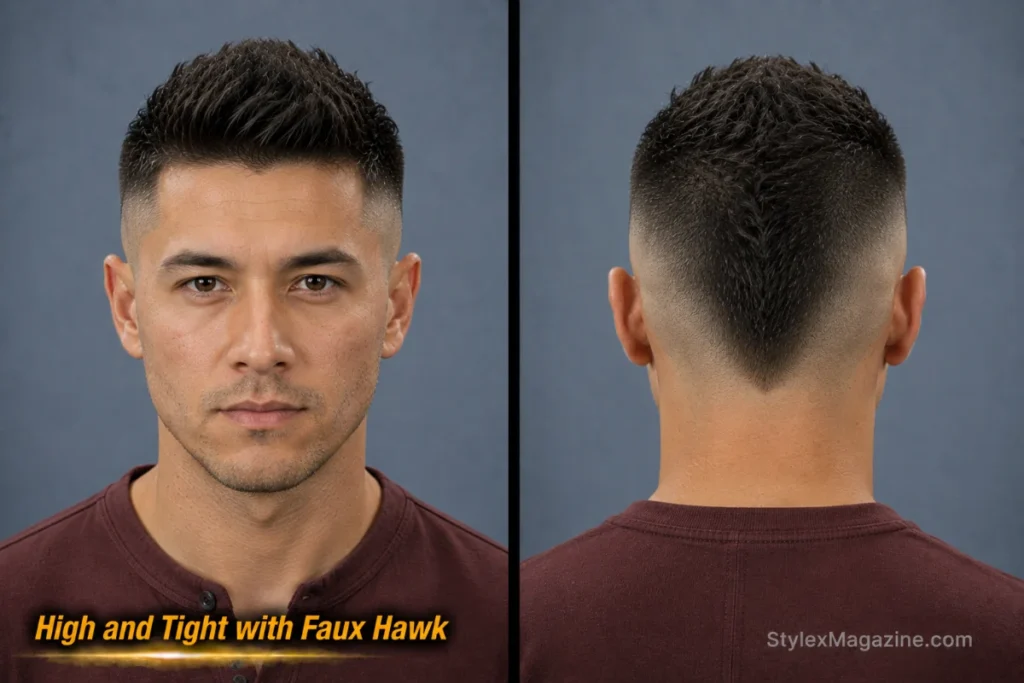
Hair pushed upward along the center, sides faded but not fully shaved. The faux hawk is the less committed version of the mohawk: the center strip is wider, the height is lower, and the overall look reads more conservative. It sits between a textured top and a mohawk on the boldness scale.
Hair type: Medium to thick. Fine hair needs strong-hold product to maintain the upward shape.
Styling tip: Blow dry upward at the center, then set with a strong-hold wax.
Tell your barber: “High and tight, faux hawk on top. Wider center section than a mohawk, skin fade on the sides.”
Maintenance: Every 2 weeks.
30. High and Tight with Forward Sweep
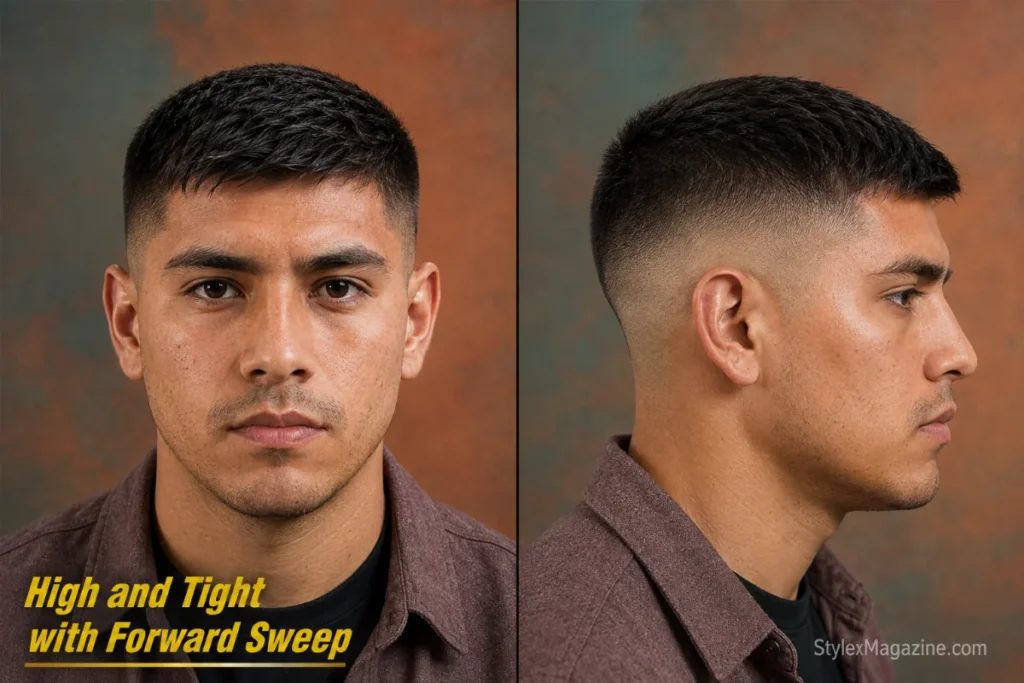
Hair on top combed forward toward the forehead rather than back or to the side. The forward direction covers more of the forehead, which makes this a strong option for men with a high hairline or large forehead. No product needed for the basic version: towel dry and comb forward.
Hair type: Straight to wavy. Curly hair tends to resist forward direction.
Styling tip: Comb damp hair forward, air dry. A light matte paste adds hold without stiffness.
Tell your barber: “High and tight, forward sweep. Leave one and a half to two inches on top, enough to fall forward. Skin fade sides.”
Maintenance: Every 2 weeks.
Which Face Shape Suits a High and Tight?
Oval and square face shapes suit the high and tight best because the cut’s proportions complement balanced or angular features. Round and heart-shaped faces need the right variation to avoid exaggerating width.
| Face Shape | Best Variation | Why |
|---|---|---|
| Oval | Any variation | Balanced proportions handle any fade height |
| Square | Classic, mid fade, textured top | Angular jaw pairs with the cut’s sharp lines |
| Rectangular | Avoid high fade; low fade or taper | Full high fade can elongate the face further |
| Round | High fade, quiff, pompadour | Added height on top counterbalances face width |
| Heart | Mid fade, side part | Avoids adding visual width at the temples |
| Diamond | Low or mid fade | Keeps proportions balanced at the cheekbones |
| Oblong | Low fade or taper, avoid extreme height on top | Prevents making the face look longer |
Not sure which face shape you have? The face shape calculator tool gives you a match in under a minute.
FAQ
Does a high and tight work with a receding hairline?
Yes, and it’s often a better choice than growing hair longer to compensate. Longer hair around a receding hairline draws attention to the areas where density drops off. A high and tight removes that contrast entirely because both the receding areas and the fuller areas are cut short. The recession becomes part of the shape rather than a flaw in it.
What clipper guards do barbers use for a high and tight?
Sides: #0 guard or straight razor for skin. Top: #3 to #6 guard depending on how much length you want (a #4 leaves roughly half an inch). Most barbers work upward from the lowest guard, blending progressively if a fade is included.
Can you get a high and tight without a fade?
Yes. The original military version uses a hard disconnect with no fade at all. The line between top and sides is abrupt and visible, which is the traditional look.
How long does a high and tight take to grow out?
The sides reach noticeable stubble within 5–7 days. A full grow-out to a standard short haircut takes 6–8 weeks. The awkward phase falls around weeks 3–4, when the sides have grown enough to lose shape but not enough to blend.
Is a high and tight professional enough for an office?
In most workplaces, yes. The taper fade version (style #10) is the safest bet for conservative environments because it avoids the full skin exposure. Skin fades and designs skew bolder and suit creative or casual workplaces better.


30 Best Short Beard Styles For Men (2026)
30 Best Mod Haircut Ideas for Men (2026)


[…] differs from a high and tight haircut, which keeps a deliberate hard edge where the short sides meet the top. The low fade version blends […]