
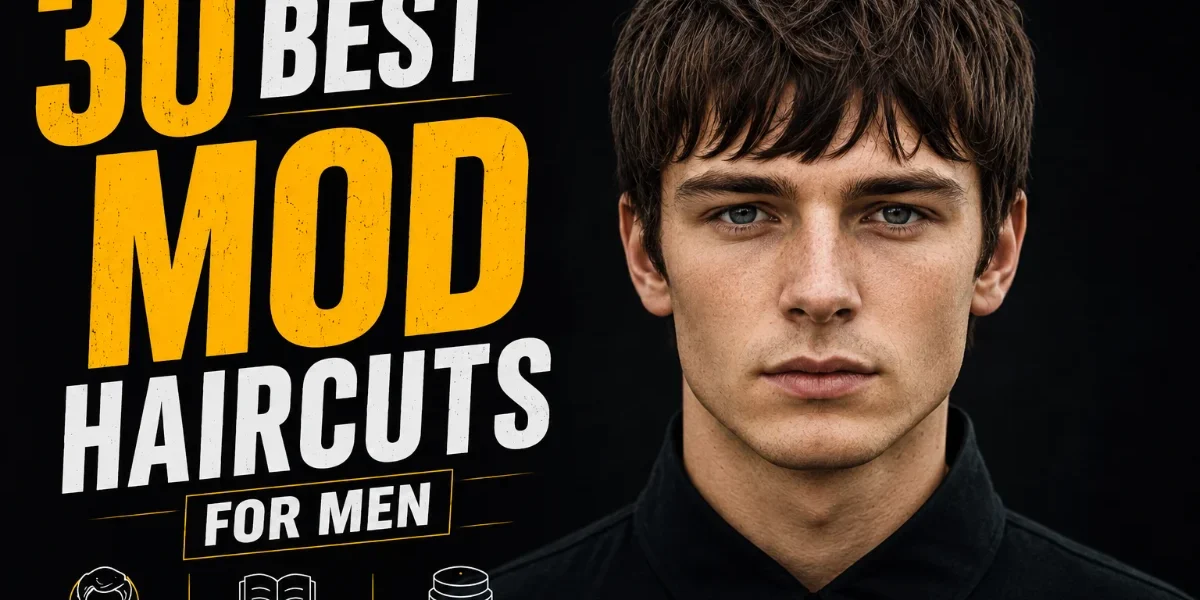

Quick Answer: A mod haircut is a scissor-cut men’s style from 1960s Britain, built around a structured fringe, textured layers, and a rounded silhouette. The sides stay at a uniform length (not faded), and the top carries enough length for forward movement. Modern versions range from short and structured to shaggy and relaxed, with most sitting between 2 and 4 inches on top.
The mod cut is one of the few men’s haircuts built entirely with scissors. No clippers on the sides, no fade graduation, no hard contrast between top and sides. The shape comes from layering, weight distribution, and a fringe that anchors the entire look. That’s what separates it from every other medium-length cut in the chair right now.
The style started in 1960s London, got revived through Britpop in the 1990s, and has come back again in 2026 as men move away from tight skin fades toward haircuts with more texture and natural movement. Jacob Elordi and Paul Mescal have both been spotted wearing modern versions, but the cut itself is older than either of them by decades. Below are 30 variations, each with the measurements and barber details you need to get it right.
What Is a Mod Haircut?
A mod haircut is a medium-length, scissor-cut style defined by three features: a structured fringe, layered top, and rounded silhouette with uniform-length sides. The sides are blended with scissors, never clipped or faded. The fringe falls forward across the forehead. The crown carries enough weight to create natural movement.
The original mod cut emerged in late-1950s London among young men who rejected American rock-and-roll grooming in favour of Italian tailoring and continental European precision. The Beatles popularised the mop top variation worldwide in 1963. Paul Weller and The Jam revived the sharper, quiff-driven version in the late 1970s. Britpop bands like Oasis brought it back again in the 1990s with a heavier, choppier fringe.
What separates a mod from any generic medium-length cut is intent. The scissor-cut sides, the deliberate fringe shape, and the clean perimeter all signal that the cut was thought about, not just grown out. A mod cut without a defined fringe is just a medium-length haircut.
What Are the Best Mod Haircut Styles for Men?
Thirty mod haircut variations covering every length, texture, and fringe type. Each style includes what defines it, who it suits by face shape and hair type, and the specific measurements your barber needs.
1. Classic 60s Mod
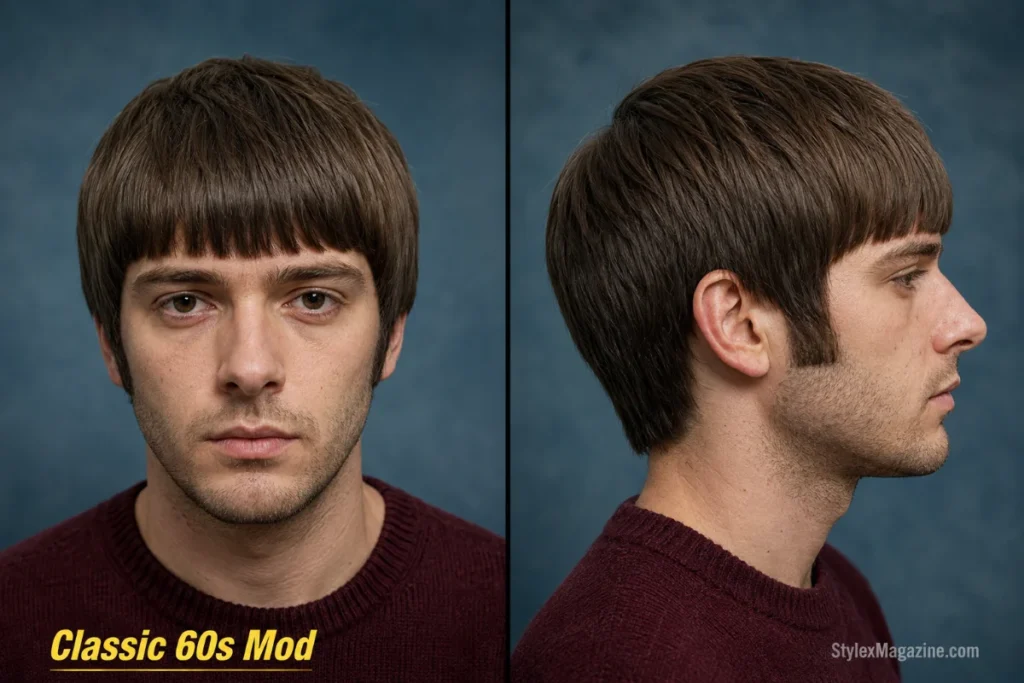
The original geometric mod. Blunt fringe cut straight across at brow level, scissor-cut sides at 1.5 to 2 inches, top at 3 inches with soft layers. The shape is clean, structured, and unmistakably retro. The Beatles made this silhouette famous worldwide in 1964. Sideburns sit at mid-ear, squared off.
Best for: Oval and oblong faces. Straight to slightly wavy hair.
Celebrity: The Beatles (1964 era).
Styling tip: Light pomade combed forward, nothing more.
2. 90s Britpop Mod
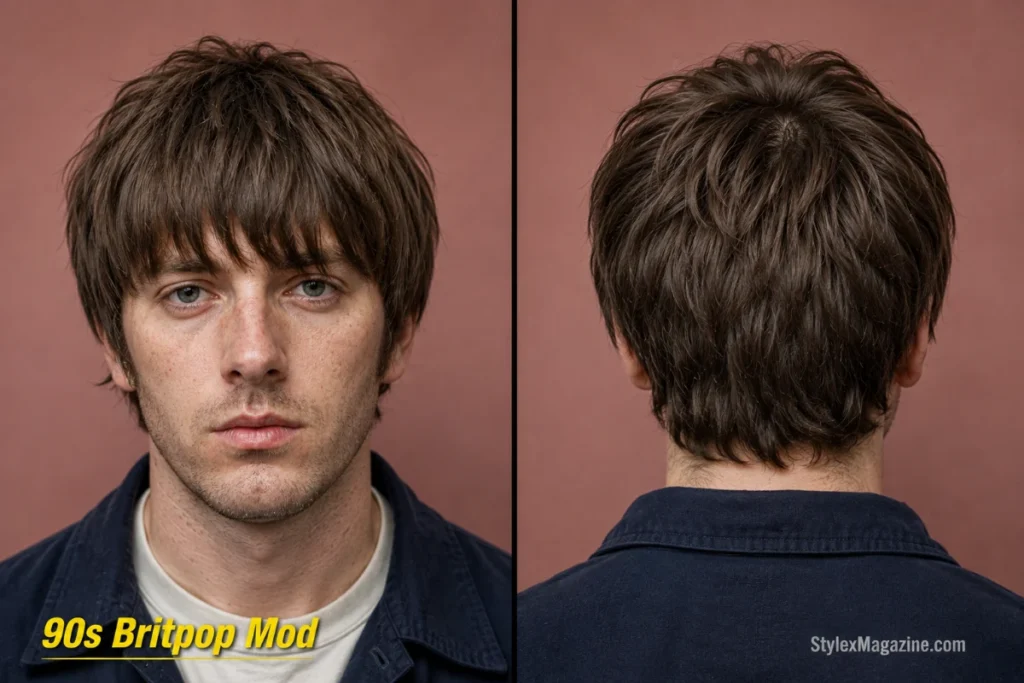
Heavier, looser, and less structured than the 60s version. The fringe sits lower on the forehead, layers are choppier, and the overall shape has more weight through the sides. Top at 3.5 to 4 inches, sides at 2 to 2.5 inches. Liam Gallagher wore this throughout the Oasis years, and it remains the most referenced mod variation in 2026.
Best for: Oval and square faces. Medium to thick, straight or wavy hair.
Celebrity: Liam Gallagher. Styling tip: Matte cream, finger-styled, minimal effort.
3. Modern Textured Mod
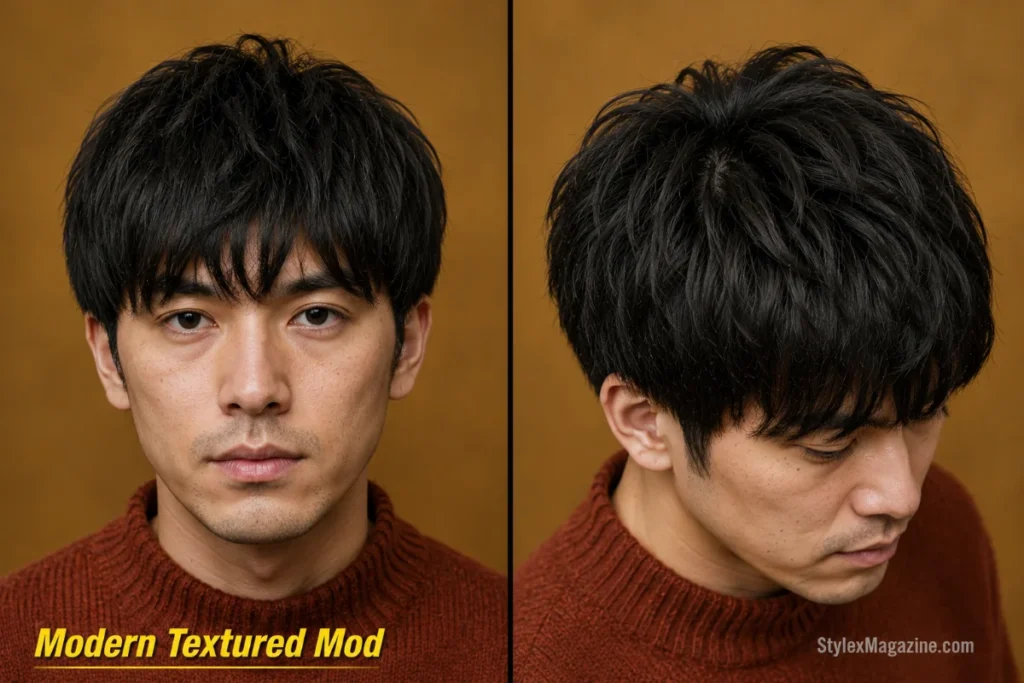
The most requested variation right now. Internal layering creates separation through the fringe and crown without the rigid geometry of the 60s original. Top at 3 to 4 inches, sides at 2 inches, fringe textured rather than blunt. I cut more of these than any other mod variation because the texture makes it forgiving across different hair densities.
Best for: All face shapes. All textures, medium to thick density.
Styling tip: Matte clay on damp hair, blow-dry forward with fingers.
4. Short Mod Cut
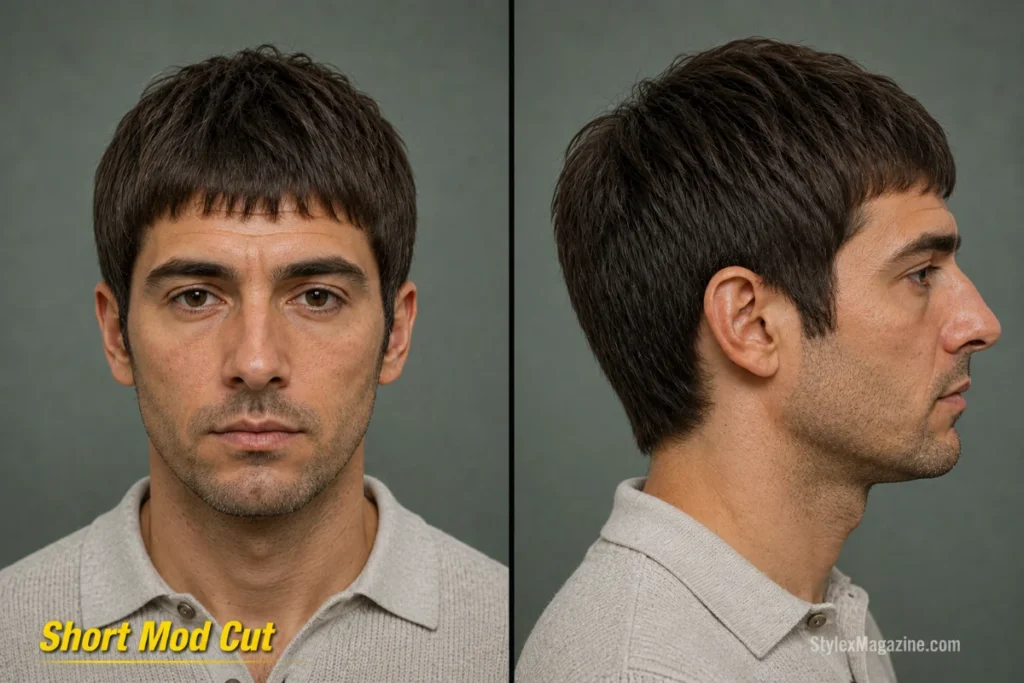
The most workplace-appropriate mod. Fringe sits just above the eyebrows, top at 2 to 2.5 inches, sides at 1.5 inches. The rounded silhouette stays, but the shorter length means less daily styling. Fine hair carries this better than the longer variations because the shape relies on structure, not volume.
Best for: All face shapes. Fine to medium density.
Styling tip: Finger-style with light cream, skip the blow dryer.
5. Choppy Mod
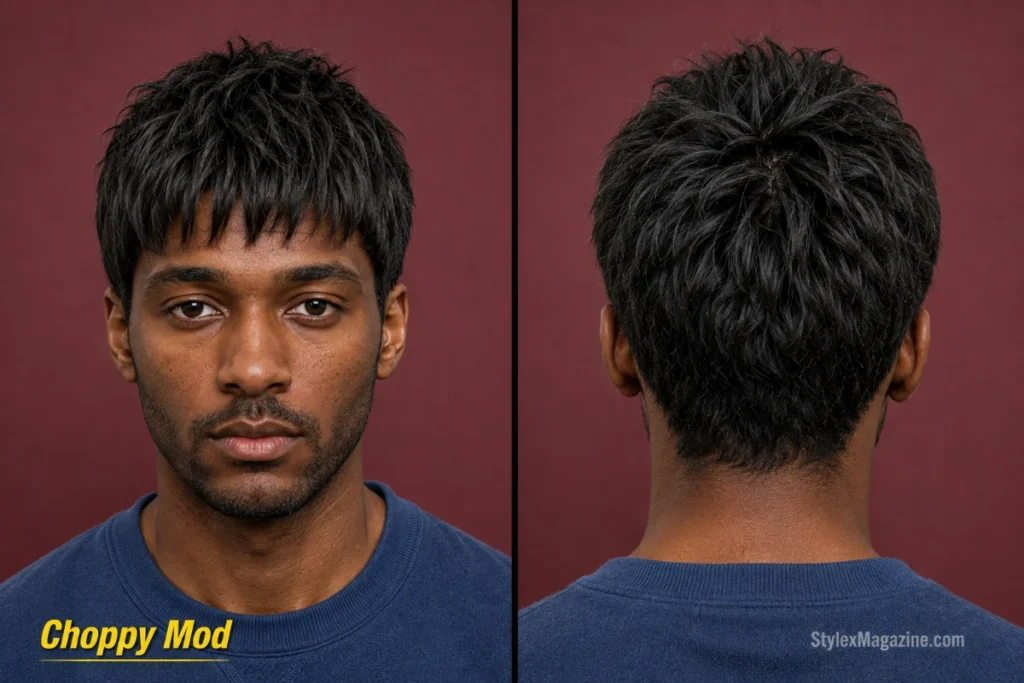
Point-cut layers break up the fringe and crown for a rougher, less polished finish. The fringe falls in pieces rather than a solid line. Top at 3 inches, sides at 2 inches, ends razored or point-cut throughout. The choppiness keeps thick hair from looking bulky and adds dimension on straight hair.
Best for: Square and diamond faces. Thick, straight to wavy hair.
Styling tip: Texture powder at the roots for lift and separation.
6. Messy Mod
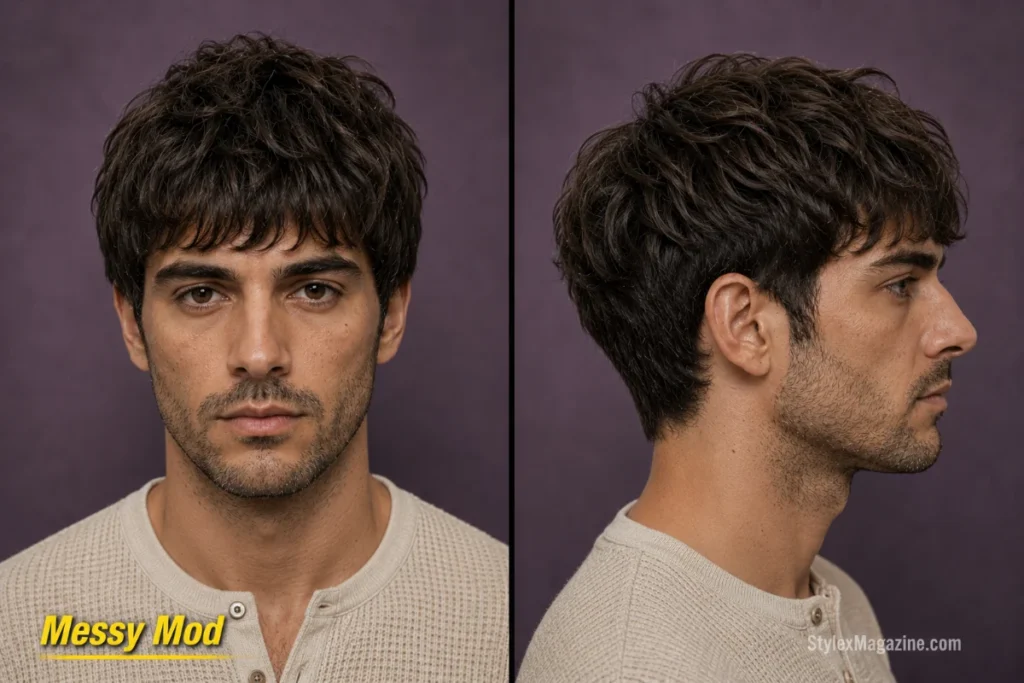
Intentionally undone. The shape is still rounded, the fringe is still forward, but the finish is tousled rather than combed. Top at 3 to 3.5 inches, sides at 2 inches, layers throughout. The messiness has to come from the styling, not from a sloppy cut. The cut itself must be precise underneath.
Best for: Oval and heart faces. Wavy or naturally textured hair.
Styling tip: A touch of matte paste, no comb, no brush. Air dry.
7. Curly Mod
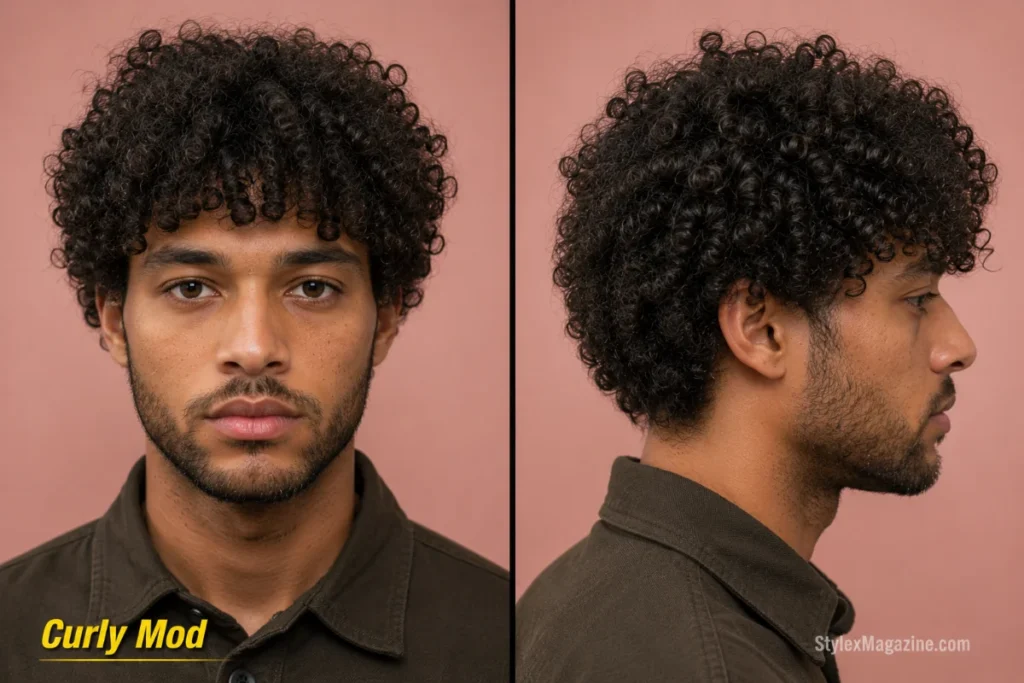
Natural curls replace the straight fringe with a fuller, textured frame across the forehead. The layering has to account for curl shrinkage. I cut curly mods at least half an inch longer than the target length because curls contract 20 to 30 percent when dry. Top at 3.5 to 4 inches wet (2.5 to 3 inches dry), sides shaped with scissors to control volume without removing curl pattern.
Best for: Oval, heart, and diamond faces. Type 2B to 3B curls.
Styling tip: Curl cream on wet hair, air dry or diffuse on low.
8. Wavy Mod
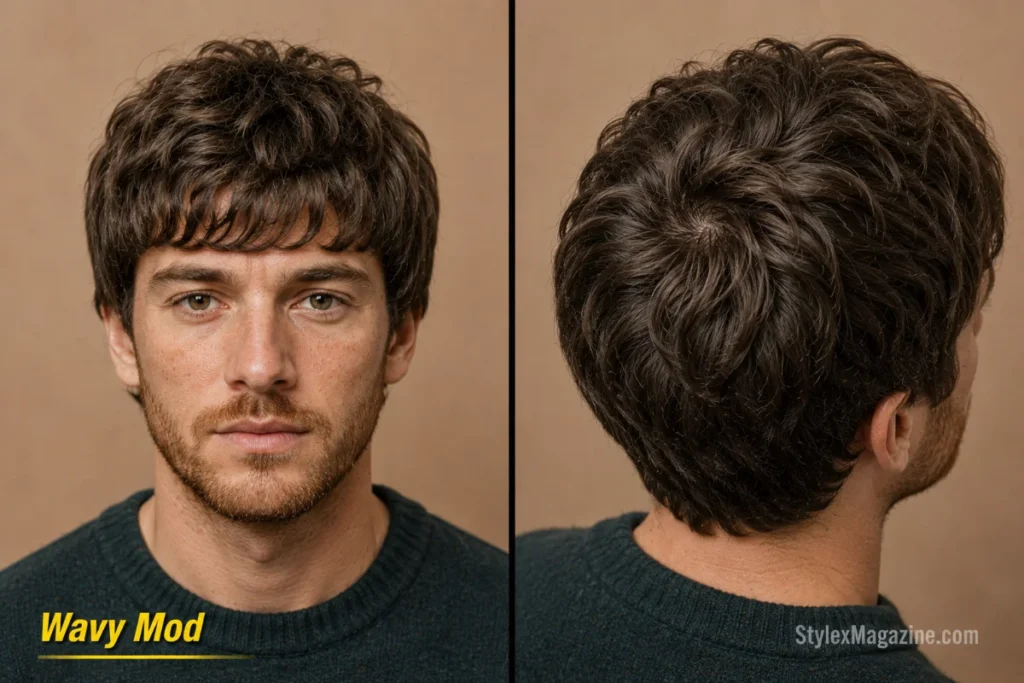
Soft waves shaped into layers that sit neatly around the head. The wave pattern does most of the work. Top at 3 inches, sides at 2 inches, fringe blended into the top rather than cut blunt. The natural texture adds movement that straight hair needs product to achieve.
Best for: All face shapes. Naturally wavy (Type 2A to 2C).
Styling tip: Sea salt spray on damp hair, finger-dry forward.
9. Mod for Straight Hair
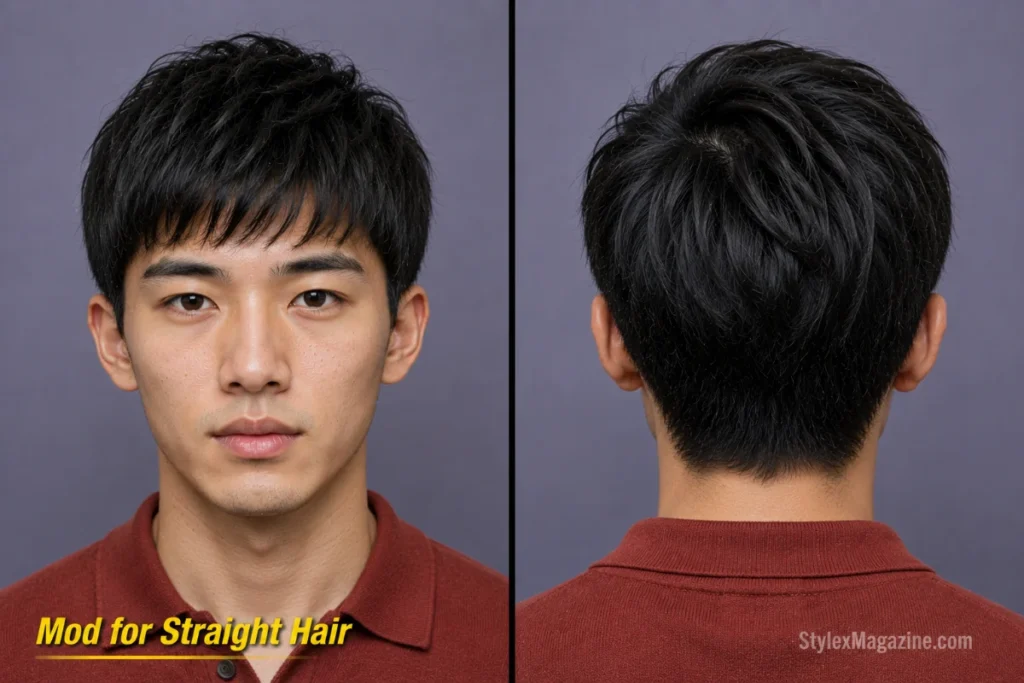
Precision-dependent. Without natural wave or curl, the cut has to create movement through invisible layering and texturizing. Straight hair shows every mistake, so the scissor work matters more here than on any other texture. Top at 3 inches, sides at 2 inches, internal point-cutting throughout to prevent flatness.
Best for: Oval and oblong faces. Straight, medium density.
Styling tip: Blow-dry forward with a round brush for shape.
10. Long Mod
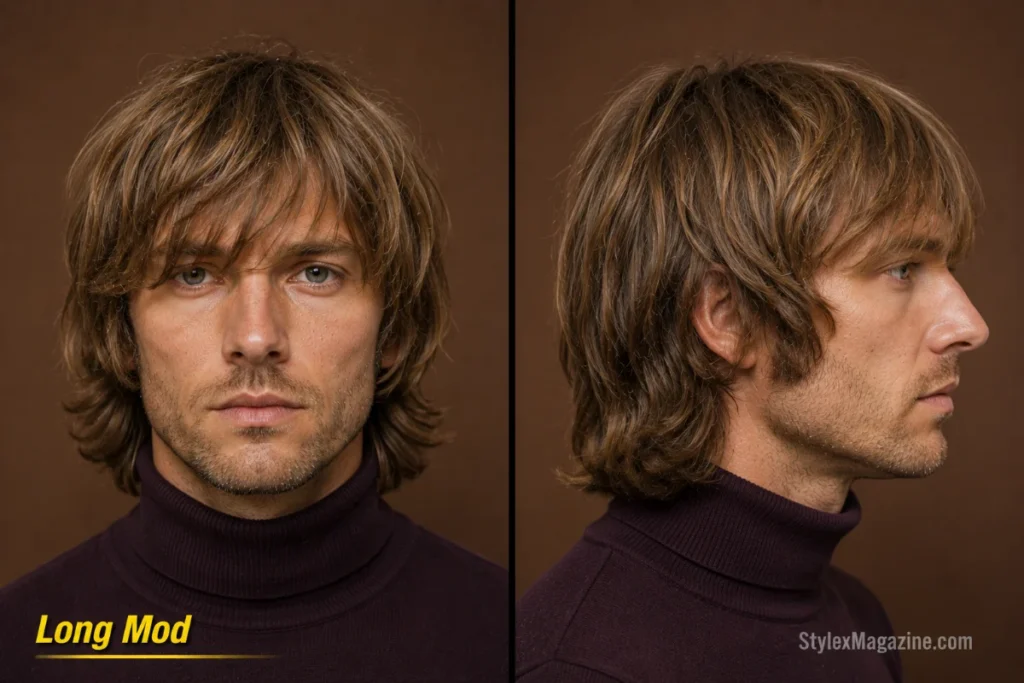
Ear-grazing sides, collar-length back, fringe past the eyebrows. Top at 4 to 5 inches, sides at 3 inches. The hair moves freely and settles on its own throughout the day. Full sideburns reaching the earlobe complete the silhouette. This is the closest variation to the original late-60s mod before the hippie movement pushed lengths further.
Best for: Oval and oblong faces. Wavy to straight, medium to thick density.
Celebrity: Early Paul McCartney (1967).
Styling tip: Minimal product, let gravity do the work.
11. Medium Mod
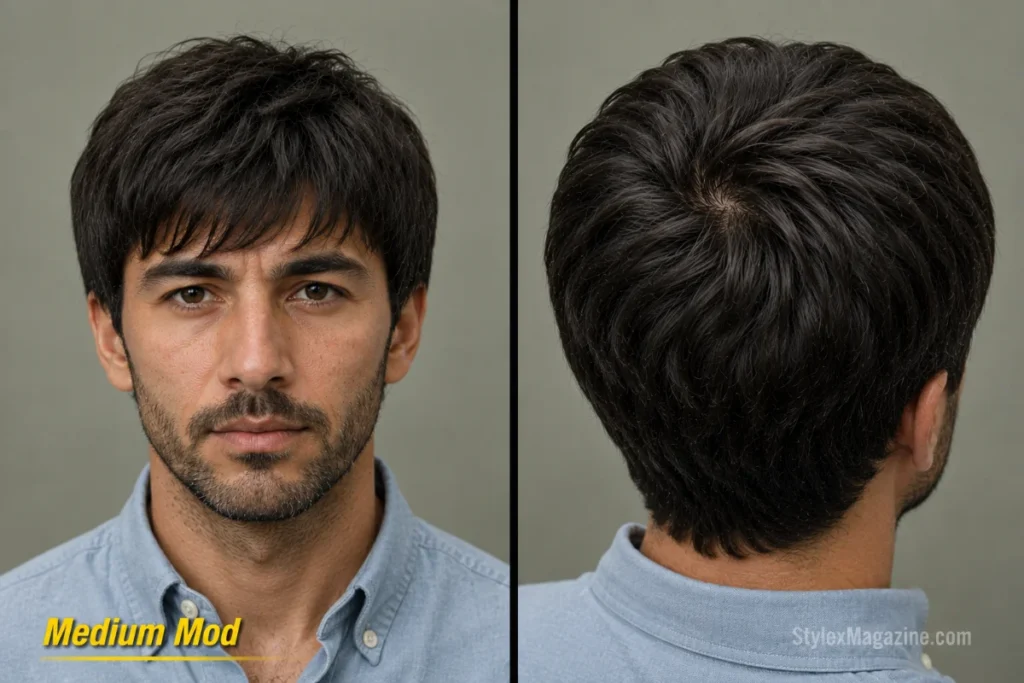
The sweet spot for most men. Top at 3 inches, sides at 2 inches, fringe at brow level. Enough length for forward movement, short enough to not require a committed morning routine. The safest starting point for a first mod cut because it grows out predictably and needs minimal daily attention.
Best for: All face shapes. All textures and densities. S
tyling tip: Light styling cream on damp hair, blow-dry forward.
12. Fluffy Mod
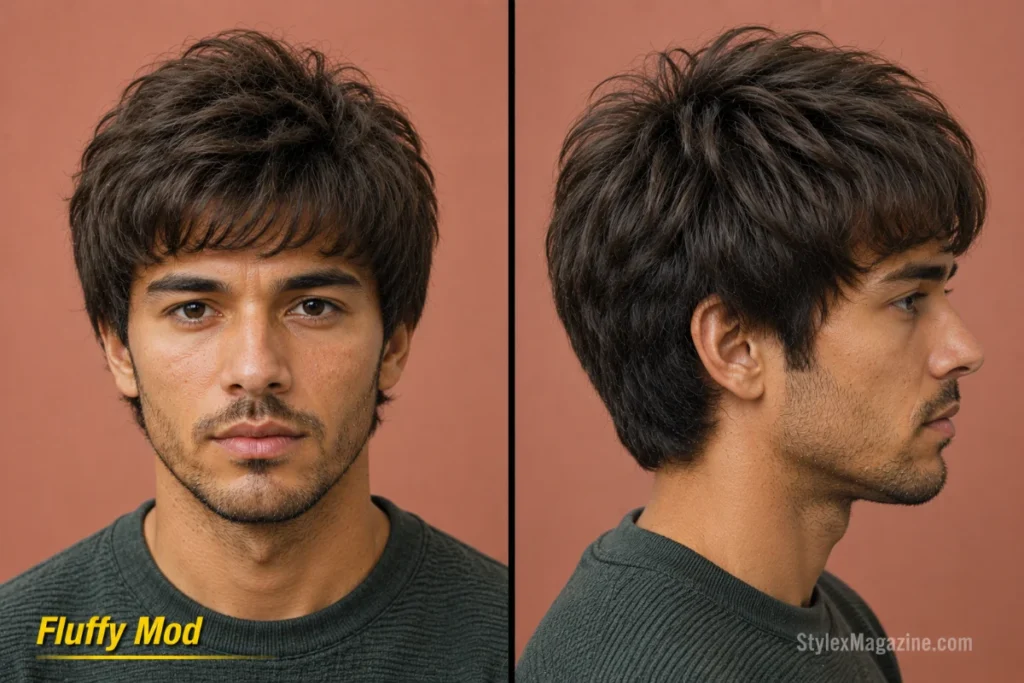
Airy volume at the crown, lifted roots, bounce through the layers. Top at 3 to 3.5 inches, sides at 2 inches, internal layers that remove weight at the roots. Volumizing mousse applied before blow-drying creates the lift. This variation needs medium to thick hair. Fine hair collapses within an hour.
Best for: Round and square faces (the height balances width). Medium to thick density.
Styling tip: Mousse at roots before blow-drying upward with fingers.
13. Shaggy Mod
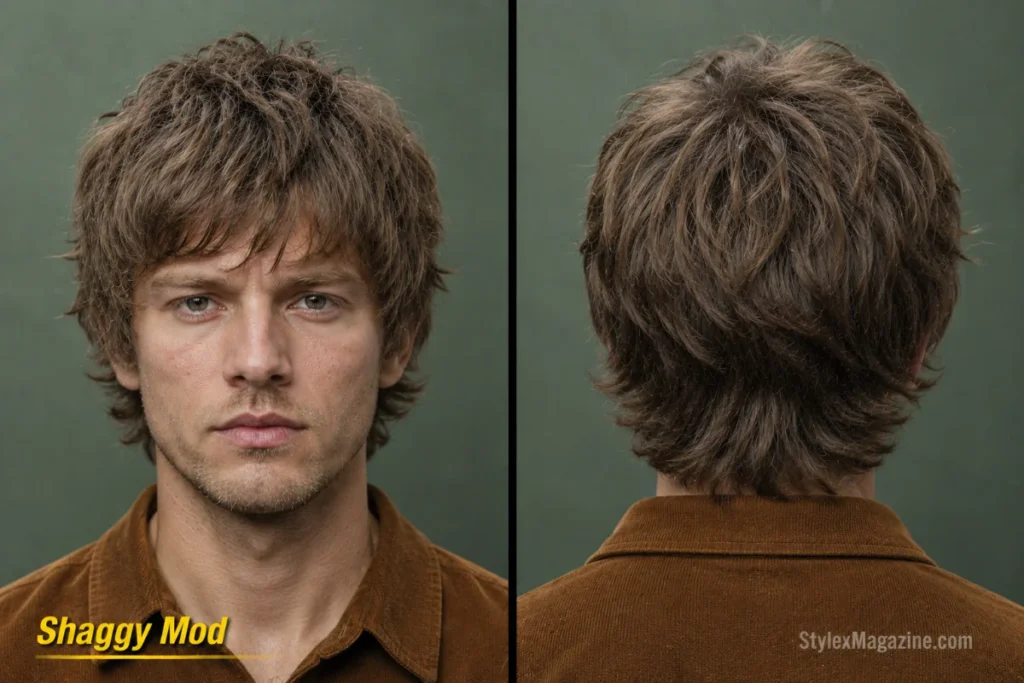
Longer layers, razored ends, more weight through the sides than a standard mod. Top at 4 inches, sides at 2.5 to 3 inches, fringe at the brow. The ragged, piecey ends and fuller sideburns keep it in mod territory rather than crossing into shag haircut territory. The difference: a shag has disconnected layers and no structured fringe. A shaggy mod keeps both.
Best for: Oval and oblong faces. Wavy or naturally textured, medium to thick.
Styling tip: Sea salt spray, scrunch, air dry.
14. Mod Mullet
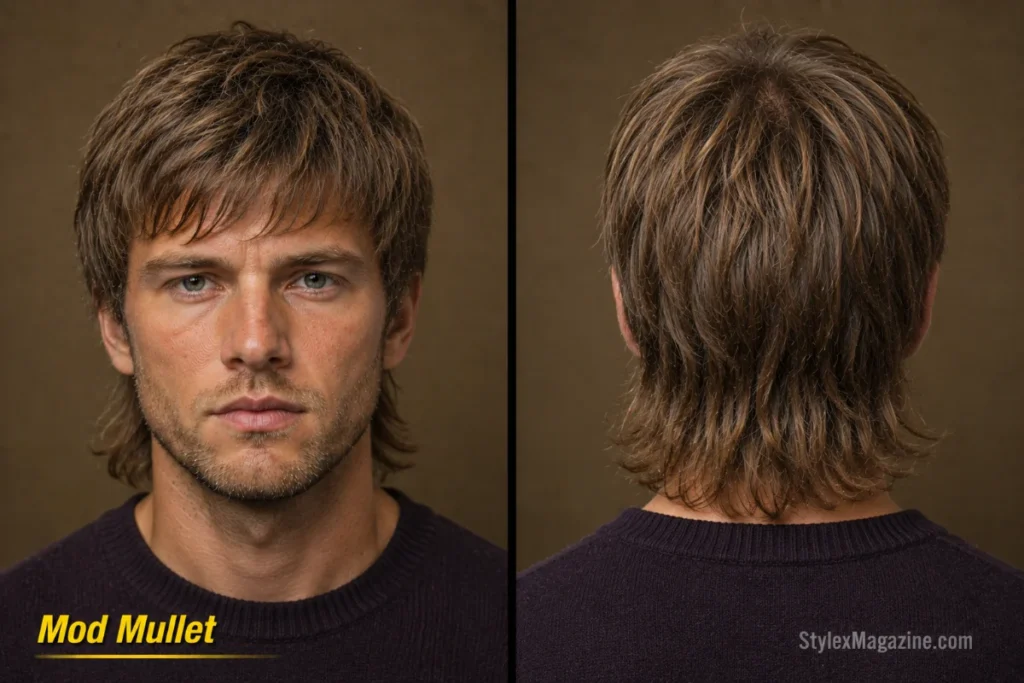
Structured front with a longer back. Top at 3 to 4 inches with a defined fringe, back dropping past the collar, sides scissor-cut at 2 inches. The sides stay uniform. This hybrid keeps the mod’s clean fringe and rounded silhouette while borrowing the mullet’s front-to-back contrast.
Best for: Oval and oblong faces. Straight to wavy hair.
Styling tip: Matte clay on the front, leave the back natural.
15. Mod Wolf Cut
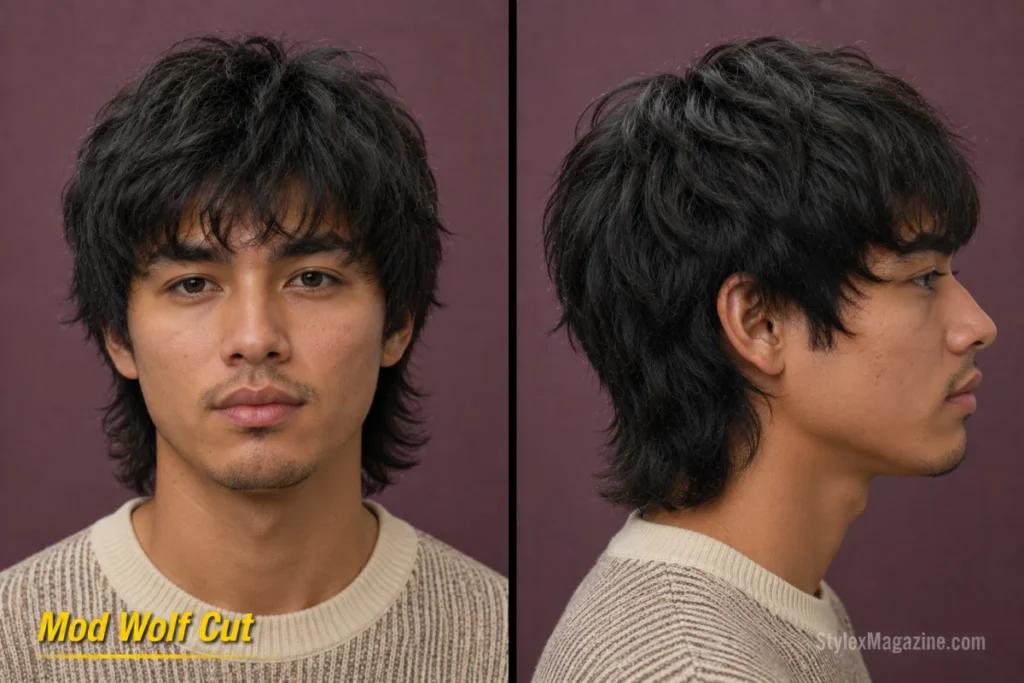
Heavier layering and a choppy fringe give this a wilder edge. Top at 3.5 to 4 inches, sides at 2.5 inches, crown with more disconnected layers than a standard mod. The back carries more length. Where the mod is structured, the wolf cut is chaotic. This hybrid sits between both worlds.
Best for: Oval and heart faces. Thick, wavy to curly hair.
Styling tip: Texturizing spray, scrunch and leave to air dry.
16. Mod Quiff (Paul Weller Style)
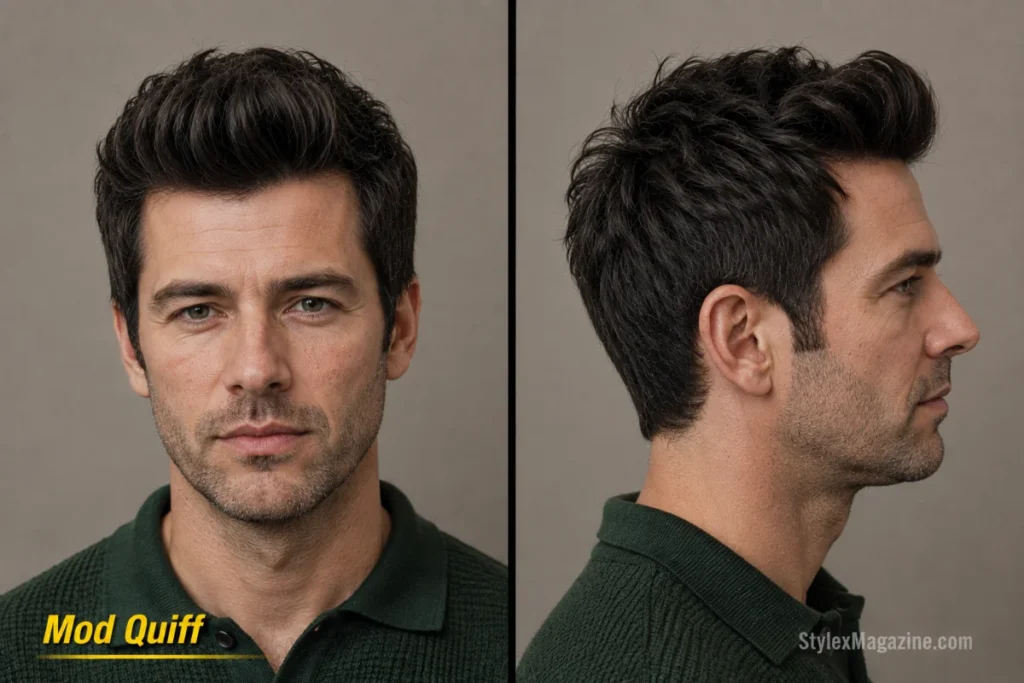
The front section lifts upward and slightly back, creating contained height above the fringe line. Top at 3 to 4 inches at the front tapering shorter toward the crown, sides at 1.5 to 2 inches. Paul Weller defined this variation during The Jam era in the late 1970s, and it remains the most culturally referenced mod cut decades later.
Best for: Round and square faces (the height elongates). Straight to wavy, medium to thick.
Celebrity: Paul Weller (1978-1982).
Styling tip: Round brush blow-dry upward, set with medium-hold pomade.
17. Mop Top (Beatles Style)
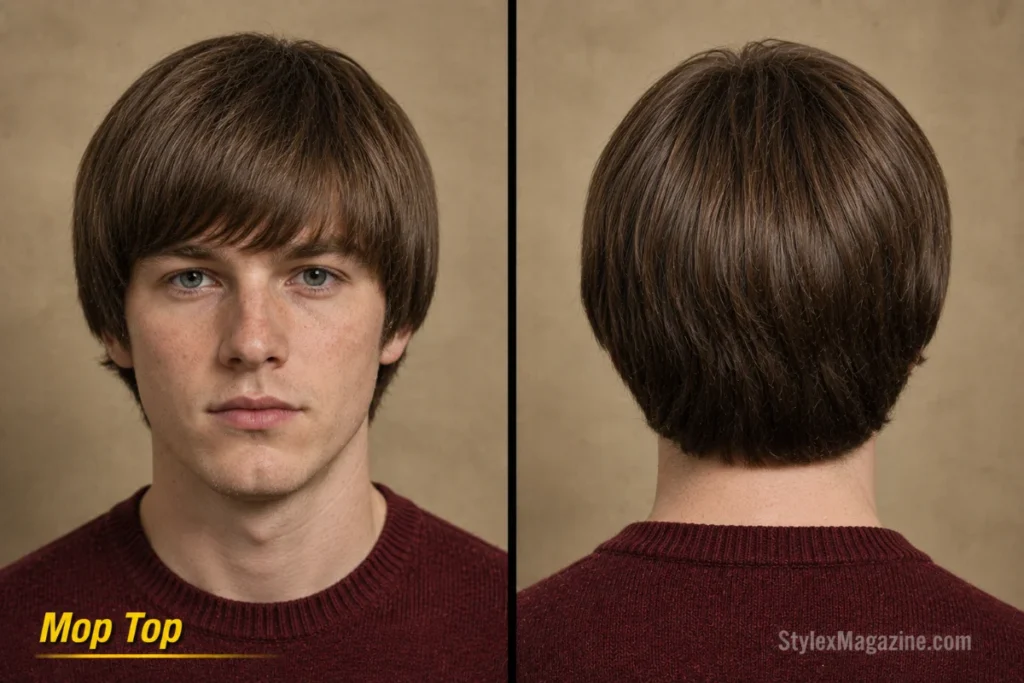
Full rounded dome with a forward-falling fringe. Top at 3 to 4 inches, sides at 2.5 to 3 inches covering the ears, back full to the collar. No visible layers, just a smooth, even contour. Sideburns trimmed short and neat, not pointed. This is the cut that introduced mod to the world in 1963.
Best for: Oval and heart faces. Straight, medium density.
Celebrity: The Beatles (1963-1964).
Styling tip: Light pomade combed forward and down.
18. Mod French Crop
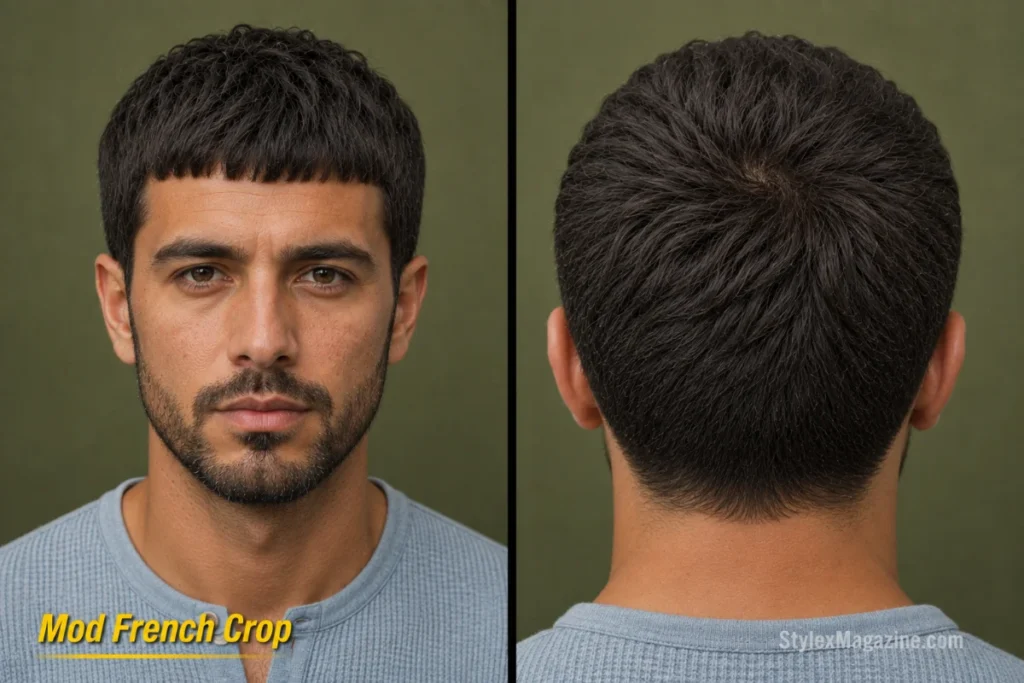
Blunt fringe cut straight across at brow level, paired with a short layered top and clean scissor-cut sides. Top at 2 to 2.5 inches, sides at 1.5 inches. The horizontal fringe is the focal point. The mod aesthetic and the French crop overlap here: both rely on a clean, defined fringe line and minimal styling.
Best for: Round and square faces. Straight to slightly wavy, all densities.
Styling tip: Matte clay pushed forward, nothing else.
19. Mod Bowl Cut
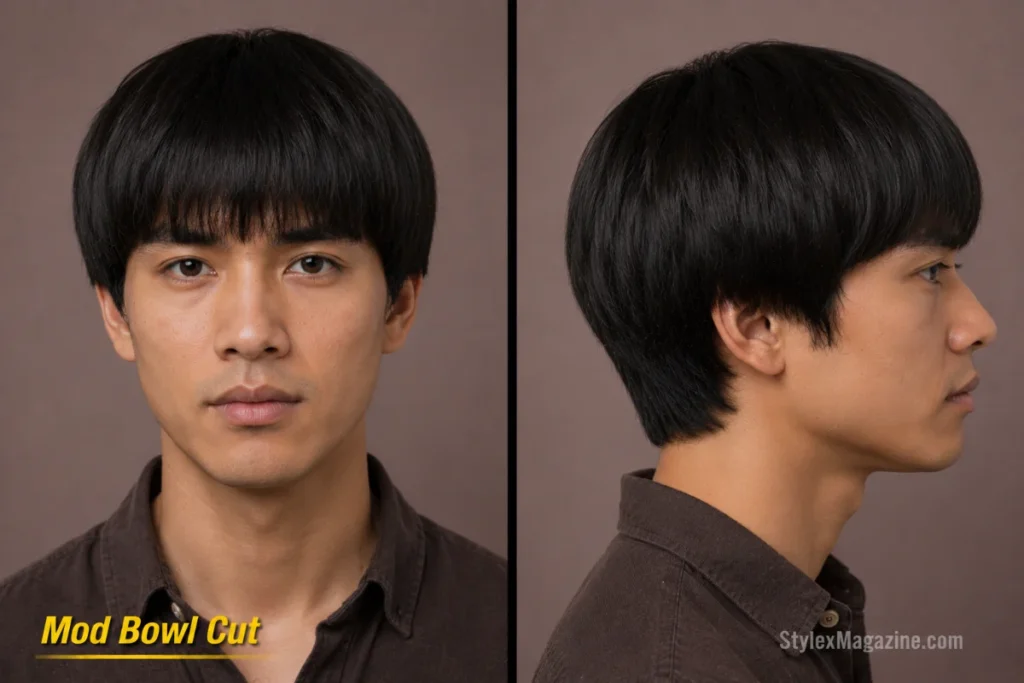
A deliberate, geometric dome with a perfectly horizontal fringe all the way around. Top at 3 inches, sides and back at a single uniform length of 2 to 2.5 inches. Bold and retro. Keep product minimal so the shape stays soft rather than helmet-like.
Best for: Oval and oblong faces. Straight, medium density.
Styling tip: Blow-dry downward, guide into place with fingers.
20. Side-Swept Mod
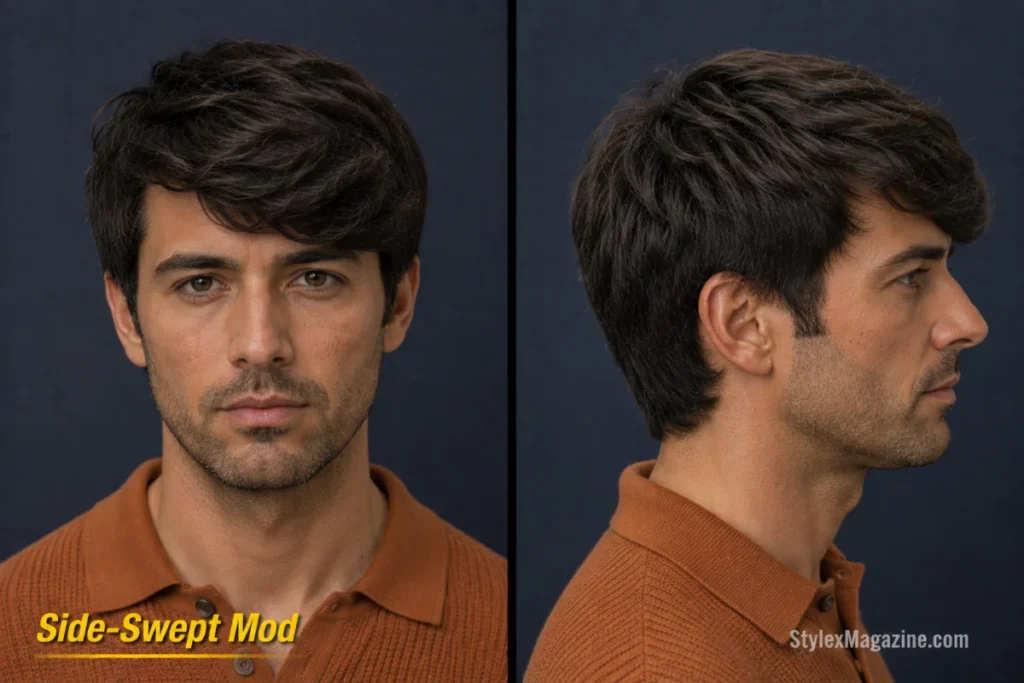
The fringe redirects to one side rather than falling straight across. Top at 3 inches, fringe swept to the natural part side, sides at 2 inches. The asymmetry softens the look compared to a blunt fringe. This variation works best when the hair already wants to move in one direction rather than fighting against a natural part.
Best for: All face shapes. Straight to wavy with a natural part.
Styling tip: Blow-dry forward and to the side, set with matte paste.
21. Mod Flow
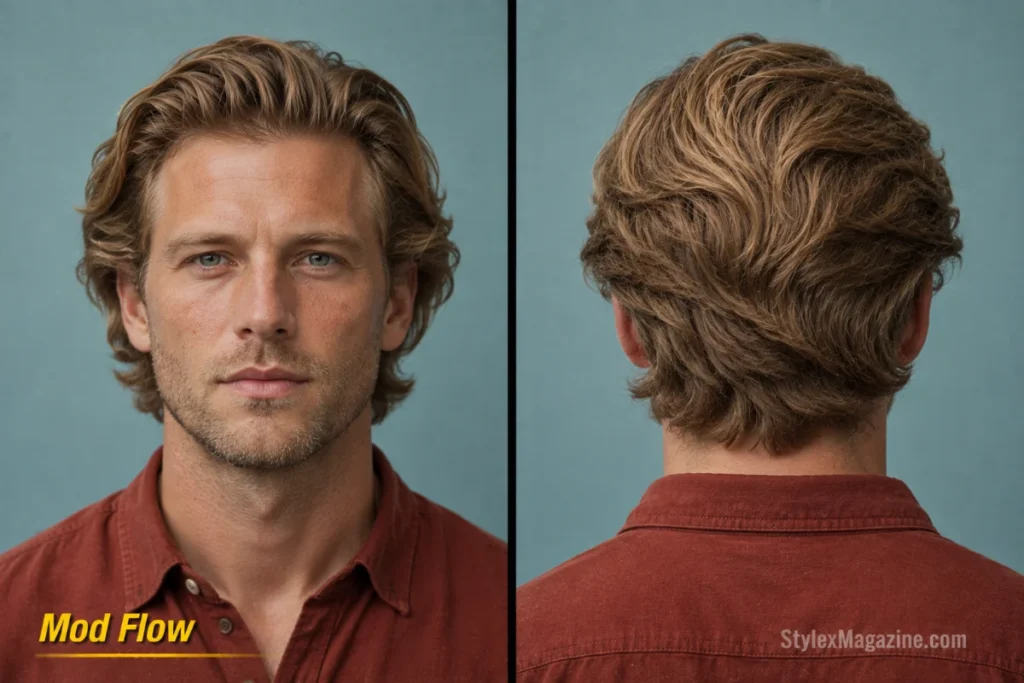
Ear-grazing length swept back and to the sides. Top at 4 inches, sides at 3 inches, no hard fringe line. The hair moves freely and settles on its own throughout the day. Full sideburns blending into the side length. This sits at the boundary between a mod cut and a flow hairstyle, with the rounded silhouette and scissor-cut sides keeping it in mod territory.
Best for: Oval and square faces. Wavy, medium to thick hair.
Styling tip: Push back with fingers while damp, sea salt spray for grip.
22. Mod with Low Taper
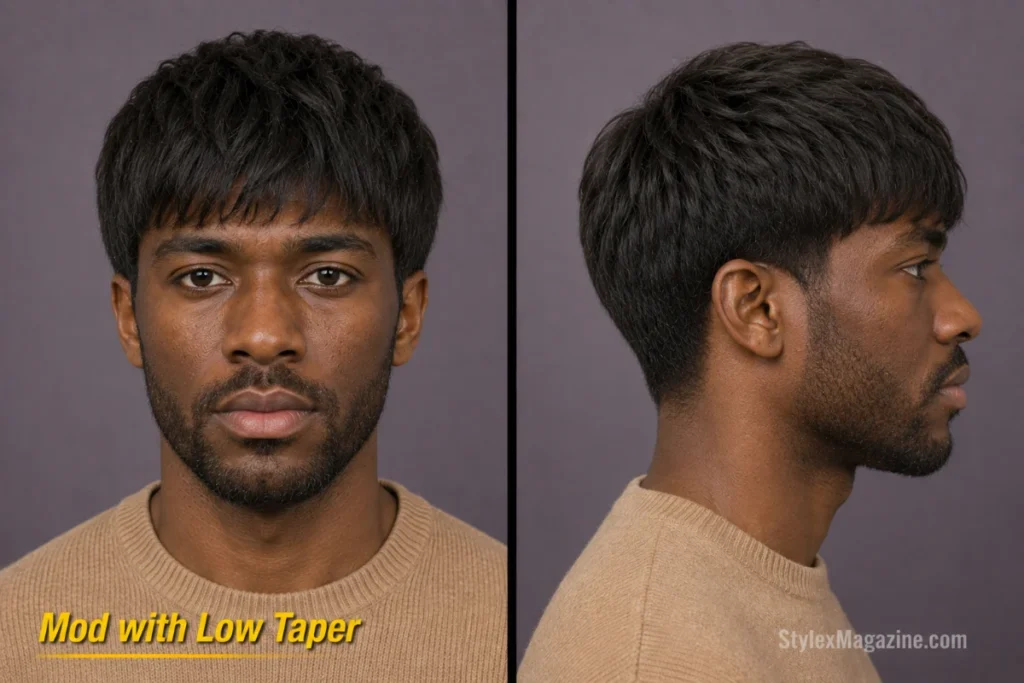
Classic mod shape on top with the very bottom edge around the ears and neckline shortened gently. Top and sides follow standard mod lengths, with only the last half-inch at the hairline tapered. This is the contested variation. Traditionalists reject any graduation on a mod. Modern barbers offer it as a cleaner, lower-maintenance compromise. Clients ask for it constantly, and the compromise works as long as the taper stays minimal.
Best for: All face shapes. All textures. Professional settings.
Styling tip: Same as any standard mod styling.
23. Blonde Mod
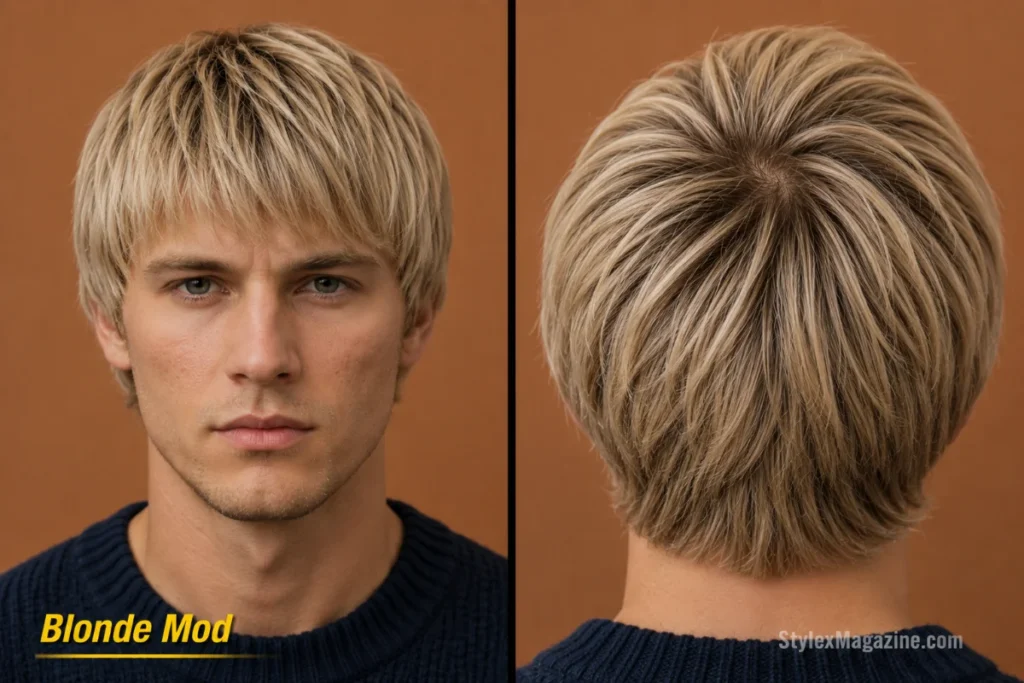
The lighter tone sharpens the outline of the cut and makes layering more visible. Top at 3 inches, sides at 2 inches, standard mod proportions. Bleached or highlighted strands show separation and movement that darker hair absorbs. Root touch-ups every five to six weeks. A drop of argan oil keeps bleached ends from drying out and splitting.
Best for: All face shapes. All textures.
Styling tip: Lightweight cream to keep blonde hair smooth, not heavy.
24. Thick Mod with Waves
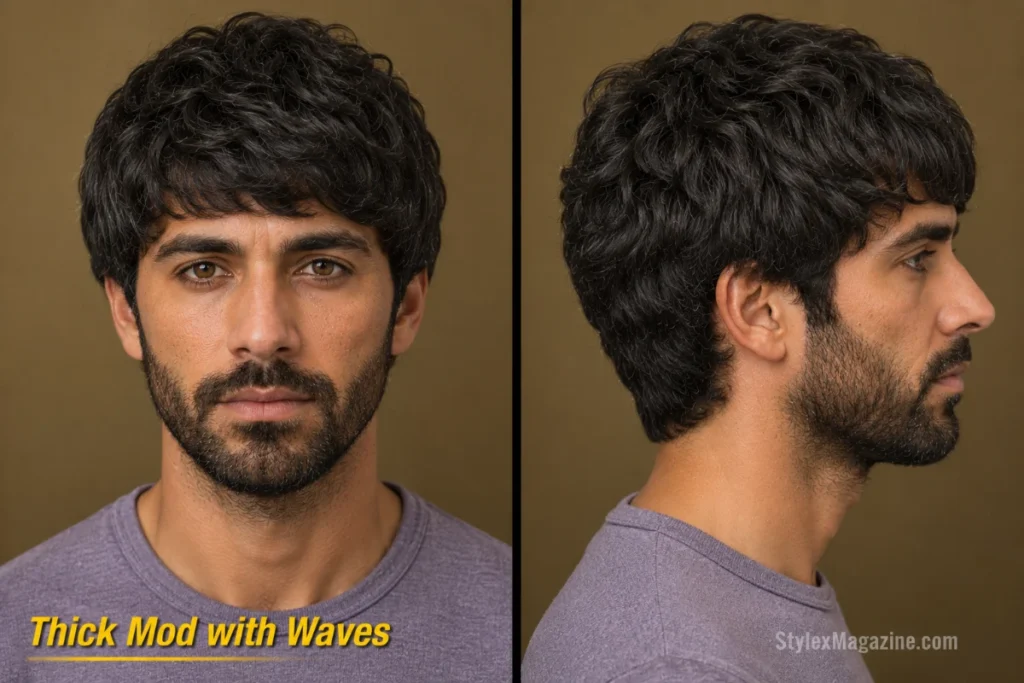
Built for hair that has natural weight and just enough movement to hold shape without encouragement. Top at 3 to 3.5 inches, sides at 2 inches, medium layers to distribute density. The wave pattern does the structural work. Without proper layering, thick wavy hair in a mod cut looks bulky rather than intentional. Ask your barber to remove weight internally, not from the perimeter.
Best for: Square and oval faces. Thick, wavy (Type 2A to 2C).
Styling tip: Blow-dry forward on low heat, finish with matte paste.
25. Spiky Mod
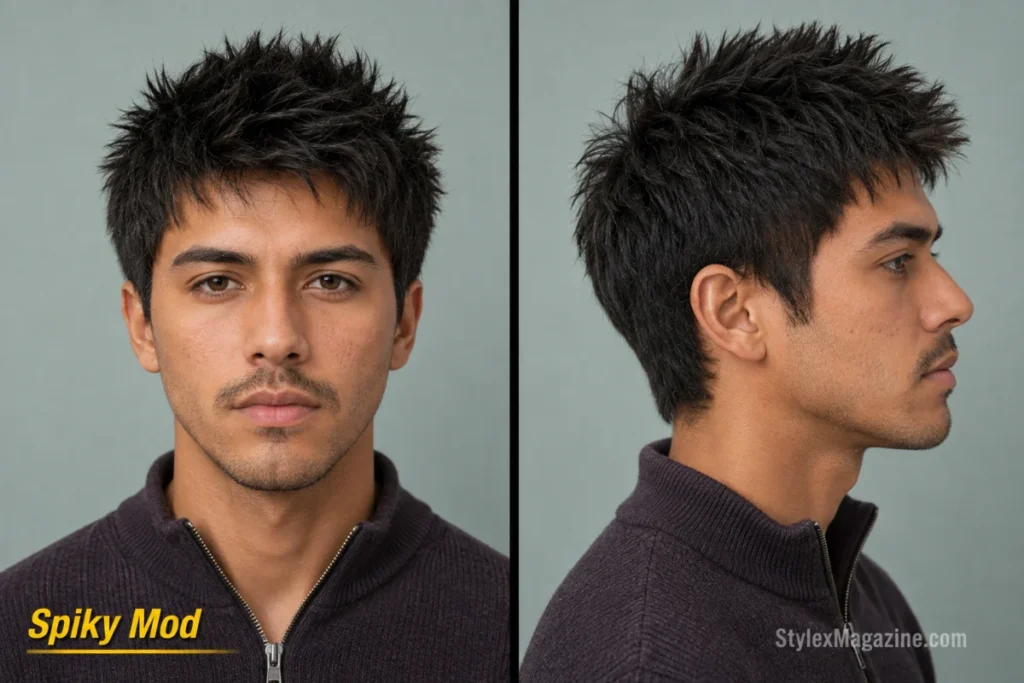
Short, choppy layers with lifted tips that give the hair a bolder, edgier read. Top at 2.5 to 3 inches, point-cut aggressively for maximum separation. Sides at 1.5 to 2 inches. The fringe lifts upward rather than falling forward, making this the most energetic mod variation.
Best for: Round and oval faces. Straight to slightly wavy, medium density.
Styling tip: Strong-hold clay, lift sections from roots outward.
26. Textured Messy Mod with Beard
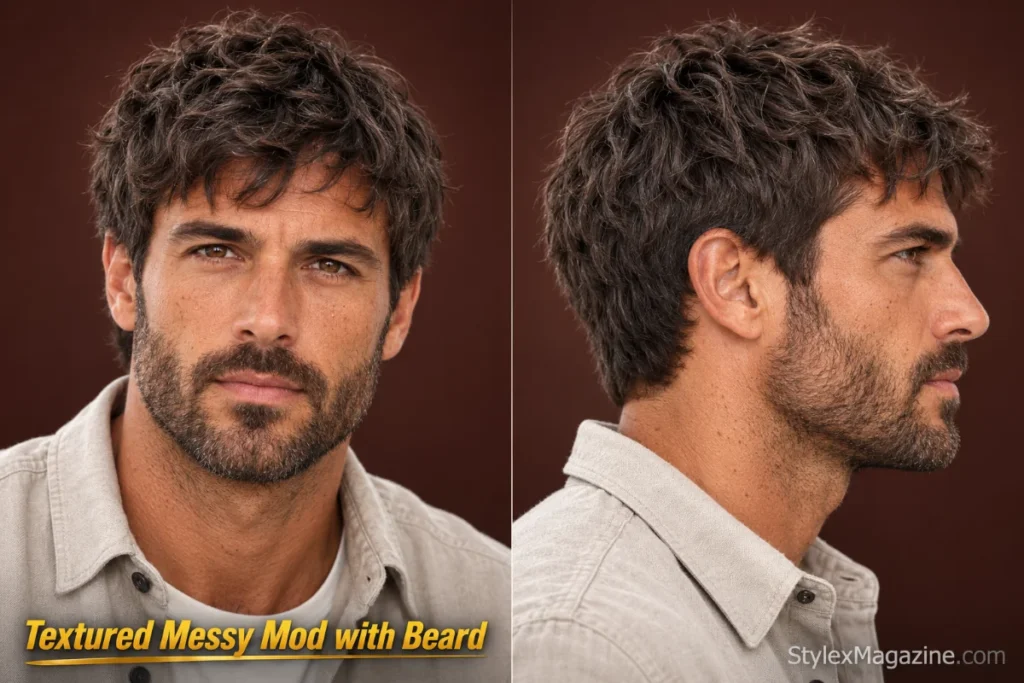
The beard grounds the look and gives the face structure the relaxed top doesn’t provide. Top at 3 to 3.5 inches with choppy layers, sides at 2 inches scissor-cut, broken fringe rather than blunt. The contrast between the messy hair and a shaped beard is what holds the style together. An unkempt beard under a mod cut looks neglected, not intentional.
Best for: Oval and square faces. All textures. Pair with full or short boxed beard.
Styling tip: Matte clay scrunched through damp hair, air dry.
27. Korean Mod
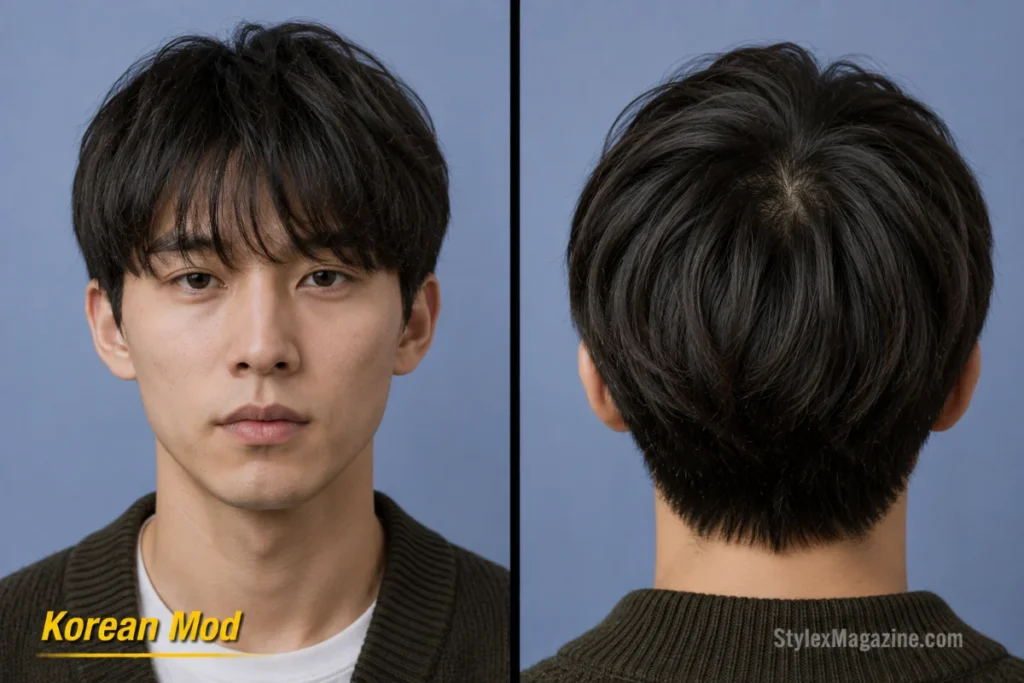
Airy, wispy fringe with soft layers and a lighter, less structured silhouette. Top at 3 to 4 inches, sides at 2.5 inches, thinning shears used through the fringe to create transparency. The K-drama influence: the fringe is thinner than a Western mod fringe, and the sides are layered longer for a relaxed fall rather than a defined perimeter.
Best for: Oval and heart faces. Straight, fine to medium density.
Styling tip: Styling cream for soft hold, blow-dry forward with fingers.
28. Mod for Fine/Thin Hair
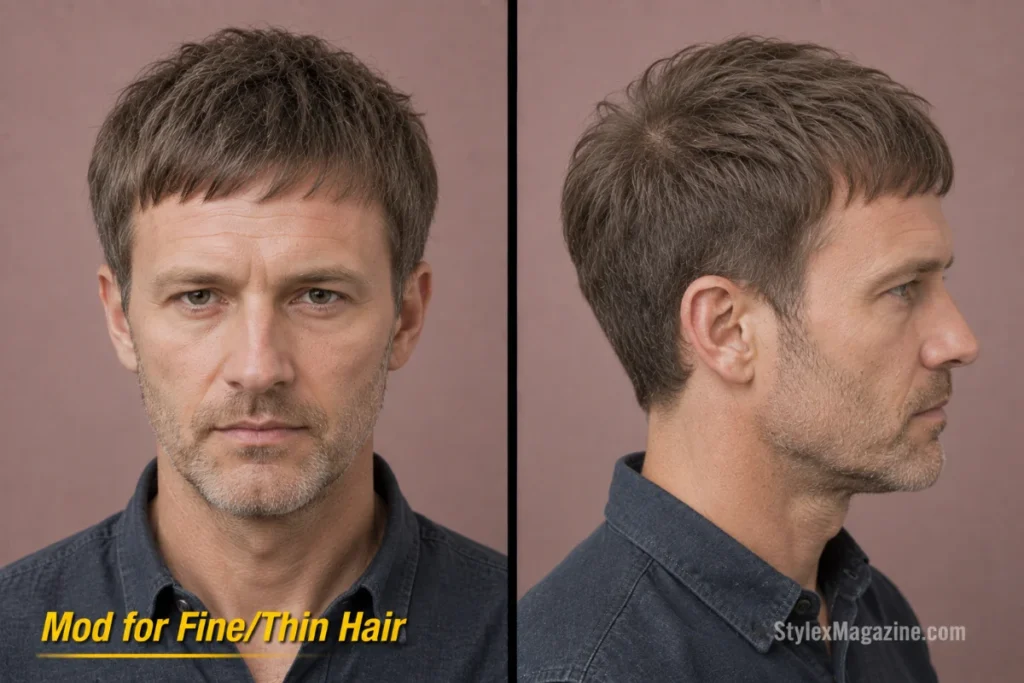
Shape over volume. Top at 2.5 inches, sides at 1.5 inches. Shorter layers prevent the hair from going flat, and the fringe is cut slightly thicker to create the illusion of density. Skip heavy products that weigh fine hair down. Texture powder at the roots gives lift without adding weight. Longer mod variations won’t hold on fine hair because there isn’t enough density to support the rounded silhouette.
Best for: All face shapes. Fine or thin hair, any texture.
Styling tip: Texture powder at roots, light cream on ends only.
29. Edgy Short Mod
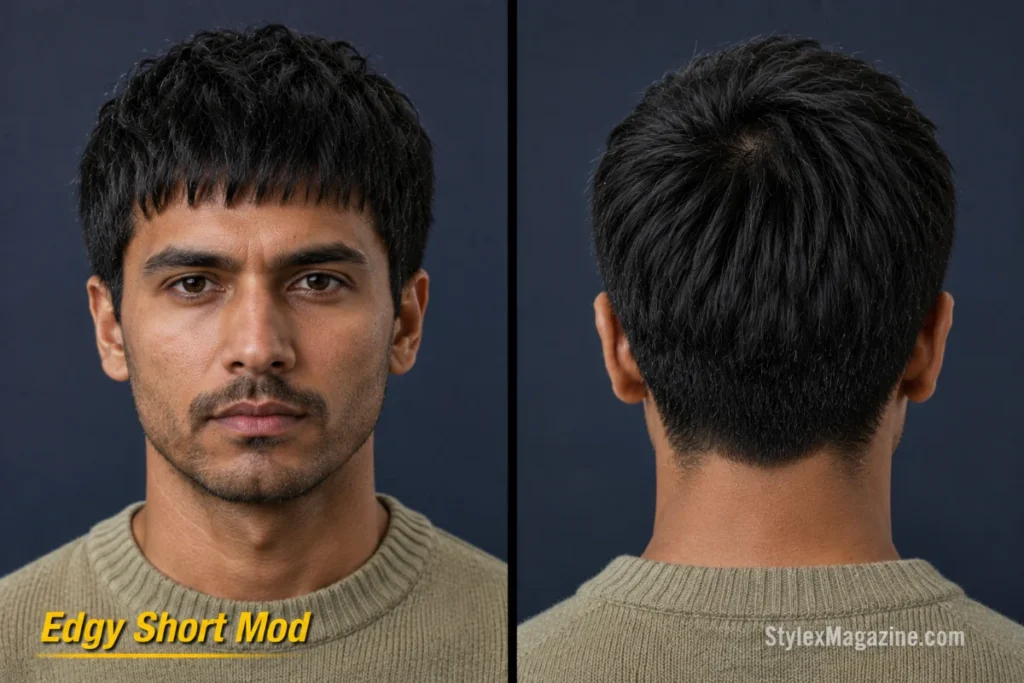
The shortest viable mod. Top at 2 inches, sides at 1.5 inches, fringe just above the brow. The fringe is the entire focal point at this length. Sharp, deliberate, and the lowest maintenance mod you can get while still keeping the fringe-forward identity. Almost styles itself.
Best for: All face shapes and all densities. Professional settings.
Styling tip: Matte clay on days you want extra definition, nothing on days you don’t.
30. Mod with Curtain Fringe
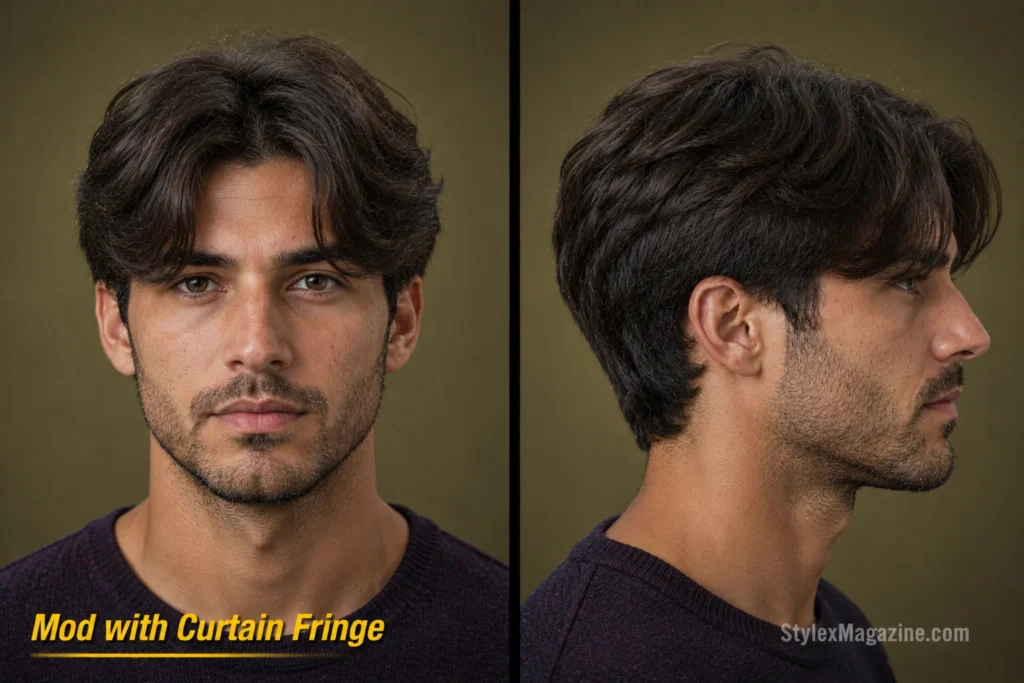
The fringe parts at the center and falls to both sides, framing the face. Top at 3.5 to 4 inches at the front, shorter toward the crown, sides at 2 inches. A 2026 crossover: the mod’s rounded silhouette and scissor-cut sides paired with the middle part fringe trend. The curtain split softens angular face shapes.
Best for: Square, diamond, and heart faces. Straight to wavy, medium density.
Styling tip: Blow-dry the fringe forward, then part with fingers, light cream to hold.
Who Should Skip a Mod Haircut?
Not every head in my chair leaves with a mod cut, even when that’s what they asked for. Some hair types and face shapes fight the style rather than carry it.
Receding hairline: The mod depends on a strong fringe, and a fringe needs density at the front. If the hairline has pulled back past the temples, the fringe thins out and exposes the recession rather than covering it. A textured crop or a short buzz gives better coverage with less visible thinning.
Very fine hair without density: Fine hair can work in a short mod (Style #28), but longer variations collapse within an hour. The rounded silhouette needs enough hair to hold the shape.
Extremely round face with a soft jawline: The rounded mod silhouette adds width. If your face is already round, the cut amplifies it. A mod quiff (Style #16) with height at the crown is the exception because it adds vertical length.
Men who won’t commit to fringe maintenance: The fringe loses its shape faster than any other part of the cut. If you’re not willing to trim it every two to three weeks, the mod stops looking like a mod within a month.
Which Face Shape Works Best with a Mod Cut?
Oval works with every variation. Square benefits from softer, textured fringe styles that offset strong angles. Heart-shaped faces suit fuller fringes that balance a wider forehead. Oblong or long faces benefit from a horizontal blunt fringe that visually shortens vertical length. Round faces should add height at the crown (mod quiff, fluffy mod) and avoid extra width through the sides. Diamond faces work well with textured, broken fringes that soften the angular cheekbones.
For detailed guidance on every face shape, the full haircuts for face shape guide covers all seven shapes with specific recommendations.
How Long Does Your Hair Need to Be for a Mod Cut?
Minimum 2.5 to 3 inches on top, 1.5 inches on the sides. If you’re currently at a buzz cut or a short crew, expect eight to ten weeks of growth before a barber can shape a proper mod. The sides take the longest because they need to reach a uniform scissor-cut length rather than being clipped down.
I’ve had clients come in too early, wanting a mod when the top is barely 2 inches. If I can’t pinch the hair between my fingers and see enough length to create layers, it’s not ready. I’ll shape what’s there and book them back in three to four weeks.
How Do You Ask Your Barber for a Mod Haircut?
Bring a photo. Two angles minimum: front and side. Then confirm four things:
The fringe: “Blunt fringe at brow level” or “textured fringe just above the eyebrows” or “side-swept fringe to the right.” The fringe drives the entire cut.
The sides: “Scissor-cut sides at two inches, no clippers, no fade.” This is what separates a mod cut from a standard medium-length haircut.
The sideburns: “Leave defined sideburns to mid-ear” or “natural sideburns, not trimmed.” Mod cuts traditionally include fuller sideburns than most modern styles.
The back: “Same length as the sides, rounded, no neckline taper” for traditional, or “slight taper at the very bottom only” for the modern compromise.
Full phrase: “Scissor-cut mod, textured fringe at the eyebrows, sides at two inches blended with scissors only, sideburns to mid-ear, rounded back.”
How Do You Style a Mod Cut at Home?
Start with damp, towel-dried hair. Apply your product before blow-drying, not after.
For textured and choppy variations: matte clay or texture paste distributed evenly, then blow-dry forward with fingers. No brush needed.
For classic and structured variations: medium-hold pomade with light shine, combed into place, then blow-dry on low with a round brush for the fringe.
For shaggy and wavy variations: sea salt spray on damp hair, scrunch, and air dry. Skip the blow dryer entirely.
The fringe gets styled last. Set everything else first, then shape the fringe into position. A misaligned fringe undermines the entire cut. Resist touching it once it’s set.
What Are the Most Common Mistakes with a Mod Cut?
Accepting a fade when you asked for a mod. Most barbers default to clipper work on the sides. If you don’t specifically confirm scissor-cut sides, you can walk out with a fade that has a mod-inspired top, not an actual mod. The low taper (Style #22) is the only graduated compromise that stays within mod territory.
Skipping the fringe trim. The fringe outgrows the cut faster than any other section. Two to three weeks is the limit before a mod fringe starts looking shapeless. Book fringe touch-ups between full cuts if your barber offers them.
Using heavy product. Thick waxes and high-shine pomades flatten the fringe and kill the natural movement the cut depends on. Matte clay, light cream, and sea salt spray are the three categories that work. Skip anything marketed as “maximum hold” or “wet look.”
Choosing the wrong variation for your hair density. Long mods and fluffy mods need thick hair to hold their shape. Fine hair collapses under the weight of longer variations. If your hair is fine, start with Style #4 or #28, not #10 or #12.
What Is the Difference Between a Mod Cut and Similar Styles?
| Mod Cut | Textured Crop | Wolf Cut | Shag | Mullet | |
|---|---|---|---|---|---|
| Fringe | Defined, forward | Short, choppy | Choppy, face-framing | Wispy, curtain-like | Short or absent |
| Sides | Scissor-cut, uniform | Faded or tapered | Layered, longer | Layered, longer | Short, disconnected |
| Back | Rounded, same as sides | Short, tapered | Long, shaggy | Long, layered | Long, flowing |
| Movement | Forward | Upward | All directions | All directions | Backward and down |
| Technique | Scissors only | Clippers + scissors | Razor + scissors | Razor + scissors | Clippers + scissors |
The mod’s defining difference is the scissor-cut sides at a uniform length. A textured crop or mullet uses clippers for contrast. A wolf cut or shag uses razored disconnection. The mod builds its shape through weight and deliberate layering, not through removing length at the sides or disconnecting layers at the back.
How Often Should You Trim a Mod Haircut?
The fringe needs trimming every two to three weeks regardless of variation. Once it drops below the eyebrows, the cut’s identity starts to dissolve.
For the full cut, frequency depends on the variation:
- Short mods (Styles #4, #18, #29): every three to four weeks
- Medium mods (Styles #3, #5, #8, #11, #20): every four to five weeks
- Long and shaggy mods (Styles #10, #13, #21): every five to six weeks
The scissor-cut sides grow out more evenly than a fade, so a mod holds its shape longer between full cuts than most modern styles. There’s no hard fade line to lose. The fringe is always the first thing that goes.
FAQs
Can a mod cut have a fade?
Strictly, no. The mod was built as a scissor-cut rejection of clipper-graduated styles. A “mod with a fade” is a fade with a mod-inspired top, not a mod. The low taper (Style #22) is the closest compromise modern barbers accept.
Is a mod cut good for professional settings?
The short mod (Style #4), edgy short mod (Style #29), and mod French crop (Style #18) all work in corporate settings. Avoid the shaggy, long, and messy variations for formal workplaces.
Did the Beatles invent the mod haircut?
No. The mod haircut existed in London barbershops before the Beatles wore it. They popularised the mop top variation and introduced the broader aesthetic to a global audience starting in 1963.
Can you pair a mod cut with a beard?
A full beard or short boxed beard pairs well (Style #26). The contrast between the relaxed top and a shaped beard adds structure. Keep the beard groomed: an unkempt beard under a mod cut looks neglected, not intentional.
Does a mod cut work for men over 40?
The short mod (Style #4), mod quiff (Style #16), and classic 60s mod (Style #1) all carry well at any age. Avoid the longer, shaggier variations that tend to read younger.
How does a mod cut grow out?
Better than most cuts because the scissor-cut sides grow at a uniform rate. There’s no hard fade line to lose. The fringe drops below the eyebrows first and loses the cut’s identity. Everything else holds shape for four to six weeks.
What is the easiest mod cut to maintain?
The edgy short mod (Style #29) and the short mod (Style #4) need the least daily styling. Both almost style themselves after a shower. The only commitment is the fringe trim every two to three weeks.

Other Articles
30 Best High and Tight Haircuts For Men (2026)
30 Best Surfer Haircut Styles for Men (2026)
No Comment! Be the first one.