
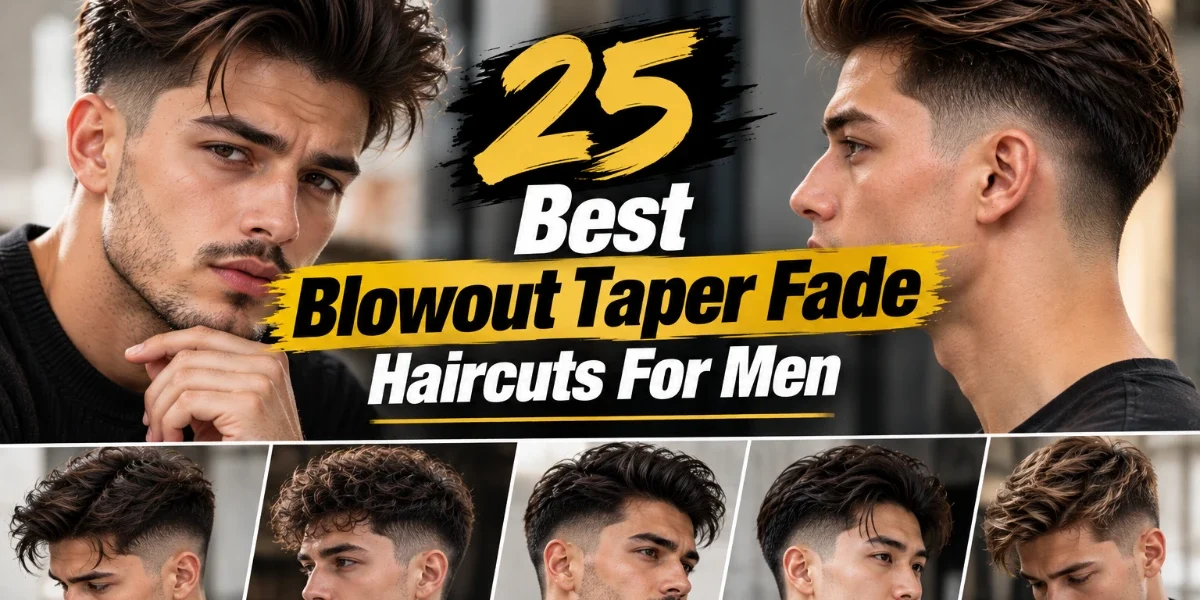

QUICK ANSWER: A blowout taper fade keeps the sides short at the edges while the top stays long enough to be blow-dried upward and back into a rounded, lifted shape. The taper sits low at the sideburns and nape, so the volume on top does the work rather than a high contrast on the sides.
The blowout taper has been the most requested cut in my chair through 2026, and the men who leave happiest are the ones who understood two things before they sat down: how much length the top needs, and how many minutes it costs every morning. Both get skipped in most style galleries.
Below are 25 variations with the clipper work behind each, plus the face shape, texture, cost and grow-out detail that decides whether this cut suits you.
Jump to: What it is · Face shapes · 25 styles · Taper height · Hair texture · Thin hair · How it is cut · Barber script · Morning styling · Heat damage · Cost and lifespan · Grow-out · Mistakes · FAQs
What Is a Blowout Taper Fade?
A blowout taper fade is a taper on the sides combined with a blow-dried lift on top. The taper shortens only the perimeter, usually from a #0.5 or #1 at the sideburn blending into a #2 or #3 above the ear. The length on top, typically 3 to 5 inches, is dried upward and back with a round brush so it holds a rounded silhouette.
The “blowout” names the drying technique, not the clipper work. Two men can have identical tapers and only one has a blowout, because the second one air-dries. That distinction matters when you book the cut: you are asking for a taper that is cut to support volume, with weight left in the crown and the corners above the temples kept intact.
The taper also stops short of skin on most versions. If you want the sides bare at the base, that moves into skin fade territory, covered in taper fade vs skin fade. For the full range of fade heights and shapes, see all fade types.
| Element | Typical spec |
|---|---|
| Sideburn base | #0.5 to #1 guard |
| Blend point | Just above the ear, below the temple |
| Length on top | 3 to 5 inches |
| Back | Tapered at the nape, not faded up |
| Drying direction | Up at the root, then back and slightly outward |
| Barber visit | Every 2 to 3 weeks |
Which Face Shape Suits a Blowout Taper Fade?
A blowout taper adds height at the crown and width above the temples, so it lengthens a round or square face and widens a narrow one. The taper staying low keeps the sides full, so this cut behaves differently from a high fade on the same head.
The shape of your blowout is adjustable in two directions: how much lift you build at the front, and how far back you sweep the sides. Those two levers are what make it work on almost any face, provided you pick the right combination.
| Face shape | What to do | What to avoid |
|---|---|---|
| Round | Maximum lift at the front, sides swept tight and back | Rounded crown with wide sides, it doubles the width |
| Square | Soft rounded top, moderate height | A flat-topped blowout, it squares the jaw further |
| Oval | Any version works, medium height suits best | Extreme height, it stretches the face |
| Oblong | Low height, more width through the sides | Tall front volume, it lengthens an already long face |
| Heart | Fuller through the sides, moderate front lift | Narrow swept sides, it sharpens a pointed chin |
| Diamond | Volume at the fringe, softer at the crown | Tight sides with a high crown, it emphasises cheekbones |
| Triangle | Width at the temples, lighter at the back | Heavy crown weight with narrow temples |
If you have not measured your proportions, the face shape calculator gives you a reading in under a minute, and the full breakdown by shape sits in haircuts for your face shape.
25 Blowout Taper Fade Styles
Each entry below lists the clipper work, the texture it suits, and the single detail that decides whether it works.
1. Classic Blowout Taper Fade
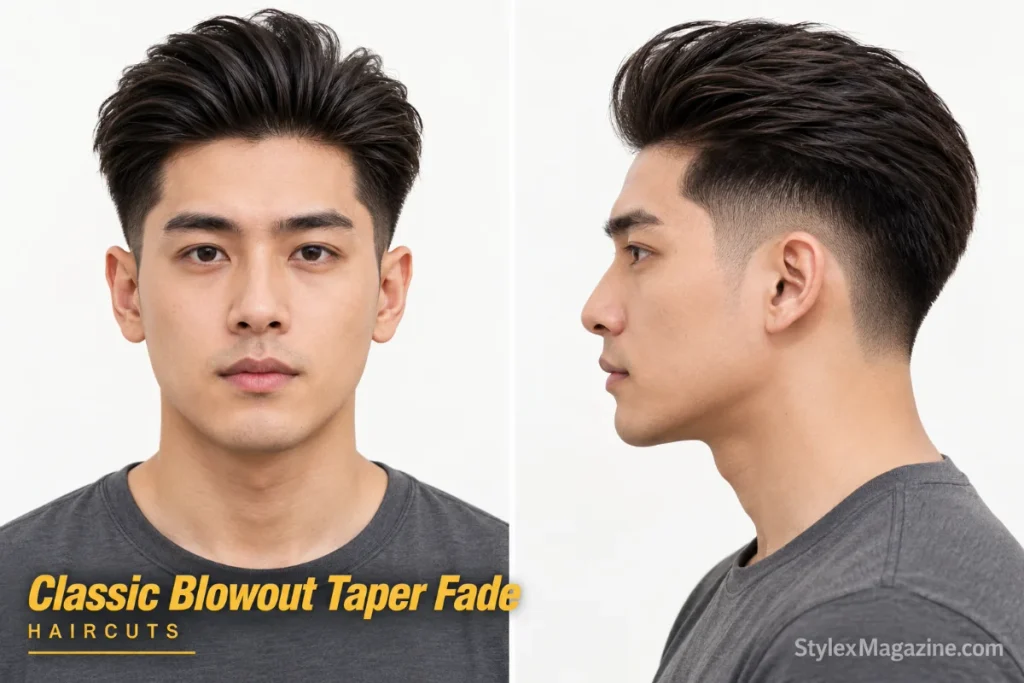
The baseline and the one to ask for if you are unsure: #1 at the sideburn blending to #3 above the ear, 4 inches on top, dried straight back with a round brush in one motion, no fringe and no part. Suits straight and wavy hair and every face shape except oblong. The corners above the temples stay intact, which is what separates a blowout taper from a standard taper with long hair on top. Four inches is the sweet spot across every texture, long enough to build a real curve and short enough to control.
2. Low Blowout Taper Fade
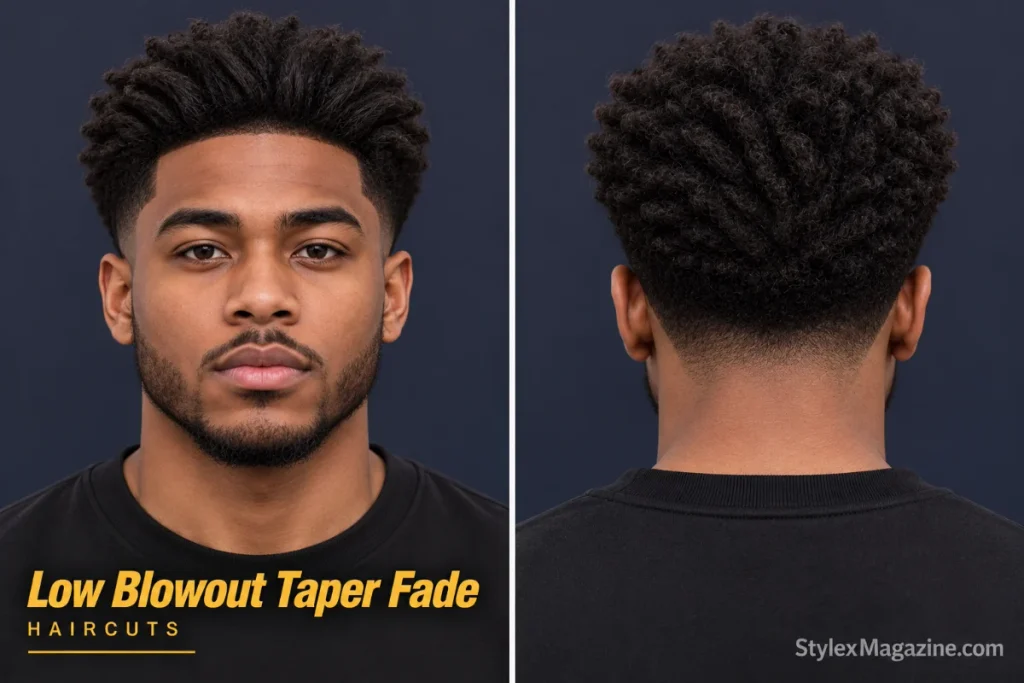
The taper starts at the sideburn and never climbs above the top of the ear. This is the most forgiving version because the long sides carry the volume outward instead of upward. Works on thick hair that would look boxy with a higher taper. Grows out cleanly for four to five weeks. The version I recommend to first-timers.
3. Mid Blowout Taper Fade
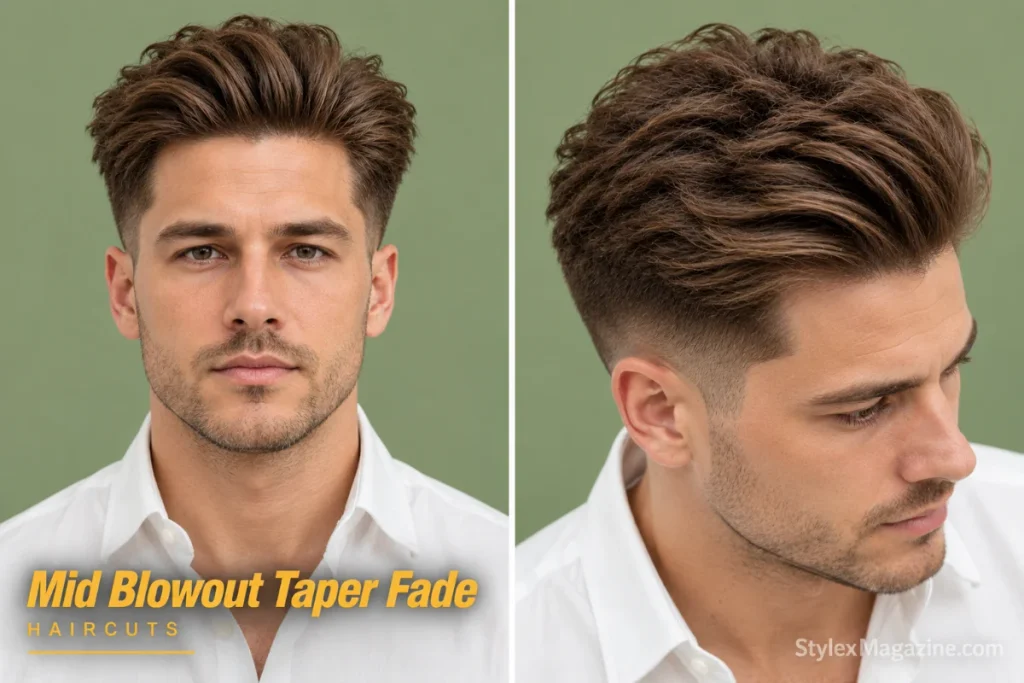
The blend sits at the temple line, roughly halfway up the side of the head. It creates a sharper contrast between the faded sides and the volume on top, which suits round faces that need vertical length. Needs a touch-up every two weeks to stay defined. Keep the top at 4 inches minimum or the proportion collapses.
4. High Blowout Taper Fade
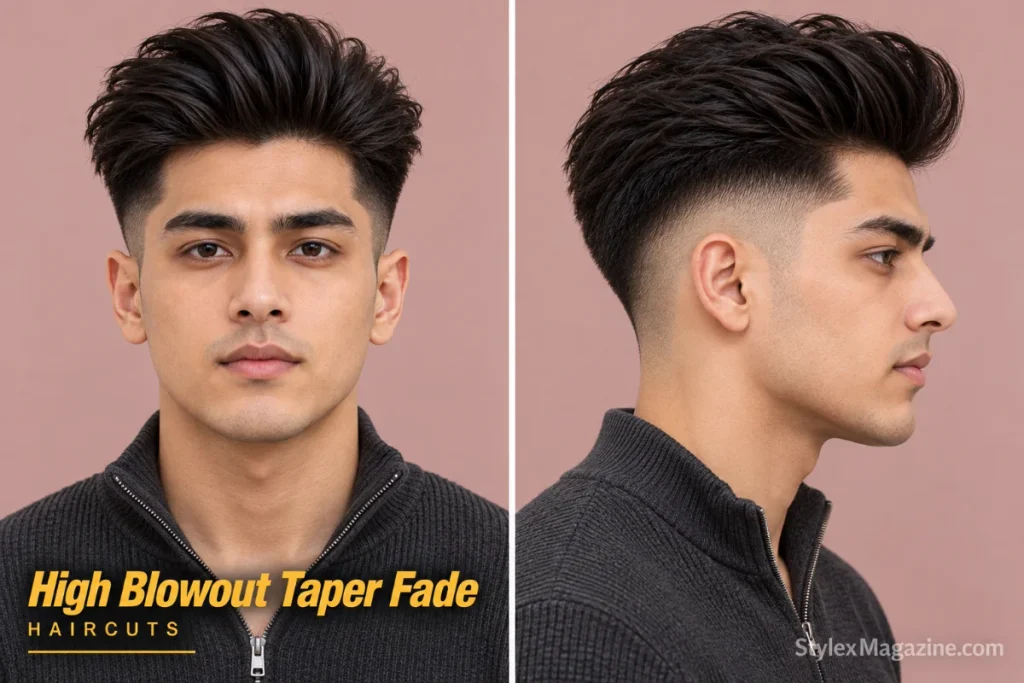
The taper rises above the temple, leaving a narrow band of length that sits like a crown. Dramatic, and unforgiving on anyone with an angular skull or a long face. It suits round and square shapes that can absorb the added height. Barber visits every 10 to 14 days. Do not attempt this one with fine hair.
5. Blowout Skin Taper
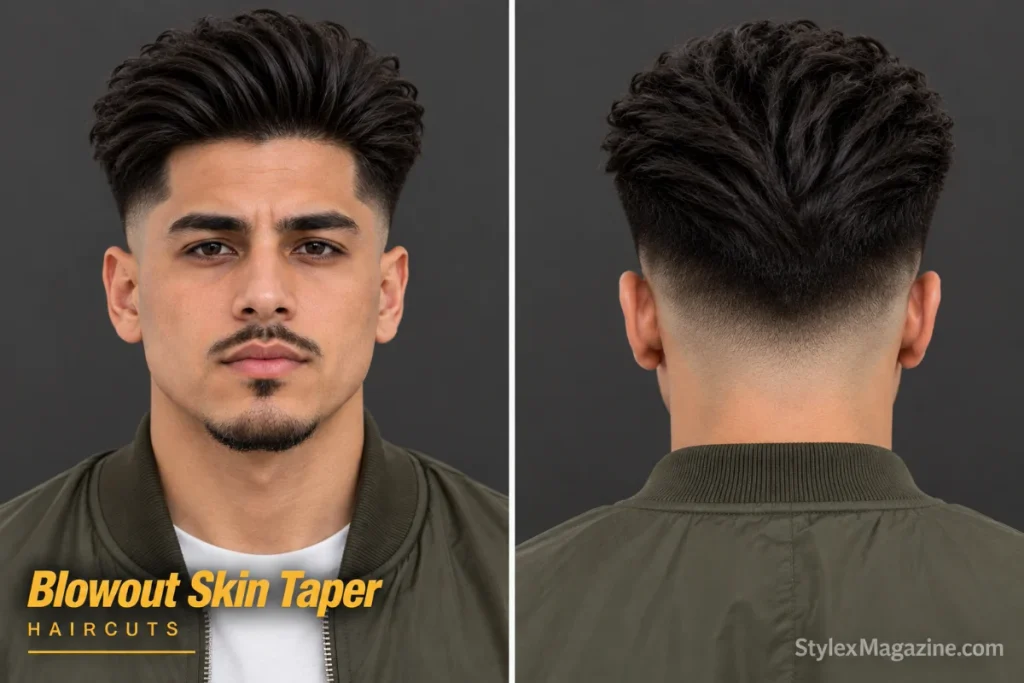
The base goes to bare skin at the sideburn and nape before blending up into a #2. The contrast is maximum, the silhouette sharpest, and the grow-out fastest, with visible stubble at the base inside a week. Best on coarse, dense hair where the skin line stays crisp. Mention “bald at the base, not up the side.”
6. Shadow Blowout Taper
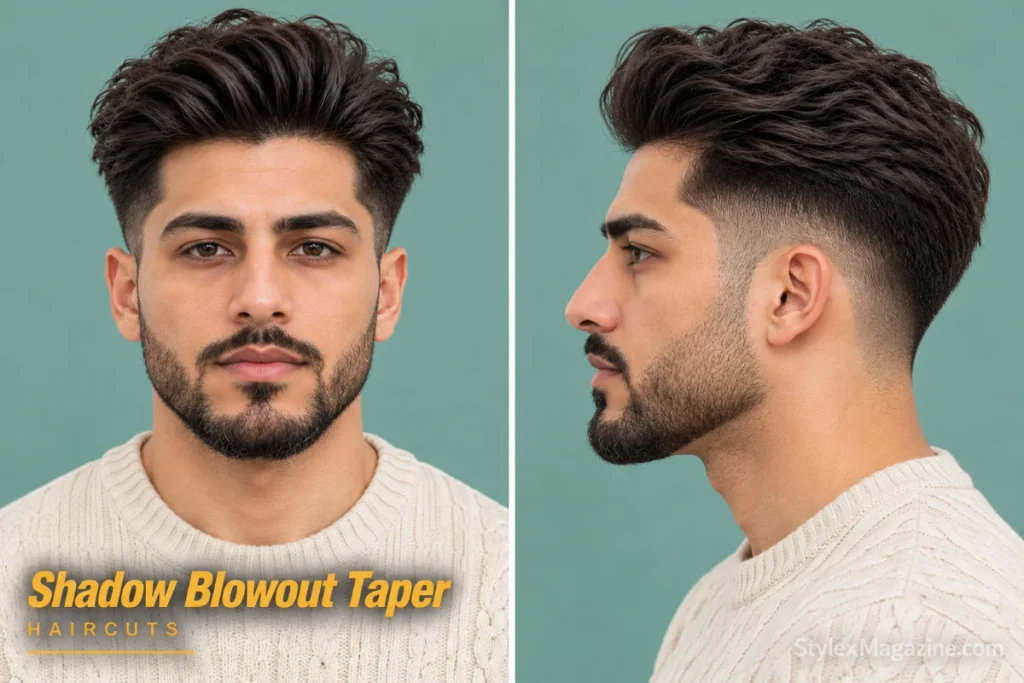
A softer version where the shortest point is a #0.5 rather than skin, leaving a faint shadow rather than a hard line. It holds its shape for three weeks instead of one and photographs more naturally. My preference for men who want the look without the fortnightly barber bill.
7. Blowout Drop Taper
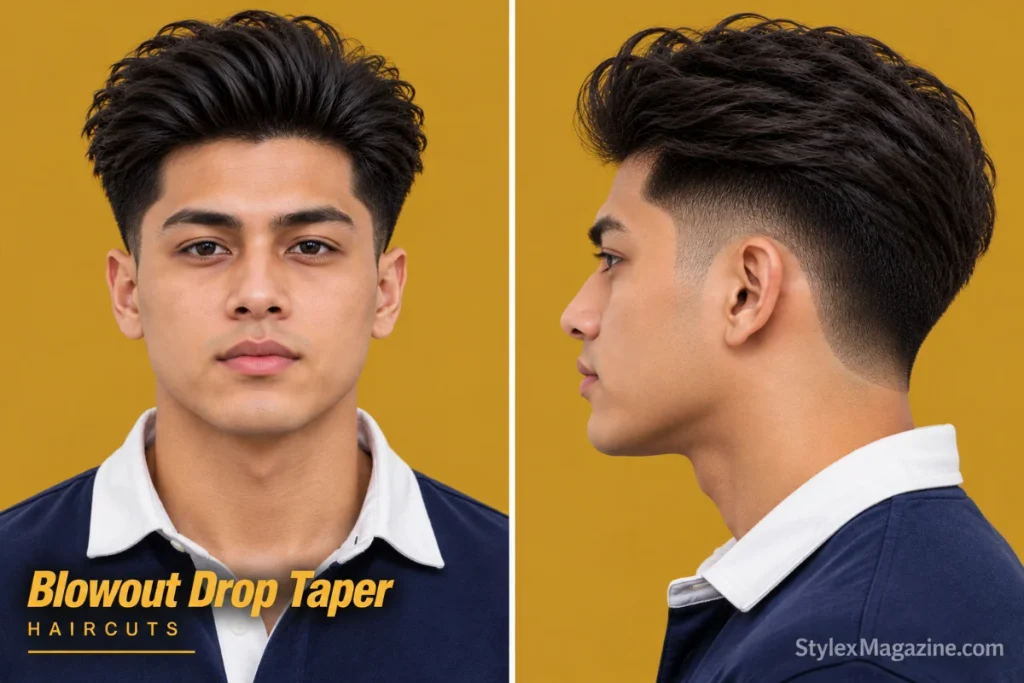
The taper line curves downward behind the ear instead of running straight, following the skull. It frames the head more softly and flatters square jaws. Harder to cut well, so bring a photo. Pairs with any top length from 3 to 6 inches.
8. Disconnected Blowout Taper
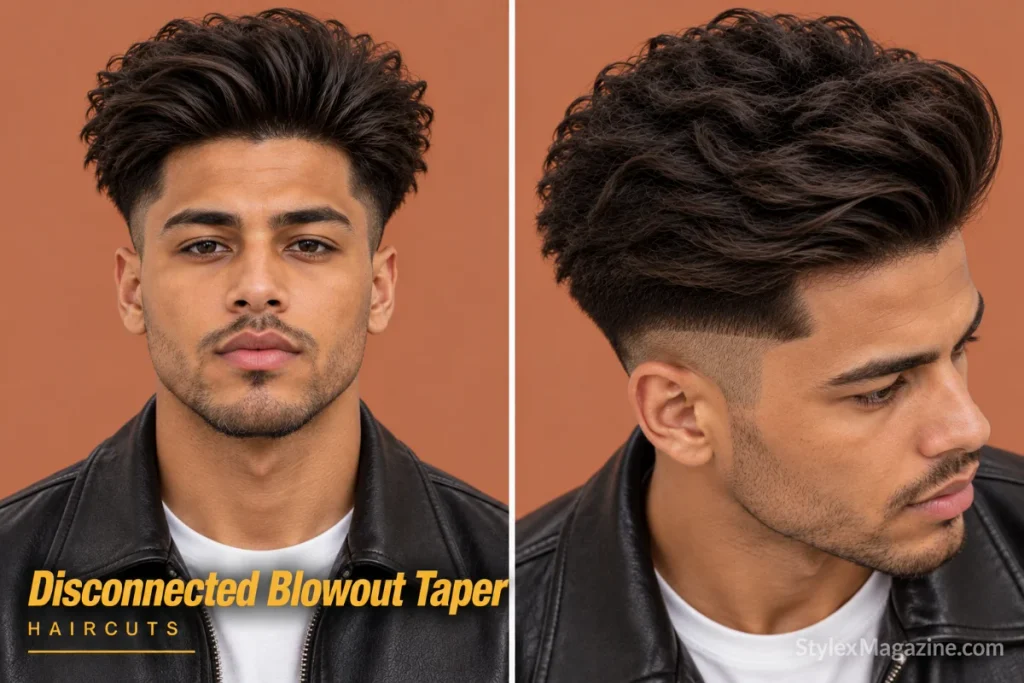
There is no blend between the sides and the top. The taper stops at a hard line and the long hair sits over it, creating a visible step rather than a gradient. Bold, and it suits dense straight hair that holds the overhang. The disconnection grows in within three weeks, so the look has a short window.
9. Long Blowout Taper
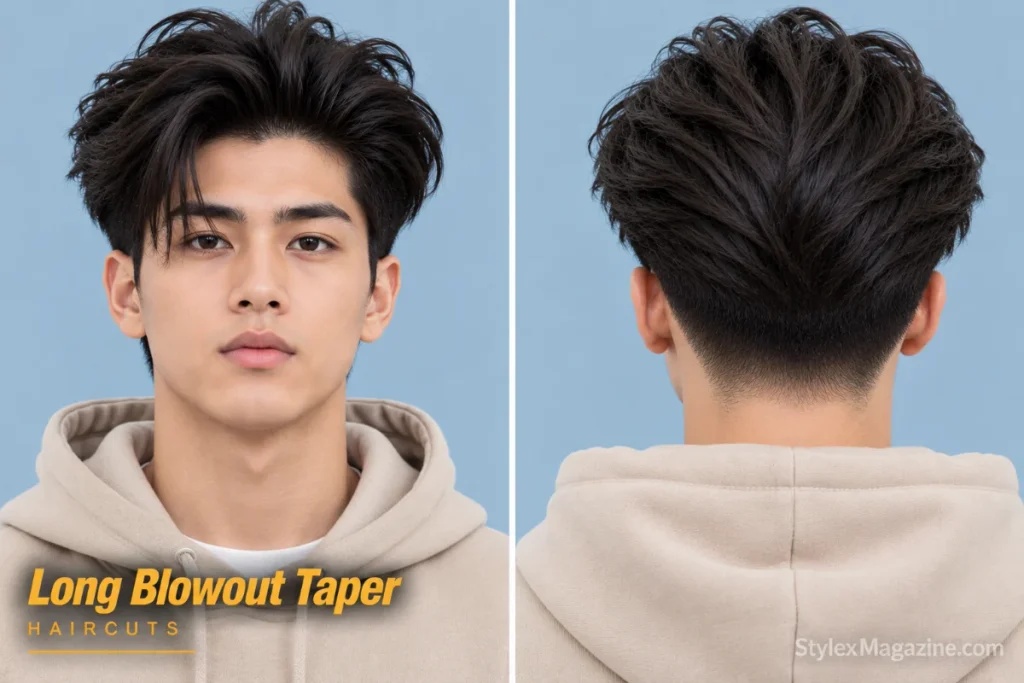
Six inches or more on top, falling back over the crown in a full sweep. The volume is impressive and the maintenance is real: ten minutes of drying, and it collapses by mid-afternoon without a strong-hold product. Best on hair with natural body. Fine straight hair cannot carry this length upright.
10. Straight Hair Blowout Taper

Straight hair has no natural lift, so the volume comes entirely from the dryer and the root direction. Apply mousse at the root while damp, dry against the growth, then set the shape. I tell straight-haired clients to expect four minutes every morning, not two. Skipping the root product is why most straight-hair blowouts fall flat.
11. Wavy Blowout Taper
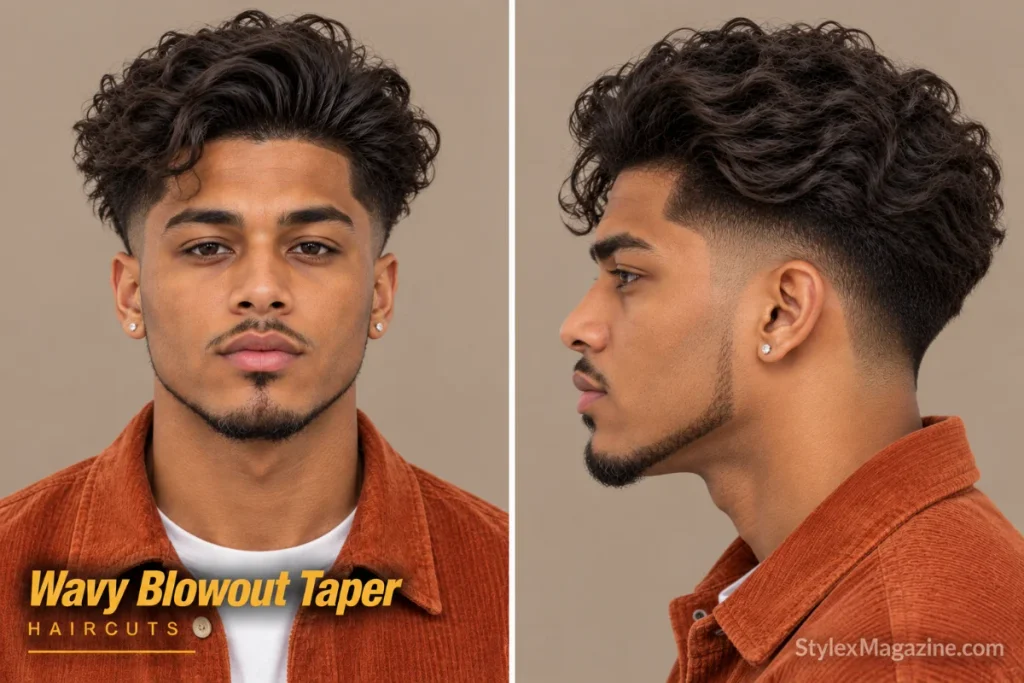
Waves do half the work, lifting at the root naturally and holding a bend through the length. Dry on medium heat with fingers rather than a brush to keep the wave pattern instead of smoothing it out. The easiest texture for this cut. A light cream is usually enough.
12. Curly Blowout Taper
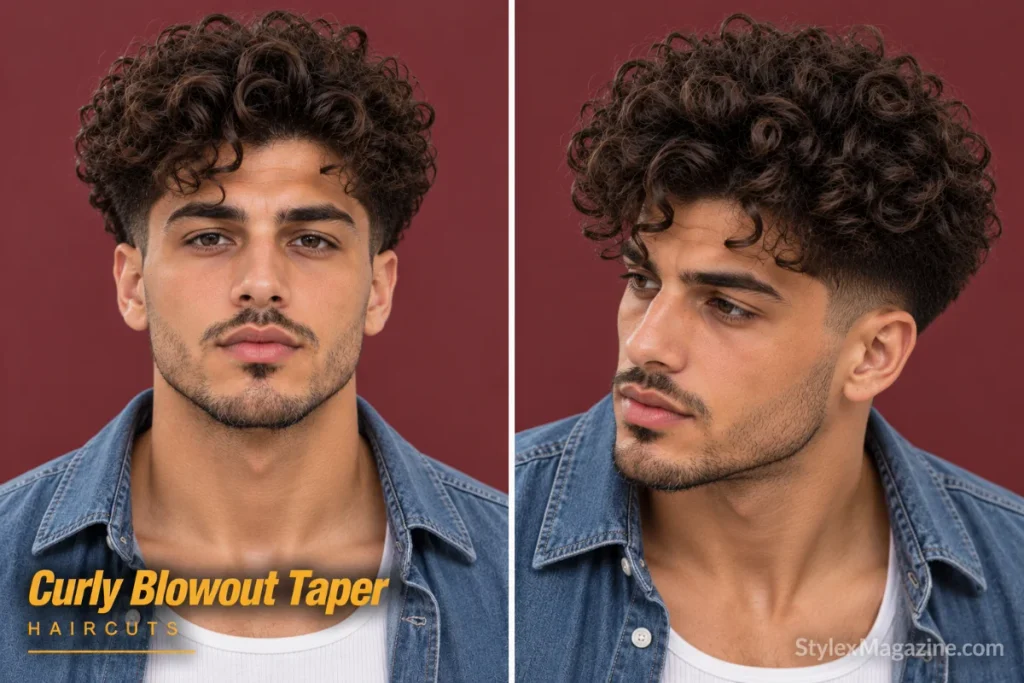
Curls expand outward when dried, so the shape builds sideways as much as upward. Use a diffuser on low speed and stop while the hair is still slightly damp, or the curls turn frizzy. Leave an extra inch on top to account for shrinkage. More on styling curls in curly hairstyles for men.
13. Coily Blowout Taper
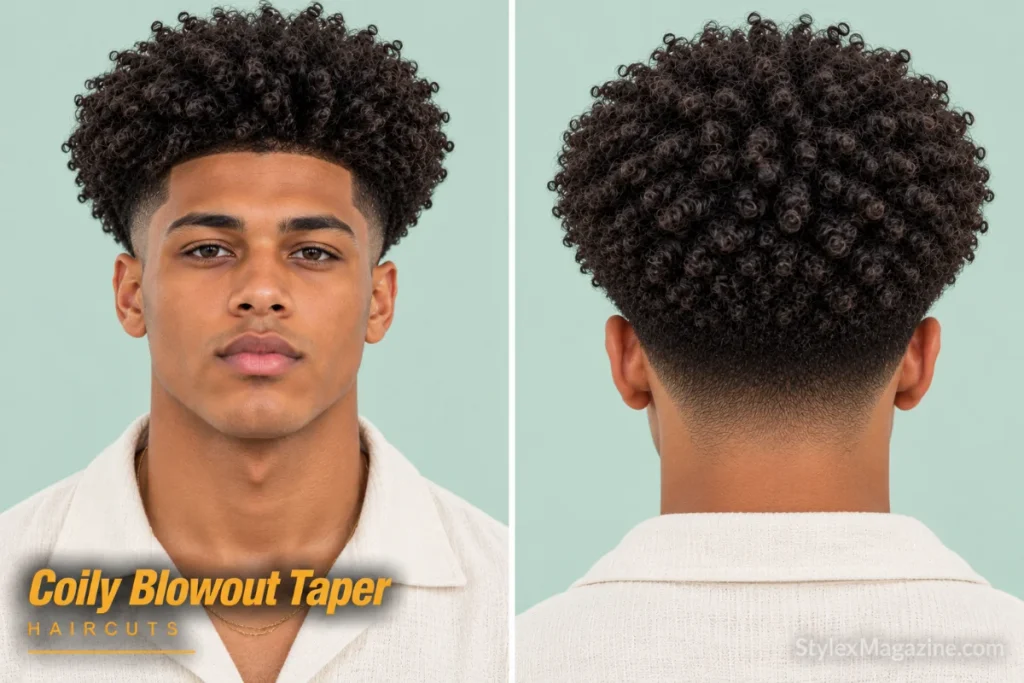
Tight coils need a pick and a diffuser rather than a brush, worked from the root outward to build an even dome. Shrinkage can be 50 percent or more, so what measures 3 inches wet sits at 1.5 inches dry. Moisture first, volume second. Full texture guidance in fade haircuts for Black men.
14. Afro Blowout Taper
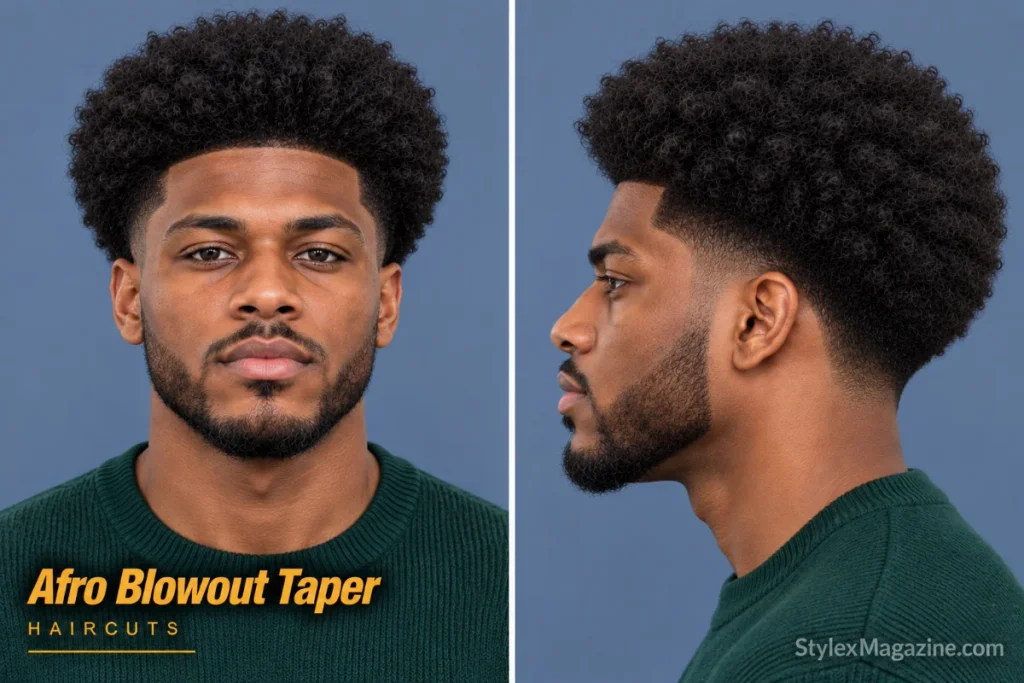
The top is left full and rounded rather than swept back, with the taper cleaning only the sideburns and nape. The silhouette is a dome, not a wave. Pick it out daily and refresh with a water-and-leave-in mist. Needs the neckline tightened every two weeks to stay sharp.
15. Asian Hair Blowout Taper

Coarse straight hair is the hardest texture for this cut, because thick strands grow downward with force and resist holding a curve. The fix is weight removal through the mid-lengths rather than more product, so the hair bends instead of standing like a brush. Keep the top at 4 inches and expect to use a firmer hold than a wavy-haired client would need. Many men with this hair type get a soft perm first, covered next.
16. Blowout Taper with a Perm
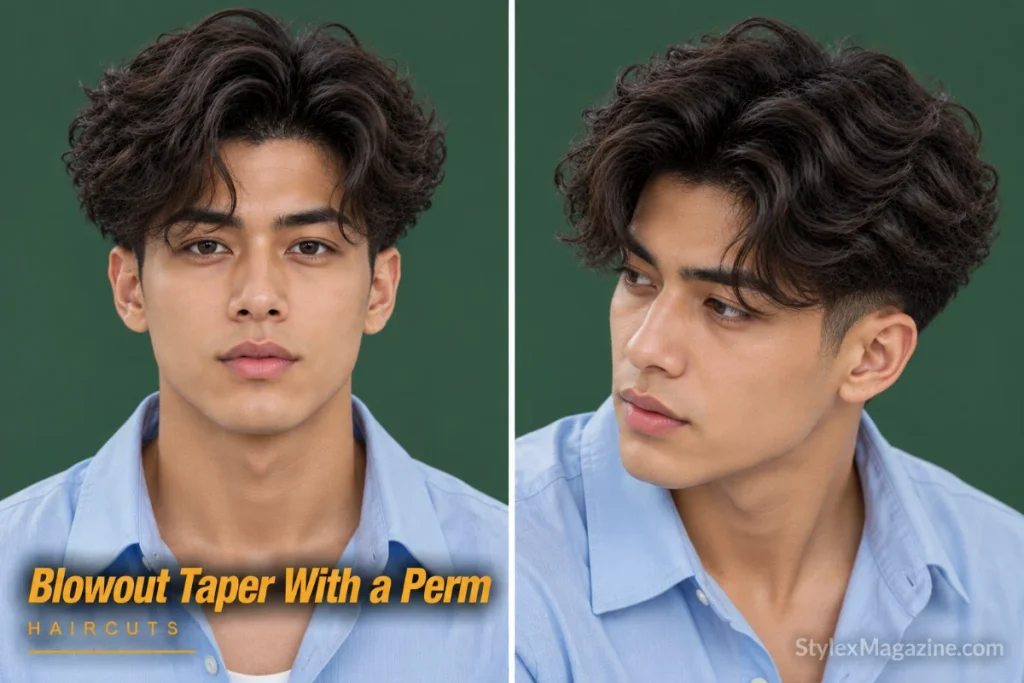
A loose digital or texture perm adds a bend that holds volume without daily brushing, cutting morning styling from four minutes to under two. It suits straight hair that refuses to lift any other way. The chemical service costs considerably more than the cut, lasts three to five months, and needs its own conditioning routine. Perm first, cut two weeks later, never the same day.
17. Blowout Taper with Textured Fringe

The front is point-cut into separated pieces that fall forward while the sides and crown sweep back. The contrast between the forward fringe and the lifted crown is what defines this version. Suits oval and square faces. Ask for the fringe to be cut dry so the length is accurate.
18. Blowout Taper with Messy Fringe

Looser and less deliberate than a textured fringe, with the front broken up by hand instead of brushed into position. Dry with fingers only. The appeal is that it tolerates a bad morning. Best on wavy hair that already falls unevenly.
19. Edgar Blowout Taper
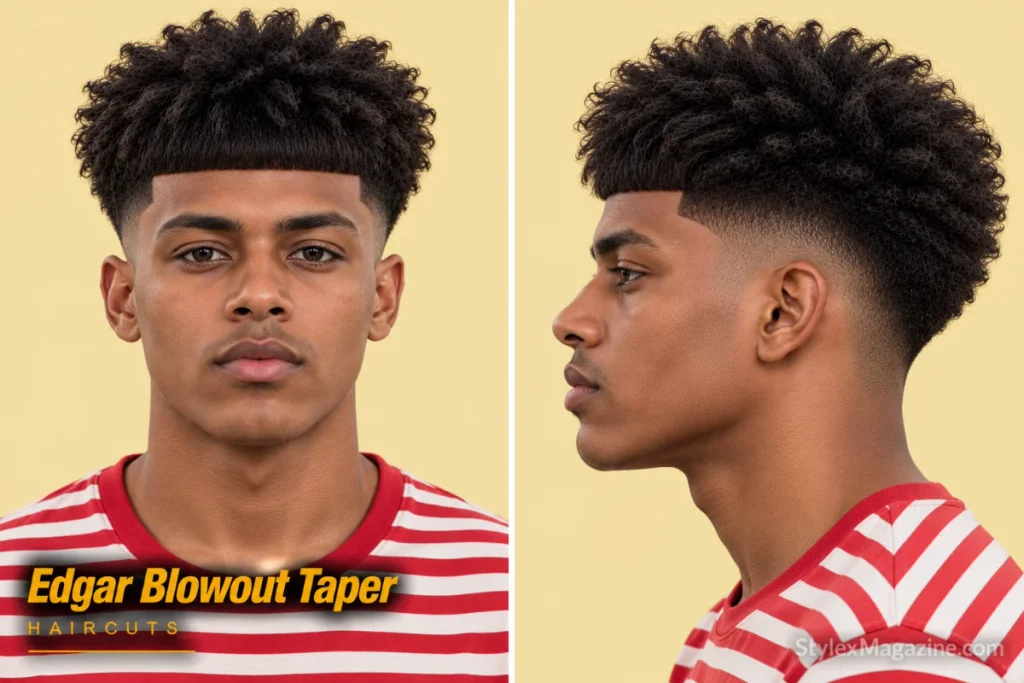
The Edgar brings a blunt, straight-across fringe cut high on the forehead, combined with the tapered sides and lifted crown behind it. The hard horizontal line of the fringe against the volume is the whole point. It suits oval and oblong faces and works against round ones, because the straight fringe widens the top of the face. Needs a trim every two weeks or the fringe line loses its edge.
20. Blowout Taper with Middle Part
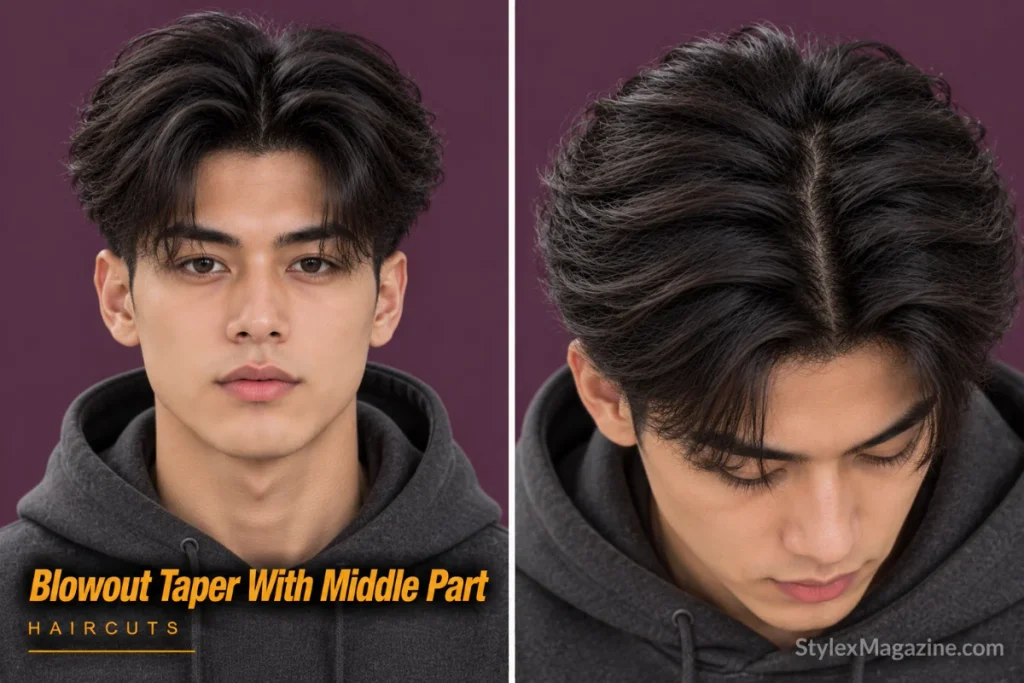
The top is split down the centre and dried outward on both sides, with the taper keeping the perimeter clean. Needs at least 4 inches to part cleanly and a natural part line that cooperates. Heavy, straight hair holds this best.
21. Blowout Taper Pompadour
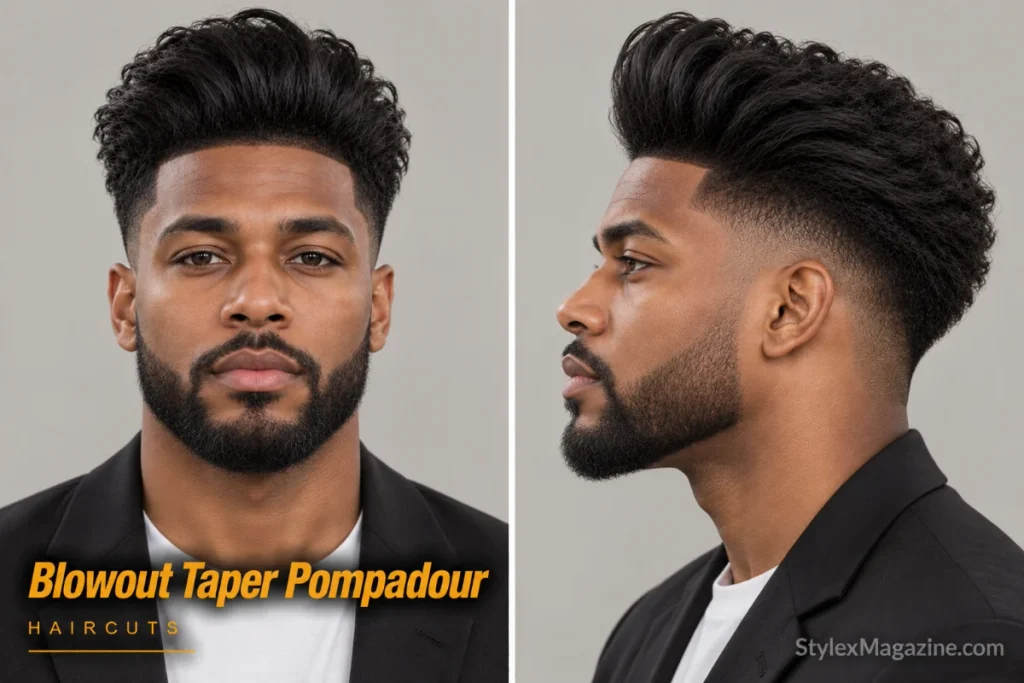
The front is lifted higher than the crown and rolled back, giving a steeper rise than a standard blowout. Needs a concentrator nozzle and a firm product to hold the front section upright. A 1950s shape built on a modern taper.
22. Blowout Taper French Crop
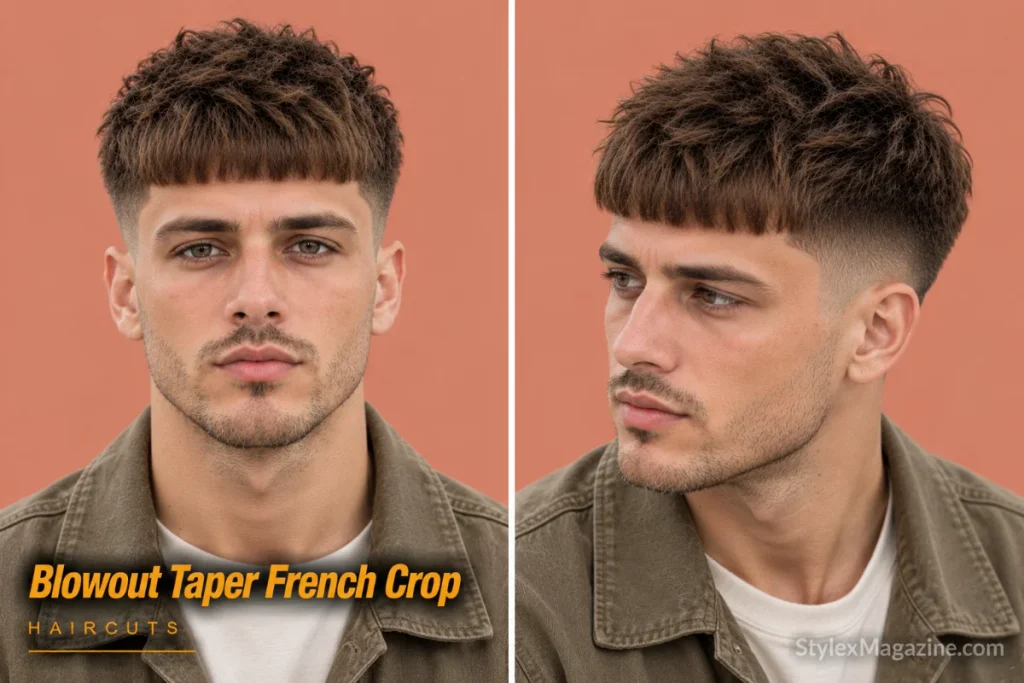
The crown is dried up while the fringe is cut blunt and left forward across the forehead. Shorter overall than most blowouts, at 3 inches, and lower maintenance. Suits men with high foreheads or an advancing hairline.
23. Blowout Taper with Beard Blend
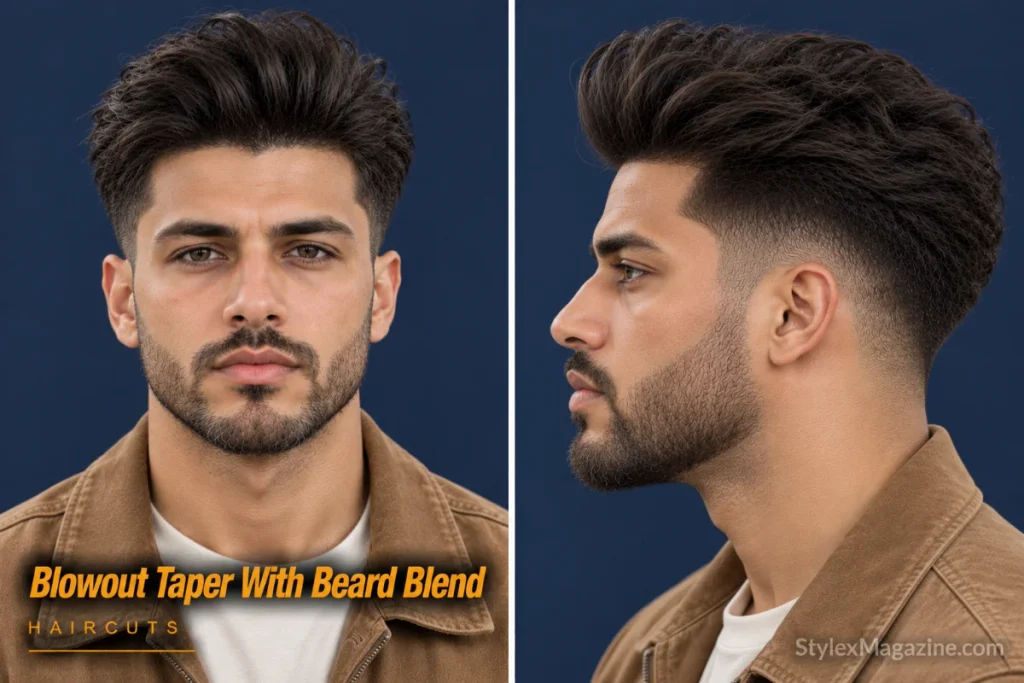
The taper connects into the beard line at the sideburn with no hard break, so the whole head carries one continuous shape. Requires a barber comfortable with both. Keep the beard at a #2 or shorter, or the weight competes with the volume on top.
24. Blowout Taper with Line-Up and Hair Design
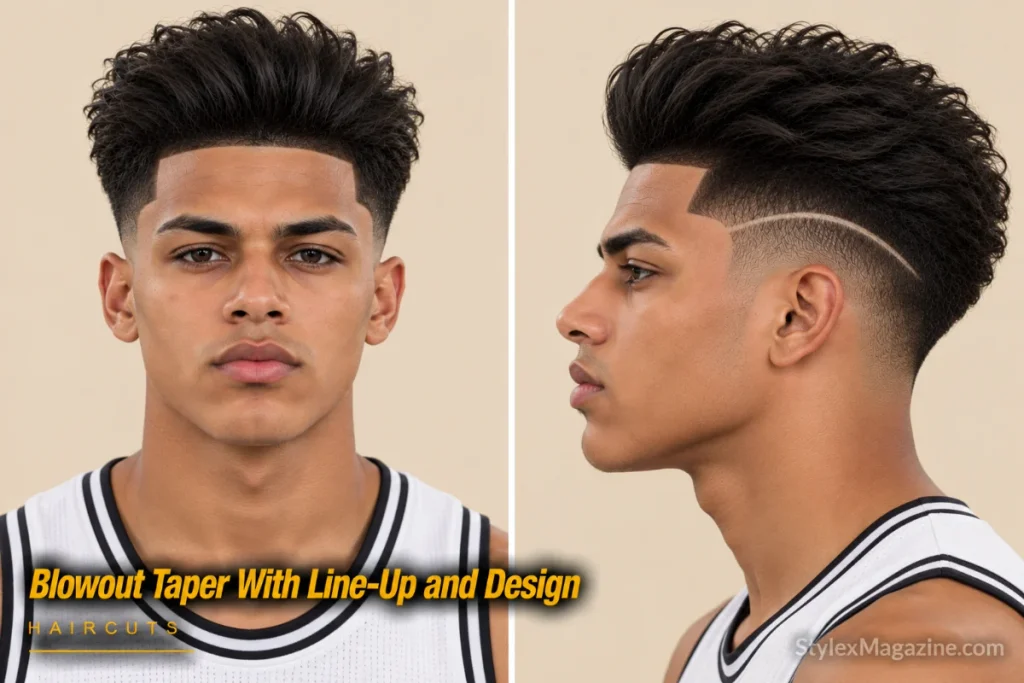
The hairline is squared off with a trimmer and, optionally, a shaved line is carved into the tapered section or along the natural part. Both create hard edges against the soft volume above, and both need recutting every 10 days. Avoid a line-up if your hairline is receding, because squaring the corners marks the recession permanently. Single clean lines age better than complex patterns.
25. Blonde Blowout Taper
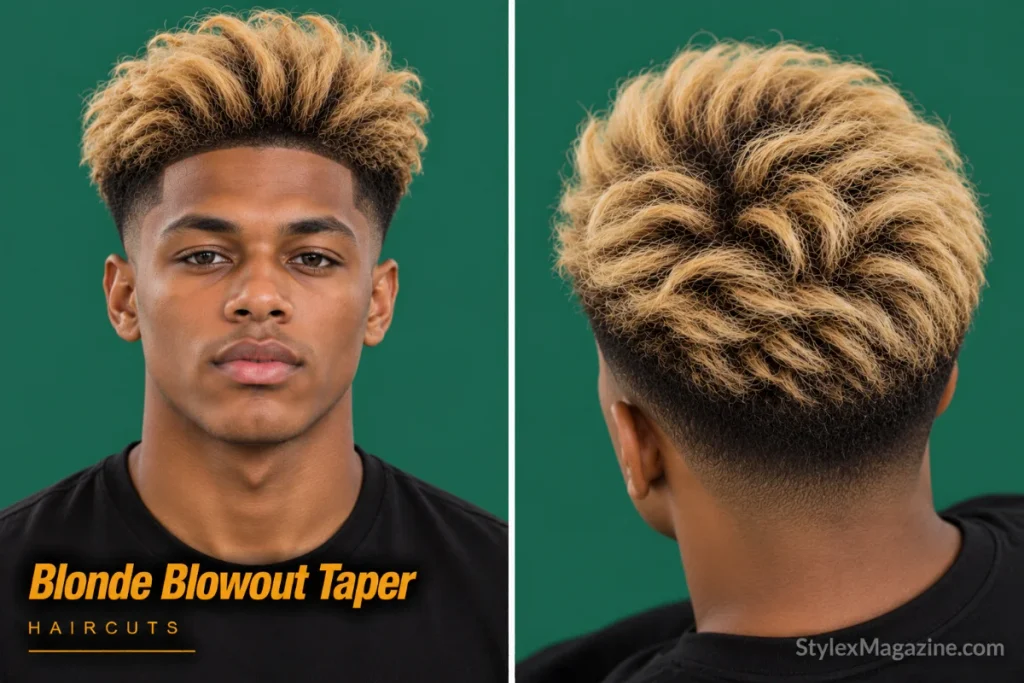
Lightening the top while leaving the tapered sides natural makes the volume look larger, because the lighter hair catches more light at the crown. Bleached hair is also drier and holds a blow-dried shape longer than virgin hair. The trade-off is fragility: bleached hair damaged by daily heat breaks at the crown first, so the heat rules below matter more on this version than any other.
Low, Mid or High: Which Taper Height Should You Pick?
Pick the height by how much contrast you want and how often you can visit a barber. A low taper keeps weight in the sides and grows out over four to five weeks. A high taper creates sharp separation and needs attention every 10 to 14 days.
| Taper height | Where it blends | Contrast | Touch-up | Suits |
|---|---|---|---|---|
| Low | At or below the ear top | Soft | 3 to 4 weeks | Thick hair, long faces, first-timers |
| Mid | At the temple line | Moderate | 2 to 3 weeks | Round faces, most hair types |
| High | Above the temple | Sharp | 10 to 14 days | Dense hair, round or square faces |
Height also changes how wide your head appears. A low taper leaves hair on the sides and holds the width; a high taper strips it and pushes all the bulk upward. If your face is already long, the low version is the safer pick. The standalone breakdown of the lowest option sits in low fade haircut.
How Does Hair Texture Change a Blowout Taper?
Texture decides where the volume comes from. Straight hair gets all of it from the dryer, wavy hair gets half from its own bend, and curly or coily hair builds outward instead of upward.
Straight hair holds the cleanest silhouette but drops fastest. Dry against the growth direction at the root, then set the shape with a medium heat pass and a cool shot. Without a root product, straight hair has nothing to grip.
Wavy hair lifts on its own and needs the least intervention. Finger-dry on medium heat and stop early. Over-drying waves turns them into frizz.
Curly hair expands in every direction when heat hits it. A diffuser on low speed, held still rather than moved around, keeps the curl pattern. Leave the hair slightly damp and let it finish on its own.
Coily hair needs a pick and moisture before anything else. Dry on low with a diffuser or a pick attachment, working outward from the root. Account for shrinkage when you decide the top length.
Can Thin or Flat Hair Hold a Blowout Taper?
Fine hair can hold a blowout taper, but only at shorter lengths. Keep the top at 3 inches or under, because fine strands lose the strength to stand up beyond that and the shape collapses into a flop by midday.
The volume on fine hair has to come from root friction rather than product weight. Texture powder applied at the root before drying adds grip with no added weight, and it is the single most useful product for this problem. Mousse works as a second option, applied to damp roots only.
Flat hair with no natural lift responds better to a mid taper than a low one, because removing weight from the sides forces what remains to stand rather than spread. I would also keep the fringe shorter than the crown. A heavy fringe on fine hair drags the whole front down within hours.
How Does a Barber Cut a Blowout Taper?
The cut runs bottom to top in four stages, and understanding the order tells you where it can go wrong.
- The guideline. The barber sets the shortest point at the sideburn and nape with a #0.5 or #1, establishing where the taper will start. Everything above is blended up to this line.
- The blend. Working upward with successive guards, usually #1 to #2 to #3, with the clipper arced away from the head so each pass leaves slightly more length. The arc is the skill; a flat pass leaves a visible band.
- The corners. Above the temple, the barber decides how much of the corner to keep. On a blowout taper, most of it stays. This is the stage where the cut most often goes wrong.
- The top. Cut dry, point-cut rather than blunt, with the weight concentrated at the crown. The length is checked by lifting sections upward rather than straight out, because the hair will be worn upward.
The whole process takes 40 to 50 minutes. Cutting it yourself is realistic for the top and unrealistic for the blend, since an even gradient across a curved skull is what takes barbers years to learn.
What Should You Tell Your Barber?
Ask for the cut by its parts rather than its name, because “blowout taper” means different things in different shops.
Say this:
“I want a low taper, starting at the sideburn and blending into a #2 above the ear. Keep the back tapered at the neckline, not faded up. Leave about four inches on top with the weight in the crown, and keep the corners above my temples. I’m blow-drying it back, so don’t thin out the top.”
The three parts that get cut wrong: the corners above the temples, which barbers often remove by habit; the back, which gets faded up when it should only be tapered at the nape; and the crown, which gets thinned when it needs the weight to hold height.
If you are growing into this cut from something shorter, say so. A blowout taper needs 3 inches minimum on top, and a barber who knows you are mid-growth will cut the sides to match where the top is heading rather than where it is now.
How Do You Style a Blowout Taper Each Morning?
Budget three to five minutes. The sequence is product on damp hair, dry at the root first, shape second, then set.
- Towel-dry to damp, not wet. Dripping hair takes twice as long and the product dilutes.
- Apply a root product to the top only. Mousse for fine hair, sea salt spray for wavy, a leave-in for curly. Nothing on the sides.
- Dry the roots first, pushing the hair against its natural growth with your fingers. All of the height comes from this step. Thirty to sixty seconds.
- Shape with a round brush, lifting at the root and sweeping back and slightly outward. Follow the brush with the dryer nozzle.
- Hit it with cool air for ten seconds. Cooling the hair in position is what locks the shape, and skipping it is why most blowouts fall within two hours.
- Finish with a light product only if needed. A matte clay or cream through the mid-lengths, never at the root. Product choice by hold and finish sits in the men’s hair products guide.
The most common mistake is drying the whole head at once and then trying to fix the shape afterwards. Root direction has to be set while the hair is wet. Once it dries flat, no amount of product will lift it.
Is Daily Blow-Drying Damaging Your Hair?
Less than most men assume, provided you keep your distance. A 2011 study in Annals of Dermatology dried hair tresses 30 times under five conditions and found that a dryer held at 15 cm with continuous motion caused less damage than letting hair dry naturally. Prolonged wetness damaged the cell membrane complex in the air-dried group, which the authors themselves called unexpected.
Distance is what decides the outcome. In the same study, surface damage rose as the dryer moved closer, and the worst cuticle damage of any group occurred at 5 cm and 95°C. No cortex damage appeared under any condition.
The American Academy of Dermatology takes the more cautious line, listing blow dryers among the habits that damage hair and advising people to “use the lowest heat setting” and to “let your hair air dry when possible.” Both positions hold together once you account for distance: a dryer used badly is worse than air drying, and a dryer used at arm’s length is better than both.
What that means for a daily blowout:
- Hold the nozzle at 15 cm, roughly six inches, and keep it moving. This is the single number that separates the safe condition from the damaging one in the research.
- Drop the heat setting. Medium builds the same shape as high, taking perhaps thirty seconds longer.
- Stop while slightly damp. Leaving 10 percent of the moisture in is gentler than drying to bone dry every day.
- Use a heat protectant on the top section before the dryer touches it.
If you notice increasing breakage at the crown, where the dryer concentrates, check your distance before you change anything else. Persistent breakage or scalp irritation is worth a dermatologist’s opinion rather than a product change.
What Does a Blowout Taper Cost and How Long Does It Last?
A blowout taper runs roughly $30 to $60 at a barbershop in the US and £25 to £45 in the UK, with the taper detail and any line-up adding to a standard cut price. The style itself lasts one day. The haircut lasts two to four weeks depending on taper height.
| What | How long | Cost |
|---|---|---|
| The dried shape | Until you wash it | Nothing |
| A high or skin taper | 10 to 14 days | $30 to $60 per visit |
| A mid taper | 2 to 3 weeks | Same |
| A low or shadow taper | 3 to 5 weeks | Same |
| Neckline tidy between cuts | Adds 1 week | $10 to $15, or free at some shops |
The blowout is not permanent and no salon treatment makes it so. A perm adds curl that supports volume, but it changes the hair structure and brings its own upkeep. Anyone selling you a permanent blowout is selling you a perm.
Over a year, a mid taper at three-week intervals works out to roughly 17 visits. That number surprises people more than the per-cut price, and it is worth doing the arithmetic before committing.
How Does a Blowout Taper Grow Out, Week by Week?
A blowout taper holds its shape for two to three weeks, then the taper line softens before the top becomes unmanageable. The sides go first, not the top.
- Week 1: Sharp. A skin taper already shows stubble at the base by day five.
- Week 2: The taper line blurs. Still clean from the front, softer from the side. Most men book here.
- Week 3: The sides begin to fill out and the silhouette widens. Low tapers still hold; mid and high tapers look overgrown.
- Week 4: The top gains weight and the lift drops. Drying takes longer for less height.
- Week 5: The shape is gone. The top is now long enough to fall rather than stand.
A neckline and sideburn tidy at week two buys you an extra week on a low taper. It takes a barber five minutes and costs a fraction of a full cut.
What Mistakes Ruin a Blowout Taper?
Six errors account for nearly every failed blowout I have had to correct in the chair.
- Taking the taper too high. A high taper on a long face removes the width that balanced it. Go lower than you think.
- Letting the barber remove the temple corners. Those corners anchor the width above the ear. Once gone, the top looks like a tuft.
- Thinning the crown. Weight is what holds height. Thinning shears at the crown guarantee collapse.
- Drying hair that is too wet. The product dilutes and the root never sets. Towel to damp first.
- Loading product before drying. Heavy product at the root blocks lift. Light product at the root, heavier product after.
- Bringing a reference photo of different hair. A photo of thick wavy hair hands your barber a target your fine straight hair cannot reach. Bring a photo of hair that matches your texture, not a face that matches your aspirations.
FAQs
What guard number is the top cut with?
None, usually. The top is scissor-cut, though barbers who clipper it use a #12 to #16, which is 1.5 to 2 inches, shorter than most blowouts need.
How is a blowout taper different from a burst fade?
A burst fade curves in a semicircle around the ear and leaves the back long. A blowout taper runs straight along the perimeter and tapers the nape too.
Does a cowlick ruin a blowout taper?
No, it usually helps. A cowlick at the crown already pushes hair upward, and most barbers will build the shape around it rather than fight it.
Can you wear a hat with one?
Not for long. A hat flattens the root within twenty minutes and the shape will not recover without re-wetting.
Does a blowout taper suit kids?
Yes. Shorten the top to 3 inches and skip the daily drying, since children’s hair usually has enough natural lift to hold the shape.
Does the gym ruin it?
Sweat at the roots drops the shape within an hour. Rinsing and re-drying is faster than trying to revive it with product.
Is the blowout taper still in style in 2026?
Yes. It remains the cut I am asked for most by clients under 30, and the low taper version has been gaining on the mid through 2026.

Other Articles

25 Best Textured Fringe Haircuts for Men (2026)
Men’s Hair Products Guide: How to Choose the Right One?


No Comment! Be the first one.