
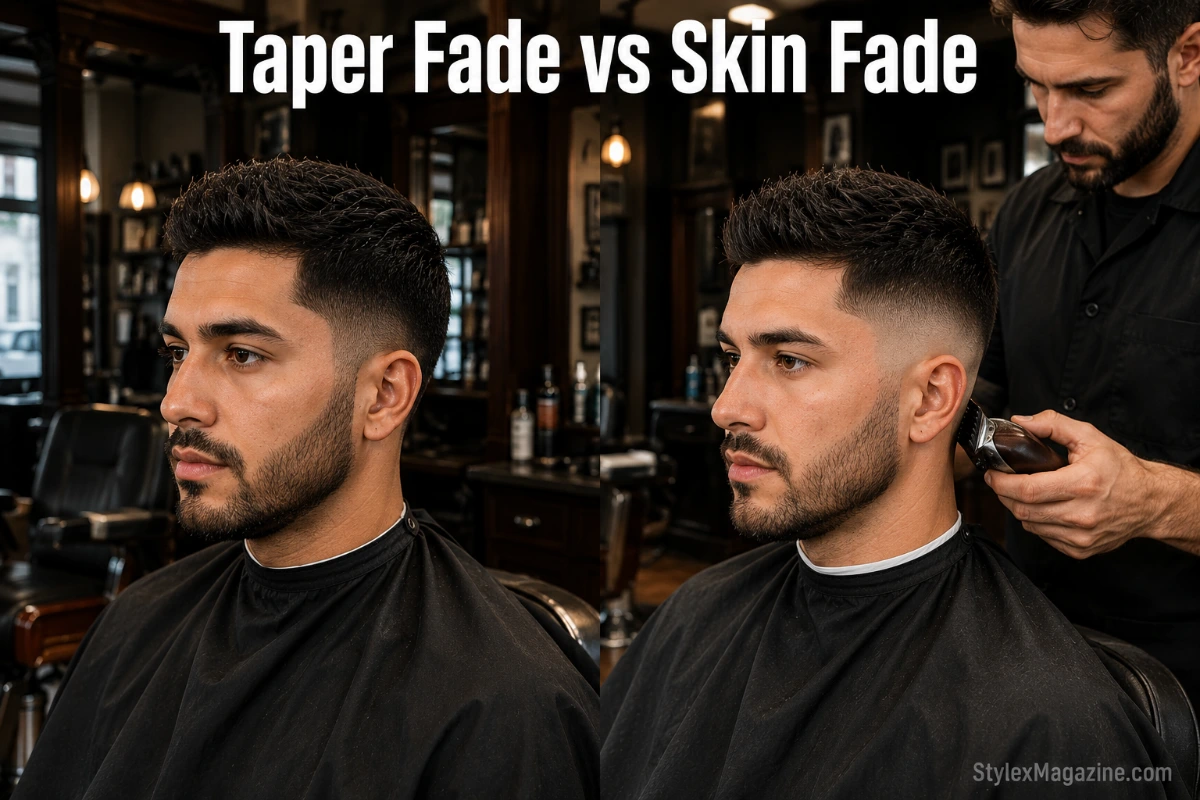

Quick Answer: A taper fade shortens the hair gradually toward the neckline but always keeps some hair at the base — it never reaches bare skin. A skin fade takes the hair all the way to bare skin at the base. One is about how much the hair shortens. The other is about how close it gets.
“Taper fade” gets used in barbershops to mean almost everything — which is exactly why men walk out confused. Eight years cutting hair, and the most common miscommunication I see is a client asking for a taper fade and getting a skin fade, or the other way around. They’re not the same cut. Here’s what actually separates them, and how to make sure you walk out with the right one. For every fade type including burst, drop, and temp variations, see all fade types.
Taper Fade vs Skin Fade: Side-by-Side Comparison
| Taper Fade | Skin Fade | |
|---|---|---|
| Shortest point | Some hair always remains | Bare skin — no hair, no stubble |
| Contrast | Low to moderate | High |
| Finish | Natural, soft | Sharp, precise |
| Clipper guard at base | #1 to #2 minimum | #0 with straight razor |
| Best for | Fine/thin hair, professional settings | Thick hair, bold looks |
| Grows out | Gracefully — 4–5 weeks | Loses definition fast — 2–3 weeks |
| Maintenance | Every 3–5 weeks | Every 1–3 weeks |
| Face shapes | All — especially oblong/long | All — especially round, square |
What Is the Key Difference Between a Taper Fade and a Skin Fade?
Technically, a taper and a fade are different techniques — a taper blends without reaching skin, a fade goes all the way down. But in most barbershops, “taper fade” gets used to mean a fade that starts low and stays conservative. When you sit down, be specific: skin or no skin. That one detail removes the ambiguity.
Worth knowing: tapers are not just a neckline-and-sideburns cut. A low taper starts just above the ear. A mid taper starts at temple level. A high taper starts above the temples. The height changes the look — only the closeness at the base stays consistent across all three.
Low Taper Fade vs Skin Fade
The most commonly confused pair. Both start just above the ear — the difference is entirely at the base.

Low taper fade: Blends to a #1 or #2 at the neckline — some hair always remains. Conservative, professional, holds for 4–5 weeks. All low fade styles are in the low fade haircut guide.
Low skin fade: Same height, but taken to bare skin with a straight razor finish. Higher contrast, needs a touch-up every 2–3 weeks.
Which to choose: Formal environment with a monthly schedule — low taper. Maximum definition at a subtle height — low skin fade.
Mid Taper Fade vs Skin Fade
The mid taper starts at temple level — the base stays with hair rather than going to skin.

Mid taper fade: Blends to a #1 or #2 at the base. More contrast than the low taper, still works in most professional settings. Holds for 3–4 weeks. Every mid fade variation is in the mid fade haircut guide.
Mid skin fade: Temple height, bare skin at the base. Presence without the extremity of a high skin fade. Every 2–3 weeks.
Which to choose: Temple height with a softer finish — mid taper. Sharpest version at that height — mid skin fade.
Which One Suits Your Face Shape?
The choice of height matters more than skin vs taper for most face shapes — but the finish affects how the sides read.
| Face Shape | Taper Fade | Skin Fade |
|---|---|---|
| Oval | Any taper level | Any skin fade level |
| Round | Mid or high taper | Mid or high skin fade — adds visual height |
| Square | Low or mid taper — softens the jaw | Mid skin fade — emphasises the jawline |
| Oblong / Long | Low taper — keeps proportions balanced | Low skin fade only |
| Diamond | Mid taper | Mid skin fade |
| Heart | Low or mid taper | Low skin fade — avoids sharpening temples |
A taper at any level suits oblong and long faces better than a skin fade at the same height. The hair remaining at the base keeps the sides fuller — a skin fade at the same height removes that fullness and makes the face look longer. For a complete guide to all seven face shapes and which cuts suit each one, see the face shape haircuts guide.
Which One Suits Your Hair Type?
The right choice changes significantly by texture.
Straight Hair
Both work. The skin fade reads sharper on straight hair than any other texture because the flat hair cuts precisely against the skin line. A taper gives a polished finish. Neither is wrong.
Curly Hair
Both work — but execution differs. Curly hair shrinks significantly once dry. A skin fade sitting at the right height when freshly washed can ride noticeably higher once the curls contract. A taper fade is more forgiving — the hair at the base absorbs the shrinkage rather than the fade line rising.
For a skin fade on curly hair: tell your barber to set the height based on how your hair looks dry, not wet. Scissor-over-comb gives more control at the curl-to-skin transition than clippers alone.
Wavy Hair
Both work. A taper grows out more naturally on wavy hair because the hair at the base blends into the wave texture. A skin fade gives a sharper result when fresh but shows grow-out faster.
Thick Hair
Skin fade. The density on top earns the high contrast at the sides. A taper on thick hair can look heavy because the hair at the base adds to the overall bulk.
Fine or Thin Hair
Taper fade only. A skin fade at mid or high height on thin hair exposes a large area of scalp — the contrast between bare skin and sparse hair on top draws attention to the density. A low taper keeps the sides looking full.
What Is a Skin Taper Fade?

A skin taper fade is a hybrid. The hair shortens gradually like a taper — starting at a conservative height — but at the very base it reaches bare skin rather than stopping at a #1 or #2.
Where a standard skin fade goes to bare skin from mid or high height, a skin taper takes the hair to skin only at the very bottom of the neckline and sideburns. Everywhere else keeps hair. Less bold than a full skin fade, cleaner at the neckline than a standard taper.
Right for: men who want the skin finish but find a full skin fade too dramatic. Fine or thin hair at low heights only — skin exposure stays minimal.
Tell your barber: “Skin taper — taper it down naturally but take the very base to skin at the neckline.”
Which Requires Less Maintenance?
The taper fade is lower maintenance than a skin fade at every level.
| Variation | Frequency | Why |
|---|---|---|
| Low taper fade | Every 4–5 weeks | Hair at base absorbs new growth naturally |
| Mid taper fade | Every 3–4 weeks | Moderate contrast — grows out cleanly |
| High taper fade | Every 3 weeks | Higher starting point shows grow-out faster |
| Low skin fade | Every 2–3 weeks | Skin line shows growth within days |
| Mid skin fade | Every 2–3 weeks | Most barbers recommend every 2 weeks |
| High skin fade | Every 1–2 weeks | Fastest to lose definition |
| Skin taper fade | Every 3–4 weeks | Minimal skin exposure — grows out like a taper |
A grown-out taper still looks intentional. A grown-out skin fade looks neglected. If your schedule only allows a monthly visit, the taper fade is the practical choice.
What Should You Tell Your Barber?
“Taper fade” means different things to different barbers. Specify the height and whether you want skin at the base — those two details cover everything.
Low taper fade: “Low taper fade — start just above the ear, keep some hair at the base, don’t go to skin.”
Mid taper fade: “Mid taper fade — start at the temple, keep some hair at the base, blend it natural.”
Low skin fade: “Low skin fade — start just above the ear, take it to bare skin at the base, straight razor finish.”
Mid skin fade: “Mid skin fade — start at the temple, bald at the base, straight razor finish.”
Skin taper fade: “Skin taper — taper it down gradually but take the very base to skin at the neckline.”
Curly hair: “Set the height based on how my hair looks dry — not wet.”
FAQ’s
What is the difference between a taper fade and a skin fade?
A taper always keeps hair at the base — never reaches bare skin. A skin fade takes the hair to bare skin using a #0 guard and straight razor. Same gradient technique, different endpoint.
Is a taper fade good for professional settings?
Yes. The conservative finish and natural grow-out make it the right choice for formal environments where a skin fade would read too bold.
What is a zero fade?
A zero fade is a skin fade taken with a #0 guard — a variation of the skin fade, not a separate cut.
Is a taper fade the same as a fade?
No. A taper always keeps hair at the base. A fade can go to skin. “Taper fade” gets used interchangeably in barbershops — but they’re technically different. Specify: skin or no skin.
Which is better for Black men — taper fade or skin fade?
Both work well on coily and 4C hair. A taper fade is more forgiving between cuts because the hair at the base absorbs shrinkage. Full breakdown coming in the fade haircuts for Black men guide.


Comb Over Haircut: Complete Men’s Style Guide
32 Best Burst Fade Haircuts For Men.

[…] The skin fade goes down to bare skin on the sides, similar in effect to a disconnected undercut but with a smoother gradient. The sharpest contrast of any fade type. Needs a well-shaped beard to balance the dramatic transition and define the jawline. For more on skin fades, see taper fade vs skin fade. […]