
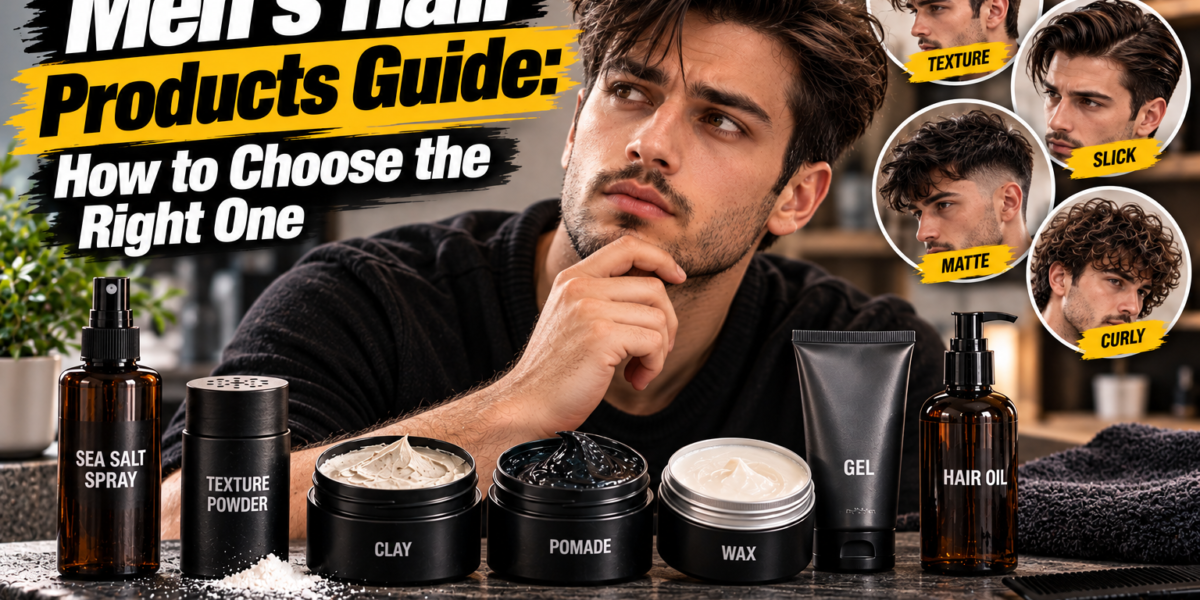

QUICK ANSWER: Hold decides whether the style survives the day. Finish decides how it looks in daylight. Malleability decides whether you can fix it at 3pm. Match all three and the product name on the tub stops mattering.
Three things separate every tub, tube and bottle on the shelf: how firmly it holds, how much light it throws back, and whether you can touch your hair again after it dries. Learn those three and the shelf stops being a guessing game.
What follows: every product scored side by side, the match to your hair type, the match to the cut you’re wearing, how much to use, what order to apply things in, which combinations are worth stacking, and how to clear the buildup that follows weeks of daily use.
Pomade is one of thirteen products a barber might reach for, and the choice between them comes down to hold, finish and how far the product lets you restyle. That comparison sits in the full men’s hair products guide.
Hold, Finish and Malleability: The Three Variables That Decide Everything
Hold is how firmly the product keeps hair where you put it, rated 1 to 10 on most labels. Light hold (1–4) lets hair move and fall naturally. Medium (5–7) keeps a shape through a working day but gives if you run a hand through. Firm (8–10) locks the shape and resists wind, humidity and movement.
Finish is one of three variables that decide whether a product suits you. Hold, finish and malleability compared across every product covers the other two.
Finish is how much light the surface reflects. Matte absorbs light and looks like thick, dry hair. Natural sits between the two and looks like nothing was applied. Shine reflects sharply and signals a deliberate, groomed style. Picking the wrong one is the most common mistake men make with an otherwise correct product, and the full comparison sits in matte vs shine: how to choose your hair finish.
Malleability is whether the product stays workable after it dries. Clay, wax and cream stay pliable, so you can reshape at lunchtime with your fingers. Gel and firm water-based pomade set into a shell that cracks rather than bends. This variable gets ignored on most labels, and it is the one that decides how your hair looks eight hours in.
Two products can carry identical hold numbers and behave nothing alike. A 7-hold clay and a 7-hold gel both keep a quiff up. Only one of them lets you rebuild it.
One more number sits behind the three: weight. A product can be light in hold and still heavy on the head, because the carrier matters as much as the hold agent. Petrolatum and beeswax carriers sit on hair and press it down. Water and alcohol carriers evaporate and leave only the polymer or the mineral behind. Fine hair fails more often from carrier weight than from hold level, so a light oil-based pomade will flatten a head that a firm powder would have lifted.
Salt spray is a pre-styler, not a hold product, so it almost always needs a second product on top. Picking that second product is covered in which product your hair type and style need.
Every Men’s Hair Product, Explained
Thirteen products cover almost every style a barber will cut. The table scores each on the three variables, then the paragraphs underneath explain what each one actually does to the hair.
| Product | Hold | Finish | Malleability | Base | Washes out with |
| Water-based pomade | 6–8 | Medium to high shine | Low once set, reactivates with water | Water + polymers | Water alone |
| Oil-based pomade | 4–6 | High shine, stays wet-look | High, never fully sets | Petrolatum, waxes | Degreasing shampoo |
| Hair clay | 6–8 | Matte to low sheen | Medium | Bentonite or kaolin clay, wax | Shampoo |
| Hair wax | 5–7 | Low sheen | Medium to high | Beeswax, carnauba | Warm water + shampoo |
| Hair paste | 4–7 | Low sheen to matte | High | Water + wax blend | Water alone |
| Hair putty | 5–8 | Flat matte | Medium | Clay + wax, thicker body | Shampoo |
| Fibre | 5–7 | Matte, visible strands | Medium to high | Wax + stringy polymers | Shampoo |
| Hair cream | 2–4 | Natural | High | Emulsified oils + water | Water alone |
| Hair gel | 8–10 | Wet to glossy | None, sets rigid | Water + PVP polymer | Water alone |
| Sea salt spray | 1–3 | Matte | High | Salt solution + humectant | Water alone |
| Texture powder | 3–5 | Flat matte | Medium | Silica silylate | Shampoo |
| Mousse | 2–4 | Natural | High | Foaming polymers | Water alone |
| Hairspray | 4–9 | Varies by formula | None where it lands | Alcohol + polymer | Shampoo |
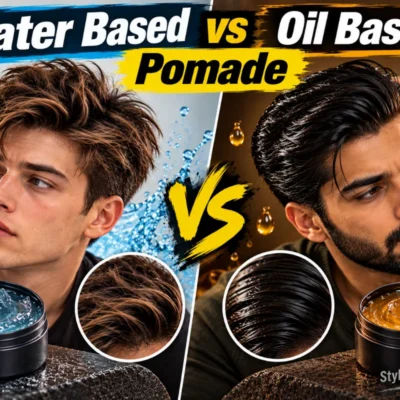
Pomade splits into two families that share a name and almost nothing else. Water-based rinses out in the shower and holds a sharper shape; oil-based keeps hair pliable for days and needs a degreaser to shift. The practical differences sit in water-based vs oil-based pomade, and the application method is covered in how to use pomade.
Clay carries wax for hold and clay minerals that absorb oil, so the surface turns matte and the hair feels thicker than it is. Step-by-step technique: how to use hair clay.
Clay sits in the middle of a shelf that runs from salt spray at one end to gel at the other. If you are still deciding whether clay is the right product for your hair at all, how every men’s hair product compares on hold and finish puts all thirteen side by side.
Wax holds through tack rather than stiffness, so it grips pieces together without setting. Thick, coarse hair takes it better than fine hair. See how to use hair wax.
If wax is wrong for your hair, something else on the shelf is right. The complete men’s hair product breakdown scores every option on hold, finish and how much it lets you restyle.
Paste sits between cream and clay. The water in the base keeps it easy to spread and easy to rinse, and the wax gives it more hold than a cream without the dryness of a clay. Short to medium hair with a light natural texture takes paste better than any other category, because it shapes without announcing itself.
Putty is thicker-bodied than paste and drier on the fingers, closer to a clay with extra grip. It suits hair that has been cut with heavy texture on top and needs pieces to stay separated rather than swept into one mass. Spread it over a wider palm area before it touches the head, or it lands in lumps.
Fibre contains stringy polymers that stretch between hair strands and pull them into visible separated pieces. The payoff is a rough, lived-in surface; the trade-off is that fibre looks obvious on fine or sparse hair, because the strands it creates are thinner than the gaps it leaves.
Paste, putty and fibre are the three names most often treated as distinct product classes when they are closer to formulation styles. Compare the hold and finish numbers on the tub before you compare the names.
Cream is the lowest-commitment product here. It tames, adds a little body and leaves no visible residue. For short cuts and natural waves it is often the only product needed.
Gel gives the highest hold of anything in a tub and the least forgiveness. Once the film dries, reshaping breaks it. Useful for slick styles that must not move.
Sea salt spray is a pre-styler, not a hold product. Salt swells the hair shaft and roughens the surface so pieces grip each other. Details in how to use sea salt spray.
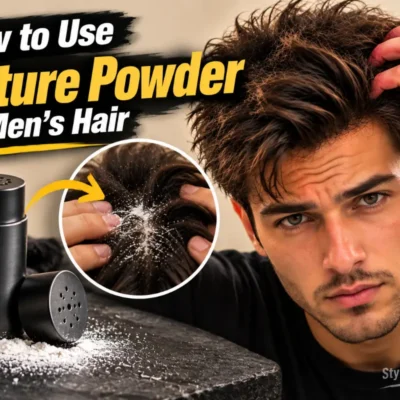
Texture powder adds friction and volume at the root with no weight at all, so it is the one product fine hair can use freely. Full method in how to use texture powder.
Mousse works on wet hair and adds body before the styler goes on. On straight hair with no colour or chemical treatment, leave-on products like this can leave an oily, dull surface if you overdo the dose (Dias, International Journal of Trichology).
Hairspray locks a finished shape from the outside. It changes nothing about how the style was built.
Match the Product to Your Hair Type
Hair type decides what the product has to overcome before it can style anything. Fine hair fails from weight, thick hair fails from under-dosing, curly hair fails from the wrong texture of product entirely.
| Hair type | What goes wrong | Use | Skip |
| Fine or thinning | Product weighs hair flat and makes the scalp visible | Texture powder, sea salt spray, light clay | Oil-based pomade, heavy wax, cream |
| Medium straight | Hair slides out of position by midday | Water-based pomade, clay, paste, firm wax | Nothing is off limits |
| Thick and coarse | Product vanishes into the mass, hair fights the cut | Firm clay, putty, wax, oil-based pomade | Powder alone, spray alone |
| Wavy | Frizz on top, waves flatten unevenly | Cream, paste, salt spray then cream | Gel |
| Curly | Curl clumps break apart, frizz halo | Curl cream, curl gel, leave-in conditioner | Clay, powder, wax |
| Coily | Dryness and breakage before styling even starts | Butter-based cream, oil-based pomade | Alcohol-heavy hairspray, clay |
Oils and oil-based products add shine by forming a film that sits on the cuticle surface rather than by changing the hair itself (Dias, International Journal of Trichology). The same film looks glossy on thick hair and greasy on fine hair, because thick hair has more surface to spread it across.
Curly and coily hair follows a method rather than a product list. Apply curl cream to soaking wet hair, rake it through in sections, then add curl gel over the top and scrunch upward. Let it air-dry or diffuse until the surface feels crisp to the touch, then break that crust by scrunching the hair gently with dry palms. The gel holds the clump shape underneath, the broken crust removes the stiffness. Skipping the final break is why gel-styled curls look hard, and skipping the gel is why cream-only curls fall out by noon.
Fine and thinning hair benefits more from the cut than from any product. Pair the right haircut with the lightest product you can get away with, starting with haircuts for men with thinning hair and best thin straight hair haircuts for men. Thick hair has the opposite problem, and the cuts that work with it are in thick straight hair haircuts for men. Curly hair has its own product logic, covered alongside the cuts in curly hairstyles for men.
Match the Product to the Hairstyle You Want
The cut on your head narrows the product choice faster than your hair type does. Check the hold column first, the finish column second, and treat the product column as a shortlist rather than a single answer.
| Hairstyle | Hold needed | Finish | Product |
| Slick back | 7–9 | High shine | Water-based pomade or gel |
| Comb over | 6–8 | Low to medium | Clay or water-based pomade |
| Pompadour | 8–9 | Medium | Firm pomade, hairspray on top |
| Quiff | 7–8 | Matte | Clay, powder at the roots |
| Crew cut or buzz | 2–4 | Matte | Cream, or nothing |
| Textured crop | 5–7 | Matte | Clay, putty or texture powder |
| Middle part and curtains | 4–6 | Natural | Cream or light paste |
| Messy and shaggy | 3–5 | Matte | Salt spray, then powder or fibre |
| Defined curls | 4–6 | Natural to low sheen | Curl cream, then curl gel |
| Fade with length on top | 6–8 | Set by the top style | Match the product to the top, not the fade |
A slick back is the one style where shine is structural rather than decorative, and gel beats pomade when the part has to stay knife-sharp all day. The styling sequence lives in slick back hairstyles for men and the product shortlist in best hair gel for slick back hair.
Comb overs need enough hold to keep the sweep and enough movement to avoid looking lacquered, so clay and medium water-based pomade sit ahead of gel. Start with comb over haircut for the cut itself.
Middle parts fail from too much product, not too little. A pea of cream on damp hair holds the split without turning the fringe into two solid slabs. See middle part hairstyles for men.
Fades put the decision entirely on the top section, since the sides need no product at all. Work out the length first in fade haircuts for men, then come back to this table.
The Order: Pre-Styler, Styler, Finisher
Most product failures are sequence failures, not product failures. Three slots, one product each, applied in this order.
Pre-styler, on damp hair. Sea salt spray, mousse, thickening tonic, heat protectant, leave-in conditioner. These add grip, body and volume. They work by increasing friction between hair fibres rather than by forming a rigid film, so they will not hold a shape on their own (Dias, International Journal of Trichology).
Styler, on damp or dry hair depending on the product. Pomade, clay, wax, paste, putty, fibre, cream, gel. One of these, not two. Water-based pomade and gel go on damp hair. Clay, wax, putty and powder go on dry hair, since water dilutes the hold.
Finisher, on finished dry hair. Hairspray to lock the shape, texture powder to lift roots that dropped, a trace of matte paste on fingertips for strays. Finishers correct, they do not build.
Blow-drying sits between the pre-styler and the styler. Drying hair into the direction you want it to sit does more for volume than any product, and it makes a 6-hold product behave like an 8.
The Care Products That Change How Styling Behaves
Four care products belong in a styling conversation, because each one alters what the styler has to work with before it goes on.
- Leave-in conditioner softens coarse and curly hair enough for a cream or gel to distribute evenly. On fine straight hair it adds weight with no styling benefit.
- Heat protectant goes on damp hair before a dryer or flat iron. It buys nothing on air-dried hair, so it is a pre-styler only when heat follows.
- Dry shampoo absorbs oil at the root on a non-wash day and leaves behind a gritty surface that grips, so a style built on dry shampoo holds better than one built on freshly washed hair.
- Hair oil or serum goes on after styling, on the ends only. A drop smooths frizz. More than a drop undoes the matte finish of every product above it.
Shampoo and conditioner choice sits upstream of all of this. Hair washed with a heavy conditioner is slippery and resists hold, and that is the single most common reason a correctly chosen clay slides out by midday.
How Much Product to Use?
Under-dosing is fixable in ten seconds. Over-dosing means washing your hair again. Start at the dose for your length and add only after the first pass is fully distributed.
| Hair length | Starting dose | Visual reference |
| Buzz to 1 inch | Pea | Covers a fingernail |
| 1–3 inches | Small almond | Covers a thumbnail |
| 3–5 inches | Large almond | Dime-sized mound |
| 5 inches and over | Grape | Two dime-sized mounds |
| Thick or coarse, any length | Add 25% to the above | |
| Texture powder | 2–3 shakes | At the roots, not on the hands |
| Sea salt spray | 4–6 pumps | Damp hair, mid-length to ends |
Warm the product between your palms until it stops looking like product and your hands feel tacky rather than coated. Apply from the back of the head forward, roots first, fringe last. The fringe takes whatever is left on your fingers, which is almost always the right amount for it.
Hair that looks greasy an hour after styling was over-dosed, not badly chosen.
Can You Combine Two Products?
Yes, within one rule: one product per slot. Pre-styler, styler, finisher. Two products from the same slot cancel each other out.
Combinations that work
- Sea salt spray on damp hair, clay once dry. Body from the spray, hold from the clay.
- Clay plus texture powder at the roots. Hold through the mid-lengths, lift at the base.
- Water-based pomade plus hairspray. Shine that survives wind.
- Mousse plus curl cream. Volume without the crunch gel leaves on curls.
- Dry shampoo at the roots, paste through the top. Grip from the powder, shape from the paste.
Combinations that fail
- Two tub products at once. Wax over water-based pomade turns gritty and rolls into visible flakes.
- Gel under wax. The gel film dries into a shell, the wax pulls at it, the shell cracks.
- Texture powder over oil-based pomade. The powder clumps on contact with oil and turns grey at the roots.
- Hairspray before the styler. It seals hair shut before anything else can grip.
- Hair oil before a matte clay. The oil fills the surface the clay minerals were meant to dry out.
How to Clear Product Buildup?
Buildup shows up as a dull film at the root, a scalp that itches by the afternoon, and product that stops holding at its usual dose. It comes from three habits: oil-based or wax-heavy formulas rinsed with water alone, daily styling without a proper wash, and dry shampoo used on consecutive days.
- Water-based products rinse clear with a normal shampoo. A single wash is enough.
- Wax, clay and putty need shampoo worked into dry hair first, before water goes near it. Water sets the wax against the hair and makes it harder to lift.
- Oil-based pomade needs a degreasing or clarifying shampoo, or a conditioner massaged through dry hair to dissolve the petrolatum before shampooing.
- Clarify once every two to four weeks if you style daily, not more. Clarifying shampoo strips sebum along with product, and over-stripping leaves hair dry and flyaway.
A product that used to hold and no longer does is almost always a buildup problem rather than a formula problem. Clarify once and test the same tub again before replacing it.
Pick Your Product in Under a Minute
Nine situations cover most of the shelf. Find yours and buy that one product first.
- Shine and a comb-set shape → water-based pomade
- Should look like hair, not product → clay, paste or cream
- Fine hair that falls flat by 10am → texture powder at the roots, then light clay
- Thick hair that fights the cut → firm clay, putty or wax
- Curly hair → curl cream, then curl gel, never clay
- Must survive a 14-hour day → gel or firm pomade, hairspray on top
- Need to restyle midday → oil-based pomade or cream
- Short all over → cream, or nothing at all
- No idea where to start → medium-hold clay. It suits more hair types and more cuts than anything else on the shelf.
Both types of pomade sit in the same slot on the shelf. If neither suits your hair, the men’s hair products guide covers clay, wax, paste, putty and the rest with the same hold and finish scoring.
FAQs
Is it bad to use hair product every day?
Daily use is fine as long as you rinse it out daily. The American Academy of Dermatology does list long-lasting-hold products among habits worth easing off, and suggests a style that needs less of them.
Can you sleep in hair product?
No. It transfers onto the pillow, redeposits on the scalp overnight and dries the hair out. Rinse with warm water even on days you skip shampoo.
Does hair product expire?
Yes. Water-based tubs last roughly 12 to 18 months after opening; wax and oil-based formulas last longer. Discard anything that separates, smells sour or changes texture.
Do styling products cause hair loss?
Product sitting on the hair shaft does not cause pattern hair loss. The styling risk is mechanical: styles pulled tight at the root, and brushing hair while it is soaking wet.
Do you need a different product in summer and winter?
Often, yes. Humidity softens wax and oil-based pomade, so summer favours clay and water-based formulas. Dry winter air favours cream and oil-based products that put moisture back.
How many products do you actually need to own?
Two. One styler matched to your cut, and one pre-styler or finisher to cover the days your hair misbehaves. A third tub only earns its place if you wear two different styles.
Does a more expensive tub perform better?
Not reliably. Price tracks fragrance, packaging and brand more than it tracks hold or finish. Compare the base ingredient and the stated hold level, then buy the cheaper of two tubs that match.
Can men use products labelled for women?
Yes. Hair responds to the formula, not the label. Mousse, curl cream, salt spray and gel are chemically identical across the two aisles; the differences are scent and bottle design.

Other Articles

25 Best Blowout Taper Fade Haircuts For Men (2026)
Water Based vs Oil Based Pomade: Which One Should You Use?


No Comment! Be the first one.