
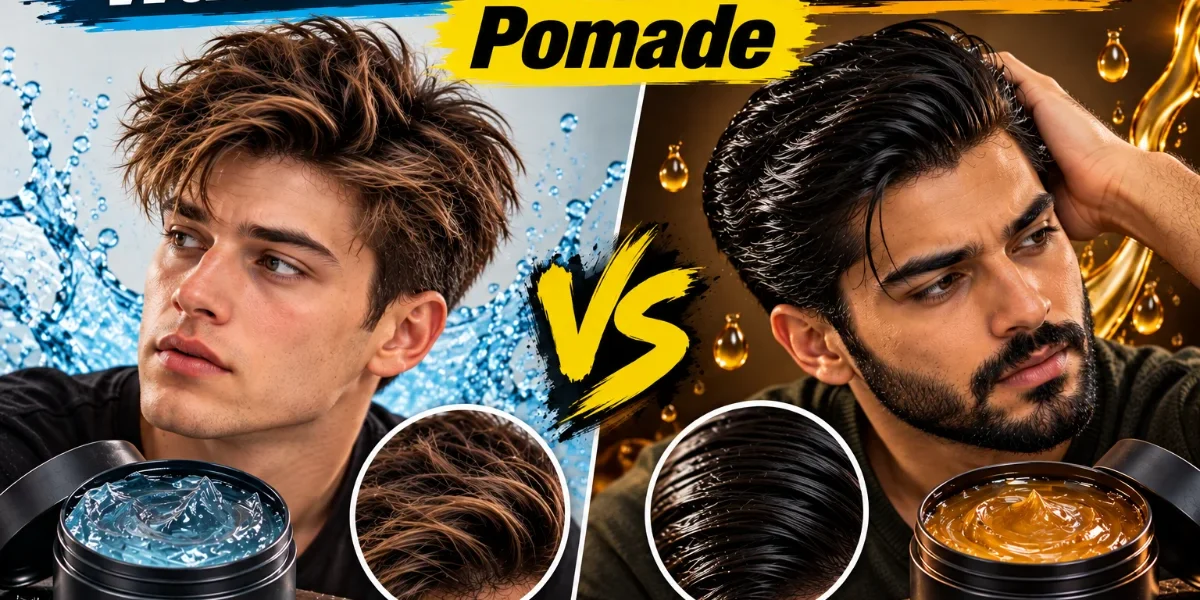

QUICK ANSWER: Water-based pomade washes out with a single shampoo, reactivates with water mid-day, and suits most modern styles and hair types. Oil-based pomade never fully dries, holds all day without re-wetting, gives higher shine, and is harder to remove. For daily use and modern cuts, water-based. For classic slick styles and all-day reworkability without water, oil-based.
What Makes Them Different — The Chemistry
The base ingredient determines everything else: how the product feels, how it holds, how it looks, and how it comes out.
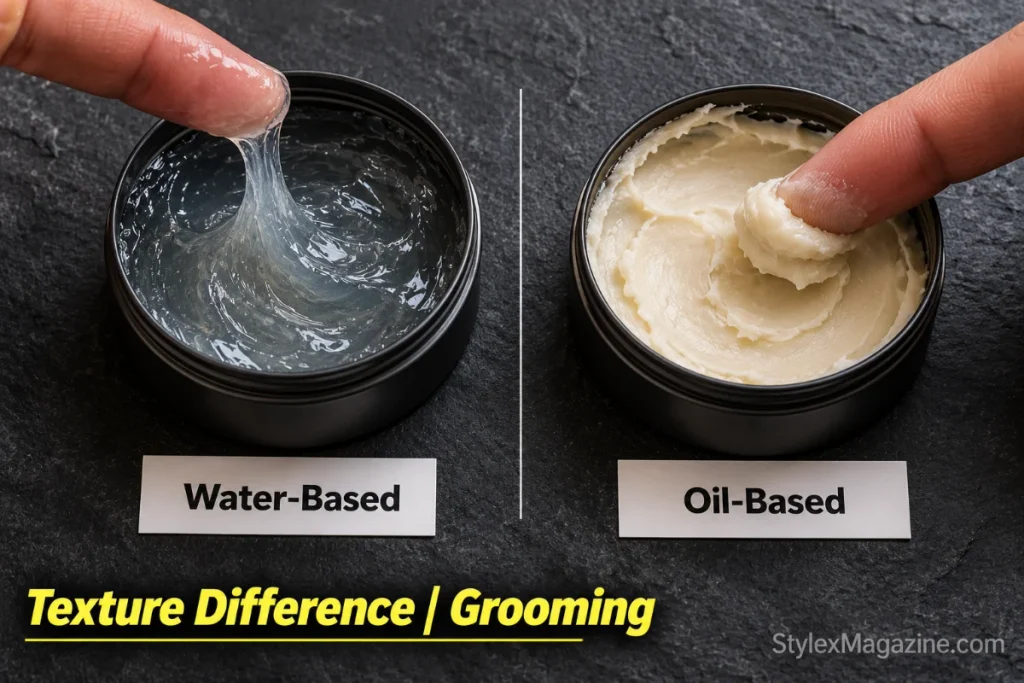
Water-based pomade uses water as its primary carrier. Polymers and waxes give it hold while the water keeps the formula spreadable. When it dries, the water evaporates and the holding agents set around the hair shaft — that’s what gives it grip. Because the hold agents are water-soluble, one shampoo dissolves them completely.
Oil-based pomade uses petroleum, mineral oil, or a wax blend (beeswax, carnauba wax, lanolin) as its base. These ingredients never fully evaporate, the formula stays in its waxy state on the hair throughout the day. That’s why you can finger-comb oil-based pomade at 4pm just as easily as at 8am. It never fully sets. Those same oils don’t dissolve in water, regular shampoo alone won’t clear them.
What About Petroleum/Petrolatum — Is It Dangerous?
This is the most common concern men raise before trying oil-based pomade. The short answer: no. Petrolatum is used in skincare, wound care, and lip balm at higher concentrations than any pomade contains. It’s non-comedogenic on the scalp in normal styling amounts. The genuine concern with oil-based pomades isn’t the ingredient, it’s the buildup from inadequate washing. Daily use without proper removal clogs the root area over time, which can affect scalp health and slow the uptake of the next application.
Head-to-Head Comparison
| Feature | Water-Based | Oil-Based |
| Hold strength | Light to strong (varies by product) | Medium to strong, flexible all day |
| Shine level | Low to high (product-dependent) | Medium to very high |
| Washout | Single shampoo — completely clean | Requires pre-wash oil + clarifying shampoo |
| Restyling | Sets as it dries — needs water to reactivate | Never fully sets — restyle with fingers anytime |
| Daily use | Safe daily — no buildup concerns | 2–3x per week recommended; clarify weekly |
| Application | Damp or dry hair | Dry hair only |
| Humidity performance | Weakens faster in heat and humidity | Holds better in humid conditions |
| Hair health | Generally lighter on the scalp | Can build up if not properly removed |
| Best for | Modern cuts, everyday convenience | Classic slick styles, all-day reworkability |
The one thing every comparison article gets wrong: water-based pomades are not automatically weaker than oil-based. A strong-hold water-based formula rivals most oil-based products for hold strength. The real difference is not strength, it’s behaviour throughout the day.
Which Hair Type Needs Which?
Fine / thin hair: Water-based. Oil-based products add weight that fine strands can’t support, hair goes flat faster and the scalp visibility problem gets worse. A lightweight water-based formula gives structure without pulling strands downward. Avoid anything with heavy mineral oil listed in the first three ingredients.
Thick / coarse hair: Either works, but oil-based gives more control over bulk without drying the strand. Thick hair can handle the oil load without going limp. For daily slick backs or pompadours, oil-based holds better over multiple hours.
Oily scalp: Water-based, always. Adding oil-based product to an already-oily scalp creates compounding buildup that no amount of clarifying shampoo fully corrects within a normal weekly wash schedule. Matte-finish water-based pomades are the right move here.
Wavy hair: Water-based, applied to slightly damp hair. Wavy hair responds well to water-based formulas because the water component works with the hair’s natural movement. Oil-based can overload wavy strands and weigh out the wave.
Dry or damaged hair: Oil-based is genuinely beneficial here, the oil component provides conditioning that the hair shaft absorbs. Men with dry or chemically treated hair often notice improvement in texture and manageability with oil-based use.
Curly hair: Water-based applied to damp hair, worked through with fingers rather than combed. Oil-based can work for defining tighter curl patterns but requires a very light hand, a pea-sized amount only.
Which Hairstyle Needs Which?
| Hairstyle | Best Type | Why |
| Slick back | Oil-based | Stays pliable all day — re-comb at lunchtime without adding water |
| Hard side part | Oil-based or strong water-based | Oil gives natural sheen; water-based holds the part sharper after initial set |
| Pompadour | Oil-based | Height and curve need a formula that stays workable while holding shape |
| Comb-over | Oil-based or water-based | Either works depending on hair weight |
| Textured quiff | Water-based | Needs to set into shape — oil-based stays too pliable for defined quiff texture |
| Relaxed side part | Water-based | Clean modern finish without mirror-high shine |
| Textured crop | Water-based | Needs a dry, set finish — oil-based gives too much sheen for this style |
| Flow / medium-length | Water-based | Natural finish suits the relaxed movement of longer styles |
I’ve seen this mismatch in the chair more times than I can count: a client using oil-based pomade for a textured quiff, wondering why it never holds the shape past two hours. The product never set, it stayed in waxy limbo all day. Switch to a strong water-based formula on that style and the shape locks in within twenty minutes of drying.
Restyling — Where They Behave Completely Differently
This is the section every comparison article skips, and it’s where most men’s frustration lives.
Oil-Based Pomade Restyling
Oil-based product never dries. The formula sits on the hair shaft in a semi-waxy state all day. To restyle, you use your fingers or a comb, the warmth of your hands softens the product slightly and lets you move the hair. No water needed. This is why traditional barbers used oil-based pomade almost exclusively — a client could leave the chair, come back at 3pm, run a comb through, and the style would reset cleanly.
Water-Based Pomade Restyling
Water-based pomade sets as it dries. Once the water has evaporated and the holding agents have activated, the product grips the hair in its dried state. Restyling by finger-combing at this point breaks the hold but doesn’t redistribute the product, you get frizz and reduced shine, not a clean restyle.
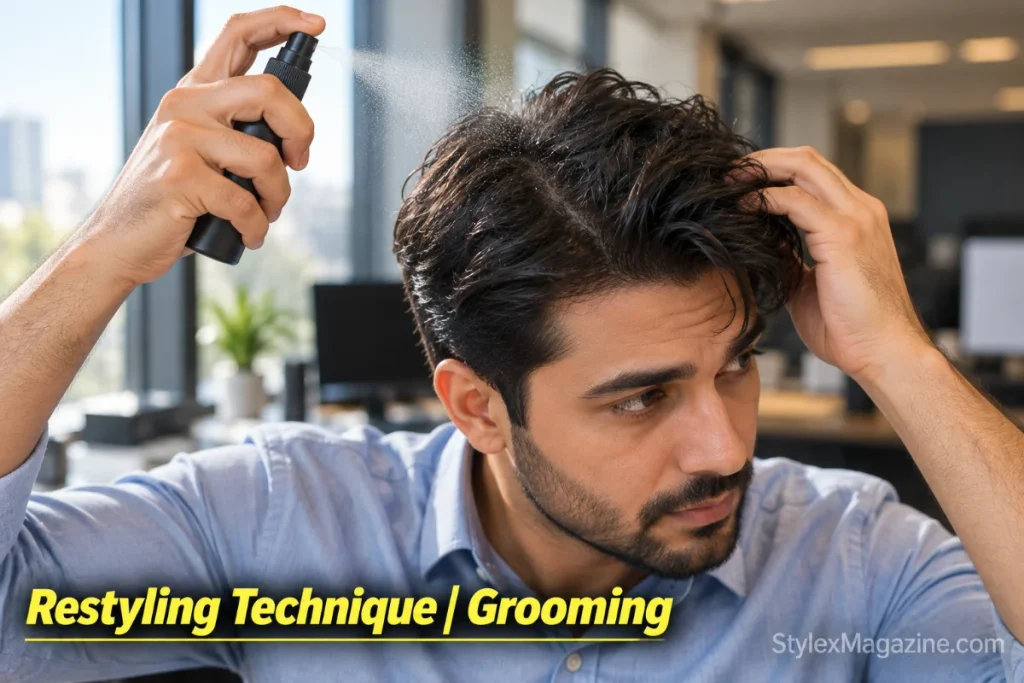
The fix: a light spritz of water (from a spray bottle, or just damping your fingertips) reactivates the water-soluble holding agents. Run your fingers or comb through immediately after damping. The product softens, redistributes, and re-sets as it dries again. A full re-style in thirty seconds.
StyleX Tip: Keep a small travel spray bottle at your desk or in your bag. A two-second mist at the roots before the midday restyle is the difference between water-based pomade looking sharp at 3pm and looking wrecked.
How to Wash Out Oil-Based Pomade Properly?
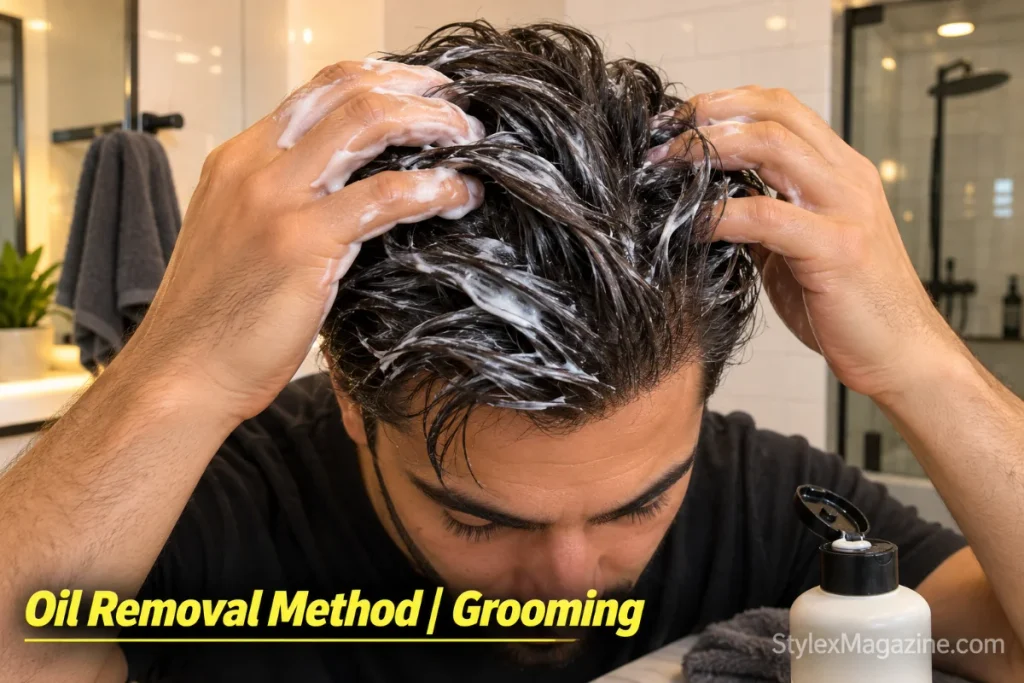
This is the biggest pain point for men who switch to oil-based and the main reason they switch back. Regular shampoo on wet hair moves right over the oil without dissolving it. You get product-slicked hair going into the rinse cycle and coming out the same way.
The Correct Method:
- Step 1 Apply conditioner or olive oil to completely dry hair — before wetting it.
Work it through the lengths. This step is what regular shampoo can’t do: oil dissolves oil. The conditioner or olive oil breaks the petrolatum-to-hair-strand bond.
- Step 2 Leave it for two minutes.
No longer needed. This gives the oil-based product time to loosen from the shaft.
- Step 3 Wet your hair with warm water — then emulsify.
Work the conditioner/oil through again now that water is present. You should feel the product loosening.
- Step 4 Apply clarifying shampoo and lather thoroughly. Rinse completely.
Regular shampoo alone won’t cut it here — clarifying shampoo is formulated to break down product residue and oil buildup.
- Step 5 For heavy buildup from multiple days of use, repeat step 4 once.
One extra round of clarifying shampoo resets the scalp completely.
After this process your hair should feel clean, no waxy coating, no residue at the scalp. If you still feel a film, your clarifying shampoo isn’t strong enough or you skipped step 1.
The shortcut: if you apply a small amount of water-based pomade on top of your oil-based product on the same day you plan to wash, the water-based formula helps break the oil-based hold and significantly simplifies removal. The wash-out drops from a multi-step process to a single clarifying shampoo.
Can You Use Oil-Based Pomade Every Day?
The short answer is no, not without daily proper removal, which becomes time-consuming.
What Actually Happens With Daily Oil-Based Use?
Petrolatum and mineral oil sit at the root base throughout the day. Scalp sebum mixes with the residue. Each application adds a layer on top of yesterday’s partial removal. By day three, the roots have a combined film of old oil, sebum, and new product. This film reduces the next application’s hold because the product can’t grip a clean shaft, creates the appearance of dandruff (it’s product flaking, not dry scalp), and causes scalp irritation in men with sensitive skin.
The practical schedule that works: oil-based pomade 2–3 times per week, with the pre-wash oil degreasing method each time. A clarifying shampoo once a week maintains a clean baseline.
Does Pomade Cause Hair Loss?
No. Pomade does not cause hair loss. The concern is that repeated, inadequate removal of heavy oil-based products can temporarily affect scalp health by blocking the follicle opening. This reduces the product’s effectiveness and can cause irritation, but it doesn’t trigger the hormonal or genetic mechanisms behind actual hair loss. If you’re seeing shedding with pomade use, the pomade is coincidental. See a dermatologist rather than switching products.
Water-based pomade used daily with normal shampooing carries no scalp concerns for most men.
How to Choose — The Decision Framework?
Most guides stop at hair type. Four variables actually determine which is right:
- How often do you wash your hair?
Daily washer → water-based. Managing oil-based buildup with daily washing and proper degreasing becomes a 15-minute routine every morning. Water-based and a single shampoo every night is the sustainable choice.
2–3 washes per week → either works. Oil-based on styling days, clarifying wash on wash days.
- What style are you wearing?
Classic slick styles (slick back, pompadour, hard side part) → oil-based performs better because reworkability is part of the style.
Modern textured styles (crop, quiff, casual side part) → water-based holds the set shape better.
- What’s your climate?
High humidity → oil-based holds more consistently. Water-based formulas lose grip faster as humidity reactivates the water-soluble polymers.
Dry climate → water-based performs well all day without the heavier oil base.
- What does your hair need?
Dry, damaged, or chemically processed → oil-based provides conditioning.
Oily scalp, fine hair, or buildup-prone → water-based is the cleaner daily choice.
FAQs
Can you mix water-based and oil-based pomade?
Yes — and it works better than most guides admit. Apply a small amount of oil-based first to get the pliability and shine, then layer water-based on top for hold and set. The water-based layer also simplifies washout at night. Keep both amounts light. This is a technique, not a reason to double-apply.
Does water-based pomade wash out if I get caught in rain or sweat heavily?
Yes — water-based pomade is water-soluble, so heavy rain or significant sweating will break down the hold and cause the product to run. Oil-based pomade is significantly more resistant to water contact because petroleum and mineral oil repel water rather than dissolving in it. If you’re outdoors in unpredictable weather or active enough to sweat heavily, oil-based is the more reliable choice for the day.
Why does oil-based pomade smell different from water-based?
Petrolatum and mineral oil have a characteristic waxy scent that water-based formulas don’t carry. Modern oil-based pomades add fragrance to mask it, but some men notice the underlying scent in the first hour after application. It dissipates. If scent is a concern, water-based is odour-neutral across most brands.
My slick back holds at the barber but not at home. Is it the pomade type?
Often, yes — but the bigger issue is usually applying to damp vs dry hair. Oil-based applied to damp hair loses hold faster because it can’t grip a wet shaft cleanly. Apply oil-based to completely dry hair, use a fine-tooth comb, and the hold comes much closer to what you got in the chair.
How do I know if I’ve built up too much oil-based pomade?
Your hair stops holding its shape as long as it used to despite using the same amount. The roots look coated even after washing. White flaking appears at the roots that isn’t dry scalp. A single pre-wash oil treatment followed by two rounds of clarifying shampoo resets everything. After that, reduce frequency or improve your removal routine.

Other Articles
Men’s Hair Products Guide: How to Choose the Right One?
Matte vs Shine Hair: How to Choose the Right Hair Finish?




[…] keeps hair pliable for days and needs a degreaser to shift. The practical differences sit in water-based vs oil-based pomade, and the application method is covered in how to use […]