
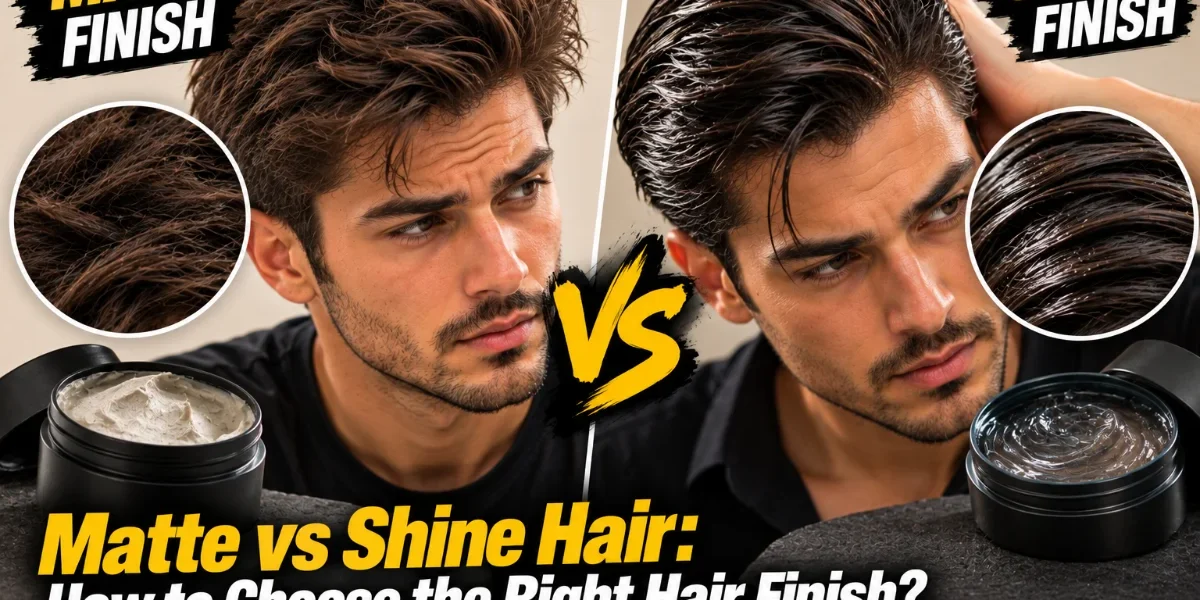

QUICK ANSWER: Matte finish absorbs light, giving hair a natural, textured, dry appearance. Shine finish reflects light, giving hair a polished, slick, deliberate look. The right choice depends on four things working together: your hair type, your hairstyle, your hold level, and how you apply the product. Get one wrong and the finish fights the style.
What Finish Actually Does to Your Hair?
Hair finish is a light problem, not a product problem. Every styling product either reflects or absorbs light — that single variable changes how your hair looks from across a room.
Matte products contain ingredients like kaolin clay or silica silylate that scatter light rather than bouncing it back. Strands appear separated, dry, and natural, as if no product is there. The trade-off is that volume and texture become more visible.
Shine products contain oils, waxes (beeswax, carnauba wax), or silicones that coat each strand with a smooth, reflective surface. Hair looks controlled, deliberate, and groomed. The trade-off is that anything underneath, scalp, thinning areas, sebum buildup, also reflects.
That second point is what most men miss. Shine doesn’t just make your style look polished. It also makes everything else more visible. On a day when your scalp is oily or your hair sits close to the head, shine compounds those problems. Matte hides them.
Matte, Low Shine, and High Shine — What’s the Real Difference?
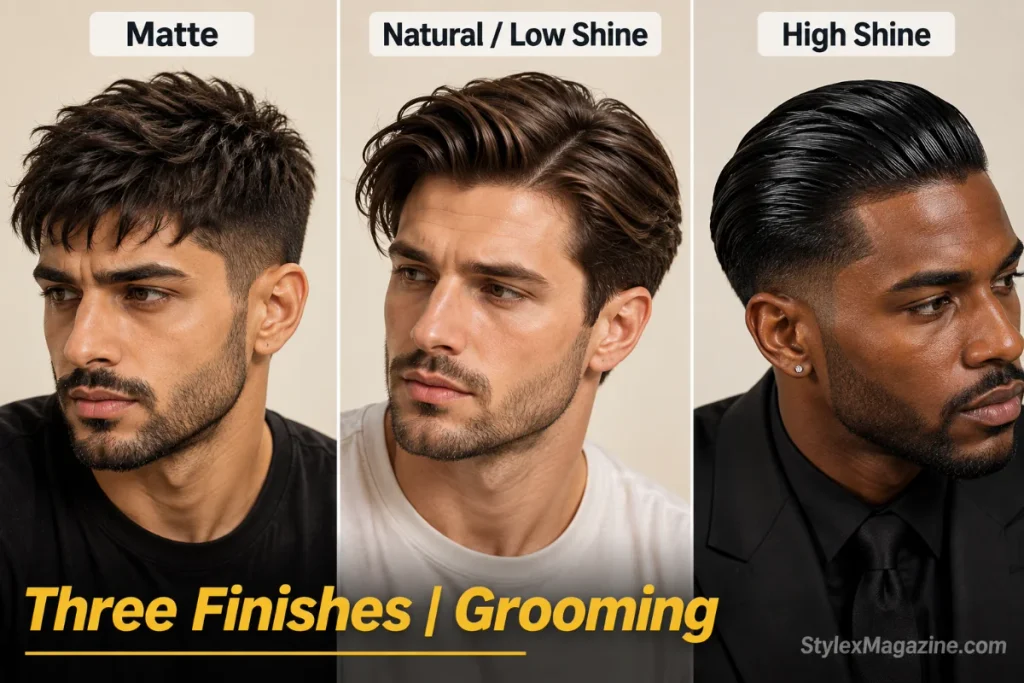
Most guides treat this as binary: matte or shiny. There are three distinct zones, and the middle one (natural/low shine) is where most daily styling actually lands.
| Finish | Light | What Hair Looks Like | Product Types | Best For |
| Matte | Absorbs / scatters light | Dry, textured, natural — no product visible | Clay, matte paste, texture powder, sea salt spray | Modern cuts, textured styles, casual everyday |
| Natural / Low Shine | Slight reflection | Healthy, controlled — styled but not obvious | Light wax, hair cream, flexible paste | Professional settings, medium-length styles, daily wear |
| High Shine | Full reflection | Polished, slick, deliberate — visibly styled | Pomade (water- or oil-based), gel, aqua wax | Classic styles, slick backs, formal occasions |
The natural/low-shine zone is where most men should be most of the time. It gives enough structure to look intentional without broadcasting shine. If you’re unsure which direction to go, this is the safer default for office, casual, and semi-formal settings alike.
In 2026, the broader trend has shifted firmly toward matte and natural finishes. Glossy, over-styled looks are out of most barbershops. That matters if you want your finish to look current, not because trends should dictate everything, but because a high-gloss finish on a modern crop now looks mismatched rather than polished.
Choose by Hair Type
Hair type changes what finish does to the style — not just what it looks like on paper.
| Hair Type | Recommended Finish | Why | What to Avoid |
| Fine / flat | Matte for volume; natural/low shine for definition | Matte separates strands and creates lift. Low shine adds definition without flattening. | High shine — reflects scalp, makes hair look thinner |
| Thick / coarse | Matte or natural | Controls bulk, preserves texture and movement | High shine can overload and look greasy |
| Wavy | Natural / low shine | Enhances the movement already there | Too much matte makes waves look dusty; too much shine overloads the pattern |
| Curly | Natural for definition; matte for shorter curly cuts | Natural finish preserves curl shape without crispness | High shine only if laying the hair down intentionally |
| Thinning / sparse | Matte — always | Diffuses light away from the scalp, makes hair look fuller | High shine — exposes scalp under bright light |
| Oily scalp | Matte — always | Absorbs sebum rather than amplifying it | Shine on oily hair creates a compounding problem by midday |
The fine hair caveat that most guides get wrong: many articles say “fine hair → matte” as a blanket rule. That’s only half-correct. Matte is the right call when you want volume and lift, the powder-like texture of clay or matte paste creates separation and makes fine strands look fuller. But if you want definition on fine hair (a clean side part, a controlled fringe), a natural or low-shine product is better, because matte alone can look flat and wispy on fine hair that has no natural thickness to work with.
I’ve seen this mistake in the chair repeatedly. A client with fine hair and a clean side part uses a matte clay and ends up with hair that looks stringy rather than defined. A lightweight pomade or natural-finish cream holds the part and gives each strand structure without weighing everything down.
Choose by Hairstyle
The hairstyle creates the angle, but the finish determines how that angle comes across. The same cut looks different under different finishes, sometimes by one step, sometimes dramatically.
| Hairstyle | Best Finish | Why |
| Textured crop | Matte | Preserves separation and the cut’s texture. Shine flattens the point of the style. |
| Messy quiff | Matte | Volume and lift look stronger without reflection. Shine pulls the quiff down visually. |
| Modern quiff | Natural / low shine | Needs definition through the top without a heavy gloss. |
| Side part (relaxed) | Matte or natural | Matte looks casual, natural looks polished. Both work depending on the occasion. |
| Side part (sharp/formal) | Natural or high shine | The structure of the part needs some reflection to look intentional. |
| Slick back | High shine | The style IS the shine. Matte on a slick back looks unfinished. |
| Pompadour | Natural to high shine | Volume plus reflection creates the silhouette. Matte makes it look like a quiff. |
| Comb-over | Natural or high shine | Precision cut that needs reflective finish to reinforce the combed lines. |
| Flow / medium-length | Natural | Keep the movement soft. Shine can make longer flow styles look heavy. |
| French crop / fringe | Matte | 2026 standard. A dry finish sharpens the fringe line. |
The principle: structured, classic styles built around clean lines and controlled shape — side parts, slick backs, pompadours, comb-overs, look sharper with some shine, because shine reinforces the deliberate intent of those cuts. Modern, textured, movement-based styles, crops, quiffs, loose looks, fades — look better matte, because the texture is the whole point.
Choose by Scalp Type and Environment
Two variables most guides skip entirely. Both matter more than most men realise.
Oily scalp: Shine products on an oily scalp create a compounding problem. The scalp produces sebum through the day. Shine products contain oils and waxes that add to that. By lunchtime, hair that looked polished at 8am looks greasy by noon, not because the product was too much, but because the finish amplified something that was already happening.
Matte products absorb sebum rather than adding to it. If your hair goes flat or greasy within four hours of styling, the finish is almost always part of the problem.

Humidity: High humidity partially reactivates the waxes and oils in shine products, increasing gloss beyond what you applied for. A natural finish in dry conditions can become a high-shine finish in a warm, humid room. Matte products hold their finish better because there’s less oil-based chemistry to reactivate. If you’re going somewhere humid (a summer outdoor event, a warm restaurant), factor this in.
Professional / formal occasions: The assumption is always “formal = shine.” That’s outdated. A natural or low-shine finish looks polished in a professional setting. High shine is only the right call if the style is inherently classic, a hard side part, a slick back, a combed look. A modern crop or a textured quiff with high shine at a job interview looks mismatched rather than formal.
StyleX Tip: Test your finish in the lighting of wherever you’re going, not just your bathroom mirror. Bathroom light runs warmer and softer than both. Office fluorescent lighting and direct sunlight both amplify shine significantly.
The Finish + Hold Combination
Finish and hold are not the same variable but they affect each other. Choosing the right finish with the wrong hold defeats both.
| Finish + Hold | Product Examples | Result | Best For |
| Matte + strong hold | Clay, matte paste (firm) | Full texture control, structure all day | Short textured cuts, crops, active days |
| Matte + light hold | Styling powder, light paste | Natural lift with flexible movement | Fine hair, casual daily styling |
| Natural + medium hold | Light wax, cream, flexible paste | Controlled shape with movement — the everyday workhorse | Side parts, medium-length styles, office-to-casual |
| High shine + strong | Water-based pomade, firm gel | Locked polished style | Slick backs, formal looks, vintage cuts |
| High shine + light | Light pomade, serum | Soft shine without structure | Longer styles, loose groomed looks |
Water-based formulas (most modern pomades, matte pastes, and clays) wash out cleanly and restyle through the day, which matters if you style daily. Oil-based and wax-heavy formulas hold harder and longer but leave more residue. For daily styling without product buildup, water-based across both matte and shine formats is the cleaner choice.
Why Your Finish Changes Through the Day?
A product that starts matte can become shinier by afternoon. A high-shine look can degrade into a flat, greasy mess. Neither means the product failed. Scalp chemistry is at work.
Your scalp produces heat and sebum continuously throughout the day. Heat softens the waxes in shine products, causing them to spread further along the hair shaft and amplify reflectivity beyond the original application. Sebum mixes with residual product oils and does the same.
Matte products are less vulnerable to this because their active ingredients (clay, silica) absorb oil rather than interacting with it, but even matte products lose grip as sebum accumulates at the root. That’s why they appear to “stop working” after several hours.
The fix by finish:
Matte drifting shinier: Your scalp is producing more sebum than the product can absorb. Switch to a clay with higher kaolin content, or apply texture powder at the roots at hour four. It reactivates the matte effect without re-styling.
Shine becoming flat/greasy: Too much sebum mixing with the product base. A lighter-weight water-based pomade and a clarifying shampoo twice a week resets the scalp chemistry.
Any finish losing hold: Apply to cooler, fully dry hair at the start. Heat opens the cuticle and reduces product adhesion. Hair styled warm loses grip faster.
Damp vs Dry Application — Where Most Men Get It Wrong
Product and finish are only two-thirds of the equation. How you apply determines what finish you actually end up with, regardless of what the product label says.

Damp hair: The cuticle is open and swollen. Product coats each strand more smoothly and evenly, more shine, more control, and a cleaner finish. A matte product applied to damp hair lands closer to natural/low-shine than the label promises.
Dry hair: The cuticle is closed. Product sits on the surface rather than coating evenly, more texture, more grip, and a drier finish. A natural-finish product applied to fully dry hair comes out more matte than the label suggests.
This is why so many men end up with the wrong finish despite using the right product. They read “matte clay” on the tin, apply it to hair that’s still slightly damp, and get a low-shine result instead. Neither is wrong, but knowing the rule puts the result in your hands.
| Application State | Effect on Finish | Effect on Hold |
| Damp (towel-dried) | Adds shine, cleaner distribution | Stronger initial hold, may soften faster |
| Fully dry | Reduces shine, adds texture | Less even distribution but grippier |
| Hot (just blow-dried) | Unpredictable — cuticle still open | Weak — grip sets better on fully cooled hair |
For deliberate matte finish: apply to fully dry, cooled hair.
For deliberate shine or clean definition: apply to towel-dried or slightly damp hair.
Can You Mix Matte and Shine Products?
Yes — and done correctly, it produces a result neither product achieves alone. No competitor covers this, and it’s among the most practical techniques in daily styling.

How it works: apply the matte product first at the roots for volume and grip, then work a small amount of a natural or shine product through the mid-lengths and top for definition without gloss.
The matte base absorbs scalp sebum and provides grip and lift. The shine layer sits on top and gives the visible surface of the style a controlled, defined look — without the scalp-reflective problem of applying shine all over.
The combinations that work:
Matte clay base + light pomade on top: strong, matte foundation at the root, subtle definition through the top section. Best for quiffs and side parts that need lift and definition simultaneously.
Texture powder at roots + natural-finish cream through lengths: root volume from the powder, soft shape from the cream. Best for fine or medium hair that needs both.
Sea salt spray (pre-style) + small amount of pomade through lengths: salt spray sets the texture on damp hair; pomade gives shape after drying. Low-shine result with proper hold. Better than either product alone.
The rule: matte always goes last if you’re using it as the primary finish. Shine always goes last if shine is the goal. Don’t reverse the order — matte on top of shine breaks the shine finish; shine on top of matte removes the matte effect.
FAQs
Why does shine make my hair look greasy even when I use the right amount?
Shine on an oily scalp compounds the problem. The product isn’t causing the grease; it’s amplifying what’s already there. Matte or natural finish is the fix. If your scalp is oily by midday regardless of product, a clarifying shampoo twice a week reduces the base-level oil load and the problem improves.
Can I use a matte product for a slick back?
Not for a traditional slick back, the definition and control of that style depend on shine to look correct. A matte product on a slick back looks unfinished or chalky. A natural or low-shine pomade is the minimum. If you want a softer, less polished layback, a natural-finish cream gives controlled shape without high gloss.
My matte product started looking shiny after a week of use. Did the product change?
No — your scalp accumulated product residue. Silica and clay-based matte products build up at the root base after several days of use. The residue mixes with sebum and starts acting like a low-shine product. A single clarifying shampoo session clears it. After that, a weekly clarifying wash maintains the matte effect.
Is high shine completely outdated in 2026?
No — it’s style-dependent, not trend-dependent. Slick backs, hard side parts, and vintage-inspired cuts still look correct with high shine because those styles are built around polish and precision. What’s shifted is that modern textured styles, crops, quiffs, soft fades — no longer default to shine. The mistake is treating shine as the formal option regardless of the cut. It’s only right when the hairstyle calls for it.
Why does my product seem to work better in winter than in summer?
Scalp oil production drops in colder, drier months, so matte products deliver stronger grip and cleaner texture because there’s less oil competing with the hold. In summer, higher scalp oil output combined with humidity means you need either a stronger matte formula or a clarifying wash more often. The product hasn’t changed; the scalp has.

Other Articles
Water Based vs Oil Based Pomade: Which One Should You Use?
How to Use Texture Powder for Men’s Hair
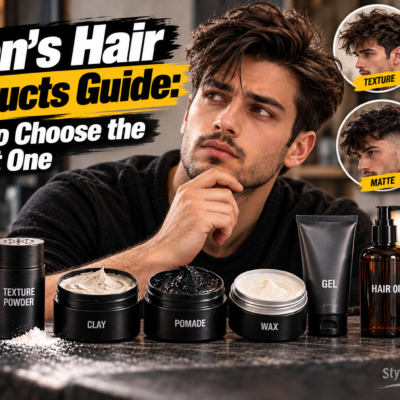
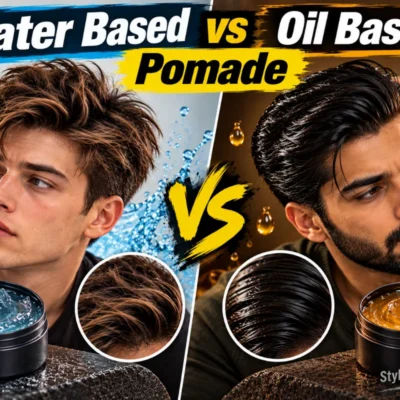
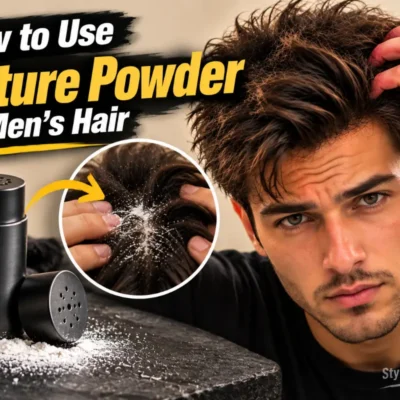

[…] Finish is how much light the surface reflects. Matte absorbs light and looks like thick, dry hair. Natural sits between the two and looks like nothing was applied. Shine reflects sharply and signals a deliberate, groomed style. Picking the wrong one is the most common mistake men make with an otherwise correct product, and the full comparison sits in matte vs shine: how to choose your hair finish. […]