

By Amir Khan · Professional Hairstylist, 8 Years Experience
Quick Answer: The best haircuts for men with thinning hair are short, textured cuts — textured crop, crew cut, Caesar, and low fade. Matte-finished, layered styles add lift and make thin hair look fuller. Avoid long flat styles and heavy products that weigh thinning strands down.
The first instinct when hair starts thinning is to grow it longer. That makes things worse. Long thin hair falls flat, clings to the scalp, and exposes every sparse area it was supposed to cover. Shorter textured cuts do the opposite — they stand up, create movement, and build volume that length never delivers.
Before picking a cut, know which problem you have. Fine hair and thinning hair are not the same thing. Fine hair means each strand has a thin diameter — always been that way, born with it. Thinning hair means overall density dropping over time — used to be thicker, now the scalp shows through. Fine hair needs volume tricks. Thinning hair needs density illusion. Most men over 40 deal with both simultaneously.
This guide covers diffuse density loss — hair getting thinner across the scalp, at the crown, at the front, or all over. If the problem is temple recession forming an M-shape, our receding hairline guide covers that territory. If it has progressed to a bald spot or the crown going bare, start with our balding men’s guide.
One rule applies to every cut on this page: texture over length, dry finish over wet-look, lift over weight. The American Academy of Dermatology notes that roughly half of all men show noticeable thinning by age 50, driven primarily by DHT — dihydrotestosterone — which miniaturises hair follicles over time (source: AAD). The right cut cannot stop that process, but it can make the hair you have look significantly fuller.
What Are the 20 Best Haircuts for Men with Thinning Hair?
Grouped by what they do — short and clean, textured for volume, medium length with structure, specific fades, or longer with honest caveats.
Short Cuts That Make Thin Hair Look Fuller
Short cuts compress the density difference between thick and thin areas. Hair stands up instead of falling flat, and the scalp becomes part of the look rather than something to hide.
1. Textured Crop
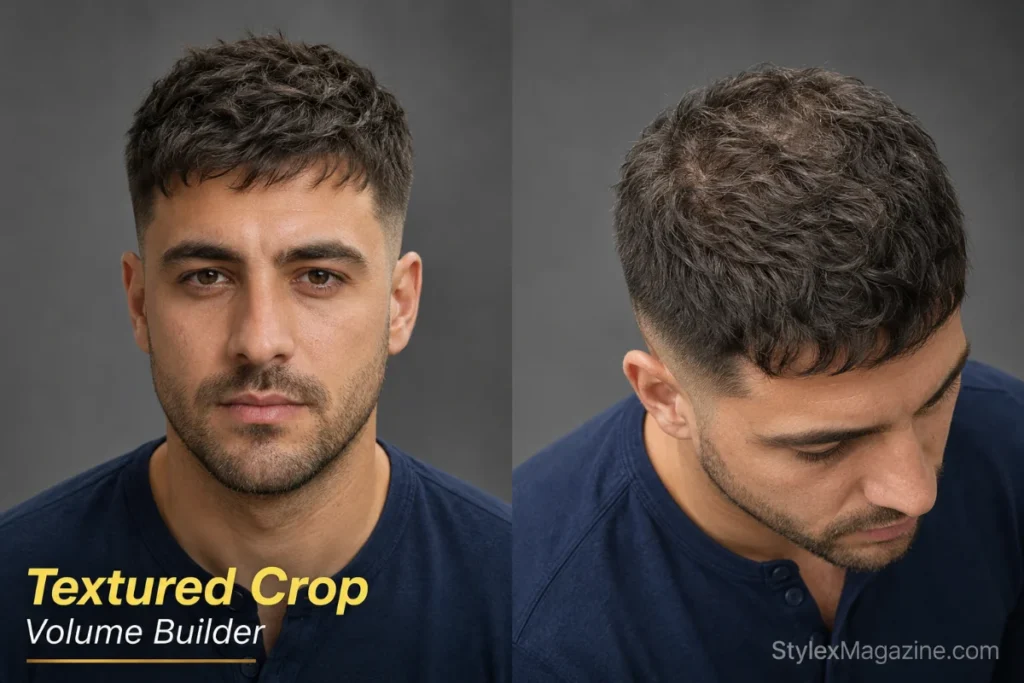
Short choppy layers on top, fade or taper on the sides. Strands point in different directions and create visual noise that fills gaps between them. The textured crop haircut for men with thinning hair is the #1 barber recommendation across editorial guides and forums alike — and for good reason. Tom Holland wore a textured crop through 2022 that showed exactly how much depth short layers add on fine hair.
Styling tip: Texture powder at the roots, matte clay through the top. Every 3-4 weeks.
2. Crew Cut For Thinning Hair
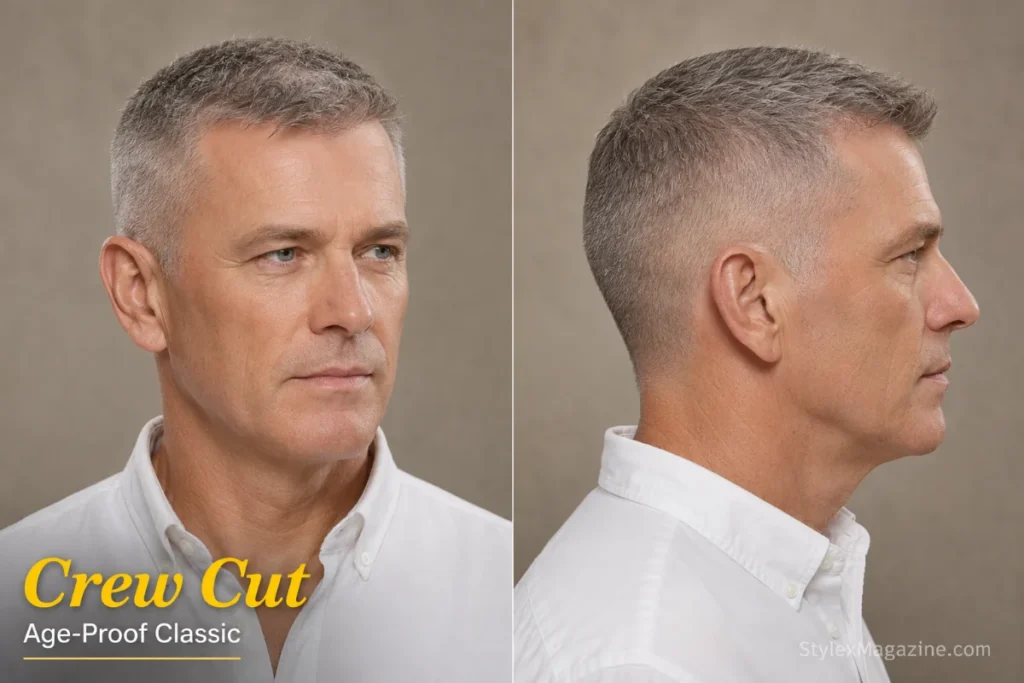
Longest at the front, gradually shorter toward the crown. The front section holds the most hair where thinning typically shows first. Grey thinning hair responds particularly well to the crew — it looks clean and age-appropriate on men in their 40s, 50s, and beyond. George Clooney has worn crew variations that never look overworked.
Styling tip: Light matte paste through the front section only. Every 3-4 weeks.
3. Caesar Cut
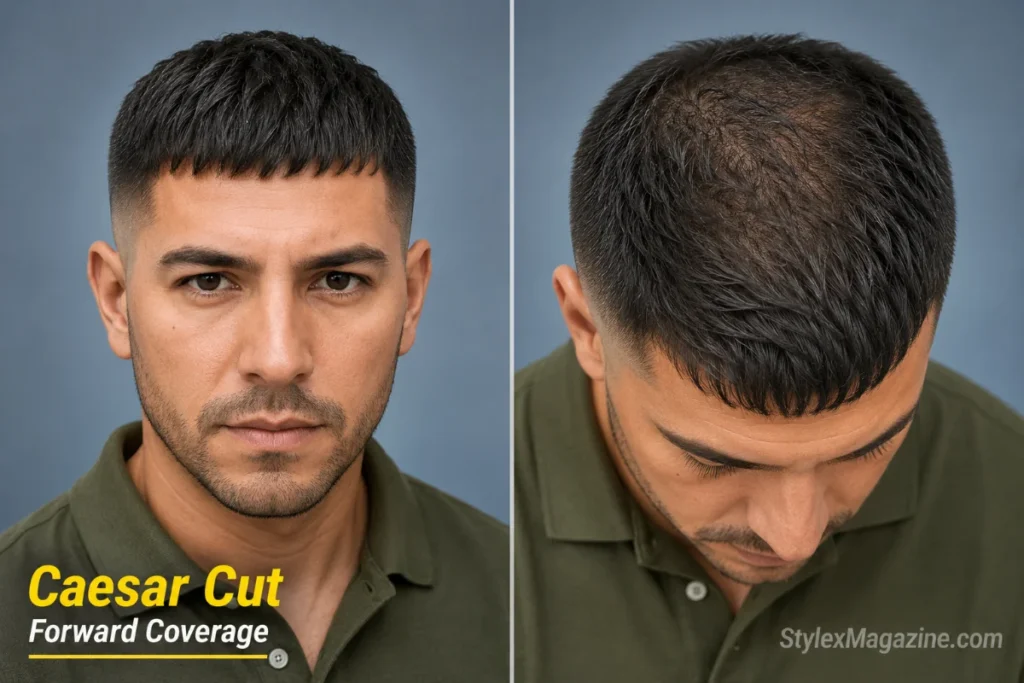
Short blunt fringe pushed forward with a low fade on the sides. The horizontal fringe line covers the forehead and drapes toward the crown — addressing thinning at both ends in one move. One of the most reliable short cuts for thinning hair on top, and consistently ranks in the top 3 for older men. George Clooney wore it through his ER years and gave it permanent credibility.
Styling tip: Styling cream pushed forward. Let gravity work. Every 3-4 weeks.
4. Buzz Cut For Thinning Hair
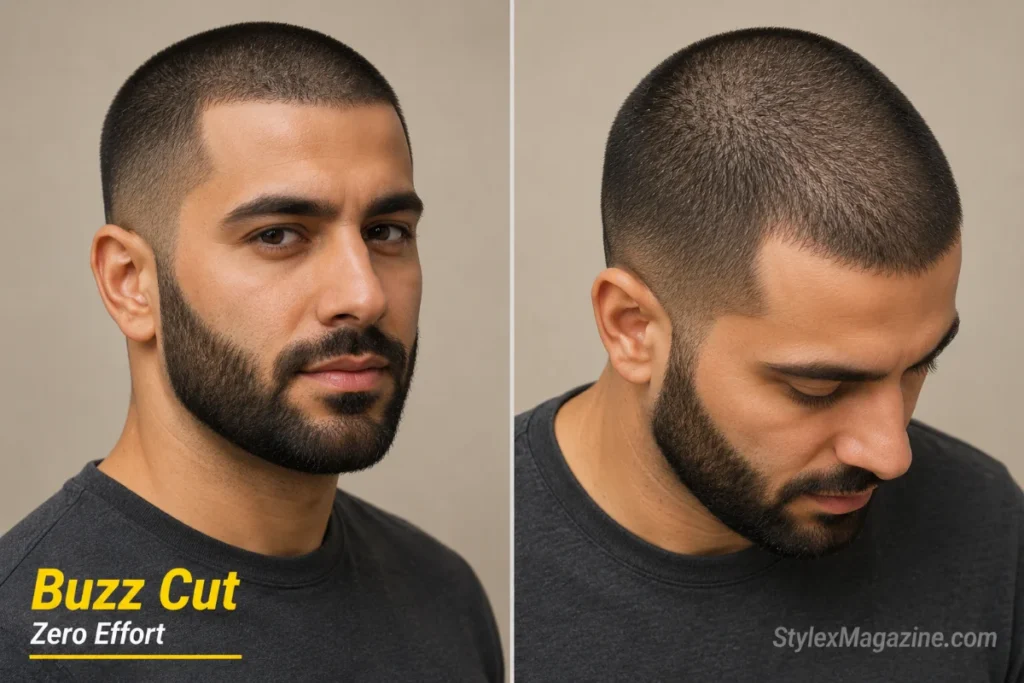
Even length all over, #2 or #3 guard. Thick and thin areas look the same because there is no length variation to highlight the gap. The simplest, lowest maintenance option — zero product, zero styling, zero effort. Jason Statham turned this into a signature and proved that confidence carries more weight than coverage.
Styling tip: None needed. A beard or heavy stubble completes the look. Every 1-2 weeks.
5. Ivy League
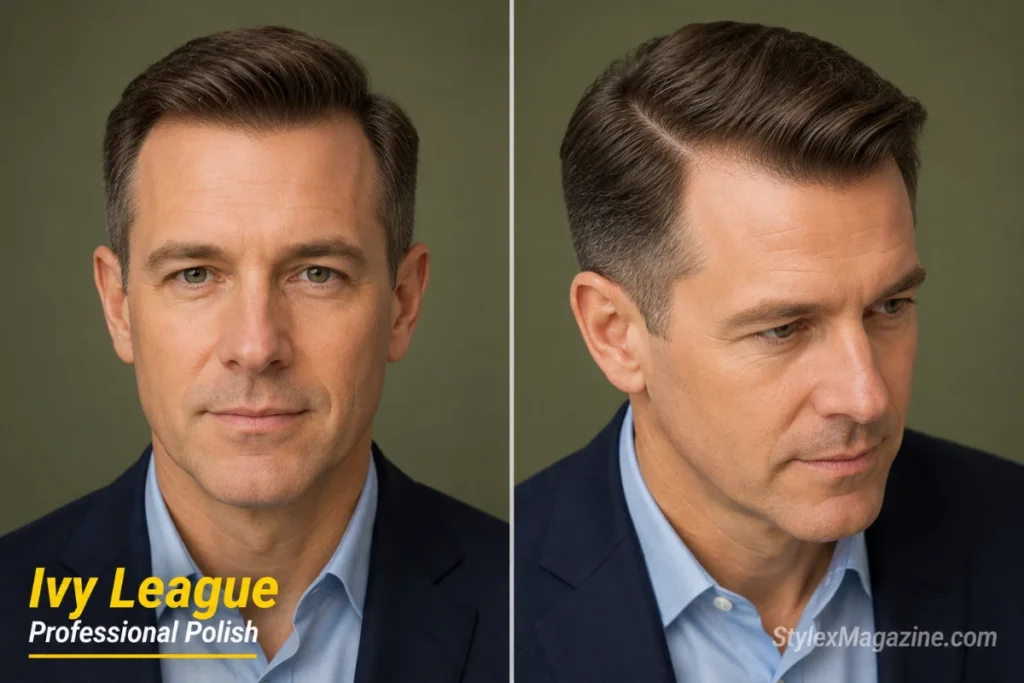
A slightly longer crew with enough top length to part or sweep to one side. Gives you styling options — forward, side-swept, or textured — without depending on density you may not have. Particularly effective for men over 40 and 50 who want something professional and age-appropriate. Chris Evans keeps this structure through most of his public appearances.
Styling tip: Light pomade, natural part — no blow-drying required. Every 3-4 weeks.
Textured Styles That Build Volume on Thin Hair
Texture is thin hair’s strongest tool. Choppy layers, piece-y fringes, and uneven lengths create movement that flat hair can never produce. These cuts lift hair off the scalp instead of letting it fall.
6. Textured Fringe
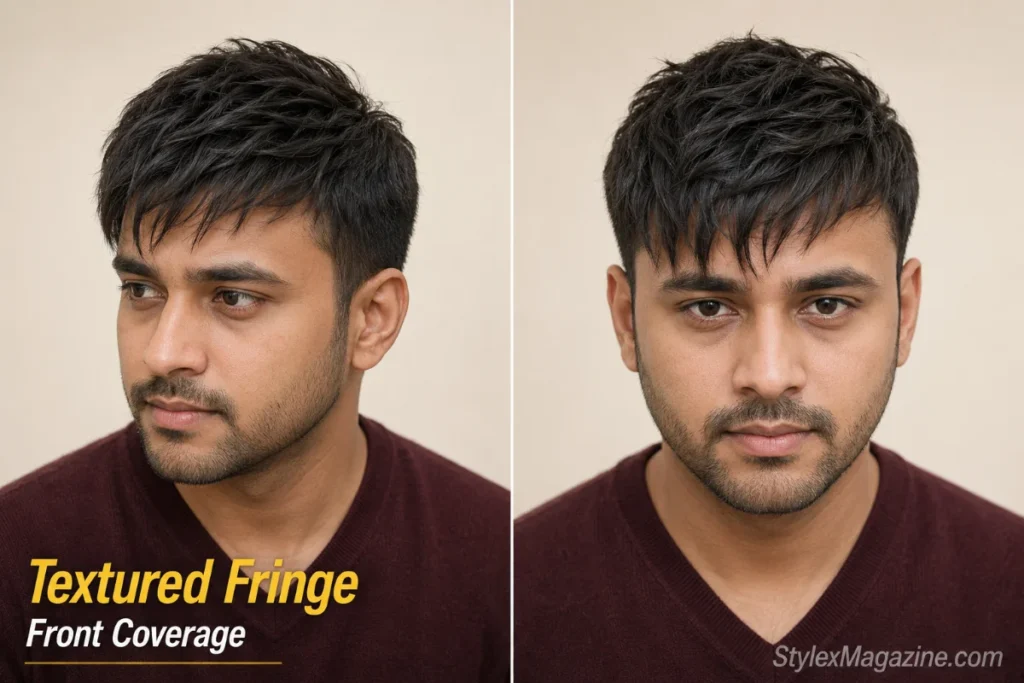
Short uneven layers with a forward fringe covering hairline thinning. The messy fringe draws attention toward the face and away from sparse areas at the temples. The best answer for haircuts for men with thinning hair in the front — the forward direction hides exactly what needs hiding. Rami Malek wears brushed-forward texture that demonstrates how effective forward movement is on fine hair.
Styling tip: Blow-dry forward with fingers, finish with texture powder. Every 3-4 weeks.
7. French Crop For Thinning Hair
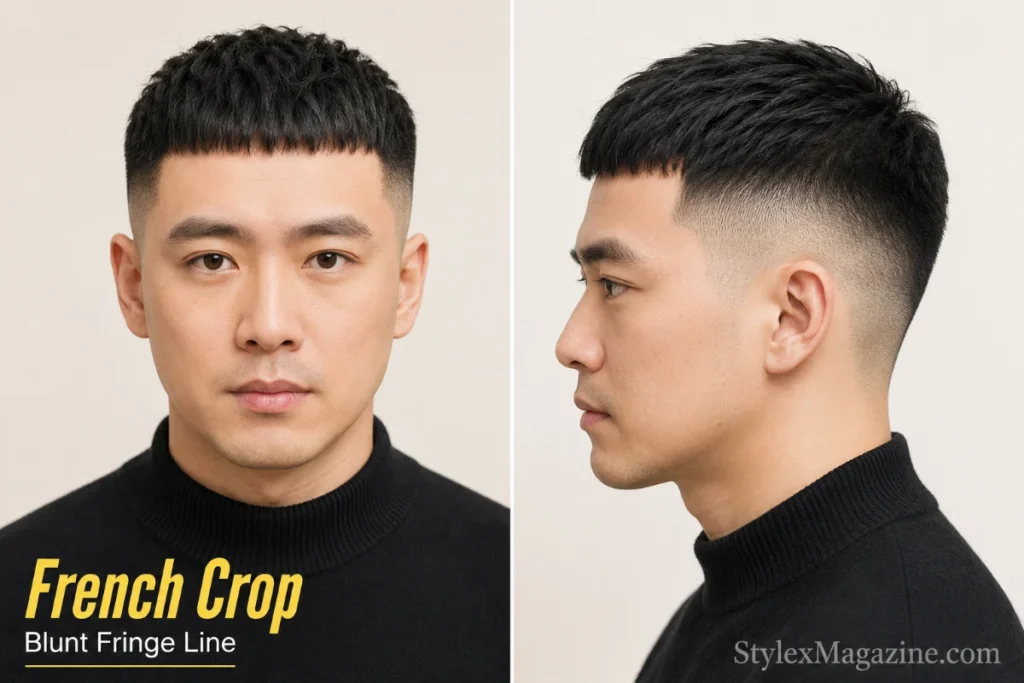
Blunt horizontal fringe with a tight fade on the sides. Heavier and more structured than a textured crop — the fringe sits straight across the forehead and creates a clean line that disguises thinning. Zayn Malik’s French crop with a low fade became one of his most copied looks.
Styling tip: Blow-dry forward on low heat, light cream to hold the fringe in place. Every 3-4 weeks.
8. Choppy Fringe
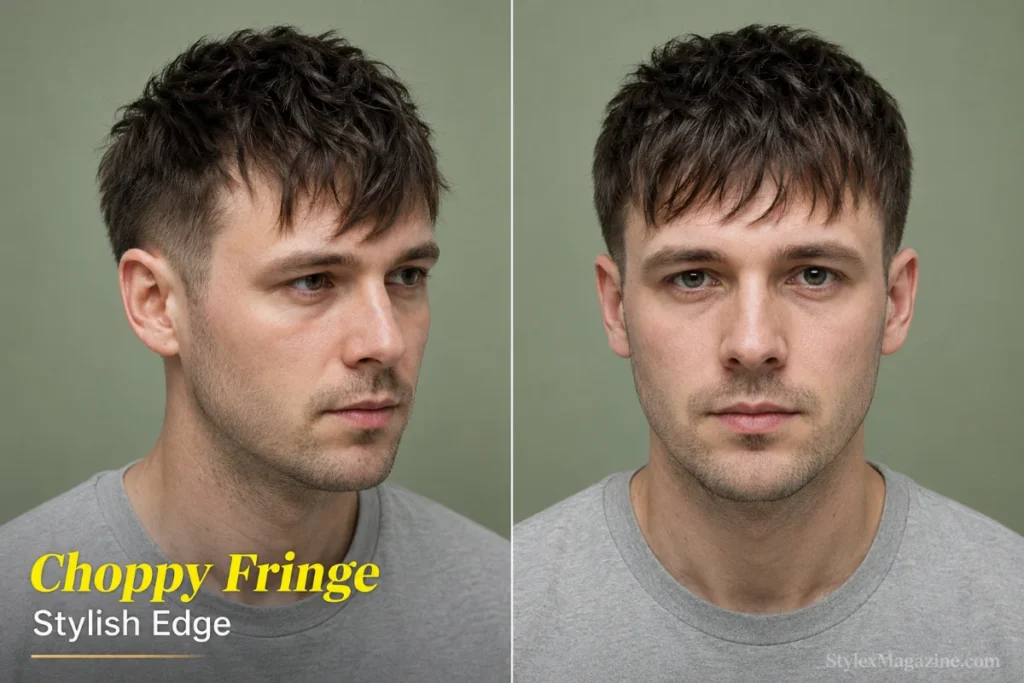
Angular, piece-y fringe falling forward and slightly to one side. The uneven lengths create natural movement that breaks up thinning areas visually. One of the more stylish options for thin hair — edgy without being extreme. Robert Pattinson has worn messy angular fringe variations throughout his career.
Styling tip: Sea salt spray on damp hair, finger-style the fringe into uneven pieces. Every 3-4 weeks.
9. Scissor Crop
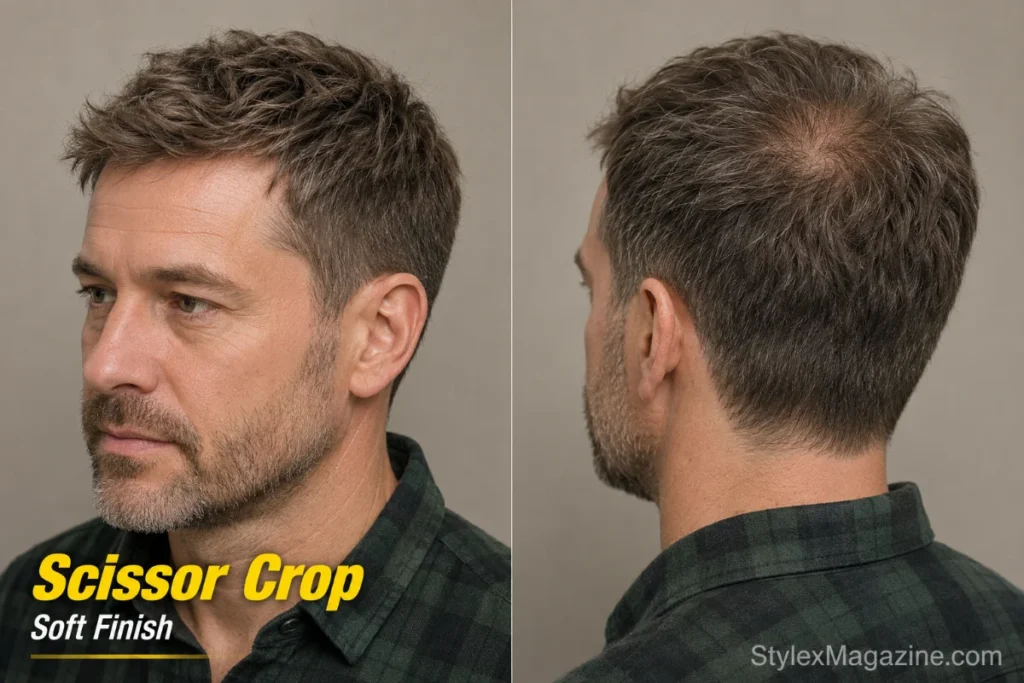
Cut exclusively with scissors — no clippers anywhere. The finish is softer than a clipper crop, and the hair grows out more naturally instead of reaching that sharp “needs a cut” phase at two weeks. Pro barber Joe Mills recommends this approach: a short scissor crop “is less brutal than a clipper cut and grows out softer” (source: GQ UK). Daniel Craig keeps his thinning hair short and textured with scissors — always sharp, never overworked.
Styling tip: Small amount of matte clay, tousled with fingers. Every 4-5 weeks.
10. Spiky Top
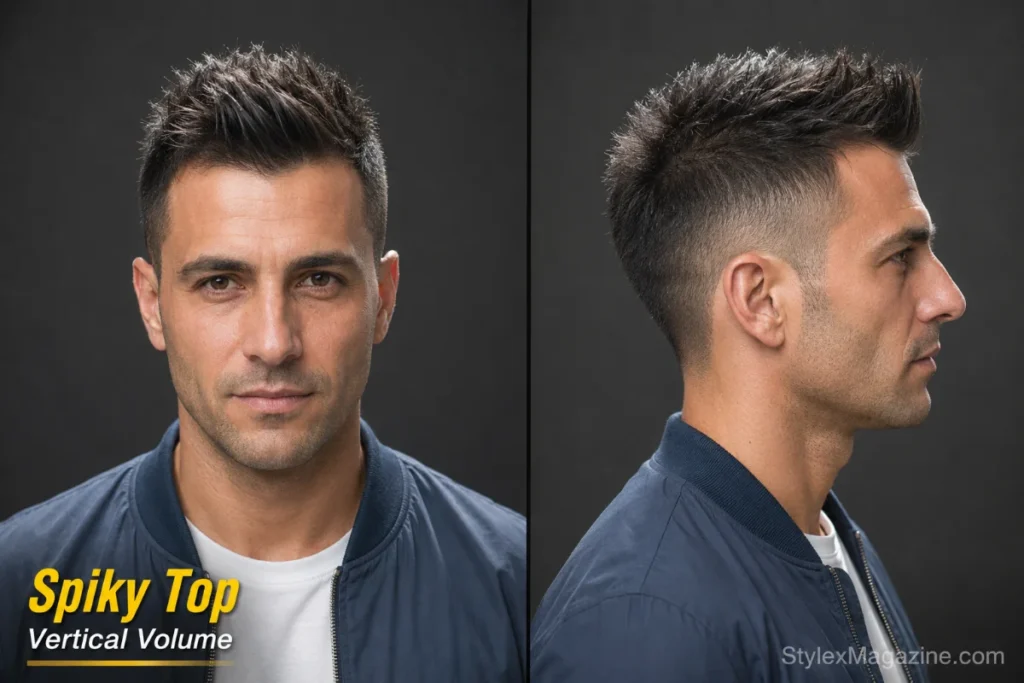
Short layered top styled upward into soft, controlled peaks. Height and texture both increase — thinning areas shrink visually because hair stands vertical instead of lying flat. Keep it subtle past 40 — structured peaks, not 2000s gel spikes. Tom Ford’s short spiky texture is the reference: understated, clean, and deliberate.
Styling tip: Blow-dry upward, light matte wax on tips only. Every 3-4 weeks.
Medium Length Styles That Work with Thinning Hair
Length on thin hair carries risk — but if density is still partially intact, medium styles hold up IF texture and layering do the heavy lifting. These cuts suit men who are not ready to go short yet.
11. Side Part For Thinning Hair
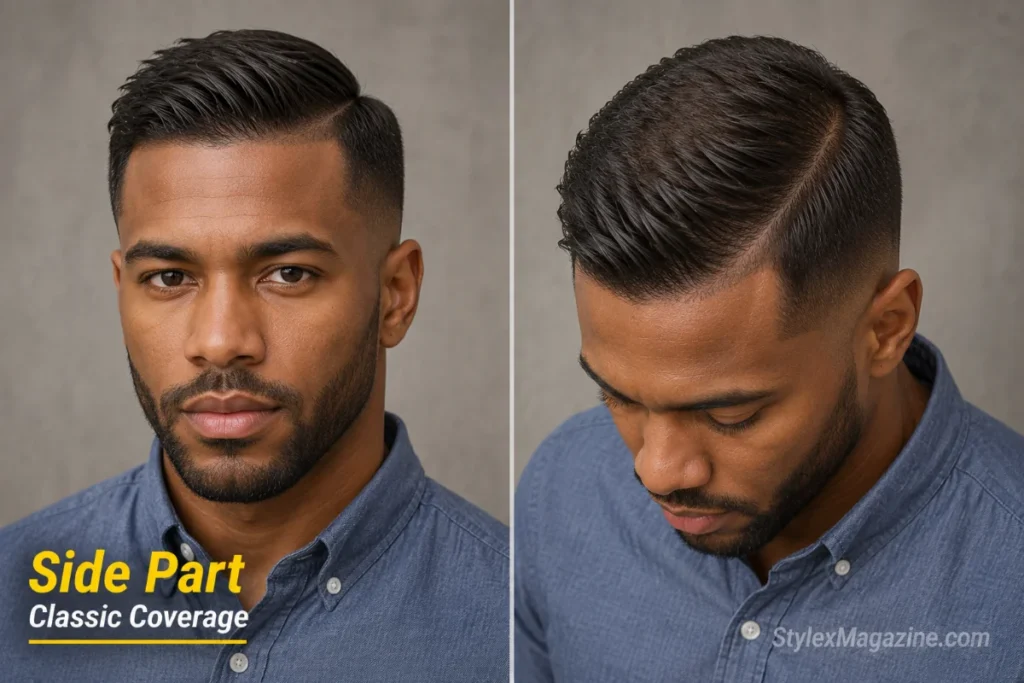
Structured part at the natural break, hair swept to one side. The directional sweep covers thinning areas — especially effective when thinning concentrates on one side. A classic that works at every age and in every professional setting. Jon Hamm wore the side part through every season of Mad Men and proved it never dates.
Styling tip: Light pomade on damp hair, comb into place, air dry. Every 4-5 weeks.
12. Modern Comb Over
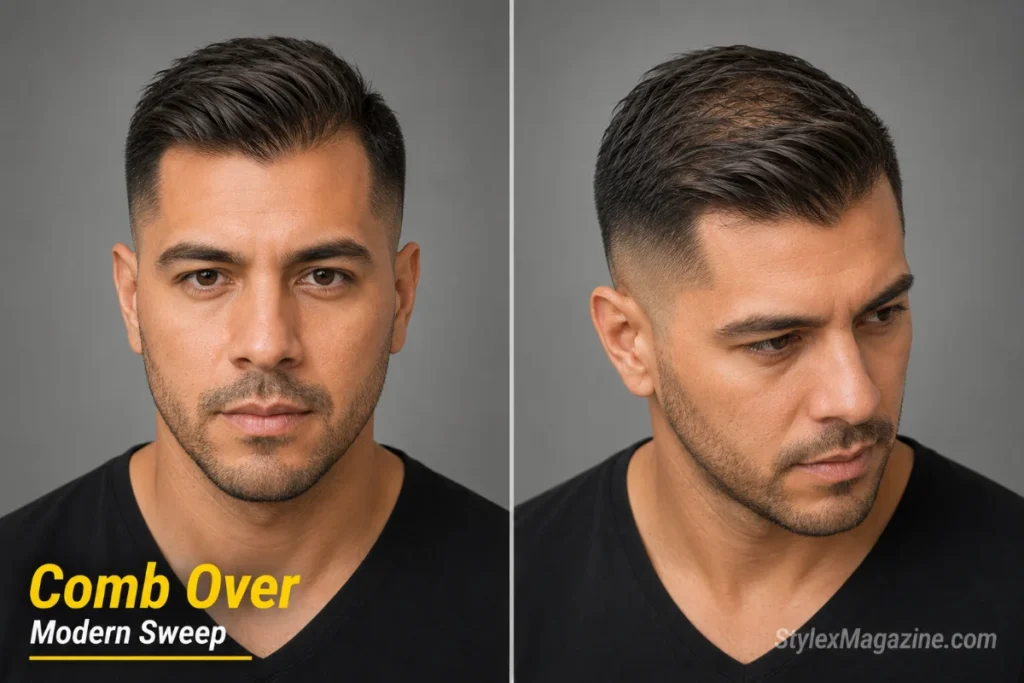
Short, textured, swept to one side. Uses existing hair directionally — the sweep creates a density illusion where flat hair would show scalp. Nothing like the dated cliché — this is structured, textured, and intentional. David Beckham’s recent variations demonstrate the modern version.
Styling tip: Lightweight cream, swept to natural fall side. Every 3-4 weeks.
13. Short Quiff For Thinning Hair
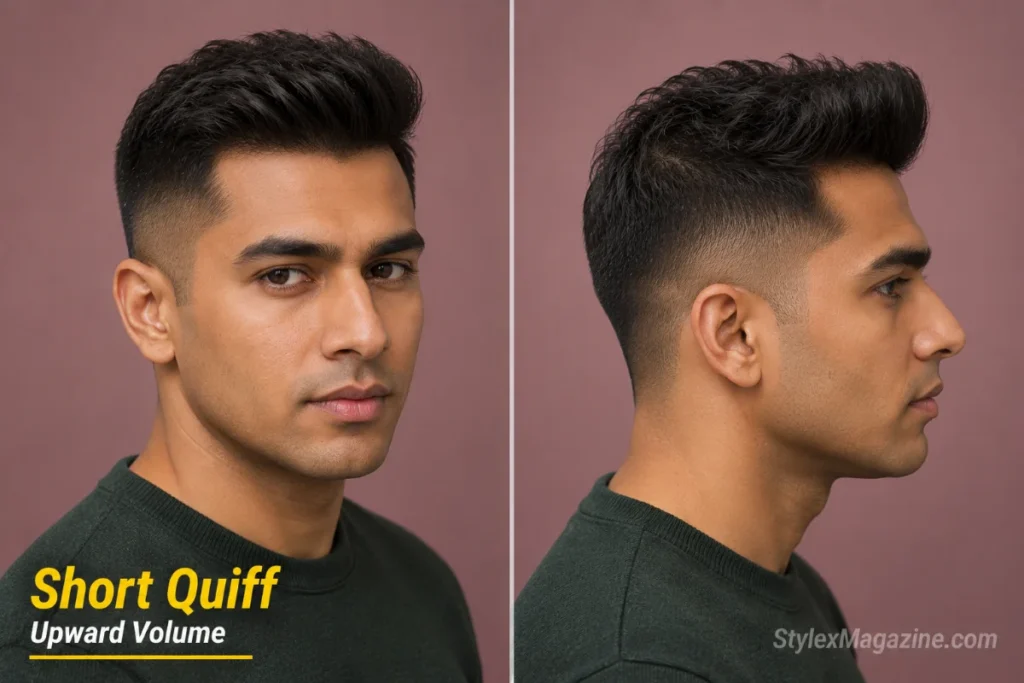
Front section lifted upward with volume, short faded sides. Height at the front pulls attention upward and away from thinning areas. Requires medium density — if the front is already very thin, a quiff will not hold. Ryan Reynolds wears quiff variations that stay controlled without looking forced.
Styling tip: Blow-dry upward with a round brush, matte clay finish. Every 3-4 weeks.
14. Slicked Back (Matte Finish Only)
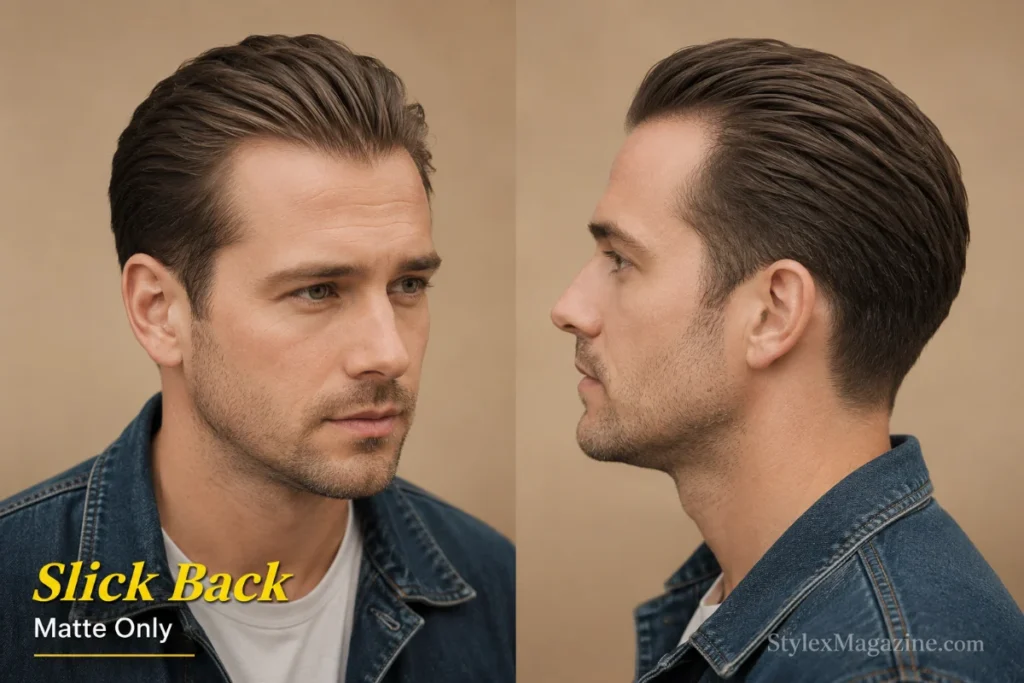
Hair swept back from the forehead with a dry, matte finish. Works ONLY at early thinning when front density still supports the backward sweep. High-shine pomade on thinning hair separates strands and reflects light off the scalp between them — that is the single worst product mistake men with thin hair make. Matte pomade or dry paste only. Matthew McConaughey wears a matte slick-back that shows how the right finish hides what shine would expose.
Styling tip: Matte pomade on damp hair, swept back with fingers — never a comb, never shiny. Every 4-5 weeks.
Best Fades for Thinning Hair
A fade on thinning hair is a double-edged decision. The wrong fade exposes more scalp and makes thinning obvious. The right fade keeps the sides clean and makes the top look fuller by comparison.
15. Low Fade For Thinning Hair
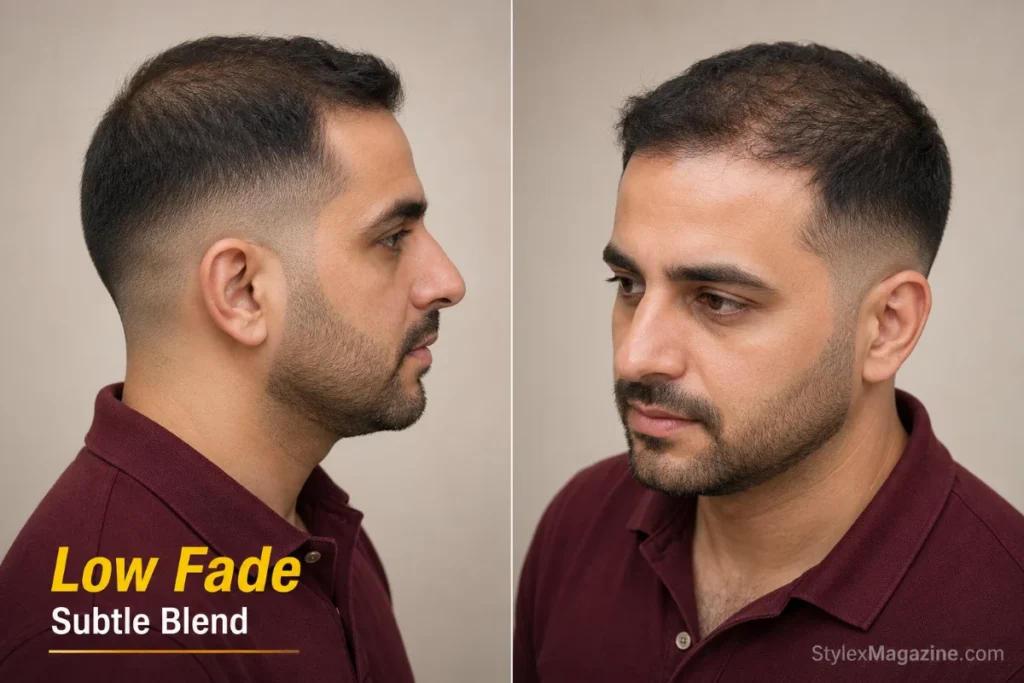
A low fade thinning hair combination starts just above the ear. The subtle transition keeps the sides quiet and lets the top do the talking. Unlike a high skin fade — which pulls the eye upward along the gradient and highlights temple thinning — a low fade blends gently enough that the scalp never becomes the focal point. Drake keeps low and mid fades as his signature.
Styling tip: Keep the top textured, let the fade do the blending. Every 2-3 weeks.
16. Taper Fade For Thinning Hair
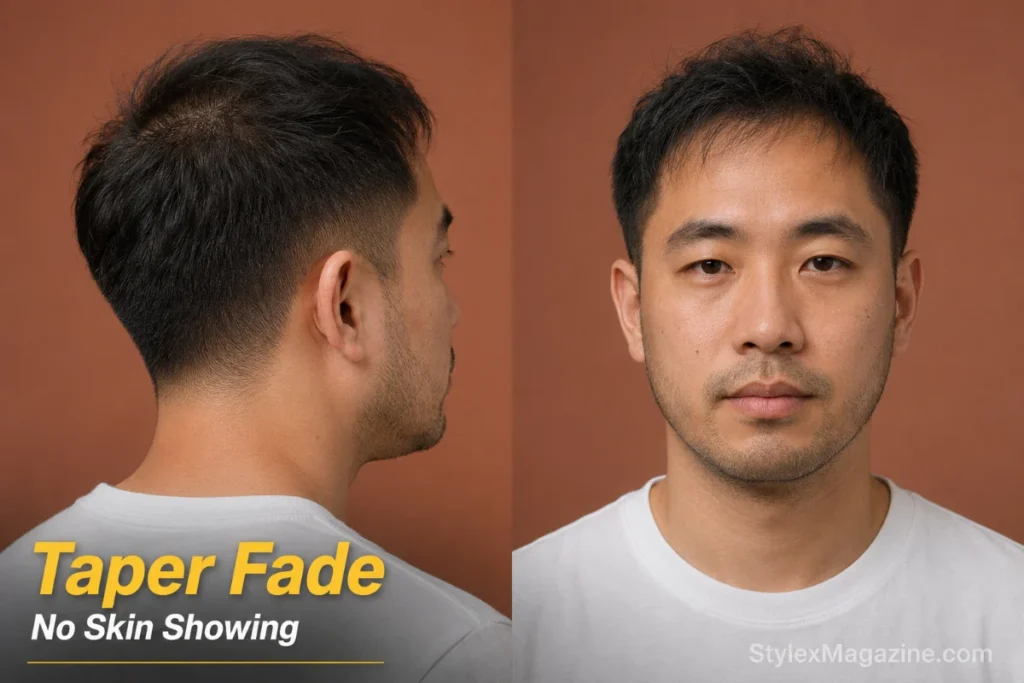
Gradual length reduction from top to neckline, no skin showing anywhere. The softest fade option. In a taper vs skin fade thinning comparison, the taper almost always wins for thin hair because it avoids exposing skin that highlights density loss. Most forgiving on missed barber visits — still looks clean at four weeks. Ryan Reynolds keeps a taper on nearly every appearance.
Styling tip: Minimal product — the taper does the work. Every 3-4 weeks.
17. Mid Fade For Thinning Hair
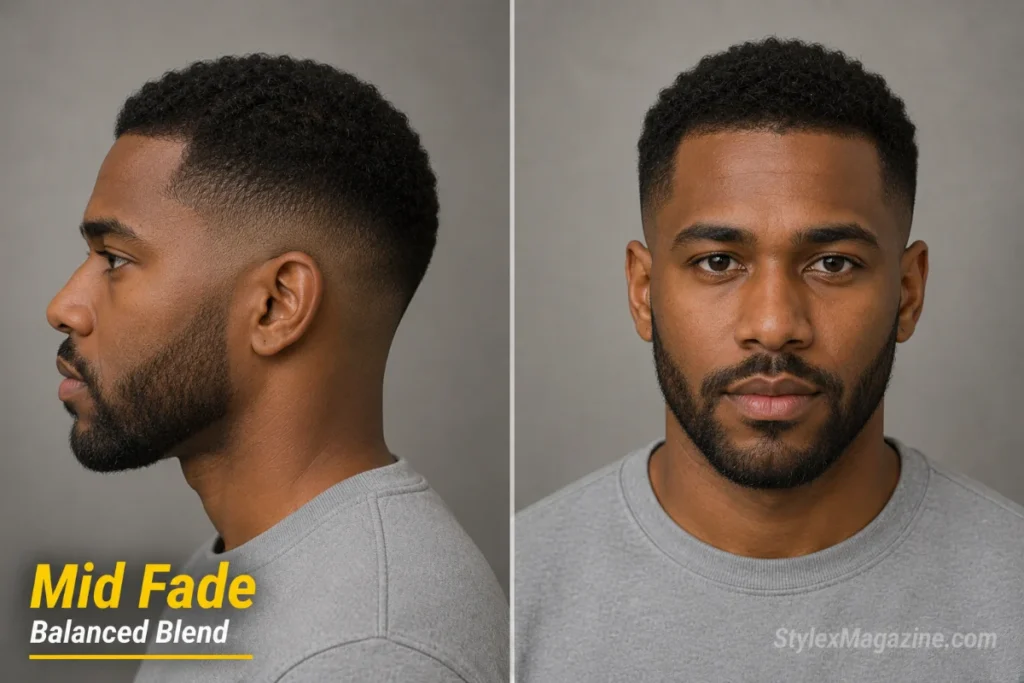
Starts midway up the sides. Balances clean sides with enough visible transition to frame the top. Works when the top has enough length for a textured crop, quiff, or side part. Idris Elba wears clean mid fades that keep everything proportional without drawing attention to any single area.
Styling tip: Matte clay on the top only, minimal amount. Every 2-3 weeks.
18. Drop Fade
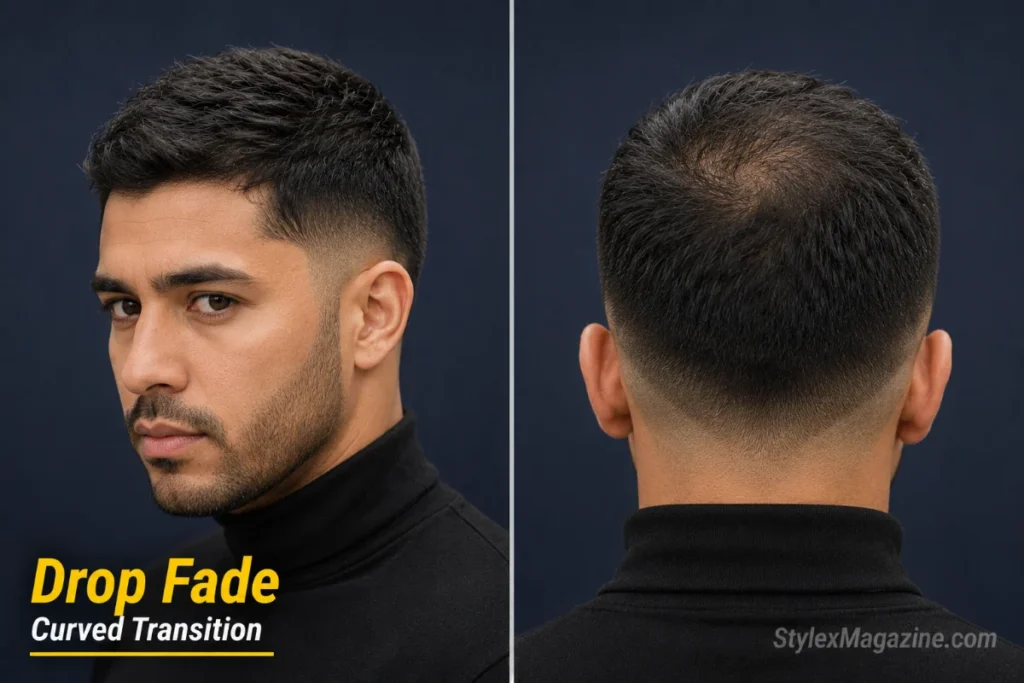
The fade line curves downward behind the ear instead of following a straight horizontal path. The arc follows the natural head shape and creates a smoother transition around the crown and back — exactly where thinning concentrates for most men. If thinning shows at the back of the head or nape area, the drop fade handles it better than any straight-line fade because the curve wraps around the problem zone. Travis Kelce wears drop fade variations that keep the sides interesting without competing with the top.
Styling tip: Pair with a textured top for crown coverage. Every 2-3 weeks.
Can You Keep Hair Longer with Thinning?
Longer styles carry the highest risk. Length pulls thin hair downward, separates strands, and exposes scalp. These two work under specific conditions — and both need wavy or curly texture to succeed. Straight fine hair at medium-to-long length almost never works.
19. Wavy Shag
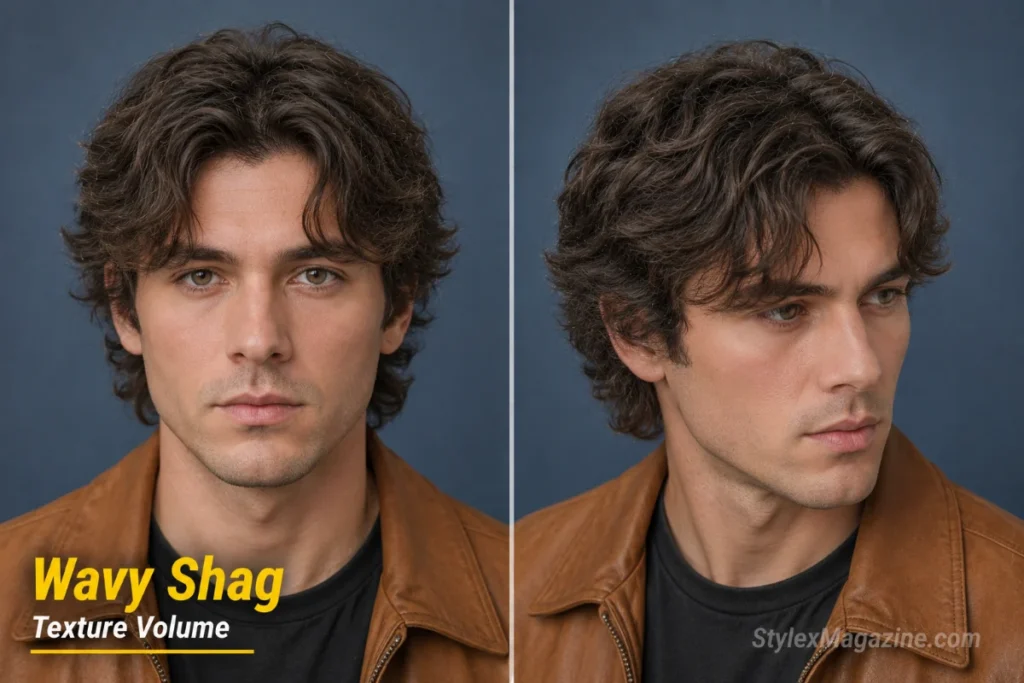
Layered waves with medium length. Natural wave texture fills gaps and adds body that straight hair cannot produce. ONLY for wavy or curly hair — straight fine hair at this length falls flat and highlights every thin area. The awkward grow-out phase lasts 3-4 months — patience is non-negotiable. Timothée Chalamet’s layered tousled look shows how messy length can look editorial on the right texture.
Styling tip: Sea salt spray on damp hair, air dry, scrunch. Every 5-6 weeks.
20. Bro Flow For Thinning Hair
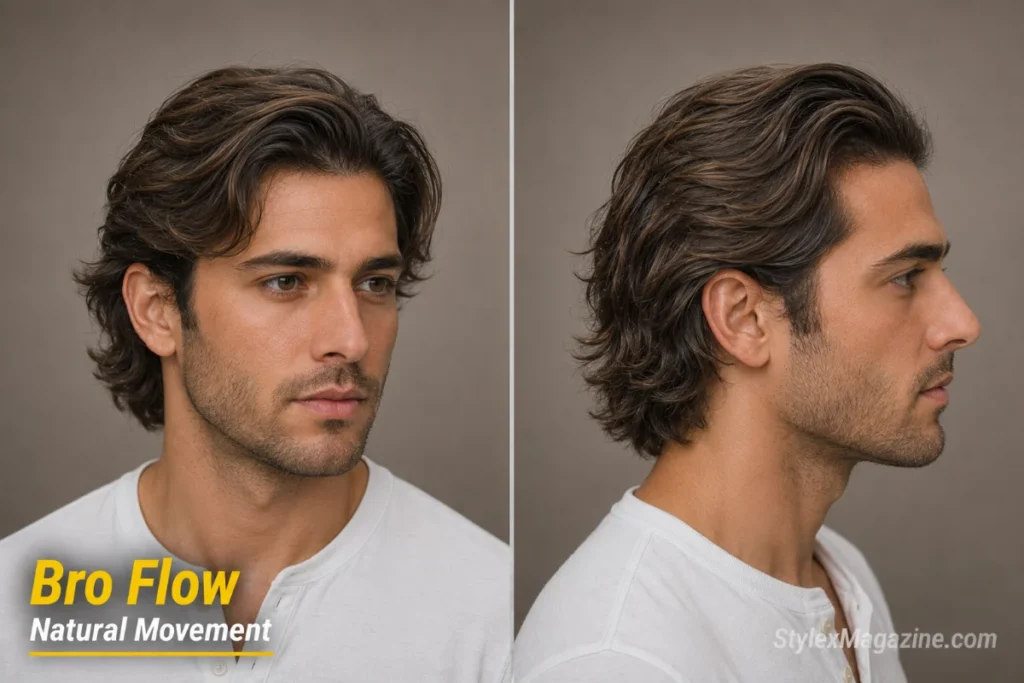
Medium length with natural bend and flow. Movement creates the fullness illusion — the hair never sits still long enough to expose the scalp beneath. Requires decent overall density — if the crown or front is already significantly thin, this cut will expose more than it conceals. Henry Cavill wears grown-out styles that demonstrate how natural bend adds body.
Styling tip: Lightweight styling cream for flexible hold. Every 5-6 weeks.
Does Thinning Hair Look Better Short or Long?
Short almost always wins. But “short” does not mean buzz cut for everyone. The best haircuts for men with thinning hair in 2026 lean heavily toward textured, layered cuts that create movement — and research backs the short direction. A University of Pennsylvania study found that men with shaved or very short hair are perceived as taller, stronger, and having greater leadership potential than men visibly holding onto thinning length.
Three tiers based on how much thinning you have:
Diffuse thinning everywhere: Short textured cuts — crew, crop, Caesar. Keep the top at 1-2 inches. Enough length to create texture, short enough that nothing falls flat.
Thinning concentrated in one zone (crown or front): A slightly longer top at 2-3 inches works. Use the length directionally — forward fringe for front thinning, textured layers for crown thinning. Keep sides short.
Wavy or curly hair with thinning: Hold more length than straight hair can — waves naturally create body. But anything past 5 inches rarely works even on curly hair.
The barber rule of thumb: keep the top between 3-5 inches. Enough hair to blow-dry and style. Not so much that it falls flat and exposes scalp (source: Victory Barber).
How to Make Thinning Hair Look Thicker at Home
The cut is step one. The daily routine is where thin hair actually transforms.
Step 1 — Wash right. Use a volumizing shampoo. Skip regular conditioner or switch to a lightweight one — standard conditioner coats thin strands with weight and pulls them flat. Wash every 2-3 days, not daily. Over-washing strips the natural oils that give hair body.
Step 2 — Apply product to WET hair. Matte clay, texture paste, or styling cream — always on wet hair, never dry. Inside each hair strand are carbon bonds that control shape. These bonds break with water and heat. Applying product to wet hair and then blow-drying reshapes those bonds into a fuller position. Product on dry hair just adds weight.
Step 3 — Blow-dry with lift. Medium heat, high airflow. Lift hair at the roots with your fingers while drying. Move the dryer in ALL directions — drying from one direction only pushes hair flat. Final move: switch to the cold setting for 30 seconds. Cold air locks the volume into place.
Step 4 — Finish. Texture powder at the roots for extra lift. For visible sparse areas, hair building fibres (keratin-based products like Toppik) cling to existing strands through static charge and create the appearance of density. Light finishing spray — not heavy hairspray — to hold without stiffness. If the finishing spray feels rigid, celebrity hairstylist Benjamin Mohapi recommends brushing it out lightly after application — “brushing out hairspray stops it from looking stiff while still holding a style” (source: Byrdie).
For men who want to go beyond styling, PRP (Platelet-Rich Plasma) treatments have shown efficacy in adding volume and slowing thinning — consult a dermatologist if styling alone is no longer enough.
Which Cut Suits Your Face Shape with Thin Hair?
Thinning changes how your face reads. A round face without top volume looks wider. An oblong face with thinning on top stretches even longer. The right cut counterbalances what the thinning does.
| Face Shape | What Thinning Does | Best Cuts | Avoid |
|---|---|---|---|
| Oval | Minimal disruption — stays balanced | Most styles: crop, crew, quiff, side part | Nothing specific — oval faces handle almost everything |
| Round | Without top volume, face looks wider and shorter | Quiff, spiky top, textured crop — anything adding height | Buzz cut without facial hair — removes all vertical emphasis |
| Square | Angular features hold the look well | Crew, Caesar, buzz cut — clean lines suit sharp bone structure | Long floppy styles that fight angular geometry |
| Oblong / Rectangle | Already long — thinning adds more perceived vertical length | Caesar, French crop (horizontal fringe shortens face), side part | Quiff or pompadour — adds height you do not need |
| Diamond / Heart | Narrow chin without top fullness creates imbalance | Textured crop, taper fade with some top length, side part | Skin fade with bare face — maximises width at the widest point |
For men with a round face and thin hair specifically: the spiky top, textured crop, or short quiff add vertical height that elongates the round shape.
What Should You Avoid with Thinning Hair?
Five things consistently make thinning more visible.
Long, flat, unstyled hair. Length without texture pulls thin strands down and exposes the scalp beneath. If you want length, layers and movement are mandatory — flat and heavy is the enemy.
Gel, heavy wax, or any shiny product. Shine separates thinning strands and reflects light off the scalp between them. Matte clay, texture powder, or dry paste close the visual gaps. Floyd’s Barbershops director Patrick Butler advises avoiding wax entirely — it “clumps the hair together, which accentuates the thinning area” (source: Byrdie).
Tight man buns or ponytails on thin hair. Both pull on weakened follicles and can accelerate loss through traction alopecia — a type of hair loss caused by sustained tension on the hair root.
Hard razor part. A razored line exposes a strip of scalp that widens visually as hair thins around it. Natural part only — soft, no blade.
Over-conditioning. Regular conditioner coats thin strands with weight. Either skip it or use a lightweight volumizing conditioner. Hair that is too soft and silky slides flat — a small amount of grit actually helps thin hair hold shape.
What Should You Tell Your Barber?
Name the thinning area, ask for texture, and state a guard number or length in inches.
Front or overall thinning: “I want a textured crop with short choppy layers on top for volume. Sides at a 1 guard, blend into the top. Texture is the priority.”
Crown thinning: “My crown is thinning. Keep the top textured with enough length to build coverage. Low fade or taper on the sides.”
Not sure yet: “My hair is thinning — what do you recommend that looks fuller? I am open to going shorter.”
One key choice: scissors or clippers on top? A scissor crop produces a softer finish and grows out more naturally. A clipper crop is sharper but hits that “needs a cut” stage faster. For thinning hair, scissors on top with clippers on the sides often delivers the best balance.
Bring a reference photo — images of haircuts for men with thinning hair from this page or similar guides give your barber a visual target that removes all guesswork. State your maintenance window — if you visit every 6 weeks, a style that needs a 2-week fade refresh will never look right past the first appointment.
FAQ
Does hair texture affect which cut works best for thinning hair?
Curly and wavy hair fills gaps naturally and holds volume at every length — thinning men with textured hair can keep more length on top than straight-haired men. Straight fine hair performs best at shorter lengths (crew, crop, Caesar) where the flat lay does not expose scalp. Coily hair creates natural density illusion even at short lengths, making it the most forgiving texture for thinning.
Does colouring thin hair make it look thicker?
Lighter shades can create the illusion of density by reducing the visible gap between hair and scalp — Pete Davidson’s platinum blonde phase demonstrated exactly this effect. Darker hair on pale scalp shows every thin area. A subtle highlight or lighter shade can soften that gap. However, chemical processing weakens already fragile strands, so use a gentle dye and consult your barber about balancing the visual benefit against the strand damage.
How often should men with thinning hair visit the barber?
Short textured cuts (crop, crew, Caesar) need a trim every 3-4 weeks to maintain texture and shape. Fades need the most frequent upkeep at 2-3 weeks. Longer styles (wavy shag, bro flow) can stretch to 5-6 weeks. The key rule: thinning hair that has grown past its intended length looks thinner than thinning hair that has just been cut. Regular trims are not optional — they are the foundation.
Does stress cause hair to thin?
Yes. Stress pushes a high number of hair follicles into a resting phase — a condition called telogen effluvium. Over time, those resting follicles shed during washing and combing, causing noticeable density loss. Floyd’s Barbershops director Patrick Butler notes that stress “plays a major role in hair loss” and the physical habit of running fingers through hair under stress further weakens follicles (source: Byrdie). Reducing stress will not regrow lost hair, but it can slow active shedding.
Can diet improve thinning hair?
Hair-friendly nutrients support strand strength. Biotin (Vitamin B7), Omega-3 fatty acids from fish and nuts, Vitamin A from leafy greens, and protein from eggs and poultry all contribute to hair health. Diet will not reverse thinning, but existing hair grows stronger and looks healthier with the right nutritional support.

Other Articles
20 Best Haircuts for Balding Men In 2026
20 Best Haircuts for Receding Hairline Men (2026)
[…] are still in the thinning stage and not ready to shave, the guides for haircuts for balding men and thinning hair haircuts cover options that buy time. This page is about what to grow on your face once the head is […]