
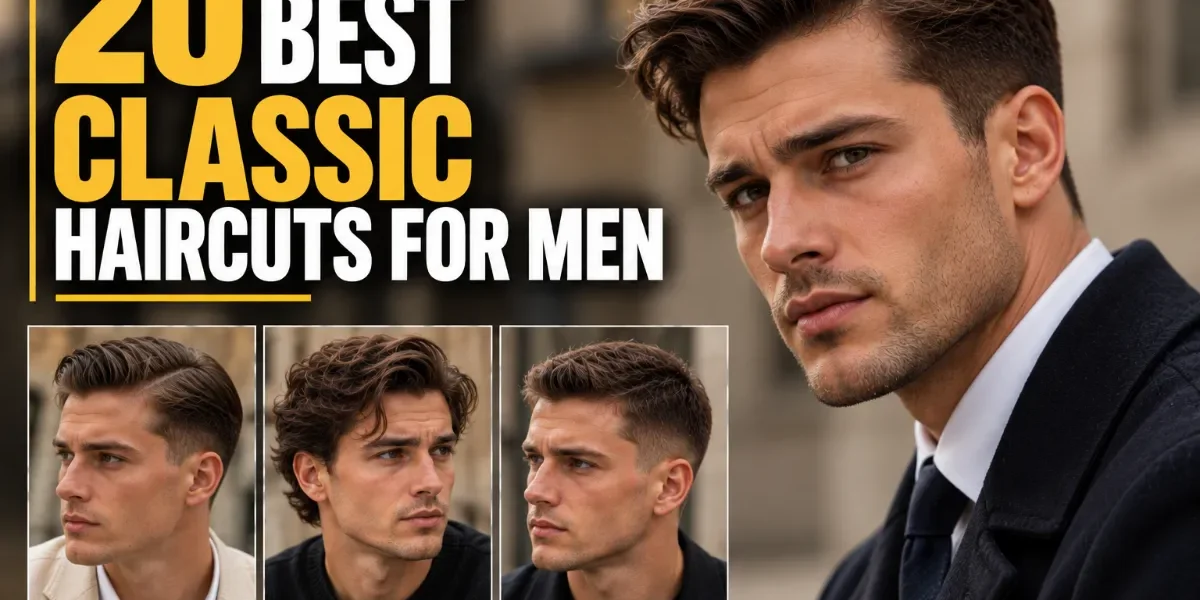

Quick Answer: Classic men’s haircuts share three qualities: clean structure, balanced proportions, and zero dependence on any single era’s trends. The crew cut, side part, pompadour, quiff, and buzz cut have held up for decades because they work across face shapes, hair types, and dress codes. After 8 years behind the chair, these are the 20 traditional styles I recommend most, each with the barber specs you need to walk in and order with confidence.
Quick-Reference Guide: All 20 Classic Cuts Compared
Use this table to narrow your options by face shape, hair type, and how much maintenance you’re willing to handle. Formality runs from 1 (casual) to 5 (boardroom-ready). Maintenance runs from 1 (wash and go) to 5 (daily styling required).
| Style | Best Face Shapes | Best Hair Types | Formality | Maintenance | Sides | Top |
|---|---|---|---|---|---|---|
| Buzz Cut | Square, oval, diamond | Any | 3 | 1 | #2 guard all over | #2-#3 guard |
| Crew Cut | Oval, square, heart | Straight, wavy | 4 | 1 | #1-#2 guard | #4 guard, finger length |
| Regulation Cut | Oval, oblong, square | Straight, wavy | 5 | 2 | #2-#3 tapered | 2-3 inches |
| Flat Top | Square, diamond, oval | Thick straight, coily | 3 | 3 | #1-#2 guard | 1-3 inches standing |
| High and Tight | Square, oval, diamond | Any | 4 | 1 | #0-#1 guard | 1-2 inches |
| Side Part | Oval, oblong, heart | Straight, wavy | 5 | 2 | #2-#3 tapered | 3-4 inches |
| Comb Over | Oval, round, heart | Straight, wavy, thinning | 4 | 2 | #2-#3 tapered | 3-4 inches |
| Ivy League | Oval, square, heart | Straight, wavy | 5 | 2 | Scissor tapered | 1.5-2.5 inches |
| Brush Back | Square, oval, oblong | Thick straight, wavy | 4 | 3 | #2-#3 tapered | 3-4 inches |
| Pompadour | Oval, square, diamond | Thick straight, wavy | 4 | 5 | #1-#2 tapered | 4-6 inches |
| Quiff | Oval, heart, diamond | Straight, wavy, thick | 3 | 4 | #2-#3 tapered | 3-5 inches |
| Slick Back | Oval, square, oblong | Straight, thick | 5 | 3 | #2-#3 blended | 4-6 inches |
| Ducktail | Oval, oblong, heart | Thick straight, wavy | 3 | 4 | Scissor tapered | 4-5 inches |
| French Crop | Round, square, heart | Any | 3 | 1 | #1-#2 faded | Finger length, textured |
| Textured Crop | Oval, round, square | Thick, wavy | 3 | 2 | #1-#2 faded | 2-3 inches, textured |
| Caesar Cut | Round, square, oval | Straight, wavy, thinning | 3 | 1 | #2-#3 tapered | 1-2 inches |
| Short Back and Sides | All face shapes | All hair types | 4 | 2 | #3-#4 blended | 2-4 inches |
| Undercut | Oval, square, diamond | Straight, wavy, thick | 3 | 3 | #0-#1 disconnected | 3-5 inches |
| Taper Cut | All face shapes | All hair types | 4 | 2 | Graduated blend | 2-4 inches |
| Mod Haircut | Oval, oblong, heart | Straight, thick | 2 | 3 | Scissor-cut, ear length | 4-6 inches |
20 Best Clean and Minimal Classics Haircuts
These cuts run tight, require the least product, and sit comfortably in any professional setting. If low maintenance is the priority, start here.
Buzz Cut
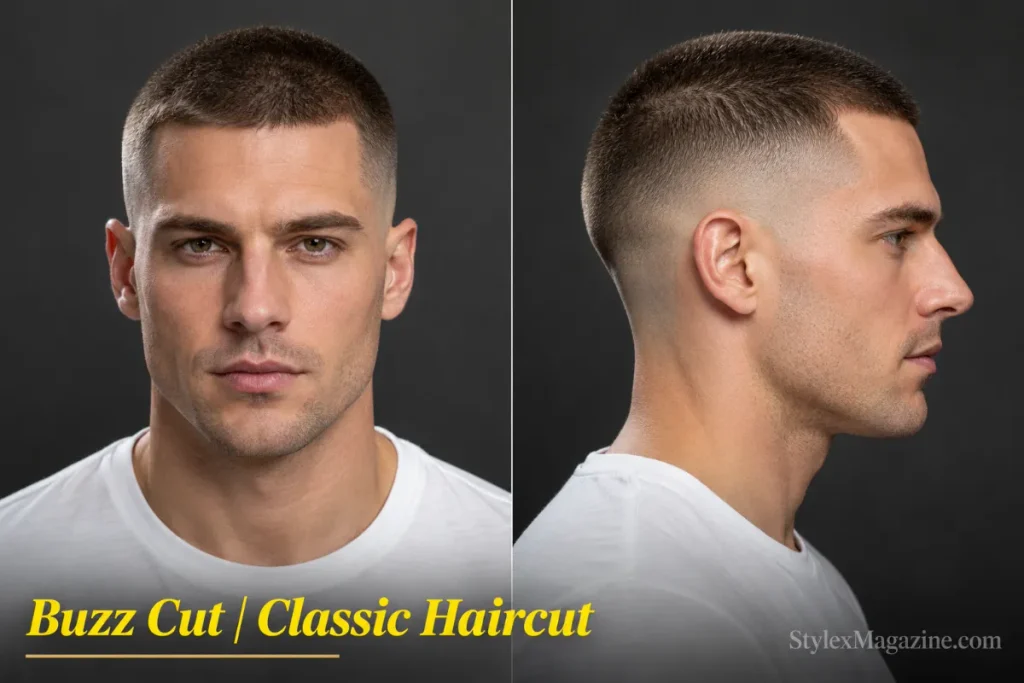
The buzz cut removes every styling decision from your morning. One guard length, all over, done.
It traces back to the military induction cut of the WWII era, where recruits had their heads clipped for hygiene and uniformity. That functional origin is also why it still works: there is nothing to outgrow, nothing to style wrong, and nothing that shifts between a Monday meeting and a Saturday cookout.
The key decision is guard length. A #2 guard (6mm) gives enough coverage to soften the scalp without looking grown out. A #3 (10mm) adds a slight shadow that suits men who want the simplicity of a buzz without the full-scalp-exposure look. For a cleaner finish, ask for a skin fade at the temples and neckline rather than a blunt edge.
Barber Spec Card
- Sides: #2 guard all over (or skin fade at temples for a cleaner finish)
- Top: #2 to #3 guard
- Technique: Clipper only
- Key product: None required (sunscreen on scalp in summer)
Best for: Square, oval, and diamond face shapes. Works on any hair texture.
Maintenance arc: Looks fresh for 1-2 weeks. Starts losing its shape around week 3. Rebook every 2 weeks for a consistently tight look.
Crew Cut
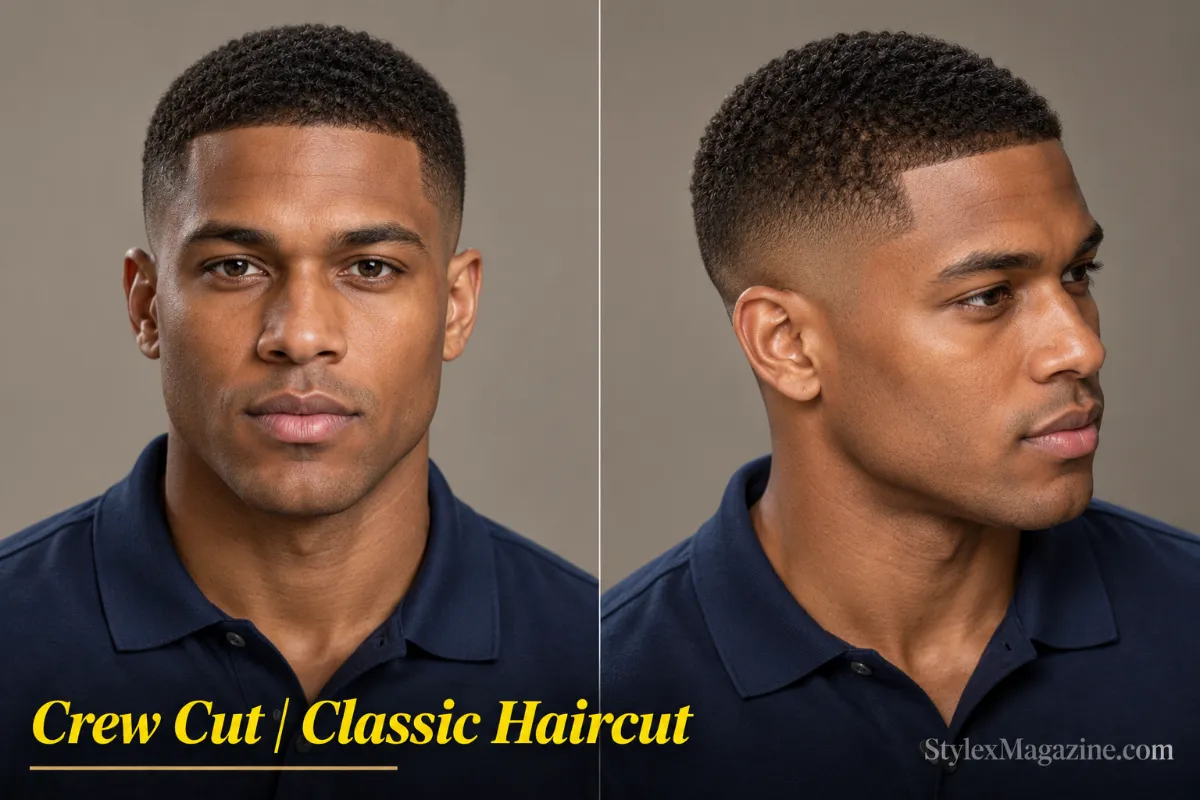
The crew cut (sometimes called the Princeton cut in Ivy League circles) is the workhorse of men’s barbering. Slightly longer on top than a buzz, tapered on the sides, and clean enough for any office dress code.
Its military roots go back to pre-WWII American service regulations, but the style crossed into mainstream culture when Ivy League athletes and rowing teams adopted it in the 1940s and 50s. That dual identity, military precision with collegiate polish, explains why it has never fallen out of rotation.
The defining feature is the graduated length from crown to forehead. The top sits at about finger length (#4 guard or scissor-cut), while the sides taper down to a #1 or #2. That taper is what separates a crew cut from a buzz: there is a visible transition, a shape that narrows the temples and adds structure to the head.
For round faces, keeping the top slightly longer and the sides tighter creates a more oval silhouette. For thinning hair, the crew cut works well because the short length minimizes the contrast between thick and thin areas.
Barber Spec Card
- Sides: #1 to #2 guard, tapered
- Top: #4 guard or finger length (~1 inch)
- Technique: Clipper sides, scissor or clipper top, blended at temples
- Key product: Light matte clay for texture, or nothing
Best for: Oval, square, and heart face shapes. Straight and wavy hair.
Maintenance arc: Holds shape 3-4 weeks. Grows out gracefully into a longer crew or short side part. Rebook every 3-4 weeks.
Regulation Cut
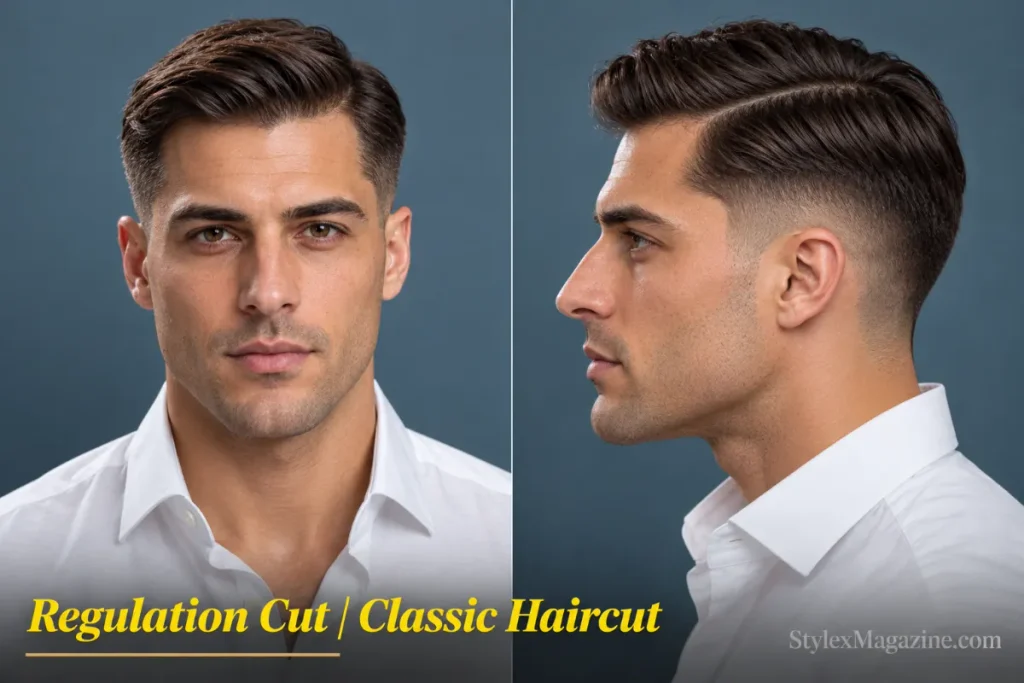
If you need something sharper than a crew cut but shorter than a full side part, the regulation cut sits in that gap. US Armed Forces grooming standards specify the template: short tapered sides with enough length on top (2-3 inches) to part and comb.
What makes it distinct from a standard side part is the stricter proportions. The sides stay tighter, the part line is more defined, and the overall silhouette is more compact. Think of it as a side part that has been through basic training.
This is a strong option for men who work in formal environments but find the crew cut too short and the side part too loose. The 2-3 inches on top give just enough length for a clean comb-over direction without requiring heavy product or daily blow-drying.
Barber Spec Card
- Sides: #2 to #3, tapered close at the neckline
- Top: 2-3 inches, parted
- Technique: Clipper sides, scissor top, hard or natural part
- Key product: Light pomade or grooming cream
Best for: Oval, oblong, and square face shapes. Straight and wavy hair.
Maintenance arc: Holds 3-4 weeks. Grows into a longer side part naturally. Rebook every 3-4 weeks.
Flat Top
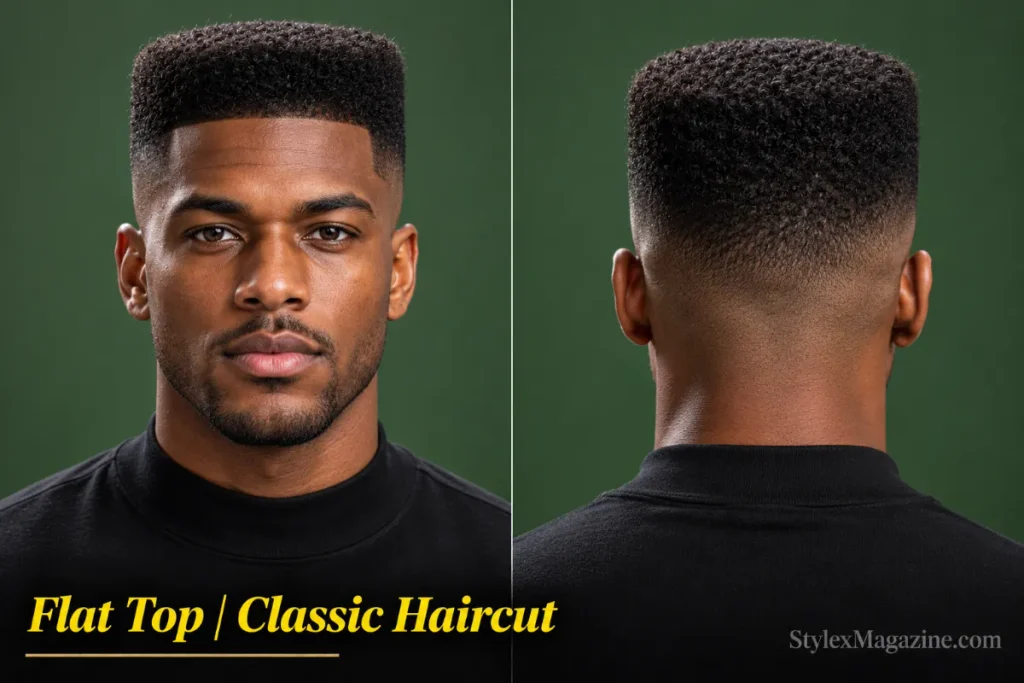
The flat top is architecture, not just a haircut. The top is cut to stand upright and form a level horizontal plane, creating a squared-off silhouette that no other style replicates.
It peaked in the 1950s and 60s as a military-adjacent style, resurfaced in the 1980s and 90s through hip-hop culture (where the hi-top fade version became iconic), and still holds a place in barbershops that value precision cutting. Getting the flat surface level requires a flat-top comb and clipper-over-comb technique, so this is not a style to attempt at a budget chain.
The flat top works best on thick, coarse, or coily hair with the density to stand upright. Fine or thin straight hair will not hold the shape without heavy product, and tends to wilt within hours.
Barber Spec Card
- Sides: #1 to #2 guard, faded or tapered
- Top: 1-3 inches standing vertically, leveled flat
- Technique: Flat-top comb + clipper-over-comb, precision leveling
- Key product: Strong-hold gel or styling wax to maintain vertical shape
Best for: Square, diamond, and oval face shapes. Thick straight or coily hair.
Maintenance arc: Starts losing its level surface at 2 weeks. Rebook every 2-3 weeks. Not a low-maintenance cut.
High and Tight
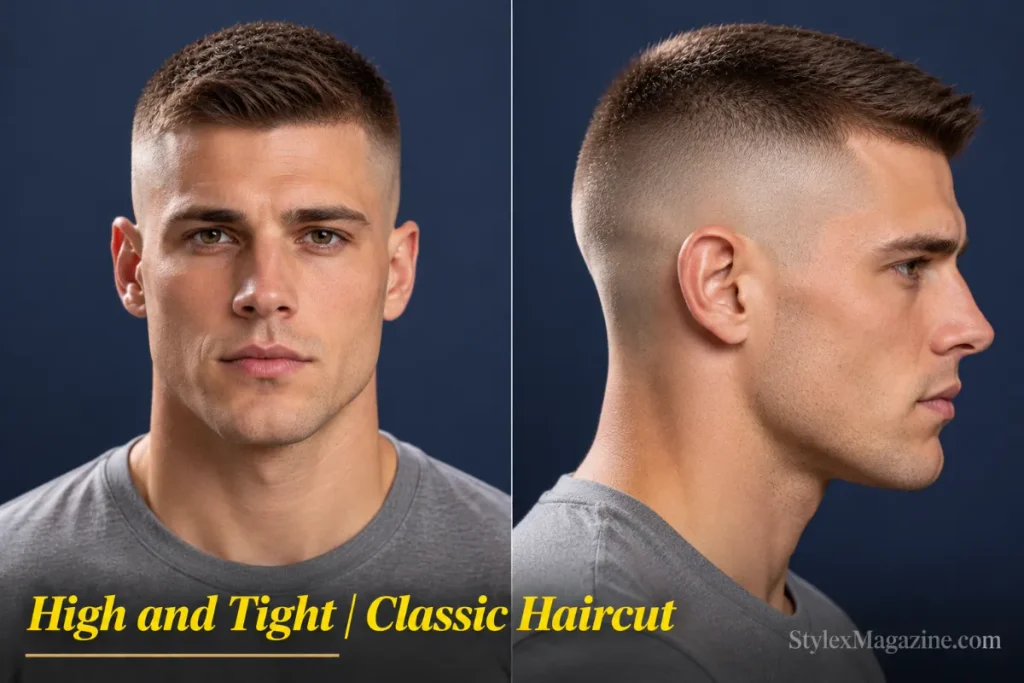
Take the military short cut family and push it to the extreme, and you land on the high and tight. Sides and back are clipped to skin or near-skin (#0-#1), with the “high” referring to how far up the head that close shave extends, often past the temples and into the upper parietal ridge.
The strip of longer hair left on top (1-2 inches) provides just enough contrast to keep this from being a full buzz cut. That top section can be left natural, brushed forward, or given a slight side direction depending on preference.
For a detailed breakdown of this style with variations and face shape guidance, see the full high and tight haircut guide.
Barber Spec Card
- Sides: #0 to #1 guard, high skin fade
- Top: 1-2 inches
- Technique: Clipper with high fade line, scissor or clipper top
- Key product: Optional light matte paste
Best for: Square, oval, and diamond face shapes. Any hair type.
Maintenance arc: Needs rebooking every 2 weeks. The contrast between shaved sides and textured top becomes obvious quickly as the sides grow in.
Parted and Structured Classics
These cuts use a visible part line, whether natural or razored, to create symmetry and direction. They look polished without requiring heavy product or extended styling time.
Side Part
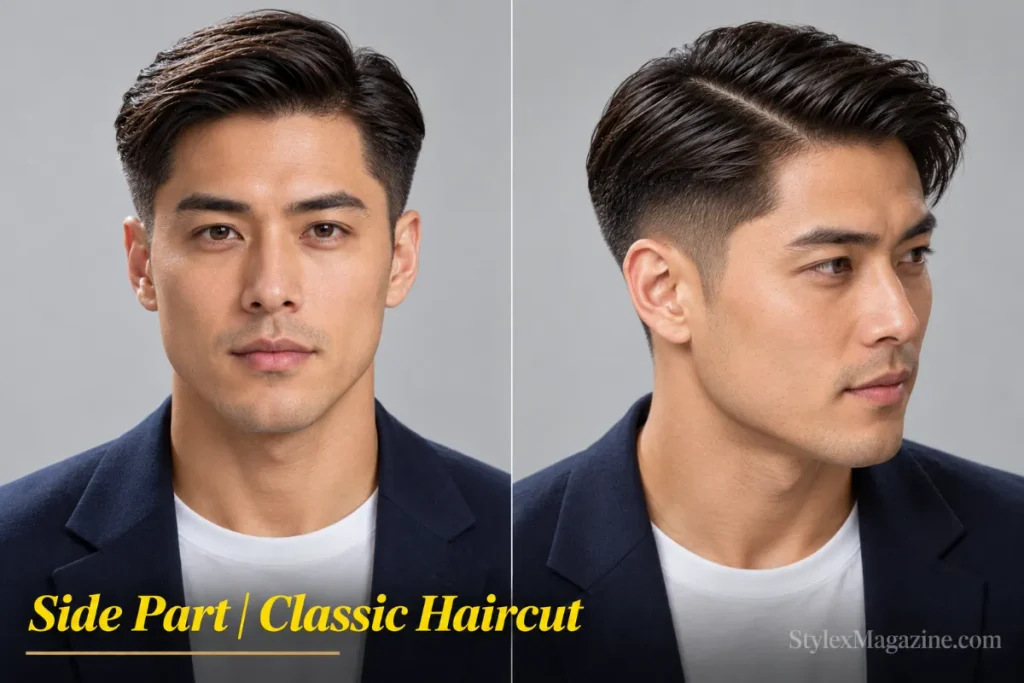
No classic cut has a longer unbroken run than the side part. A natural or defined part line on one side, longer hair on top combed across, shorter tapered sides. That formula has worked without interruption since the 1920s.
Its staying power comes from adaptability. A side part can sit close to the head with pomade for a 1940s look, or be worn with loose texture and matte product for something more current. The structure stays the same. Only the finish changes.
From behind the chair, the most common mistake I see is men parting their hair on the wrong side. Hair has a natural growth direction, and parting against it creates a cowlick-heavy fight every morning. Run your fingers through wet hair and push it to each side. The side where it falls with less resistance is your natural part. Use that.
For men with thinning hair, the side part is a reliable option because the directional sweep creates the appearance of density. Keeping the part low (closer to the temple than the center of the crown) maximizes that coverage.
Barber Spec Card
- Sides: #2 to #3, tapered (or low/mid fade for a sharper contrast)
- Top: 3-4 inches
- Technique: Scissor top, clipper sides, natural or hard part
- Key product: Medium-hold pomade for shine, matte clay for a drier finish
Best for: Oval, oblong, and heart face shapes. Straight and wavy hair.
Maintenance arc: Holds well for 4-5 weeks. One of the longest-lasting classic cuts. Rebook every 4-5 weeks.
Comb Over
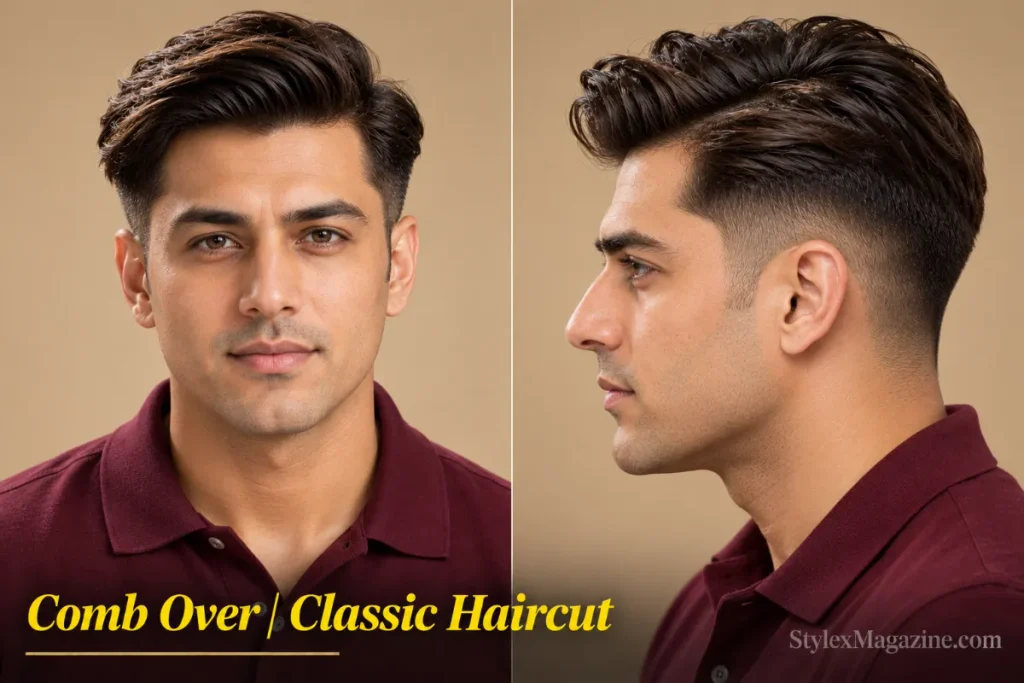
The comb over haircut is a directional style where the top hair is swept to one side with volume, creating a fuller silhouette than a flat side part. The distinction from a standard side part is the lift: a comb over is styled up and over rather than combed flat across.
It suits men dealing with thinning hair or early-stage hair loss, because the volume and directional sweep create natural coverage without looking like a cover-up. Keep the sides proportional. If the sides are too short relative to the top volume, the contrast draws attention to what you are trying to conceal.
Pair it with a tapered or faded side rather than a disconnected undercut. The gradual transition looks more natural and ages better as the hair grows out.
Barber Spec Card
- Sides: #2 to #3, tapered or low faded
- Top: 3-4 inches, layered for volume
- Technique: Scissor top with layering, clipper sides, blended transition
- Key product: Volumizing mousse or lightweight pomade
Best for: Oval, round, and heart face shapes. Straight, wavy, or thinning hair.
Maintenance arc: Holds 3-4 weeks. Grows out into a longer sweep that still looks intentional. Rebook every 3-4 weeks.
Ivy League
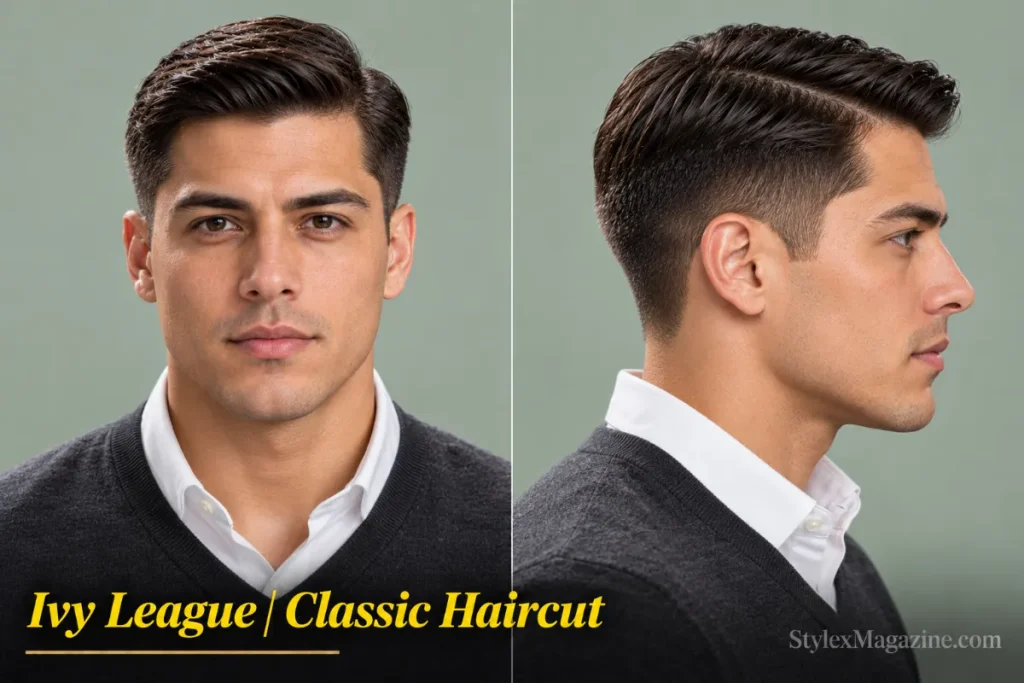
The Ivy League haircut is a longer crew cut with enough top length (1.5-2.5 inches) to part and comb to one side. It gets its name from the prep-school and university culture of the 1950s American East Coast, where the look signaled polish without effort.
What separates it from a crew cut is that partable top length. What separates it from a full side part is the shorter, tighter overall profile. It sits between the two and works in environments where a crew cut feels too informal and a slicked side part feels too sharp.
For a complete breakdown of 25 Ivy League variations with face shape matching and barber specs, see the full guide.
Best for: Oval, square, and heart face shapes. Straight and wavy hair.
Maintenance arc: Holds 3-4 weeks. Grows gracefully into a side part.
Brush Back
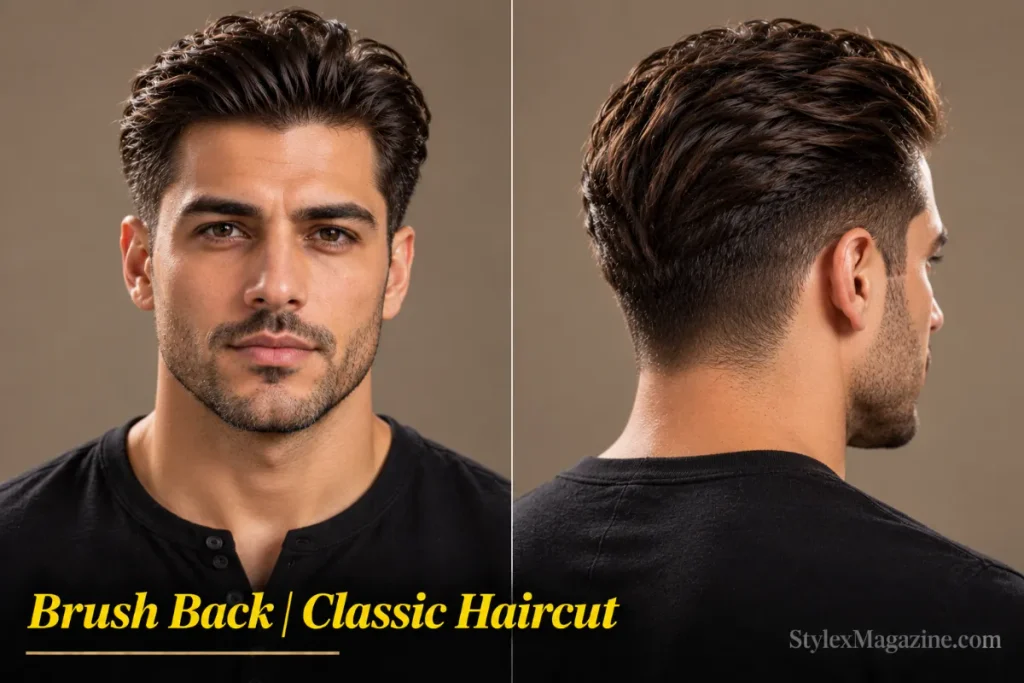
Think of the brush back as a slick back with the volume turned down. Instead of slicking hair flat against the skull with high-shine pomade, you sweep it rearward with lighter product, leaving visible texture and natural movement.
It suits men whose hair has enough natural body to hold a backward direction without heavy styling aid. The cut underneath is tapered sides (#2-#3) and a longer top (3-4 inches). The difference between a brush back and a slick back lives entirely in the finish: grooming cream and fingers instead of pomade and a fine-tooth comb.
Barber Spec Card
- Sides: #2 to #3, tapered
- Top: 3-4 inches
- Technique: Scissor top, clipper sides, blended
- Key product: Grooming cream or light-hold matte paste
Best for: Square, oval, and oblong face shapes. Thick straight and wavy hair.
Maintenance arc: Holds 3-4 weeks. Grows out cleanly. Rebook every 4 weeks.
Volume and Movement Classics
These styles use height, sweep, or directional flow to create visual impact. They require more product and styling time, but the payoff is a silhouette that carries presence.
Pompadour
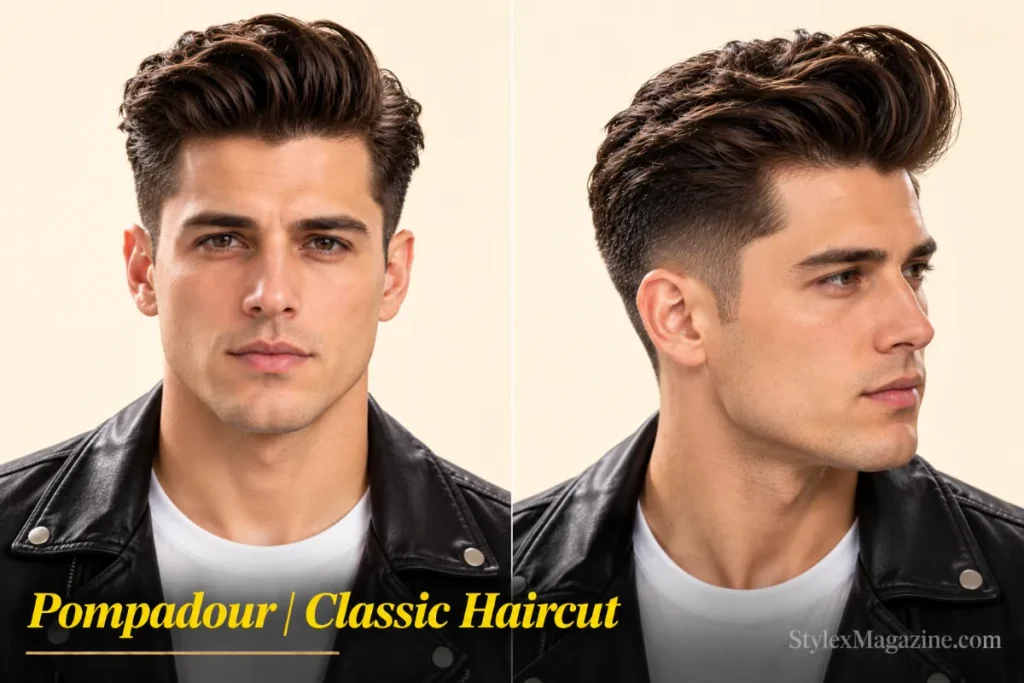
The pompadour is named after Madame de Pompadour, the mistress of King Louis XV of France in the 1750s. The men’s version took hold in the 1950s when Elvis Presley and James Dean turned the high-volume, swept-back silhouette into a symbol of rebellion and cool.
The defining element is height at the front. Hair is combed up and back from the forehead, building volume that tapers toward the crown. The sides are kept short and tight to emphasize the contrast between the sculpted top and the clean perimeter.
Getting a good pompadour starts with enough length on top: at least 4 inches, ideally 5-6 for a fuller shape. Thick hair holds the volume naturally. Fine hair can achieve it with mousse and a blow-dryer, but the hold fades faster without a strong-hold product.
Expect 5-10 minutes of styling each morning: towel-dry, apply product, blow-dry forward and up from the roots, then comb back into shape. A round brush during blow-drying builds the volume base.
Barber Spec Card
- Sides: #1 to #2, tapered or faded
- Top: 4-6 inches, longest at the front hairline
- Technique: Scissor top, clipper sides, disconnected or blended transition
- Key product: Strong-hold pomade or mousse + blow-dryer
Best for: Oval, square, and diamond face shapes. Thick straight and wavy hair.
Maintenance arc: Starts losing shape at 2-3 weeks. The height collapses as weight increases. Rebook every 2-3 weeks for the full silhouette.
Quiff
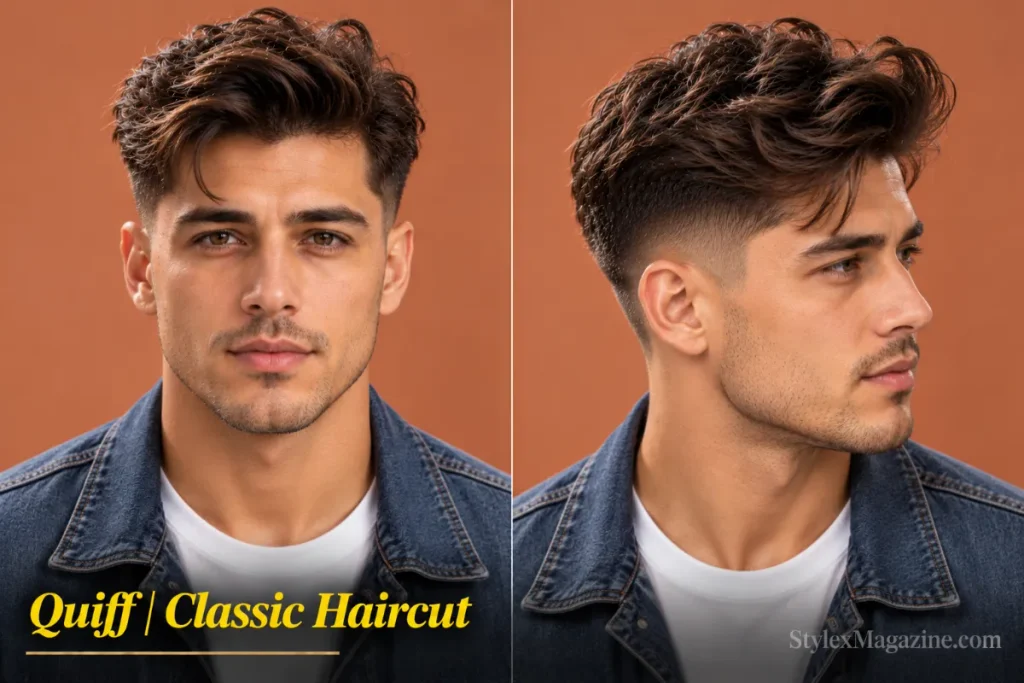
The quiff emerged from 1950s British rock-and-roll culture, blending elements of the pompadour’s height with the crew cut’s clean sides. It is shorter and more textured than a pompadour, with the volume focused at the front and less formal sweep.
Where a pompadour lifts and combs back, a quiff lifts and falls slightly forward or to the side. That forward direction gives it a more casual, less sculpted feel. It suits men who want height without the daily commitment of a pompadour.
The quiff also bridges classic and modern better than most cuts on this list. Add texture and matte product for a 2026 look. Use pomade and a comb for a 1950s version. Same base cut, different finish.
For men with longer faces, keep the sides at a #3 rather than fading to skin. Removing too much volume at the temples while adding height on top exaggerates vertical proportions.
Barber Spec Card
- Sides: #2 to #3, tapered or mid faded
- Top: 3-5 inches, longest at the fringe
- Technique: Scissor top, clipper sides, textured or blended
- Key product: Matte clay or sea salt spray for texture, mousse for volume
Best for: Oval, heart, and diamond face shapes. Straight, wavy, and thick hair.
Maintenance arc: Holds 3-4 weeks. Grows out into a messy fringe if not maintained. Rebook every 3-4 weeks.
Slick Back
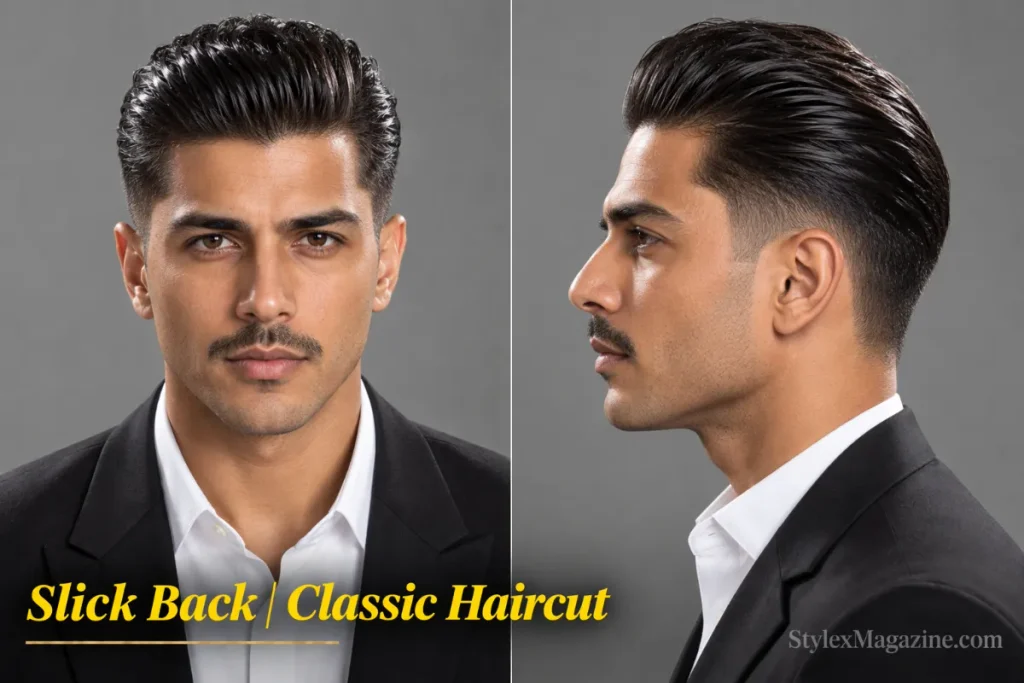
The slick back hairstyles for men category covers a formal look that has held its ground in men’s grooming since the 1920s. Hair is combed straight back from the forehead with a high-shine product, creating a sleek, flat-to-head silhouette with no visible part.
Straight hair works best. Wavy hair can achieve the look with more product and heat styling, but the hold tends to break down by midday. Curly hair requires chemical straightening to pull this off consistently, which is not worth the damage for most men.
The modern version uses a matte-finish pomade instead of high-shine gel, softening the look for settings where a wet finish would feel overdone. For a complete walkthrough on styling technique, see the how to style a slick back guide.
Barber Spec Card
- Sides: #2 to #3, blended taper
- Top: 4-6 inches
- Technique: Scissor top, clipper sides, blended
- Key product: High-shine pomade (classic) or matte pomade (modern)
Best for: Oval, square, and oblong face shapes. Straight and thick hair.
Maintenance arc: Holds 3-4 weeks. Top length remains manageable longer than a pompadour because there is no height to collapse. Rebook every 4 weeks.
Ducktail
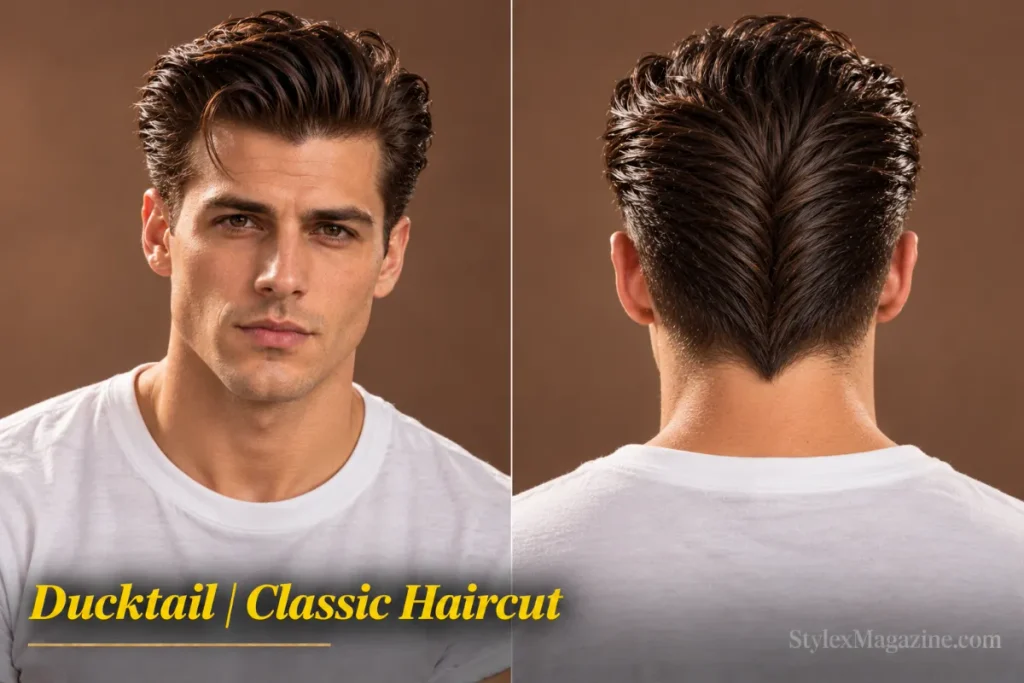
What defines the ducktail is what happens at the back of the head. Hair from both sides is combed toward the center, meeting at a vertical seam that resembles the tail of a duck. The front is typically swept up and back in a pompadour or quiff direction.
It fell out of mainstream fashion after the 1950s but has maintained a cult following among rockabilly enthusiasts and men who appreciate vintage Americana. In modern barbering, the ducktail nape detail can be added to a contemporary pompadour or slick back for a heritage nod without going full retro.
The cut requires enough length on top and at the back (4-5 inches) for the hair to reach the center seam. It works best on thick, straight, or wavy hair that holds a comb direction.
Barber Spec Card
- Sides: Scissor tapered, left long enough to comb back
- Top: 4-5 inches, swept back
- Back: Combed to center seam, tapered at nape
- Key product: Medium-to-strong hold pomade
Best for: Oval, oblong, and heart face shapes. Thick straight and wavy hair.
Maintenance arc: Needs frequent touch-ups. The back seam loses definition at 2-3 weeks. Rebook every 2-3 weeks.
Textured and Cropped Classics
These styles prioritize surface texture over sleek direction. They tend to work well across a broader range of hair types because the texture hides imperfections and cowlicks rather than fighting them.
French Crop
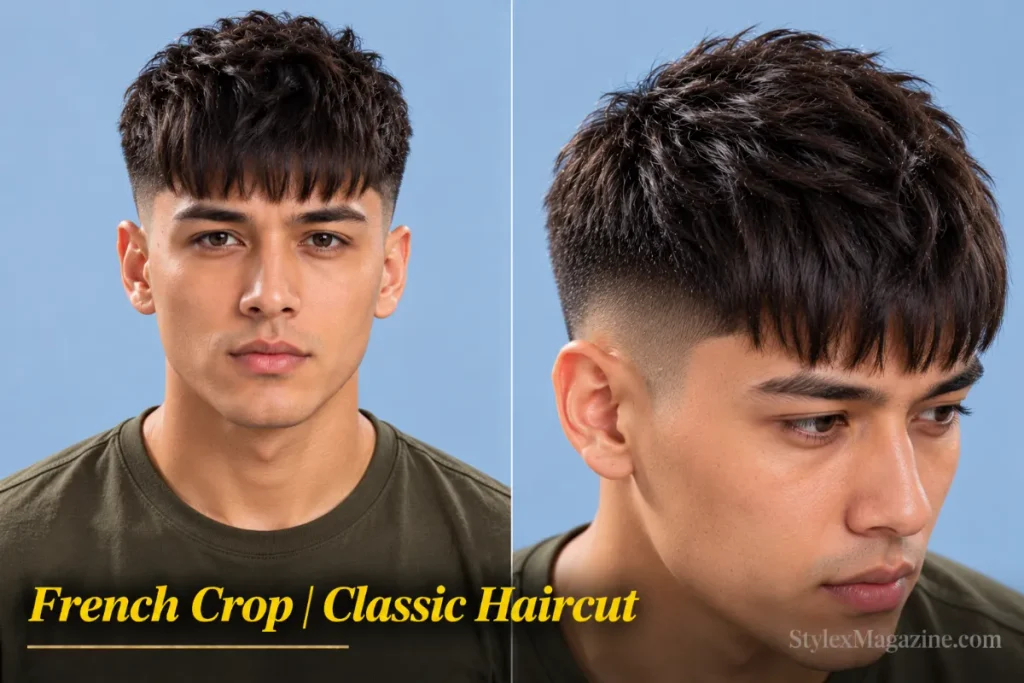
A blunt or slightly textured fringe falling across the forehead is what sets the French crop apart from every other short cut. The sides are faded or tapered, keeping the focus on the top and front.
The fringe works as a built-in face-framing element, making it flattering across nearly every face shape. Round faces benefit from a slightly longer, side-swept fringe that breaks the circular outline. Square faces work well with a textured, choppy fringe that softens angular jaw lines.
For men with receding hairlines, the French crop is a reliable option. The forward-falling fringe covers the recession zone naturally without looking like a deliberate concealment. For more options in that category, see the haircuts for receding hairlines guide.
Styling takes under two minutes. Towel-dry, work a small amount of matte clay or texture paste through the top, and push the fringe forward or slightly to one side with your fingers.
Barber Spec Card
- Sides: #1 to #2, faded
- Top: Finger length, textured with point cutting
- Fringe: Blunt or choppy, falling to mid-forehead
- Technique: Clipper fade sides, scissor top with point cutting
- Key product: Matte clay or texture paste
Best for: Round, square, and heart face shapes. Any hair type.
Maintenance arc: Holds 3-4 weeks. The fringe starts to fall past the brow line around week 4. Rebook every 3-4 weeks, or get just a fringe trim at week 3.
Textured Crop
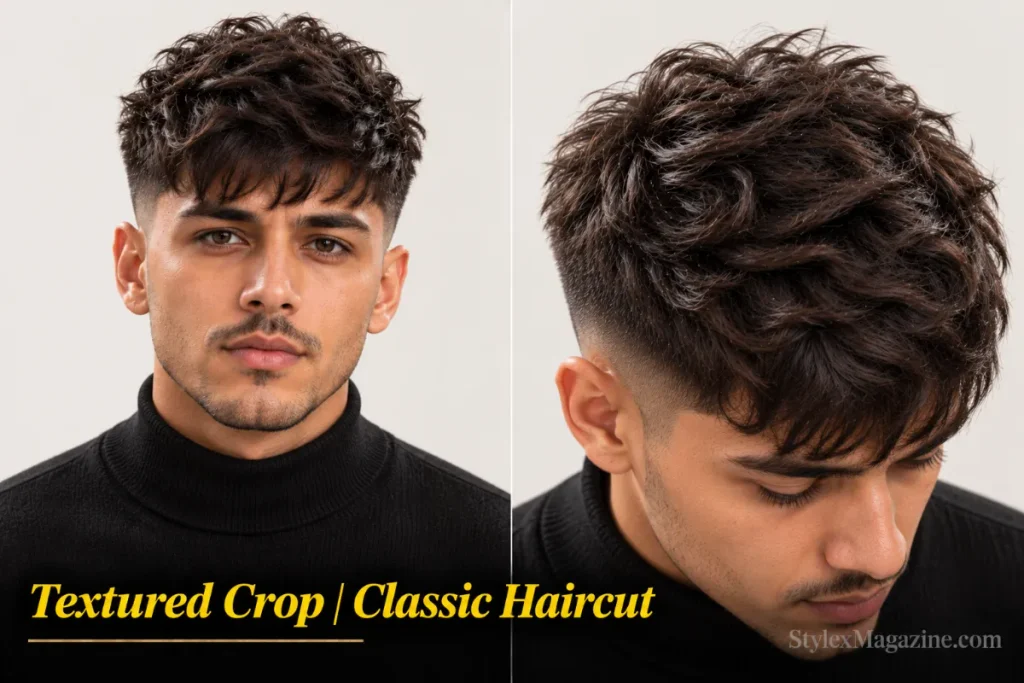
Start with the French crop blueprint, then add more deliberate layering, choppier ends, and a messier finish, and you get the textured crop. It sits somewhere between structured and undone.
Where the French crop aims for a neat, blunt fringe, the textured crop pushes for movement and irregularity. The layers are cut at varying lengths to create natural lift and separation without needing volume products.
This is a strong choice for thick or wavy hair, where the natural texture does most of the styling work. Fine hair can pull it off but will need a texturizing spray or dry shampoo to create the separation that thicker hair achieves on its own.
Barber Spec Card
- Sides: #1 to #2, faded
- Top: 2-3 inches, layered and textured
- Technique: Scissor with point cutting and slide cutting, clipper fade sides
- Key product: Texturizing spray or matte wax
Best for: Oval, round, and square face shapes. Thick and wavy hair.
Maintenance arc: Holds 3-4 weeks. Actually looks better at week 2-3 than fresh, because slight growth adds to the textured effect. Rebook every 4 weeks.
Caesar Cut
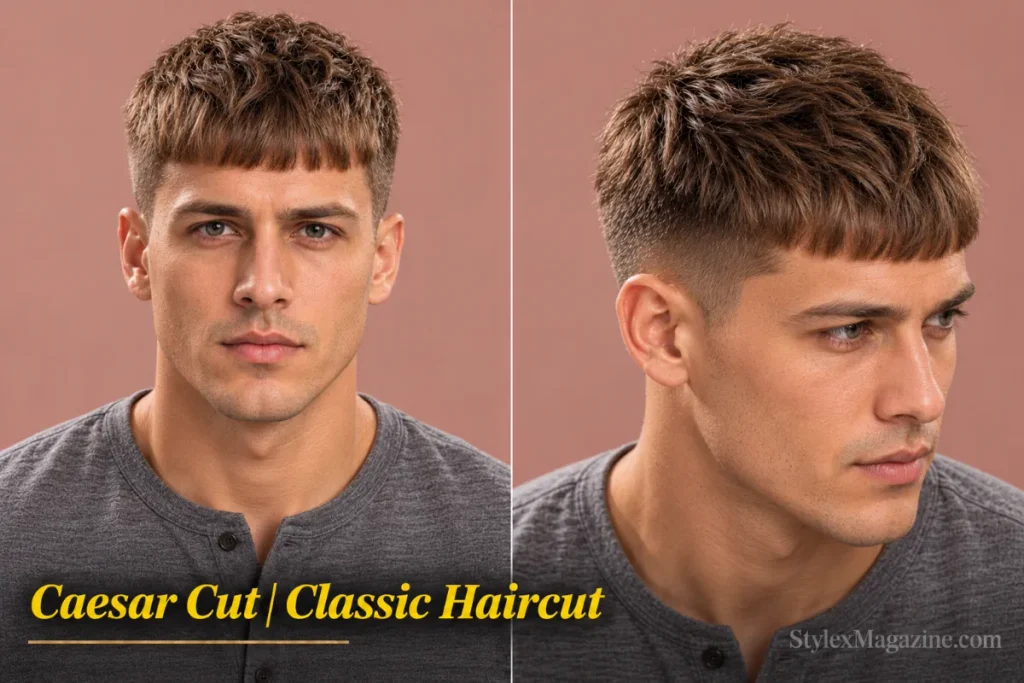
Named after Julius Caesar, who reportedly combed his hair forward to cover thinning at the crown, this short, uniform-length style with a straight, blunt fringe has outlasted most trends by several centuries.
That origin story is also the cut’s strongest practical advantage: the forward direction and short length make it highly effective for managing early hair loss. The uniform length eliminates the thick-to-thin contrast that makes thinning more visible.
For variations, face shape matching, and barber communication advice, see the full Caesar haircut guide.
Best for: Round, square, and oval face shapes. Straight, wavy, and thinning hair.
Maintenance arc: Holds 2-3 weeks. Very short length means growth is noticeable quickly. Rebook every 2-3 weeks.
Short Back and Sides
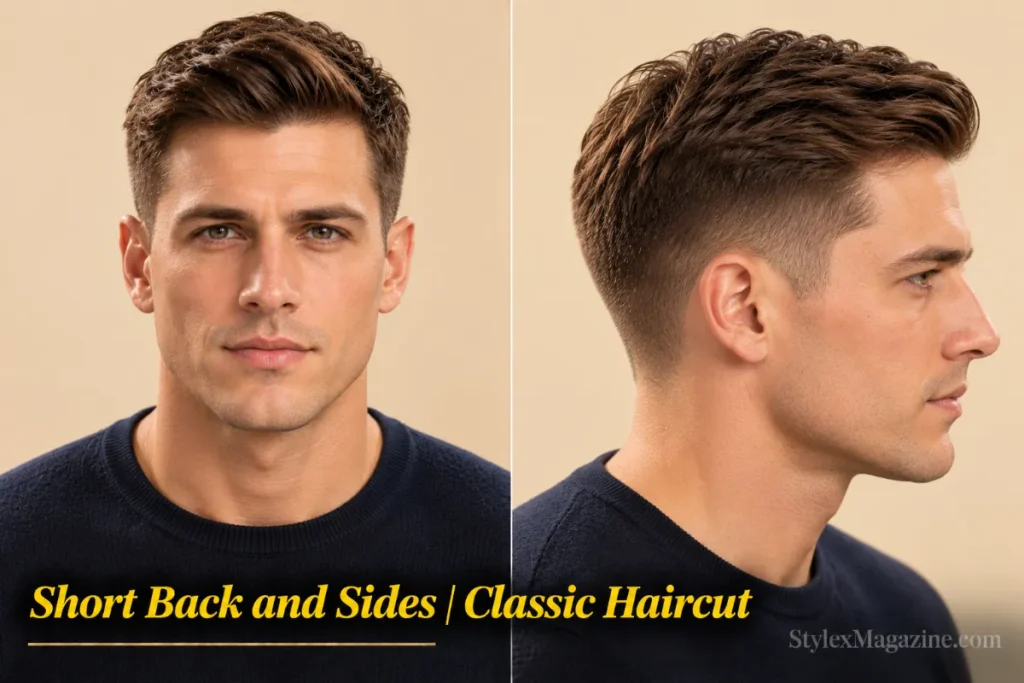
“Short back and sides” is not a single cut. It is the foundation template that most classic men’s haircuts are built on: clipper-cut sides and back, longer scissor-cut top, blended transition between the two.
When a man sits in the barber’s chair without a specific style in mind, “short back and sides” is the starting instruction. The barber then tailors the top length, transition style, and finish based on face shape and hair type.
In British barbering, this phrase carries more specific weight. It generally means a #3-#4 guard on the sides, 2-4 inches on top, and a gradual taper from short to long. It is the default gentleman’s cut in UK barbershops and serves as the base for variations like the side part, the brush back, and the Ivy League. The recent old money haircut trend leans heavily on this template: a clean short-back-and-sides base with a longer, swept top styled for quiet-luxury polish.
Barber Spec Card
- Sides: #3 to #4 guard, tapered
- Top: 2-4 inches, scissor cut
- Technique: Clipper sides, scissor top, blended
- Key product: Depends on styling direction (pomade, clay, cream, or nothing)
Best for: All face shapes. All hair types. This is the universal starting point.
Maintenance arc: Holds 4-5 weeks. Grows out gradually and gracefully. Rebook every 4-5 weeks.
Contrast and Edge Classics
These cuts use a sharp distinction between short and long sections to create visual tension. They lean more modern than the previous groups but have long enough track records to qualify as established classics.
Undercut
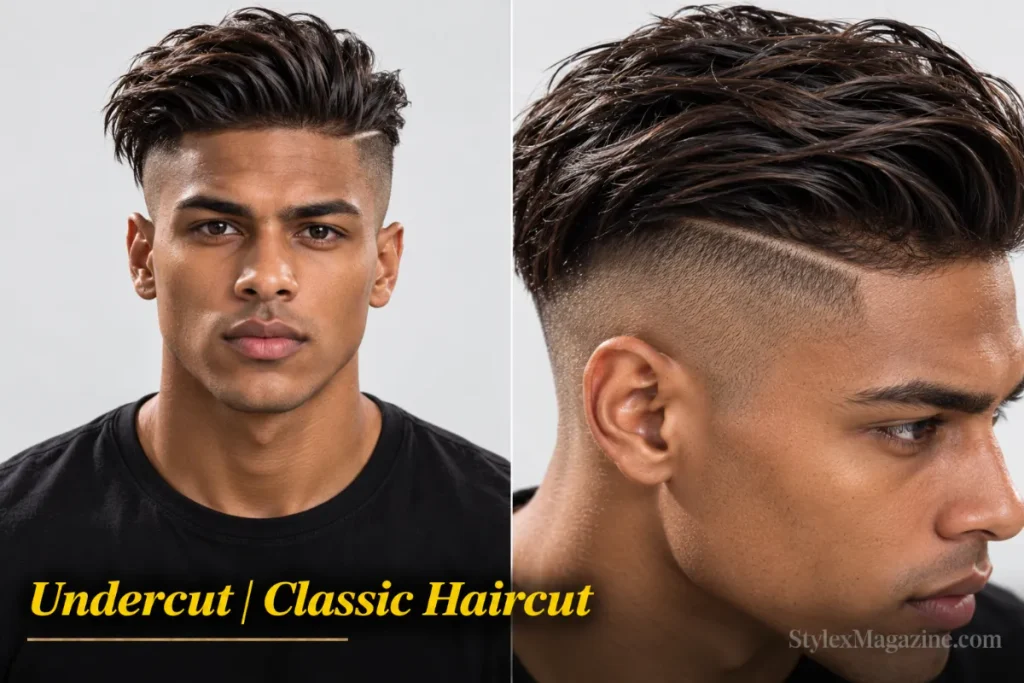
The undercut first appeared in the 1920s Weimar Republic era, where it was associated with working-class men and counter-culture movements. It disappeared for decades, returned through 2010s menswear culture, and has now settled into a permanent position in the classic rotation.
What separates the undercut from every other style on this list is disconnection. Unlike a taper or fade, where the sides gradually blend into the top, the undercut creates a hard line between short sides (#0-#1) and a dramatically longer top (3-5 inches). That abrupt transition is the style’s signature.
The top can be styled in any direction: slicked back, combed to one side, pushed forward as a quiff, or left loose with texture.
One caution: the undercut grows out poorly. The disconnection that looks sharp at week 1 becomes an awkward shelf of hair by week 4. This is not a set-it-and-forget-it cut. Budget for frequent maintenance.
Barber Spec Card
- Sides: #0 to #1 guard, disconnected (no blend)
- Top: 3-5 inches
- Technique: Clipper sides with hard line, scissor top
- Key product: Depends on top styling direction
Best for: Oval, square, and diamond face shapes. Straight, wavy, and thick hair.
Maintenance arc: Looks sharp for 2 weeks. The disconnection starts to blur at week 3. Rebook every 2-3 weeks.
Taper Cut
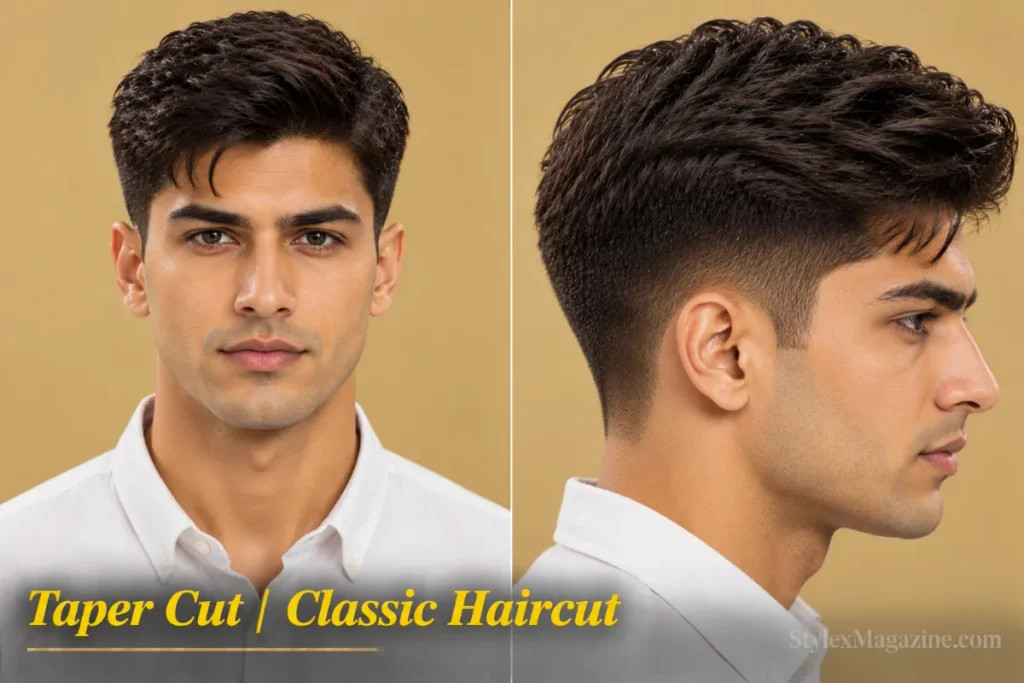
More technique than style, the taper is the foundational barbering method that underpins most classic cuts on this list. Hair gradually decreases in length from the top down to the neckline and around the ears, with no hard lines or abrupt transitions.
When someone asks for “just a taper,” you get a clean, graduated silhouette that is short at the perimeter and longer at the crown. It can serve as a standalone cut or as the base for a side part, comb over, or brush back.
The taper differs from a fade in one critical way: a taper keeps some visible hair at the shortest point, while a fade blends down to skin. For men who want clean lines without the maintenance commitment of a skin fade, the taper is the better option.
Barber Spec Card
- Sides: Graduated blend, no skin exposure
- Top: 2-4 inches
- Technique: Clipper-over-comb at perimeter, scissor top, seamless blend
- Key product: Based on top style choice
Best for: All face shapes. All hair types.
Maintenance arc: Holds 4-5 weeks. Grows out more gracefully than any fade because there is no skin-to-hair grow-in line. Rebook every 4-5 weeks.
Mod Haircut
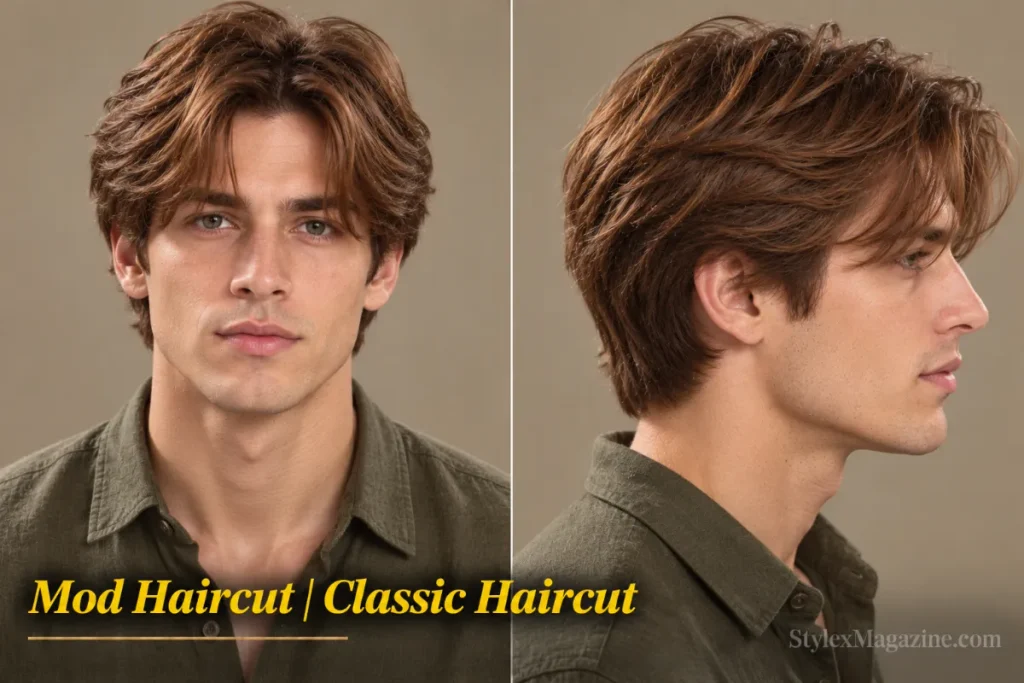
The mod haircut comes from the 1960s British Modernist subculture that prized clean lines, tailored clothing, and a sharp-but-effortless approach to personal style. The cut features longer, layered hair on the top and sides, worn with natural movement and minimal product.
Unlike most classics on this list, the mod cut does not use clippers on the sides. The entire cut is scissor-work: the sides are trimmed to ear length or slightly below, and the top is left long enough (4-6 inches) to fall naturally with a center or side parting.
It is the least formal classic cut in this collection and the most difficult to maintain, because any scissor-only cut requires more frequent shaping to keep its lines clean.
For a detailed look at mod haircut variations, see the full mod haircut for men guide.
Best for: Oval, oblong, and heart face shapes. Straight and thick hair.
Maintenance arc: Needs a trim every 3-4 weeks. Without regular shaping, the layered structure loses definition and starts looking like generic long hair.
How to Pick the Right Classic Cut
Start with your face shape. If you are not sure of yours, use the face shape calculator or check the haircuts by face shape guide.
Oval face: You have the most flexibility. Any cut on this list works. Start with the side part or crew cut and adjust from there.
Round face: Avoid uniform-length cuts like the buzz cut, which emphasize circular proportions. Go for styles with height on top and tight sides: the quiff, pompadour, or French crop. The vertical lift elongates the face.
Square face: Strong angles suit structured cuts. The crew cut, buzz cut, and side part complement your jaw line. Avoid rounded, floppy styles that fight the face’s geometry.
Oblong face: Skip anything that adds height (pompadour, quiff). The side part, regulation cut, and brush back keep proportions balanced by adding width rather than height.
Heart face: Styles with some length on the sides (short back and sides, Ivy League) balance a wider forehead against a narrower chin. Avoid very tight sides that make the forehead look wider.
Diamond face: Angular cuts (undercut, textured crop) work with the face’s natural angles. The quiff and pompadour also suit diamond shapes well because the top volume balances the cheekbone width.
Next, match your hair type. Men with thick straight hair can pull off high-volume styles (pompadour, quiff, brush back) without much product. Men with thin or fine hair should lean toward shorter cuts (crew, French crop, buzz) that do not depend on density for their shape. For curly hair, the textured crop and French crop work with natural curl patterns rather than fighting them.
Men over 40: Classic cuts become more fitting with age, not less. Avoid high-contrast skin fades and disconnected undercuts that compete with facial aging for attention. The side part, crew cut, regulation cut, and short back and sides age well in both professional and casual settings.
Pairing with a beard: Facial hair changes the proportions of any cut. Shorter cuts (buzz, crew, French crop) balance a fuller beard. Longer-top styles (pompadour, quiff) can overwhelm when combined with heavy facial hair, so keep the beard trimmed shorter if the top runs past 4 inches.
Finally, be honest about your maintenance tolerance. If you will not spend more than 30 seconds on your hair each morning, stick to the buzz cut, crew cut, or French crop. If you are willing to invest 5-10 minutes, the pompadour, quiff, and slick back become viable.
What to Tell Your Barber?
The barber spec cards above give you the technical details. Here is how to translate them into a productive barber conversation:
Bring a reference photo. One photo is worth 50 words of verbal description. Show the barber what you want from the front and, if possible, from the side.
State three things: (1) the style name, (2) the guard number or length you want on the sides, and (3) how long you want the top. Example: “I want a crew cut. Number 2 on the sides, tapered, finger length on top.”
Specify the transition. “Tapered” means a gradual blend. “Faded” means blending down toward skin. “Disconnected” means a hard line between short and long. These words make a bigger difference to your final look than the style name itself.
Mention your problem areas. If you have a cowlick, a double crown, a receding hairline, or thinning at the crown, tell the barber before the cut starts. A good barber adjusts the cut to work with these features, not against them.
FAQ
What is the most classic haircut for a man?
The side part. It has remained in continuous use since the 1920s, works with virtually every face shape, suits both casual and formal settings, and requires minimal product. The crew cut and buzz cut are close seconds, but the side part’s adaptability across decades puts it at the top.
What is the difference between a classic and modern haircut?
Classic haircuts rely on clean structure, balanced proportions, and techniques that have been standard in barbering for decades (tapering, parting, scissor-over-comb). Modern haircuts tend to feature sharper contrasts (skin fades, hard parts, disconnected undercuts) and textured, less polished finishes. Many of today’s popular styles are modern updates of classic foundations.
Do classic haircuts work on curly or wavy hair?
Yes, with adjustments. The French crop, textured crop, crew cut, and short back and sides all work well with curly and wavy textures. Styles that require combing into a specific direction (slick back, pompadour) are harder to maintain on curly hair and may need heat styling or stronger product. For dedicated options, see the curly hairstyles for men guide.
How often should you trim a classic haircut?
Frequency varies by cut. Buzz cuts and high-and-tights need rebooking every 2 weeks. Crew cuts, side parts, and French crops hold shape for 3-4 weeks. Short back and sides and taper cuts can stretch to 4-5 weeks. The spec cards above list the exact maintenance window for each style.
Can you modernize a classic haircut without losing its identity?
Yes. The three most common updates are: (1) replacing a tapered side with a skin fade for sharper contrast, (2) adding texture to the top with matte product instead of using pomade for a slick finish, and (3) keeping the overall shape but wearing it messier and less sculpted. These changes update the aesthetic without changing the underlying cut.
What classic haircut is best for a receding hairline?
The French crop, crew cut, buzz cut, and Caesar cut all work well because they minimize the length contrast between thick and thin areas. The French crop’s forward fringe can conceal early recession. For a full guide on managing hair loss with the right cut, see the haircuts for receding hairlines guide.

Other Articles
25 Best Ivy League Haircuts for Men (2026)

[…] For the full rundown of timeless cuts in this category, see classic men’s haircuts. […]
[…] height as the classic but taken to bare skin at the base, #0 guard, straight razor finish. The sharpest result a low fade […]