
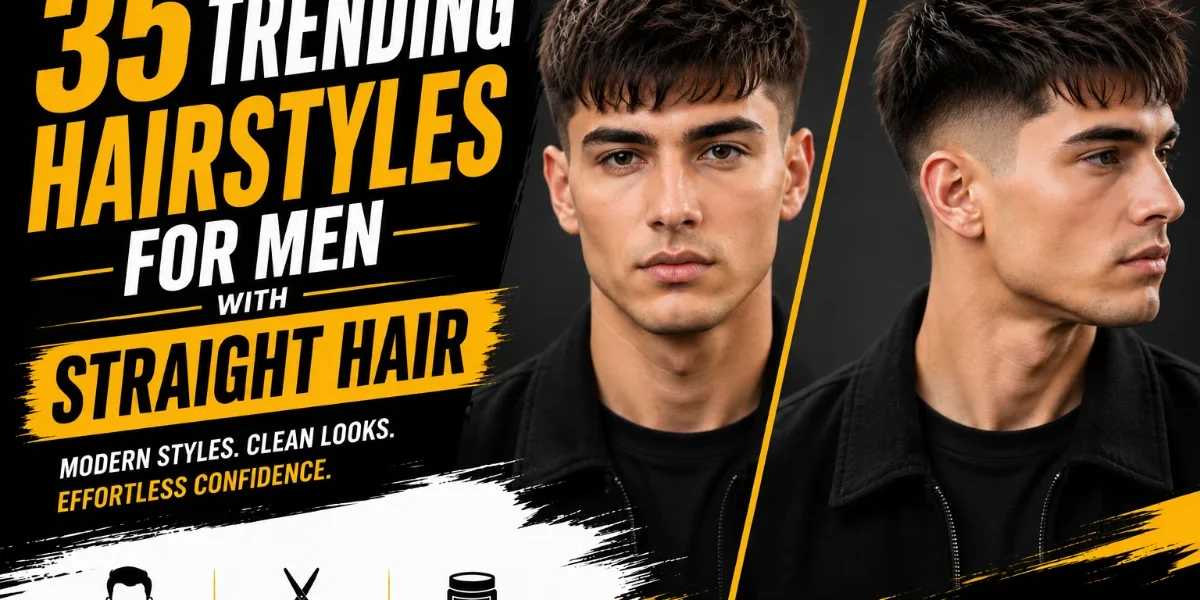

Quick answer: The crew cut, textured quiff, and side part consistently rank as the strongest all-round choices for straight hair because they hold shape with minimal product, suit most face shapes, and take under five minutes to style each morning.
Straight hair sits flat from root to tip. It reflects light evenly, rarely frizzes, and holds clean lines better than any other hair type. That makes it the easiest texture to cut and style, but also the easiest to get wrong. A bad cut on straight hair has nowhere to hide.
This guide covers 35 haircuts that work on straight hair, organized by length. Each one includes face shape matches, what to tell your barber, and a styling tip you can use the same day. If your hair is thick and dense, we have a separate guide covering cuts that manage bulk: Thick Straight Hair Haircuts for Men. If your hair is fine or thinning, the approach changes. Read Thin Straight Hair Haircuts for Men for volume-focused options.
How to Match a Haircut to Your Face Shape
Your face shape determines which cuts sharpen your features and which ones work against them.
| Face Shape | What Works | What to Avoid | Why |
| Oval | Almost anything: crew cut, quiff, pompadour, curtain bangs | No restrictions | Balanced proportions handle all styles |
| Round | Height on top: pompadour, quiff, faux hawk, textured crop with high fade | Uniform-length cuts, chin-length bobs | Vertical volume elongates a round face |
| Square | Textured crop, side part, layered cuts, messy fringe | Ultra-short buzz cuts that expose the full jaw | Texture softens strong angles |
| Oblong | Fringe styles, curtain bangs, side-swept cuts | Tall pompadours, slick backs with no side volume | Adding width prevents the face from looking longer |
| Diamond | Side part, quiff, curtain bangs, layered mid-length | Very short all-over cuts | Volume at the forehead and jaw balances narrow points |
| Heart | Fringe or side-swept bangs, medium-length textured cuts | Styles that add width at the temples | Covering the forehead slightly balances a narrow chin |
| Triangle | Textured quiff, pompadour, side-swept fringe with volume on top | Cuts that add bulk at the jawline, such as full beards paired with short tops | The wider jaw needs visual weight shifted upward toward the forehead |
How to find your face shape in 30 seconds: Stand in front of a mirror with your hair pulled back. Compare three measurements: forehead width, cheekbone width, and jawline width. If all three are roughly equal, you have a square or round face (jaw angle tells you which). If your forehead is widest, that is heart-shaped. If your cheekbones are widest, diamond.
If your jawline is the widest point, triangle. If your face is noticeably longer than wide, oblong. If nothing stands out, oval. Men with a large forehead should also factor forehead coverage into their cut choice. Fringe styles and textured crops work well.
Short Hairstyles for Straight Hair (1–3 Inches)
Short cuts on straight hair look sharp with minimal effort. The texture sits naturally, lines stay clean, and most of these need under two minutes to style.
1. Buzz Cut
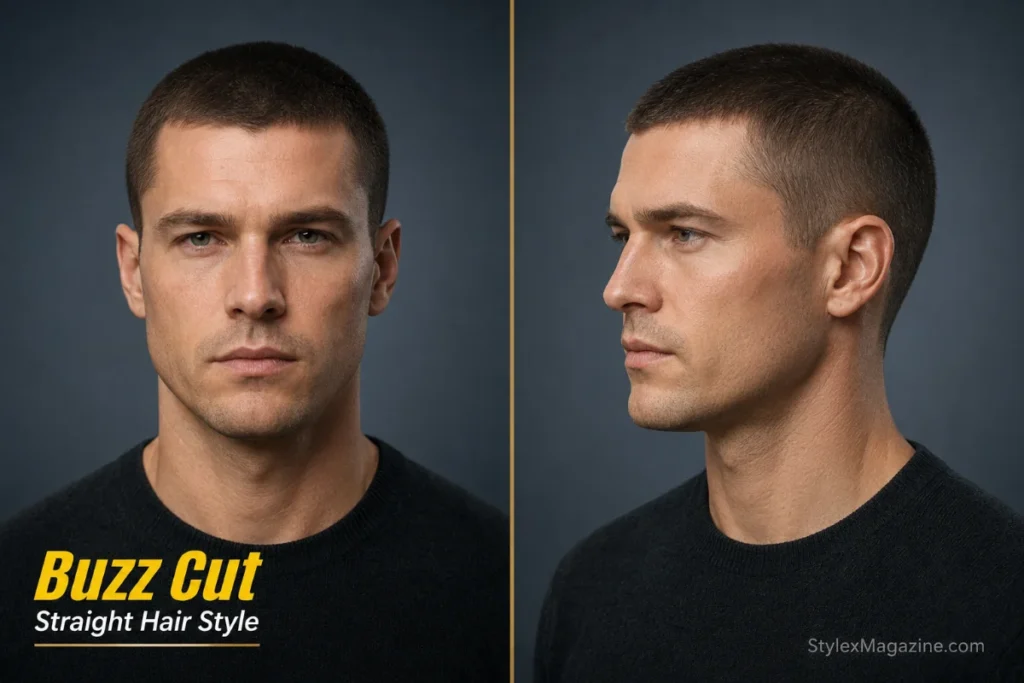
A single clipper guard all over, typically a #2 or #3. Zero styling required. The buzz cut strips everything back to the skull shape, so it works best on men with symmetrical head shapes and defined facial features. Jason Statham built an entire career look around this cut.
- Best face shape: Oval, square
- Ask your barber: “Number 2 all over, squared neckline, clean around the ears.”
- Styling tip: No product needed. Apply SPF to the scalp in summer. Exposed skin burns fast.
2. Burr Cut with Line Up
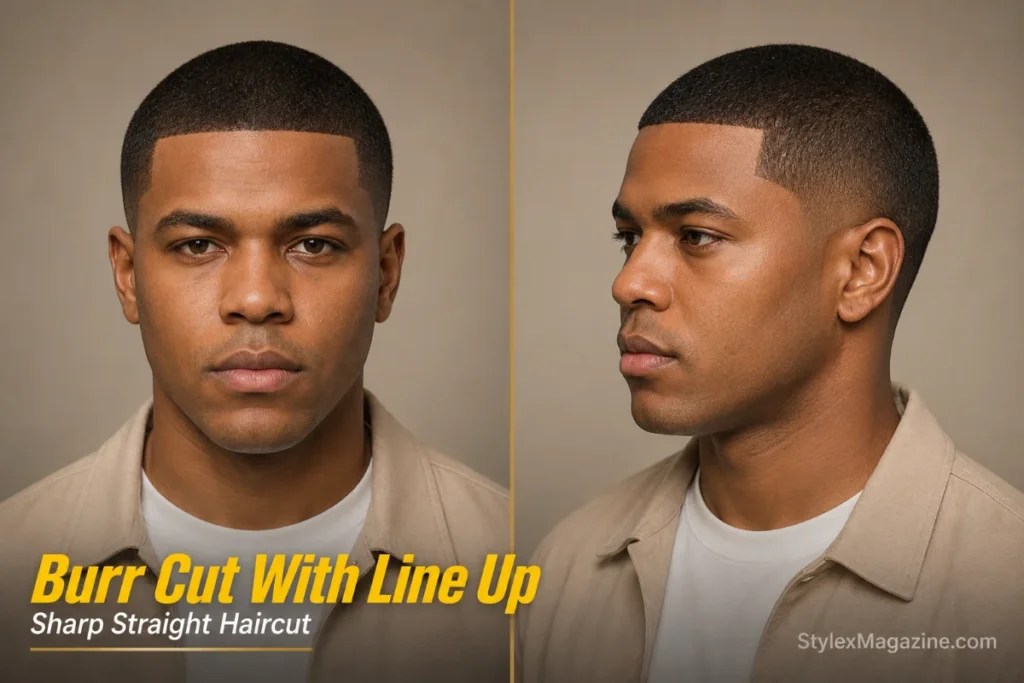
Similar to a buzz but with a razor-sharp geometric edge around the hairline. The line up adds structure to what would otherwise be a plain clipper cut. Barbers use a straight razor or detailer to square the forehead, temples, and neckline into clean right angles.
- Best face shape: Round, oval. The sharp edges add angles to softer faces
- Ask your barber: “Burr cut, #2 guard, with a sharp line up at the forehead and temples.”
- Styling tip: Apply edge control gel along the hairline to maintain the crisp line between barber visits.
3. Crew Cut
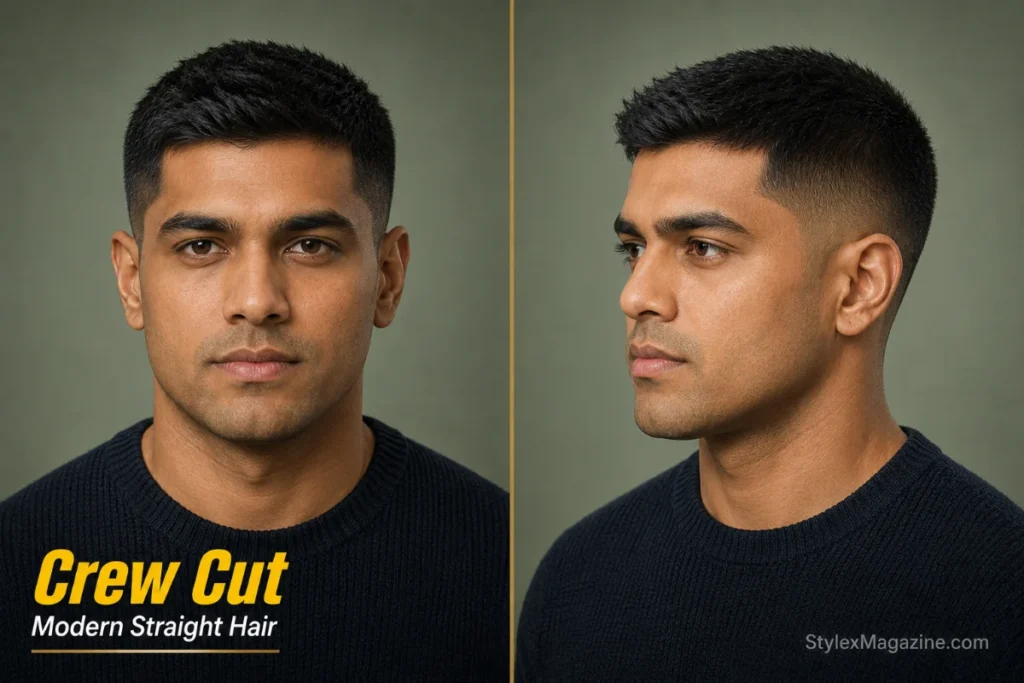
One to two inches on top, tapered sides. The crew cut is the most reliable short haircut in men’s grooming. It flatters every face shape and works in every professional setting. Straight hair makes the top lie flat and controlled, which is exactly what this cut demands. Chris Evans wore a textured crew cut through most of his Captain America run.
- Best face shape: All face shapes
- Ask your barber: “Crew cut, an inch and a half on top, tapered sides, blended neckline.”
- Styling tip: A fingertip of matte clay pressed into towel-dried hair adds texture without shine. Style forward for a modern look or to the side for a classic finish.
4. Textured French Crop
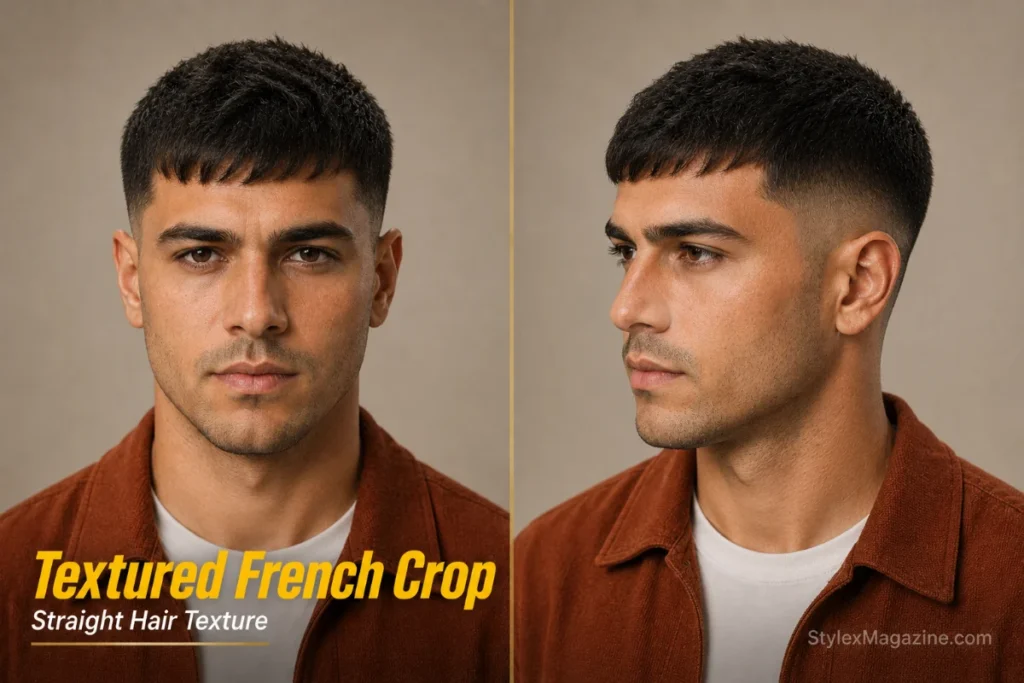
Short on the sides with a choppy, forward-falling fringe that sits just above the eyebrows. The fringe is point-cut (scissors held at an angle) to remove weight and create internal movement. This prevents the flat-sheet look that straight hair defaults to at this length. Tom Holland wore a version of this in multiple press tours.
- Best face shape: Round, oval, heart. The fringe shortens a long face and balances a wide forehead
- Ask your barber: “French crop, low fade on the sides, point-cut the top for texture, blunt fringe just above the brows.”
- Styling tip: Texture powder at the roots lifts straight hair without adding weight. Pinch small sections with your fingers for a piece-y finish.
5. Caesar Cut
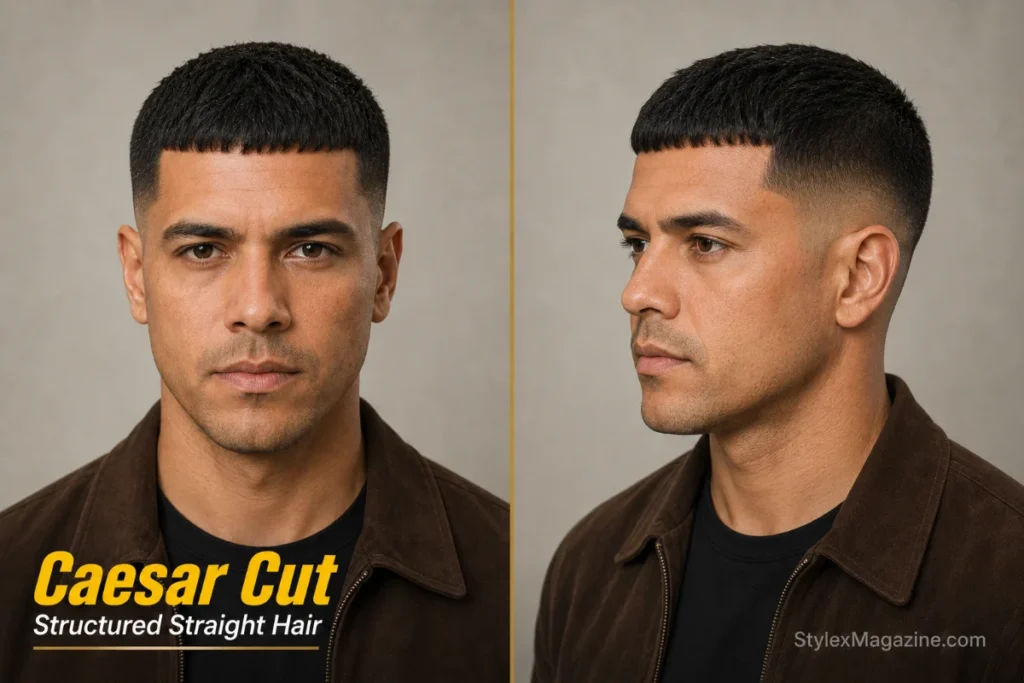
A short, blunt fringe cut straight across the forehead with uniform length on top (about one to two inches). The Caesar has a deliberate, geometric quality that straight hair handles perfectly. Every strand sits exactly where it should. This cut also works as a strategic choice for men with slightly receding hairlines, since the forward fringe covers the hairline naturally.
- Best face shape: Oval, square, oblong
- Ask your barber: “Caesar cut, blunt fringe sitting flat on the forehead, mid fade on the sides.”
- Styling tip: Blow-dry the fringe forward with a flat brush. A light flexible wax keeps it lying uniform all day.
6. Edgar Haircut
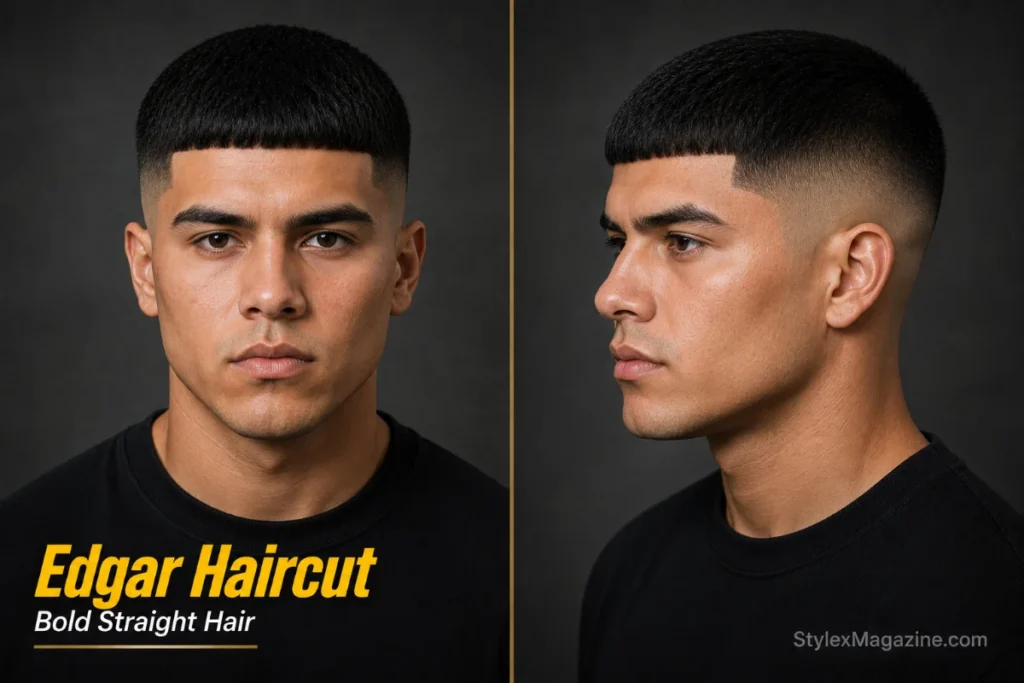
A blunt, perfectly horizontal fringe paired with a high skin fade. The Edgar originated in Latin American barbering culture and gained global popularity through social media. The look is geometric, bold, and intentional. The hard horizontal line across the top meets nearly invisible sides. Straight hair with enough density holds that sharp line without breaking.
- Best face shape: Square, diamond. Angular faces match the geometric structure
- Ask your barber: “Edgar cut: high skin fade, blunt horizontal fringe, crisp line at the top.”
- Styling tip: Strong-hold matte clay keeps the fringe sharp. This cut needs touch-ups every 2–3 weeks because the high fade and blunt line grow out fast.
7. High and Tight
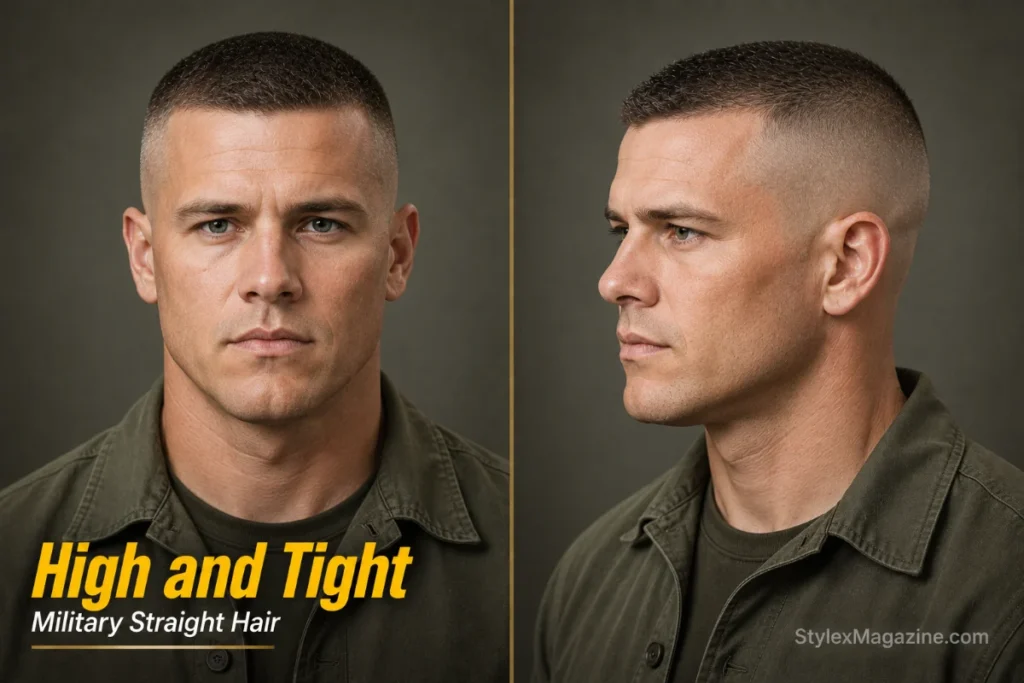
Military origin. The sides are shaved close to the skin starting almost at the crown, leaving a small defined patch of hair on top. In 2026, barbers soften the harsh military line by adding a subtle skin fade at the temples. Minimal effort, maximum structure.
- Best face shape: Oval, square, diamond
- Ask your barber: “High and tight: sides to skin, keep about an inch on top, fade at the temples.”
- Styling tip: Optional: a small amount of matte paste pressed in with fingertips gives the top patch a clean, intentional look.
8. Skin Fade with Textured Top
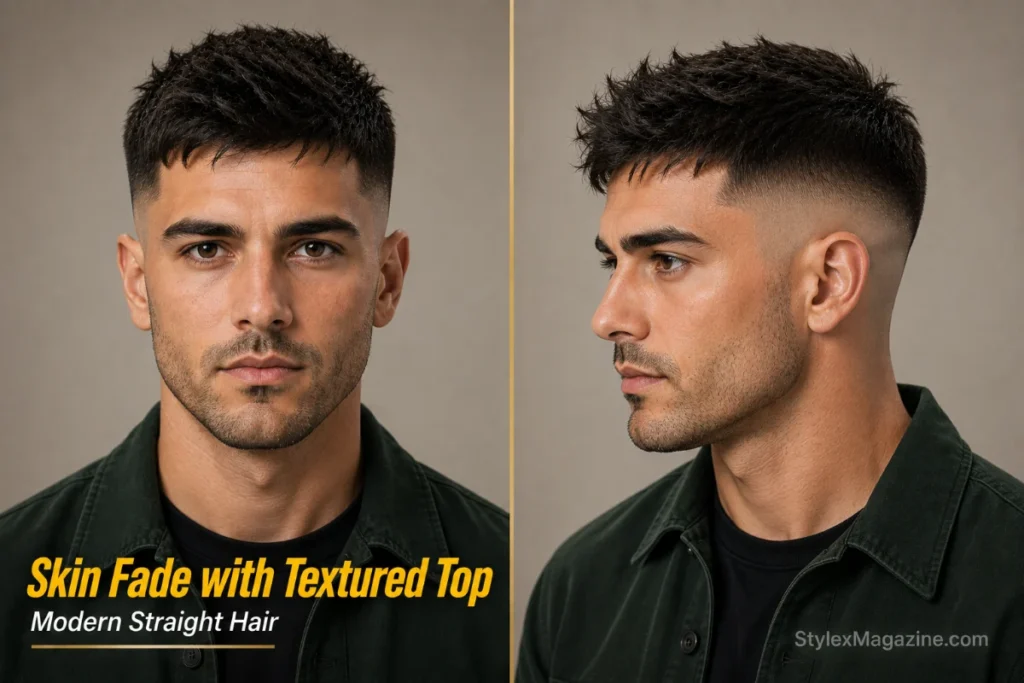
The sides fade down to bare skin while the top stays at two to four inches with point-cut texture for movement and separation. This is one of the most requested cuts globally in 2026, according to barbershop trend reports from Booksy. Straight hair benefits heavily from the textured top. Without it, the contrast between the faded sides and a flat top looks unfinished.
- Best face shape: All face shapes. Universally flattering
- Ask your barber: “Skin fade on the sides, leave 3 inches on top, point-cut for texture and movement.”
- Styling tip: Rough-dry with a blow dryer while tousling with your fingers. Apply matte clay and define sections for a piece-y, separated finish. Do not comb. The imperfection is the point.
9. Textured Crop with Hard Part
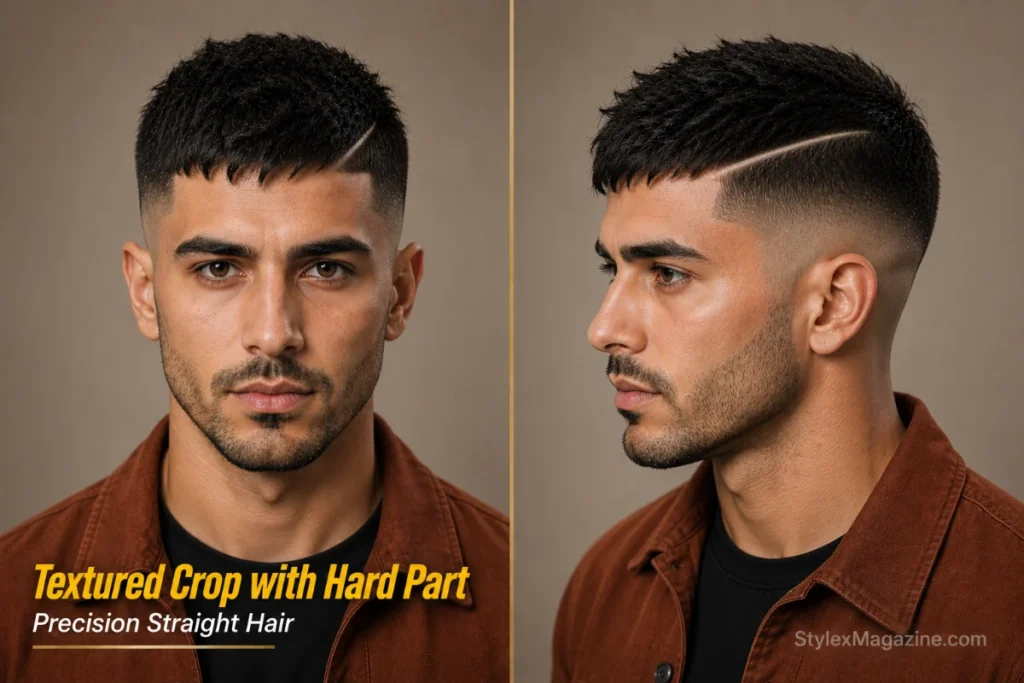
A short textured top with a razor-shaved line cut into the scalp along the natural parting. The hard part creates a visible white line that adds geometric precision. This is a high-detail cut. The shaved line and textured top require a skilled barber who understands proportions.
- Best face shape: All face shapes. The hard part adds structure to any profile
- Ask your barber: “Textured crop, mid fade, hard part shaved on the left side.”
- Styling tip: The hard part needs re-shaving every 2–3 weeks as hair fills it in. Style the top away from the part with matte clay.
10. Drop Fade with Straight Fringe
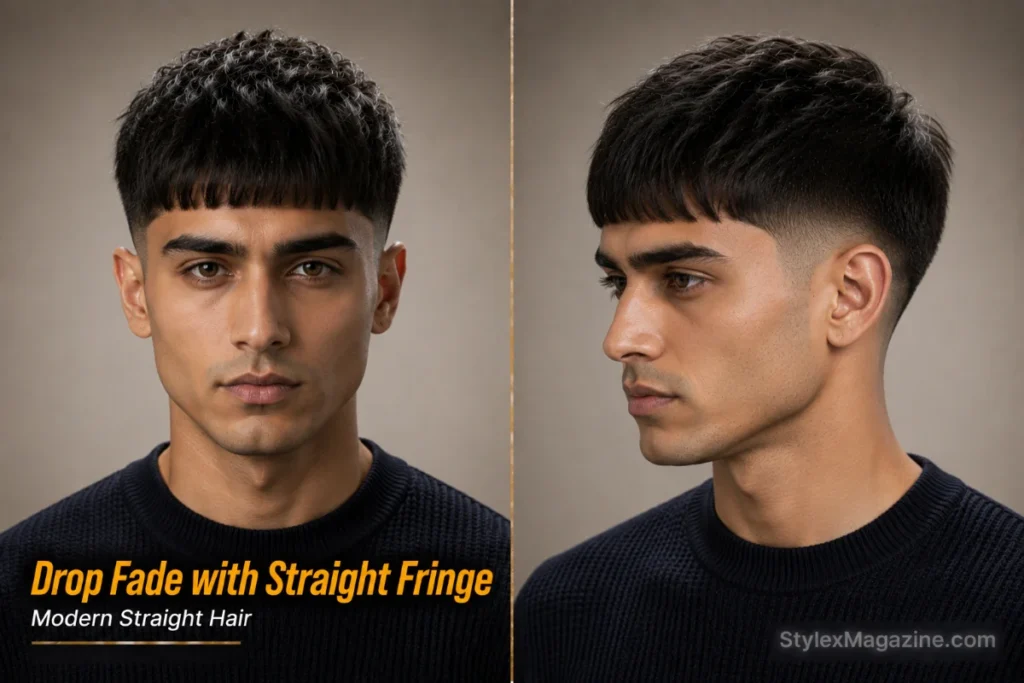
The fade curves downward behind the ear instead of running horizontally, creating a rounded silhouette from the back. Paired with a straight, blunt fringe at the front, you get a contrast between the curved back and the geometric front that looks distinctly modern.
- Best face shape: Oval, round. The curved silhouette softens angular skull shapes
- Ask your barber: “Drop fade, curving down behind the ear, blunt fringe at the front, 2 inches on top.”
- Styling tip: Blow-dry the fringe flat with a paddle brush. Light-hold wax keeps the fringe lying clean.
Medium-Length Hairstyles for Straight Hair (3–5 Inches)
Medium length gives you the most styling options. You can wear these cuts slicked back, swept sideways, or textured forward, and change the look daily with different products.
11. Classic Side Part
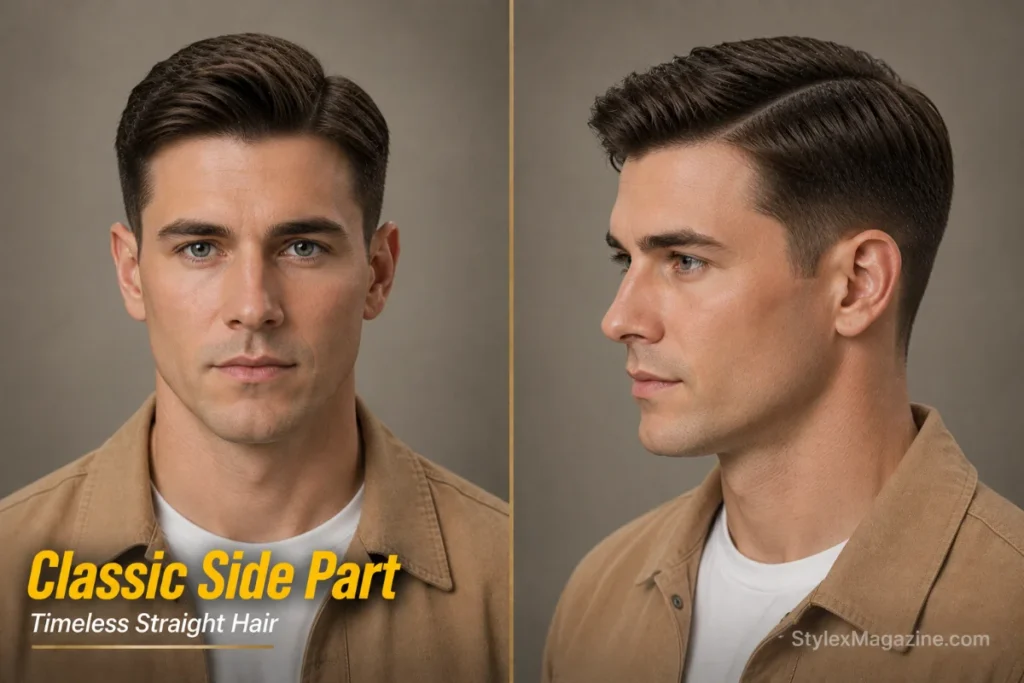
A defined part on one side with the hair swept across the top. Ryan Gosling and Jon Hamm made this cut a modern staple. Straight hair holds a side part better than any other texture because it naturally falls in one direction. This cut transitions from boardrooms to bars without changing a thing.
- Best face shape: Square, heart, diamond. The structured part adds symmetry
- Ask your barber: “Natural part on the left, 3 inches on top, tapered sides, no fade.”
- Styling tip: Create the part on damp hair with a fine-tooth comb. Apply light grooming cream and blow-dry the top away from the part for volume. A low-shine finish reads modern; high gloss reads dated.
12. Pompadour
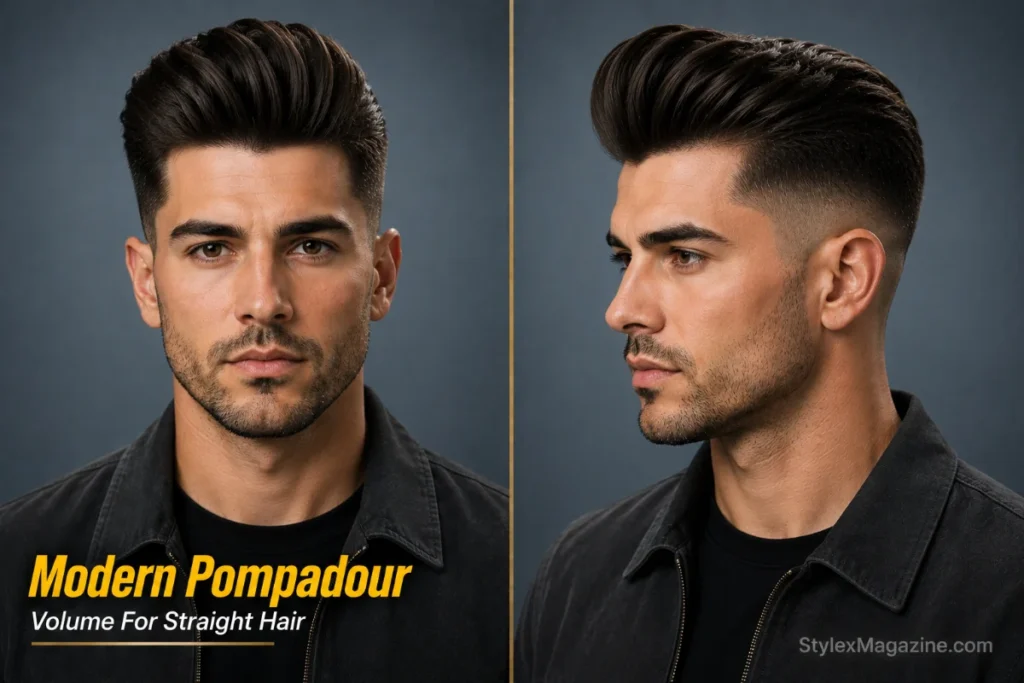
Volume swept upward and backward from the forehead, creating dramatic height at the front. The pompadour is architecturally the most ambitious men’s hairstyle, and straight hair needs deliberate blow-drying to build that lift. Elvis Presley made it iconic. David Beckham and Bruno Mars brought it back.
- Best face shape: Oval, round, square. Vertical volume elongates the face
- Ask your barber: “Pompadour: 4 to 5 inches on top, mid fade on the sides, blend the back.”
- Styling tip: Apply heat protectant first. Use a round brush to lift the front section upward while blow-drying. Lock the shape with medium-hold pomade while hair is still warm. Finish with a cool blast to set.
13. Textured Quiff
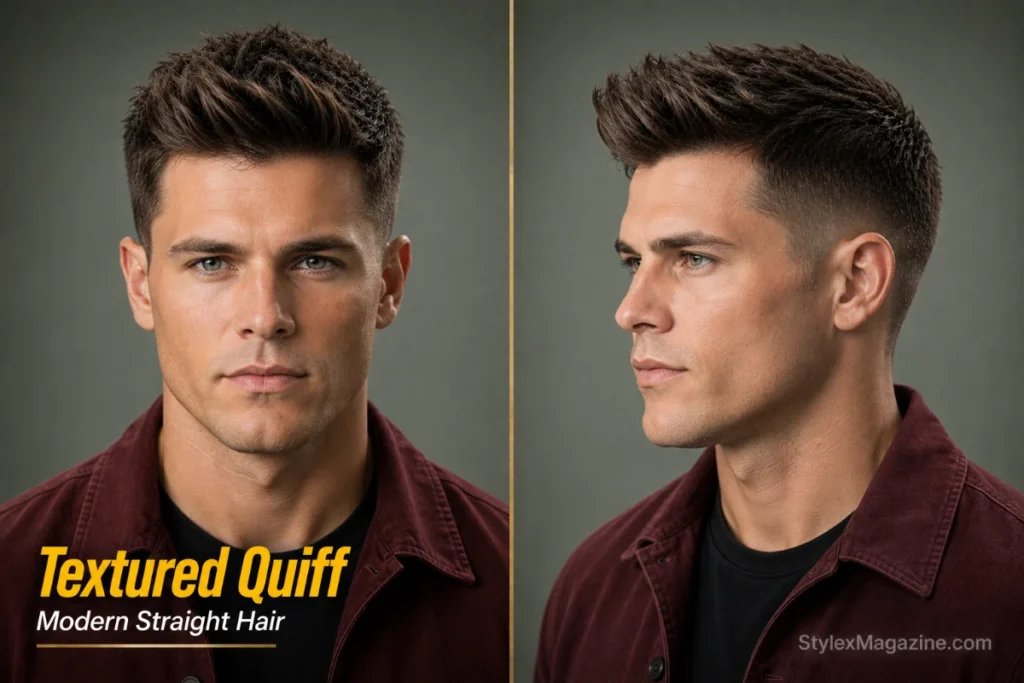
A shorter, more relaxed version of the pompadour. The front lifts upward and slightly to one side with visible texture and separation, intentionally disheveled rather than sculpted. Zayn Malik wore variations of this throughout his solo career. The quiff works especially well on fine straight hair because the internal texture adds visual bulk.
- Best face shape: All face shapes. One of the most versatile medium-length cuts
- Ask your barber: “Textured quiff: 3 inches at the front, tapered shorter toward the crown, low taper on the sides.”
- Styling tip: Apply sea salt spray to damp hair, rough-dry with fingers (not a brush), then push the front upward and to the side with matte clay. Do not over-refine it.
14. Comb Over with Fade
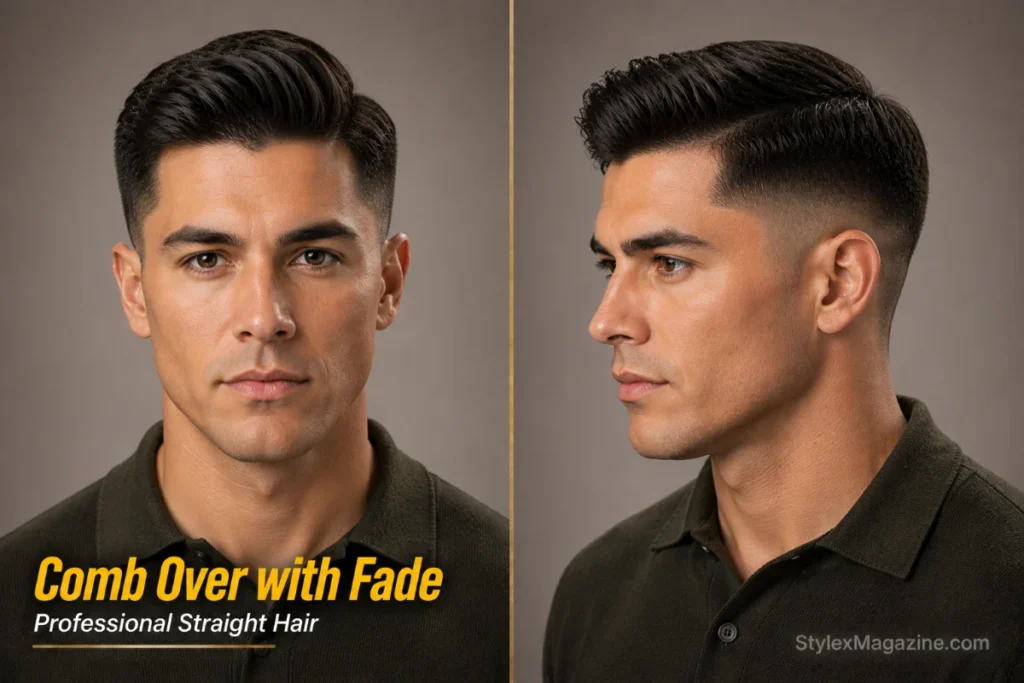
Hair swept firmly to one side (3–4 inches on top) with a mid to high fade on the sides. The comb over fade lost its old-school stigma years ago, and its classic version remains the most requested cut in professional barbershops. Modern versions are textured, voluminous, and sharp. Straight hair makes the directional sweep look clean and deliberate.
- Best face shape: All face shapes
- Ask your barber: “Modern comb over, mid fade, keep 3 to 4 inches on top, blend the transition.”
- Styling tip: Use a wide-tooth comb on damp hair to set the sweep direction. Apply light pomade and blow-dry in that direction with a flat brush to lock the shape.
15. Slick Back
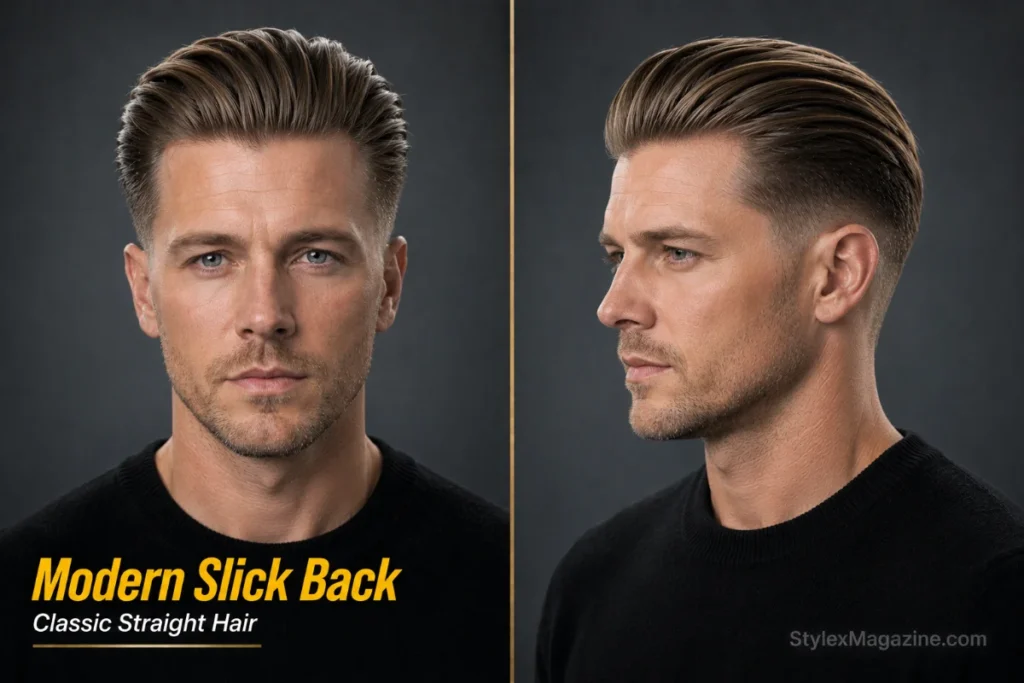
All hair swept directly backward from the forehead. The 2026 version uses matte or low-shine products for an airy, natural flow, not the heavy, greasy look from decades past. Brad Pitt in Fury showed how a slick back with an undercut creates a controlled, military-sharp aesthetic.
- Best face shape: Oval, square, oblong
- Ask your barber: “Slick back: 4 to 5 inches on top, undercut or low fade on the sides, tight neckline.”
- Styling tip: Blow-dry backward with a vented brush to create lift and flow. Apply medium-hold, low-shine pomade at 80% dry. Finish with a cool-air blast.
16. Faux Hawk
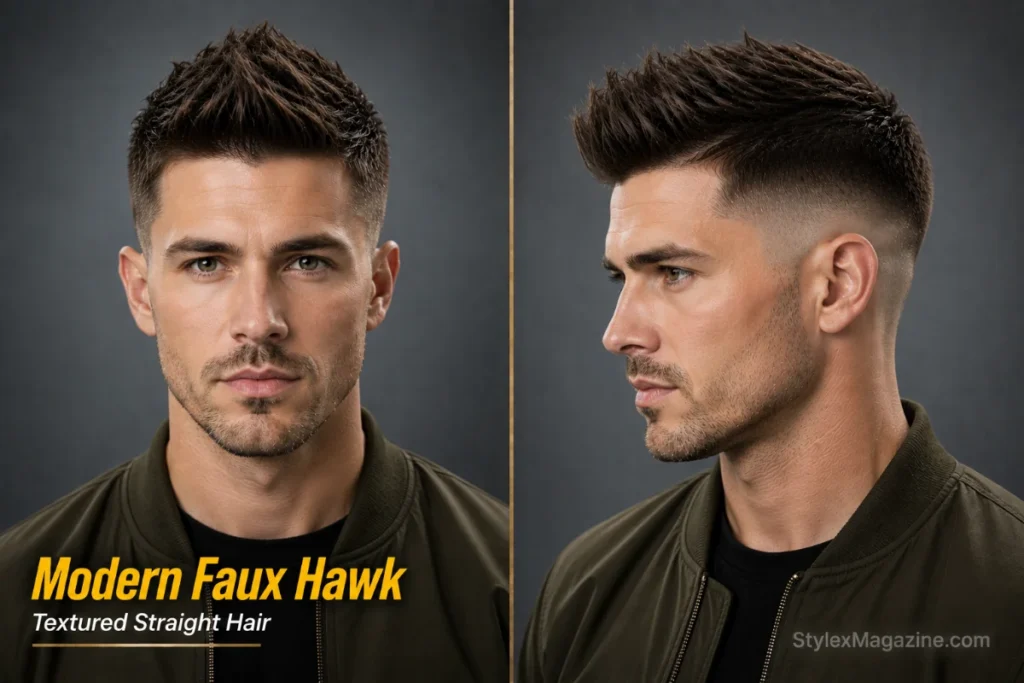
The sides are faded while the hair on top is pushed inward from both sides toward the center, creating a raised ridge from front to back. It gives the visual impression of a mohawk without the commitment. Straight hair creates a clean, sharp central ridge because the smooth texture cooperates with the inward direction.
- Best face shape: Oval, diamond
- Ask your barber: “Faux hawk: mid to high fade on the sides, leave 3 inches through the center.”
- Styling tip: Apply strong-hold matte clay to damp hair. Push the sides inward and upward using your palms. Define the central ridge with your fingers. A light mist of flexible hairspray keeps the shape locked.
17. Modern Mullet
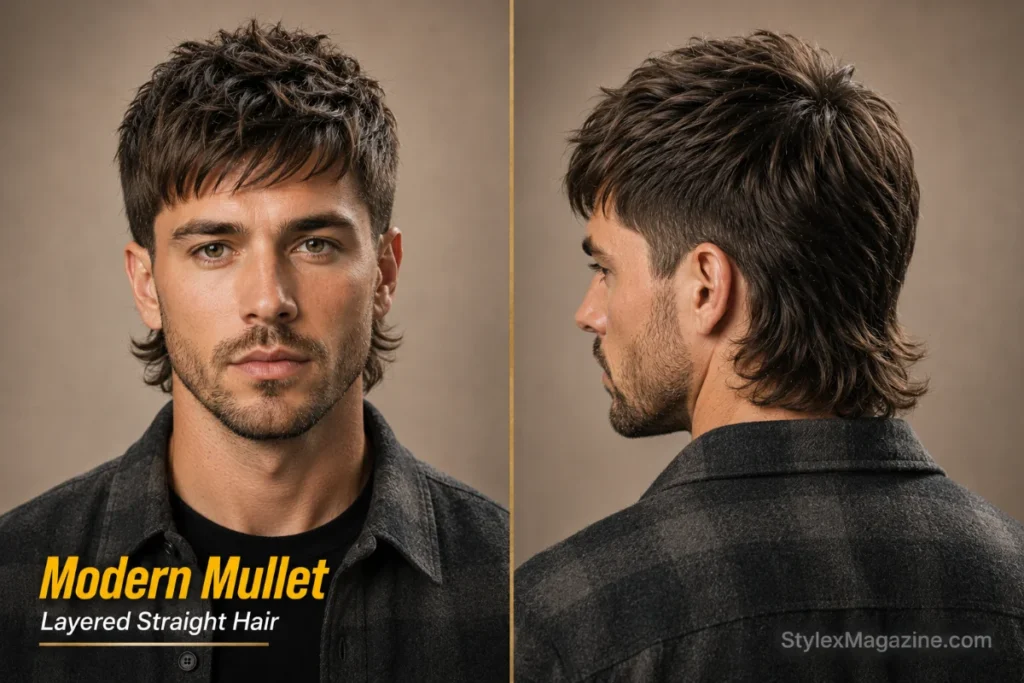
The mullet returned in the early 2020s and is now a legitimate style choice, not a joke. The 2026 version keeps the sides neatly tapered, the top textured and forward-styled, and the back grown to collar length with layers for movement. Straight hair gives the back section an elegant, flowing silhouette that heavier textures struggle to achieve.
- Best face shape: Oval, oblong
- Ask your barber: “Modern mullet: tapered sides, textured top styled forward, back to the collar with layers.”
- Styling tip: Apply a salt-based texturizing spray to the entire head while damp, rough-dry the top, and let the back air-dry naturally for a relaxed flow.
18. Curtain Bangs (Middle Part)
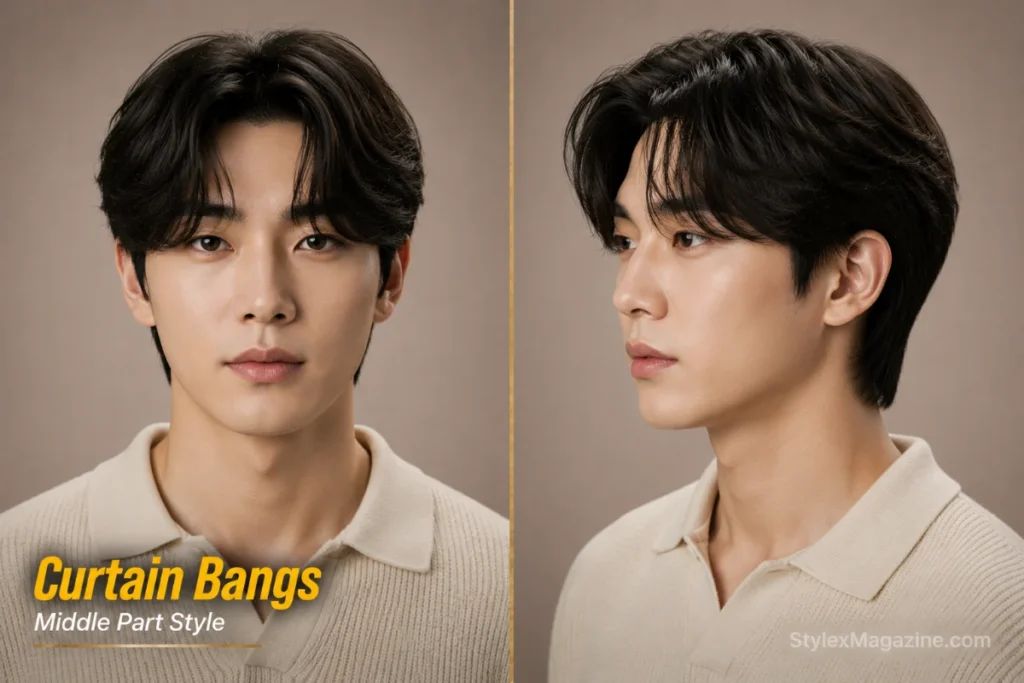
Hair parted down the center with the front sections falling to each side, framing the face symmetrically. Timothée Chalamet and multiple BTS members popularized this cut globally. Straight hair produces the cleanest version. The curtains fall in symmetrical lines without frizz or unpredictability.
- Best face shape: Oval, oblong, diamond. Softens strong jawlines and balances wider foreheads
- Ask your barber: “Curtain bangs, middle part, medium length with light layers for movement.”
- Styling tip: Blow-dry each side outward with a round brush: left side to the left, right side to the right, curving slightly inward at the ends. Light styling cream keeps the shape without flattening movement.
19. Two Block Cut
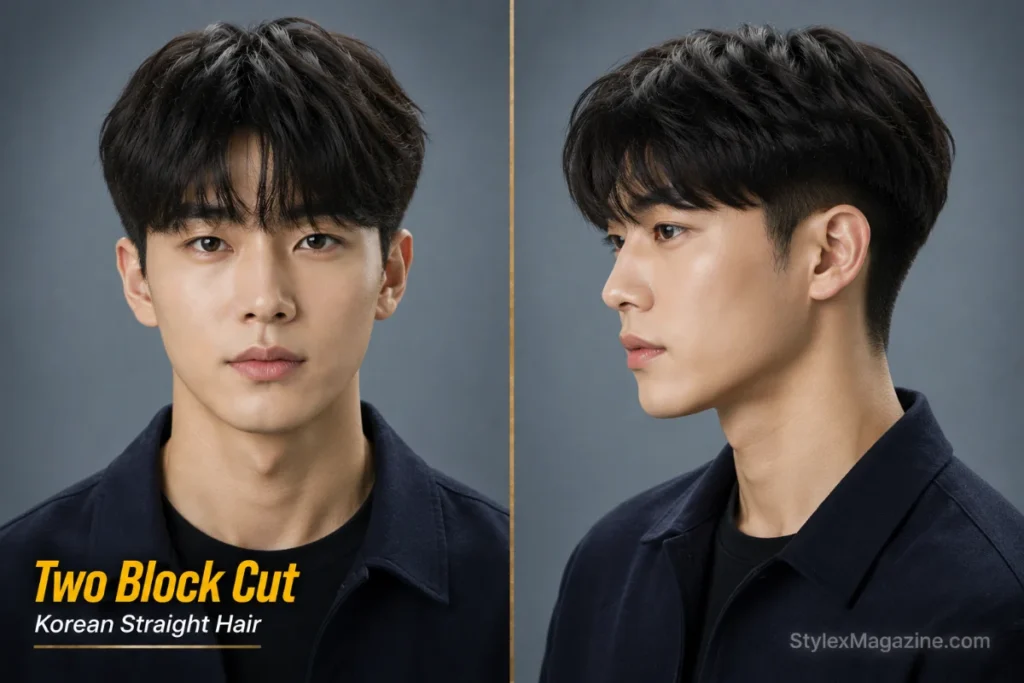
Originated in South Korean barbering. Block one: a long top (3–5 inches) left at full length. Block two: sides and back cut very short with no gradual blending. The dramatic contrast is the entire point. Straight hair falls forward or to the side naturally at this length. Most K-drama actors and K-pop idols wear some version of this cut.
- Best face shape: Oval, heart
- Ask your barber: “Two block cut: disconnected, sides at a #1 or #2, top left 4 inches, no blending.”
- Styling tip: A small amount of light styling cream on the top section is all you need. The cut does the structural work.
20. Korean Comma Hair
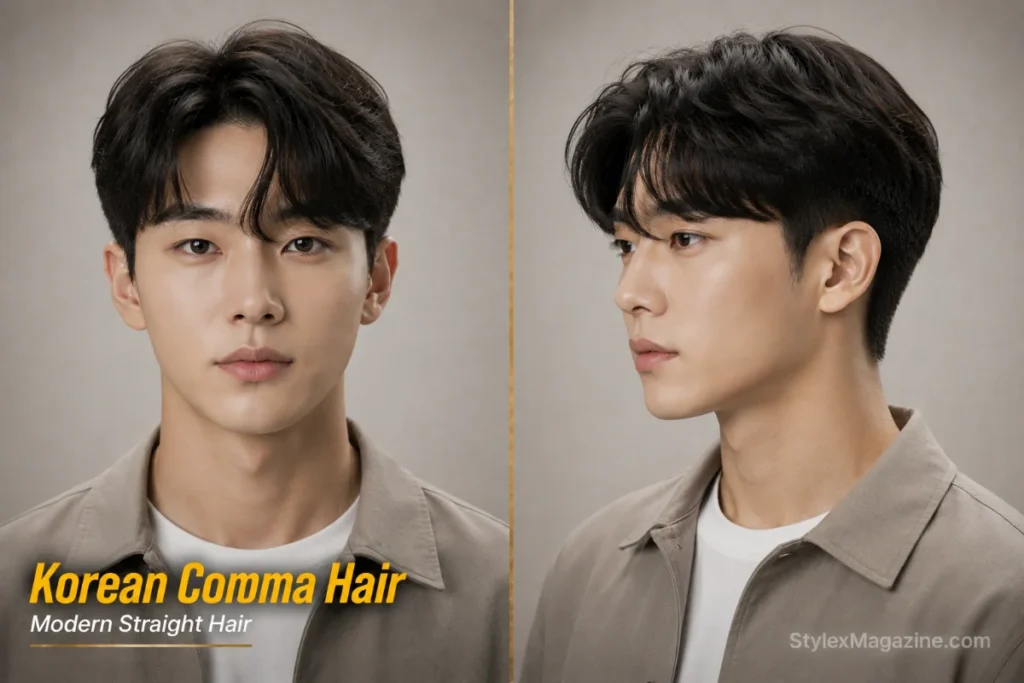
A styling technique where the front section curves inward at the ends, creating a shape that resembles a comma. The fringe reaches mid-forehead to brow level. This style works almost exclusively with straight hair. Achieving the precise inward curl on wavy or curly hair requires chemical straightening.
- Best face shape: Oval, heart
- Ask your barber: “Comma hair fringe: medium length at the front, light layers, two block structure on the sides.”
- Styling tip: Blow-dry the front section inward using a round brush. Point the dryer nozzle downward and rotate the brush so the ends curl toward the face. Lock with light styling cream.
21. Ivy League
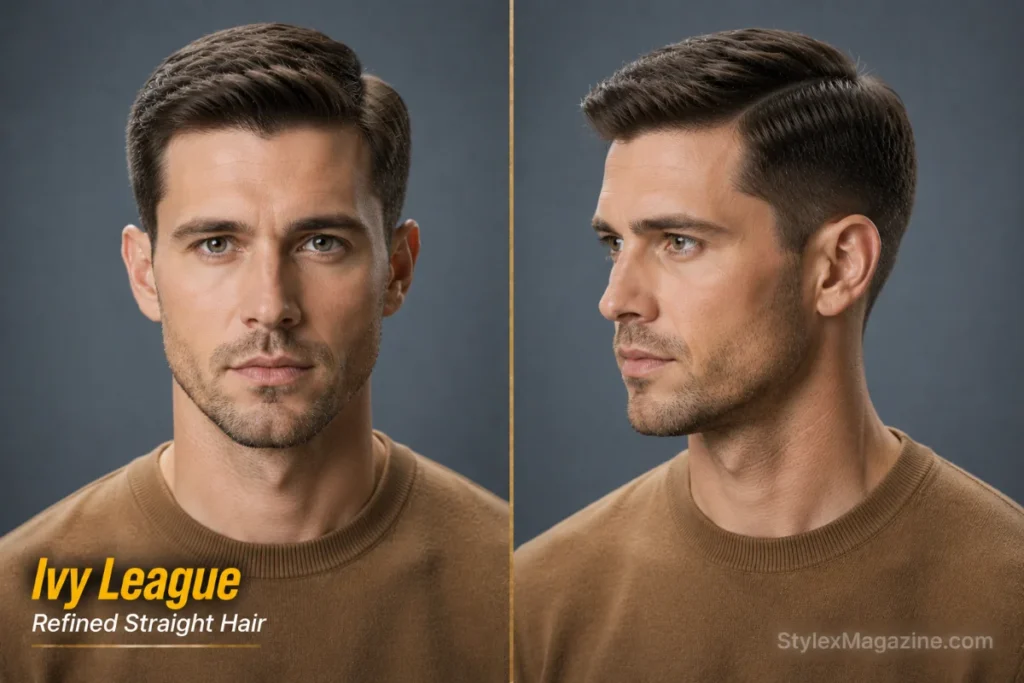
A longer crew cut with enough length on top (2–3 inches) to create a clean side part. The sides are tapered, not faded, maintaining a conservative profile. JFK wore this cut. In 2026 it remains the standard for intelligent, professional grooming across law, finance, and academia.
- Best face shape: Oval, diamond
- Ask your barber: “Ivy League: enough length on top to part to the side, tapered sides, clean around the ears.”
- Styling tip: Fine-tooth comb plus light-hold pomade creates a crisp part. For the old-money aesthetic trending in 2026, use low-shine product instead of high-gloss.
22. Side-Swept Fringe
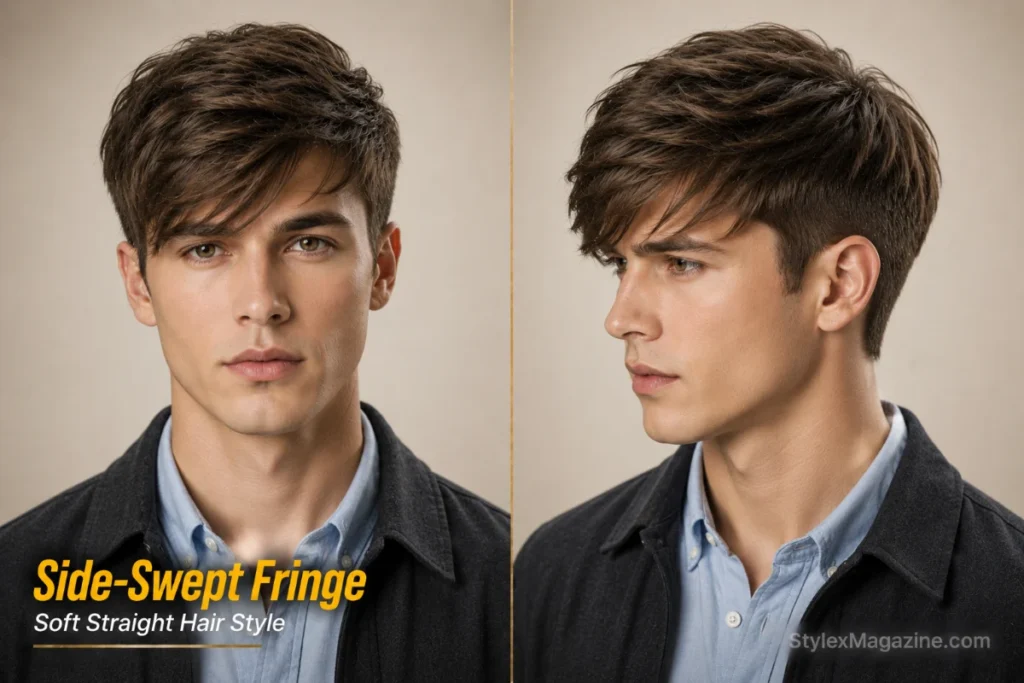
The front hair falls diagonally across the forehead in a soft sweeping arc. One of the most enduringly popular cuts because it occupies the perfect middle ground between structured and relaxed. Straight hair’s natural weight makes the sweep easy to achieve and maintain. Zac Efron wore this through most of his early career.
- Best face shape: All face shapes. The diagonal line softens any profile
- Ask your barber: “Side-swept fringe, 3 to 4 inches at the front tapering shorter at the back, light taper on the sides.”
- Styling tip: Comb the front across while damp, blow-dry in that direction with a round brush. A tiny amount of flexible paste holds the sweep without stiffness.
23. Burst Fade with Textured Top
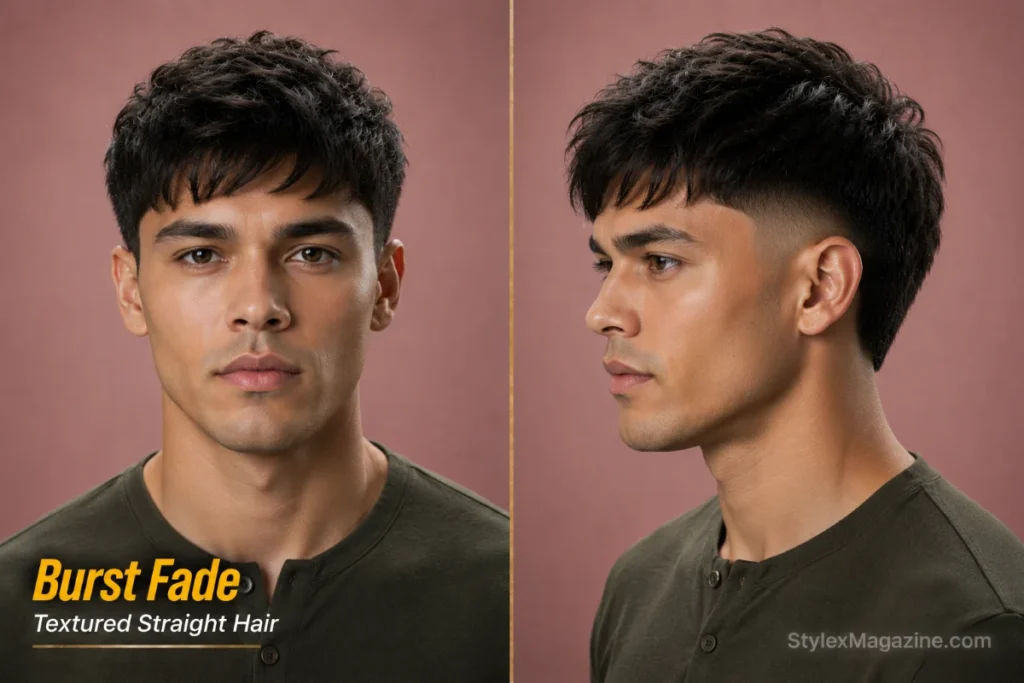
The burst fade creates a semi-circular pattern radiating outward around the ear, like an arc of gradually increasing hair density. Paired with a textured top, it gives a sporty, dynamic silhouette. For straight hair, the burst creates strong geometric contrast against the naturally smooth top.
- Best face shape: Oval, diamond
- Ask your barber: “Burst fade around the ears, 2 to 3 inches on top, textured with point-cutting.”
- Styling tip: The burst pattern is purely barbering technique, so no home maintenance needed for the fade itself. Style the top with matte clay for a textured finish. Touch-ups every 2–3 weeks.
24. Temple Fade
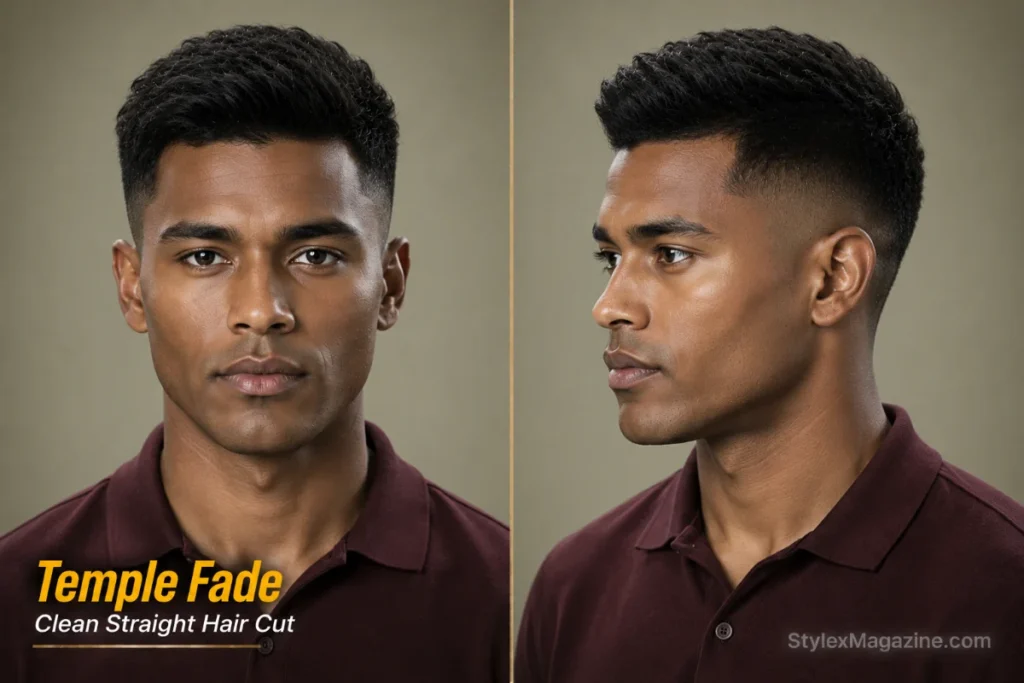
All fade work concentrated at the temple area, the zone between the hairline and the ear. The rest of the hair stays fuller. Known regionally as the Brooklyn Blowout. This cut cleanly removes bulk at the temples without changing the overall structure, making it one of the most subtle fades available.
- Best face shape: Round, oval, square. The clean temples sharpen the profile
- Ask your barber: “Temple fade: clean at the temples, keep the rest full, low fade finish.”
- Styling tip: Blow-dry longer top hair upward for volume or sweep shorter hair forward for contrast.
25. Disconnected Undercut
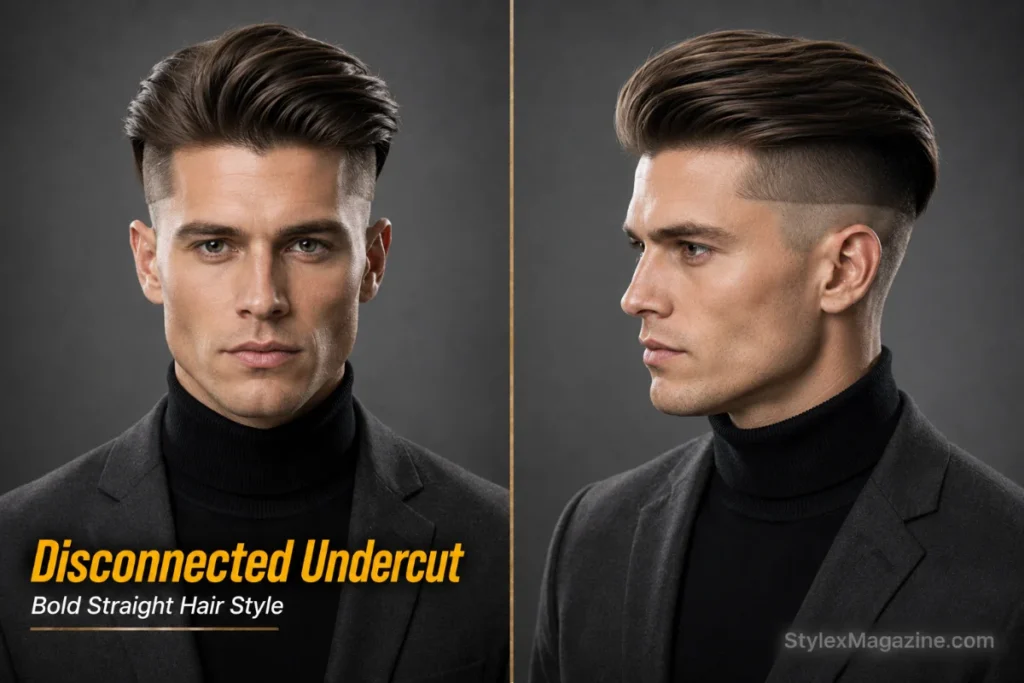
Sharp contrast between long top sections and shaved sides with no blending. Cillian Murphy in Peaky Blinders made this cut iconic. The complete removal of the side hair reduces bulk dramatically, a major advantage for men with thick straight hair who struggle with heavy sides weighing down the top.
- Best face shape: Square, heart. Bold visual contrast suits defined features
- Ask your barber: “Disconnected undercut: #1 guard on the sides, no blending, 4 to 5 inches on top.”
- Styling tip: Style the top in any direction: forward, side, or swept back. Use medium-hold matte paste with fingers rather than a comb to maintain natural separation.
Long Hairstyles for Straight Hair (5+ Inches)
Long straight hair requires more maintenance but offers a distinctive look. The key is regular trims and internal layering. Without layers, straight hair at this length falls as a single flat sheet.
26. Bro Flow
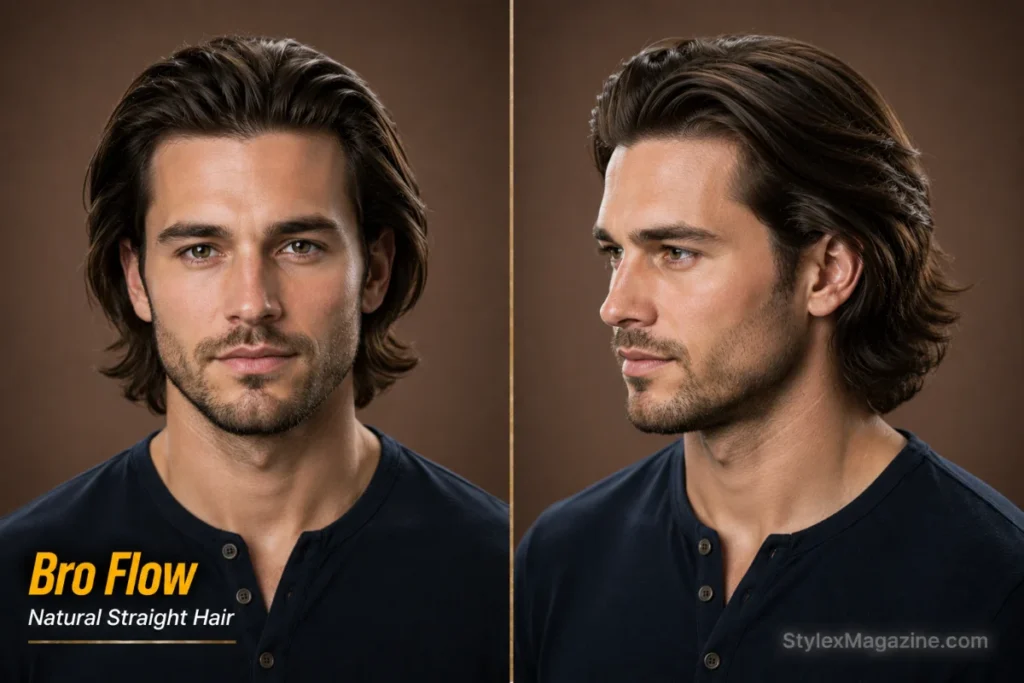
Medium to long hair (chin to collar length) swept backward and to the sides naturally. Chris Hemsworth is the gold standard for this cut. The bro flow only works when the hair is healthy, shiny, and maintained. Damaged or dry straight hair at this length looks neglected rather than intentional.
- Best face shape: All face shapes. The deciding factor is hair health, not face shape
- Ask your barber: “Growing it out for a flow. Clean up the ends, add internal layers for movement, keep the length.”
- Styling tip: Run fingers through after showering and sweep backward. A small amount of sea salt spray prevents flat-against-the-scalp fall. Or skip product entirely and let it air-dry.
27. Man Bun
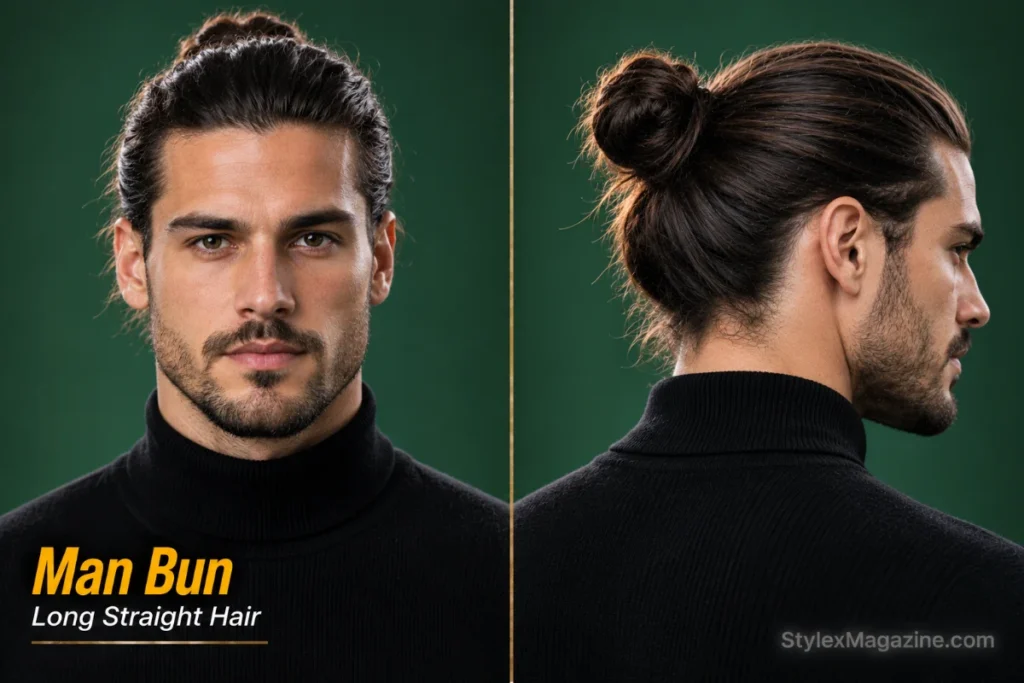
When straight hair reaches 8+ inches, pull it into a bun at the back of the crown. Jason Momoa and Jared Leto both wore this style through extended public periods. Straight hair creates a naturally sleek, polished bun, but tension matters. The American Academy of Dermatology warns that tight hairstyles can cause traction alopecia, hair thinning from repeated mechanical pulling. Use soft fabric ties and avoid tying too tightly.
- Best face shape: All face shapes
- Ask your barber: “Just clean the outline and remove split ends. I am keeping the length for a bun.”
- Styling tip: Tie at the natural resting point on the back of the head, not high, not forced. A light smoothing serum tames flyaways without greasiness.
28. Shoulder-Length Flow
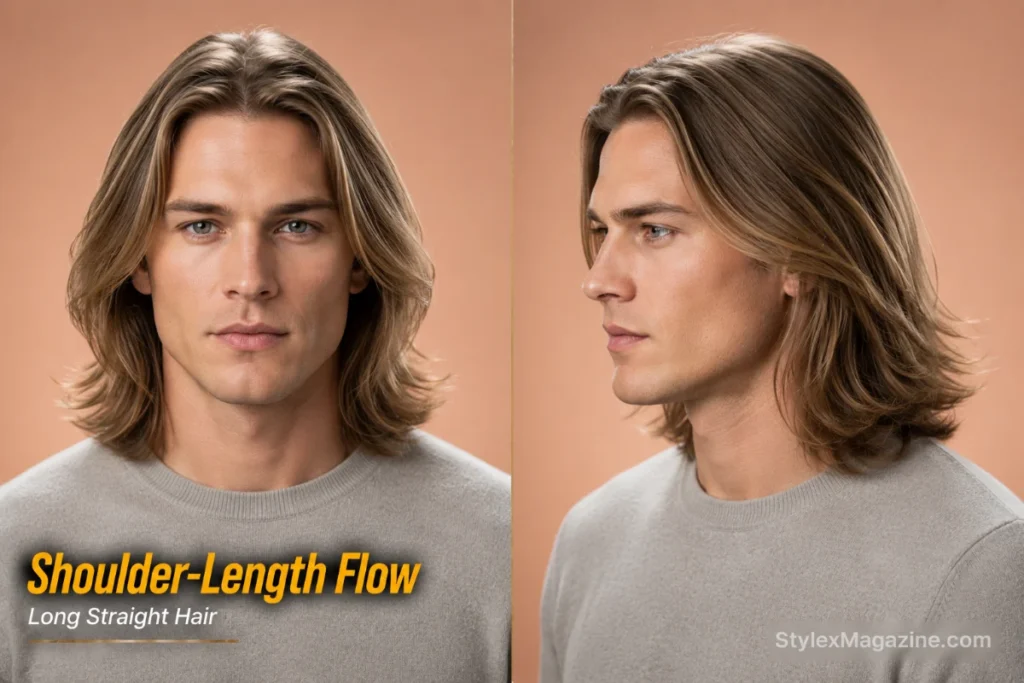
Straight hair grown to shoulder length with minimal styling intervention. At this length, straight hair expresses its greatest natural asset: smooth, light-reflecting movement that requires almost no product. Regular trims and conditioning are non-negotiable. Split ends at this length travel up the hair shaft and cause breakage.
- Best face shape: Oval, oblong
- Ask your barber: “Trim the ends for health, add light internal layers, do not remove length.”
- Styling tip: Apply a light hair oil or serum to mid-lengths and ends while damp. Air-dry completely. Brush with a wide-tooth wooden comb when dry to distribute natural oils.
29. Half-Up, Half-Down Bun
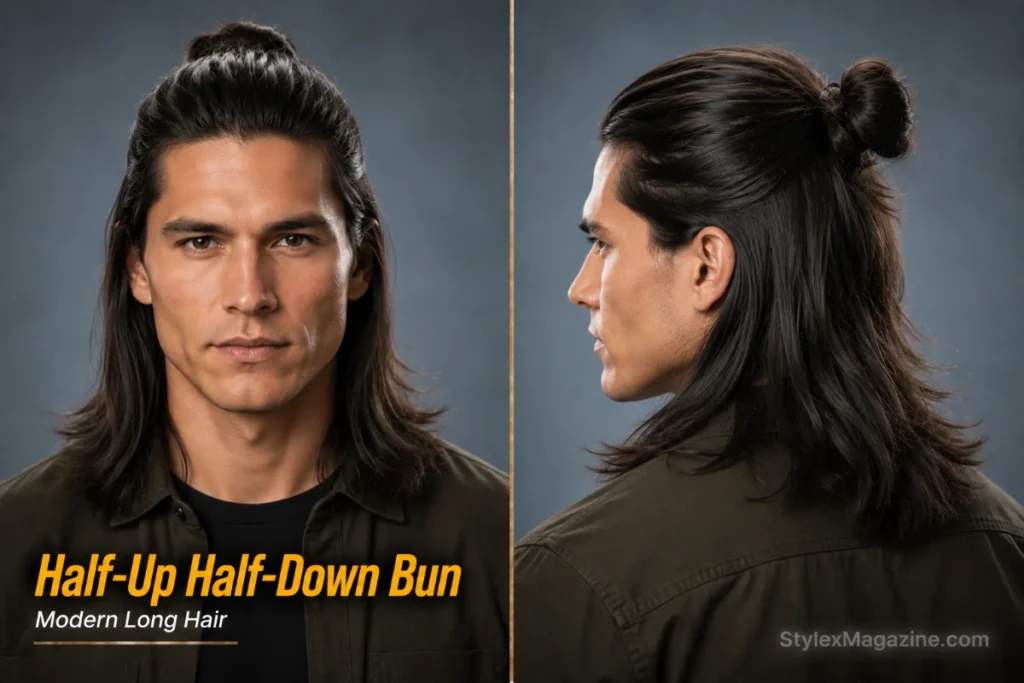
The top section (crown to temples) ties into a small bun while the bottom hangs freely. This gained cultural momentum through the Urban Viking trend in 2025–2026, blending a raw, masculine aesthetic with groomed sophistication. Straight hair’s smooth texture keeps the lower section looking elegant without product.
- Best face shape: All face shapes. Works best at 6–8 inches minimum
- Ask your barber: “Maintaining the length. Just trim the ends and keep the layers balanced.”
- Styling tip: Separate at a horizontal line from temple to temple. Tie the top into a small bun with a fabric tie. Leave the rest down. Gravity and straight hair’s natural weight do the work.
30. Long Slick Back
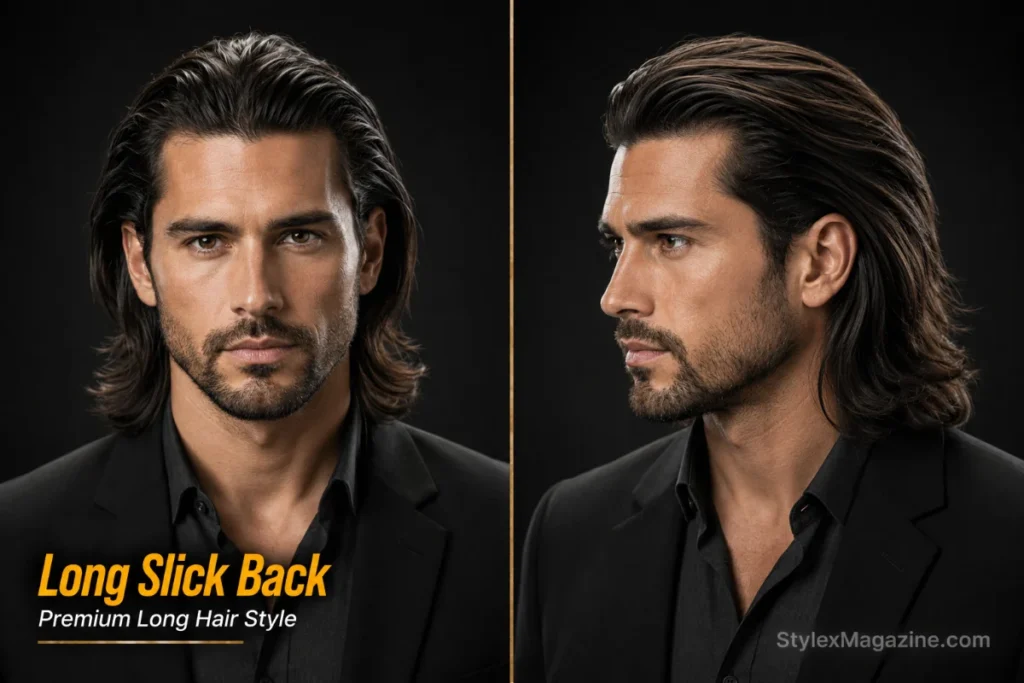
All hair combed straight back with a polished, deliberate finish. This is the formal evening option with old Hollywood energy. Straight hair achieves the best version of this because the naturally smooth texture prevents frizzing or flyaways that would break the refined surface. Works for weddings, business dinners, and black-tie events.
- Best face shape: All face shapes at longer lengths
- Ask your barber: “Keep the length at 6 inches minimum, light layers for movement, tapered neckline.”
- Styling tip: Apply light-hold, medium-shine pomade to wet hair. Comb straight back with a fine-tooth comb. Air-dry rather than blow-dry to maintain smooth, natural flow.
Trending Cuts for 2025–2026
The trend direction in 2026 moves away from rigid, high-shine styling toward natural texture, matte finishes, and cuts that work with hair rather than against it. Heavy gel and stiff holds are declining. Movement and flexibility are taking over, according to styling trend reports from Booksy’s 2026 Beauty Industry Trends Report and Fresha’s Selfcare Report 2025.
31. Warrior Cut
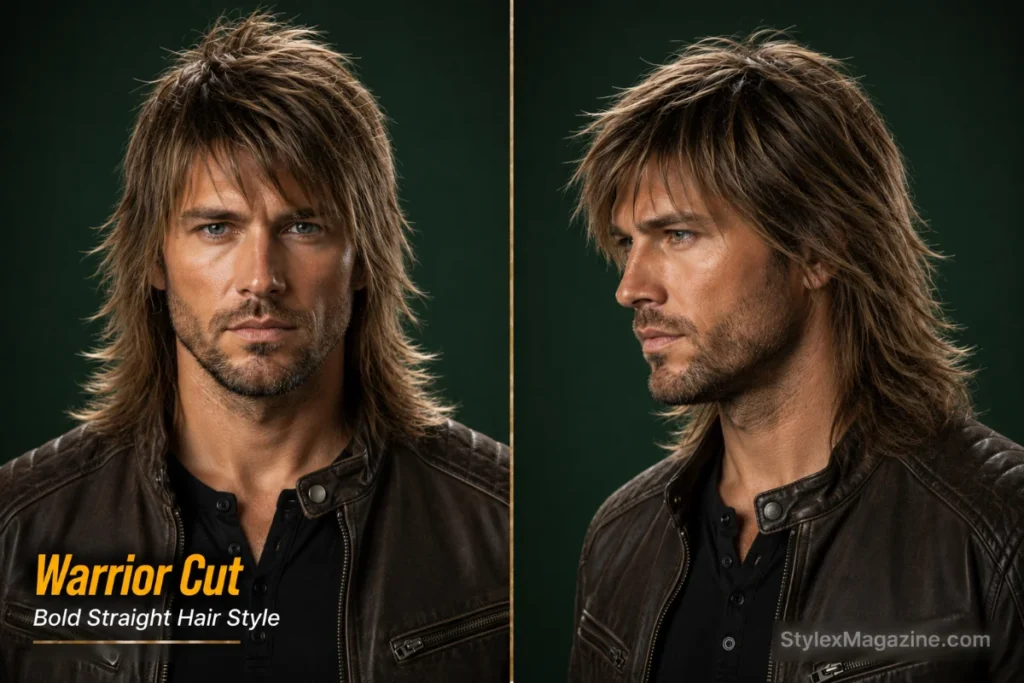
The breakout style of 2025 carrying into 2026. Heavily textured, spiked-up layers on top with softer, shorter sides. The look is controlled chaos, sharp enough to be intentional, messy enough to feel effortless. Straight hair suits this cut well because the texture comes from the cutting technique (point-cutting and razor work), not from natural curl.
- Best face shape: Oval, square, diamond
- Ask your barber: “Warrior cut: heavily textured top with spiked layers, softer sides, not a hard fade.”
- Styling tip: Rough-dry upward, apply strong-hold matte clay, and pinch sections with your fingers for defined, spiky texture.
32. Textured Flow Fade
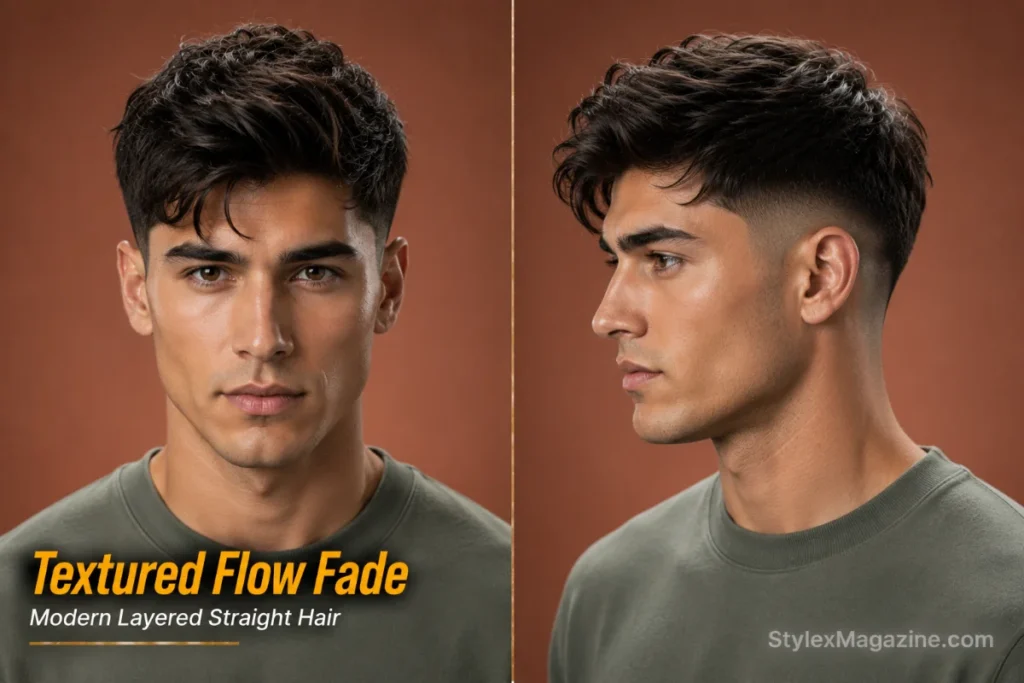
Medium hair on top with a clean fade on the sides. The top is left slightly longer for a soft, natural flow, not swept back, not pushed forward, just falling in its natural direction with visible movement. This cut captures the 2026 preference for looking styled without looking like you tried.
- Best face shape: All face shapes
- Ask your barber: “Flow fade: mid fade on the sides, leave 3 to 4 inches on top with layers for natural movement.”
- Styling tip: Blow-dry loosely with fingers for direction, then let it settle. A light cream or spray adds hold without eliminating the natural fall.
33. Messy Straight Fringe
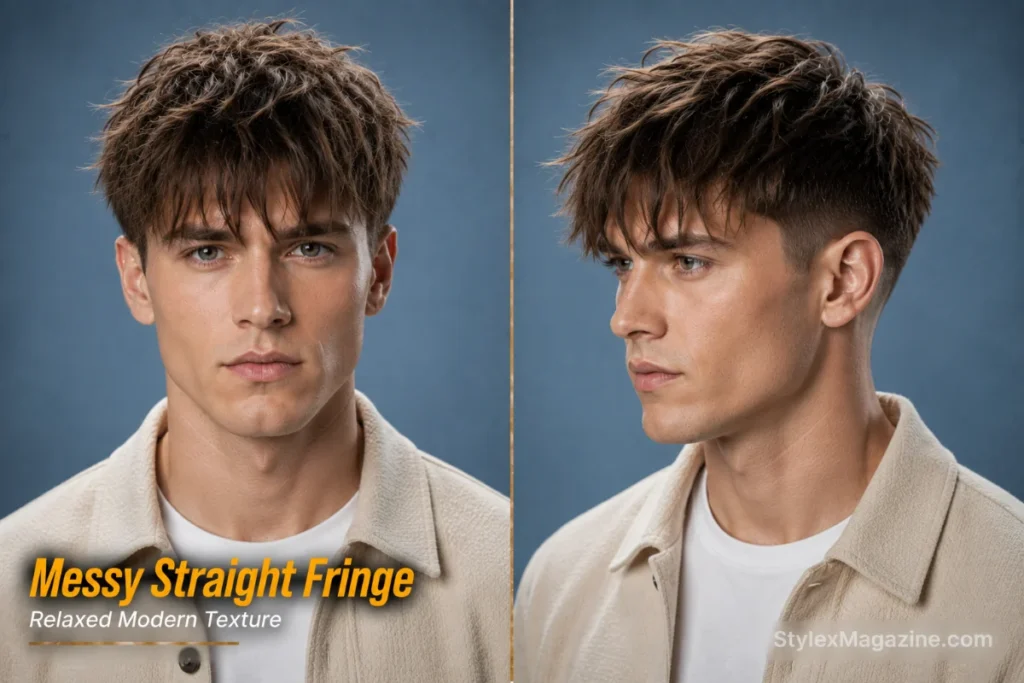
The front section falls toward the forehead in a deliberately casual, layered way. The fringe is point-cut into multiple layers to prevent it from falling as one heavy sheet. The result looks effortless but requires a skilled cut. The layers create natural separation that makes the style appear lived-in rather than unkempt.
- Best face shape: All face shapes. Especially popular with men in their teens through early 30s
- Ask your barber: “Messy fringe: layered through the front with point-cutting, sides tapered, relaxed finish.”
- Styling tip: Towel-dry without brushing. Apply texturizing spray to the damp front section and air-dry naturally.
34. Shag with Layers
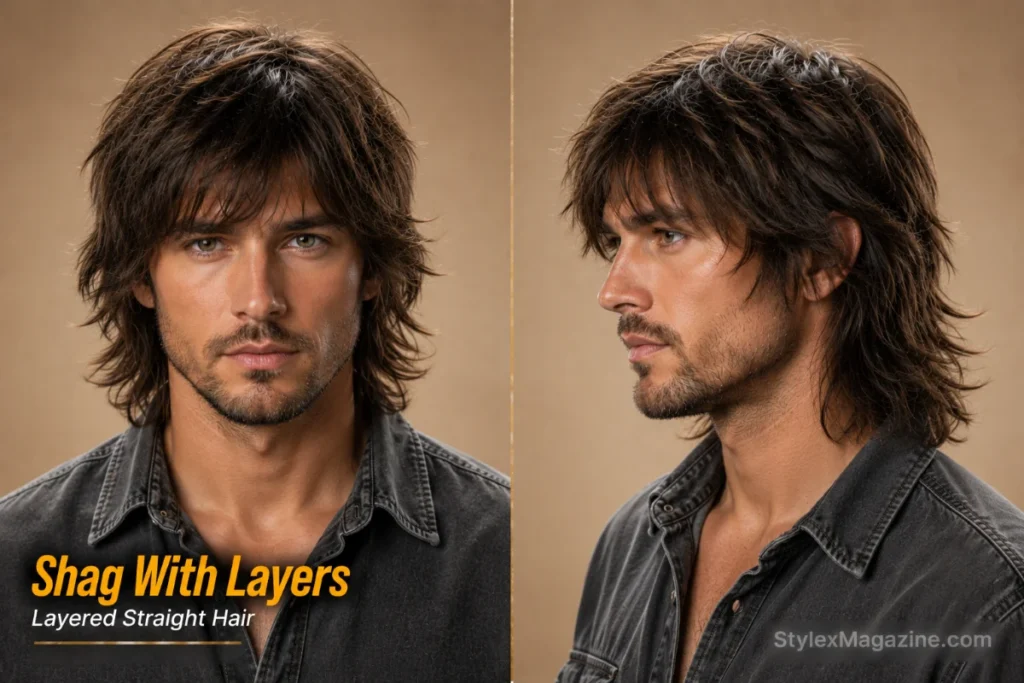
Messy layers throughout: choppy levels that flow into longer sides with a tapered back. The shag solves straight hair’s biggest problem: flatness. Multiple internal layers at varying lengths force the hair to move in different directions, creating the illusion of natural volume. This cut works at medium to long lengths and suits creative, informal, or outdoor lifestyles.
- Best face shape: Oval, oblong, heart
- Ask your barber: “Shag cut: messy layers throughout, soft fringe, slightly longer sides, tapered back.”
- Styling tip: A lightweight salt spray on damp hair, rough-dry with fingers, and leave it alone. Avoid brushing. Combing layered straight hair defeats the purpose.
35. Asymmetrical Fringe
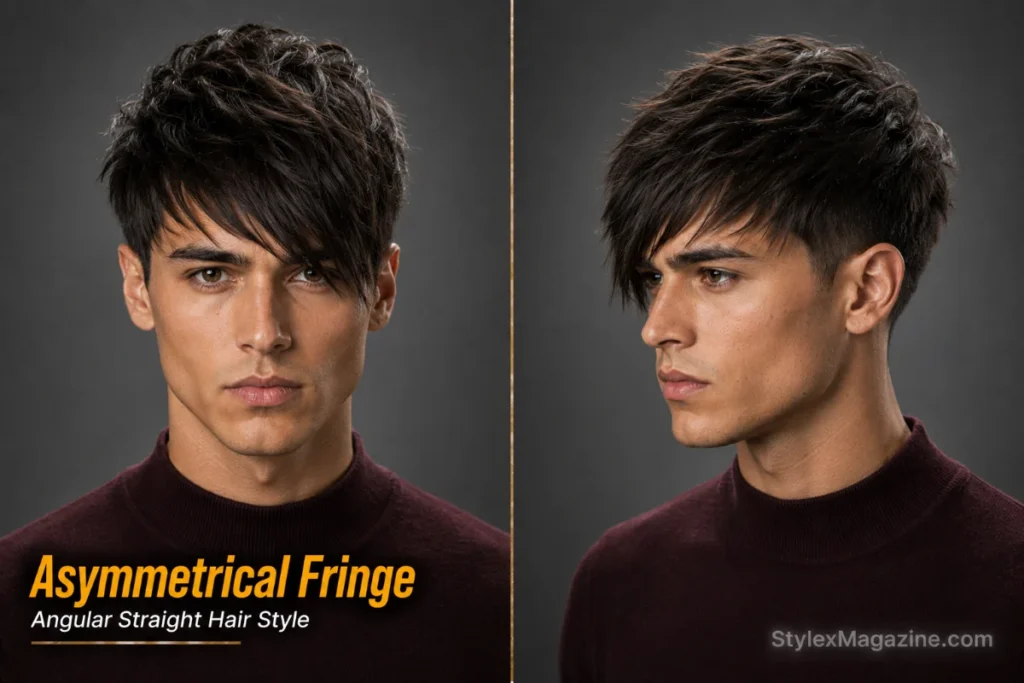
One side of the fringe is cut significantly longer than the other, creating a sharp diagonal line across the forehead. The asymmetry introduces a strong visual dynamic that straight hair handles cleanly. The long sweep falls in a precise, predictable line without frizz breaking the angle.
- Best face shape: Oval, oblong. The diagonal line adds a horizontal element that shortens a longer face
- Ask your barber: “Asymmetrical fringe: longer on the right sweeping to the left, shorter on the other side, subtle fade or taper on the sides.”
- Styling tip: Blow-dry the fringe in the direction of the longer sweep using a flat brush. Apply a light serum or smoothing cream for shine. Matte products fight this style’s sleekness.
The 5-Minute Morning Styling Routine
Most styling advice stops at “apply product and style.” That skips the how. Here is a real routine with actual timing:
Full routine (5 minutes):
1. Towel-dry to damp, not dripping, not dry (30 seconds)
2. Apply a dime-sized amount of product to palms, rub together, work through roots and mid-lengths (1 minute)
3. Blow-dry with direction: up for volume, back for slick, forward for fringe. Lift at the roots with fingers or a round brush (2 minutes)
4. Shape with fingers or a comb depending on your cut (1 minute)
5. Finish with a cool blast from the dryer to set the shape (30 seconds)
Running late? 2-minute version:
1. Spray texture spray or sea salt spray into dry hair at the roots
2. Rough it into shape with your fingers
3. Walk out the door
Product Guide: What to Use and Why
Straight hair responds differently to different products. Choosing the wrong one is the most common styling mistake. Heavy pomade on fine hair flattens it, light spray on thick hair does nothing. This table matches product types to results.
| Product | Hold | Finish | Use It For | Avoid If |
| Matte clay | High | Matte | Textured crops, quiffs, faux hawks, warrior cut | You want shine or have very fine hair |
| Water-based pomade | Medium-high | Shine | Pompadour, slick back, side part, comb over | Hair is fine or thin. The weight pulls it flat |
| Sea salt spray | Low | Matte, natural | Pre-styling volume, flow styles, bro flow, shag | You need strong all-day hold |
| Styling cream | Low-medium | Natural | Daily wear, curtain bangs, Ivy League | You need all-day hold in humid conditions |
| Texture powder | Medium | Matte | Root volume, fine hair lift, textured crops | Oily scalp. It absorbs oil and clumps |
| Fiber paste | Medium-high | Low shine | Flexible everyday hold, messy fringe | You want a wet or glossy look |
| Grooming cream | Low | Natural shine | Classic side part, polished low-key styles | You need volume. Creams add weight |
Source for product science: Kaolin and bentonite clays physically thicken each hair strand by coating it with mineral particles, which is why clay-based products add visible density to fine straight hair. Water-based pomades wash out cleaner than oil-based formulas and cause less long-term buildup, making them the better choice for scalp health according to trichology research reviewed by the International Association of Trichologists.
Maintenance: How Often to Cut, Wash, and Restyle
| Cut Type | Trim Frequency | Daily Styling Time | Notes |
| Buzz cut, burr cut | Every 2–3 weeks | Under 1 minute | Fastest growth visibility. Looks overgrown quickly |
| Crew cut, Caesar, Ivy League | Every 3–4 weeks | 2–3 minutes | The most forgiving short cuts for growth |
| Textured crop, quiff, Edgar | Every 3–4 weeks | 3–5 minutes | Fades and hard parts need frequent maintenance |
| Side part, comb over, pompadour | Every 4–5 weeks | 5–7 minutes | Blow-drying is required, not optional |
| Curtain bangs, two block, mullet | Every 5–6 weeks | 3–5 minutes | Trim the fringe between full cuts |
| Flow, shag, man bun, long styles | Every 8–12 weeks | 2–5 minutes | Trim for health (split ends), not for shape |
The Professional Beauty Association recommends scheduling trims based on how quickly your specific cut loses its intended shape, not on a fixed calendar.
Washing frequency: Two to three times per week is enough for most men with straight hair. Straight hair shows oil faster than curly hair because sebum travels down the shaft unobstructed, but daily washing strips natural oils and leaves hair flat and dry. A quality dry shampoo between washes absorbs excess oil without over-stripping.
Common Mistakes That Ruin Straight Hair Styles
Skipping the blow dryer. If your cut needs volume (pompadour, quiff, textured crop, side part), air drying leaves straight hair flat. A blow dryer is not optional for these styles. Two minutes of directed heat changes everything.
Using the wrong product weight. Heavy pomade on fine straight hair weighs it down and makes it look greasy by noon. Match your product weight to your hair density. Fine hair needs powder, spray, or light clay. Thick hair can handle pomade and paste.
Touching your hair throughout the day. Every time you run your fingers through styled straight hair, you break the shape and transfer oil from your hands. Style it once in the morning and leave it alone.
Ignoring your natural growth direction. Straight hair has a preferred direction it wants to fall. Work with it. If it naturally moves right, part it right. Fighting the natural direction means fighting your hair all day.
Choosing a cut based on a photo of wavy hair. Many hairstyle photos online show naturally wavy hair that has been straightened or styled with texture. The same cut on naturally straight hair will not look identical. The internal movement is different. Show your barber multiple reference photos and ask for their honest assessment of how the cut will translate to your texture.
Frequently Asked Questions
Can I switch between two different hairstyles without getting a new cut?
Yes, if the base cut supports it. A 3–4 inch top with tapered sides lets you wear a side part one day and a slick back the next — the only change is product and blow-dry direction. Shorter cuts like a buzz or crew cut are locked into one look. Medium-length cuts give you the most daily flexibility.
How do I grow out a short haircut without looking awkward?
The awkward stage hits around weeks 6–10, when the sides puff outward while the top is still catching up. Ask your barber for maintenance trims on the sides only — keep them tapered while the top grows. A headband, styling cream, or a backward sweep with light pomade hides the transition. Most men need 4–6 months to go from a crew cut to a combable medium length.
Does sleeping on straight hair damage the style for the next day?
Straight hair flattens overnight more than any other texture because the smooth strands compress against the pillow. A silk or satin pillowcase reduces friction and static. In the morning, a 30-second blast of heat at the roots with a blow dryer restores lift without re-wetting. Avoid cotton pillowcases — the rougher surface pulls moisture from the hair and increases next-day flatness.
Should I show my barber a photo or describe the cut in words?
Both. A reference photo sets the visual target, but verbal instructions prevent misinterpretation. Tell your barber the guard number you want on the sides, the length on top in inches, and whether you want a fade or a taper. Photos of celebrities often show post-production styling or naturally wavy hair — your barber can flag what will translate differently on your texture.
Why does my straight hair look good after the barber but not when I style it at home?
Three reasons. First, barbers blow-dry with professional-grade heat and technique — most men skip the dryer at home. Second, barbers apply product to damp hair at the right moisture level, not to fully dry or soaking wet hair. Third, the cut looks freshest on day one; after a week of sleeping, sweating, and touching it, shape softens. Learning to blow-dry with direction — even for two minutes — closes most of the gap between salon finish and home finish.
What is the difference between a taper and a fade?
A taper gradually shortens hair from top to bottom but leaves visible length at the lowest point — typically a #2 or #3 guard at the neckline. A fade takes that gradient all the way down to bare skin. Tapers look more conservative and suit professional environments. Fades create sharper contrast and read as more modern. Both work well on straight hair — the choice is about how much contrast you want between the top and sides.

Other Articles
27 Best Haircuts For Men With Thin Straight Hair (2026)
No Comment! Be the first one.