
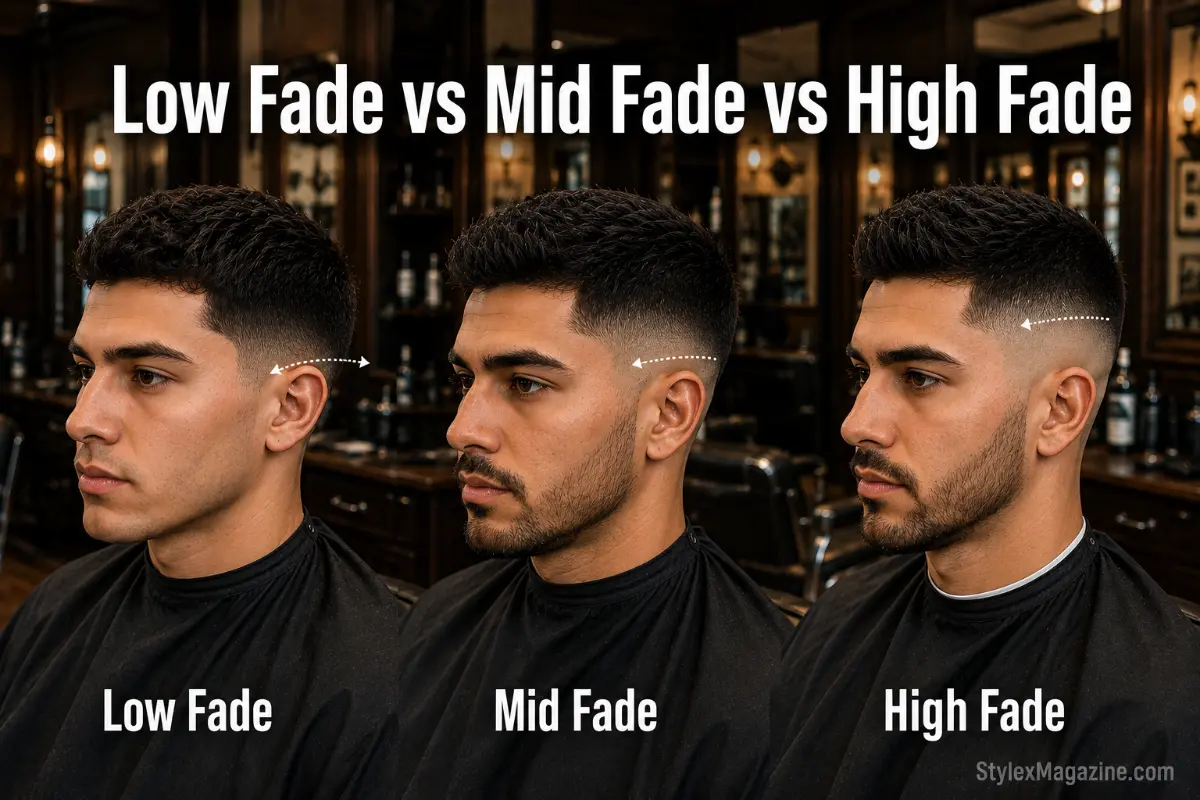

Quick Answer: The only difference between a low, mid, and high fade is where the fade starts. Low starts just above the ear. Mid starts at temple level. High starts above the temples. Higher starting point means more skin, bolder contrast, and more frequent maintenance.
Eight years behind the chair, and this is still the question I get most not “what style should I get,” but “what height?” Most men don’t realise the height is the whole decision. Get it wrong and the cut works against your face shape, your schedule, or your workplace. Get it right and it holds for weeks. For every fade type including burst, drop, and temp variations, see all fade types.
Low Fade vs Mid Fade vs High Fade: Side-by-Side Comparison
| Low Fade | Mid Fade | High Fade | |
|---|---|---|---|
| Where it starts | Just above the ear | Temple level | Above the temples |
| Contrast | Subtle | Moderate | Bold |
| Skin visible | Minimal | Moderate | Maximum |
| Best face shapes | All — especially oblong/long | All | Oval, round, square |
| Avoid if | N/A | N/A | Oblong/long face |
| Fine/thin hair | Any variation works | Taper finish only | Shadow fade only |
| Maintenance | Every 3–4 weeks | Every 2–3 weeks | Every 1–2 weeks |
| Best environment | Office, professional | Most settings | Bold, creative, athletic |
| Grows out | Cleanest | Moderately | Loses definition fastest |
What Is the Key Difference Between Low, Mid, and High Fade?
Where the fade starts everything else follows from that one decision.
Low fade: The transition sits close to the ear and neckline. Most of the side hair stays. Four weeks out and it still holds shape.
Mid fade: Starts at temple level. More skin on the sides, stronger contrast between top and sides. The most requested fade in most barbershops, and for good reason it adapts to more face shapes, more settings, and more hair types than either of the other two.
High fade: Starts above the temples. Maximum skin on the sides. The hair on top stops being part of the cut and becomes the entire point of it. A week’s growth shows — there’s no hiding it at this height.
Low Fade vs Mid Fade: What Is the Difference?

An inch of height on the head reads as a completely different haircut on the street. The low fade sits just above the ear conservative, structured, and professional. The mid fade sits at the temple — the contrast is stronger, more skin is visible, and the overall look carries more edge without tipping into bold.
Low fade: Right for oblong and long faces, men in formal environments, and anyone who doesn’t want to be back in the chair every two weeks. There are 18 variations worth knowing the low fade haircut guide covers all of them.
Mid fade: Right for most men in most settings. If you’re unsure, this is where to start.
Low Fade vs High Fade: What Is the Difference?

These two sit at opposite ends of the spectrum. The low fade is restraint — clean sides, most of the hair still there, grows out without drama. The high fade is commitment everything above the temples goes tight, the sides are mostly skin, and every week of growth is visible.
Low fade: The choice for long and oblong faces, conservative workplaces, and anyone who wants a cut that still looks intentional at four weeks.
High fade: The choice for round and square faces the height adds visual length to the face. Works in creative and athletic environments. If you can’t commit to 1–2 week visits, this isn’t your cut. The high fade haircut guide covers 28 styles across every hair type.
High Fade vs Mid Fade: What Is the Difference?

The mid fade is the more practical cut. It delivers modern contrast without the upkeep that comes with going higher. The high fade is sharper, bolder, and significantly less forgiving — a week’s growth on a high fade looks neglected; the same growth on a mid fade just looks like it needs a trim.
Mid fade: The professional’s choice — sharp enough to look intentional, forgiving enough to hold for two to three weeks. The mid fade haircut guide covers 26 variations matched to face shape and hair type.
High fade: Maximum contrast. Thick hair handles it best — the density on top earns the bold sides.
Skin Fade vs High Fade: What Is the Difference?

These two get mixed up constantly they’re measuring different things entirely.
Skin fade is about closeness. The hair at the base is taken down to bare skin — #0 guard, finished with a straight razor. Height has nothing to do with it. A low skin fade, mid skin fade, and high skin fade all exist.
High fade is about height. The fade starts above the temples. What happens at the base skin, stubble, or a #1 — is a separate decision.
A high skin fade combines both: high starting point, bare skin at the base. The sharpest finish available, and the highest maintenance on this list — every 1–2 weeks without exception.
Which Fade Suits Your Face Shape?

Some guides put the low fade as the best choice for round and square faces. That’s backwards. Round and square faces benefit from height — a mid or high fade adds visual length to the face. The low fade is the right call for oblong and long faces precisely because it doesn’t add that height.
| Face Shape | Best Fade | Why |
|---|---|---|
| Oval | Any | Balanced proportions — all three work |
| Round | Mid or high fade | Adds visual height |
| Square | Mid or high fade | Emphasises jawline, adds structure |
| Oblong / Long | Low fade | Doesn’t add height |
| Diamond | Mid fade | Keeps width at the sides |
| Rectangular | Low or mid fade | Avoids adding more height |
| Heart | Low or mid fade | Avoids sharpening the temples |
Every face shape in the table above has more to it than just fade height the face shape haircuts guide breaks down all seven shapes with cuts, lengths, and what to tell your barber.
Which Fade Suits Your Hair Type?
Low Fade vs Mid Fade vs High Fade for Straight Hair

All three work on straight hair — what changes is how fast the grow-out shows. Straight hair has no texture to absorb new length, so the fade line becomes visible faster than on curly or wavy hair.
- Low fade: Four weeks before it reads as grown-out.
- Mid fade: Two to three weeks.
- High fade: A week. Sharpest when fresh, first to look neglected.
One consistent issue with straight hair at any fade level: without texture on top, the cut can look flat. Tell your barber to point cut the top section — it makes a significant difference.
Low Fade vs Mid Fade vs High Fade for Curly Hair

Curly hair shrinks when it dries. A fade that sits at temple level fresh from the wash can read as a high fade once the curls contract sometimes significantly higher. This is the most common mistake I see with curly hair and fades, at any level.
The fix is simple: tell your barber to set the height based on how your hair looks dry, not wet.
- Low fade + curly hair: The most forgiving. If the fade rises slightly once dry, it still reads as low.
- Mid fade + curly hair: Worth being precise about — what looks like a mid fade wet can easily become a high fade dry.
- High fade + curly hair: Already starts high. Curls contracting push it further. Scissor-over-comb gives more control at the curl-to-fade transition than clippers alone.
Drop fade or burst fade works best at any level for curly hair both follow the head’s natural growth pattern rather than cutting against it.
Which Fade Suits Your Lifestyle?
Office or formal: Low fade. A mid fade with a comb over or side part also sits within professional range. A high skin fade doesn’t.
Casual or creative: Any of the three. The high fade is the natural choice if you want the cut to make a statement.
Athletic: High or mid fade. The short grow-out looks clean between sessions and doesn’t need daily styling.
Low maintenance: Low taper fade. It stays presentable longer than any other variation on this list.
What to Tell Your Barber?
Most men walk in and say “fade” — which tells the barber almost nothing. Height, closeness, and shape are three separate decisions. Get specific on all three.
Low fade: “Low fade, just above the ear.”
Mid fade: “Mid fade, starting at the temple.”
High fade: “High fade, above the temples.”
Then closeness: “Skin at the base” or “keep some hair at the base.”
Then shape: “Straight all around” or “drop it behind the ear.”
Full phrase: “Mid fade, starting at the temple, skin at the base, straight line all the way around.”
How Often Should You Get Each Fade?
| Fade Level | Skin Fade | Classic Fade | Taper Finish |
|---|---|---|---|
| Low fade | Every 2 weeks | Every 3 weeks | Every 3–4 weeks |
| Mid fade | Every 1–2 weeks | Every 2–3 weeks | Every 3 weeks |
| High fade | Every 1–2 weeks | Every 2 weeks | Every 2–3 weeks |
When in doubt, go lower. A fresh low fade looks better than a grown-out high fade every time.
Quick Decision Guide
1. How often can you visit the barber?
- Every 1–2 weeks → High fade
- Every 2–3 weeks → Mid fade
- Every 3–4 weeks → Low fade
2. What’s your face shape?
- Long or oblong → Low fade only
- Round or square → Mid or high fade
- Oval → Any
3. What’s your environment?
- Formal office → Low or mid fade
- Creative or casual → Any
- Maximum contrast → High skin fade
4. What’s your hair density?
- Thick → Any, including high skin fade
- Fine or thin → Low or mid taper fade only
FAQ
What is the difference between low, mid, and high fade?
Starting height. Low starts just above the ear. Mid starts at temple level. High starts above the temples. Higher means more skin, more contrast, more maintenance.
Which fade lasts the longest?
Low fade. A low taper fade holds for 3–4 weeks before it needs a touch-up.
Which fade is best for a round face?
Mid or high fade — both add visual height. The low fade is the right call for oblong and long faces, not round.
Which fade is most versatile?
The mid fade. It works across the most face shapes, hair types, and environments.
What is the difference between a low fade and a mid taper?
A low fade starts just above the ear and can go to skin. A mid taper starts at temple level but always keeps some hair at the base — never reaches bare skin.
What is the difference between a skin fade and a high fade?
Skin fade is about closeness — bare skin at the base. High fade is about height — starts above the temples. A high skin fade means both.
Can curly hair get any of the three fades?
Yes. Tell your barber to set the height based on dry hair — curls shrink when they dry and push the fade line higher than intended.
Which fade is best for straight hair?
All three work. Low fade grows out the cleanest. High fade gives the sharpest lines fresh but shows grow-out the fastest.

32 Best Burst Fade Haircuts For Men.
28 Best High Fade Haircuts For Men in 2026.


No Comment! Be the first one.