
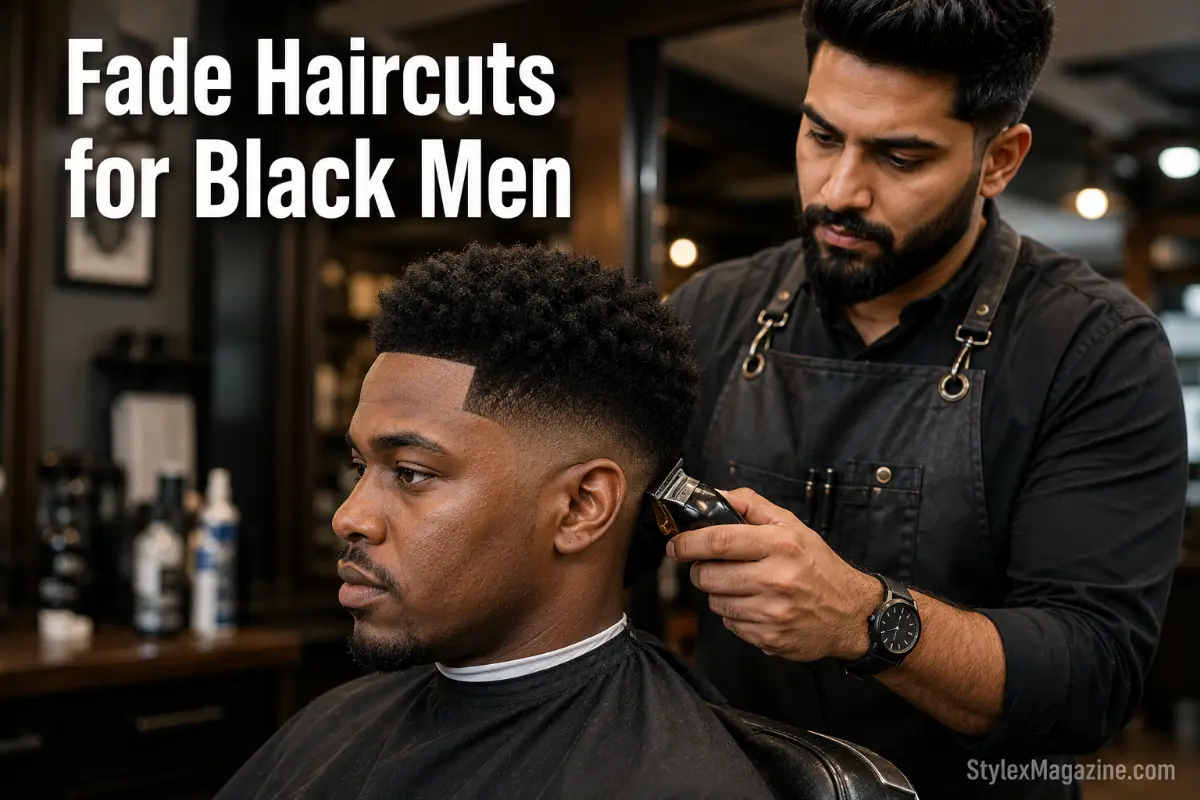

Quick Answer The fade works better with Black hair than any other texture — coily and kinky hair holds a clean edge precisely because it doesn’t lie flat. Low, mid, high, burst, drop, temp, and skin fades all work. The right choice depends on your hair type (Type 3 vs Type 4), your face shape, and how your hair behaves once it dries — not when it’s freshly washed.
The fade didn’t start as a trend. It came out of Black barbershop culture in the 1940s and 1950s — built specifically to work across the full range of Black hair textures, from loose Type 3 curls to tightly coiled 4C hair. Every variation since has been built on that foundation. Finding a fade that works for Black hair isn’t the problem — knowing which one works for your specific texture is. For every fade type explained in full, see all fade types.
Why Does the Fade Work So Well with Black Hair?
Black hair falls within Type 3 (curly) and Type 4 (coily/kinky) categories — and both types hold a fade line more cleanly than straight or wavy hair. The reason is texture. Coily and kinky hair doesn’t lay flat after cutting — each strand holds its position. That’s what makes a skin fade on 4C hair look sharper than the same cut on fine straight hair.
Type 3 hair (3A, 3B, 3C): Loose to defined curls. Fades blend naturally at the transition zone. All fade heights work well. The curl pattern on top stays visible even after a high skin fade on the sides.
Type 4 hair (4A, 4B, 4C): Tightly coiled to kinky. The highest density of any hair type. Fades cut precisely and hold the line well — but the shrinkage factor is significant. 4C hair can shrink by more than half its length once dry. A fade that sits at temple level when freshly washed can ride significantly higher once the hair contracts.
Always tell your barber the height you want based on how your hair looks dry, not wet.
What Are the Best Fade Haircut Styles for Black Men?
Every style below works across Type 3 and Type 4 hair — the right choice depends on your texture, face shape, and how much maintenance you can commit to.
1. Low Fade

The low fade starts just above the ear — the cleanest, most conservative option. On coily hair, the fade line stays close to the natural hairline rather than removing length from the sides. Professional environments, first-time fade wearers, and men with longer or oblong face shapes all land here. For all low fade variations, the low fade haircut guide covers every style in detail.
Best for: All face shapes. Especially oblong and long.
Tell your barber: “Low fade, just above the ear — keep the hairline natural.”
Maintenance: Every 3–4 weeks.
2. Low Fade with Waves

360 waves need a low, clean fade that doesn’t distract from the wave pattern on top. The fade starts just above the ear, keeping enough side hair to flow into the wave movement rather than cutting against it. Brush consistently with a medium or hard wave brush and keep a durag on between sessions to hold the pattern.
Tell your barber: “Low fade, just above the ear — I’m wearing waves on top, keep the sides clean.”
Maintenance: Every 3 weeks. Lineup every 2 weeks to keep the edge sharp.
3. Low Taper Fade

The low taper starts just above the ear but keeps hair at the base — never reaches bare skin. On coily hair this is the most forgiving option between cuts because the hair at the neckline absorbs new growth rather than exposing a skin line. Right for professional environments and men who want 4–5 weeks between visits.
Tell your barber: “Low taper fade — start just above the ear, keep some hair at the base, don’t go to skin.”
Maintenance: Every 4–5 weeks.
4. Low Temp Fade

The temp fade focuses on the temples and hairline — tight at the front, less faded at the back. On coily and Type 4 hair this is the most popular option for men with shorter top styles. The sharp temple edge frames the face without fading the entire side. A lineup is almost always added alongside it to sharpen the front hairline.
Tell your barber: “Low temp fade — tight at the temples, keep the back fuller, clean lineup at the front.”
Maintenance: Every 2–3 weeks. The temple edge loses definition fastest.
5. Mid Fade

The most requested fade in most barbershops — and for good reason on Black hair specifically. The fade starts at temple level, which gives enough contrast to show off the texture on top without cutting away too much side hair. Works with every top style from short afros to longer twists. For all mid fade variations, the mid fade haircut guide has 26 styles in full.
Best for: All face shapes.
Tell your barber: “Mid fade, starting at the temple — blended clean.”
Maintenance: Every 2–3 weeks.
6. Mid Fade with Curls

Type 3B and 3C curls on top with a mid fade on the sides — the fade starting at temple level gives the curls room to sit without the sides competing for attention. The scissor-over-comb technique at the transition zone keeps the curl-to-fade blend natural rather than creating a hard line between the curly top and the shorter sides.
Tell your barber: “Mid fade at the temple — scissor-over-comb at the transition, I want the curls to blend natural.”
Maintenance: Every 2–3 weeks.
7. Mid Fade with Beard

Mid fade starting at the temple, blended down into the beard at the sideburn. On Black men with coarse beard texture, the blend between the faded hair and the beard line needs specific attention — coarse beard hair doesn’t blend the same way fine hair does. The barber needs to fade the sideburn gradually into the beard rather than creating a hard stop. Without asking, most barbers leave a disconnection.
Tell your barber: “Mid fade at the temple — blend the sideburn into the beard, no hard stop, the beard is coarse so take your time at that transition.”
Maintenance: Fade every 2–3 weeks. Beard trim alongside.
8. Medium Fade Textured Crop

Short choppy layers on top, fringe pushed forward, mid fade on the sides. Works well on Type 3 and softer Type 4A hair where the crop texture stays defined rather than shrinking flat — and on straight or relaxed Black hair where the point-cut layers create movement that a blunt cut doesn’t. A different look from the classic afro — the top is sculpted forward rather than growing outward.
Tell your barber: “Mid fade on the sides, textured crop on top — point cut the fringe, not blunt.”
Maintenance: Fade every 2–3 weeks. Crop trim every 5–6 weeks.
9. High Fade

The fade starts above the temples — maximum contrast between the tight sides and whatever’s on top. On dense 4C hair this reads the sharpest of any hair type. The density on top is what the bold sides need — without it the cut looks sparse rather than sharp. Not suited for fine or thinning hair where a high skin fade would overexpose the scalp on the sides. For every high fade style, the high fade haircut guide covers 28 variations.
Best for: Oval, round, and square face shapes.
Tell your barber: “High fade — above the temples, tight on the sides.”
Maintenance: Every 1–2 weeks.
10. High Skin Fade with Waves

Waves on top with a high skin fade on the sides. The diagonal fade that continues the hairline at the forehead is a variation popular specifically in Black barbershop culture — the fade line follows the hairline direction rather than staying strictly horizontal. Requires a barber experienced with wave patterns to keep the wave movement continuous to the skin line.
Tell your barber: “High skin fade — bald at the base, follow the hairline direction, I’m wearing 360 waves on top.”
Maintenance: Every 1–2 weeks.
11. High Top Fade

The sides fade to skin at high height while the top is left long and shaped into a flat, boxy rectangular structure. Built on Type 4 coily hair — the tight coil pattern is what holds the flat top shape. Popularised during the 1980s and 1990s and still current. Pharrell Williams brought it back into mainstream conversation. Requires a barber who can shape the top precisely — the flat edge needs a razor-straight finish.
Best for: Oval and round face shapes. Type 4 hair.
Tell your barber: “High top fade — skin on the sides, leave the top long enough to shape into a flat top, I want the top squared off clean.”
Maintenance: Every 1–2 weeks. The flat top edge loses definition fast.
12. High Fade Afro

Natural afro on top with a high fade on the sides. The fade starts above the temples and the afro volume sits on top — maximum contrast between the tight faded sides and the full natural texture. Works with all Type 4 hair patterns. On 4C hair specifically, set the fade height based on dry hair — the afro will sit noticeably lower once it contracts, which means the fade line rises relative to the top volume.
Tell your barber: “High fade on the sides — keep the afro natural on top, set the height based on how my hair looks dry.”
Maintenance: Every 2 weeks.
13. High Fade with Design

Geometric lines, curved patterns, or shaved shapes in the faded area on the sides. High fade provides the canvas — the large faded area from above the temples to the neckline gives a barber room for geometric designs. A hard part is the most conservative design option. Full geometric patterns need a barber who specializes in haircut designs.
Tell your barber: “High fade on the sides — add [describe your design] in the faded area, and sharpen the lineup at the front.”
Maintenance: Every 1–2 weeks. Designs fade faster than the haircut itself.
14. Skin Fade

The hair at the base goes completely to bare skin — #0 guard, finished with a straight razor. On coily and 4C hair the contrast between bare skin and the natural texture above is the sharpest possible finish. Michael B. Jordan has worn this combination consistently. The quality of a skin fade varies significantly between barbers — this is the cut where experience with coily hair matters most. Clipper work alone isn’t enough; trimmer detailing and straight razor work around the edges is what separates a clean skin fade from a sharp one on coily hair.
Best for: Dense, thick hair. All face shapes.
Tell your barber: “Skin fade — bald at the base, straight razor finish, specify low/mid/high for height.”
Maintenance: Every 1–2 weeks. Growth is visible within days.
15. Burst Fade

The fade curves around the ear in a semi-circular arc — the back stays longer than a standard fade. On coily and kinky hair the arc follows the natural growth pattern of the head more naturally than a straight horizontal line does. Common with mohawks, natural afro styles, and frohawks because the curved arc preserves back length. On 4C hair the arc also sits more accurately after shrinkage than a straight fade line at the same height — the curve absorbs the contraction rather than fighting it. Full burst fade haircut guide has 32 styles.
Best for: All face shapes. Especially round and square with curly or coily hair.
Tell your barber: “Burst fade — curved arc around the ear, leave more length at the back.”
Maintenance: Every 2–3 weeks.
16. Burst Fade Mohawk

Strip of longer hair down the center, burst fade arcing around the ear on both sides. On Type 4 hair the mohawk strip holds its shape — the density and coil pattern keep the strip defined without product. The burst fade preserves back length which a standard high fade would cut away.
Tell your barber: “Burst fade on the sides — leave a strip of length down the center, arc around the ear, blend the edges into the fade.”
Maintenance: Every 2 weeks.
17. Drop Fade

The fade line drops downward behind the ear rather than staying horizontal — a rounded sculpted silhouette at the back of the head. On coily hair this drop line creates a distinctive back profile that a straight fade line doesn’t have. Wear it with waves, thick curls, twists, or braids for a fresh look. A drop mid fade holds mid-level height on the sides but drops lower behind the ear.
Tell your barber: “Drop fade — let the fade line curve and drop lower at the back, keep it sharp where it drops.”
Maintenance: Every 2–3 weeks.
18. Drop Fade with Waves

360 waves on top with a drop fade curving behind the ear at the back. The drop adds a sculpted back profile to what would otherwise be a standard waves-and-fade combination. The wave pattern continues into the drop line rather than being cut by a straight horizontal edge.
Tell your barber: “Drop fade — let the line drop at the back, I’m wearing waves on top, keep the wave pattern continuous.”
Maintenance: Every 2–3 weeks.
19. Temp Fade / Temple Fade

The fade focuses around the temples and frontal hairline — sharp at the front, longer at the back. On Black hair the temp fade is often paired with a lineup edge for maximum front definition. The temple fade is the standard starting point for shorter cuts like buzz cuts, sponge curls, and low afros where most of the style interest is at the front.
Tell your barber: “Temp fade — tight around the temples and frontal hairline, keep the back fuller, clean lineup.”
Maintenance: Every 2–3 weeks.
20. Fade with Lineup / Edge-up

A lineup — also called an edge-up or shape-up — is a razor-sharpened outline around the hairline: forehead, temples, and sometimes behind the ears. It’s not a separate fade type; it’s added to any fade. On Black hair specifically, a lineup is the finishing detail that takes a fresh fade from clean to razor-sharp. It works with the natural hairline rather than against it — a skilled barber reads the natural M-shape or widow’s peak and sharpens it, not straightens it. Forcing a straight line on a receding or naturally curved hairline reads as artificial.
Tell your barber: “Add a lineup after the fade — follow my natural hairline, don’t force it straight.”
Maintenance: Every 2 weeks. The lineup loses definition faster than the fade.
21. Fade with 360 Waves

360 waves require a specific combination: a low or mid fade that doesn’t cut into the wave pattern, paired with consistent brushing and a wave compression routine to hold the pattern between sessions. On coily and Type 3C–4A hair, waves form through repeated compression — the fade keeps the sides neat while the wave pattern develops on top. A hard wave brush for the initial training phase, a medium brush for maintenance.
Tell your barber: “Mid or low fade — I’m training waves on top, keep the sides clean and the transition smooth.”
Maintenance: Fade every 3 weeks. Lineup every 2 weeks.
22. Fade with Afro

The afro fade is the most natural pairing for Type 4 hair — the volume of the natural afro against the tight faded sides creates contrast without needing any styling. Low fade gives a fuller silhouette, high fade gives maximum contrast. The afro needs moisture to maintain definition; a leave-in conditioner or curl cream keeps the coil pattern intact between washes. According to Healthline’s hair care guide, coily hair benefits significantly from sealing moisture with oil after conditioning — directly relevant to maintaining the afro texture on top.
Tell your barber: “Fade on the sides — leave the top natural, I want the afro shape, set the height based on dry hair.”
Maintenance: Every 2–3 weeks for the fade.
23. Fade with Dreadlocks

Locs on top with a fade on the sides. The contrast between the tight faded sides and the textured locs is sharp and intentional — the longer the locs, the more dramatic the contrast. Any fade height works depending on how bold you want the sides. Travis Scott has worn this combination with a burst fade on the sides.
Tell your barber: “Fade on the sides — keep the locs on top, arc around the ear if burst fade, clean edges at the lineup.”
Maintenance: Every 2–3 weeks for the fade. Locs maintenance separate.
24. Fade with Braids

Cornrows or box braids on top with a fade on the sides. The mid fade is the most common combination — starting at temple level gives the braids room to sit and flow without the sides competing. A drop fade pairs particularly well with longer braids because the curved back line follows the braid direction naturally.
Tell your barber: “Mid fade on the sides — I’m getting braids on top, keep the sides clean and the lineup sharp.”
Maintenance: Fade every 3 weeks. The braids will cover the fade grow-out.
25. Fade with Twists

Two-strand twists on top with a fade on the sides. The twist texture creates natural definition — the fade keeps the sides tight while the twists add visual interest on top. Works on Type 4A and 4B hair where the twist pattern holds without heavy product. A mid or high fade gives maximum contrast between the textured twists and the tight sides.
Tell your barber: “Mid fade on the sides — I’m wearing twists on top, keep the sides tight and the lineup clean.”
Maintenance: Every 2–3 weeks.
26. Fade with Sponge Curls

A hair sponge creates defined coil patterns on short natural hair — the sponge curls sit on top while the fade keeps the sides clean. Works best on Type 4A and 4B hair where the sponge can create consistent coil definition. A temp or low fade keeps the front hairline sharp while the sponge curls on top give the cut its visual interest.
Tell your barber: “Temp fade or low fade — I’m using a hair sponge for the top, keep the front hairline sharp.”
Maintenance: Every 2–3 weeks.
27. Fade with Hard Part

A razor-shaved line cut precisely into one side of the head — on Black hair the hard part is sharper than on any other texture because the coil pattern creates a clean edge where the part is cut. A mid fade on both sides with a hard part on the left reads professional and sharp at the same time. The hard part and the lineup together are the two defining sharp details of this combination.
Tell your barber: “Mid fade on both sides — razor hard part on the left side, about an inch back from the hairline.”
Maintenance: Every 2 weeks. The hard part loses definition faster than the fade.
28. Frohawk Fade

A frohawk keeps the natural coily texture in a strip from front to back — the sides are faded while the center strip stays natural. The difference from a mohawk is that the frohawk strip remains as natural coily or kinky texture rather than being shaped or styled upward. A high burst fade gives maximum contrast while preserving the back length the natural strip needs.
Best for: Oval and oblong face shapes. Type 4 hair.
Tell your barber: “High burst fade on the sides — leave a natural strip of coily hair down the center, don’t touch the top.”
Maintenance: Every 2 weeks.
29. South of France Fade

A diagonal fade that follows the hairline direction at the forehead — the fade line starts at the temple and slopes diagonally toward the ear rather than running straight across. Paired with 360 waves or a defined curl pattern on top, the diagonal fade integrates the hairline into the overall cut. Popular in Black barbershop culture as a more personalized alternative to the standard horizontal fade line.
Tell your barber: “South of France fade — diagonal fade line following my hairline, not straight across.”
Maintenance: Every 2–3 weeks.
30. Buzz Cut Fade

Short even buzz on top with a fade on the sides. On coily hair a buzz cut with a mid or high skin fade gives a clean uniform look where the texture on top reads as intentional against the tight faded sides. Minimal daily styling. The low taper fade version keeps the sides fuller for a slightly less bold result.
Tell your barber: “Mid fade on the sides — number two or three all over on top, skin at the base.”
Maintenance: Every 2 weeks.
31. Faux Hawk Fade

Hair styled upward along the center without fully shaving the sides. On coily hair the faux hawk ridge holds naturally — the texture creates lift without product. A burst fade or high fade on the sides gives the faux hawk contrast without fully committing to a mohawk. Works particularly well with Type 3C and 4A hair where defined curls in the center strip create natural visual height.
Tell your barber: “Burst fade or high fade on the sides — leave a strip down the center long enough to push up.”
Maintenance: Every 2 weeks.
32. High Fade with Kinky Top

High skin fade on the sides with short kinky/coily natural hair on top left untouched. No shaping, no product — just the natural 4B or 4C texture against the tight faded sides. The contrast between the bare skin sides and the dense kinky top is immediate and bold. The hairline needs a clean lineup to frame the natural texture at the front.
Tell your barber: “High skin fade on the sides — leave the top natural, no shaping on top, sharp lineup at the front.”
Maintenance: Every 1–2 weeks.
What Happens to a Fade on Black Hair When It Dries?
Every article covers fade types. Almost none of them explain what happens to the fade on Black hair specifically once it dries.
Coily and 4C hair can shrink by more than half its length when it dries — sometimes significantly more on very tight 4C patterns. A mid fade sitting precisely at temple level when freshly washed can read as a high fade — or higher — once the hair contracts. This matters at every fade height:
- Low fade on 4C hair: Even at the lowest starting point, shrinkage can push the fade line up past the ear once dry. A low fade set when wet can look like a mid fade once the hair contracts.
- Mid fade on 4C hair: Almost always reads higher once dry. On very tightly coiled hair, a mid fade set when wet may be a high fade by the time the hair dries.
- High fade on 4C hair: Already starts above the temples. Shrinkage can push it further — sometimes uncomfortably so.
The fix: Tell your barber to set the fade height based on how your hair looks dry. If you’ve just washed it, let it dry before sitting in the chair. If you need to go straight after washing, describe the dry height explicitly — “mid fade at temple level when my hair is dry, not wet.”
Which Fade Suits Your Hair Type?
| Hair Type | Pattern | Best Fade | Key Note |
|---|---|---|---|
| Straight (relaxed/Type 3A) | Flat or loose wave | Any — all levels work | Sharpest fade lines of all textures — hair lies flat |
| Type 3A | Loose curls | Any — low or mid preferred | Curls blend naturally at transition |
| Type 3B | Defined curls | Any — mid or high | Scissor-over-comb at transition |
| Type 3C | Tight defined curls | Any — mid or burst fade | Shrinkage moderate |
| Type 4A | S-pattern coils | Mid or burst fade | Shrinkage significant — set height dry |
| Type 4B | Z-pattern coils | Low or mid — shadow fade preferred | Dense texture, skin fade reads very sharp |
| Type 4C | Tightest coils, minimal pattern | Low or mid — shadow or skin fade | Highest shrinkage — always set height dry |
Shadow fade note for Type 4B and 4C: A shadow fade — which stops at stubble rather than going to bare skin — is worth considering on very tightly coiled hair. The gradual gradient from dark stubble at the base looks more natural on dense coily texture than a hard skin line in some cases.
How Do You Choose the Right Fade?
By face shape:
| Face Shape | Best Fade Height | Why |
|---|---|---|
| Oval | Any | Balanced proportions |
| Round | Mid or high | Adds visual height |
| Square | Mid or high | Adds structure |
| Oblong / Long | Low only | Doesn’t add height |
| Diamond | Mid | Keeps side width |
| Heart | Low or mid | Avoids sharpening temples |
By lifestyle:
- Office or formal → Low taper or low skin fade. Mid fade with lineup is the furthest most formal environments accept.
- Creative or casual → Any fade height.
- Athletic → Mid or high skin fade. Short grow-out stays clean between sessions.
- Low maintenance → Low taper. Holds 4–5 weeks on coily hair.
By receding hairline:
A receding hairline doesn’t eliminate fade options. A temp fade with a tight lineup that follows the natural M-shape or widow’s peak is the cleaner approach. Avoid high fades that start above where the hairline is naturally receding — they draw attention to the recession rather than framing around it.
What Should You Tell Your Barber?
On Black hair specifically, three details matter beyond height and closeness:
1. Wet vs dry: “Set the fade height based on how my hair looks dry.” 2. Hairline: “Follow my natural hairline — don’t force it straight.” 3. Beard blend (if applicable): “Blend the fade into my beard at the sideburn — my beard is coarse, take your time at that transition.”
Full phrases per style:
- Low fade: “Low fade, just above the ear — follow my natural hairline.”
- Mid fade: “Mid fade at the temple — blended clean, set height for dry hair.”
- High fade: “High fade above the temples — tight on the sides, skin at the base.”
- Burst fade: “Burst fade — curved arc around the ear, leave length at the back.”
- Temp fade: “Temp fade — sharp at the temples, fuller at the back, lineup at the front.”
- Lineup: “Add a lineup — follow my natural hairline, don’t straighten it.”
How Often Should Black Men Get a Fade?
| Variation | Frequency | Note |
|---|---|---|
| High skin fade | Every 1–2 weeks | Growth shows within days |
| High top fade | Every 1–2 weeks | Flat top edge loses definition fast |
| Fade with design | Every 1–2 weeks | Designs fade faster than the cut |
| Lineup (standalone) | Every 2 weeks | Sharpest element, first to grow out |
| Mid skin fade | Every 2 weeks | Most barbers recommend 2 weeks |
| Burst fade | Every 2–3 weeks | Arc shape loses definition |
| Mid taper fade | Every 2–3 weeks | Moderate grow-out |
| Low skin fade | Every 2–3 weeks | Skin line shows growth |
| Low taper fade | Every 4–5 weeks | Hair at base absorbs grow-out |
| Low fade with braids/locs | Every 3–4 weeks | Top style covers grow-out |
Between visits: Keep the neckline clean with a trimmer at home. Avoid heavy products on the faded sides — buildup makes uneven growth more visible and makes the fade look patchy faster. The American Academy of Dermatology recommends keeping coily hair moisturized and minimizing heat and friction between styling sessions — directly relevant to maintaining the texture on top between fade touch-ups.
What Is the Biggest Mistake Black Men Make with a Fade?
Asking the barber to make the lineup straight when the natural hairline curves. A forced straight line on an M-shaped hairline or a widow’s peak looks unnatural and ages faster than the fade itself. The lineup should sharpen what’s there — not reshape it into something it isn’t. Work with the hairline, not against it.
FAQ
What is the best fade haircut for Black men?
The mid fade is the most versatile — works on every face shape, every Type 3 and Type 4 hair pattern, and every setting. If you’re unsure, start with a mid fade and adjust from there.
What fade looks good on Black hair?
All fade types work. Coily and kinky texture holds a fade line more precisely than any other hair type. The choice depends on your specific texture (Type 3 vs Type 4), face shape, and maintenance commitment.
How often should Black men get a fade?
Low taper: every 4–5 weeks. Mid fade: every 2–3 weeks. High skin fade or fade with design: every 1–2 weeks. The lineup needs a touch-up every 2 weeks regardless of fade height.
Can straight hair get a fade?
Yes. Straight hair on Black men — often from chemical relaxers or naturally looser curl patterns (Type 3A) — takes a fade well and produces the sharpest possible fade lines because the hair lies flat and cuts precisely.
What is a lineup for Black men?
A razor-sharpened outline around the hairline — forehead, temples, and sideburns. Added after any fade, it defines the front hairline. On Black hair, it’s the finishing detail that separates a clean fade from a sharp one.
How do you maintain a fade with coily hair?
Keep the neckline clean with a trimmer between barber visits. Moisturize the hair on top — coily hair is prone to dryness, and dry hair loses curl definition faster. A leave-in conditioner followed by a light hair oil seals moisture in.
Which fade lasts longest on coily hair?
Low taper fade — the hair at the base absorbs new growth rather than creating a visible skin line. Holds 4–5 weeks on Type 4 hair before needing a touch-up.
What is a temp fade?
A temple fade — the fade focuses tightly around the temples and frontal hairline while the back of the head stays longer. Often paired with a lineup for maximum front definition. Common on shorter styles like buzz cuts, sponge curls, and low afros.

25 Low Fade Haircuts For Men In 2026.
26 Best Mid Fade Haircuts for Men in 2026.

[…] Use a single-blade razor or electric foil shaver instead of multi-blade cartridges. Shave with the grain, never against. Apply a salicylic acid aftershave to prevent ingrowns. A line-up at the hairline connecting through the sideburns into the Van Dyke creates one continuous outlined shape. For the full guide on coily hair and beard pairings, see fade haircuts for Black men. […]
[…] Use a single-blade razor or electric foil shaver on the chin. Shave with the grain. Apply a salicylic acid aftershave. A line-up at the hairline connecting through the sideburns into the chops creates one continuous framed shape. For the full guide on coily textures, see fade haircuts for Black men. […]
[…] Single-blade razors or electric foil shavers reduce irritation compared to multi-blade cartridges. Shave with the grain on the cheeks, never against. Apply a salicylic acid aftershave to prevent ingrowns. For the full guide on pairing beard styles with coily hair textures, see fade haircuts for Black men. […]
[…] For curly and coily beards: Coily hair contracts after cutting, so the neckline appears to jump higher after trimming than where you set it. Cut slightly lower than the two-finger point to account for shrinkage. For the full guide on coily textures, see fade haircuts for Black men. […]
[…] Coily and coarse hair textures create naturally sharper buzz lines. The beard needs defined edges and consistent moisture to match the crispness of the cut. For the full guide, see fade haircuts for Black men. […]
[…] Use a single-blade razor or electric foil shaver on the cheeks. Shave with the grain. Apply a salicylic acid aftershave to prevent ingrowns. A line-up at the hairline connecting through the sideburns creates a framed, architectural look. For the full guide on coily textures and beard pairings, see fade haircuts for Black men. […]