
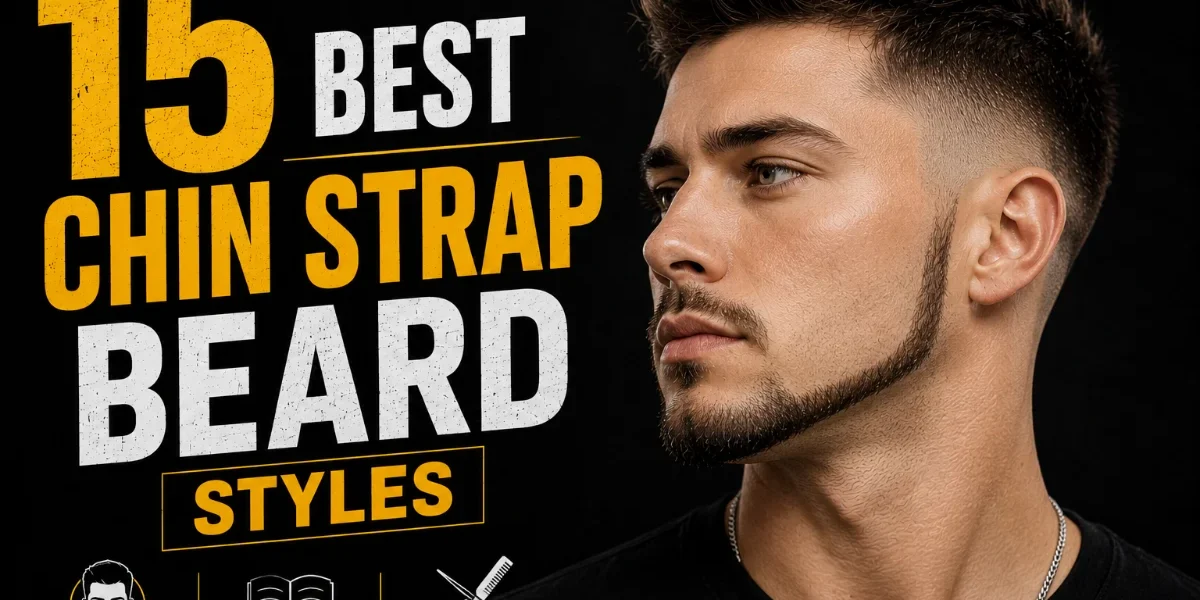

Quick Answer: A chin strap beard is a narrow band of facial hair that runs from sideburn to sideburn along the jawline, with the cheeks and upper lip shaved clean. Width ranges from 5mm (pencil-thin) to 20mm (bold). The classic, faded, and chin strap with goatee are the three most requested variations in 2026. Touch-ups every 2-3 days are non-negotiable.
The chin strap beard is having its sharpest moment since the early 2000s, but the 2026 version has nothing in common with the thin, uneven lines from that era. Lewis Hamilton wears a clean, precise strap at F1 race weekends. Stormzy made it part of his signature look. Drake shifts between a classic strap and a chin strap goatee depending on the season. What was once dismissed as outdated has come back as the cleanest, most jawline-defining style a man can wear.
The chin strap sits at a specific intersection: more defined than stubble, less commitment than a full beard, and more structured than a goatee. It rewards men who are willing to maintain sharp edges every two to three days. If that sounds like too much work, this is not the style for you. If precision is what you want, every variation, trim step, face shape match, and barber script is below.
What Is a Chin Strap Beard?
A chin strap beard is a strip of facial hair that follows the jawline from one sideburn, down along the jaw, across the chin, and back up to the other sideburn. The cheeks stay clean. The upper lip stays clean in the classic version. The name comes from the resemblance to the strap on a helmet fastened under the chin.
The width of the strap defines the look. Thin straps (5-8mm) create a sharp, modern line. Medium straps (8-12mm) are the standard starting point. Wide straps (12-20mm) lean more rugged and start approaching short boxed beard territory. Anything wider than 20mm is not a chin strap anymore.
Chin strap vs chin curtain: These get confused constantly. A chin strap is a narrow, defined band that traces the jaw’s edge. A chin curtain (Abraham Lincoln’s style) is wider and covers the full chin and lower jaw without a mustache. The curtain fills. The strap outlines. For the full range of no-mustache options including the chin curtain, the beard styles without mustache guide covers 20 variations.
What Are the Best Chin Strap Beard Styles?
Every style below includes the width, face shape match, and what to tell your barber. The order runs from classic to modern to combination styles.
1. Classic Chin Strap
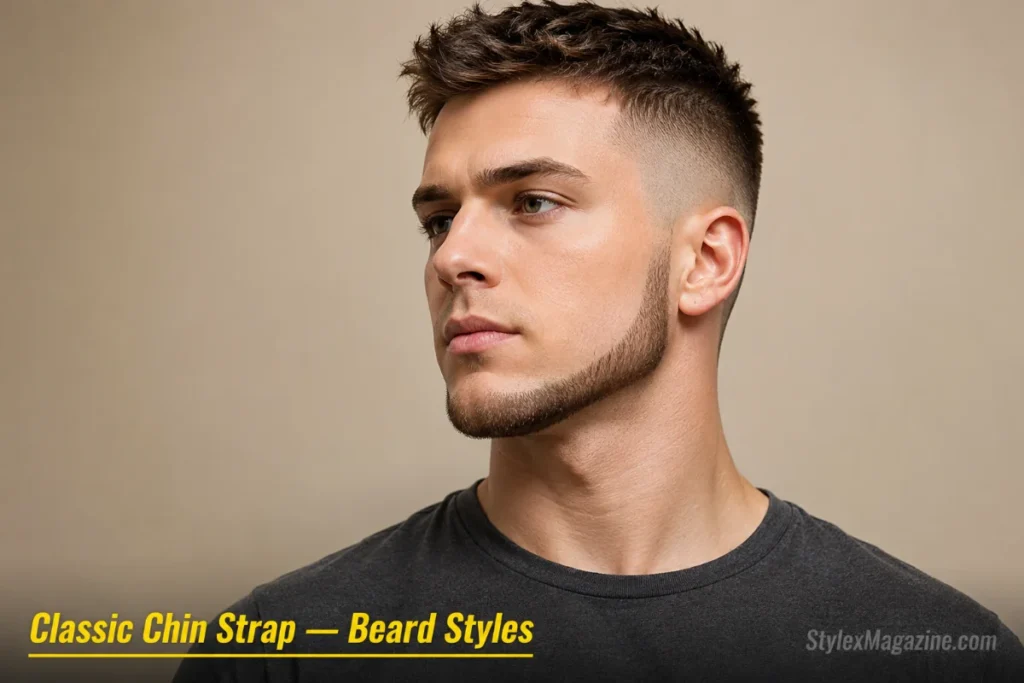
Celebrity: Lewis Hamilton | Hair type: All | Width: 8-12mm
An even band of facial hair running from sideburn to sideburn at medium width, clean cheeks, bare lip. The starting point for every chin strap variation. At 8 to 12mm wide, this looks intentional and clean without demanding the precision of a thinner line. Lewis Hamilton has made this his signature grooming choice at trackside and on red carpets.
Best for: Oval, square, and oblong face shapes.
Tell your barber: “Classic chin strap, about a centimetre wide, even from ear to ear, clean cheeks and lip.”
Maintenance: Touch up edges every 2-3 days. Guard 2-3 within the strap.
2. Thin Chin Strap
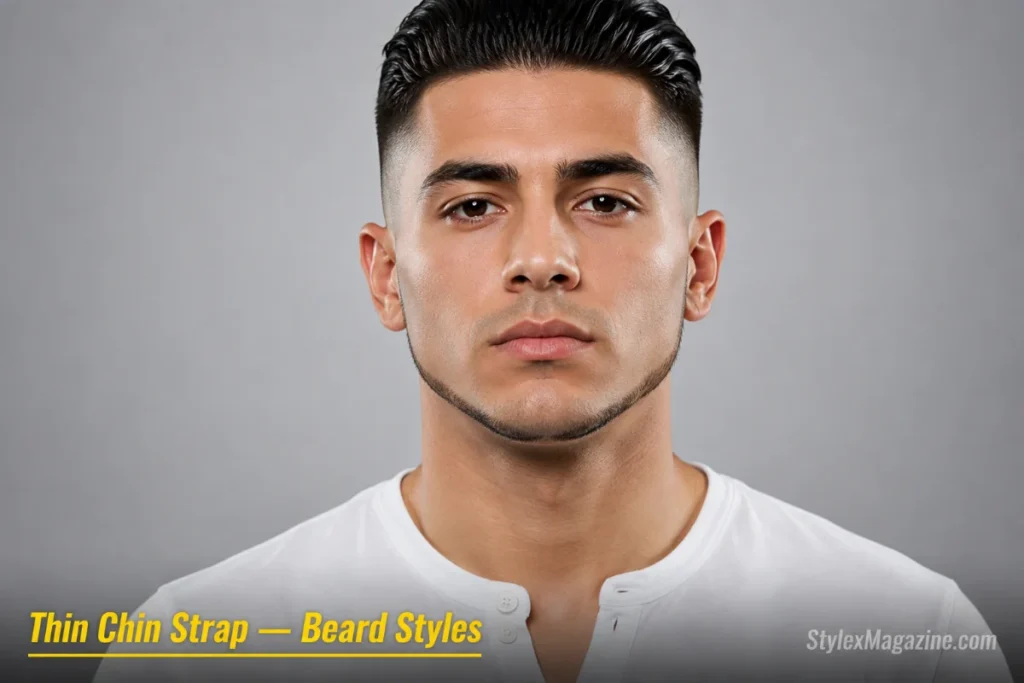
Celebrity: Lewis Hamilton (thinner variation) | Hair type: All | Width: 5-7mm
A pencil-thin line hugging the jaw’s edge. Maximum definition, maximum maintenance. Every millimeter of width matters at this scale, so any asymmetry or stray hair shows immediately. The thin chin strap is the hardest version to maintain at home and the one that benefits most from a barber setting the initial shape.
I trim more chin straps too thin than too thick. Start at 10mm and narrow gradually over two or three sessions rather than going pencil-thin on the first attempt.
Best for: Diamond, round (adds structure), and oblong face shapes.
Tell your barber: “Thin chin strap, 5 to 7mm wide, razor-sharp edges, bare cheeks and lip.”
Maintenance: Touch up every 1-2 days. High commitment.
3. Thick/Wide Chin Strap
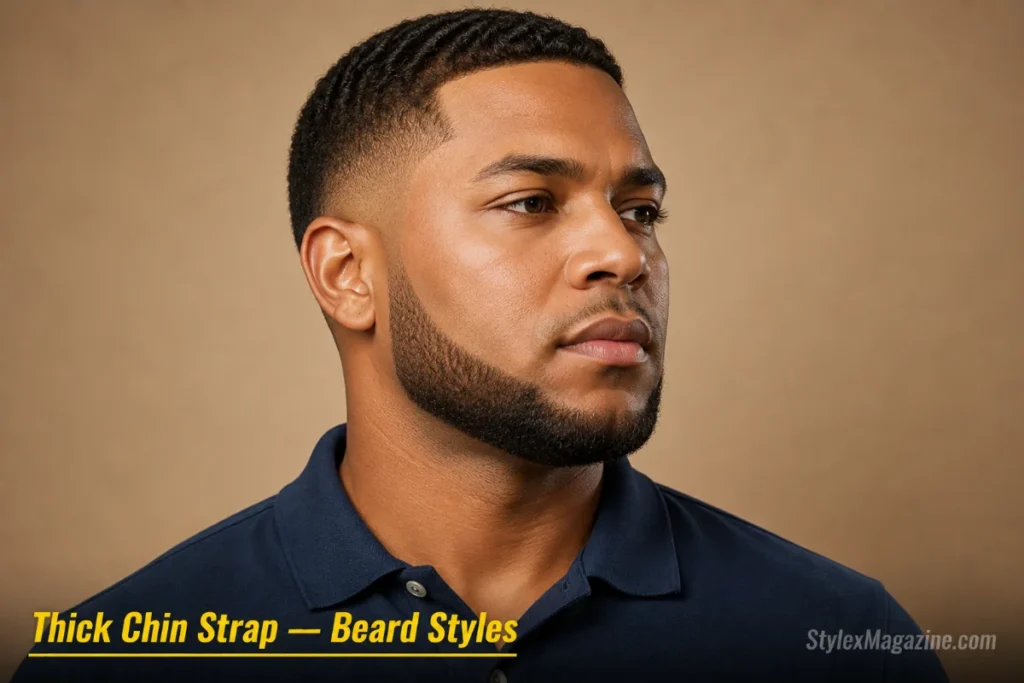
Styling tip: Start wide, narrow later | Hair type: All | Width: 15-20mm
A bold band covering more of the jaw’s surface. More forgiving to maintain than thinner versions because small edge inconsistencies are less visible against the wider strip. The thick strap adds real jawline definition to round and heart-shaped faces without requiring the precision of a pencil line. Once the width passes 20mm, you are entering short beard territory.
Best for: Round and heart-shaped faces. Men new to chin straps.
Tell your barber: “Wide chin strap, about 15 to 20mm, clean cheeks, clean lip, defined edges.”
Maintenance: Touch up every 2-3 days. The most forgiving strap variation.
4. Stubble Chin Strap
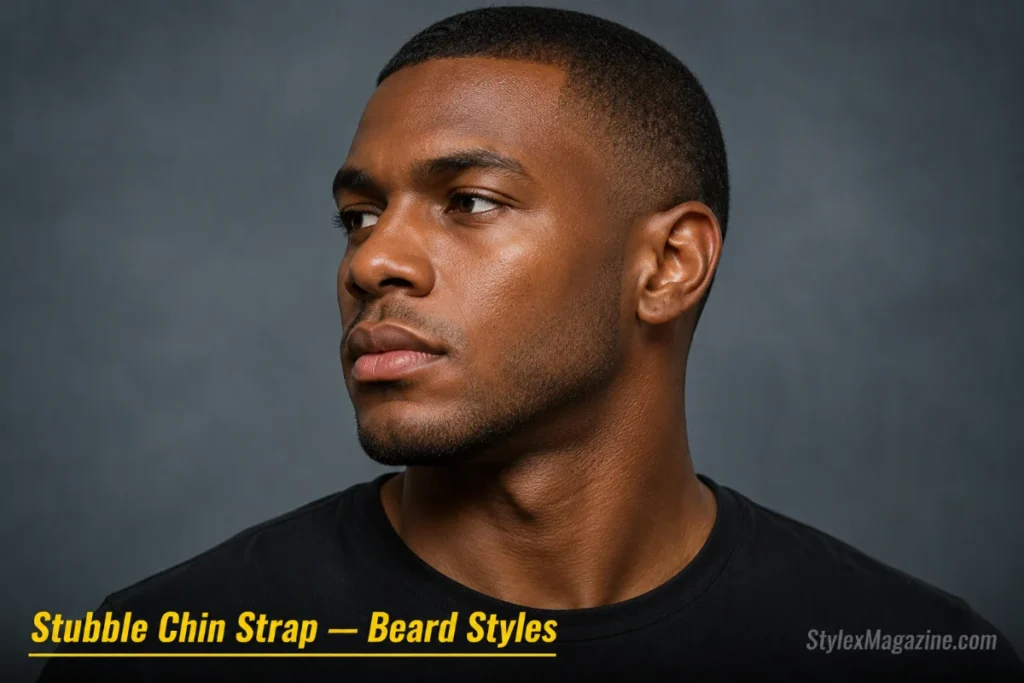
Celebrity: Stormzy | Hair type: All | Width: 10-15mm
Heavy stubble concentrated along the jawline with softer edges. Lower maintenance than any hard-edged variation because the stubble texture disguises minor inconsistencies. Stormzy wears this as his default. The stubble chin strap is the entry-level option for men who want jawline definition without the twice-weekly razor commitment.
Best for: All face shapes. Men trying a chin strap for the first time.
Tell your barber: “Stubble chin strap, guard 1 to 2 along the jaw, soft edges, clean cheeks.”
Maintenance: Trimmer pass every 3-4 days. Lowest commitment of any chin strap.
5. Faded Chin Strap
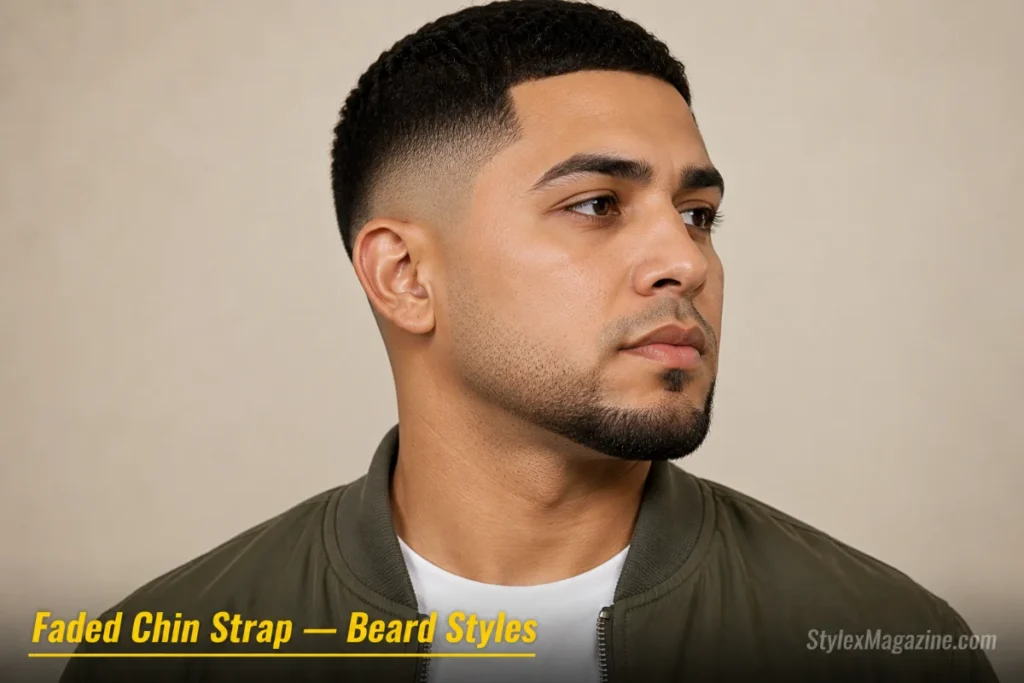
Styling tip: Barber work, not home work | Hair type: All | Width: 12-18mm
The hair grades from bare skin near the sideburns through progressively denser growth into full coverage at the chin. No hard edge between skin and beard. The faded chin strap is the most modern interpretation, and it has become the most requested chin strap variation in 2026 as barbershop fade culture has influenced beard styling.
This is not a DIY style. The gradient needs clipper-over-comb blending and multiple guard changes, then re-blending every two to three weeks to keep the transition smooth. Book a barber for the initial shape, then maintain the cheek and lip areas at home between visits.
Best for: All face shapes. Pairs well with any fade haircut.
Tell your barber: “Faded chin strap, bare at the sideburn, full at the chin, gradient through the cheekbone.”
Maintenance: Barber every 2-3 weeks. Home cleanup every 3 days.
6. Disconnected Chin Strap
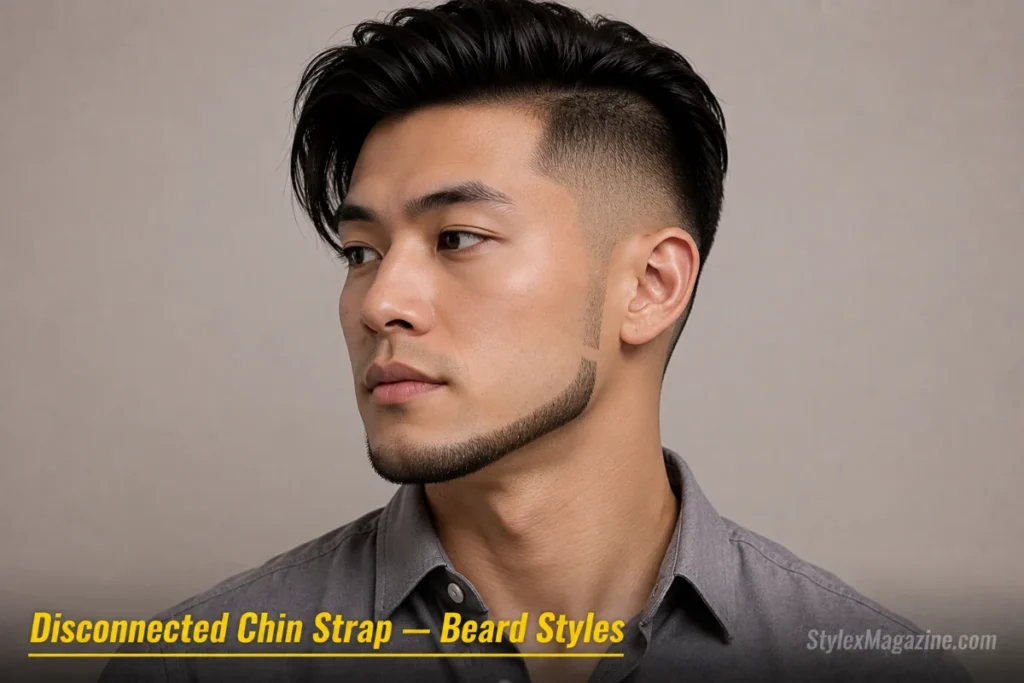
Styling tip: Position the gap with precision | Hair type: All | Width: 8-12mm
A classic chin strap with a clean-shaved gap somewhere along the jaw. The break is the personality. Most men position the gap where the jaw meets the ear or at the corner of the chin. Creates an edgy, geometric look that looks modern and intentional.
Best for: Oval, square, and round face shapes.
Tell your barber: “Disconnected chin strap, clean break at the jaw corner, about a centimetre gap.”
Maintenance: Re-shave the gap and edges every 2-3 days.
7. Extended Chin Strap
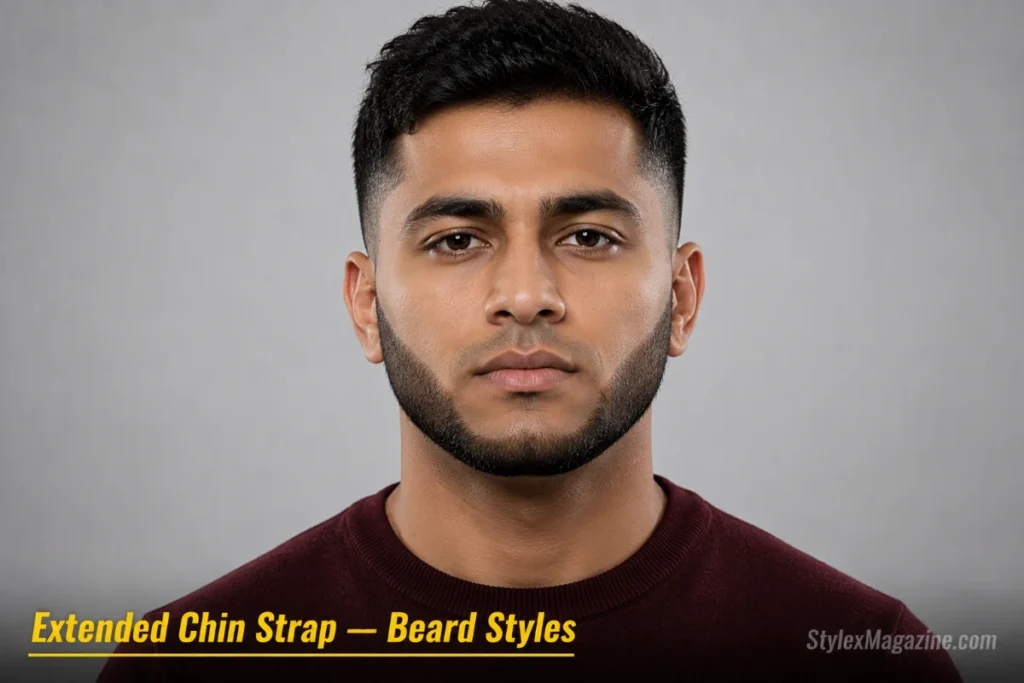
Hair type: Dense growth needed | Width: 15-20mm
A wider strap that extends higher up toward the cheeks, blurring the line between a chin strap and a short boxed beard. More coverage, more presence, still recognizably a chin strap because the cheek line stays below the cheekbone. The extra width adds horizontal structure that benefits long and narrow faces.
Best for: Oblong and narrow face shapes. Men who want more coverage.
Tell your barber: “Extended chin strap, wider band, slightly higher cheek coverage, defined edges.”
Maintenance: Touch up every 2-3 days. Barber shape-up every 3-4 weeks.
8. Chin Strap with Goatee
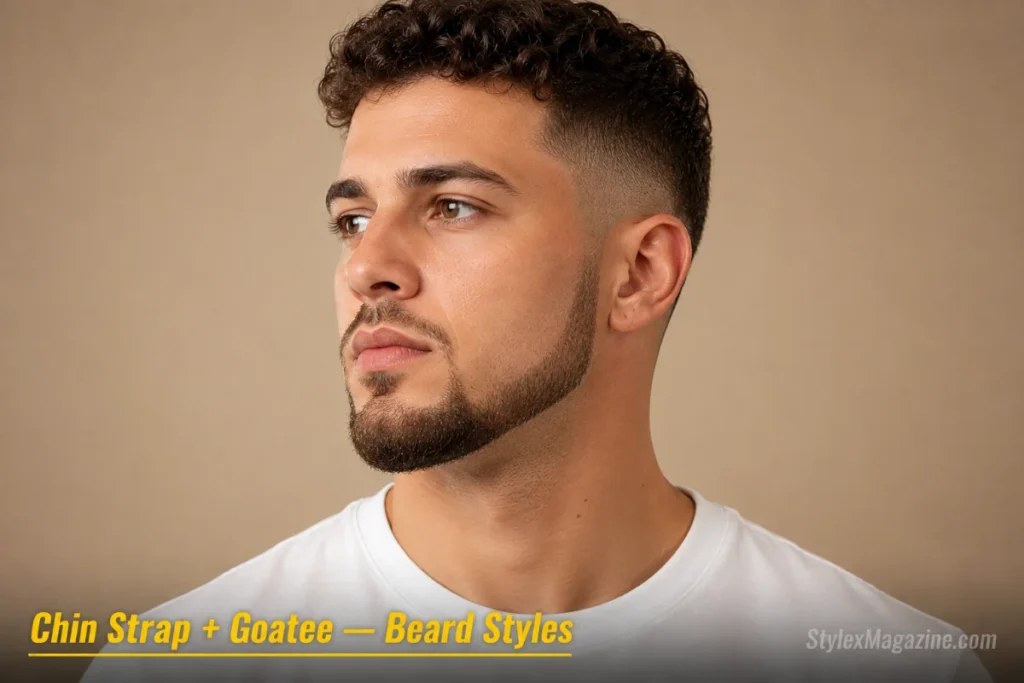
Celebrity: Drake, 50 Cent | Hair type: All | Width: 8-12mm strap + goatee
The chin strap meets a goatee at the center of the chin, adding vertical emphasis and mouth framing. Drake has made this his primary facial hair style for years. The goatee adds visual weight to the chin that the strap alone cannot provide. The most popular chin strap combination because it gives more presence while keeping the cheeks open.
Best for: Oval, round, and diamond face shapes.
Tell your barber: “Chin strap with goatee, matching lengths, clean cheeks, connected at the chin.”
Maintenance: Touch up strap edges and goatee outline every 2-3 days.
9. Chin Strap with Mustache
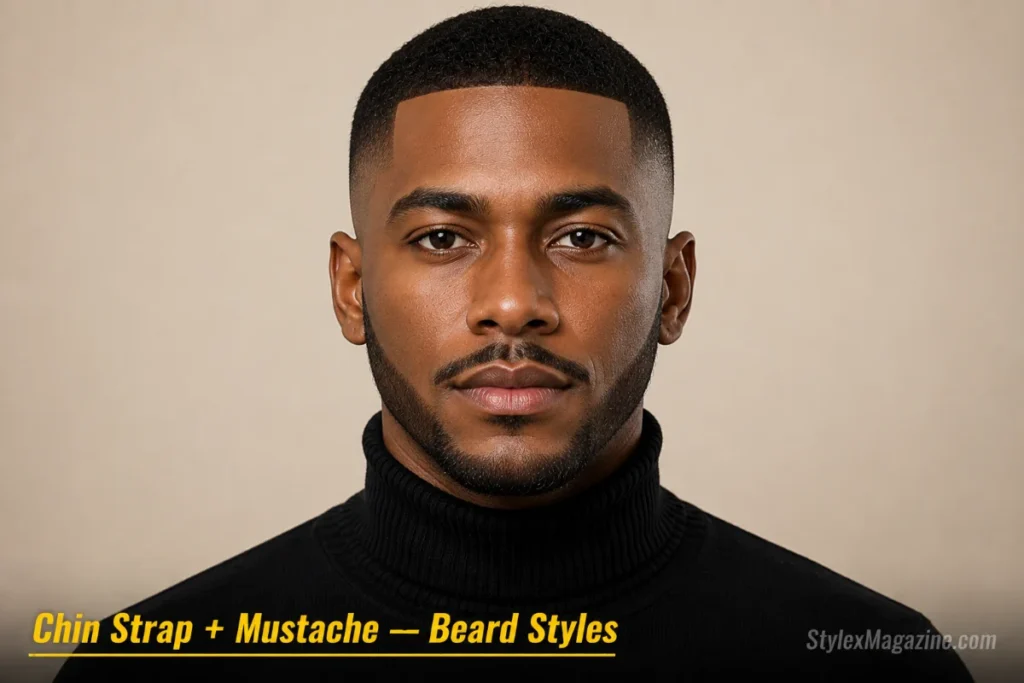
Celebrity: Stormzy (various eras) | Hair type: All | Width: 8-12mm
A chin strap paired with a clean, evenly trimmed mustache at the same length. Adding the mustache frames the entire lower face: jawline, chin, and lip. Keep the mustache and strap at matching lengths so they look like one continuous style rather than two separate decisions.
Best for: Oval, square, and oblong face shapes.
Tell your barber: “Chin strap with mustache, same length, clean cheeks, everything connected.”
Maintenance: Touch up every 2-3 days. Comb the mustache daily.
10. Beardstache Chin Strap
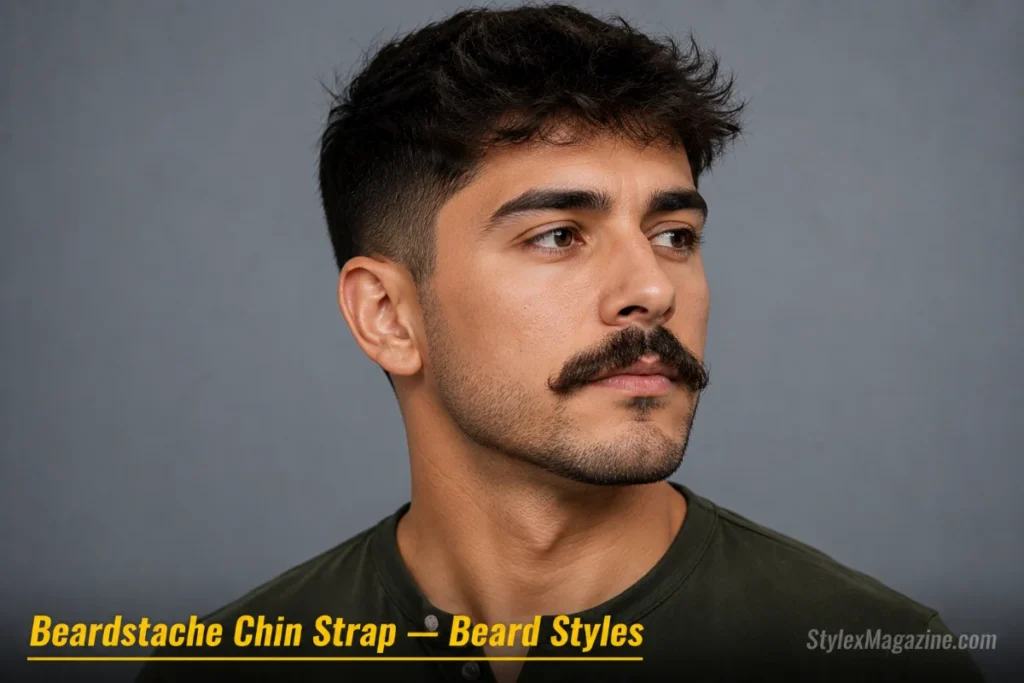
Styling tip: Mustache leads, strap frames | Hair type: All | Width: 8-12mm strap
A thick, full mustache paired with a chin strap at stubble length. The mustache dominates. The strap supports. On its own, this creates three distinct zones: clean cheeks, defined jawline, prominent mustache. Trending in 2026 as part of the broader “hybrid beard shapes” movement where elements of different classic styles combine with purpose.
Best for: Oval and oblong face shapes. Men with strong mustache growth.
Tell your barber: “Beardstache chin strap, keep the mustache full and thick, strap at guard 1 to 2, clean cheeks.”
Maintenance: Strap trimmed every 2-3 days. Mustache shaped every 3-4 weeks.
11. Anchor Chin Strap
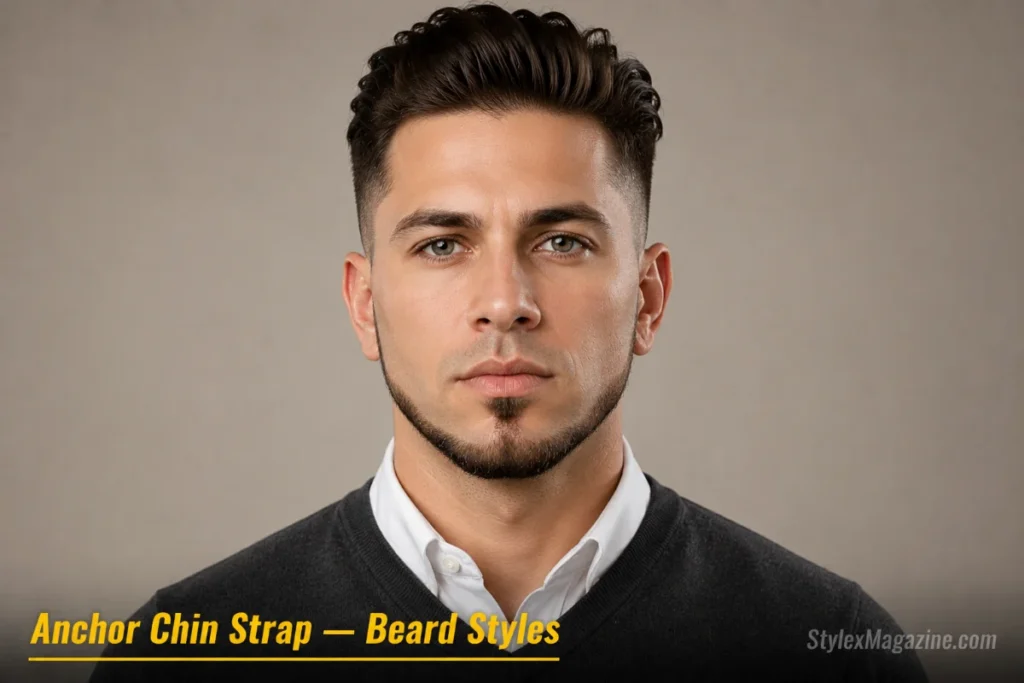
Celebrity: Robert Downey Jr. (modified) | Hair type: All | Width: 8-12mm
A chin strap with a pointed chin extension and soul patch, shaped to resemble a ship’s anchor. Three separate elements (jawline band, chin point, soul patch) all need independent edging every two to three days. The anchor chin strap is the most refined and hardest-to-maintain variations, but it carries more visual interest than a plain strap.
Best for: Square and diamond face shapes.
Tell your barber: “Anchor chin strap, pointed chin section, soul patch, jawline band, all edges clean.”
Maintenance: Detail trimmer every 2-3 days. High maintenance.
12. Chin Curtain (Amish Style)
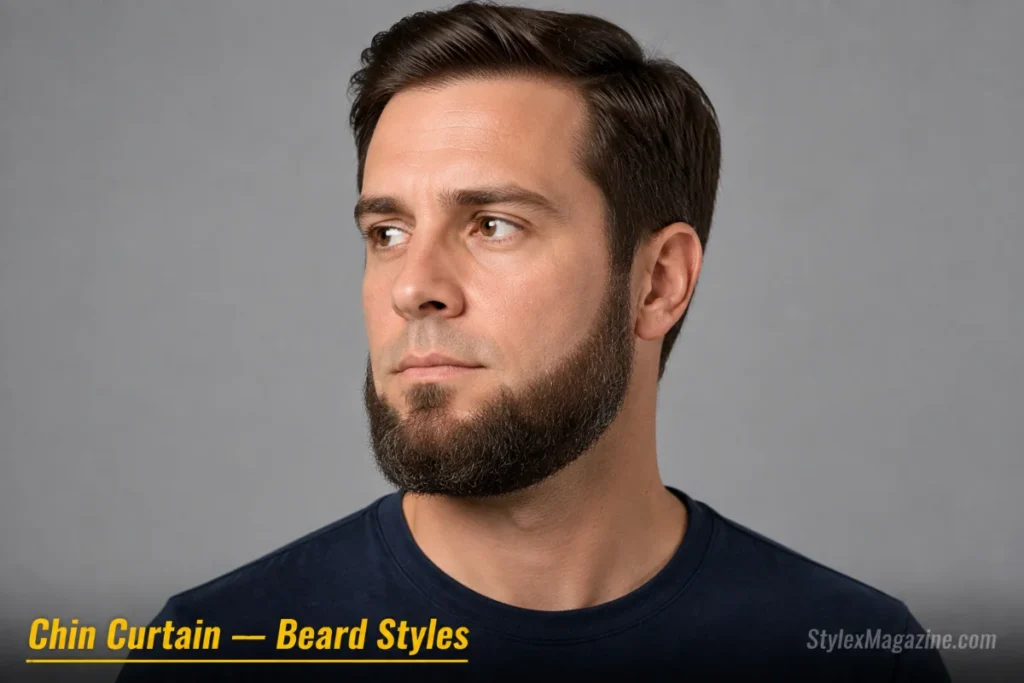
Styling tip: This is NOT a chin strap | Hair type: Dense jaw growth | Width: Full coverage
Full beard coverage from ear to ear across the chin and jaw, with the lip shaved clean. Wider and fuller than any chin strap variation, the chin curtain fills the entire lower face below the cheekbones. Abraham Lincoln wore the most famous version. In Amish tradition, married men grow chin curtains because mustaches carry military associations that conflict with pacifist values.
Including it here because it gets confused with the chin strap constantly. If you want a thin defined line, you want a chin strap. If you want full jaw coverage with no mustache, you want a chin curtain. The beard styles without mustache guide covers the chin curtain and 19 other no-mustache variations in depth.
Best for: Oval and round face shapes. Men with dense, even jaw growth.
Tell your barber: “Chin curtain, full coverage ear to ear, no mustache, natural cheek line, neckline above the Adam’s apple.”
Maintenance: Barber shape every 3-4 weeks. Daily oil and brush.
13. Chin Strap for Black Men
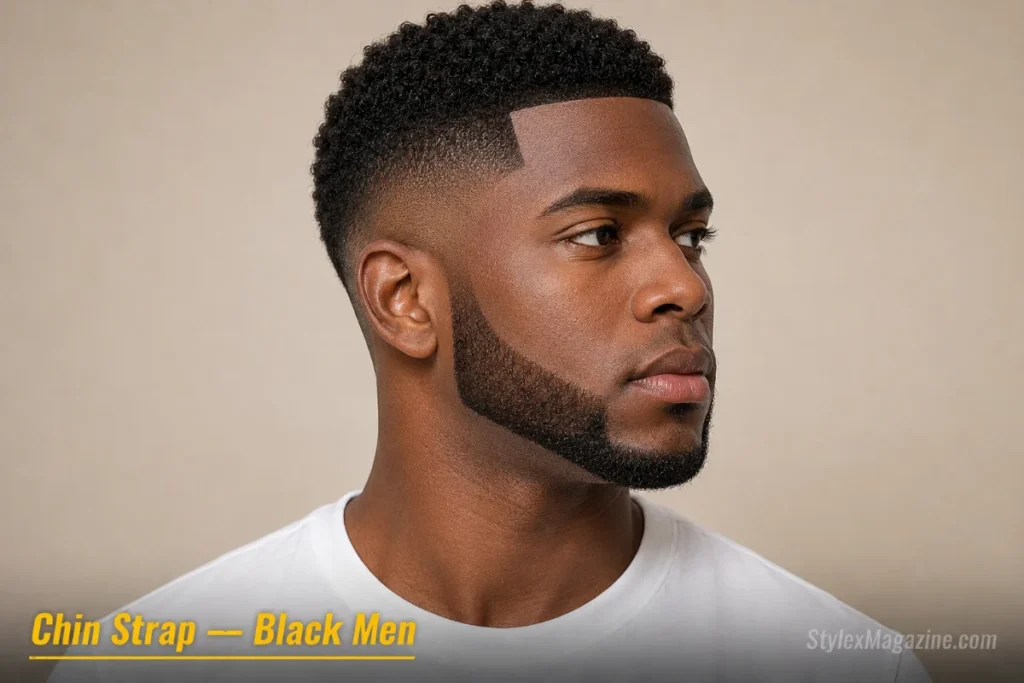
Styling tip: Moisture is non-negotiable | Hair type: Coily, 4A-4C | Width: 8-15mm
Coily and coarse textures create naturally sharper edges on a chin strap, but the skin underneath needs specific care. Razor bumps (pseudofolliculitis barbae) are more common with coily hair because the tight curl pattern causes freshly shaved hairs to grow back into the skin. The clean-shaved cheeks that a chin strap demands put this area under repeated stress.
Single-blade razors or electric foil shavers reduce irritation compared to multi-blade cartridges. Shave with the grain on the cheeks, never against. Apply a salicylic acid aftershave to prevent ingrowns. For the full guide on pairing beard styles with coily hair textures, see fade haircuts for Black men.
Best for: All face shapes. Pairs well with a line-up, skin fade, or burst fade.
Tell your barber: “Chin strap, 10mm wide, sharp edges, line-up at the hairline, blend the sideburn.”
Maintenance: Touch up every 2-3 days. Moisturize shaved areas daily.
14. Patchy-Friendly Chin Strap
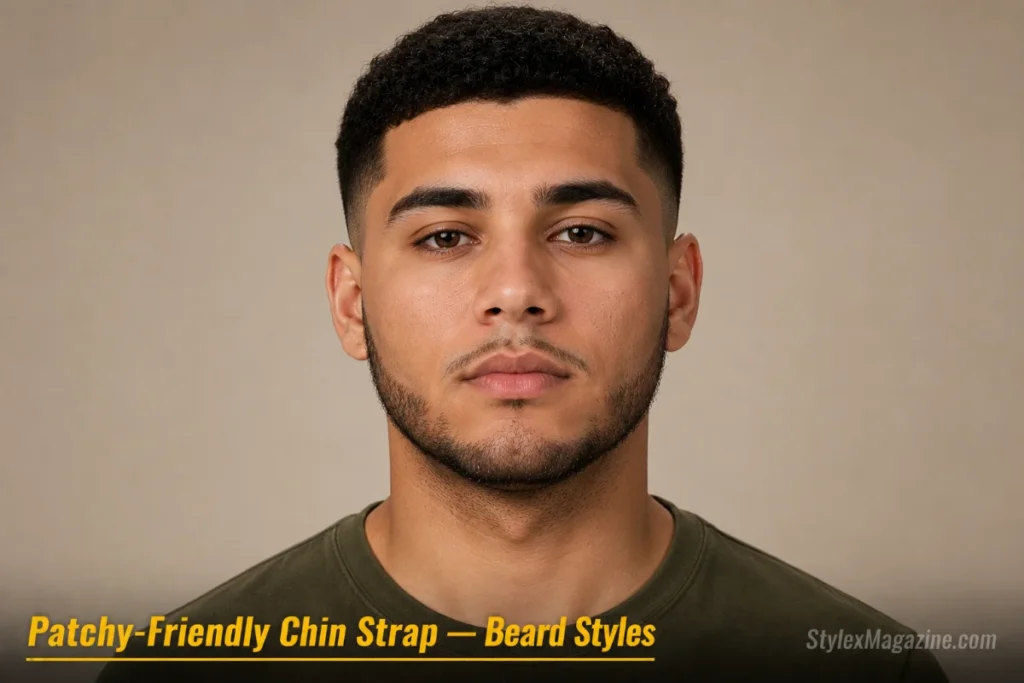
Styling tip: Work WITH your growth pattern | Hair type: All | Width: 12-18mm
A wider strap that uses the densest sections of your jawline growth, with slightly softer edges. The chin strap is the most forgiving style for patchy growth because it only uses jawline hair, not cheek coverage. If your jaw fills in but your cheeks do not, a chin strap turns that pattern into a deliberate style rather than a failed full beard.
Keep it wider (12-18mm) because narrow straps expose thin spots. Leave a slight shadow below the strap line on the neck rather than shaving to bare skin, because that faint stubble creates an illusion of density. A stubble or faded variation works better than hard edges when coverage is uneven.
Best for: All face shapes. Men with patchy cheek growth but consistent jawline density.
Tell your barber: “Chin strap, wider band, soft edges, focus on where the growth is thickest.”
Maintenance: Trimmer every 3-4 days. More forgiving than hard-edged variations.
15. Sideburn-Connected Chin Strap
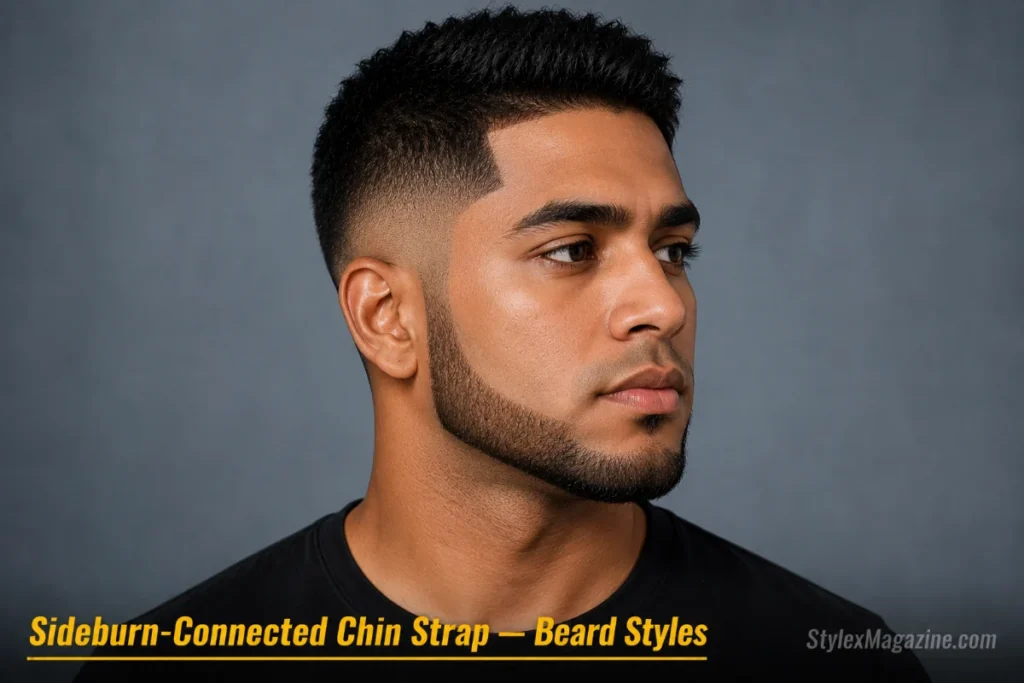
Styling tip: Needs a fade haircut to work | Hair type: All | Width: 10-15mm
The strap runs from the jawline up through the sideburns and connects directly to the hairline, framing the entire lower face. The chin strap meets the haircut at the sideburn. The connection creates one unbroken line from hair to jaw, and it only looks cohesive when paired with a fade that graduates the transition. Without a fade, the connection point looks abrupt.
Best for: Oval and square face shapes. Men with fade haircuts.
Tell your barber: “Chin strap connected through the sideburns into the fade, no break between haircut and beard.”
Maintenance: Barber every 2-3 weeks for the fade. Home cleanup every 2-3 days.
How Do You Trim a Chin Strap Beard?
The first shape is the hardest. Once the template is set, maintenance is straightforward. Here is the process I walk clients through at the chair.
Step 1: Grow first, shape second. Let your full face grow to at least 5mm (about 10-14 days) before touching a trimmer. You need enough material along the jawline to see where your natural density sits.
Step 2: Set the length. Trim your entire face to an even length using a guard. Guard 2 (6mm) for a standard strap. Guard 1 (3mm) for a stubble strap.
Step 3: Outline the top edge. Using a precision trimmer with no guard, define the upper border of the strap by following your jawline from one sideburn to the other. Start from the sideburn and work toward the chin on both sides, alternating sides every few strokes to maintain symmetry. Use the natural crease where your jaw meets your cheek as a guide.
Step 4: Set the width. The distance between the top edge (Step 3) and the bottom edge is your strap width. For a standard chin strap, 8 to 12mm. Measure with a ruler the first time if needed.
Step 5: Outline the neckline. Place two fingers above your Adam’s apple. That point is your neckline. Trim everything below that line clean. Follow the natural curve under your jaw from that center point up toward the back of each ear.
Step 6: Clear the cheeks. Remove all hair above the top edge of the strap. Use a razor for the cleanest finish, or a trimmer with no guard if your skin is sensitive.
Step 7: Clean the lip (classic version). Shave from the lip line upward toward the nose. Never shave downward into the beard. Stay within the mustache zone only (directly above the lip, between the lip corners).
Step 8: Check symmetry. Step back. Close one eye, then the other. Use your earlobes and the corners of your mouth as horizontal reference points. Small corrections are normal.
Step 9: Apply aftershave or beard oil. The freshly shaved border areas will be irritated. Oil conditions both the remaining hair and the exposed skin.
In my experience, eight out of ten clients who attempt their first chin strap at home take it too thin too fast. Start wider than you think you want. You can always narrow it next session. You cannot add width back.
What Haircuts Work Best with a Chin Strap?
The haircut you pair with a chin strap changes the entire look. The strap traces the jawline. The haircut frames the skull. When both align, the combination looks like one cohesive shape from crown to chin.
| Haircut | Best Chin Strap Pairing | Why |
|---|---|---|
| Skin fade or high fade | Faded chin strap, classic | The matched gradients create one seamless silhouette |
| Mid fade | Classic, with goatee | Balanced proportion between head and jaw |
| Buzz cut | Stubble chin strap, classic | Minimal head matches minimal beard, military-clean look |
| Textured crop | Stubble, disconnected | Casual texture on top echoes the relaxed strap below |
| Slick back | Classic, thin, with mustache | Polished hair pairs with polished chin lines |
| Bald or shaved head | Thick/wide, with goatee | The chin strap is all the structure the face has |
For specific fade and beard pairing guides, see fade haircut with beard. For buzz and beard pairings, see buzz cut with beard.
What Are the Most Common Chin Strap Mistakes?
1. Going too thin on the first attempt. The pencil-thin strap is the hardest to execute and the least forgiving. Taking it thin on Day 1 means any wobble or asymmetry is permanently visible until the next full regrowth. A wider strap trimmed down over two sessions always produces a cleaner result than a thin strap attempted cold.
2. Neglecting symmetry checks. A chin strap that is 2mm wider on the left than the right looks crooked from every angle. Alternate sides during every trim session. Check reference points (earlobes, mouth corners) before finishing.
3. Shaving the neckline at the jawline. The same mistake as with any beard style, but worse here because the strap is narrow enough that a high neckline removes visible volume. Two finger-widths above the Adam’s apple, not at the jaw.
4. Skipping skin care on the shaved areas. The cheeks, lip, and neck get shaved every two to three days for this style. That is a lot of razor contact. Moisturize, use aftershave, and switch to a single-blade razor if you are getting bumps.
5. Letting it grow out “just a few extra days.” Three days of stubble growth around a chin strap erases the style completely. Unlike a full beard, which can tolerate a lazy week, the chin strap depends entirely on contrast between clean skin and defined hair. If the contrast goes, the style goes with it.
FAQs
What is a chin strap beard called?
The name changes with the variation. A standard band along the jawline is a chin strap (or chinstrap). With a goatee added, it becomes a chin strap goatee. With a mustache, a chin strap with mustache. The wider, full-coverage version with no mustache is a chin curtain, not a chin strap. Abraham Lincoln wore a chin curtain. Drake wears a chin strap.
Does a chin strap beard look professional?
A well-maintained chin strap with clean edges is appropriate for most professional settings. The stubble and faded variations are the most universally office-friendly. Pencil-thin straps can attract more attention in conservative workplaces. The rule is the same as any beard: sharp edges and consistent length signal grooming intention.
How long does it take to grow a chin strap beard?
Most chin strap styles need 10 to 14 days of growth to reach a workable length from clean-shaven. The stubble version can be shaped after 7 to 10 days. Thicker variations like the extended or defined chin strap need 3 to 4 weeks for proper fullness.
Can you have a chin strap with a patchy beard?
The chin strap is the most forgiving style for patchy growth because it only uses jawline hair, not cheek coverage. If your jaw fills in but your cheeks do not, the chin strap turns that pattern into an intentional design. Keep the width wider (12-18mm), use soft edges or a stubble variation, and avoid pencil-thin lines that expose gaps.
How wide should a chin strap beard be?
Most chin straps sit between 8 and 15mm wide. Start at 10-12mm (a standard starting point) and adjust based on your face shape: narrower for square faces where the jaw is already prominent, wider for round faces that need more structure. Going thinner than 7mm requires near-daily maintenance and barber-level precision.
Amir Khan is a professional hairstylist with 8 years of barbershop experience. He specialises in men’s haircuts, fades, and grooming, and writes every article on StyleX Magazine from the chair, not a desk.

Other Articles

17 Best Bald Head with Beard Styles (2026)
35 Buzz Cut with Beard Combos That Actually Work (2026)
No Comment! Be the first one.