

Quick Answer: A bald head with beard is one of the strongest grooming combinations a man can wear. The beard becomes the only frame your face has, so shape, length, and line placement matter more here than on any other look. Heavy stubble, a short boxed beard, and a shaped full beard are the three safest starting points. Choose by growth pattern first, face shape second.
A shaved head with beard works because the contrast itself is the style. No fringe, no fade line, no parting to guide the eye. That leaves the beard doing all the structural work a haircut would normally share, and the wrong beard shape shows faster on a bald man with a beard than it would with hair softening the edges.
Smooth scalp against textured facial hair creates a focal point at the jaw. Jason Statham has built an entire on-screen identity around stubble and a shaved head. Dwayne Johnson pairs his with a clean goatee. Idris Elba rotates between stubble and a short full beard depending on the role. The bald and bearded combination has outlasted every grooming trend of the last decade because it is not a trend. It is a structural choice that puts the strongest part of a man’s face front and center.
If you are still in the thinning stage and not ready to shave, the guides for haircuts for balding men and thinning hair haircuts cover options that buy time. This page is about what to grow on your face once the head is clean.
What Are the Best Bald Head with Beard Combinations?
Every style below is matched to the face shapes and growth patterns that suit it best. The order runs from low maintenance to high.
1. Heavy Stubble
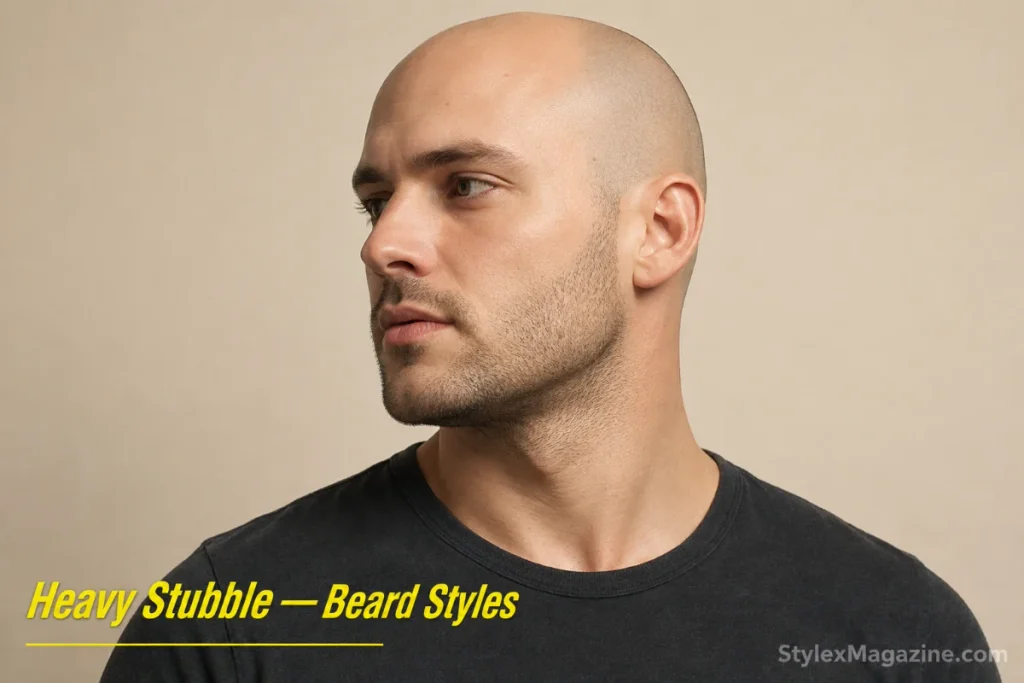
Four to five millimeters of growth, roughly ten days without a razor. The stubble shades the jaw enough to add definition without committing to a full beard shape. At this length, patchy areas blend into the texture rather than standing out as gaps. It is also the single most forgiving style for bald men who are new to facial hair.
I recommend heavy stubble as the starting point for any client who shaves his head and has never grown a beard before. If it suits you at 5mm, you can always grow from there. If it does not, you have lost nothing.
Best for: All face shapes. Round faces especially benefit from the jawline shadow. Men with uneven growth patterns.
Tell your barber: “Even stubble at a 4 or 5mm guard, clean up the neckline, leave the cheek line natural.”
Maintenance: Trimmer pass every 2-3 days. No styling product needed.
2. Short Boxed Beard
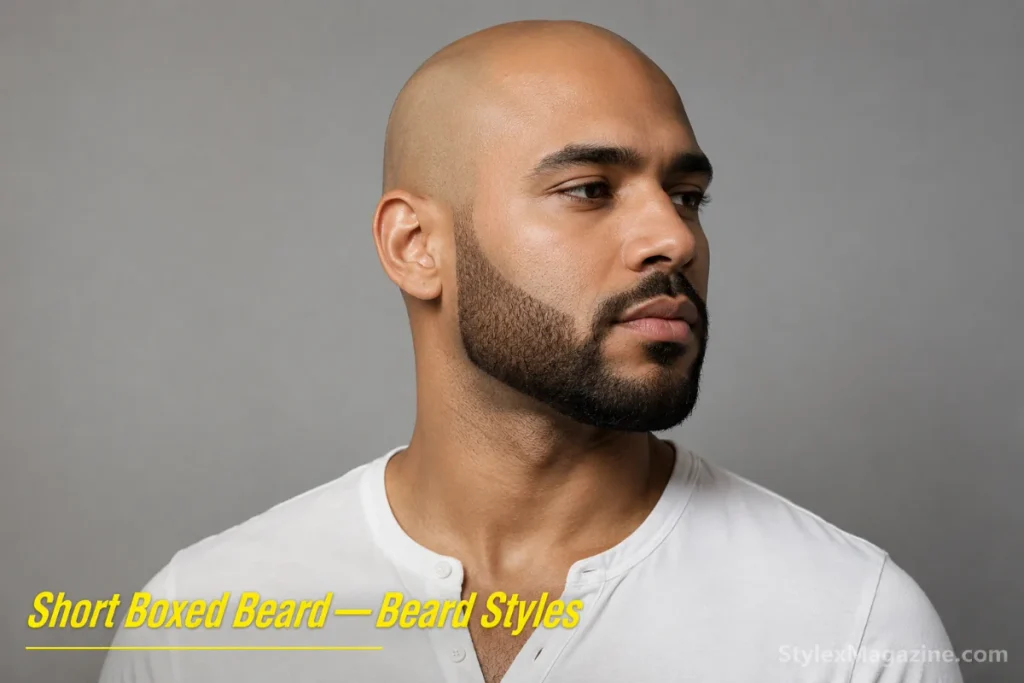
Half an inch to one inch, with sharp cheek and neck lines (a #4 to #8 guard on most trimmers). The short boxed beard is heavy stubble with structure. Those defined edges make it read as a deliberate choice, and the length stays short enough that it never needs styling product. For a deeper look at short beard variations and guard-length breakdowns, the short beard styles guide covers them in full detail.
This is the strongest all-around pick for bald men who walk into the shop without a specific style in mind. The lines do the work, the length stays manageable, and no office on the planet objects to it.
Best for: All face shapes except very long or oblong (keep the chin section shorter than the sides for those).
Tell your barber: “Short boxed beard, grade 6 all over, clean lines at the cheeks and neck, blended at the sideburn into the scalp.”
Maintenance: Re-edge cheek and necklines every 3-4 days. Barber shape-up monthly.
3. Goatee
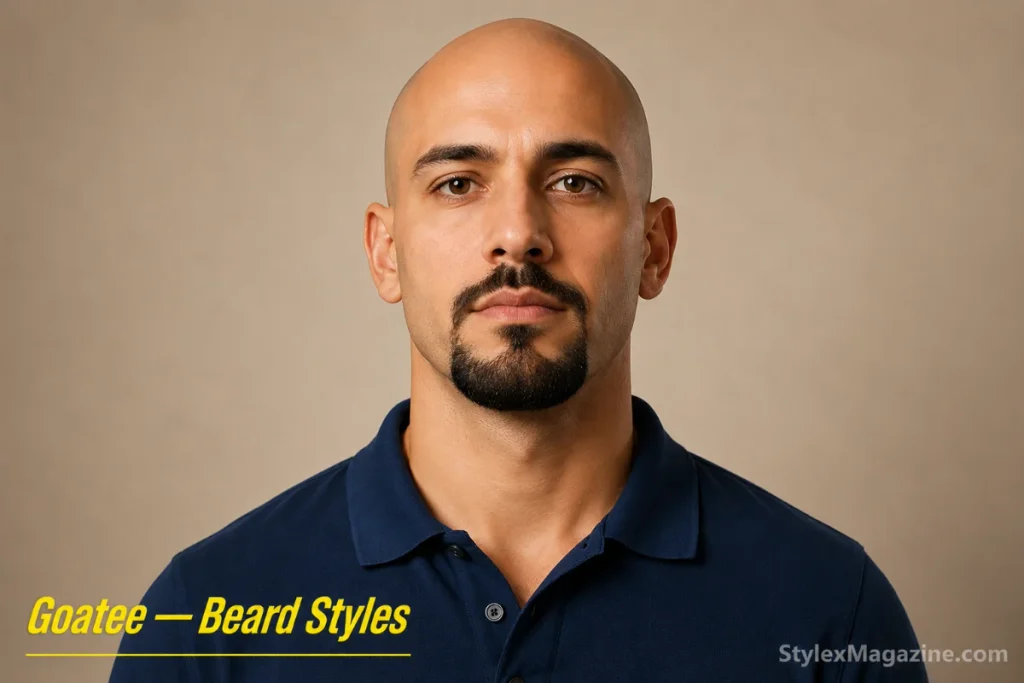
Chin beard and mustache, cheeks clean. The goatee is built for men whose cheek growth never filled in. Rather than stretching thin coverage across the full face, you concentrate everything where the density lives. On a bald head, the goatee pulls the eye to the center of the face and adds vertical length at the chin, which round and wider faces need.
A goatee with scruff around it looks like a failed full beard. Shave the cheeks every other day to keep the edges deliberate.
Best for: Round and oval face shapes. Men with patchy cheek growth but strong chin and mustache density.
Tell your barber: “Goatee, half inch to one inch at the chin, clean cheeks, connected mustache.”
Maintenance: Shave cheeks every 2-3 days. Trim goatee length every 2 weeks.
4. Full Beard
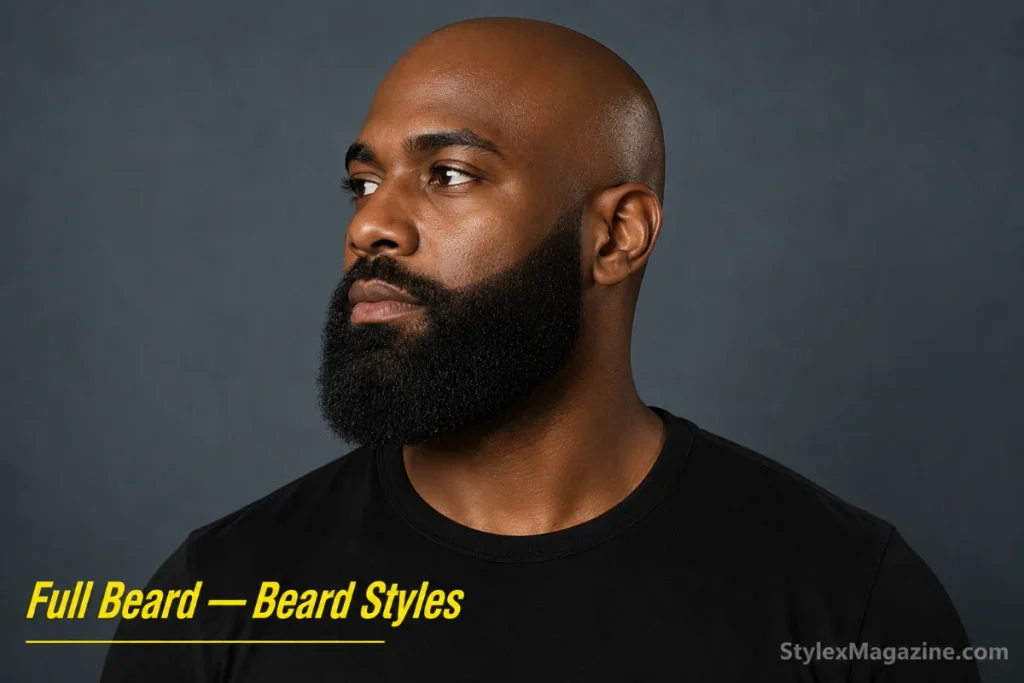
Complete coverage from sideburn to sideburn. Maximum contrast against a bare scalp: smooth on top, full below. The full beard is the strongest pick for men who shaved their head after the crown thinned. All the growing power your face still has goes into one dense, deliberate statement. The full beard styles guide covers shape variations (squared, rounded, tapered) and face shape pairing in detail.
Allow three to six months for real density. Do not judge it before week eight, because a large share of “patchy” full beards are just unfinished ones. Keep the cheek line natural, set the neckline two finger-widths above the Adam’s apple, and start applying beard oil from week two to survive the itch phase.
Best for: Oval and square face shapes. Triangle and diamond faces that need jaw volume. Men with dense, even growth.
Tell your barber: “Full beard, natural cheek line, neckline above the Adam’s apple, take the bulk off the sides so it doesn’t wing out.”
Maintenance: Barber shape every 3-4 weeks. Daily oil and brush.
5. Faded Beard
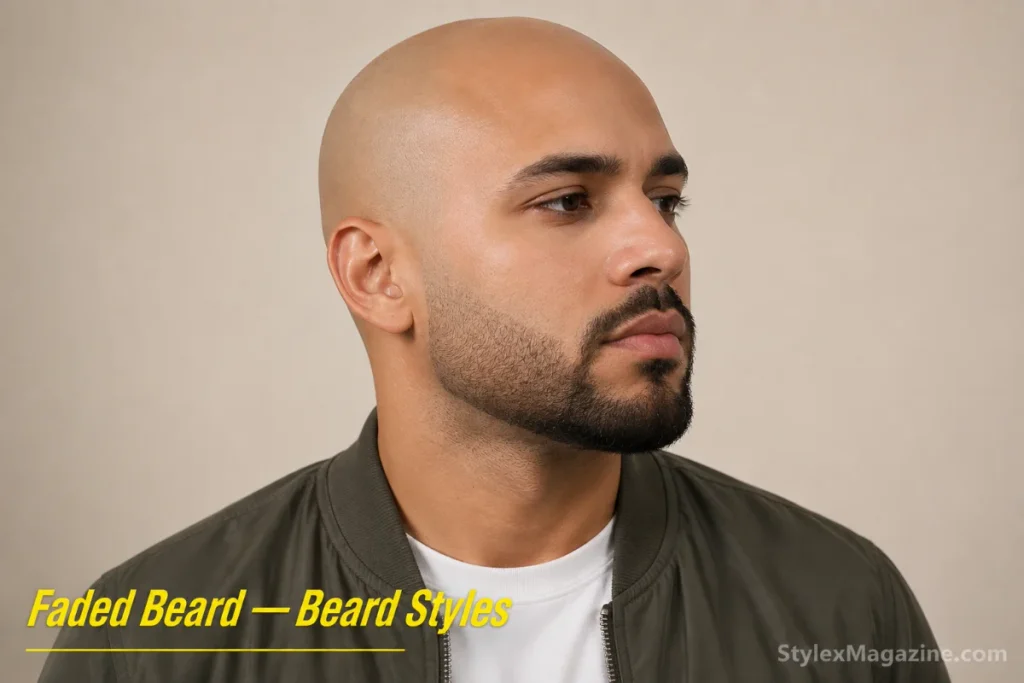
The beard grades from bare skin at the temple down through progressively longer growth into full density at the chin. The same seamless gradient a skin fade haircut uses, applied to facial hair. On a bald head, the faded beard is the closest thing to a single unbroken shape from polished scalp to full beard. No hard stop at the sideburn, no abrupt transition. Just one continuous gradient.
This has become the most requested beard service in the shop heading into 2026. Bald men are its best customers because the fade runs from smooth scalp straight into full coverage without interruption.
This is barber work, not home work. The gradient needs clipper-over-comb blending and multiple guard changes, then a re-blend every two to three weeks to stay crisp.
Best for: All face shapes. Men who want the most polished, modern version of the bald-and-bearded look.
Tell your barber: “Skin fade the beard from the sideburn. Bare at the temple, full at the chin, shadow through the cheekbone.”
Maintenance: Barber every 2-3 weeks. The fade loses definition faster than a standard beard line.
6. Van Dyke
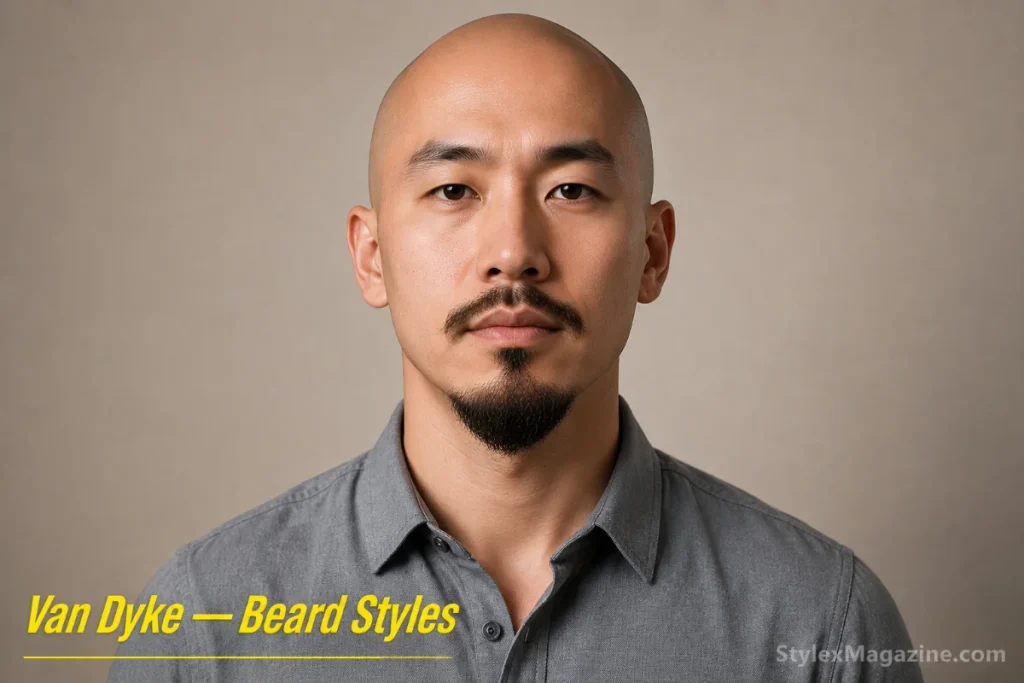
A pointed chin beard and a detached mustache with clean skin between them. That separation is the personality of the style. On a bald head, the Van Dyke gives the face a strong vertical line that round and softer faces need badly. The gap between lip and chin sections requires a razor pass every couple of days, because the moment they reconnect, you have a circle beard.
Best for: Round and oval face shapes. Men with strong chin growth.
Tell your barber: “Van Dyke, pointed chin section about an inch long, separated from the mustache, cheeks clean.”
Maintenance: Razor pass between mustache and chin every 2 days. Shape every 2-3 weeks.
7. Circle Beard
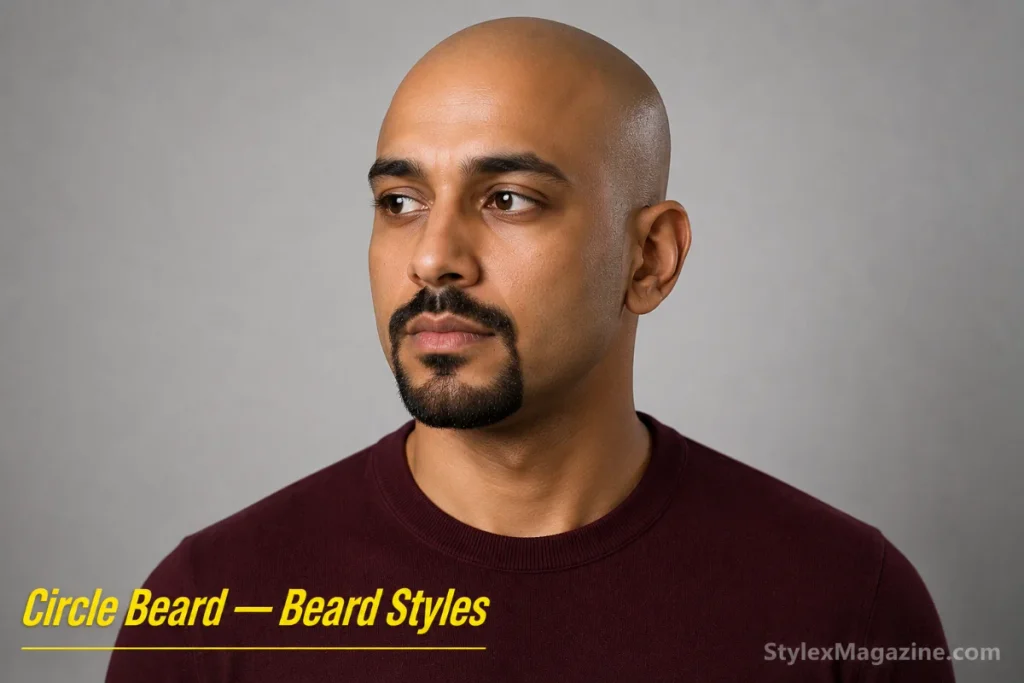
The mustache connects to a rounded chin beard in one continuous ring. More contained than a goatee, more defined than stubble. The circle beard is the diplomatic option for professional settings: enough presence to frame the face, zero dress code risk. It softens square and angular jawlines by introducing a rounded shape to the lower face.
Best for: Square and angular face shapes. Professional settings.
Tell your barber: “Circle beard, about a centimetre of length, tight round line, cheeks clean.”
Maintenance: Re-shape the circle line every 2-3 weeks. Cheeks shaved every 2-3 days.
8. Beardstache
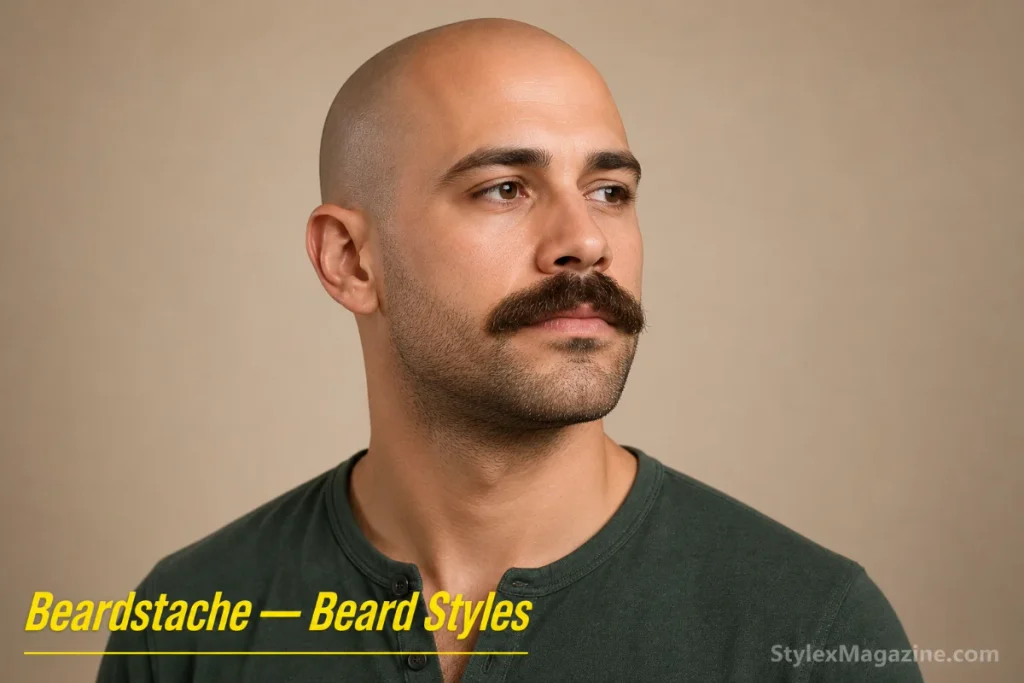
A thick, full mustache over short stubble. The mustache becomes the focal point, and the stubble becomes the frame. On a bald head, this combination creates three distinct zones: bare scalp, stubble jaw, prominent mustache. The contrast between the three is the entire style.
This is a strong pick for bald men with a powerful upper lip and average cheek growth. The pattern most men actually have. Grow the mustache for six to eight weeks while holding the beard at 3-4mm with a trimmer, and keep the two elements clearly distinct. The moment the lengths blur together, you have an indecisive short beard instead of a deliberate contrast.
Best for: Oval and oblong face shapes. Men with strong mustache growth.
Tell your barber: “Keep the beard at 3-4mm, leave the mustache full, natural shape, no wax.”
Maintenance: Trimmer pass on the stubble every 3 days. Mustache trim every 3-4 weeks.
9. Balbo
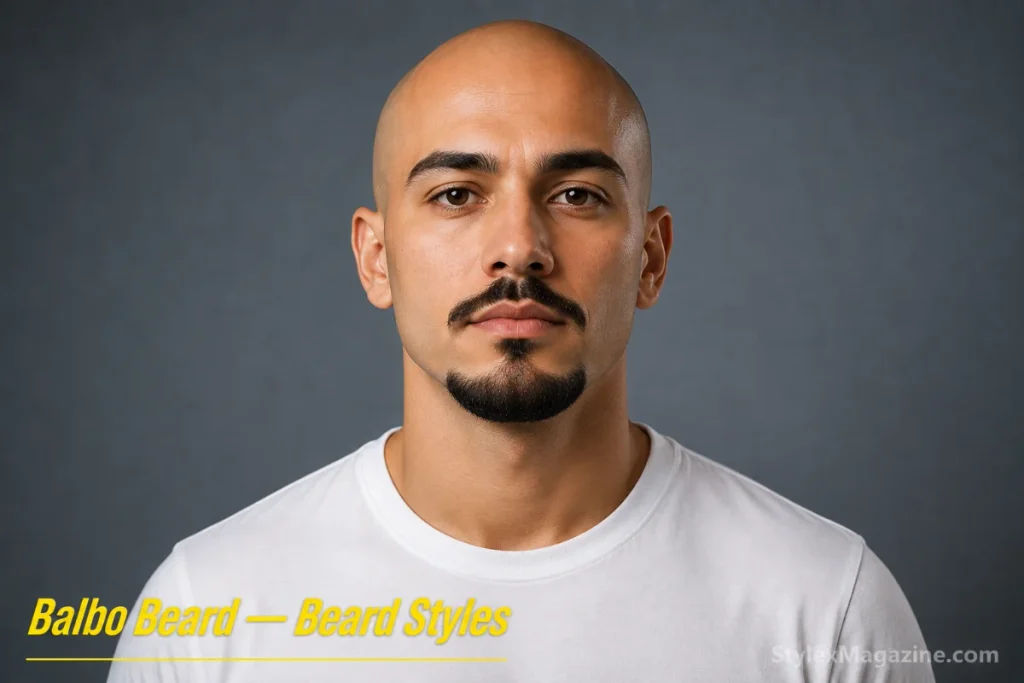
A floating chin beard that follows the jawline without touching the sideburns, paired with a detached mustache. Robert Downey Jr. turned the Balbo into a personal trademark. Three separate floating elements, all edged, all symmetrical. The wide chin section builds jaw definition that a plain goatee cannot match.
Grow a month of even coverage first, then carve the shape out of it. You cannot grow a Balbo directly. The disconnected pieces keep the face from feeling crowded, and the floating chin section adds jawline width that bald men with softer bone structure need.
Best for: Oval face shapes. Men with soft jawlines who need definition. Men with patchy sideburn growth.
Tell your barber: “Balbo. Chin beard following the jaw, not connected to sideburns. Detached mustache above. All three elements edged clean.”
Maintenance: Detail trimmer every 2-3 days. Barber shape-up every 3 weeks. High maintenance.
10. Extended Goatee
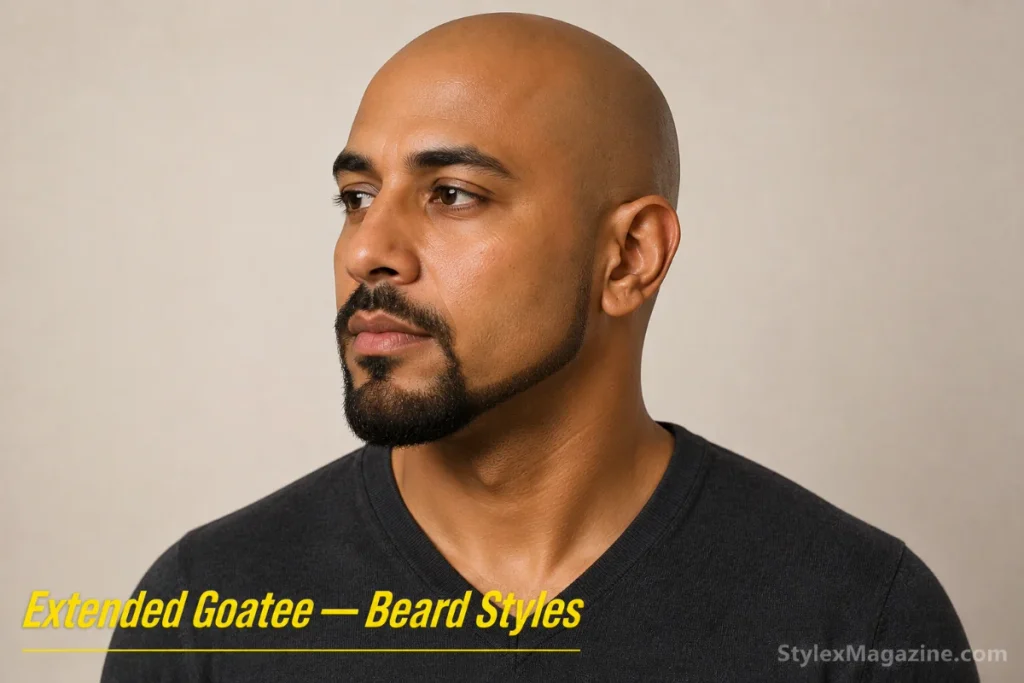
The standard goatee stretched along the jawline toward the ears, without connecting to the sideburns. More jaw coverage and more presence than a plain goatee, but the cheeks stay clean. The extra jaw coverage adds width and definition along the bone, making it a strong option for narrow and long faces.
Best for: Long and narrow face shapes. Men with patchy cheeks but strong jawline growth.
Tell your barber: “Extended goatee, follow the jawline toward the ears, fade out gradually near the sideburn, cheeks clean.”
Maintenance: Upper cheek edge razored every 2-3 days. Shape every 2-3 weeks.
11. Anchor Beard
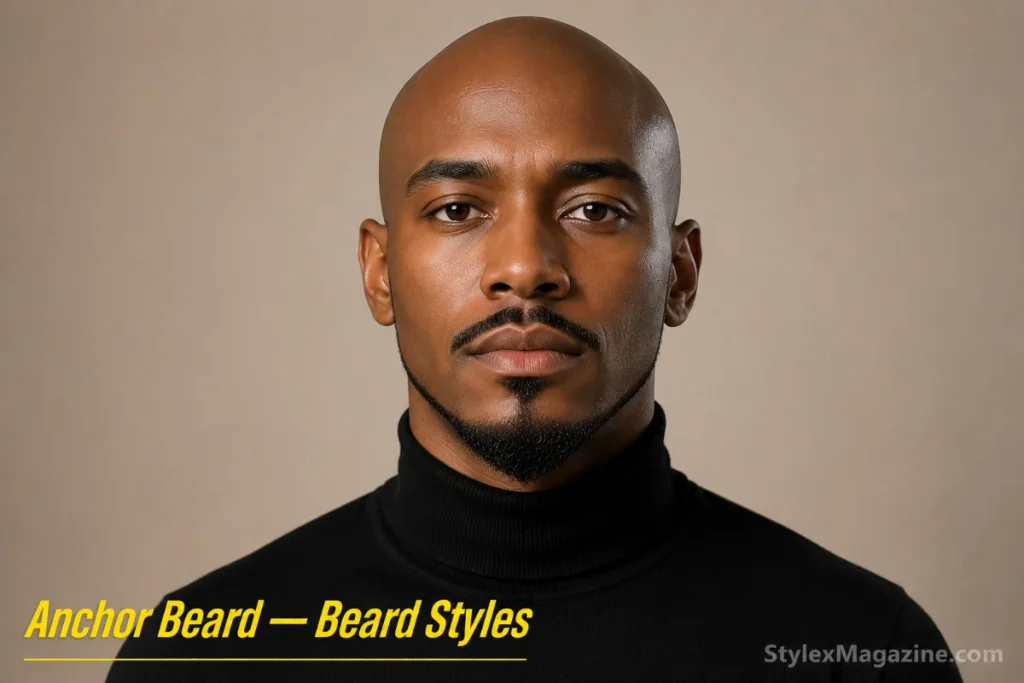
A thin band tracing the jawline widens into a pointed chin section, paired with a detached mustache. From the front it draws a ship’s anchor on the face. Three separate elements need edging every two to three days with a detail trimmer, and the jaw band must stay thin. Let it thicken and the anchor collapses into a chinstrap-goatee hybrid.
In my experience, this is the best option for bald men with patchy cheek growth who still want defined jaw structure. Every part of the anchor sits on the strong-growth zones: jaw edge, chin, upper lip.
Best for: Oval and long face shapes. Men with patchy cheek growth.
Tell your barber: “Anchor beard, thin jaw band, pointed chin section, detached mustache. All three edges clean.”
Maintenance: Detail trimmer every 2-3 days. High maintenance.
12. Ducktail Beard
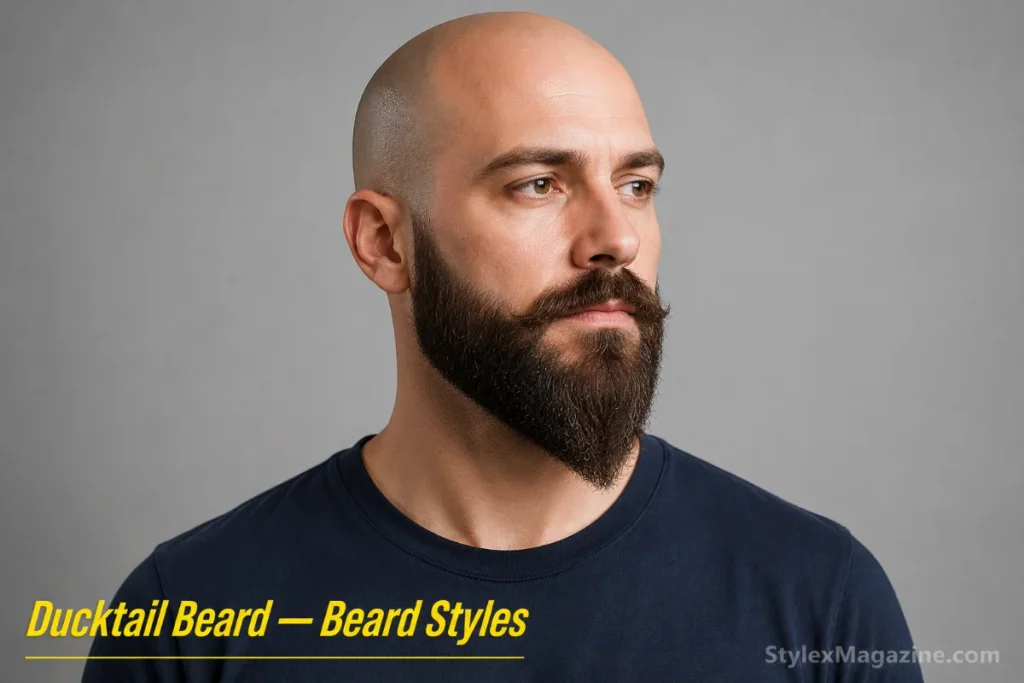
A full beard rounded through the cheeks and tapering to a deliberate point at the chin. The ducktail is the default recommendation for round-faced bald men who want real length. The point adds the vertical line their face needs, while groomed sides keep width in check.
Four inches or more of chin length is needed before the tail shape properly appears. Budget three months minimum. Brush downward and to the center daily so the hair trains toward the point, and seal it with balm to hold the shape through the day.
Best for: Round face shapes. Men with dense, even growth who can commit to the grow-out.
Tell your barber: “Ducktail, tight at the cheeks, tapered to a point at the chin, natural cheek line.”
Maintenance: Barber shape every 3-4 weeks. Daily balm at the point.
13. Corporate Beard
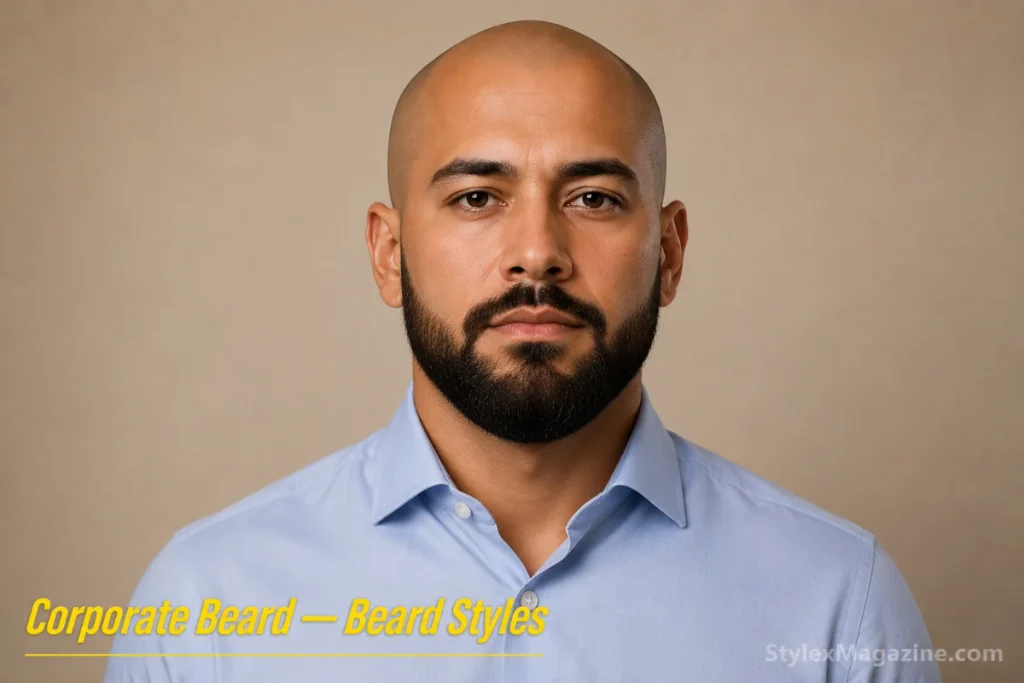
One to two inches, fully grown-in cheeks, every edge sharpened for the boardroom (a #6 to #10 guard all over). The corporate beard has quietly become the most requested style among bald professionals. Enough coverage to carry real presence, groomed tightly enough that no HR handbook mentions it. Paired with a polished scalp, it is about as authoritative as this list gets.
The formula: cheek line cleaned just below its natural boundary, neckline exact at two finger-widths above the Adam’s apple, daily oil and a downward brush to keep it sitting flat under office lighting. Monthly barber visit to re-balance the shape.
Best for: All face shapes. Professional and corporate settings.
Tell your barber: “Corporate beard, grade 8 all over, cheek line cleaned below natural, neckline exact, blended at the sideburn.”
Maintenance: Barber visit monthly. Daily oil and downward brush.
14. Salt and Pepper Beard
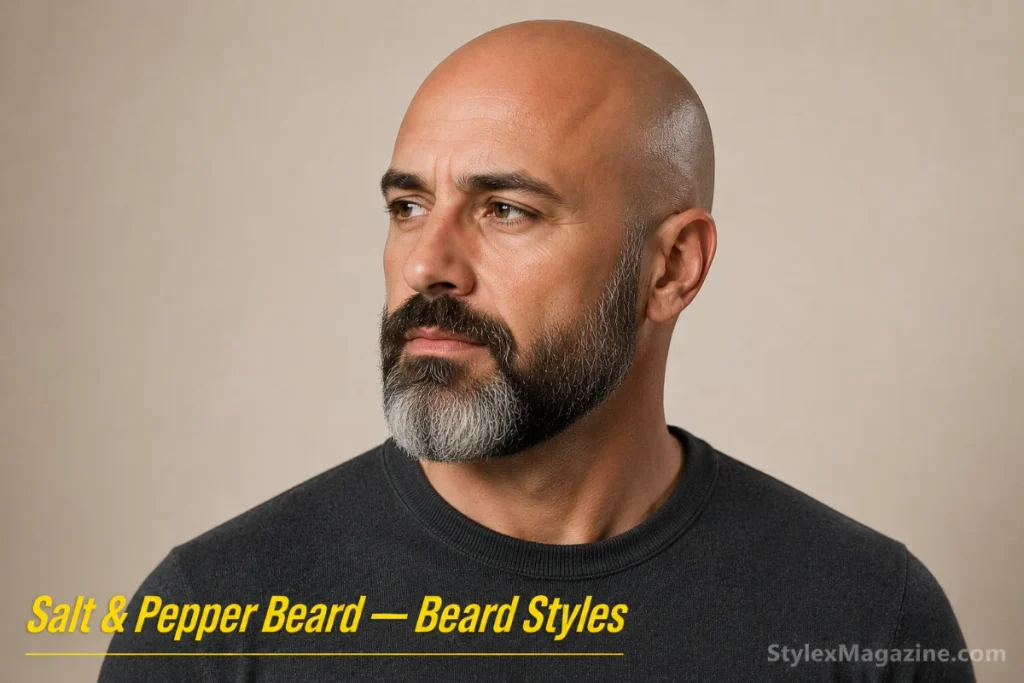
Grey entering the beard is an advantage on a bald head, not a problem to manage. The mix of dark and silver adds visual texture that solid-colored beards cannot match, and it carries an authority that no product can replicate. Some of the sharpest-looking bald men in any barbershop are silver-bearded men with polished scalps.
Grey hair is coarser and drier than pigmented hair. Oil daily without fail, use a beard wash with no harsh sulfates, and keep the shape a touch tighter than you would a dark beard, because silver appears larger and wirier at the same length.
Skip the dye. A dyed beard under a bald head fools nobody, and the two-tone regrowth line is worse than any amount of silver.
Best for: Men over 40 with natural greying. All face shapes.
Maintenance: Daily oil. Wash 2-3 times per week with sulfate-free beard wash. Shape tighter than normal.
15. Chin Strap
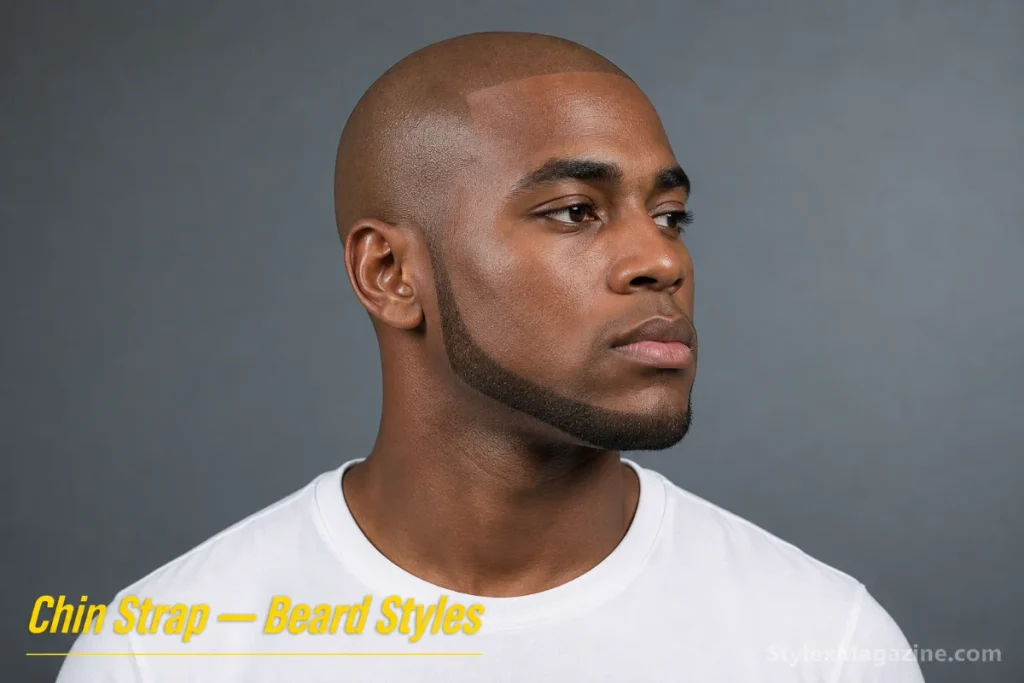
A thin strip of hair following the jawline from ear to ear. On a bald head, the chin strap draws a hard border between skull and jaw, defining the jawline more sharply than any other style on this page. It works only with precise, clean edges. Anything fuzzy and the strap loses its entire purpose. The dedicated chin strap beard guide covers width variations, face shape suitability, and trim technique in full.
Best for: Oval and round face shapes. Men with strong jawline growth but patchy cheeks.
Tell your barber: “Thin chin strap, even width, clean edges, from ear to ear along the jawline.”
Maintenance: Trimmer every 2-3 days. The edges are the style.
16. Tapered Beard
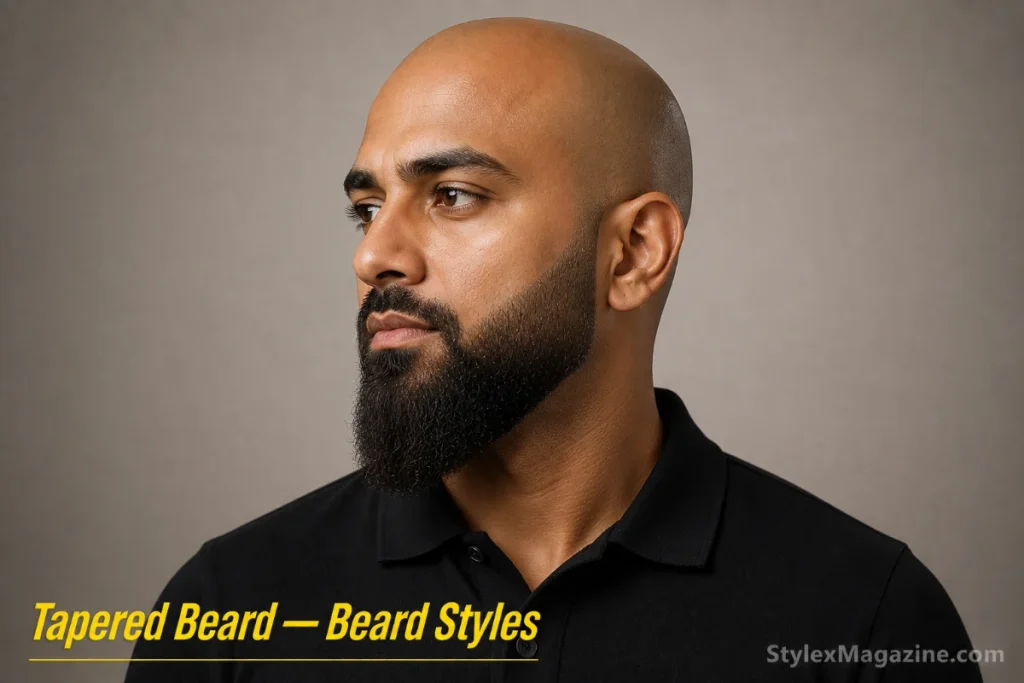
Short at the sideburns, progressively longer at the chin, no hard lines. The bare scalp flows into short side growth and finishes in real length at the chin, one unbroken shape from crown to beard tip. The taper creates a natural gradient that no other style achieves, similar in logic to the faded beard (#5) but with more length at the endpoint.
This is barber work. The grade has to be rebalanced every two to three weeks, because a taper that grows out unevenly just looks like an unkempt full beard. Between visits, your only job is oil, brushing, and keeping the neckline honest.
Best for: Round face shapes. Men who want a natural-looking beard with chin length.
Tell your barber: “Taper the beard, tight at the sideburns, full at the chin, no hard lines, blend it.”
Maintenance: Barber every 2-3 weeks. Oil daily.
17. Viking / Long Beard
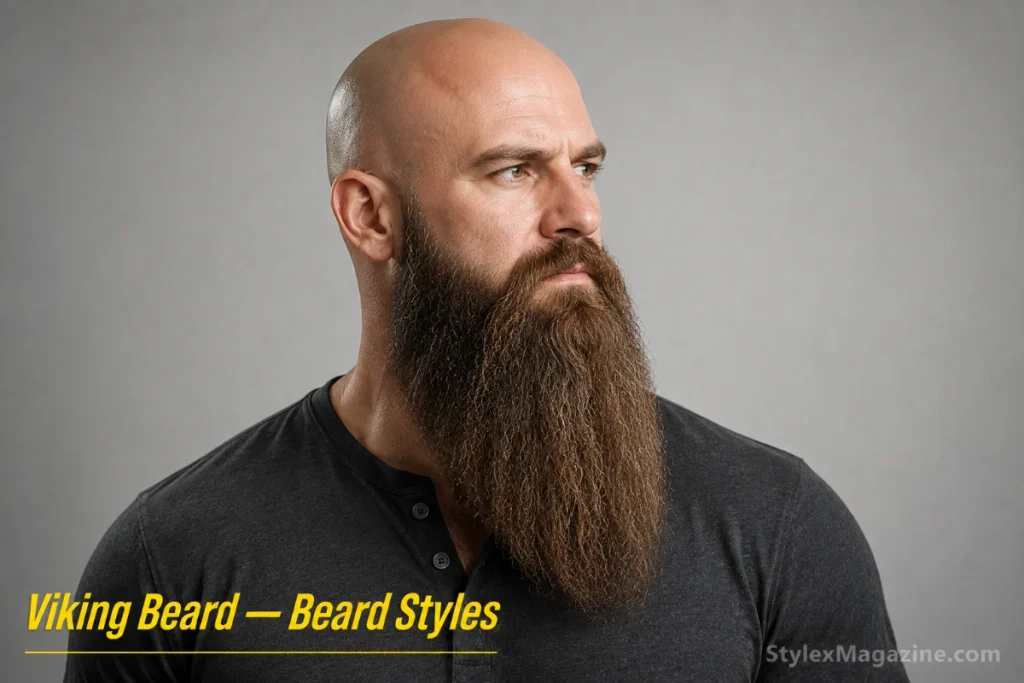
Four or more inches of dense, textured growth. With a bald head, the Viking beard creates the boldest possible silhouette. Expect eight to twelve months of committed growth and dense, even coverage to pull it off. Patchy cheeks at this length cannot hide, and there is no styling trick to fake density that is not there.
The maintenance is non-negotiable: wash twice a week, condition weekly, oil daily, and comb morning and night to prevent matting at the root. Keep a neckline even at this length. An inch lower than a short beard’s neckline, but present. Suits bigger frames and stronger features best.
Best for: Men with dense, even growth. Larger builds. Oval and square face shapes.
Tell your barber: “Shape the sides, even out the length, keep the neckline clean. Don’t take off more than half an inch.”
Maintenance: Oil daily. Comb twice daily. Barber trim every 6-8 weeks.
Which Beard Style Fits Your Face Shape When You’re Bald?
A bald head with beard means the beard carries the entire balancing job alone. No hair up top to share the work. The table below matches each face shape to the styles that correct its proportions, and the styles that make them worse.
| Face Shape | Best Styles | Avoid |
|---|---|---|
| Round | Ducktail, Van Dyke, extended goatee, anchor, tapered | Wide full beards with rounded bottoms (repeats the circle) |
| Oval | Any style on this page | Nothing specific. Oval faces have full freedom. |
| Square | Circle beard, rounded full beard, corporate, faded | Adding more hard corners with a square-shaped beard |
| Oblong / Long | Short boxed, wide full beard, stubble, extended goatee | Pointed or ducktail shapes that add chin length |
| Heart / Triangle | Full beard, tapered beard, corporate | Goatee or chin-only styles that narrow the jaw further |
| Diamond | Full beard, extended goatee, Balbo | Chin strap (adds width at the narrowest point) |
The one rule: grow length where your face lacks it, stay tight where it already has width. A round face needs chin length. A long face needs side fullness. A square face needs softness. The beard fills what the bone structure does not.
What Is the Biggest Mistake Bald Men Make with a Beard?
Setting the neckline at the jawline. A neckline carved that high makes the beard look thin, the chin look doubled, and the whole thing look accidental. Two finger-widths above the Adam’s apple is the standard for a reason. From that point, the neckline follows the natural crease under the jaw, curving up toward the back of the ear.
The second mistake: ignoring the sideburn-to-scalp transition. On a bald head, the point where bare skin meets beard growth is the first thing people notice. A hard, abrupt line between polished scalp and fuzzy growth breaks the entire look. Ask your barber to blend that transition with graduated length, or use a trimmer at home to create a short gradient from bare scalp down into beard density.
The third: skipping SPF on the scalp. A bald head with a well-groomed beard and a sunburned, flaking scalp is a grooming contradiction. Moisturize with SPF every morning. No exceptions.
FAQs
Does a bald head look better with or without a beard?
For most men, with. A beard restores facial structure that a shaved head removes, pulls the eye to the jawline, and gives you back a styling variable you control completely. The main exception is extremely sparse growth: in that case, clean-shaven or light stubble is stronger than forcing a fuller style that will not fill in.
What beard length works best with a bald head?
The proportion sweet spot for most bald men is 1 to 3 inches, from a short boxed beard to a shaped full beard. Heavy stubble at 4-5mm is the minimum that adds real jawline definition. Longer beards (4+ inches) work too, but they need visible grooming to carry the contrast against a bare scalp. If you are not fully shaved and still have a buzz cut, the buzz cut with beard guide covers pairings matched by guard number.
Can I grow a beard if my head hair is thinning?
Head hair and beard hair run on completely separate systems. Going bald has no bearing on what your face can grow. Many men with significant hair loss have dense, full beard growth. If you are still in the thinning stage and not ready to shave, the haircuts for men with thinning hair guide covers options that work while you decide.
What if my beard grows in patchy?
Patchy growth limits which styles work, but it does not eliminate options. Heavy stubble at 2-4mm hides thin areas by turning them into texture rather than gaps. Styles built on the strong-growth zones (goatee, Van Dyke, anchor, Balbo, beardstache) turn a patchy pattern into a deliberate design by shaving the weak areas entirely. Give any beard eight weeks before judging: late-filling patches are the rule, not the exception.
How often should a bald man visit the barber for beard maintenance?
Every 3-4 weeks for most styles. High-precision shapes (anchor, Balbo, ducktail, tapered beard, faded beard) benefit from every 2-3 weeks. Between visits, handle cheek lines and neckline at home with a trimmer every 2-3 days. The beard shape is only half the appointment: ask your barber to blend the sideburn-to-scalp transition at the same time.

Other Articles

15 Best Van Dyke Beard Styles with Trim Guide (2026)
15 Best Chin Strap Beard Styles with Trim Guide (2026)
No Comment! Be the first one.