

Quick Answer: A Van Dyke beard is a detached mustache paired with a pointed or rounded goatee, with clean-shaven cheeks and a visible gap of bare skin between the two elements. That gap is the entire style. The classic, modern faded, and pointed versions are the three most requested variations. Touch up the disconnect every 2-3 days or it collapses into a circle beard.
Half the men who sit in my chair and ask for a “goatee” are pointing at a photo of a Van Dyke. The confusion is everywhere: barber forums, Google Images, even other stylists. A goatee is chin hair only, no mustache. A Van Dyke is a mustache and a chin beard that never touch. That strip of bare skin between them is the defining feature, and it is the first thing that disappears when maintenance slips.
The Van Dyke is named after Anthony van Dyck, the 17th-century Flemish painter who wore it in his self-portraits. The spelling varies (Vandyke, Van Dyck, Van Dyke) but the style is the same. It was also called a “Charlie” after King Charles I of England, who van Dyck painted wearing it.
Johnny Depp brought it back as Captain Jack Sparrow. Christian Bale and Pierce Brosnan have both worn variations on red carpets. Four centuries of staying power, because the style solves a problem most men have: strong growth on the upper lip and chin, patchy growth everywhere else. The Van Dyke keeps only the strong zones and shaves the evidence away.
What Is a Van Dyke Beard?
A Van Dyke is two separate pieces of facial hair: a mustache on top and a goatee on the chin, with visible bare skin between them and clean-shaven cheeks. The disconnect between mustache and chin is not a trimming error. It is the style.
The chin piece can be pointed (the classic shape), rounded (the softer modern version), or extended into real length (the statement version). The mustache can be natural, shaped, or styled into a handlebar. What stays constant across every variation is the gap, the clean cheeks, and the two-element structure.
Van Dyke vs goatee vs circle beard: These three get confused constantly, and using the wrong name in the barber chair means walking out with the wrong style.
- Goatee: Chin hair only. No mustache. One element.
- Van Dyke: Mustache and chin beard, separated by bare skin. Two elements.
- Circle beard: Mustache and chin beard connected in a continuous ring. One connected loop.
The word you need at the barber is “separate” or “disconnected.” That single instruction prevents the most common mix-up. For a deeper look at chin-only and no-mustache options, the beard styles without mustache guide covers 20 variations.
What Are the Best Van Dyke Beard Styles?
Every style below includes length, face shape match, and the barber script to request it. The order runs from classic to modern to combination styles.
1. Classic Van Dyke
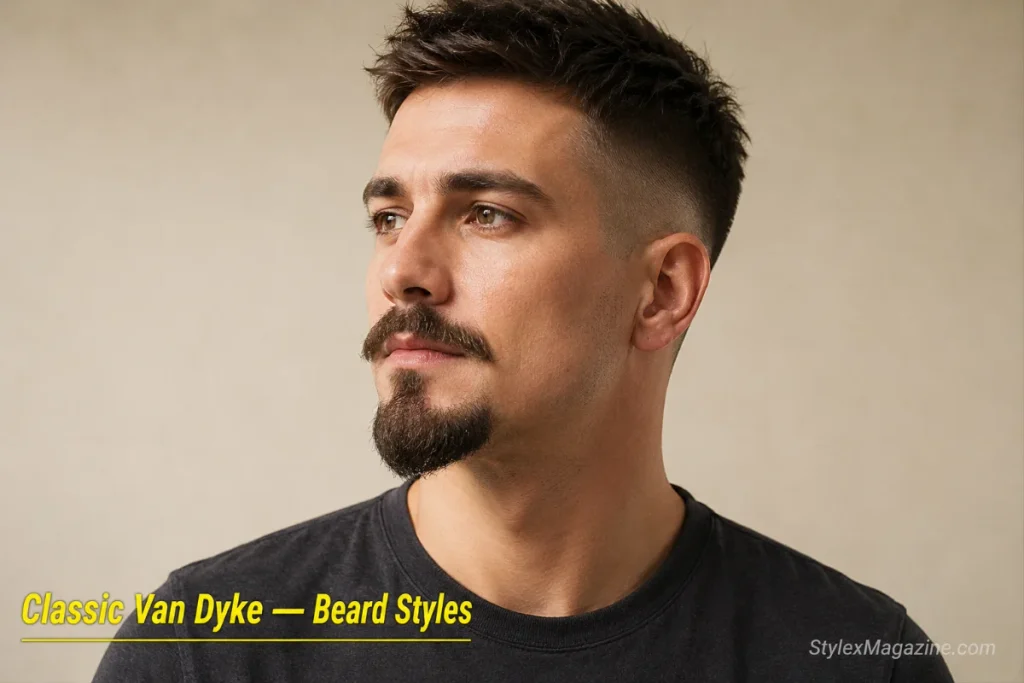
Celebrity: Johnny Depp | Hair type: All | Length: 1-2 inches chin, guard 3 mustache
A chin piece shaped to a soft point at 1 to 2 inches, a mustache trimmed neat just above the lip line, and a clean gap between them. The starting point for every other variation on this list. Nothing waxed, nothing exaggerated. The proportions speak for themselves.
If you are trying a Van Dyke for the first time, start here. Keep the mustache on a guard 3, scissor-trim the chin point by eye, and re-edge the cheeks twice a week. Every other variation is just this blueprint with a dial turned up or down.
Best for: Oval and round face shapes.
Tell your barber: “Classic Van Dyke, pointed chin piece about an inch long, natural mustache, disconnected, cheeks clean.”
Maintenance: Re-shave gap and cheeks every 2-3 days. Weekly length trim.
2. Short Van Dyke
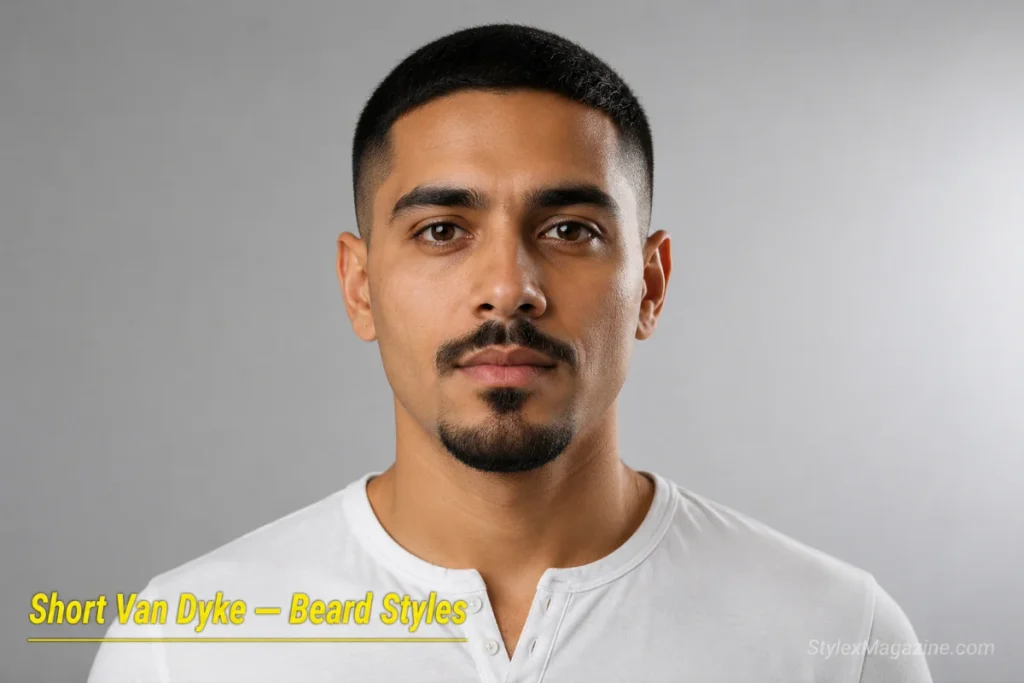
Styling tip: Best for dense, coarse growth | Hair type: All | Length: Guard 2-3 (5-10mm) both elements
Both the mustache and chin piece clipped to guard 2 or 3 (5-10mm). The shape is unmistakably Van Dyke, but it stays understated. This is the version men in conservative workplaces and professional settings request, because it signals grooming intention without demanding attention.
Dense, coarse growers benefit most from the short version. Keeping it tight prevents thick hair from ballooning outward and looking heavy on the chin. Fine hair can wear it too, but the shorter the length, the more visible any density gaps become.
Best for: All face shapes. Professional settings.
Tell your barber: “Short Van Dyke, guard 3 both pieces, disconnected, cheeks clean.”
Maintenance: One trimmer pass per week. Gap and cheek shave every 2-3 days.
3. Long / Extended Van Dyke
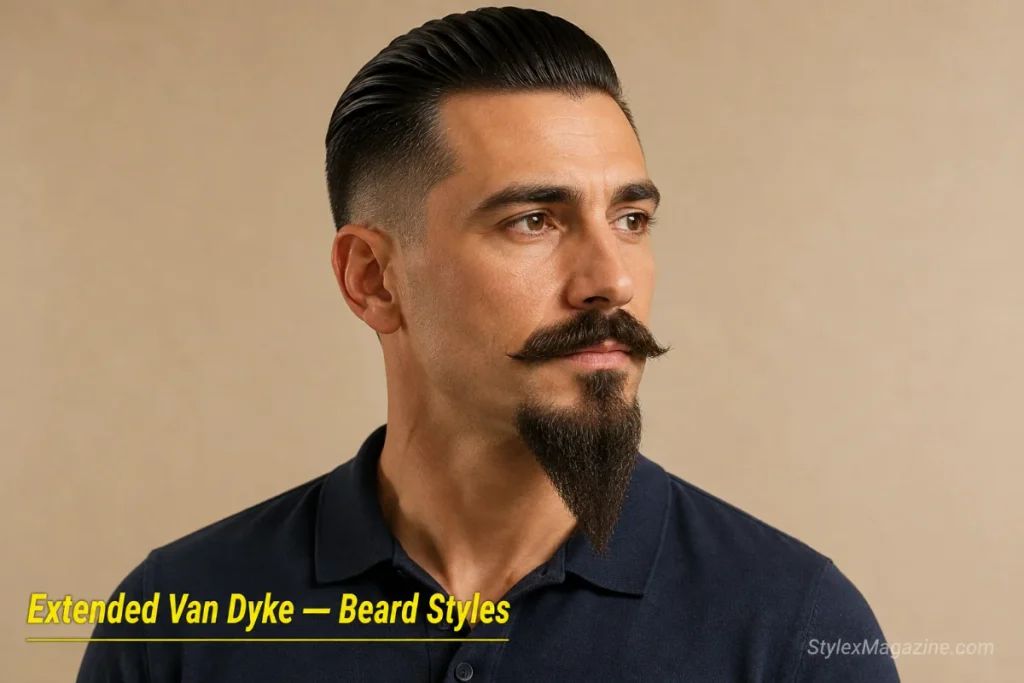
Styling tip: Trim the point with scissors only | Hair type: Dense growth needed | Length: 3-4 inches chin, full mustache
The chin piece grown to 3 to 4 inches with the mustache kept substantial enough to balance it. The statement version. The length pulls the face downward, so it flatters round and square shapes and can overwhelm an already long face.
From about 2 inches, the chin point starts drying out and going wispy. Work 3-4 drops of beard oil through it daily and comb downward to train the growth direction. Trim the point with scissors only. One careless pass with a trimmer takes months to undo at this length.
Best for: Round and square face shapes. Men with dense, even chin growth.
Tell your barber: “Extended Van Dyke, leave the chin piece long, just trim the point and shape the outline, keep the mustache full.”
Maintenance: Daily oil and comb. Barber shape every 4-6 weeks. High commitment.
4. Pointed Van Dyke
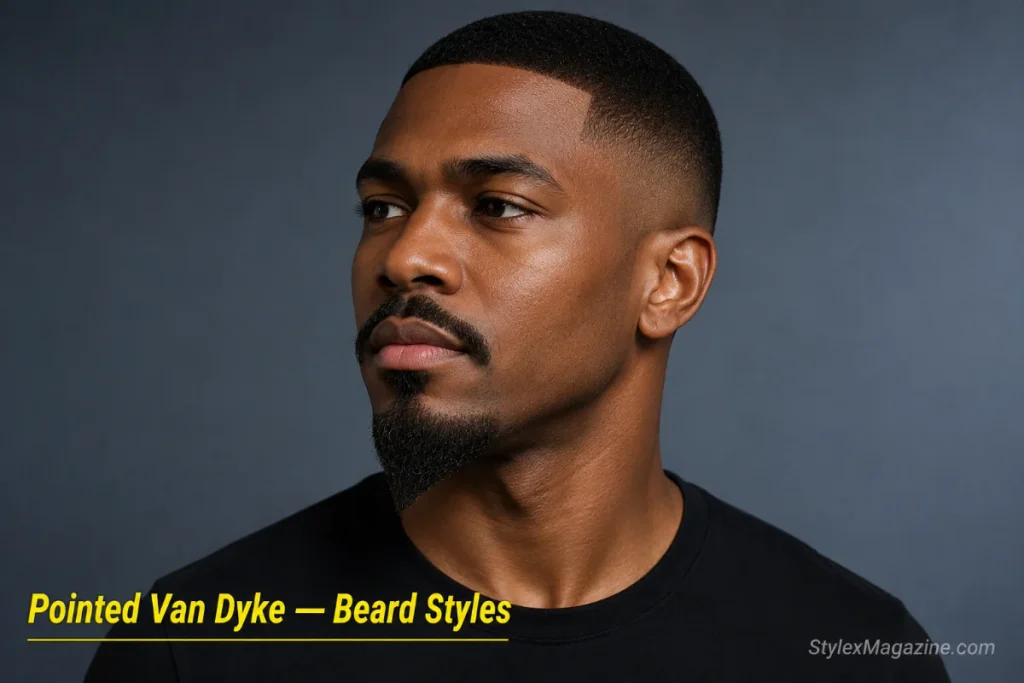
Celebrity: Anthony van Dyck (the original) | Hair type: Straight to wavy | Length: 1-2 inches chin, medium mustache
The chin piece sculpted into a sharp triangular point. The Renaissance portrait version, and the one that gives the Van Dyke its reputation. The point pulls the eye downward, adding vertical length to round and wide faces. It is my go-to recommendation for round-faced men who want their chin to look stronger.
The point does not hold itself. Work a small amount of beard balm through the chin hair each morning and twist the tip between your fingers to set the shape. Keep the mustache at medium length so it does not compete with the point for attention.
Best for: Round and heart-shaped faces. Men who want maximum chin definition.
Tell your barber: “Pointed Van Dyke, sharp triangle at the chin, medium mustache, cheeks clean.”
Maintenance: Daily balm at the point. Trim sides of the triangle every 2 weeks.
5. Rounded Van Dyke
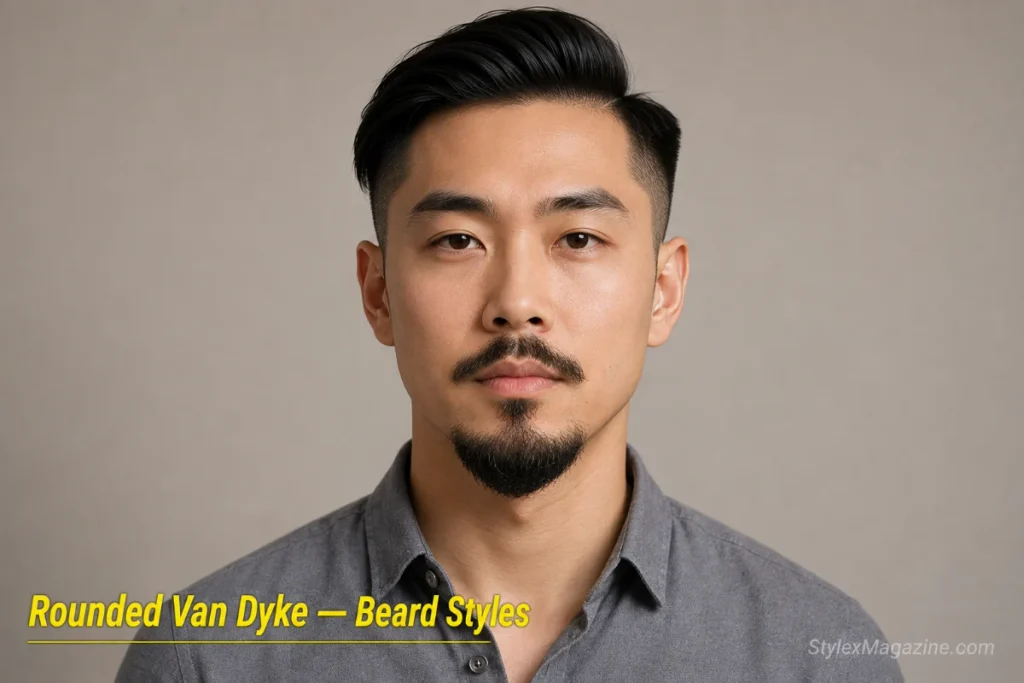
Styling tip: Shape with scissors, not trimmers | Hair type: All | Length: 1-2 inches chin, natural mustache
Every point and corner swapped for a curve: the chin piece finishes in a gentle U-shape, the mustache follows the natural arc of the lip, and all edges are softened. The friendliest Van Dyke variation. Same structure, none of the sharpness.
This is the version that works best on angular and square faces, where the curves offset a hard jawline that a pointed version would sharpen further. Round the corners with scissors, not a guard trimmer, because guards cut flat planes and this style avoids them.
Best for: Square, diamond, and angular face shapes.
Tell your barber: “Rounded Van Dyke, U-shape at the chin, soft edges, no point, cheeks clean.”
Maintenance: Scissor trim every 2 weeks. Gap and cheek shave every 2-3 days.
6. Stubble Van Dyke
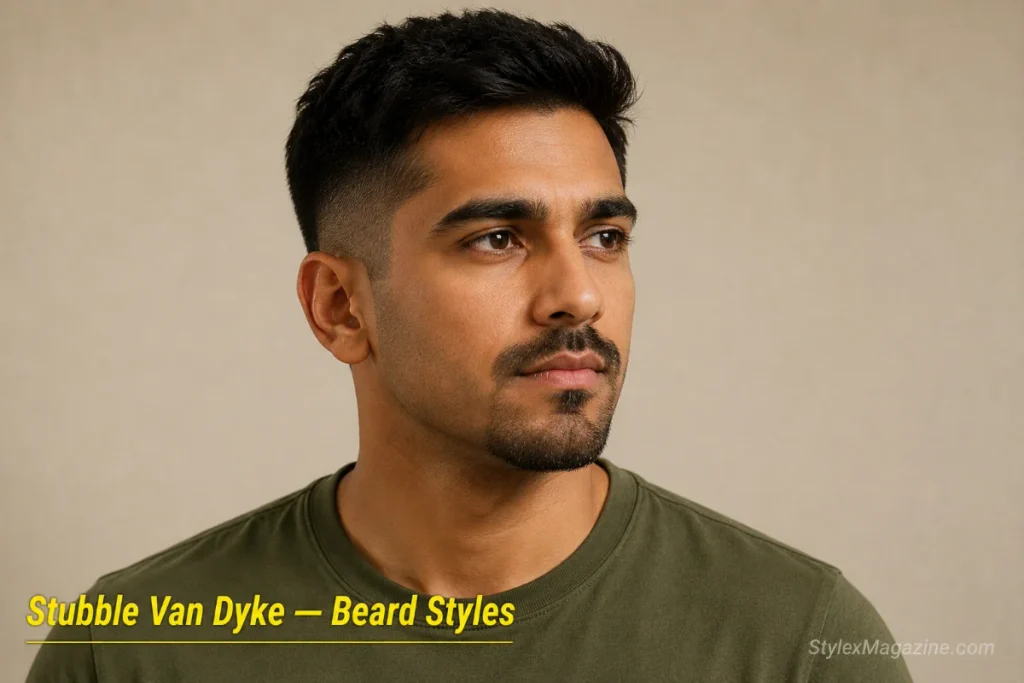
Styling tip: The test drive version | Hair type: All | Length: Guard 0.5-1 (2-4mm) both elements
The full Van Dyke layout at 2 to 4mm length. You keep the shape, the shadow, and the jaw definition with almost none of the commitment. This is the version I suggest when a client is not sure the style suits him: wear it at stubble length for two weeks, and if you like the shape, let it grow.
Short hair shows neglect faster than long hair. Run the trimmer over it every 3-4 days and keep the cheek edges shaved, or it stops looking like a style and starts looking like a lazy weekend.
Best for: All face shapes. Men testing the Van Dyke for the first time.
Tell your barber: “Stubble Van Dyke, guard 1 both pieces, soft disconnect, cheeks shaved.”
Maintenance: Trimmer pass every 3-4 days. Lowest commitment Van Dyke.
7. Disconnected Van Dyke (Wide Gap)
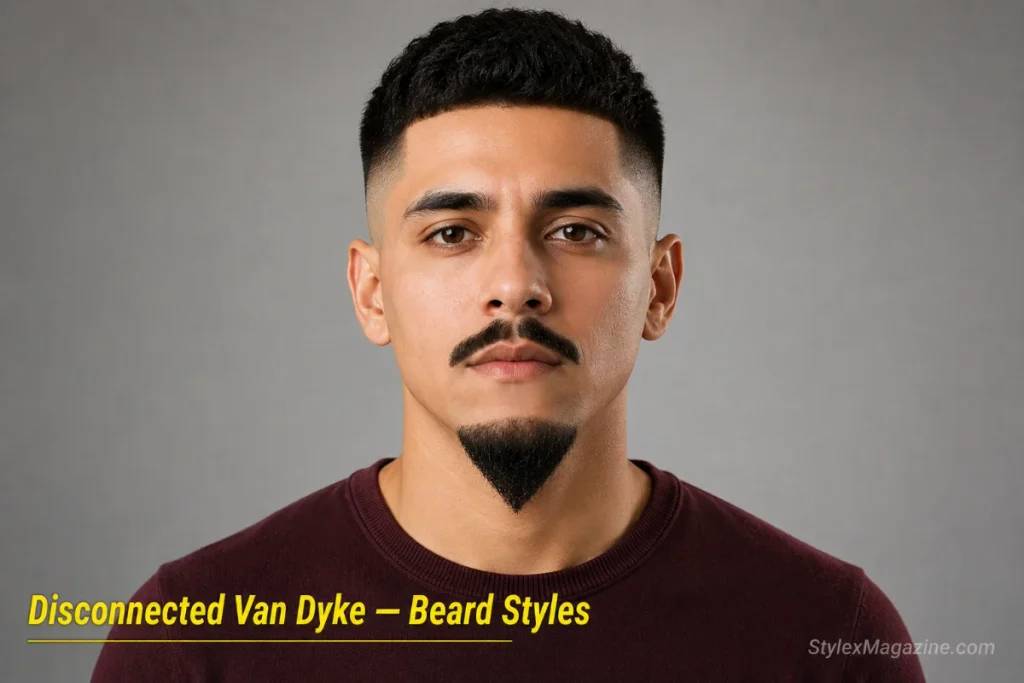
Styling tip: Every-other-day razor commitment | Hair type: All | Length: 1-2 inches chin, medium mustache
An inch or more of bare skin between mustache and chin piece instead of the usual few millimeters. All that negative space makes both shapes look deliberately placed. The gap becomes a frame that highlights the mouth and lip area.
The cost is upkeep: a wide gap shows regrowth within 48 hours, so this is an every-other-day razor commitment. Edge with a precision trimmer first, then finish the gap with a razor for clean-skin contrast.
Best for: Oval face shapes. Men with full lips or strong mouth definition.
Tell your barber: “Disconnected Van Dyke, wide gap between the mustache and chin, at least a finger width of bare skin.”
Maintenance: Razor the gap every 2 days. High maintenance.
8. Van Dyke with Handlebar Mustache
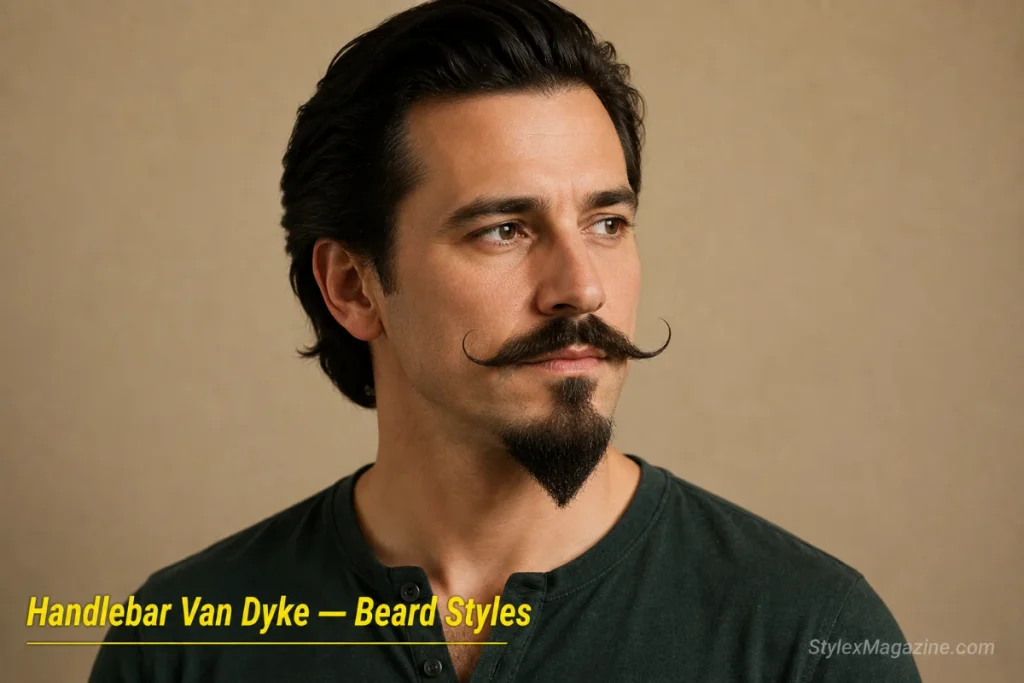
Styling tip: 3-4 months before the ends curl | Hair type: Straight to wavy mustache growth | Length: 3+ inches mustache, 1-2 inches chin
A pointed chin piece paired with a handlebar mustache grown past the mouth corners and curled upward with wax. The full vintage-gentleman effect. The contrast between the flamboyant top and the disciplined chin is what makes it work.
Be honest with yourself about the routine. The handlebar alone needs 5-10 minutes of warming wax between your fingers and shaping each morning, plus 3-4 months of growth before the ends will curl at all. During the awkward middle phase, train the hairs sideways daily with a small comb.
Best for: Oval and oblong face shapes. Men committed to a high-maintenance style.
Tell your barber: “Van Dyke with handlebar, pointed chin, curled mustache, cheeks clean, disconnect visible.”
Maintenance: Daily wax and shape. Barber trim every 3-4 weeks.
9. Van Dyke with Soul Patch
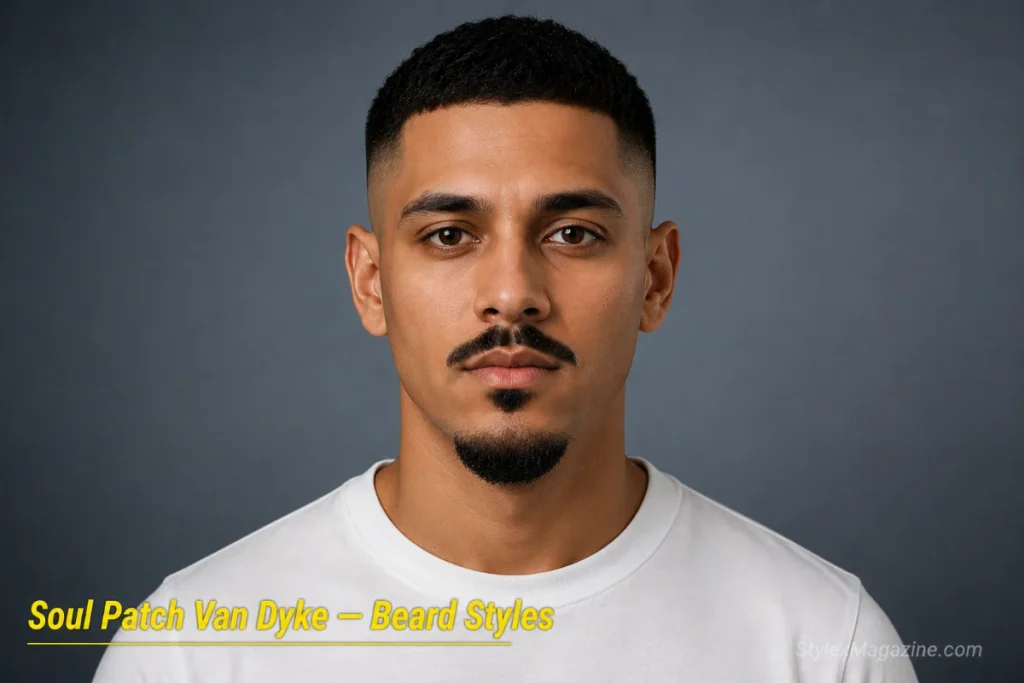
Styling tip: Keep the patch thumbnail-sized | Hair type: All | Length: 1-2 inches chin, guard 3 mustache, small soul patch
A three-piece composition: mustache, soul patch, goatee, all separated by bare skin. The soul patch bridges the gap between mustache and chin without closing it, softening the starkness of a standard Van Dyke.
Keep the patch small and tight. A thumbnail-sized rectangle or triangle, clipped to the same length as the mustache. Let it grow and it merges into the chin piece, collapsing the three-element effect into two.
Best for: Oval and diamond face shapes.
Tell your barber: “Van Dyke with soul patch, three separate pieces, small patch below the lip, everything disconnected.”
Maintenance: Re-edge all three separations every 2-3 days.
10. Modern / Faded Van Dyke
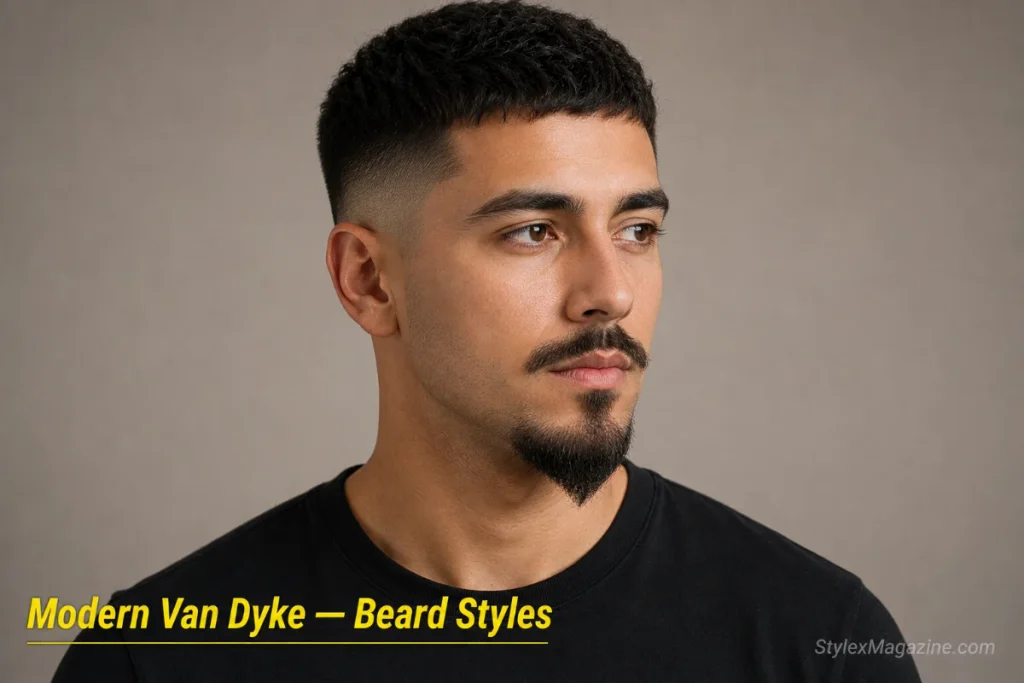
Styling tip: Ask for “blended, not harsh” | Hair type: All | Length: Guard 3-4 chin, natural mustache
Edges done with a precision trimmer, a subtle fade where the chin piece meets bare skin instead of a hard stop, and lengths that transition rather than jump. The 2026 version of the Van Dyke. Less about razor-drawn lines, more about blended sharpness that still looks defined but not stamped on.
This is what most men under 35 mean when they ask for a Van Dyke, whether they know the name or not. It sits naturally alongside a skin fade or taper haircut, and the barber visit every 2-3 weeks keeps both elements in sync.
Best for: All face shapes. Pairs well with any fade haircut.
Tell your barber: “Modern Van Dyke with faded edges, tight but blended, nothing harsh, cheeks clean.”
Maintenance: Barber every 2-3 weeks. Home edging every 3 days.
11. Natural Van Dyke
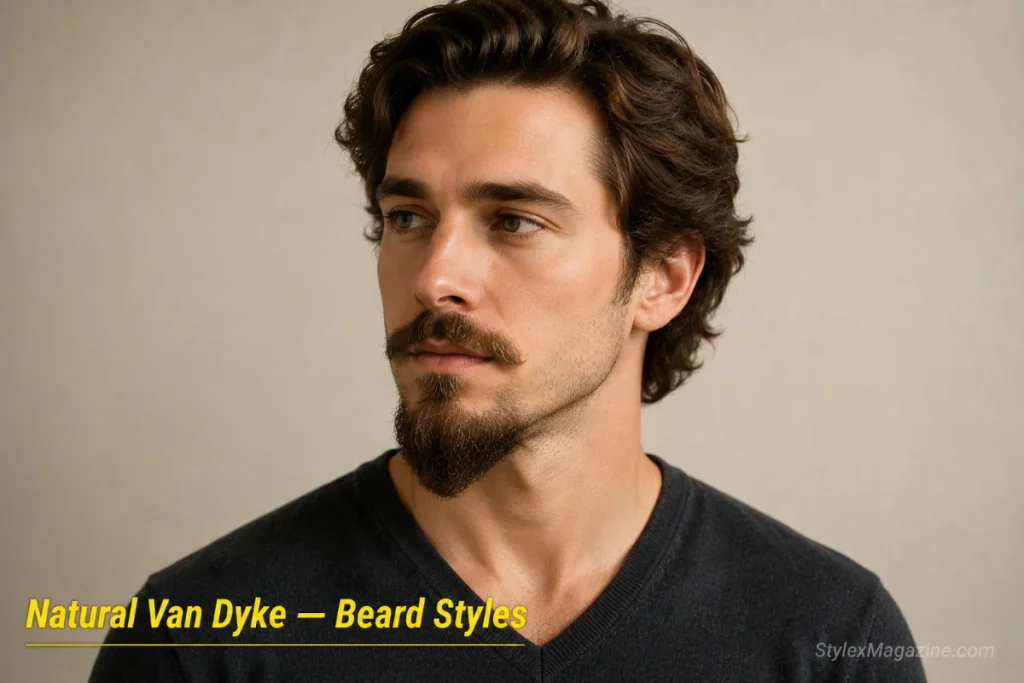
Styling tip: Works best on wavy and curly beard hair | Hair type: Wavy to curly | Length: 1-2 inches chin, natural mustache
The Van Dyke framework with the polish dialed down. Edges are trimmed but not razored into hard lines. Lengths vary slightly the way hair actually grows. The whole style works with your growth pattern instead of against it.
This is the best version for wavy and curly beard hair, which fights geometric shaping anyway. Let the texture do the styling. Upkeep is a weekly scissor tidy and a cheek shave every three days. The line between “natural” and “neglected” is the cheeks. Keep them clean and everything else looks intentional.
Best for: Oval and round face shapes. Men with wavy or curly facial hair.
Tell your barber: “Natural Van Dyke, soft edges, no hard lines, let the texture show, cheeks clean.”
Maintenance: Weekly scissor tidy. Cheek shave every 3 days.
12. Thick Van Dyke
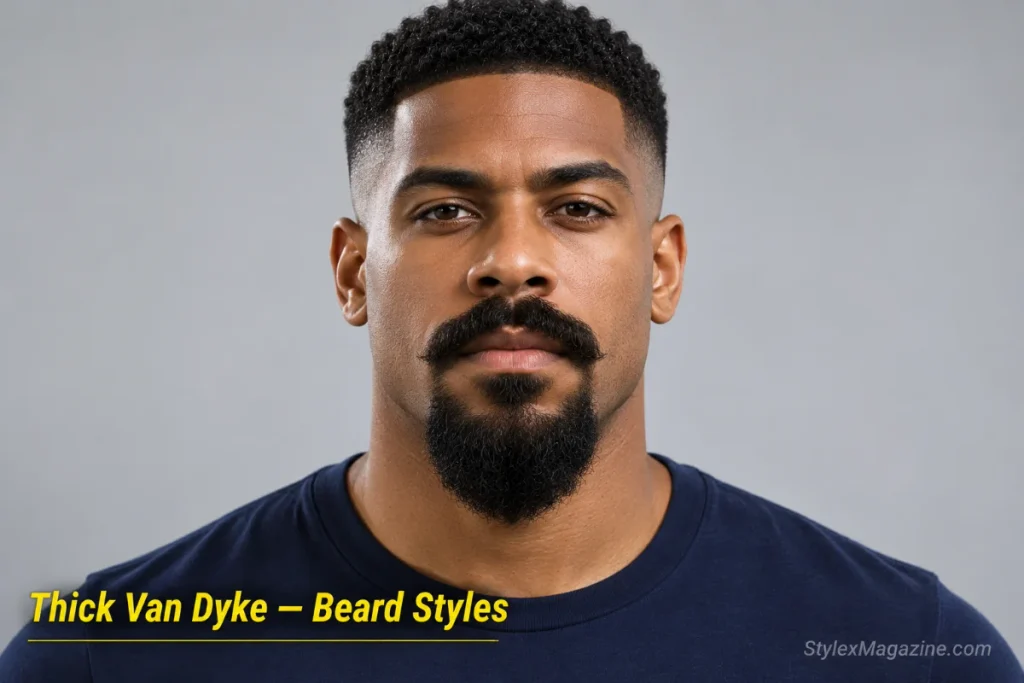
Hair type: Dense growth required | Length: 1-2 inches chin, full mustache
Maximum density in both elements. A chin piece and mustache that are unmistakably full and heavy. On the right genetics this carries more presence than anything else on this list. On thin growth it is not available, and that is fine. Pick the stubble or short version instead.
Thick hair needs thinning, which surprises most men. Every few weeks a barber should go through a heavy Van Dyke with thinning scissors to remove bulk while keeping the silhouette. Otherwise the chin piece turns into a solid block. And watch the gap: dense growth closes it faster than fine hair does. Miss two shaves and you have accidentally grown a circle beard.
Best for: Oval and square face shapes. Men with genuinely dense growth.
Tell your barber: “Thick Van Dyke, full density, thin out the bulk but keep the shape, disconnect clean.”
Maintenance: Barber every 3 weeks for thinning. Gap shave every 2 days.
13. Van Dyke for Black Men
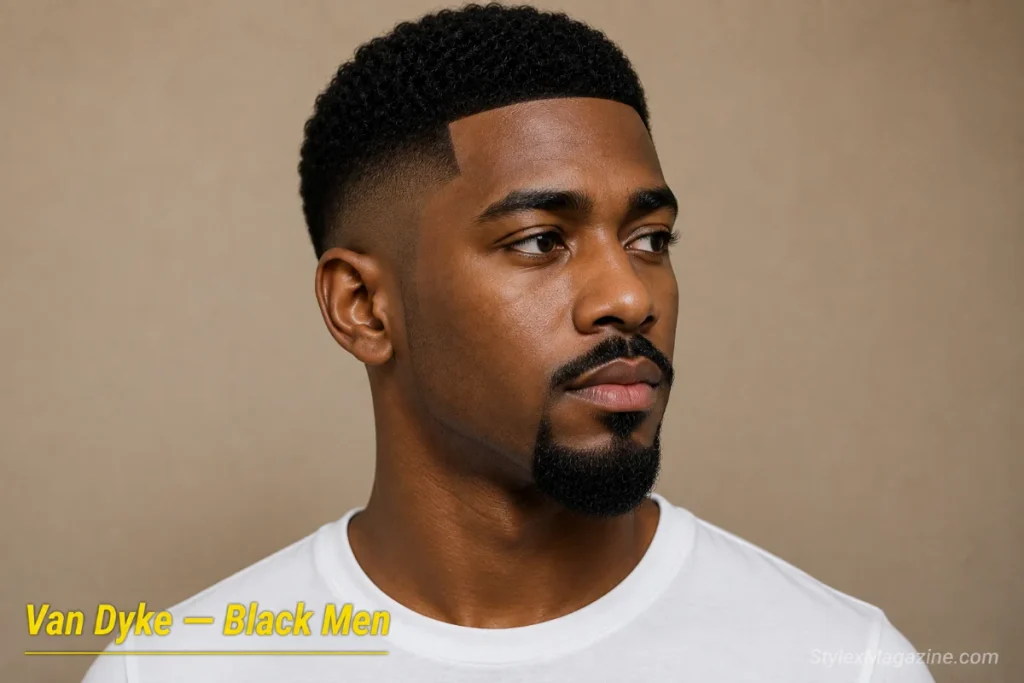
Styling tip: Single-blade or foil shaver on cheeks | Hair type: Coily, 4A-4C | Length: Guard 2-4 chin, natural mustache
Coily textures create naturally sharper Van Dyke edges, but the clean-shaved cheeks need specific care. Razor bumps (pseudofolliculitis barbae) are more common with coily hair because tight curl patterns cause freshly shaved hairs to grow back into the skin. The cheeks, gap, and lip area all get shaved every 2-3 days for this style, putting those zones under repeated stress.
Use a single-blade razor or electric foil shaver instead of multi-blade cartridges. Shave with the grain, never against. Apply a salicylic acid aftershave to prevent ingrowns. A line-up at the hairline connecting through the sideburns into the Van Dyke creates one continuous outlined shape. For the full guide on coily hair and beard pairings, see fade haircuts for Black men.
Best for: All face shapes. Pairs well with a line-up, skin fade, or burst fade.
Tell your barber: “Van Dyke, sharp edges, line-up at the hairline, blend the sideburn, single-blade on the cheeks.”
Maintenance: Cheek and gap shave every 2-3 days. Moisturize shaved areas daily.
14. Professional Van Dyke
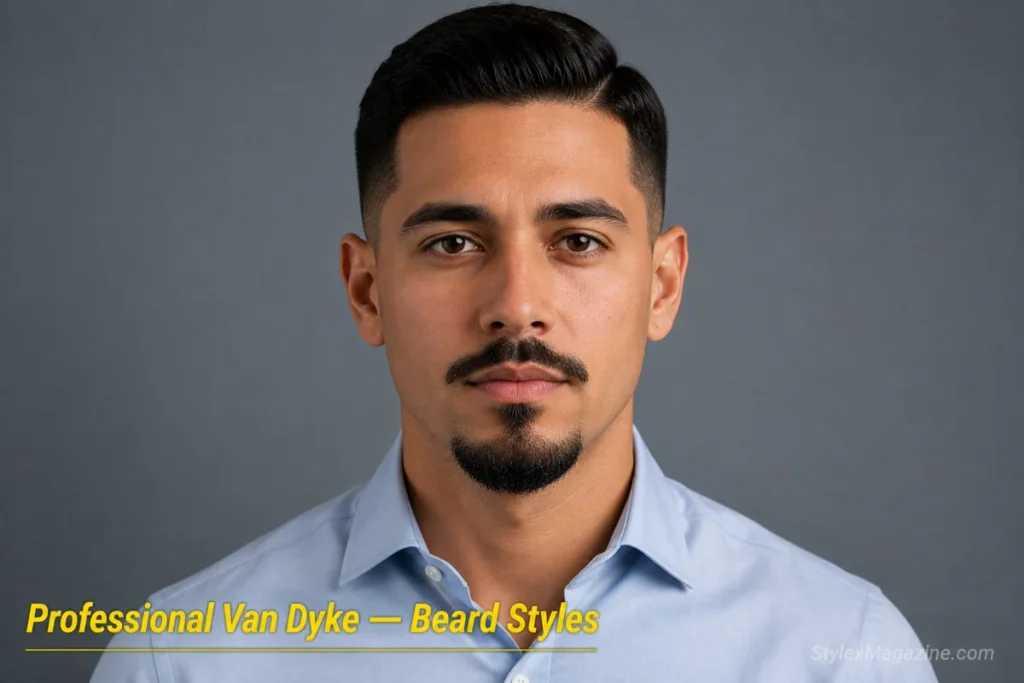
Styling tip: Consistency is the entire trick | Hair type: All | Length: Guard 2-3 (5-10mm) both elements
Both elements at a uniform medium length, no dramatic point, no wax, no wide gap, every line quietly clean. The version engineered to pass in any boardroom. Enough character to signal grooming intention, never enough to become a talking point.
A professional Van Dyke that is sharp Monday and fuzzy Thursday defeats its own purpose, so the routine is small but daily: thirty seconds checking the gap and cheek lines each morning, a proper trim once a week.
Best for: All face shapes. Corporate and formal settings.
Tell your barber: “Professional Van Dyke, guard 3 both pieces, clean disconnect, soft edges, nothing dramatic.”
Maintenance: Daily gap check. Weekly trim. Monthly barber visit.
15. Salt and Pepper Van Dyke
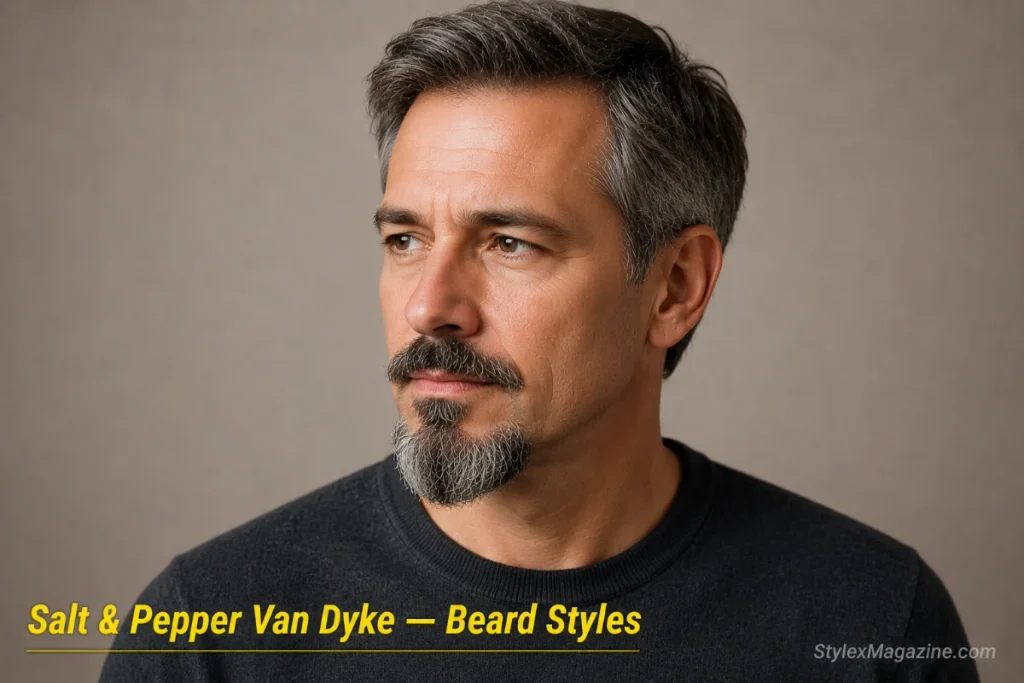
Hair type: Natural greying | Length: 1-2 inches chin, natural mustache
Grey threading through a Van Dyke is not a problem to manage. It is a feature. The mix of dark and silver adds natural contrast that makes the shape look sharper, and the tone variation gives the style a depth you cannot replicate with solid-colored hair.
Most men grey unevenly: mustache and chin at different rates. That asymmetry gives the Van Dyke character. Grey hair is coarser and drier, so it absorbs beard oil faster. Use it daily or the silver turns dull and wiry. Keep the style a half-step shorter than you would a pigmented version, because silver hair appears larger at the same length.
Best for: Men over 40. All face shapes.
Tell your barber: “Salt and pepper Van Dyke, natural grey, keep the shape tight, no dye.”
Maintenance: Daily oil. Shape tighter than a pigmented version. Wash 2-3 times weekly.
What Haircuts Work Best with a Van Dyke?
The Van Dyke’s clean cheeks and defined lines pair best with haircuts that share the same precision. Messy or heavily textured cuts can create a mismatch between a disciplined beard and a casual head.
| Haircut | Best Van Dyke Pairing | Why |
|---|---|---|
| Skin fade or high fade | Modern faded, classic | Matched clean gradients from haircut to beard |
| Mid fade | Classic, pointed | Balanced proportion between head and jaw |
| Slick back | Classic, pointed, with handlebar | Polished hair pairs with polished facial hair |
| Buzz cut | Short, stubble | Minimal head matches minimal beard |
| Side part | Professional, classic | Conservative, office-ready combination |
| Bald or shaved head | Classic, thick, extended | The Van Dyke becomes the only feature, so commit to a fuller version |
For specific fade and beard combinations, see fade haircut with beard. For buzz and beard pairings, see buzz cut with beard. For bald head combinations, see bald head with beard styles.
What Are the Most Common Van Dyke Mistakes? {#mistakes}
1. Letting the gap close. Three days of stubble in the disconnect zone turns a Van Dyke into a circle beard. That visible separation between mustache and chin is what makes this style work. Shave it every 2-3 days without exception. If you cannot commit to that schedule, the short beard or a circle beard is a better fit.
2. Making the goatee too wide. The chin piece should sit within the mouth corners. Extending it wider turns the Van Dyke into a short beard with clean cheeks. Use the corners of your mouth as the boundary lines.
3. Cutting the chin point too aggressively. You cannot add hair back. Start with a broader base and narrow the point gradually over two or three sessions. Chasing a sharp point on the first attempt usually ends in a shape too narrow to fix.
4. Mismatching mustache and chin lengths. If the mustache is guard 4 and the chin is guard 2, the two elements fight each other for attention. Keep them within one guard number of each other, or make the contrast deliberate (beardstache variation).
5. Using the word “goatee” at the barber when you mean Van Dyke. To most trained barbers, “goatee” means chin-only, no mustache. If you sit down and say “goatee” but mean a Van Dyke, you risk walking out with the chin piece only and a bare upper lip. Say “Van Dyke” or “disconnected mustache and chin beard” and the barber will shape both elements with the gap between them.
FAQs
How long does it take to grow a Van Dyke beard?
Four to eight weeks of growth before the first proper shaping. You need roughly half an inch of length on the chin and lip before a shape will hold. Because you are only growing the mouth-and-chin zone and shaving everything else, it comes in faster than almost any full beard style. Fast growers can be shapeable in three weeks. Slower or finer growth needs the full two months.
What is the difference between a Van Dyke and a goatee?
A goatee is chin hair only, no mustache. A Van Dyke adds a mustache but keeps it separated from the chin hair by a strip of bare skin. The style everyone mislabels as a “goatee” (mustache and chin hair joined in a ring around the mouth) is actually a circle beard. Goatee is one element. Van Dyke is two separate elements. Circle beard is one connected loop. Use those exact words with your barber.
Can you grow a Van Dyke with patchy facial hair?
The Van Dyke is the best style for patchy growth. It only requires hair on the upper lip and chin, the two zones where nearly every man grows strongest, and it shaves away the cheeks where patchiness usually shows. If even the lip or chin has thin spots, keep the length shorter, because short hair appears denser than long hair stretched over gaps.
Does a Van Dyke beard look professional?
A short or professional Van Dyke at guard 2-3 with clean edges is appropriate for most professional settings. The style signals grooming precision, not rebellion. Consistency matters more than anything else with this style: a sharp Van Dyke Monday that is fuzzy by Thursday defeats its own purpose. Daily gap checks and weekly trims keep it office-ready.
How do you maintain a Van Dyke beard?
Three habits: shave the cheeks and the gap every 2-3 days, trim the mustache and chin piece to length weekly (scissors for the shape, trimmer for the bulk), and work a few drops of beard oil through it daily so the hair stays soft and lies flat. The cheek-and-gap shaving is the non-negotiable part. The entire style is built on visible separation, and 72 hours of stubble is enough to blur a Van Dyke into a scruffy circle beard. Total time once the shape exists: about five minutes every other day.


16 Best Goatee Styles for Men
17 Best Bald Head with Beard Styles (2026)



beard cannot match. For the full guide on pointed and styled disconnected variations, see the Van Dyke beard