
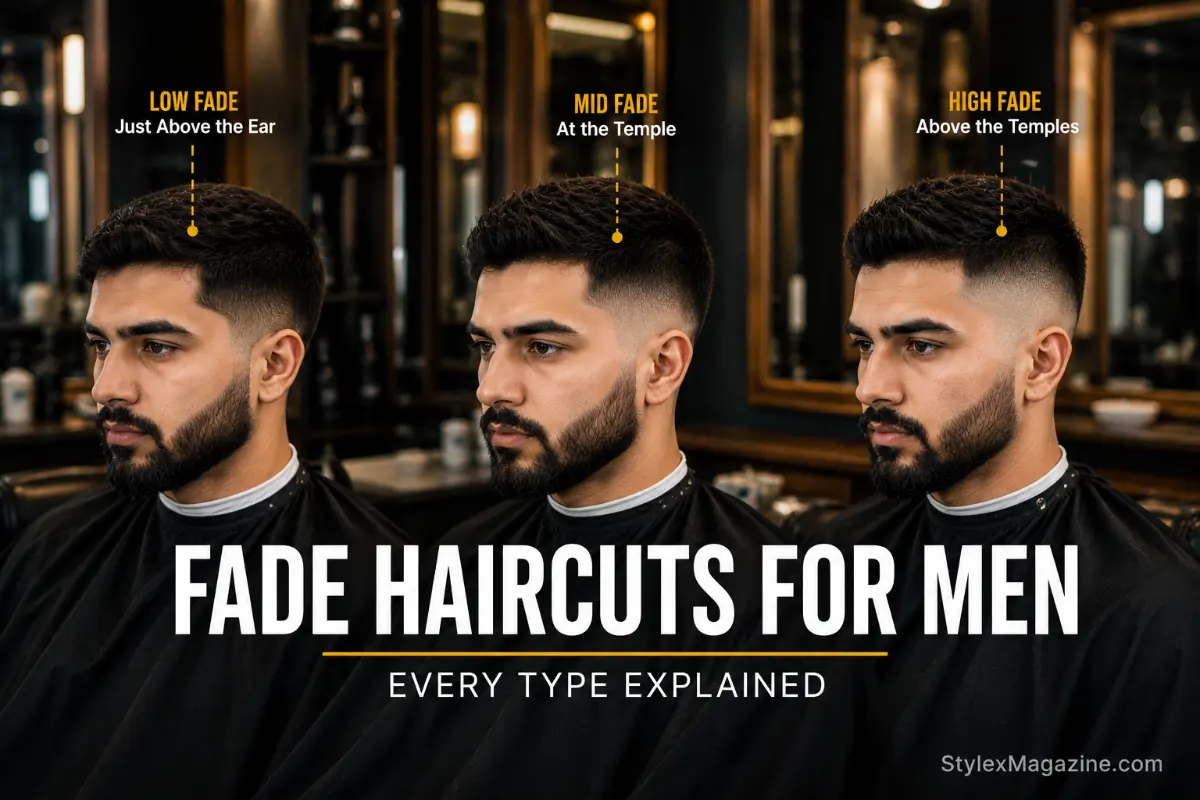

Quick Answer: A fade haircut gradually blends the sides and back from longer hair on top to shorter hair toward the neckline, with no visible lines between lengths. Seven distinct types exist, each defined by where the fade starts, how short it goes, or the shape it follows.
A fade is not one haircut. It is seven, and most men walk into a barbershop asking for “a fade” without knowing which one they mean. The barber fills in the blanks, and the outcome is a coin flip.
The differences between fade types are small in description but significant in the mirror. A starting point that shifts one inch higher changes the entire character of the cut. A finish that stops at stubble instead of skin changes how often you sit in the chair. A line that curves instead of running straight changes how the cut looks from behind.
I have spent eight years cutting fades on every head shape, hair density, and texture that sits in the chair. The single biggest gap between what clients want and what they get comes down to one thing: not knowing which fade to ask for.
What Is a Fade Haircut?
A fade is a barbering technique where the hair on the sides and back transitions from longer at the top to progressively shorter toward the neckline, with a seamless blend between each length. No hard lines, no steps, no visible breaks between clipper guards.
The barber builds the gradient by working through shorter clipper settings from the top of the sides downward. Each pass is shorter than the last, and each blends into the next. The transition should look continuous rather than layered.
Fades are classified by three variables:
| Variable | What It Controls | Options |
|---|---|---|
| Height | Where the shortest point starts on the head | Low (above ear), Mid (temple), High (above temple) |
| Closeness | How short the hair gets at the base | Skin (bare), Shadow (stubble), Taper (short hair remains) |
| Shape | The path the fade line follows | Straight, Drop (curves down behind ear), Burst (arc around ear) |
Combine any height with any closeness and any shape and you have a specific fade. A “low skin drop fade” starts above the ear, goes to bare skin, and curves down behind the ear. A “high shadow fade” starts above the temple and stops at stubble. The system is modular.
The fade originated in Black barbershop culture in 1940s and 1950s America, developed specifically to work across the full range of Black hair textures, from loose curls to 4C coils. The military contributed the short tapered sides, but the barbershop refined the precision blending technique into what barbers use today. The American Barber Association classifies fades by their starting point, which remains the primary distinction.
What Are the 7 Types of Fade Haircuts?
Seven types. Each section below covers what makes it different and who it suits. For the full style gallery, face shape breakdown, and barber scripts for each type, follow the dedicated guide.
Low Fade Haircuts

Starts just above the ear. The most subtle fade available, and the one most barbers recommend to first-time fade clients. Growth absorbs into the existing length between visits, so the cut stays presentable longer than any other fade height.
Suits every face shape and every professional setting. The lowest maintenance of all fade heights, with 3-4 weeks between visits being standard. Every low fade style, variation, and detailed face shape match is in the low fade haircut guide.
Mid Fade Haircuts

Starts at temple level. More contrast than the low fade, less commitment than the high. The most requested fade in most barbershops because it balances sharpness with practicality.
Works on every face shape, every hair type, every setting. Needs a barber visit every 2-3 weeks. All mid fade styles with face shape and hair type matching are in the mid fade haircut guide.
High Fade Haircuts

Starts above the temples, sometimes as high as the crown. The boldest standard fade, with the most scalp visible on the sides. The top hair becomes the clear focal point because the sides are cut short enough to create dramatic contrast.
Suits oval, round, and square face shapes best. On oblong or long faces, the added height can make the face look longer. Needs a barber visit every 1-2 weeks. Every high fade variation and detailed face shape guide is in the high fade haircut guide.
Burst Fade Haircuts

Follows a semi-circular arc around the ear instead of a straight horizontal line. The back stays longer than any standard fade. That longer back is why burst fades pair naturally with mullets, mohawks, and styles where back length matters.
Works well with curly and coily hair because the arc follows the head’s natural growth pattern. Every burst fade style including mullets, mohawks, and curly variations is in the burst fade haircut guide.
Skin Fade (Bald Fade)

“Skin” describes closeness, not height. A skin fade takes the hair all the way to bare skin at the base, finished with a straight razor. You can have a low skin fade, a mid skin fade, or a high skin fade.
The sharpest finish available. Quality varies more between barbers on this cut than any other. Growth at the skin line becomes visible within days, making this the highest-maintenance option at 1-2 week intervals. For a detailed breakdown of how a skin fade differs from a taper, see the taper fade vs skin fade comparison.
Taper Fade Haircuts

The hair shortens toward the neckline but never reaches bare skin. There is always some hair remaining at the shortest point, typically a #1 or #1.5 guard. Growth absorbs into the existing length rather than creating a visible line, making this the most forgiving fade to grow out.
The most conservative option. Suits formal environments, low-maintenance schedules, and men who want precision without drama. Visits every 3-4 weeks.
Drop Fade Haircuts

A modification, not a standalone type. The fade line stays at its chosen height on the sides but curves downward behind the ear rather than running straight across. From the front, a drop mid fade looks like a standard mid fade. From the back, the curved drop creates a sculpted silhouette.
Works well with curly and wavy hair, and with styles where the back profile matters. Can be combined with any height (low drop, mid drop, high drop) and any closeness (skin, shadow, taper).
How Do the 7 Types Compare?
| Low Fade | Mid Fade | High Fade | Burst Fade | Skin Fade | Taper Fade | Drop Fade | |
|---|---|---|---|---|---|---|---|
| Starts at | Above ear | Temple | Above temple | Arc around ear | Any height | Neckline | Any height (curves at back) |
| Closeness | Skin or taper | Skin or taper | Skin or taper | Skin or taper | Bare skin only | Hair remains | Skin or taper |
| Contrast | Subtle | Balanced | Bold | Moderate | Maximum | Minimal | Varies |
| Maintenance | 3-4 weeks | 2-3 weeks | 1-2 weeks | 2-3 weeks | 1-2 weeks | 3-4 weeks | 2-3 weeks |
| Best for | Professional, first fade | Most men | Statement looks | Mullets, mohawks | Maximum sharpness | Formal settings | Back profile shape |
For a deeper side-by-side of how low, mid, and high fades differ by face shape, hair type, and grow-out timeline, the full breakdown is in the low fade vs mid fade vs high fade comparison.
How Do You Choose the Right Fade?
Three factors decide which fade works for you: how often you visit the barber, what environment you work in, and your hair density. Face shape matters, but these three narrow the field first.
By Maintenance Schedule
This is the filter most men skip, and the reason most men end up unhappy with their fade two weeks later.
- Every 1-2 weeks: High fade, skin fade, high burst fade
- Every 2-3 weeks: Mid fade, classic burst fade, drop fade
- Every 3-4 weeks: Low fade, taper fade
If you cannot commit to fortnightly barber visits, a high skin fade will look grown out and unkept within 10 days. A low taper fade in the same window still looks intentional. Choose the height your schedule can sustain.
By Setting
- Corporate, finance, law: Low fade or taper fade. Conservative, never out of place.
- Creative, tech, casual offices: Mid fade. Sharp without being aggressive.
- Athletic, creative fields, personal brand: High fade, burst fade. The bolder the better, if you maintain it.
By Hair Density
- Thick hair: Any fade works. High skin fades create the cleanest contrast against dense hair.
- Fine or thin hair: Stay at low or mid height. A high fade on thin hair exposes scalp on the sides, drawing attention to density rather than the cut. Shadow fade (stopping at stubble) works better than skin fade.
- Curly or coily hair: Any height works, but burst fades and drop fades follow the natural growth pattern. Tell your barber the height you want based on your dry hair, not freshly washed. Curly hair shrinks once dry and the fade line shifts higher.
For face shape guidance matched to a specific fade type, each sub-topic guide covers which face shapes work best for that particular fade.
By What You’re Wearing on Top
The top style influences which fade height pairs best:
| Top Style | Best Fade Pairing | Why |
|---|---|---|
| Crew cut | Low or mid fade | Clean, professional, no contrast needed |
| Pompadour | Mid or high fade | Height on top needs matching contrast on sides |
| Textured crop | Any height | Textured crops adapt to every fade level |
| Comb over | Low or mid fade | Sharp part line needs clean, not bold, sides |
| Mohawk | High fade or burst fade | Central strip needs maximum side contrast |
| Mullet | Burst fade | Burst arc preserves the back length a mullet needs |
| Slick back | Low or mid fade | Smooth finish pairs with subtle sides |
| Natural curls | Mid fade, burst fade, drop fade | These follow the natural curl direction |
How Often Should You Get a Fade?
The fade type sets the maintenance cycle. Going beyond the recommended window does not just look untidy, it changes the shape of the cut. A high skin fade at three weeks is no longer a high skin fade. It is a grown-out mid fade that lost its lines.
| Fade Type | Touch-Up Window | Why |
|---|---|---|
| High skin fade | Every 1-2 weeks | Bare skin grows in visibly within days |
| High fade (non-skin) | Every 2 weeks | High contrast shows growth fast |
| Mid fade | Every 2-3 weeks | Moderate contrast allows some grow-out |
| Burst fade | Every 2-3 weeks | Arc shape loses definition after 3 weeks |
| Low fade | Every 3-4 weeks | Subtle blend absorbs new growth |
| Taper fade | Every 3-4 weeks | Most forgiving, grows out gradually |
Between visits, keep the neckline clean with a trimmer at home. Stay away from heavy products on the faded sides. Buildup makes uneven growth more visible and causes the fade to look patchy faster.
How Do You Tell Your Barber What You Want?
Most miscommunication happens because the client names a type without specifying the three variables that define the cut. “Give me a fade” covers seven different haircuts. “Give me a low skin drop fade” covers one.
Specify three things every time:
1. Height: where the shortest point starts. “Low” (above the ear), “mid” (at the temple), or “high” (above the temple).
2. Closeness: how short the base goes. “Skin” (bare), “shadow” (stubble), or “taper” (short hair remains).
3. Shape: the path the fade follows. “Straight” (standard), “drop” (curves down behind the ear), or “burst” (arc around the ear).
Complete phrase examples:
“Low taper fade, straight all the way around.”
“Mid skin fade, drop behind the ear.”
“High shadow fade, straight line.”
“Low burst fade around the ear, taper finish.”
If you have a reference photo, bring it. But describe the cut in these three variables regardless, because photos show the result and not the instruction, and two barbers may interpret the same photo differently.
For Black men, one additional instruction matters: tell your barber the height you want based on how your hair looks dry. Coily hair shrinks significantly once dried. A fade that sits at mid height when freshly washed can shift to high once the hair contracts. A complete guide to fades suited for Black hair textures is in the fade haircuts for Black men guide.
FAQ’s
What is the easiest fade for a first-timer?
A low taper fade. It starts low, never goes to skin, and grows out cleanly over 3-4 weeks. If the blend is not perfect, the low starting point hides it better than a mid or high fade would.
How much does a fade haircut cost?
$25-$45 in most US barbershops, $20-£35 in the UK. Skin fades and detailed work (designs, hard parts) may cost more. Price depends on the shop, the barber’s experience, and your city.
Can you do a fade at home?
Technically, but the blend is the hardest part of the cut. Home fades tend to show lines because the back of the head is impossible to see and blend simultaneously. If you attempt it, stick to a low taper fade (the most forgiving) and use a hand mirror for the back.
Do all barbers know how to fade?
Most trained barbers can do a basic fade. Skin fades, burst fades, and fades on curly or coily hair require specific experience. If you want a skin fade or textured fade, ask to see examples of the barber’s work on that specific type before sitting down.
What is the difference between a fade and a regular haircut?
A regular haircut (scissors cut) keeps a uniform or graduated length on the sides with no gradient toward skin. A fade specifically blends the sides shorter and shorter toward the base using clippers, creating a visible gradient. The transition from hair to shorter hair (or skin) is what makes it a fade.
Are fades unprofessional?
Low fades and taper fades are accepted in every professional setting, from law firms to finance. Mid fades suit most workplaces. High skin fades with designs may not fit conservative environments, but the fade itself is not inherently unprofessional. It is the most common men’s haircut in both the US and UK.

Other Articles

No Comment! Be the first one.