
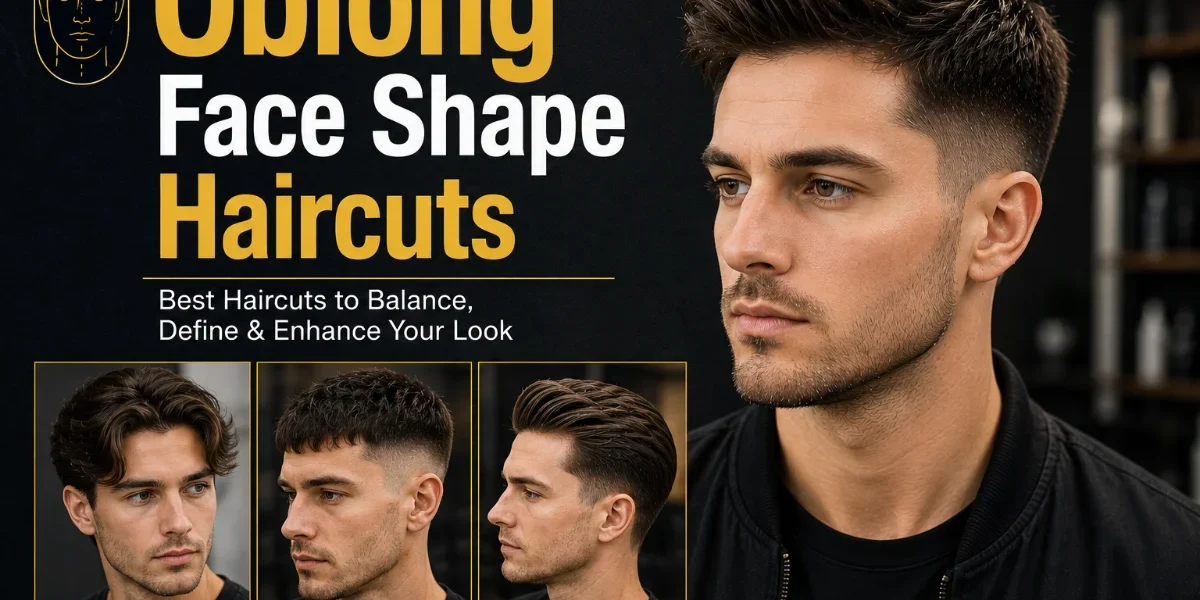

The best haircuts for oblong face shapes add width at the sides and keep height on top low. Textured crops, Caesar cuts, French crops, curtain bangs, and deep side parts all work. Choose a low fade over a high fade it preserves the temple width that balances a long face.
Men with oblong faces typically find out the hard way a high fade that felt modern at the barber looks narrower by the time they get home, or a pompadour that worked on someone else just makes their face look longer. The shape isn’t the problem. The cut is.
Every cut below follows the same logic: width over height. The differences are in how each one achieves it.
What Is an Oblong Face Shape?
An oblong face shape has a length-to-width ratio of 1.7:1 or above, with the forehead, cheekbones, and jaw at similar widths. The sides run straight rather than curving inward. That straight cheek line is what separates oblong from oval, which sits closer to a 1.5:1 ratio with gently curved sides.
You may have seen it called a long face or rectangular face these are the same shape. The distinction matters because haircut advice written for rectangular faces applies directly to oblong, and vice versa.
If this sounds like you:
- Face length is your most dominant measurement
- Forehead, cheekbone, and jaw widths are close to equal
- Cheek lines run straight, not angled
- Chin is rounded or only mildly squared
Which Men Have Oblong Face Shapes?
Ben Affleck’s face length significantly outpaces his jaw width, with straight sides that run parallel from temple to chin classic oblong. Adam Driver carries the same proportion; his jaw and forehead are both narrow relative to the vertical distance. Keanu Reeves shows the balanced-width oblong, where no single feature dominates the width the length does all the work.
Adam Levine and Liam Hemsworth both run long with straight cheek lines, though Hemsworth’s jaw carries slightly more definition at the base. The cuts they’ve worn well share a pattern: side weight, fringe or texture on top, rarely any significant height.
Oblong and oval faces are often confused because both are longer than they are wide. Use our Face Shape Calculator to check your shape before choosing a haircut.
20 Best Haircuts for Oblong Face Shape Men
The best haircuts for oblong face shape men are the textured crop, Caesar cut, French crop, deep side part, and Ivy League. Each adds width at the sides or breaks vertical length with a fringe. Curtain bangs and the two-block cut are strong trending options. All work by redirecting the eye horizontally rather than up and down.
One rule applies across every cut on this list: keep styled height on top under 2–3 inches. Everything else fade level, fringe type, part direction can flex depending on your hair type and preference. That single measurement is the one that determines whether a cut balances an oblong face or compounds its length.
1. Textured Crop with Low Fade
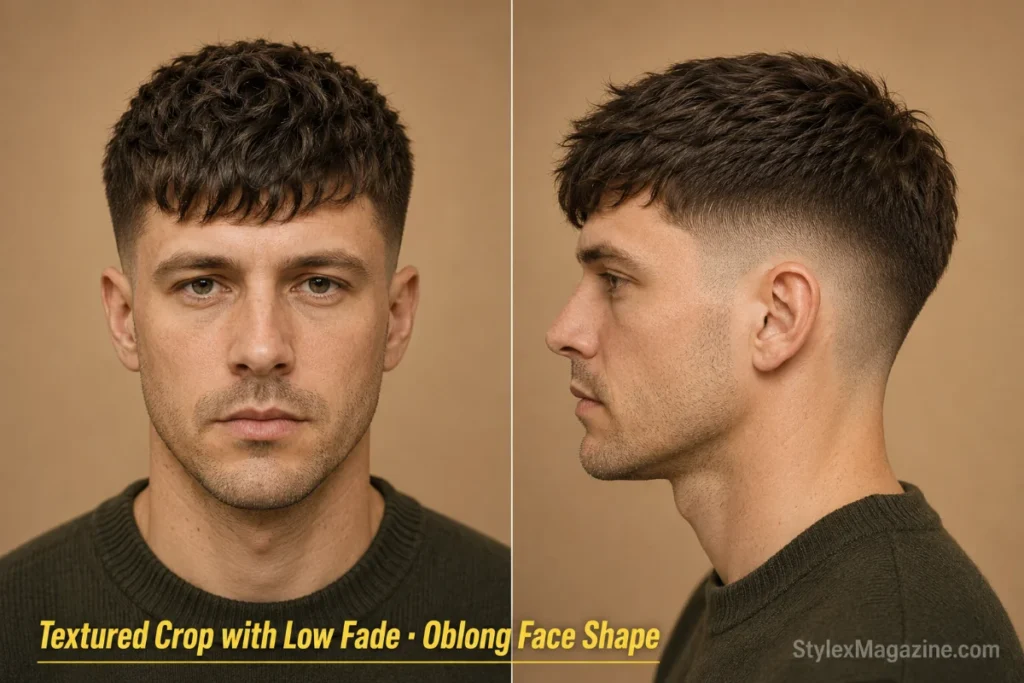
The strongest choice for most oblong faces. The textured top pushes forward and out not upward — creating horizontal mass across the crown. A low fade keeps hair present through the temples, which is exactly where oblong faces need width.
Ask for 1.5–2.5 inches on top with a matte finish. Push the fringe toward the eyebrows rather than lifting it. Every styling choice here should move the hair across the face, not up it.
Hair type: Works best with thick or medium hair. Fine hair needs a firmer paste to hold texture without collapsing.
Maintenance: Every 3–4 weeks.
2. Caesar Cut
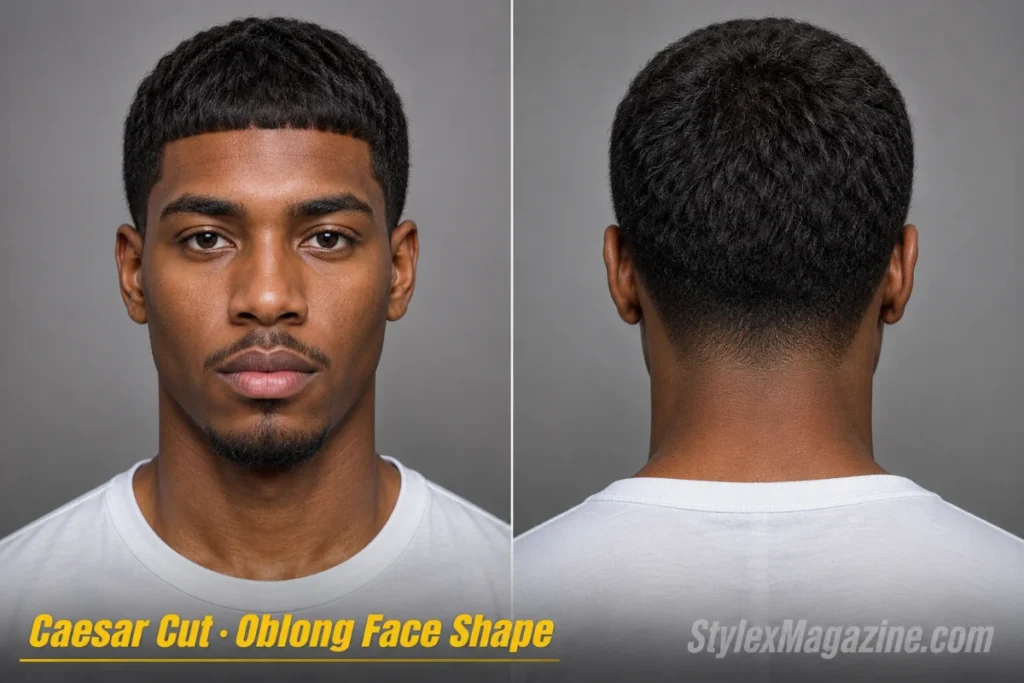
The Caesar creates a horizontal fringe that runs straight across the forehead. That horizontal line is doing real work the eye reads across it rather than tracking up the full length of the face. It shortens the perceived face length by covering the upper forehead while creating a defined visual break.
Keep the fringe at eyebrow level or just above. Sides stay relatively short but avoid going to a high fade keep enough hair through the temples to maintain width.
Hair type: Best on straight to slightly wavy hair. Coarse hair cuts cleanly; fine hair works if kept short. Maintenance: Every 4–5 weeks.
3. French Crop
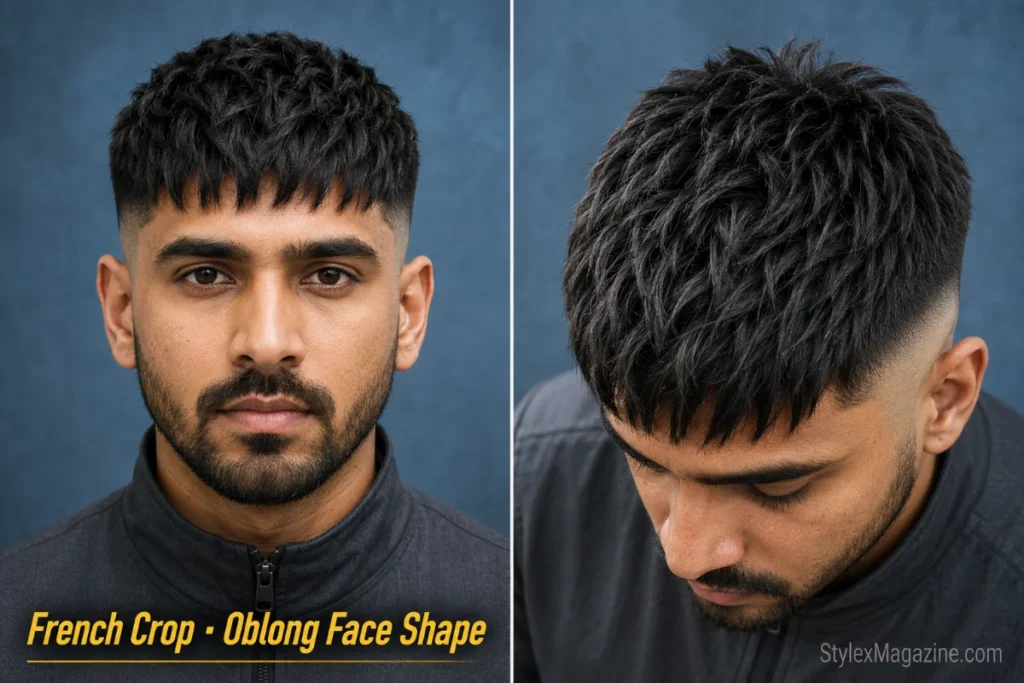
Same forehead-shortening benefit as the Caesar, with a more textured finish on the ends. Where the Caesar fringe is blunt and horizontal, the French crop is piece-y the individual sections break up the outline and add visual width at the front.
Ask for a low fade, not a skin fade. The fringe needs to be left long enough to sit forward. Use a matte paste, not gel gel flattens the texture and removes the width effect.
Hair type: Works on most textures. Wavy hair takes to this cut naturally.
Maintenance: Every 3–4 weeks.
4. Deep Side Part
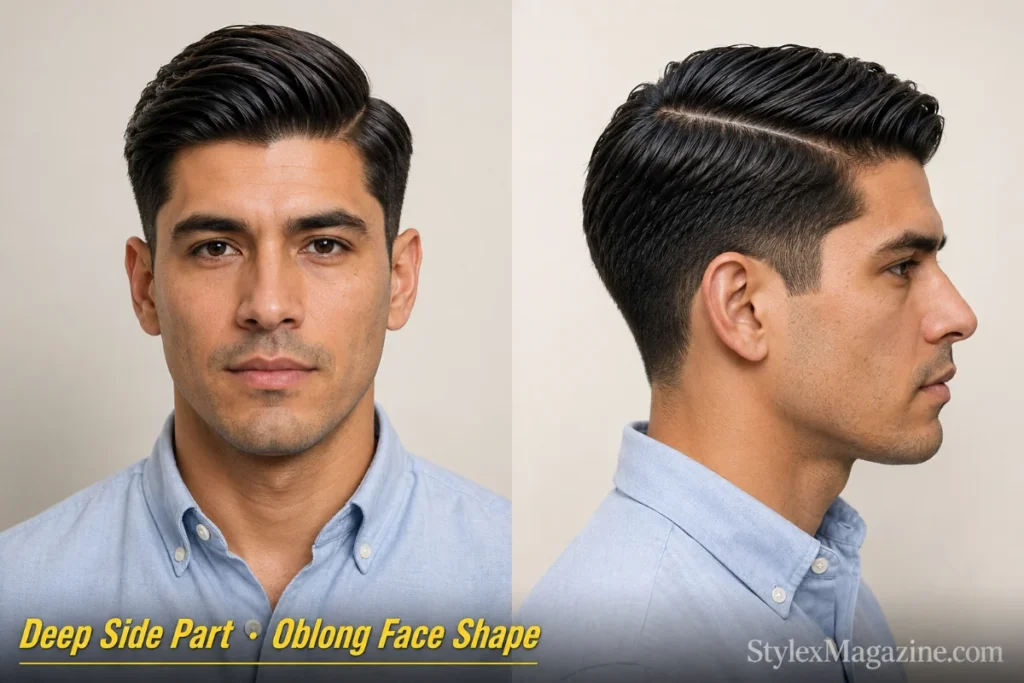
The diagonal line created by a deep side part redirects the eye across the face rather than up and down. A tapered side not a high fade keeps volume through the temples, which oblong faces need. The longer top gets directed across, never straight up.
This works particularly well in professional settings. A medium-hold pomade or cream, combed clean while damp, holds the part without flattening the sides.
Hair type: Any — straight, wavy, or lightly curly all take a side part well.
Maintenance: Every 4–6 weeks.
5. Ivy League
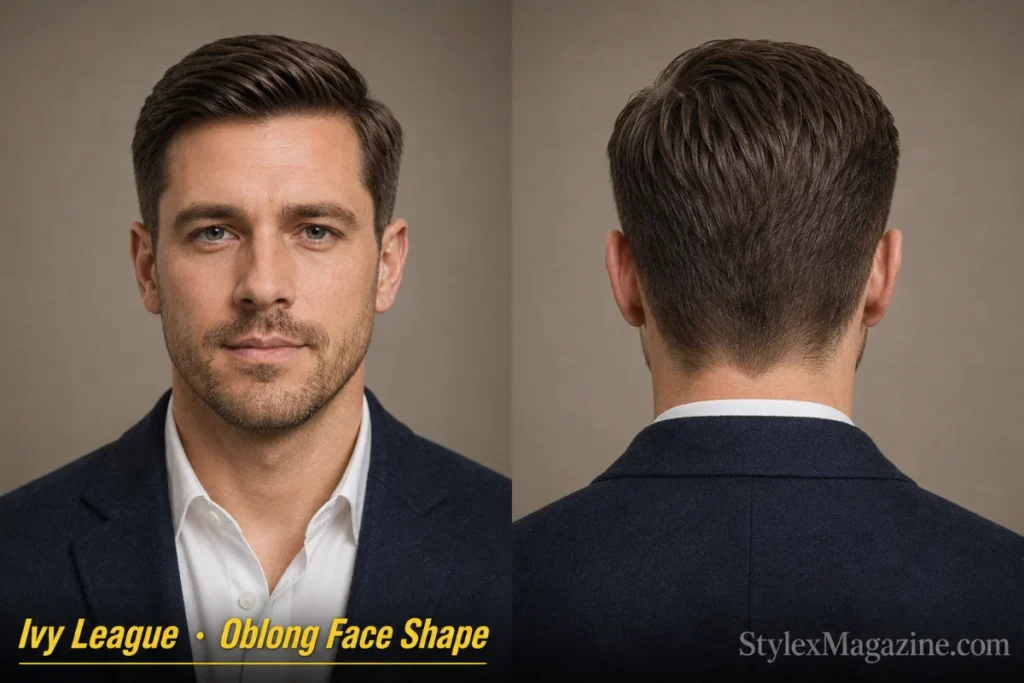
A slightly longer crew cut that lets you style the top to the side. The top sits at 2–3 inches and sweeps across, avoiding any vertical lift. Tapered sides — scissor-cut or light clipper taper — keep side presence without a hard fade line.
It grows out cleanly between cuts, works in most workplaces, and needs minimal daily product — push it to the side in the morning and it holds.
Hair type: Works on straight and wavy hair. Curly hair benefits from a longer version.
Maintenance: Every 4–5 weeks.
6. Curtain Bangs
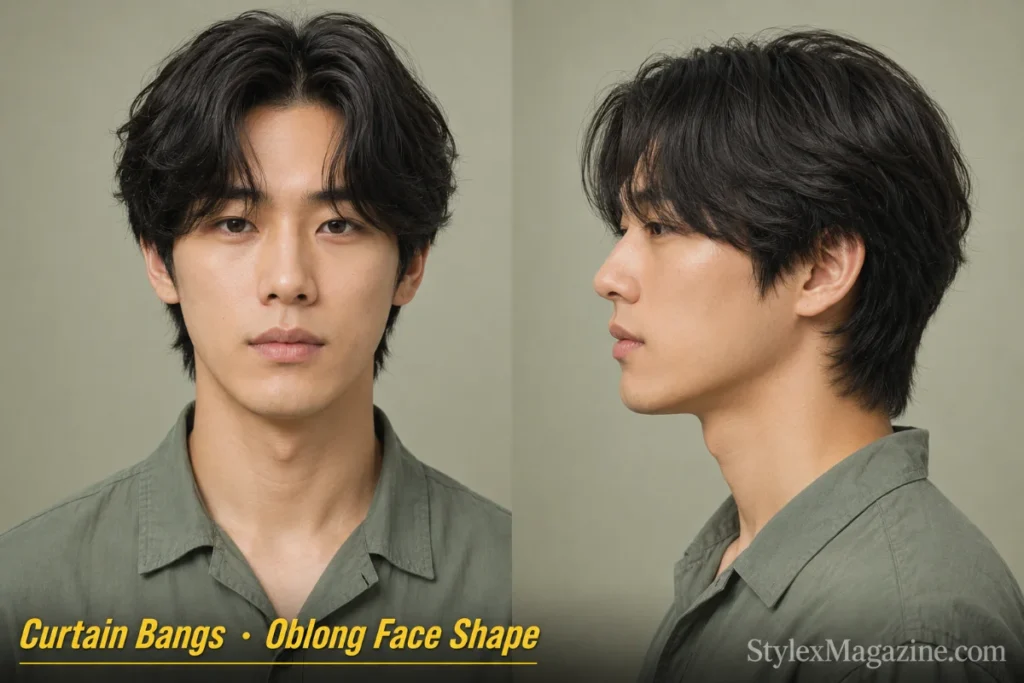
The centre-parted fringe splits outward toward each temple that outward spread is horizontal movement across the forehead, covering length while widening the mid-face. It’s one of the stronger options trending right now precisely because it solves two oblong problems at once: forehead coverage and temple width.
Keep the part soft, not a hard centre divide. The fringe should sit at eyebrow level and fall naturally rather than being pushed back. A lightweight sea salt spray or texture spray keeps the split looking natural.
Hair type: Best on wavy or lightly curly hair, which holds the split naturally. Fine straight hair needs product to stay parted.
Maintenance: Every 4–5 weeks to keep the fringe from getting too long.
7. Two-Block Cut
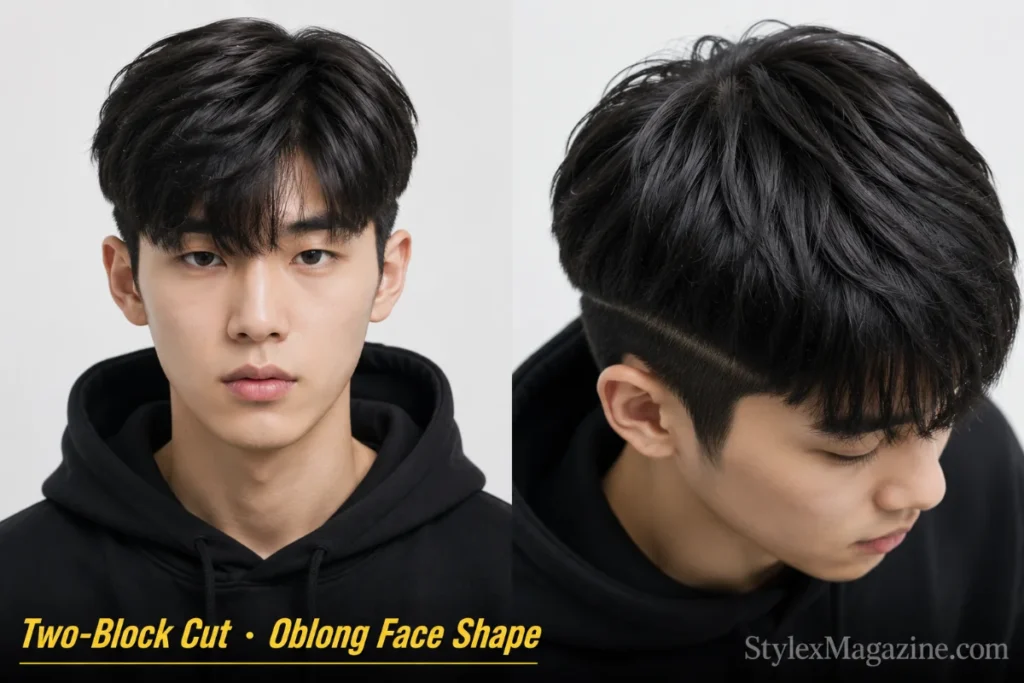
The two-block Korean-originated, now mainstream keeps the top longer and disconnects from short sides with a clean line. That contrast creates the illusion of width at the top-side boundary, pulling the eye outward rather than upward.
The block line sits roughly at the temple. Keep the sides from going too high this cut works for oblong faces precisely because the side disconnect happens lower, preserving some width through the ears.
Hair type: Works on straight and fine hair particularly well.
Maintenance: Every 3–4 weeks the clean line blurs quickly.
8. Messy Textured Medium Length
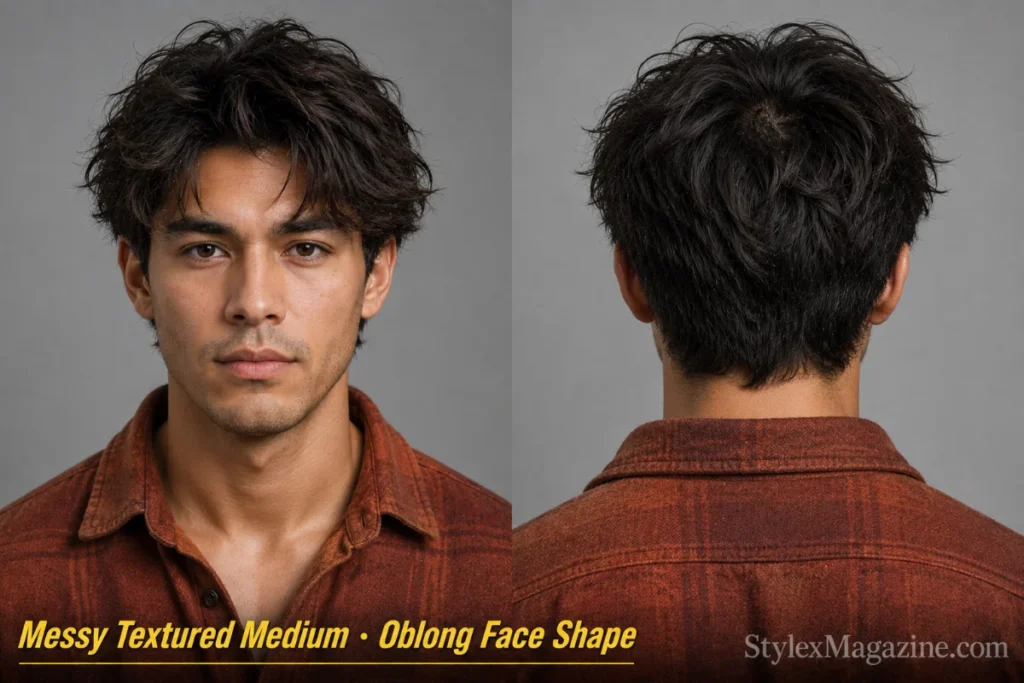
Medium length kept at 2–3 inches all over, with heavy texturizing throughout. The piece-y, undone shape moves in multiple directions — across, forward, sideways — which naturally disrupts the vertical outline that elongates an oblong face.
This is a forgiving cut. It doesn’t require a precise fringe or a specific part. Push it forward and sideways, never straight back. A matte clay or fibre product gives movable hold without stiffness.
Hair type: Works on most textures. Wavy hair often needs no product. Fine hair needs volume paste. Maintenance: Every 5–6 weeks.
9. Classic Short Back and Sides
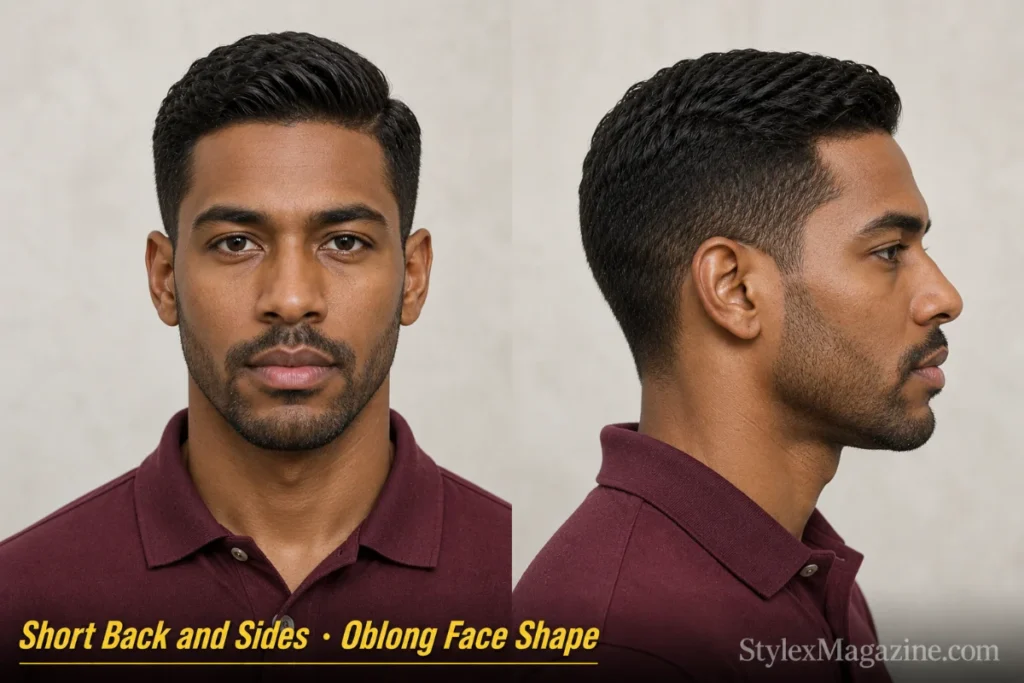
When the sides are kept at 1–2 inches rather than close-clipped, the short back and sides maintains enough width through the temples to balance an oblong face. The key word is when take the sides too short and you’re back to elongating the face.
Style the top with a side part or forward push. Avoid slicking straight back; that removes every horizontal element the cut has.
Hair type: Universal — works across all textures.
Maintenance: Every 4–5 weeks.
10. Side-Swept Fringe
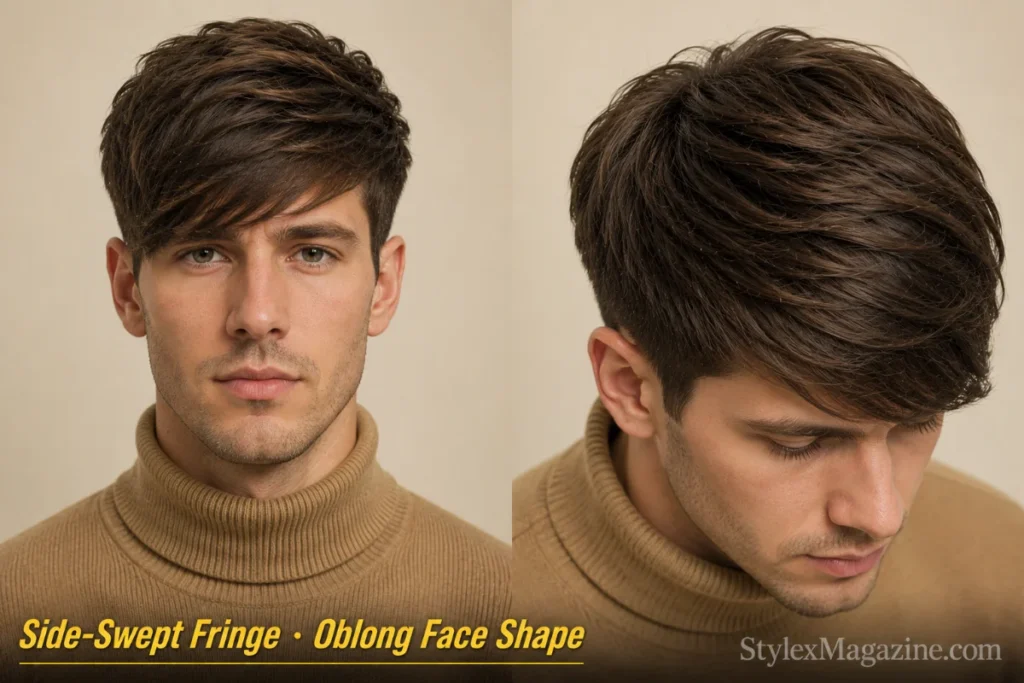
A longer fringe that sweeps across the forehead to one side. The diagonal movement breaks the vertical line more aggressively than a straight side part — the hair covers more forehead, adding width in the process. Ryan Gosling has worn this cut at its most natural.
Keep volume low on top. The sweep should happen from the front, not the crown — height from the back undoes the width effect of the fringe.
Hair type: Best on straight to wavy hair. Thick hair holds the sweep; fine hair needs a hold product. Maintenance: Every 4–5 weeks.
11. Undercut with Textured Top
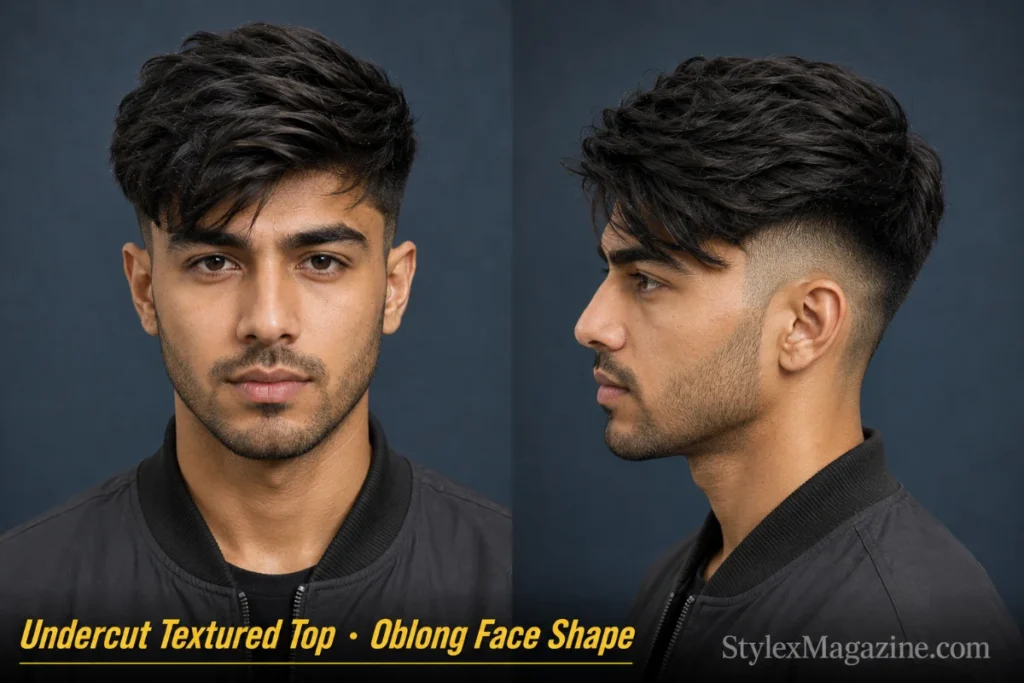
An undercut disconnects the top from the sides cleanly, which creates strong contrast and draws the eye to the textured top section. For oblong faces, this only works if the disconnect sits low around the temple not at the crown. A high undercut strips the side area that oblong faces rely on for width.
Use a medium-hold clay on the top section and work it in with your fingers, separating the texture outward rather than building it upward. The more the top spreads sideways, the more the undercut works in your favour.
Hair type: Best on medium to thick hair the top section needs enough body to stay textured.
Maintenance: Every 3–4 weeks — the disconnection line blurs fast.
12. Crew Cut (Longer Variation)
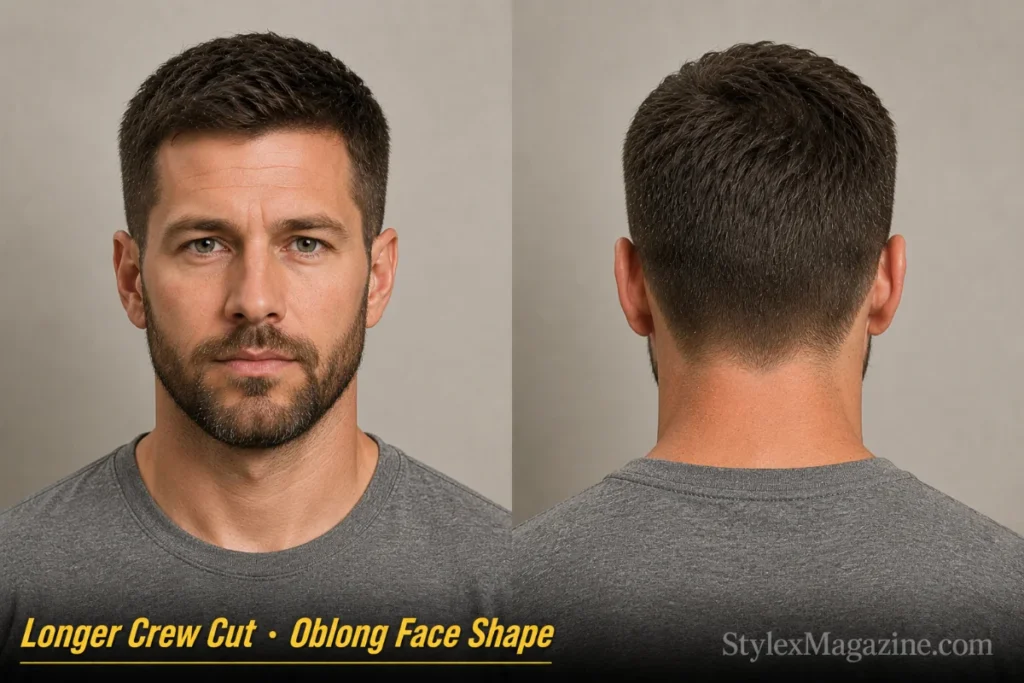
A longer crew cut 1.5–2 inches on top keeps enough hair to add some horizontal texture. Keep the sides at a minimum of 1 inch before tapering. A longer crew cut paired with a short beard does the most for oblong proportions of any close-cut option.
This is not a strong oblong cut on its own. Pair it with facial hair and it becomes significantly more balanced.
Hair type: Any texture.
Maintenance: Every 3–4 weeks to keep the taper clean.
13. Comb Over Fade
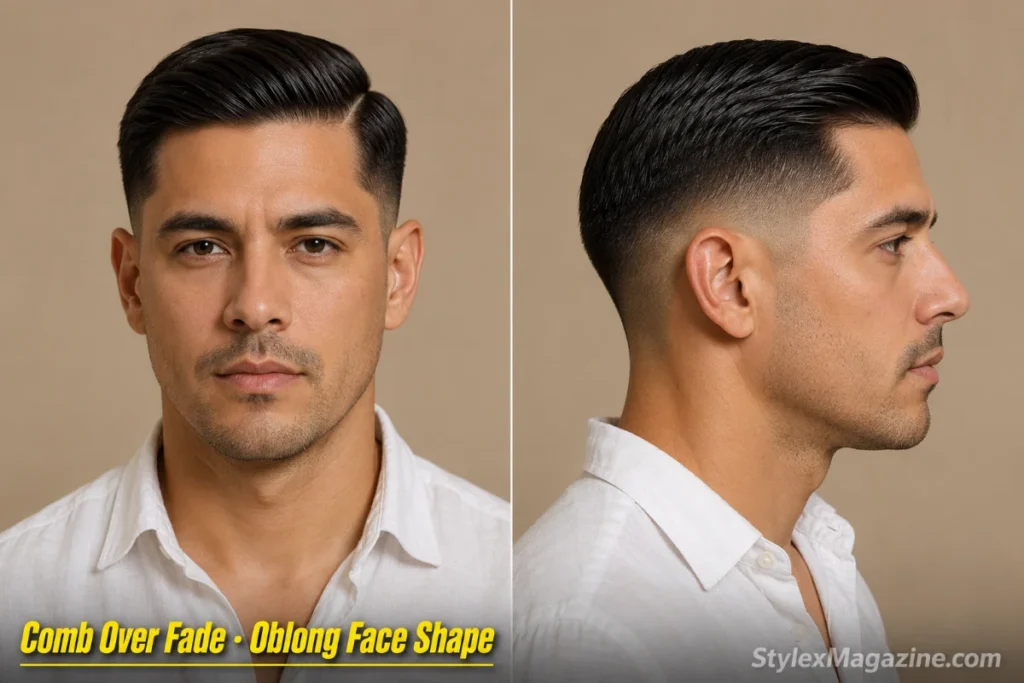
A comb over directed firmly to one side with a low fade. Where the deep side part keeps a clean divide and natural movement, the comb over sweeps harder and flatter — more deliberate, more directional. Keep the fade low, the direction flat across the crown, and avoid any product that lifts the hair upward.
The comb over haircut has variations that range from subtle to sharp — for oblong faces, the lower and flatter, the better.
Hair type: Best on straight or wavy hair with some natural weight.
Maintenance: Every 3–4 weeks.
14. Taper Fade with Textured Top
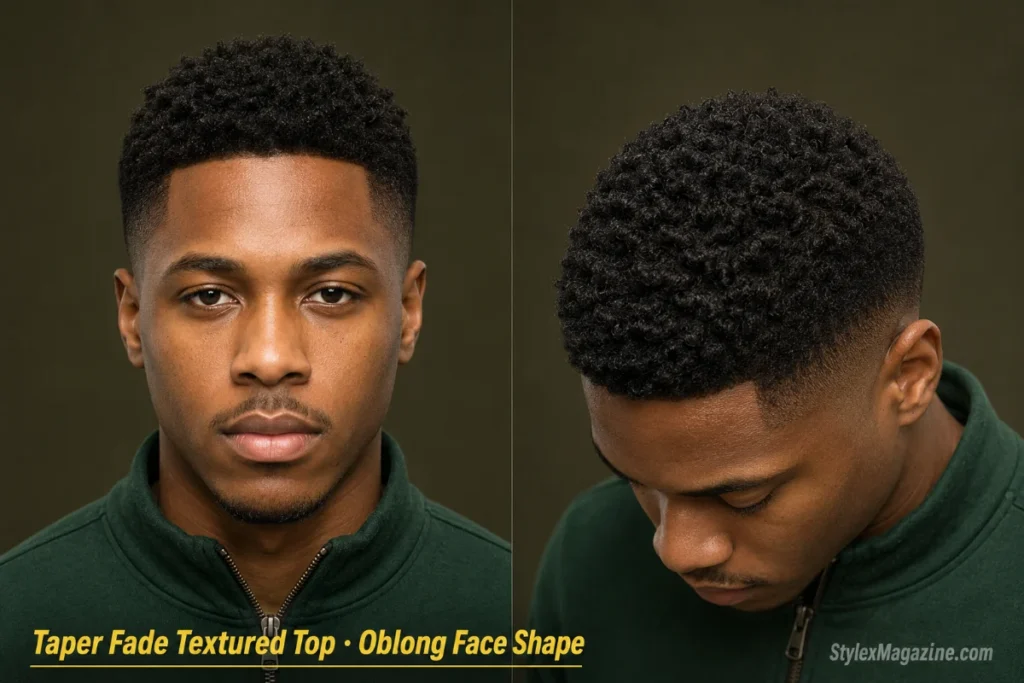
A taper which gradually shortens the sides from top to bottom rather than starting at a fixed point is more forgiving for oblong faces than a standard fade. The gradual reduction preserves more side hair, keeping width through the temples while still looking clean.
Pair with a matte paste worked into damp hair from the back forward. Starting from the back prevents the product from building height at the crown a common mistake that turns a balanced cut into one that adds length. The taper does the clean-up work on the sides without stripping the width a standard fade would remove.
Hair type: Works across textures.
Maintenance: Every 4–5 weeks.
15. Quiff (Low Volume Only)
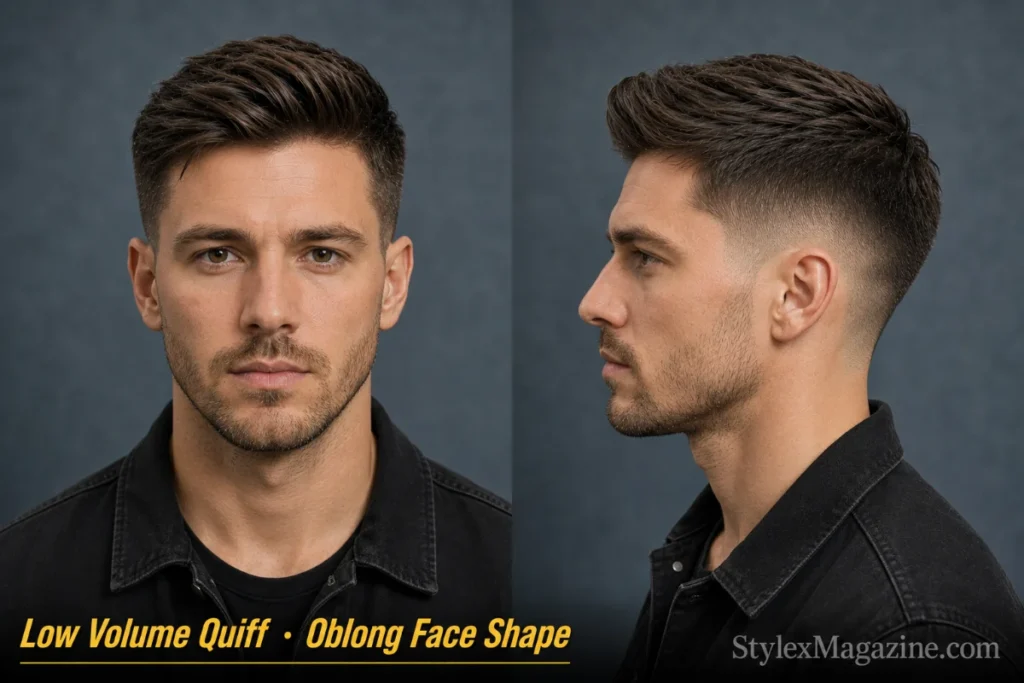
A standard quiff adds vertical height and elongates an oblong face. A low-volume quiff — where the lift is minimal and the hair flows forward and to the side rather than straight up — works differently. The key metric: styled height should not exceed 1–1.5 inches above the natural hairline.
This is the most conditional cut on the list. Get it right and it adds shape. Go 2 inches of lift and you’ve added length to a face that doesn’t need it.
Hair type: Medium to thick hair holds a low quiff without product overload. Fine hair struggles to maintain any lift without collapsing or going stiff with product.
Maintenance: Every 3–4 weeks.
16. Wavy Top with Taper
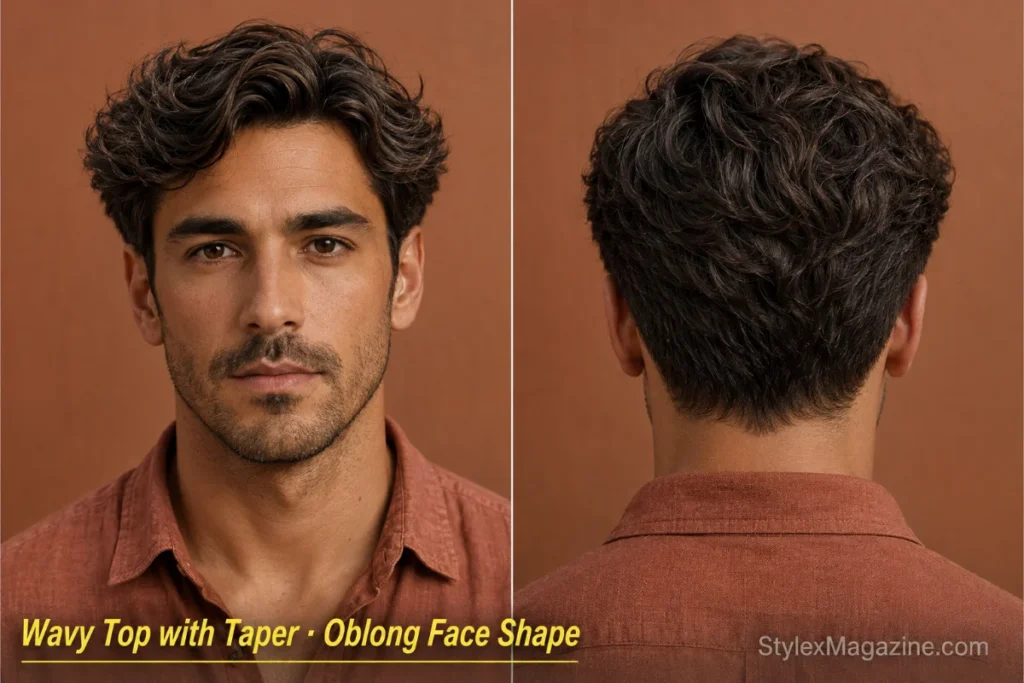
If your hair is naturally wavy or curly, it’s already working in your favour for an oblong face natural waves add horizontal spread without any effort. Let the waves grow out at 2–3 inches on top and direct them sideways. A low taper on the sides keeps the shape without stripping the width.
Curl cream or a sea salt spray enhances the natural spread. Avoid products that define individual curls upward you want the wave to move across, not stand up.
Hair type: Wavy and curly hair only. Straight hair cannot replicate this without a perm.
Maintenance: Every 5–6 weeks more forgiving shape as it grows.
17. Slick Side Part (Controlled)
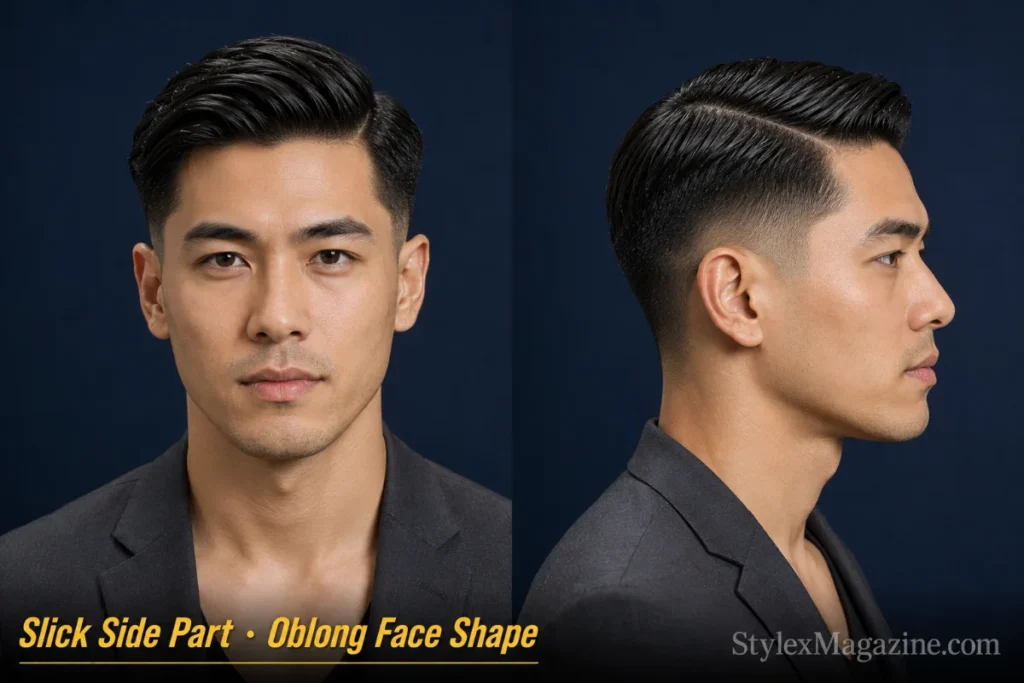
A slick side part with clean lines and a low to mid fade. The side part itself creates diagonal movement; the slick finish adds polish without lifting. The risk here is going too slick — fully slicked hair removes texture and can expose face length.
Use a medium-hold pomade, not a high-hold gel. The finish should show shine without making the hair rigid. This looks professional and suits formal settings where the textured crop is too casual.
Hair type: Straight hair only — wavy or curly hair won’t stay slick without heavy product, which defeats the purpose.
Maintenance: Every 4–5 weeks.
18. Shag Haircut
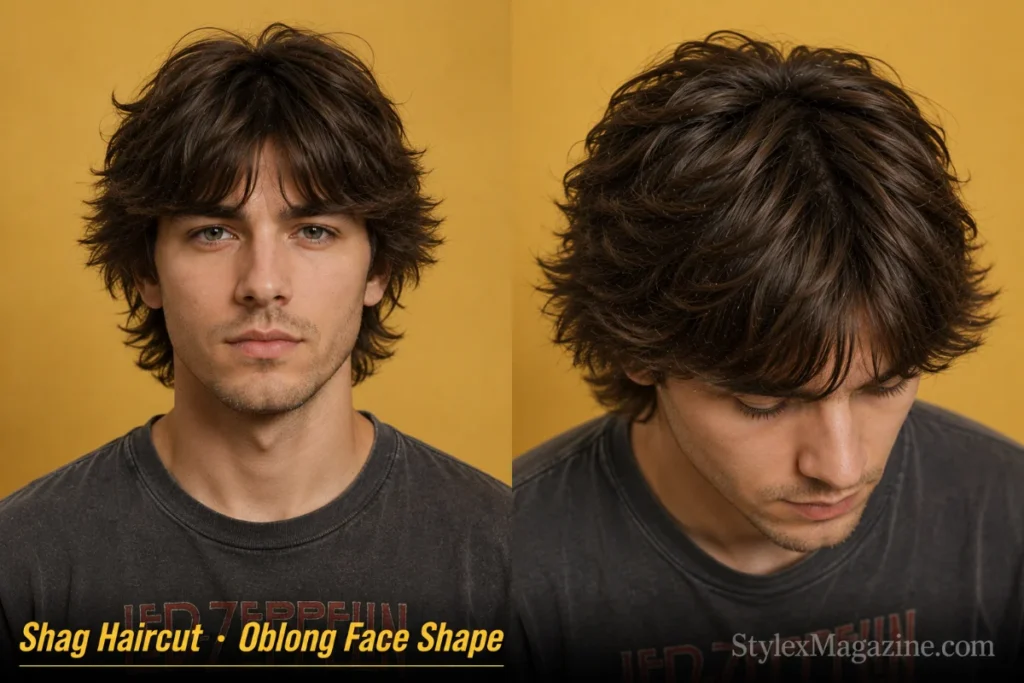
The shag brings layers and texture throughout, which adds volume in all directions — including sideways. The outward spread of layered ends at the sides and temples creates exactly the width effect oblong faces need. Layers also break up the straight vertical outline of longer oblong faces.
Keep layers starting from the mid-length — not too close to the scalp. A shag that’s too tight to the head loses the outward volume that makes it work.
Hair type: Best on wavy or curly hair, which naturally accentuates the layered shape. Works on straight thick hair with texturizing product.
Maintenance: Every 6–8 weeks — layers grow out gradually.
19. Edgar Cut
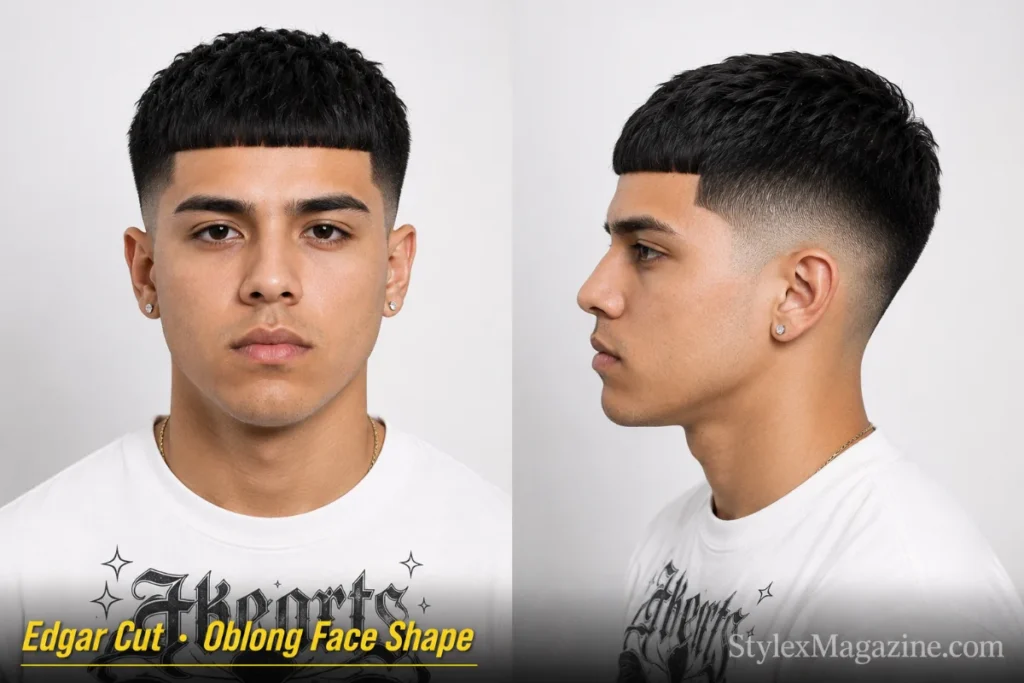
The Edgar cut features a blunt, horizontal fringe that cuts straight across at the forehead. That horizontal line is aggressive and deliberate it shortens the perceived face length more dramatically than a textured fringe. A low or mid fade on the sides keeps the overall shape balanced.
This is a bolder option than the Caesar or French crop. The blunt finish looks sharper and more defined. If the fringe goes too short above mid-forehead it stops covering length effectively and starts looking like a styling error.
Hair type: Works on straight and thick hair. Fine hair can struggle to hold the blunt edge cleanly. Maintenance: Every 3–4 weeks the blunt line defines the cut.
20. Mid-Length Layered Cut
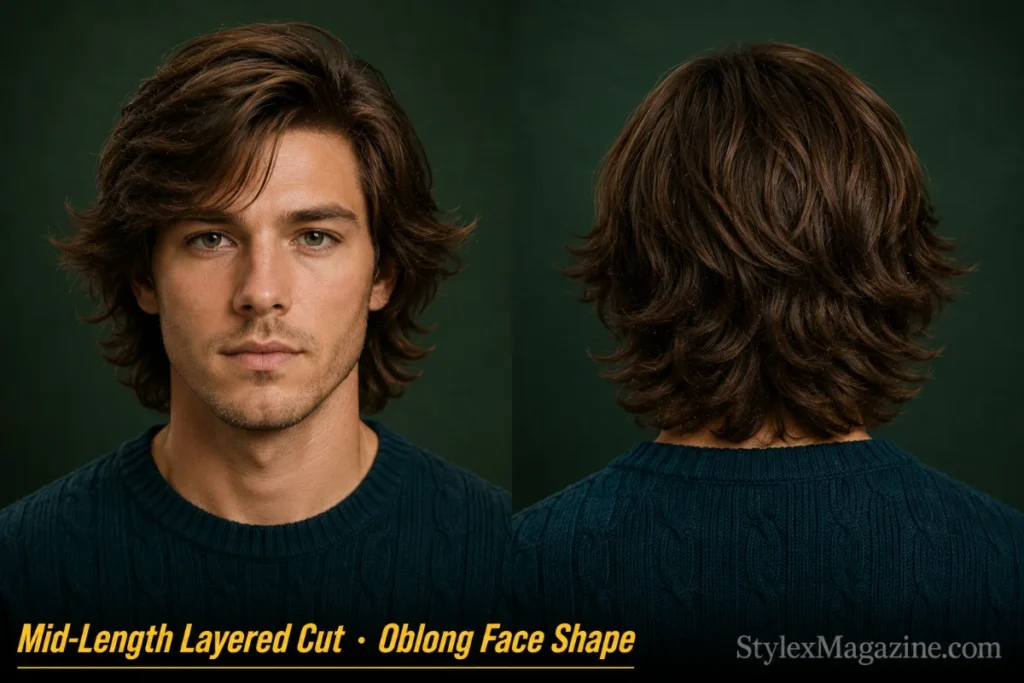
For men who want to wear hair at 3–5 inches or longer, layers are the answer for an oblong face. Layering removes weight from the lengths and lets the hair move sideways at the mid-face level — near the cheekbones — where oblong faces need the most width.
Without layers, long straight hair on an oblong face hangs down vertically and reinforces the length. With layers, the same length creates horizontal movement and frame. Avoid growing it long without layering — that is the one approach that makes an oblong face look most elongated.
Hair type: Works on all textures, but performs best on wavy or thick hair where layers hold their shape. Maintenance: Every 8–10 weeks — layers grow out slowly.
Which Fades Work for an Oblong Face — and Which Make It Worse?
Low fades work best for oblong face shapes. A low fade starts just above the ear and preserves hair through the temples, which adds width where an oblong face needs it. Mid fades are acceptable with the right top length. High fades and skin fades strip side volume and make the face read longer avoid them as a default choice.
The problem with high fades on oblong faces is mechanical, not aesthetic. When the sides are clipped close from the ear upward, there’s nothing to break the long vertical line from the top of the skull to the jaw. The eye travels straight down without interruption, which makes the face appear narrower and longer than it is.
| Fade Level | Where It Starts | Effect on Oblong Face | Verdict |
|---|---|---|---|
| Low fade | Just above the ear | Preserves temple width — adds horizontal mass | ✅ Best choice |
| Mid fade | Temple level | Acceptable — keep top moderate, avoid extra height | ⚠️ Use with care |
| High fade | 2+ inches above ear | Strips side volume, elongates the face | ❌ Avoid |
| Skin fade | Any level | Maximum exposure — worst option for oblong | ❌ Avoid |
For a full breakdown of fade types, see all fade haircuts for men. If a low fade is the direction, the low fade haircut guide covers execution in detail.
What to Tell Your Barber?
Most men walk in, say “I have a long face,” and the barber nods and does nothing different. A shape name tells the barber what you have — these phrases tell him what to do with it.
“I need weight kept on the sides — low fade, not high. Push the fringe forward, not upward. Matte finish, nothing that lifts.” — Use for: textured crop, French crop
“Short, even length with a horizontal fringe sitting at eyebrow level. Keep the sides from going tight — I need width through the temples.” — Use for: Caesar cut, Edgar cut
“Deep side part, tapered sides rather than faded. Keep volume through the temples. Medium hold, natural finish — nothing slicked back.” — Use for: side part, Ivy League, slick side part
“Two to three inches on top directed sideways. Scissor taper on the sides, not clippers. Nothing vertical on the crown.” — Use for: Ivy League, crew cut longer variation
“Curtain fringe split down the centre, falling to eyebrow level on both sides. Leave enough length for it to fall naturally — don’t cut it too short.” — Use for: curtain bangs, mid-length layered cut
What not to say: “Just make it look good” tells the barber nothing. “Something that makes my face look less long” is better — but the phrases above get you a specific result rather than a guess.
FAQ
What is the difference between an oblong and oval face shape?
Both are longer than wide, but the proportions differ. Oval faces run at roughly 1.5:1 length-to-width with gently curved sides and slightly wider cheekbones. Oblong faces sit at 1.7:1 or above with straight, parallel cheek lines. Most haircut advice for oval applies to oblong, but oblong needs more deliberate width-adding the straight sides give the face less natural visual balance.
Can an oblong face shape change over time?
Yes. Weight gain or loss affects the face first and can shift your length-to-width ratio enough to move you between shape categories. Significant jaw muscle development — from diet, chewing habits, or teeth grinding can also widen the lower face over time. If your current haircut has stopped working and it’s been over a year since you last checked your shape, your proportions may have shifted.
Does hair colour affect how an oblong face reads?
Lighter colour and highlights add visual volume and width, which works in an oblong face’s favour. Dark, flat colour with no variation tends to make the face look narrower and longer. If you colour your hair, keeping the sides slightly lighter than the top reinforces the width effect your haircut is already creating.
What if I’m between oblong and oval — which rules apply?
Borderline cases are common. If your length-to-width ratio sits between 1.5:1 and 1.7:1, the oval rules apply more loosely you have more flexibility with fade height and top length. The one principle that holds regardless of where you fall on that spectrum: avoid pulling all your hair straight back or up. That elongates both shapes equally.
Does the oblong face shape affect how hats or caps fit?
An oblong face suits wide-brimmed hats and structured caps better than narrow or tall styles — the same principle as haircuts applies. A snapback or flat-brim cap worn straight adds horizontal width at the forehead. Avoid tall hats like beanies pulled high or top hats — they add vertical height and compound the face’s length. A beanie worn low and folded sits closer to the skull and works better than one pulled up.
Conclusion
The oblong face shape has one consistent styling objective: move the eye across, not up. Every cut on this list achieves that differently some through a fringe, some through side volume, some through diagonal movement. The method matters less than the direction.
For a broader look at how face shape affects haircut choices across every shape, the guide to haircuts for face shape covers the full picture.

25 Best Short Curly Hairstyles for Men.
20 Best Haircuts for Balding Men In 2026
[…] Oblong: Noticeably longer than wide, similar forehead and jaw width. […]