
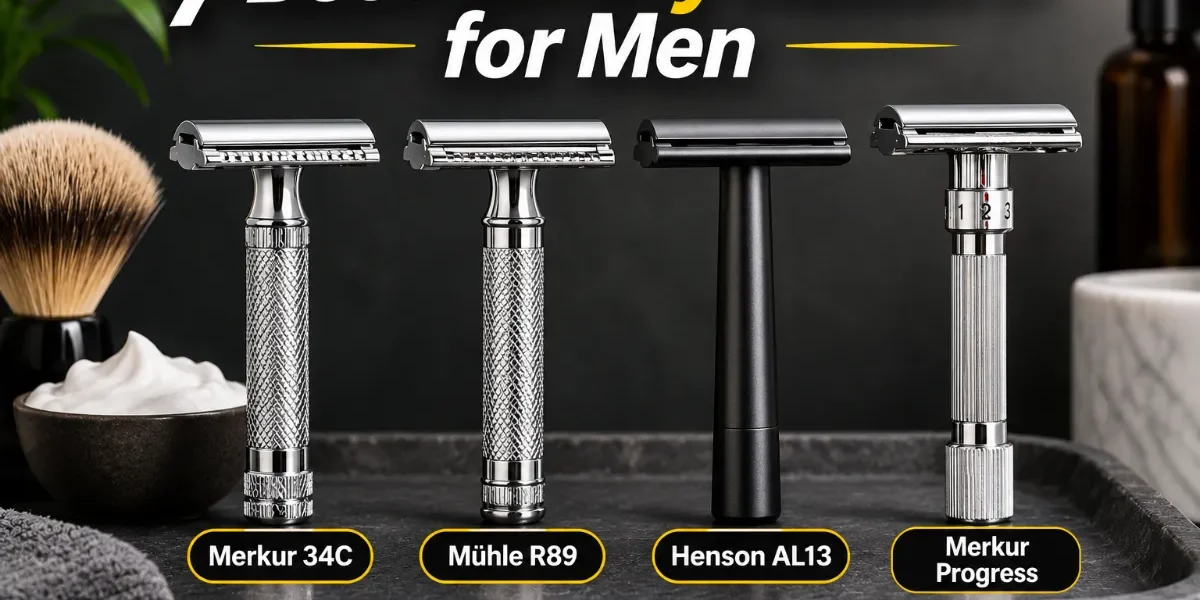

Quick answer: For most men, the Merkur 34C is the best safety razor — mild, heavy, and forgiving enough to learn on. Beginners can start even gentler with the Mühle R89, or, for sensitive and bump-prone skin, the ultra-mild Henson AL13. The Merkur Progress dials from gentle to aggressive as your skill grows, the Leaf Twig shaves at a fixed angle like a cartridge for an easy switch, the Vikings Blade Chieftain is the cheapest way in, and the Rex Ambassador is the one to buy for life. Match the razor to your skin and experience, not the price.
A safety razor uses a single blade and the weight of the handle to cut, so it gives a closer, less irritating shave than a multi-blade cartridge and costs a few cents a shave to run. The trade is a short learning curve. Pick the right razor for your skin and your beard, learn the angle, and you may never go back. Below is which razor suits whom, how to choose, which blades to pair, and how to shave without nicks — all part of the wider men’s shaving guide.
Best Safety Razors for Men at a Glance
| Razor | Best for | Comb | Aggressiveness | Loading | Handle | Price |
|---|---|---|---|---|---|---|
| Merkur 34C | Overall / most men | Closed | Mild–medium | 2-piece | Short | $ |
| Mühle R89 | Beginners, daily shave | Closed | Mild | 3-piece | Medium | $ |
| Henson AL13 | Sensitive skin, razor bumps | Closed | Very mild | 3-piece | Medium | $$ |
| Merkur Progress | Dialing in aggressiveness | Closed | Adjustable | 2-piece | Short/long | $$ |
| Vikings Blade Chieftain | Best budget / first try | Closed | Mild–medium | 1-piece (twist) | Medium | $ |
| Leaf Twig | Easiest transition (single-edge) | Closed | Mild | Twist-to-open | Long | $ |
| Rex Ambassador | Premium, buy-it-for-life | Closed | Adjustable | 2-piece | Short | $$$ |
Price: $ budget · $$ mid-range · $$$ premium. Some, like the Vikings Blade Chieftain, include a case and blades in the box.
The 7 Best Safety Razors for Men
Which safety razor is right for you?
- Nervous beginner, scared of cuts → Mühle R89 or Merkur 34C — mild and forgiving
- Sensitive skin, razor bumps or ingrowns → Henson AL13 — barely any blade exposure
- Coarse or thick beard, want efficiency → Merkur Progress on a higher setting
- Coming straight off a cartridge → Leaf Twig — fixed angle, nothing to learn
- Smallest spend, just testing it out → Vikings Blade Chieftain
- Buying once, for life → Rex Ambassador
Merkur 34C — Best Overall
Best Overall
Merkur 34C
The razor almost every wet-shaver learns on, and the yardstick the rest get measured against.
- Best for: Most skin types and beards — a safe all-rounder
- Aggressiveness: Mild–medium (~0.71 mm gap)
- Blades: Standard double-edge — universal, a few cents each
- Weight: Heavy — the weight does the cutting for you
- Build: Chrome-plated, made in Germany
- Use: Wet shave
- In the box: Razor only (blades sold separately)
Pros
- Heavy, stubby build lets the weight cut — you add no pressure
- Close enough to satisfy, forgiving enough for your first week
- German-made, runs for decades on blades that cost cents
- Knurled grip holds firm with wet, soapy hands
Cons
- Short handle feels cramped in large hands
- Two-piece head must unscrew to change blades
- Fixed — no way to dial it milder or keener
Buy it if you want the safe default — one razor that fits most faces and most beards and is hard to outgrow. Skip it if you have large hands and want a longer handle, or you already know you want an adjustable.
Mühle R89 — Best for Beginners
Best for Beginners
Mühle R89
The mildest, most forgiving razor to learn on — low blade exposure makes a serious cut hard to manage.
- Best for: Nervous beginners and daily shavers; normal skin, light-to-medium beards
- Aggressiveness: Mild (~0.45 mm gap), low blade exposure
- Blades: Standard double-edge — universal, a few cents each
- Weight: Medium — well balanced
- Build: Chrome-plated metal, made in Germany
- Use: Wet shave
- In the box: Usually razor only — check listing
Pros
- Small gap and low exposure make it very hard to cut yourself
- Three-piece head holds the blade dead rigid
- Standard-length (~93 mm) handle, a good reference point
- Shares its head design with the much-loved Edwin Jagger DE89
Cons
- Too mild for three or more days of dense growth
- Needs a sharper blade (such as Feather) for more bite
- Chrome-over-zinc, not solid stainless
Buy it if you are nervous about cutting yourself and want the gentlest possible start. Skip it if you have a thick, coarse beard or want a close shave on several days’ growth.
Henson AL13 — Best for Sensitive Skin & Razor Bumps
Best for Sensitive Skin
Henson AL13
Engineered to leave almost no blade exposed, so it cuts close with the least room to irritate skin that reacts.
- Best for: Sensitive skin, razor bumps and ingrowns; coarse or curly hair
- Aggressiveness: Very mild — extremely low blade exposure (Mild version)
- Blades: Standard double-edge — universal, a few cents each
- Weight: Light — aluminum, takes a shave or two to adjust
- Build: 6061 aircraft-grade aluminum, machined in Canada
- Use: Wet shave
- In the box: Razor + 5 blades
Pros
- Minimal blade exposure beats razor bumps and ingrowns
- Ideal for coarse or curly hair that other razors irritate
- Aircraft-grade aluminum, machined to tight tolerances in Canada
- Comes in Mild and Medium — start on Mild
Cons
- Feather-light — unlearning pressure takes a shave or two
- Too mild on Mild for heavy multi-day growth
- Costs more than a classic steel-and-zinc DE
Buy it if your skin flares into bumps and ingrowns, or you have coarse, curly hair. Skip it if you want a heavy razor or the closest possible shave on thick growth.
Merkur Progress — Best Adjustable
Best Adjustable
Merkur Progress
A dial on the base changes the blade gap, so one razor runs gentle on day-one stubble and keen on three-day growth.
- Best for: Men who want one razor for every beard length and their growing skill
- Aggressiveness: Adjustable dial — mild on low settings, aggressive on high
- Blades: Standard double-edge — universal, a few cents each
- Weight: Medium-heavy
- Build: Chrome-plated metal, made in Germany
- Use: Wet shave
- In the box: Usually razor only — check listing
Pros
- One dial covers light stubble to several days of growth
- Beginner-safe on low settings, with room to grow
- Short (500) and long (510) handle versions
- The adjustable most wet-shavers recommend first
Cons
- Dearer than a fixed Merkur
- The dial adds parts to rinse and dry
- Bulkier head than a plain 34C
Buy it if you want a single razor that adapts to any beard and your improving technique. Skip it if you prefer the simplicity of a fixed razor or want solid stainless at this price.
Vikings Blade Chieftain
Best Budget
Vikings Blade Chieftain
A twist of the base opens the butterfly doors — the easiest razor here to load, and the cheapest to buy.
- Best for: First-timers on the smallest budget; normal skin, light-to-medium beards
- Aggressiveness: Mild–medium, closed comb — forgiving for beginners
- Blades: Standard double-edge — universal, a few cents each
- Weight: Medium-heavy — brass core gives it real heft
- Build: Chrome-plated brass core
- Use: Wet shave
- In the box: Razor + travel case + 5 blades
Pros
- Butterfly twist-to-open — drop a blade in, no unscrewing
- Ships with a travel case and five blades, ready to shave
- Brass core gives real weight for the price
- Mild–medium closed comb forgives beginner technique
Cons
- Chrome finish can wear over years of use
- Lacks the refinement and tolerances of Merkur or Mühle
- Butterfly doors hold the blade less rigidly than a three-piece
Buy it if you want the lowest-cost, ready-to-shave way to try wet shaving. Skip it if you want heirloom build quality or plan to shave a heavy coarse beard daily.
Leaf Twig — Best Single-Edge & Easiest Transition
Easiest Transition
Leaf Twig
A fixed blade angle means you glide it down your face like a cartridge — there is no angle to get wrong.
- Best for: Men switching straight from a cartridge; most skin types
- Aggressiveness: Mild — single blade at a fixed ~30° angle
- Blades: Single-edge — snap a cheap DE blade in half, nothing proprietary
- Weight: Medium
- Build: Chrome-plated metal
- Use: Wet or dry
- In the box: Razor + starter blades
Pros
- Fixed ~30° angle removes the main beginner hurdle
- Twist-to-open head swaps blades fast
- Uses cheap single-edge blades — snap a DE blade in half, nothing locked in
- The gentlest bridge from a multi-blade cartridge
Cons
- A single edge cuts less close than a true double-edge pass
- Less control over angle than a DE razor
- Single-edge feel differs from a standard DE
Buy it if you are coming straight off a cartridge and want zero learning curve. Skip it if you want the closest shave or the full control of a double-edge razor.
Rex Ambassador — Best Premium, Buy-It-For-Life
Best Premium
Rex Ambassador
Solid stainless with a lifetime guarantee and an adjustment range wider than almost anything else — a buy-once razor.
- Best for: Committed wet-shavers buying once for life; any beard via the dial
- Aggressiveness: Adjustable — wide range, mild to aggressive
- Blades: Standard double-edge — universal, a few cents each
- Weight: Heavy — solid stainless steel
- Build: Solid stainless steel, made in USA, lifetime guarantee
- Use: Wet shave
- In the box: Usually razor only — check listing
Pros
- Machined from solid stainless in the USA, lifetime guarantee
- Wide adjustable range covers gentle to very close
- Low-profile head reaches under the nose and along a beard line
- Heavy, knurled handle with a tactile, premium feel
Cons
- Expensive — far more than a capable beginner razor
- Heavy — a different feel if you are used to light razors
- Often back-ordered because demand outstrips supply
Buy it if you are committed to wet shaving and want a precision razor to keep for decades. Skip it if you are a beginner or unsure wet shaving is for you — start cheaper.
Safety Razor vs Cartridge Razor
The appeal of a single blade is not nostalgia — it is the shave and the running cost.
- Less irritation. A cartridge’s “lift and cut” tugs each hair below the skin, the main cause of razor bumps and ingrowns. A single blade cuts once, at the surface, so sensitive and bump-prone skin usually reacts less.
- Far cheaper over time. Double-edge blades cost a few cents to a quarter each; cartridges run several dollars. The razor pays for itself inside a year or two.
- Less waste. An all-metal razor and thin steel blades, with little or no plastic.
- The catch — a learning curve. You unlearn cartridge habits: no pressure, a set angle, shorter strokes. Most men have it down within a week.
If you would rather keep things simple, an electric shaver is the lower-maintenance route, and the best electric razor for men sorts those by beard and skin.
How to Choose a Safety Razor?
The best safety razor for men is the one matched to your skin and your experience, not the one with the widest blade gap. Six things decide the fit.
- Aggressiveness (blade gap and exposure). The bigger the gap between blade and guard, the more aggressive — closer, but less forgiving. Beginners want mild (small gap, low exposure); hardy skin and coarse beards can handle more. Adjustables let you change this on the fly.
- Closed comb vs open comb. A closed comb has a solid safety bar and suits most men and all beginners. An open comb — teeth that feed more hair and lather through — shaves longer or coarser growth more aggressively, and is better left until your technique is solid.
- Double-edge vs single-edge. Double-edge (DE) is the standard, with the widest blade choice. Single-edge (SE), like the Leaf Twig, is often pre-angled and easier to learn, but with fewer blade options.
- Blade loading. Two-piece and three-piece razors unscrew to swap blades and hold them rigidly; butterfly (twist-to-open) heads are the quickest to reload and the friendliest for beginners.
- Handle length and material. Short handles give control around the face; long handles suit big hands, head shaving, and anyone used to a cartridge. Stainless steel lasts a lifetime, brass is traditional and durable, aluminum is light, and zinc is cheaper but wears sooner.
- Adjustable or fixed. A fixed razor is simpler and cheaper; an adjustable lets one razor run mild one day and keen the next, which is useful if your beard or your confidence changes over time.
Choosing Your Blades
The blade matters as much as the razor — the same razor feels sharp with one brand and mild with another. Feather blades are the sharpest (ideal for coarse beards, punishing for sensitive skin), Astra Superior Platinum is a smooth all-rounder, and Derby and Gillette Silver Blue sit on the milder side. Buy a blade sampler of several brands, run each for about a week, and find the one your skin, water, and lather like best — then buy that one in bulk.
If your skin flares into razor bumps afterward, a milder blade and a with-the-grain-only pass usually settle it — the American Academy of Dermatology recommends shaving in the direction of hair growth with a sharp blade to keep them down, and how to get rid of razor burn covers calming the skin and stopping the next round. Source: American Academy of Dermatology
How to Use a Safety Razor?
- Prep. Shave after a shower, or hold a warm, damp towel to your face, then work in a cushioning lather — the best shaving creams make the first safety-razor shaves far easier.
- Set the angle. Rest the head flat against your cheek, then tilt the handle down until the blade sits about 30° to the skin. That angle, not pressure, is what cuts.
- No pressure. Let the razor’s weight do the work. Use short strokes, going with the grain first.
- Stretch and rinse. Stretch the skin on the neck and chin, rinse the blade every stroke or two, and turn your head to reach under the nose with the short end of the handle.
- Finish. Rinse with cold water and apply an alcohol-free balm — the best aftershave for men breaks down the balms and splashes that calm skin without stinging. Change the blade every five to seven shaves.
FAQ
What is the best safety razor for beginners?
A mild, forgiving razor like the Mühle R89 or Merkur 34C, or the very gentle Henson AL13. All three are hard to cut yourself with while you learn the angle and pressure. Start on a short-to-standard handle and a smooth blade rather than the sharpest one.
Why is it called a safety razor?
The guard or comb between the blade and your skin limits how much edge is exposed, which made it far safer than the open straight (“cut-throat”) razor it replaced. You still get a single-blade shave, with much less risk of a deep cut.
What safety razor gives the closest shave?
An aggressive or adjustable razor on a high setting, paired with a sharp blade and good technique. Closeness comes from the blade and your angle as much as from the razor itself, so a keen blade in a mild razor often beats a dull one in an aggressive head.
What is the best safety razor for sensitive skin or coarse, curly hair?
A mild, low-exposure razor such as the Henson AL13, used with a sharp-but-smooth blade and with-the-grain passes. The single blade is what stops the razor bumps that multi-blade cartridges cause by tugging each hair below the skin.
How many shaves does a safety razor blade last?
About five to seven shaves. Replace it once it starts to tug — a dull blade causes far more irritation than a sharp one.
Can you take a safety razor on a plane?
Under TSA rules, a safety razor can go in your carry-on only with the blade removed; the razor with a blade loaded, and loose double-edge blades, must travel in checked baggage. Pack blades in your checked bag or buy them at your destination. Source: TSA

Other Articles

40 Best Teen Boy Haircuts for 2026 — Every Hair Type & Face
How to Get Rid of Razor Burn (and Stop It Coming Back)



[…] razor: a single blade gives the closest shave for the lowest running cost, and choosing the best safety razor comes down to the handle’s aggression and how well your skin takes a close […]
[…] reacts easily, a single-blade razor cuts less aggressively than a multi-blade cartridge, and the best safety razor comes down to how mild you need […]
[…] a little closeness for far fewer nicks and a much faster shave. If closeness is non-negotiable, a safety razor still […]