
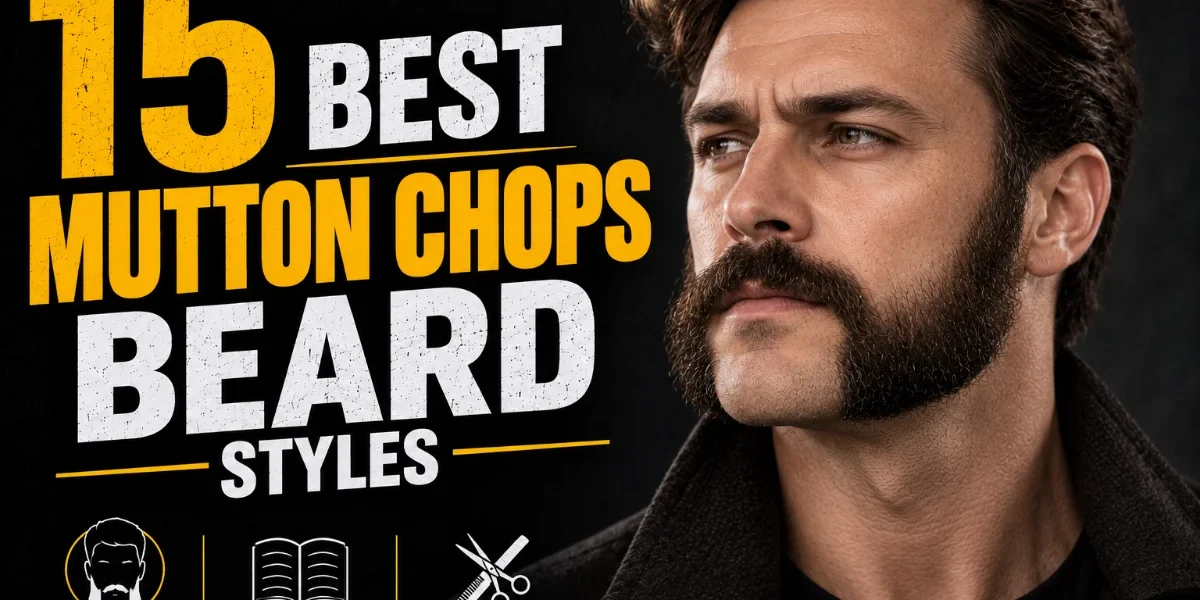

Quick Answer: Mutton chops are thick sideburns that extend down the cheeks while the chin stays clean-shaven. The classic version has no mustache. The friendly version connects to a mustache. The chin is always bare. These 15 variations cover every width, length, and combination worth wearing, matched to face shape, with the barber script for each.
Mutton chops are back in barbershop requests for the first time in years. Hugh Jackman’s Wolverine made them a pop culture fixture. Elvis Presley turned them into rock and roll identity. John Lennon wore them through the Beatles’ final era. The style dates back to the 1800s Victorian era, when Union general Ambrose Burnside wore his sideburns so prominently that his name, reversed, gave us the word “sideburns.” Two centuries later, the structure is the same: heavy facial hair on the cheeks, nothing on the chin.
In my experience, men who ask for mutton chops in the chair fall into two groups. Half want the full Wolverine statement piece. The other half want something subtler that carries the same jawline-framing effect without turning heads at the office. Both are on this page.
What Is a Mutton Chops Beard?
Mutton chops are extended sideburns that grow down the cheeks and jawline while the chin stays completely clean-shaven. The name comes from the resemblance to a cut of mutton (sheep meat) that includes rib and backbone. The facial hair mirrors that shape on each side of the face.
Classic vs friendly: Classic mutton chops have no mustache. Friendly mutton chops connect the sideburns to a mustache, creating a horseshoe frame around the mouth with the chin still bare. Both keep the chin shaved. That clean chin is what separates mutton chops from a full beard or a chin curtain.
Mutton chops vs chin curtain vs sideburns: Standard sideburns stop at the earlobe. Mutton chops extend well past the earlobe down the jawline. A chin curtain covers the chin from ear to ear without a mustache. Mutton chops skip the chin entirely. For the full range of no-mustache styles, see beard styles without mustache.
What Are the Best Mutton Chops Beard Styles?
Every style below includes width, length, face shape match, and the barber script. The order runs from classic to modern to combination styles.
1. Classic Mutton Chops
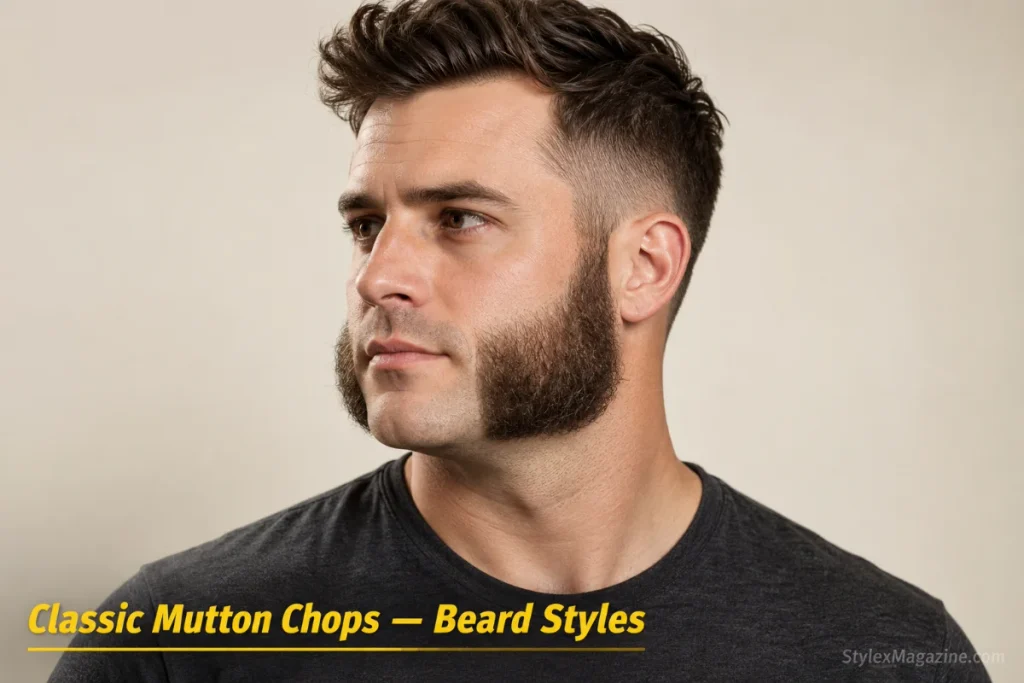
Celebrity: Ambrose Burnside (the original) | Width: 2-3 inches | Length: Guard 4-6
Thick sideburns extending from the temples down to the jaw corners, chin and lip shaved clean. The starting point for every variation on this list. Moderate width, moderate length, no mustache. The clean chin creates a high-contrast frame that draws the eye to the cheekbones and jawline.
Best for: Oval, square, and oblong face shapes.
Tell your barber: “Classic mutton chops, about 2 inches wide, no mustache, chin and neck shaved clean.”
Maintenance: Shave chin every 2-3 days. Trim chops weekly.
2. Friendly Mutton Chops
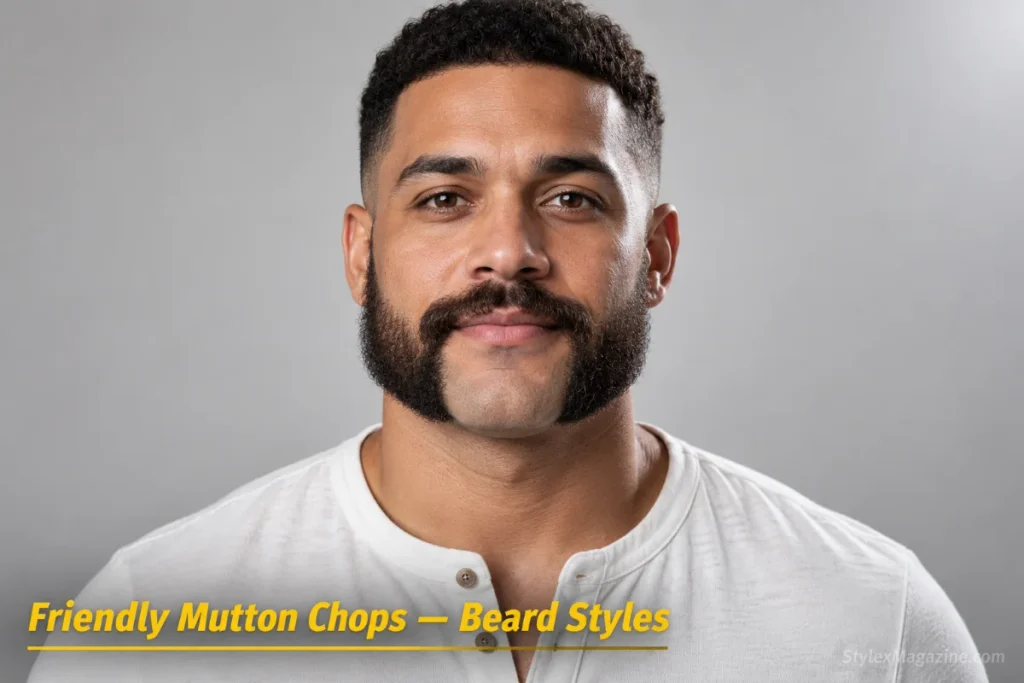
Celebrity: Lemmy Kilmister | Width: 2-3 inches | Length: Guard 4-6
Classic chops connected to a mustache, creating a horseshoe frame around the mouth while the chin stays bare. The most popular variation because the mustache softens the boldness. The connection point at each mouth corner needs careful edging to look intentional rather than overgrown.
Best for: Oval and round face shapes. Men who want chops with less intensity.
Tell your barber: “Friendly mutton chops, connected to the mustache, chin clean, horseshoe shape.”
Maintenance: Shave chin every 2-3 days. Edge the mustache connection weekly.
3. Short Mutton Chops
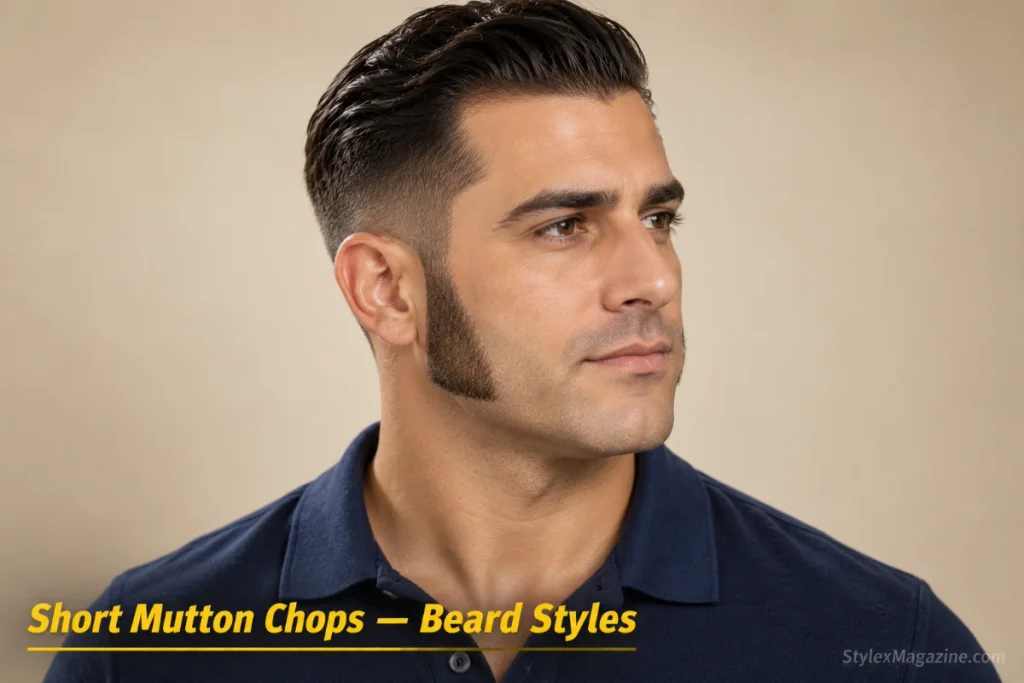
Styling tip: Best entry point for beginners | Width: 1.5-2 inches | Length: Guard 2-3
The classic shape at conservative length, approximately 1 inch. Sharp edges, tight length, zero bulk. This is the version that works in offices, interviews, and conservative settings where full-width chops would be too bold. Short chops need more frequent trimming because regrowth shows faster at this length.
Best for: All face shapes. Professional settings. First-time mutton chop wearers.
Tell your barber: “Short mutton chops, guard 3, clean edges, chin shaved, keep it neat.”
Maintenance: Trim every 4-5 days. Chin shave every 2-3 days.
4. Thick Mutton Chops
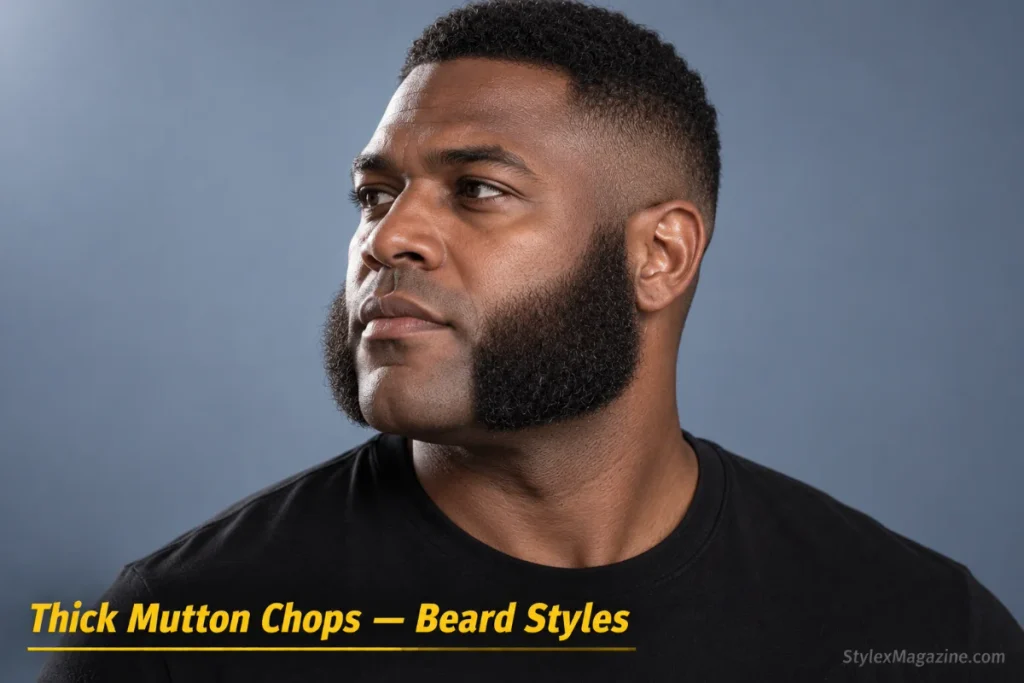
Hair type: Dense growth required | Width: 3-4 inches | Length: Guard 5-8
Maximum density and width. The thick version fills the entire cheek from sideburn to jaw corner with dense, full coverage. This demands naturally heavy growth. Patchy cheeks at this width look unfinished. Thinning scissors every few weeks prevent the chops from looking like a solid block.
Best for: Square and oblong face shapes. Men with dense cheek growth.
Tell your barber: “Thick mutton chops, full density, thin out the bulk, chin clean.”
Maintenance: Barber every 2-3 weeks for thinning. Chin shave every 2-3 days.
5. Bushy / Wild Mutton Chops
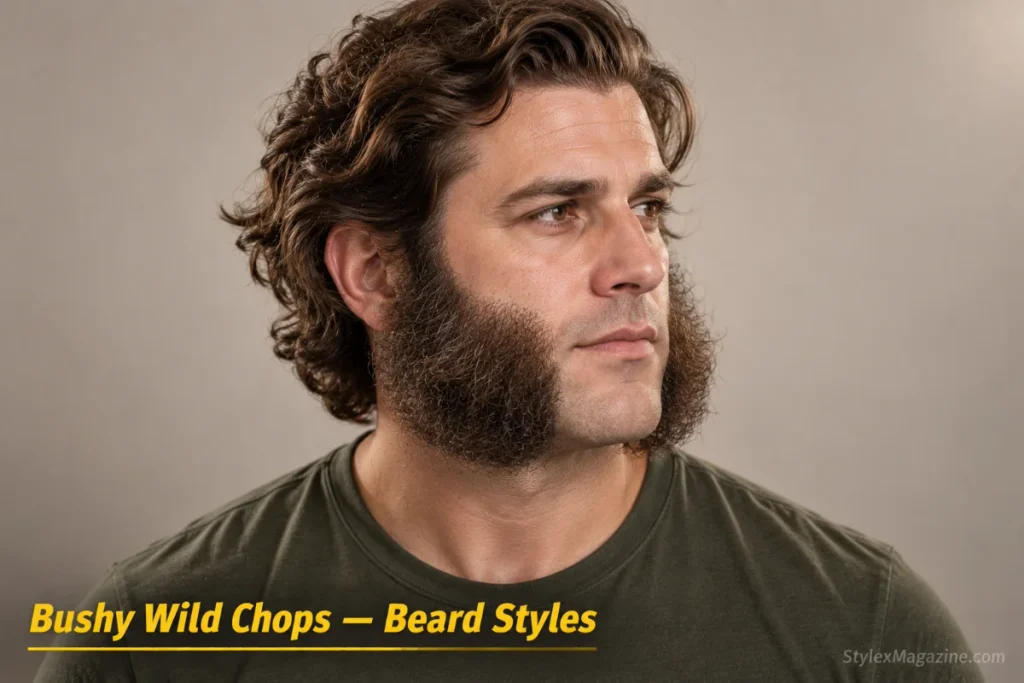
Styling tip: Controlled neglect, not actual neglect | Width: 3-5 inches | Length: Grown out, minimal trimming
Untamed, voluminous chops with natural texture and rough edges. The John Lennon version. Let the sideburns grow freely within the basic shape. The edges stay trimmed enough to show a clear boundary between chops and clean skin, but the body stays wild. Comb daily to prevent matting. Oil to prevent dryness.
Best for: Oval and angular face shapes. Creative/casual settings.
Tell your barber: “Bushy mutton chops, keep the shape but leave the texture wild, chin clean.”
Maintenance: Oil daily. Comb daily. Chin shave every 2-3 days. Shape edges monthly.
6. Wolverine Style
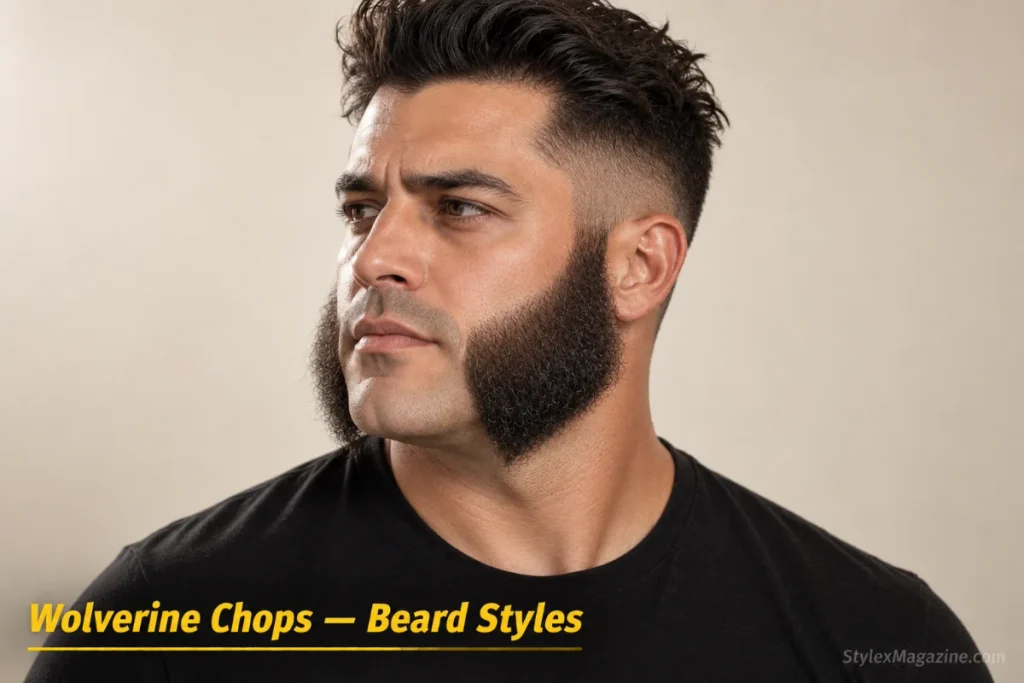
Celebrity: Hugh Jackman | Width: 4-5 inches | Length: Grown out
Thick, exaggerated chops that extend wide and long, often pointed toward the chin area without covering it. The statement piece. Hugh Jackman wore these across a decade of X-Men films. The chops reach their widest point at the mid-cheek, then taper toward the jaw. The chin stays bare. This is the highest-commitment version on this page.
Best for: Square and angular face shapes. Strong builds. Men comfortable with attention.
Tell your barber: “Wolverine mutton chops, full width, pointed toward the jaw, wild but shaped, chin bare.”
Maintenance: Barber every 2-3 weeks. Daily oil and comb. Chin shave every 2 days.
7. Thin Mutton Chops
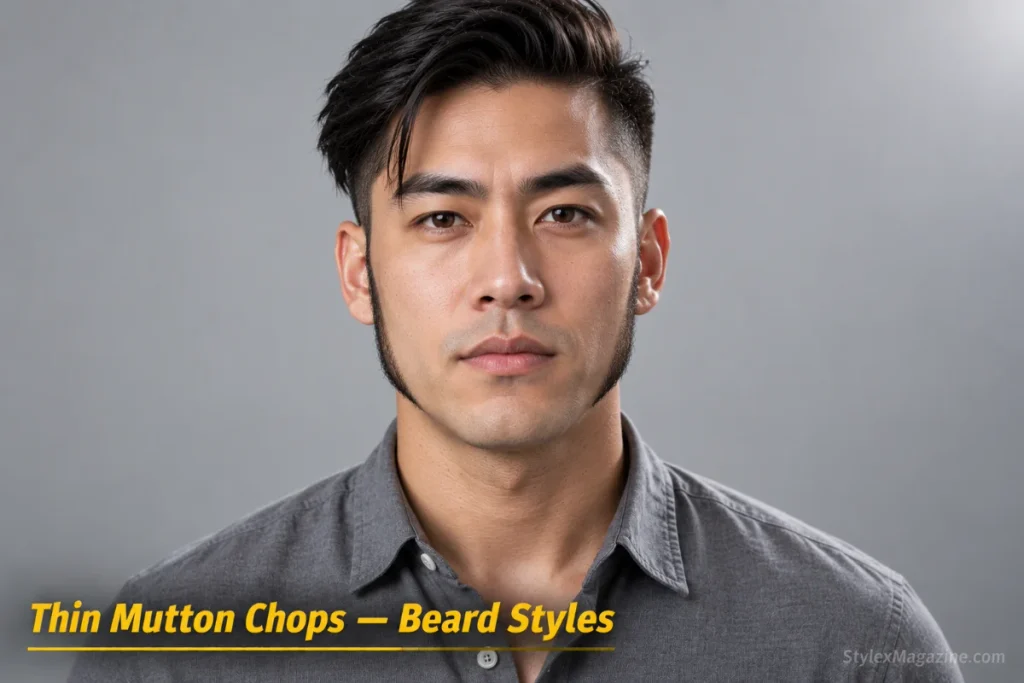
Styling tip: Precision trimming every 3-4 days | Width: 0.5-1 inch | Length: Guard 2-4
Narrow sideburns with defined edges, more about the line than the volume. The thinnest version that still identifies as mutton chops rather than standard sideburns. The narrow width suits men with smaller facial features or those who want the jawline framing without the bulk. Every millimeter of width matters at this scale, so asymmetry shows immediately.
Best for: Oval and diamond face shapes. Smaller facial features. Conservative settings.
Tell your barber: “Thin mutton chops, about an inch wide, precise edges, chin clean.”
Maintenance: Re-edge every 3-4 days. High precision required.
8. Stubble Mutton Chops
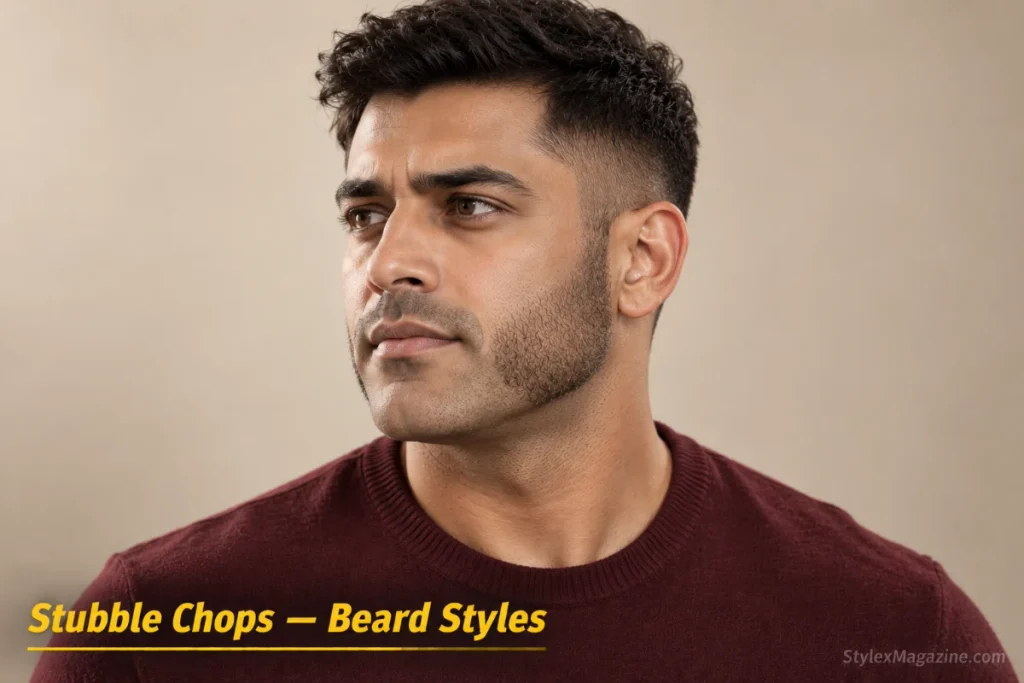
Styling tip: The test-drive version | Width: 2-3 inches | Length: Guard 0.5-1 (2-4mm)
The full mutton chop layout at heavy stubble length with slightly softer edges. Lowest commitment, lowest risk. The stubble texture disguises thin spots and makes the style feel casual rather than committed. Grow everything for two weeks, then shape the chops out of what you have. If you like the shape at stubble, let it grow.
Best for: All face shapes. Men testing mutton chops for the first time.
Tell your barber: “Stubble mutton chops, guard 1, soft edges, chin shaved.”
Maintenance: Trimmer every 3-4 days. Chin shave every 2-3 days.
9. Tapered Mutton Chops
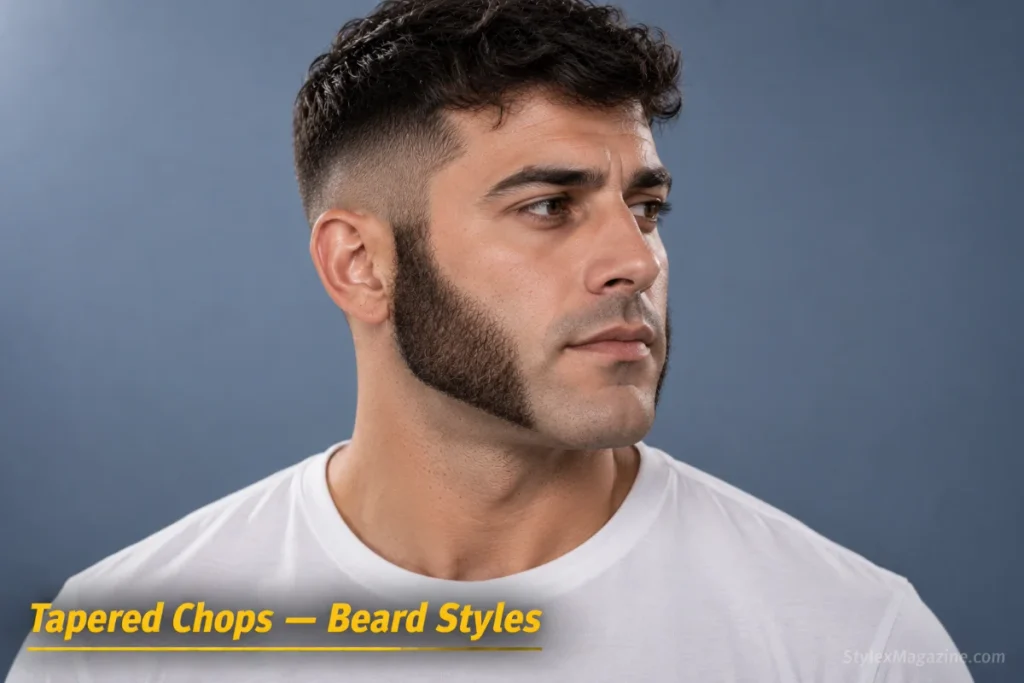
Styling tip: Barber work, not home work | Width: Wide at top, narrow at jaw | Length: Guard 4-6
Gradually narrowing from thick at the sideburns to pointed tips at the jaw corners. The most refined variation. The taper creates elegant lines that flatter most face shapes by adding structure without bulk at the jawline. Professional barbers recommend this as the first-time mutton chop for men who want a polished appearance.
Best for: All face shapes. The most universally flattering variation.
Tell your barber: “Tapered mutton chops, thick at the sideburn, narrow at the jaw, pointed tips, chin clean.”
Maintenance: Barber every 2-3 weeks for the taper. Chin shave every 2-3 days.
10. Modern / Faded Mutton Chops
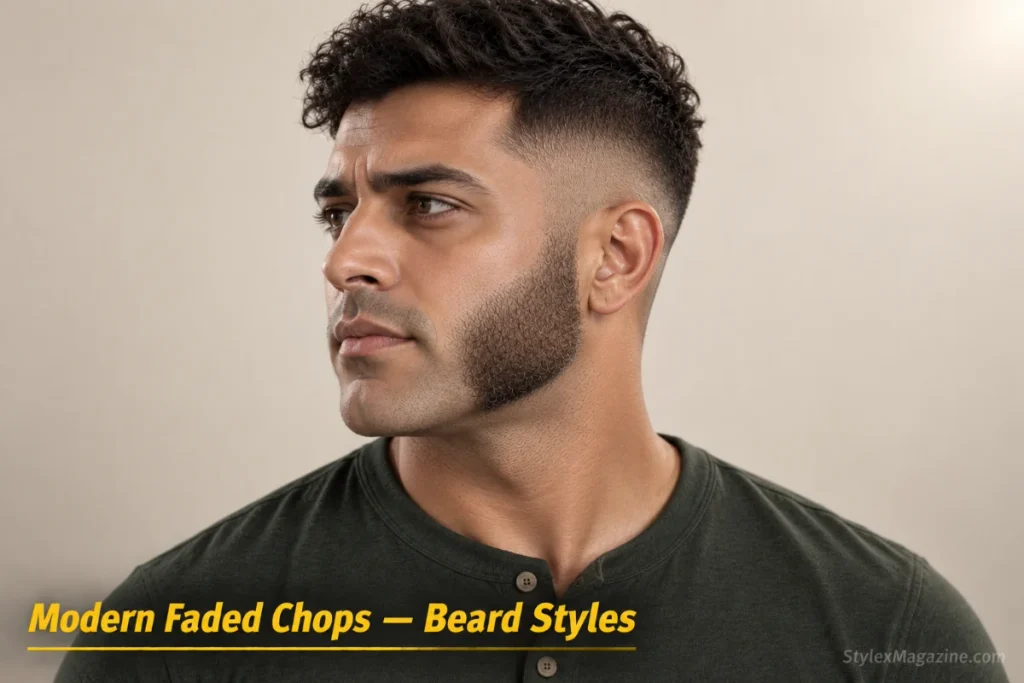
Styling tip: Pairs with any fade haircut | Width: 2-3 inches | Length: Gradient
Classic chops with faded edges that blend into the haircut at the sideburn area. No hard stop between hair and chops. The gradient creates one continuous shape from scalp to jawline. Mutton chops meet 2026 barbershop culture, and it has become the most requested version among men under 35.
Best for: All face shapes. Men with fade haircuts.
Tell your barber: “Modern mutton chops, fade the transition into the haircut, no hard line at the sideburn, chin clean.”
Maintenance: Barber every 2-3 weeks for the fade blend. Chin shave every 2-3 days.
11. Wide Mutton Chops
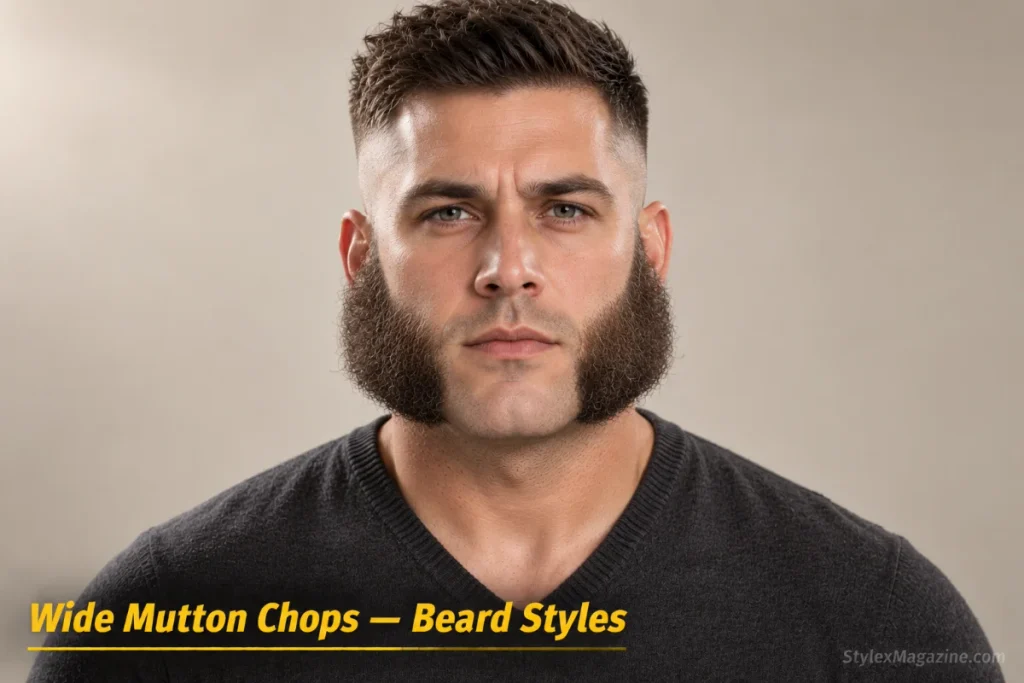
Hair type: Dense, even growth required | Width: 4-5 inches | Length: Guard 5-8
Maximum horizontal coverage for the boldest possible frame. The chops dominate the side profile. This works on narrow and oblong faces that need horizontal width, and it overwhelms round faces that already have it. The extreme width needs exceptional facial hair density. Sparse areas at this coverage level cannot hide.
Best for: Narrow and oblong face shapes. Men with dense, even cheek growth.
Tell your barber: “Wide mutton chops, maximum coverage, sharp edges, chin clean.”
Maintenance: Weekly edge trimming. Chin shave every 2-3 days.
12. Long Mutton Chops
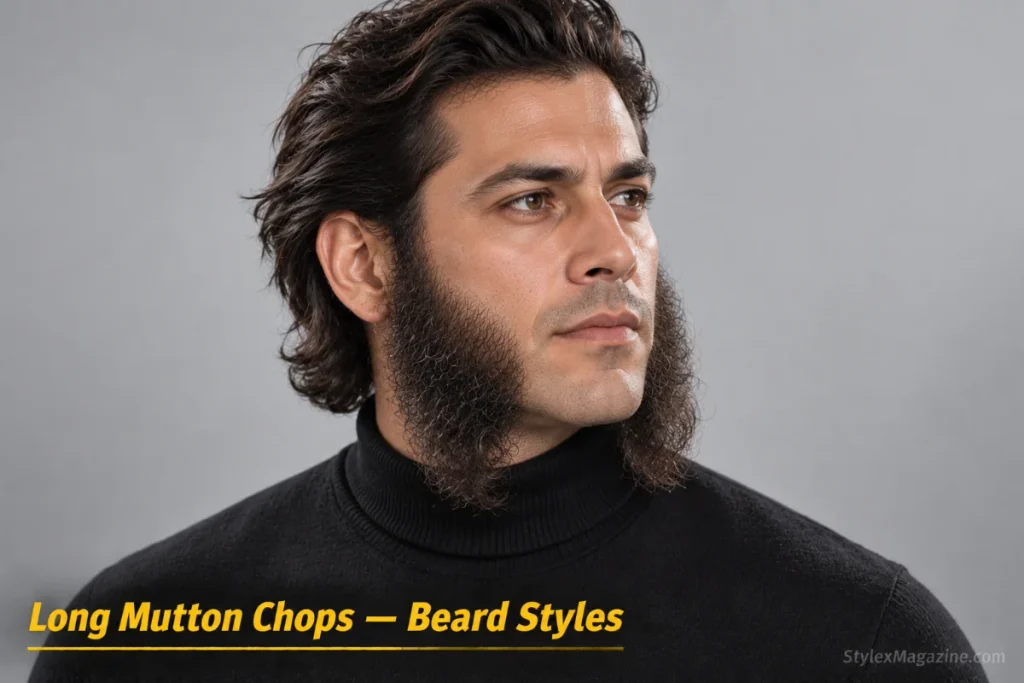
Styling tip: Condition weekly or the ends go wiry | Width: 2-3 inches | Length: 3-4 inches below jawline
Sideburns grown well past the jaw corner, extending 3 to 4 inches below the jawline for full Victorian drama. The long version is where mutton chops become a true statement. The extended length creates powerful facial framing that commands attention, but it also demands months of growth and consistent conditioning. Beard oil daily. Balm at the ends. Comb downward to train direction. Without this routine, the tips go wiry and split within weeks.
Best for: Oval and oblong face shapes. Men who can commit to 3+ months of growth.
Tell your barber: “Long mutton chops, keep the length, just shape the outline and clean the chin.”
Maintenance: Daily oil and comb. Barber shape every 4-6 weeks. Chin shave every 2-3 days.
13. Mutton Chops with Goatee
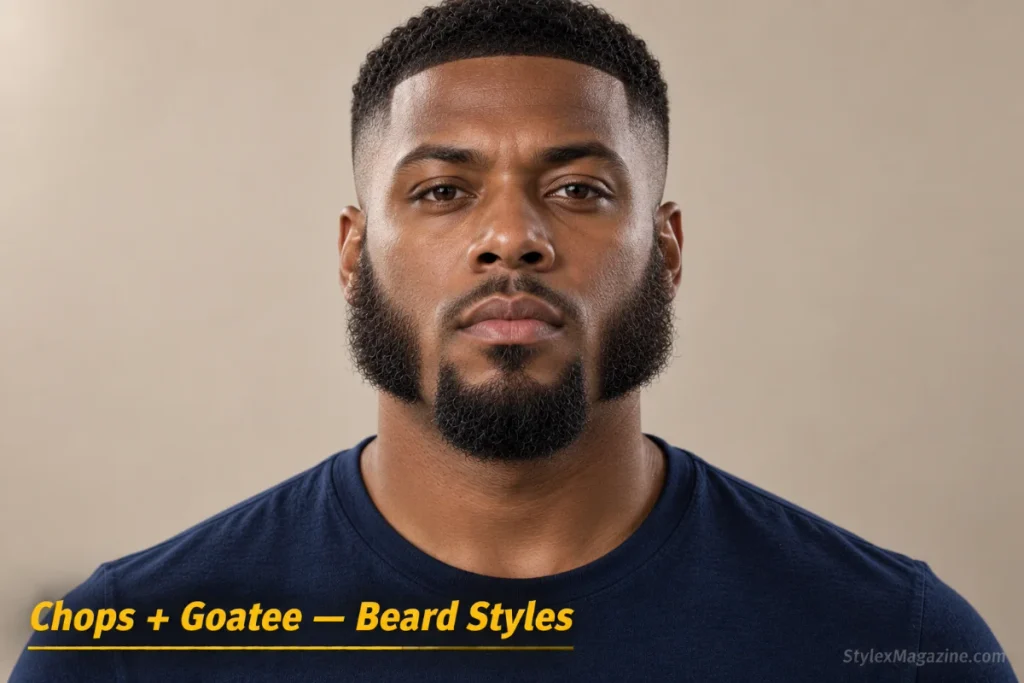
Styling tip: Three elements, all separate | Width: 2-3 inches chops | Length: Guard 3-5
Classic mutton chops paired with a goatee at the chin, creating a three-point design. This hybrid breaks the fundamental “clean chin” rule of mutton chops and adds chin coverage for men who want more facial hair without committing to a full beard. The chin element must stay visibly separate from the chops.
Best for: Round and oval face shapes. Men who want more coverage.
Tell your barber: “Mutton chops with separate goatee, all three elements disconnected, gap between chops and chin.”
Maintenance: Edge all three separations every 2-3 days.
14. Salt and Pepper Mutton Chops
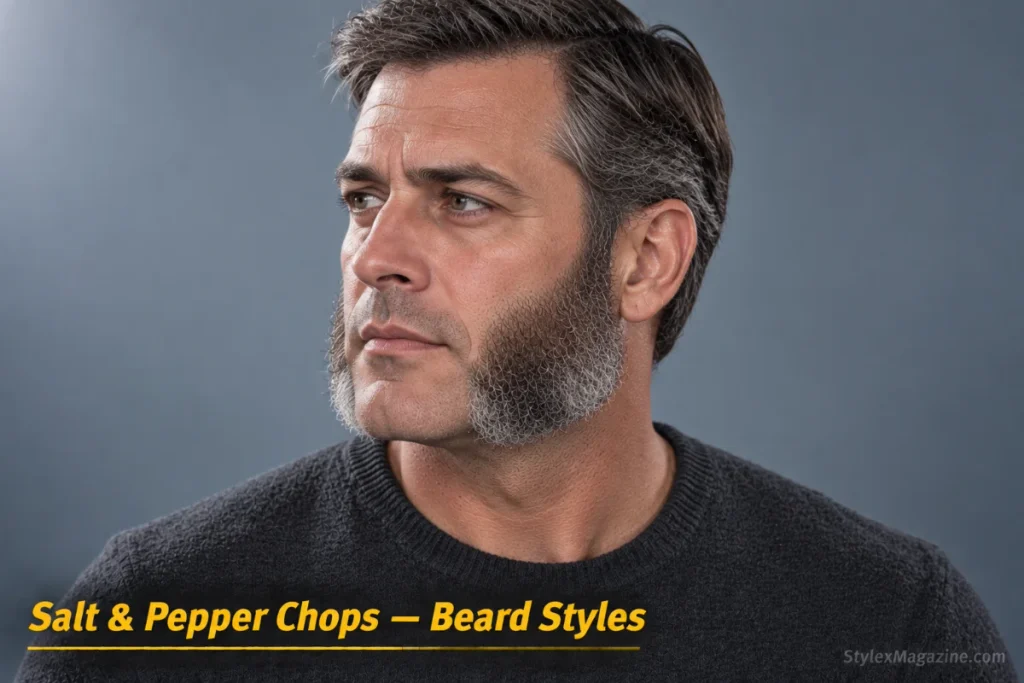
Hair type: Natural greying | Width: 2-3 inches | Length: Guard 4-6
Grey threading through the chops adds depth and authority that solid-colored hair cannot match. The silver and dark mix creates natural contrast within the chops themselves, making the shape appear fuller. Grey hair is coarser, so oil daily and keep the style a half-step shorter than you would a pigmented version.
Best for: Men over 40. All face shapes.
Tell your barber: “Salt and pepper mutton chops, keep the grey natural, no dye, shape tighter than normal.”
Maintenance: Daily oil. Tighter trim than pigmented versions. Chin shave every 2-3 days.
15. Mutton Chops for Black Men
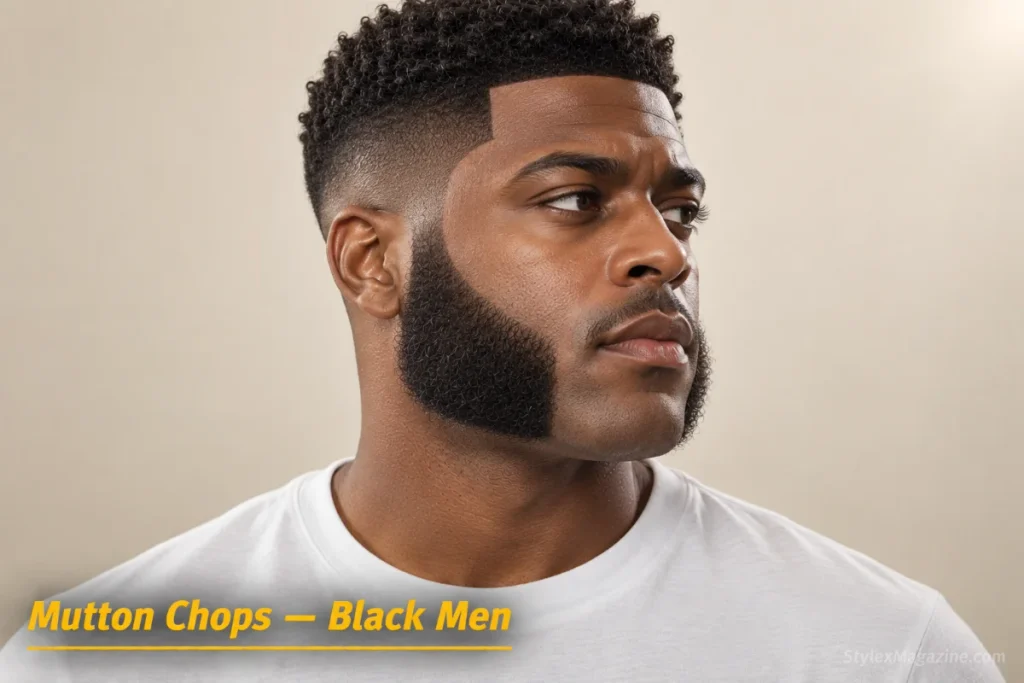
Styling tip: Single-blade on the chin | Hair type: Coily, 4A-4C | Width: 2-3 inches
Coily textures create naturally sharper chop edges, but the chin area needs specific care. The chin gets shaved every 2-3 days for this style, and razor bumps (pseudofolliculitis barbae) are more common with coily hair because tight curl patterns cause freshly shaved hairs to grow back into the skin.
Use a single-blade razor or electric foil shaver on the chin. Shave with the grain. Apply a salicylic acid aftershave. A line-up at the hairline connecting through the sideburns into the chops creates one continuous framed shape. For the full guide on coily textures, see fade haircuts for Black men.
Best for: All face shapes. Pairs well with a line-up, skin fade, or burst fade.
Tell your barber: “Mutton chops, sharp edges, line-up at the hairline, single-blade on the chin.”
Maintenance: Chin shave every 2-3 days. Moisturize chin daily.
Which Mutton Chops Fit Your Face Shape?
Mutton chops add horizontal width to the face. That structural effect flatters narrow and long faces and can work against round faces unless the chops stay narrow.
| Face Shape | Best Mutton Chops Styles | Avoid |
|---|---|---|
| Oval | Any variation | Nothing specific |
| Square | Tapered, classic, Wolverine | Very wide (over-squares the face) |
| Round | Thin, tapered, short | Wide or bushy (adds more width) |
| Oblong / Long | Wide, thick, classic, long | Thin (adds no horizontal balance) |
| Heart / Triangle | Friendly, tapered | Very wide at the cheekbone (emphasizes a wide forehead) |
| Diamond | Classic, thin, stubble | Thick or bushy (overwhelms narrow chin) |
How Do You Shape Mutton Chops?
Grow a full beard for 4-6 weeks, then carve the chops out of it. You cannot shape what is not there.
Step 1: Set an even base length across the full beard using a guard trimmer.
Step 2: Shave the chin completely clean. Razor, not trimmer. The cleaner the chin, the bolder the chops.
Step 3: Shave the neck clean. Two finger-widths above the Adam’s apple, following the jaw’s natural crease.
Step 4: Define the upper cheek line. Follow the natural cheek contour from sideburn downward.
Step 5: Define the lower edge at the jaw corners. The chops end here and clean skin begins.
Step 6: Choose your mustache status. Shave it clean (classic) or connect it to the chops (friendly).
Step 7: Check symmetry. Alternate sides in small passes. Step back 3-4 feet from the mirror. A phone camera in selfie mode catches asymmetry that mirrors hide.
I trim more chops too thin on the first attempt than too thick. Start wider and longer than you think you want. You can narrow next session. You cannot add width back.
What Haircuts Pair Best with Mutton Chops?
Mutton chops frame the cheeks. The haircut frames the skull. When both align, the entire head works as one shape.
| Haircut | Best Chops Pairing | Why |
|---|---|---|
| Skin fade or high fade | Modern/faded, classic, Wolverine | Matched clean gradients from haircut to chops |
| Mid fade | Classic, tapered, friendly | Balanced proportion between head and jaw |
| Buzz cut | Short, stubble, thin | Minimal head matches minimal chops |
| Quiff or pompadour | Classic, thick, Wolverine | Height on top balances width on the cheeks |
| Long hair | Bushy/wild, thick, friendly | Volume on top echoes volume in the chops |
| Bald or shaved head | Classic, friendly, thick | The chops become the only framing, so commit to a fuller version |
For specific fade and beard combinations, see fade haircut with beard. For buzz and beard pairings, see buzz cut with beard. For bald head combinations, see bald head with beard styles.
FAQs
How long does it take to grow mutton chops?
Four to eight weeks of full facial hair growth before the first shaping. Grow a complete beard first, then carve the chops out of it by shaving the chin and shaping the sideburns. Shorter variations like the stubble chops are shapeable within 2-3 weeks. Wolverine-width chops need 2-3 months.
What is the difference between mutton chops and friendly mutton chops?
Classic mutton chops have no mustache. The sideburns, chin, and lip are all separate zones: sideburns stay, chin and lip get shaved. Friendly mutton chops connect the sideburns to a mustache, creating a horseshoe frame around the mouth. The chin stays bare in both versions.
Can you wear mutton chops in a professional setting?
Short, neatly trimmed mutton chops with clean edges are appropriate for most professional settings. The short (#3), thin (#7), and tapered (#9) variations are the safest for conservative workplaces. Sharp edges and consistent length signal grooming intention regardless of facial hair style.
What face shape suits mutton chops best?
Oval and oblong faces suit mutton chops best because the side coverage adds width that balances their proportions. Square faces benefit from tapered versions. Round faces need narrower, angular chops to avoid adding more width. The clean chin exposes your jaw shape, so men with a strong chin benefit most.
How do you maintain mutton chops?
Shave the chin and neck every 2-3 days. That clean chin is the defining feature. Edge the chop borders weekly. Oil daily to prevent dryness (the chops are fully exposed to wind and sun). Alternate sides when trimming to maintain symmetry. Book a barber shape-up every 2-3 weeks for tapered, faded, or Wolverine variations.

Other Articles
Best Beard Style for Your Face Shape: The Complete Guide
16 Best Goatee Styles for Men


jawline growth, thin cheeks: Chin strap, mutton chops, extended