

Quick Answer: The most popular korean hairstyles for men are the Two Block, Comma Hair, Curtain, Wolf Cut, and Down Perm. Every style below is tagged by face shape, hair type, and trim frequency so you can pick the right one.
How to Choose the Right Korean Hairstyle for Your Face Shape?
Your face shape determines which Korean haircut will sharpen your features and which will work against them. Round faces need height on top and tighter sides. Square jaws soften with waves and layered fringe. Oblong faces shorten with horizontal fringe that breaks the forehead line. The table below matches all seven face shapes to the best styles covered here.
| Face Shape | Best Korean Styles | What to Avoid |
|---|---|---|
| Oval | Two Block, Curtain, Middle Part, Dandy Cut | Nothing specific — oval faces suit almost every Korean cut |
| Round | Two Block, Comma Hair, Textured Fringe, Taper Fade, Side Swept Fringe | Bowl cuts and flat fringe that widen the face further |
| Square | Curtain, Korean Perm, Side Bangs, Flow Cut, Down Perm | Buzz cuts and sharp geometric cuts that emphasize the jaw |
| Oblong | French Crop, Caesar, See-Through Bangs, Bowl Cut, Leaf Perm | Styles with extreme height on top and no fringe |
| Heart | Side Bangs, Dandy Cut, Layered Cut, Side Part | Heavy volume on top with no width at jaw level |
| Diamond | Middle Part, Curtain, S-Shaped Fringe, Slicked Back | Short cropped sides with no top length — highlights wide cheekbones |
| Triangle | Textured Crop, Two Block with volume, Wolf Cut, KPop Style | Styles that add width at the jaw — keep sides tight |
For a deeper breakdown of how each face shape affects your haircut choice, check our full guide to haircuts for your face shape.
What Are the Best 35vKorean Hairstyles for Men in 2026?
Korean men’s haircuts driven by Hallyu culture and the “soft masculinity” aesthetic from K-pop and K-drama prioritize natural hair texture, layered volume, and face-framing fringe over the hard fades and rigid structure common in Western barbershops. The styles below are ordered from short to long, so scroll to your preferred length or scan the tags to find cuts that match your hair texture and density.
1. Two Block
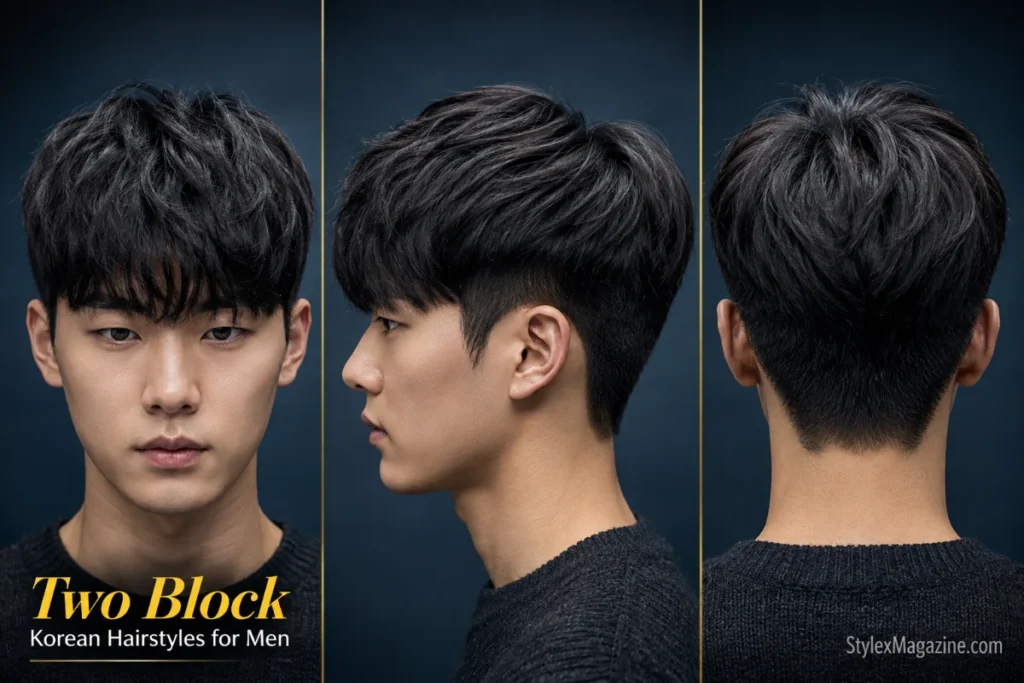
Among short korean hairstyles men ask for, the Two Block remains the most requested Korean haircut worldwide. The sides and back are cut short usually a #3 or #4 guard — while the top stays 3 to 5 inches long, creating a sharp disconnection between the two “blocks.” I’ve cut more Two Blocks in the last two years than any other Asian-inspired style, and the men who wear it well are the ones who keep the top forward and slightly textured instead of slicked back. The disconnected silhouette adds height and frames the forehead cleanly.
Best for: Round, Oval | Hair type: Straight, thick | Maintenance: Every 3–4 weeks
2. Caesar Cut
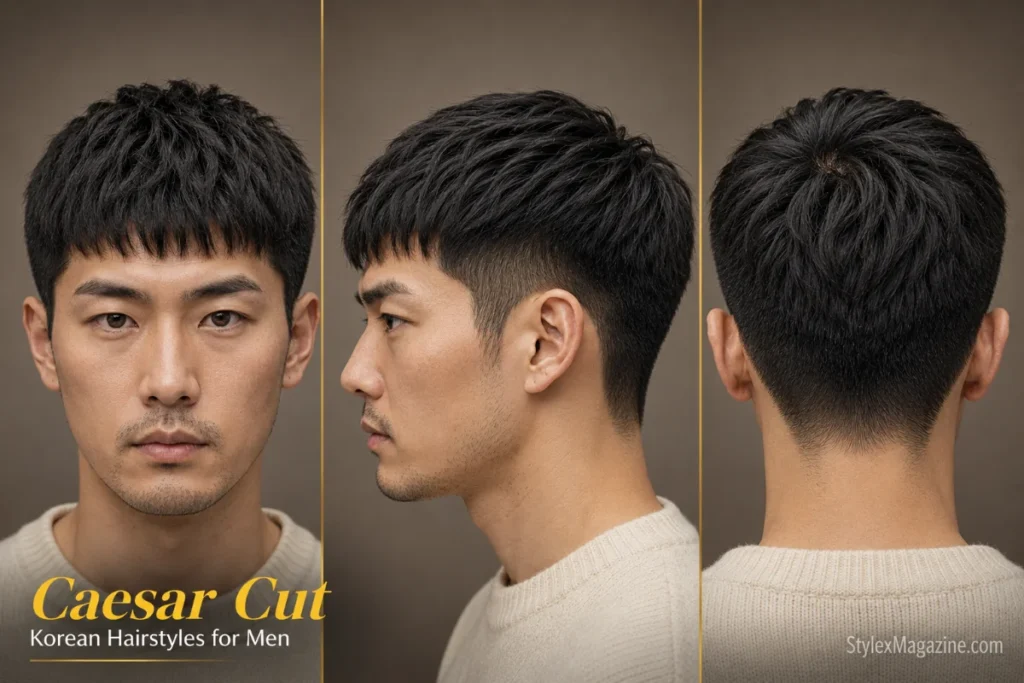
The Korean Caesar keeps the top at a uniform 1 to 2 inches with a straight, blunt micro fringe sitting just above the eyebrows. Faded sides bring it into 2026 territory — this is not the flat Roman original. That horizontal fringe line visually shortens the forehead and brings the proportions into balance. No product needed. Blow-dry forward and walk out.
Best for: Oblong, Oval | Hair type: Straight, fine to medium density | Maintenance: Every 2–3 weeks — the fringe loses its line fast.
3. Textured Crop
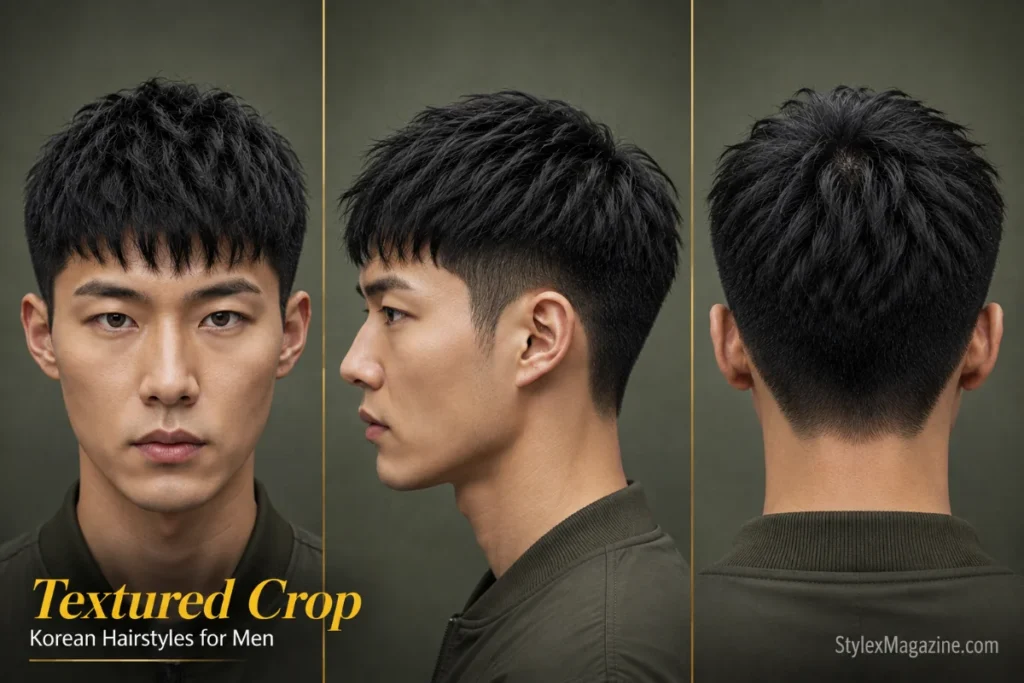
Short choppy layers on top with clean faded sides — the Korean textured crop is the easiest short style to maintain in this entire list. A fingertip of matte clay scrunched through the crown creates separation and lift. Thick straight hair holds this shape all day without re-touching. Fine hair benefits from texture powder at the roots first, then the clay on top. The textured top adds visual width without extra length.
Best for: Oblong, Oval | Hair type: Straight, thick or fine | Maintenance: Every 3 weeks
4. French Crop
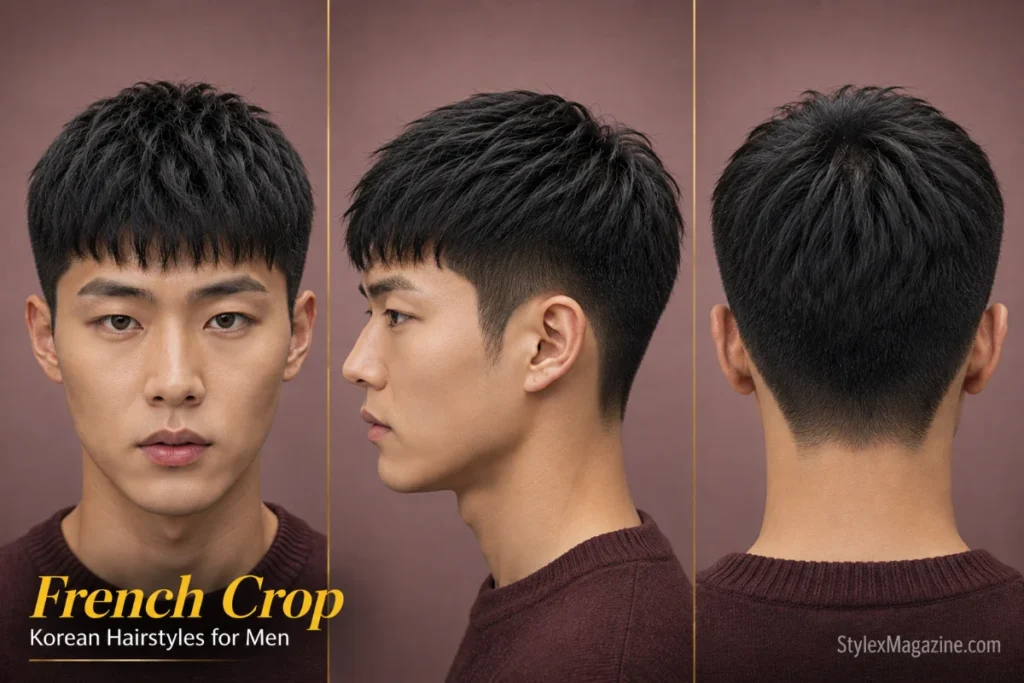
A blunt fringe sitting above the eyebrows, short faded sides, and light layering on top. For korean hairstyles for men short hair, the French crop is the lowest-effort option on this list — zero styling, zero product, zero blow-drying. The horizontal fringe shortens the visual face length — but skip this if your face is already wide, because the horizontal line adds width.
Best for: Oblong, Long faces | Hair type: Straight, any density | Maintenance: Every 3 weeks
5. Buzz Cut
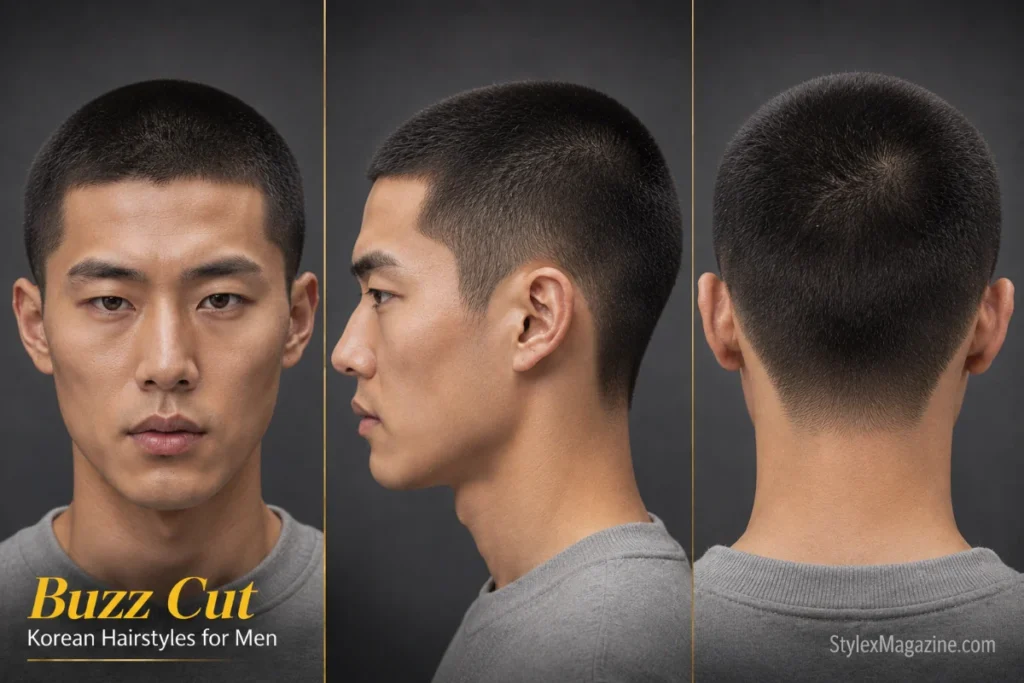
Not a traditional short hairstyle for men korean salons push, but Seoul street fashion has embraced the buzz cut with a subtle taper or skin fade on the sides. A uniform #2 or #3 guard all over works when the bone structure carries the look — feel for flat spots or bumps before committing. A buzz cut hides nothing. Pair it with clean grooming and sharp clothing, because the hair is no longer doing any work for you.
Best for: Oval, Diamond | Hair type: Any — this cut overrides texture | Maintenance: Every 2 weeks to keep it sharp
6. Drop Fade
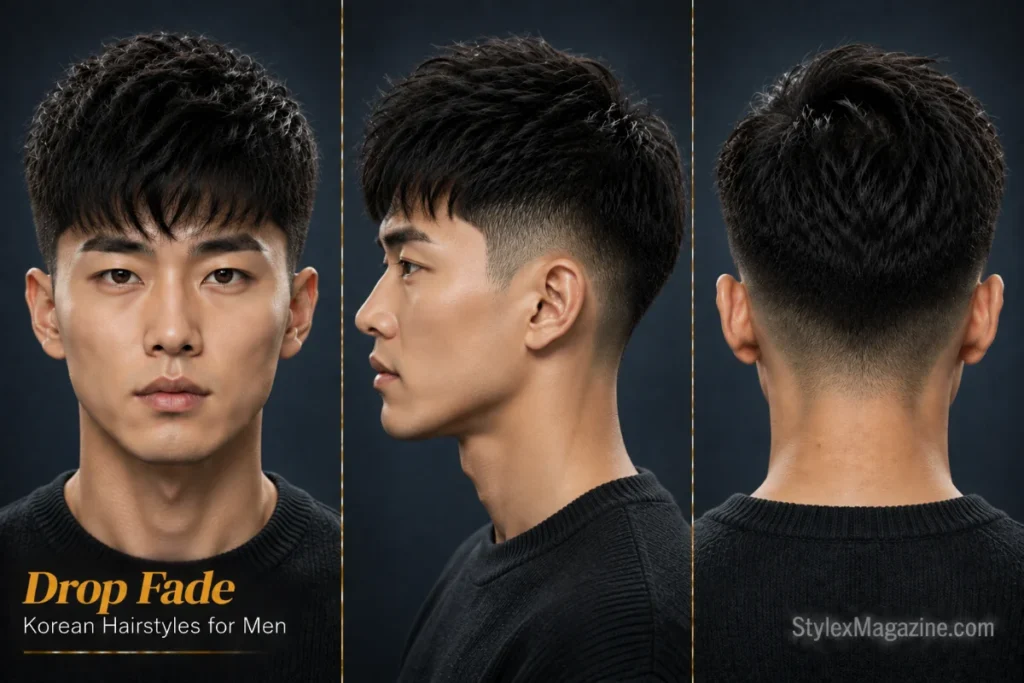
The drop fade curves behind the ear in an arc instead of following a straight horizontal line around the head. Korean barbers pair this with a voluminous layered top the contrast between the curved fade and the textured top creates a modern, clean silhouette. The curved line softens angular jawlines while the top volume maintains proportion. The downside: the curve grows out unevenly, so you need a mid fade style touch-up every 2 to 3 weeks.
Best for: Square, Oval | Hair type: Straight, thick | Maintenance: Every 2–3 weeks — the curve loses shape faster than a straight fade
7. Taper Fade
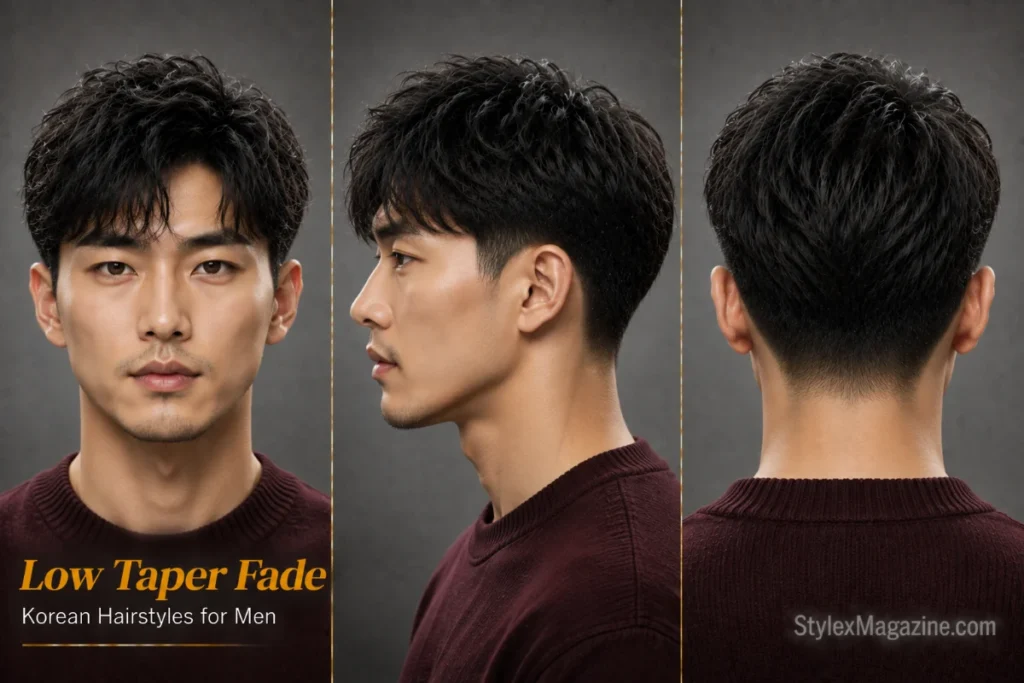
The safest Korean fade for a first-timer. Hair gradually shortens around the ears and neckline without ever reaching skin this is the key difference between a Korean taper and a Western skin fade. K-drama actors almost always wear tapers, not fades, because the transition is softer. It flatters nearly every face shape and works on every hair density. Ask your barber for a natural taper blending into the sideburns, not a hard line.
Best for: All face shapes | Hair type: All textures and densities | Maintenance: Every 3–4 weeks
8. Korean Ivy League
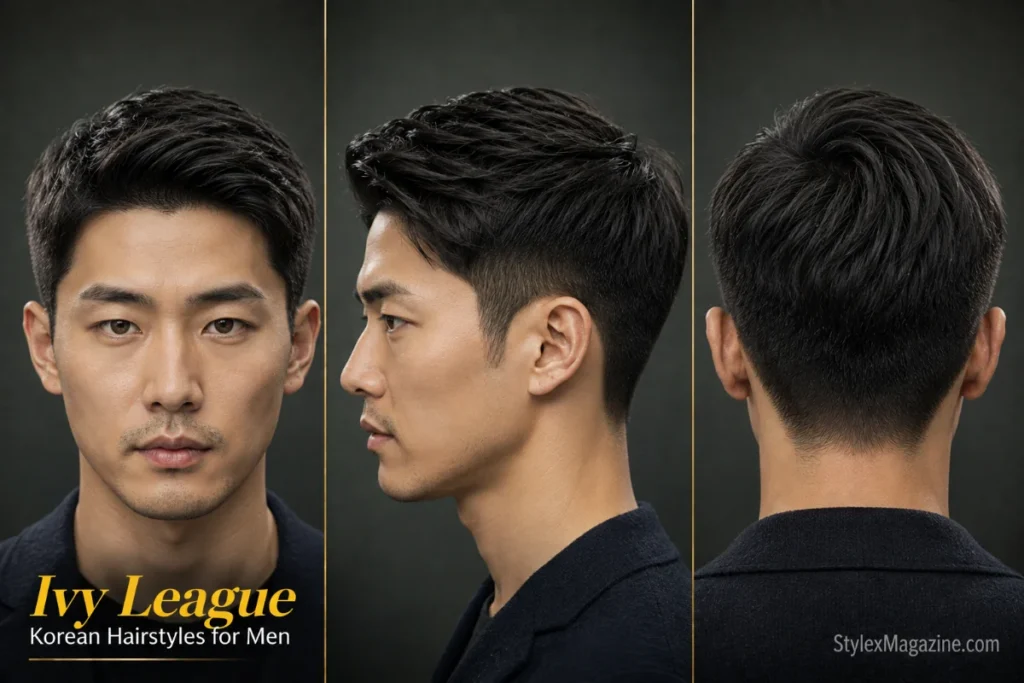
A refined side-parted cut with short tapered sides and enough length on top to comb to one side the Korean Ivy League sits somewhere between a Two Block and a classic gentleman’s cut. It works in corporate environments where a disconnected Two Block might feel too bold. The side part creates asymmetry that balances strong features. A light pomade keeps the part clean without looking stiff.
Best for: Oval, Square | Hair type: Straight, medium to thick | Maintenance: Every 3–4 weeks
9. Short Textured
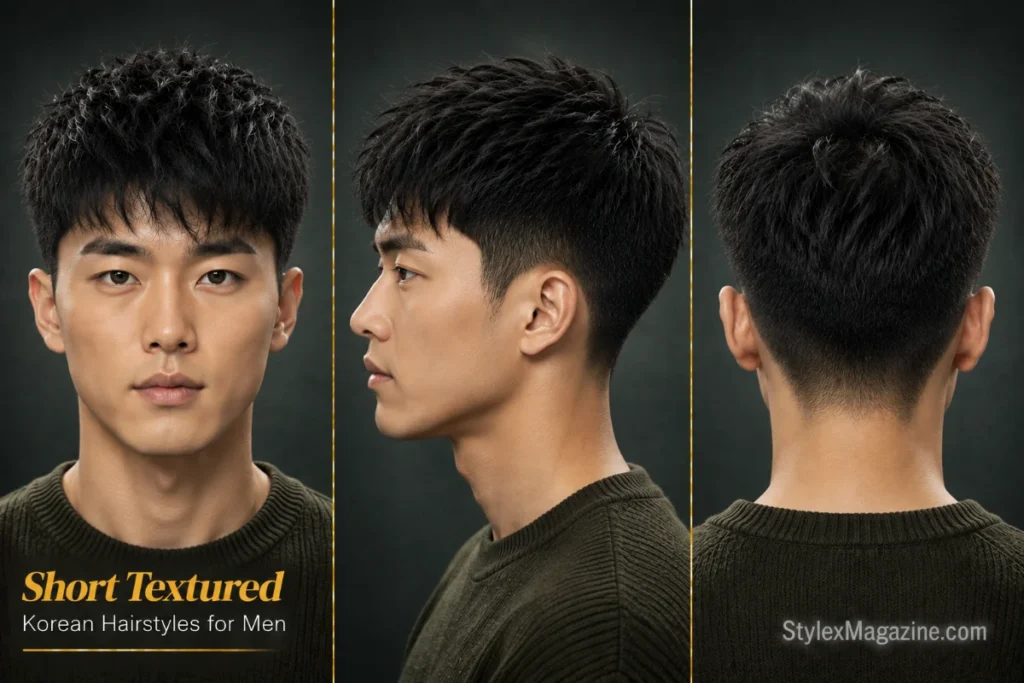
Choppy short top with no defined fringe, clean tapered sides. As a korean hairstyle male short option, this is the “I just woke up” cut intentionally undone, zero effort. It works specifically on thick straight Asian hair because the natural density provides the texture without product. On fine hair, it can fall flat, so add texture powder at the roots. The undefined top avoids adding extra height.
Best for: Oblong, Oval | Hair type: Thick straight preferred | Maintenance: Every 3 weeks
10. Comma Hair
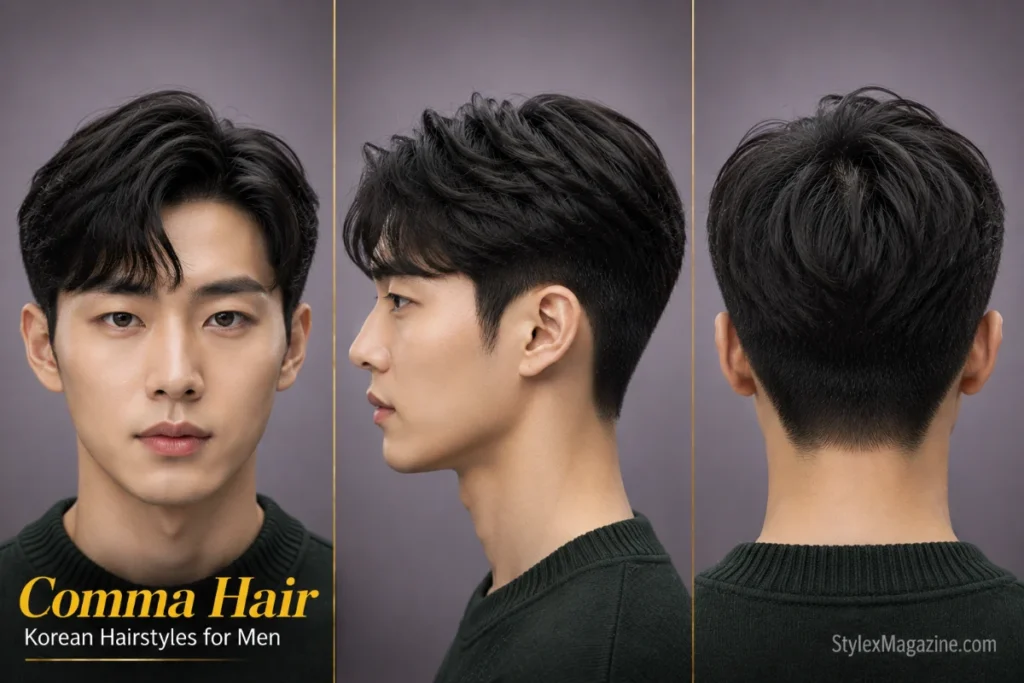
The fringe curls inward like a comma at the temple, framing the forehead with a soft curve this is the most distinctively Korean style on the list. The curve is achieved through a garma perm or by wrapping the fringe around a round brush while blow-drying on medium heat. Without some curl technique, straight Asian hair will not hold the comma shape past lunch. The inward curve narrows the visual face width and eases the forehead line. I’d recommend asking your barber for 4 to 5 inches on top and a disconnected or soft taper on the sides.
Best for: Round, Square | Hair type: Straight needs perm or heat styling for the curve | Maintenance: Every 4 weeks daily blow-dry to reshape
11. Curtain Haircut
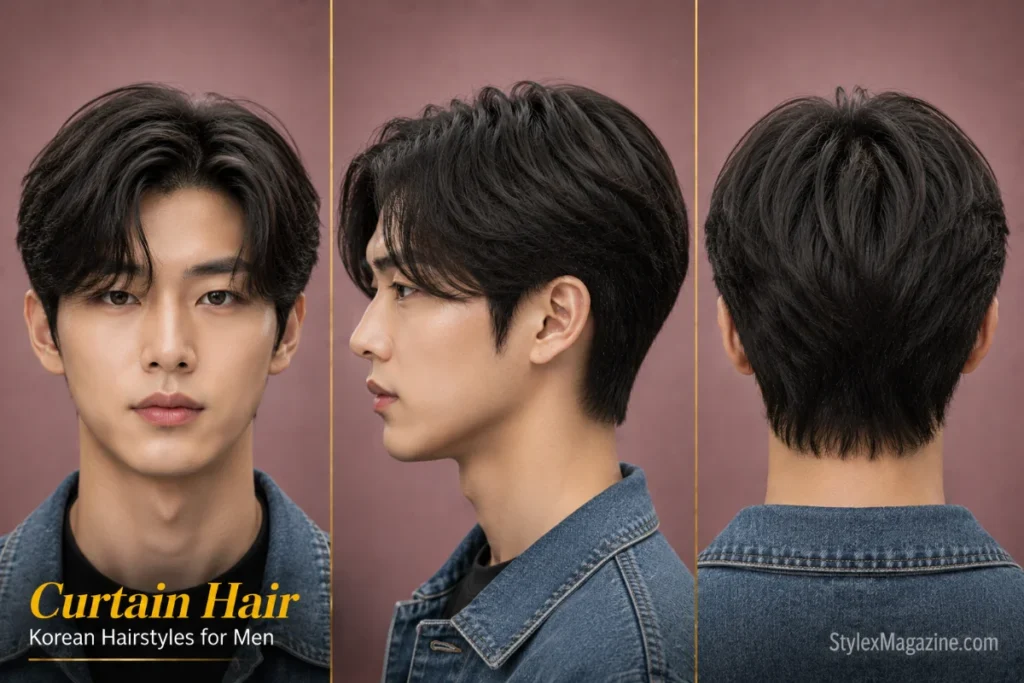
Center-parted with both sides falling outward like curtains past the cheekbones. The Korean curtain is softer and more textured than the Western 90s version the ends flip outward gently instead of hanging straight down. Blow-dry each side away from the center using a round brush at the tips. The parted fringe breaks the forehead line and rounds out angular jawlines. This pairs naturally with an Asian comb over fade on the sides for sharper contrast.
Best for: Square, Oval, Diamond | Hair type: Straight to wavy, medium to thick | Maintenance: Every 4–5 weeks
12. Middle Part
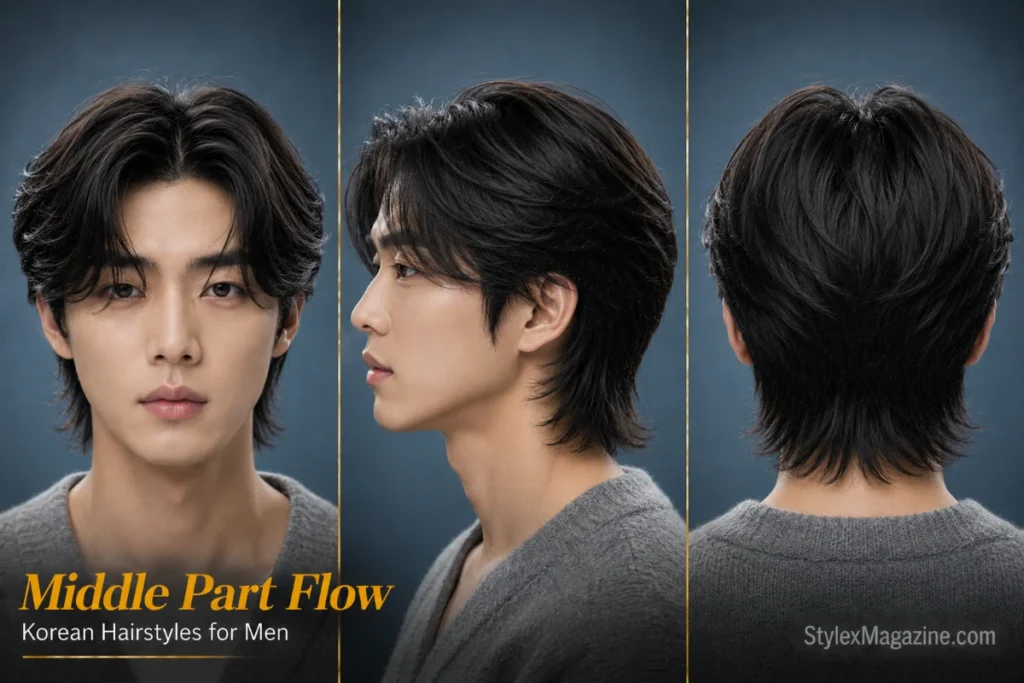
A center part with volume lifted at the roots, sides falling naturally. Not the same as a curtain haircut the middle part hairstyle sits closer to the head with less outward movement. Less layering than a curtain cut, more uniform length. The symmetrical part emphasizes balanced features. If your face is wide, add root lift — flat sides without volume can emphasize width.
Best for: Oval, Diamond | Hair type: Straight, medium density | Maintenance: Every 4–5 weeks
13. Side Part
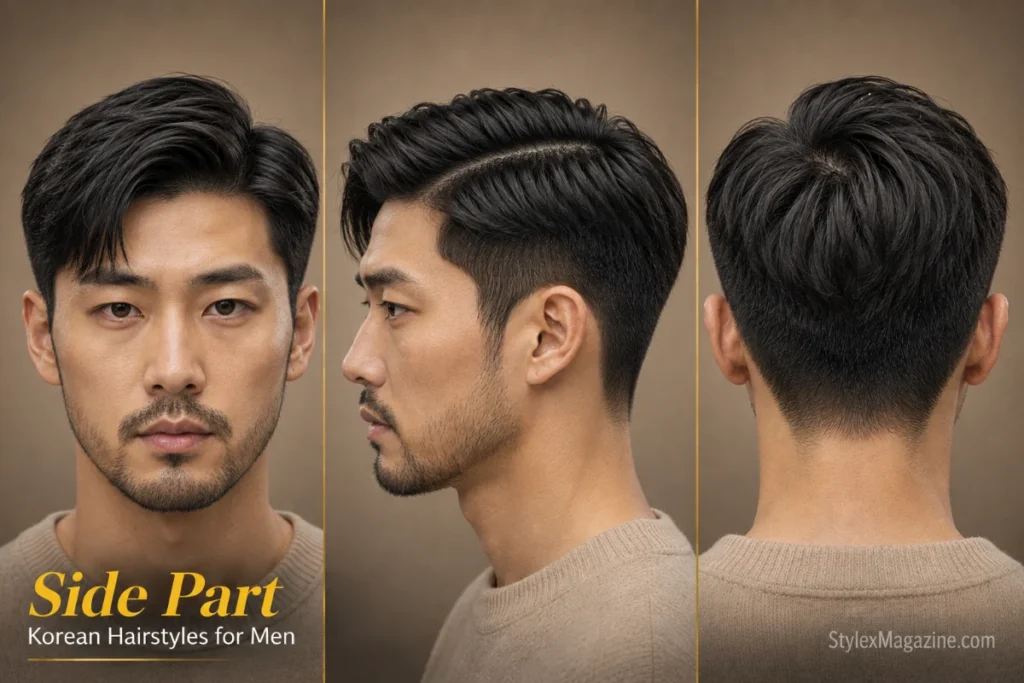
A natural divide, longer top swept to one side, clean tapered sides. The Korean version is softer than a Western hard part no razor line, just a natural divide that forms during blow-drying. Light pomade holds the direction without adding shine. The asymmetry widens narrow faces. For a polished finish, blow-dry while combing the top to one side, then set with a matte styling cream.
Best for: Oval, Oblong | Hair type: Straight, any density | Maintenance: Every 3–4 weeks
14. Dandy Cut
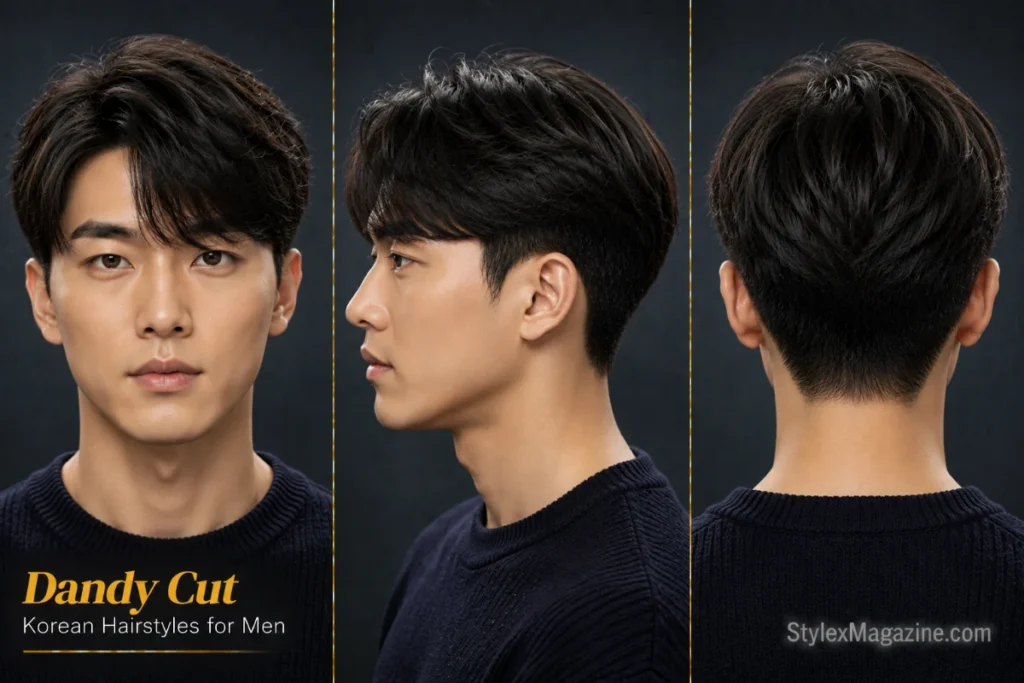
Named after the Korean salon term for a soft, gentlemanly cut the Dandy is a gentler version of the Two Block. The disconnection between top and sides is softer, the fringe longer and swept to one side with natural volume. Professional enough for any office setting. The side-swept fringe adds width without extra height. In my experience, this is the cut men switch to after outgrowing a Two Block same DNA, more refined.
Best for: Oval, Oblong, Heart | Hair type: Straight, medium to thick | Maintenance: Every 4 weeks
15. See-Through Bangs
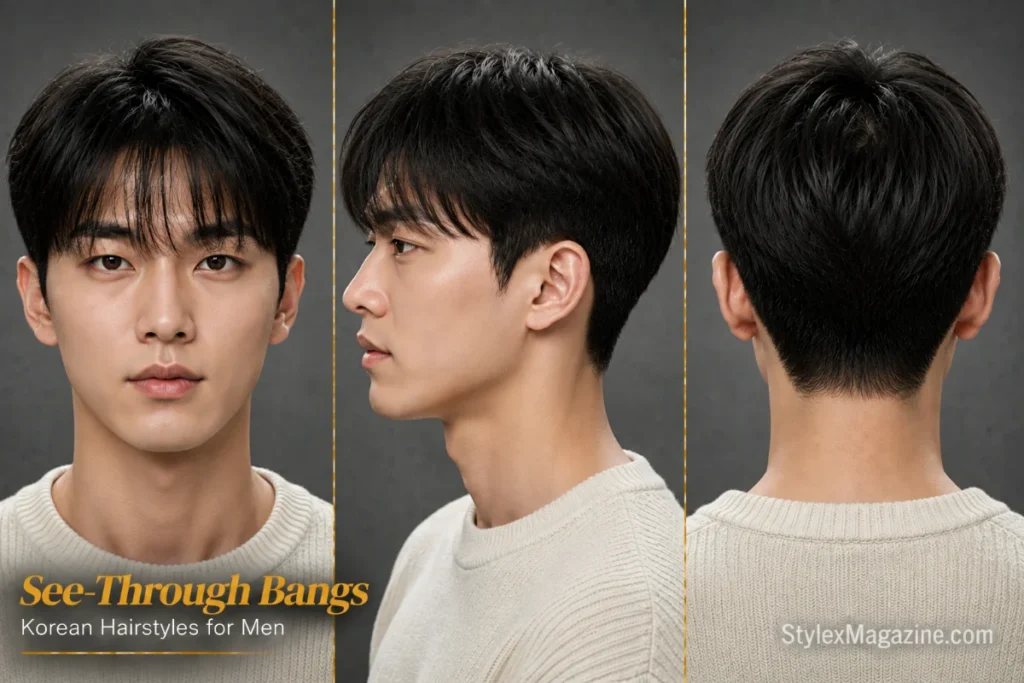
Wispy, thin fringe that reveals the forehead underneath the lightness is the entire point. The bangs are deliberately thinned with texturizing shears so they float rather than sit flat. The see-through effect softens the forehead without fully covering it. One problem most men don’t anticipate: these get oily fast. The fringe sits directly on the skin, absorbing forehead oil within hours. Wash the fringe daily even if you skip the rest of your hair, and avoid product on the bangs entirely.
Best for: Round, Oblong | Hair type: Straight, fine to medium thick hair resists the wispy effect | Maintenance: Every 3–4 weeks
16. Textured Fringe
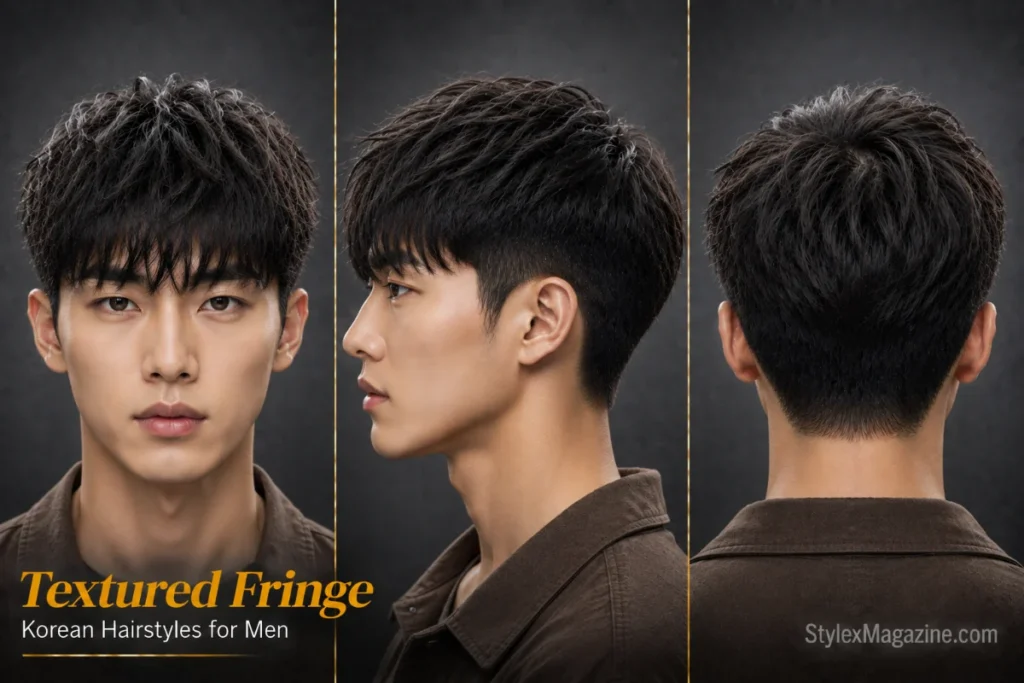
Piecey, separated fringe with visible strand separation thicker than see-through bangs but with deliberate texture between each piece. A small amount of texture powder at the roots creates the piecey lift. The vertical strand separation lengthens the face line. The difference from see-through bangs is density textured fringe has more hair, just styled with gaps rather than thinned at the cut.
Best for: Round, Oblong | Hair type: Straight, medium to thick | Maintenance: Every 3–4 weeks
17. S-Shaped Fringe
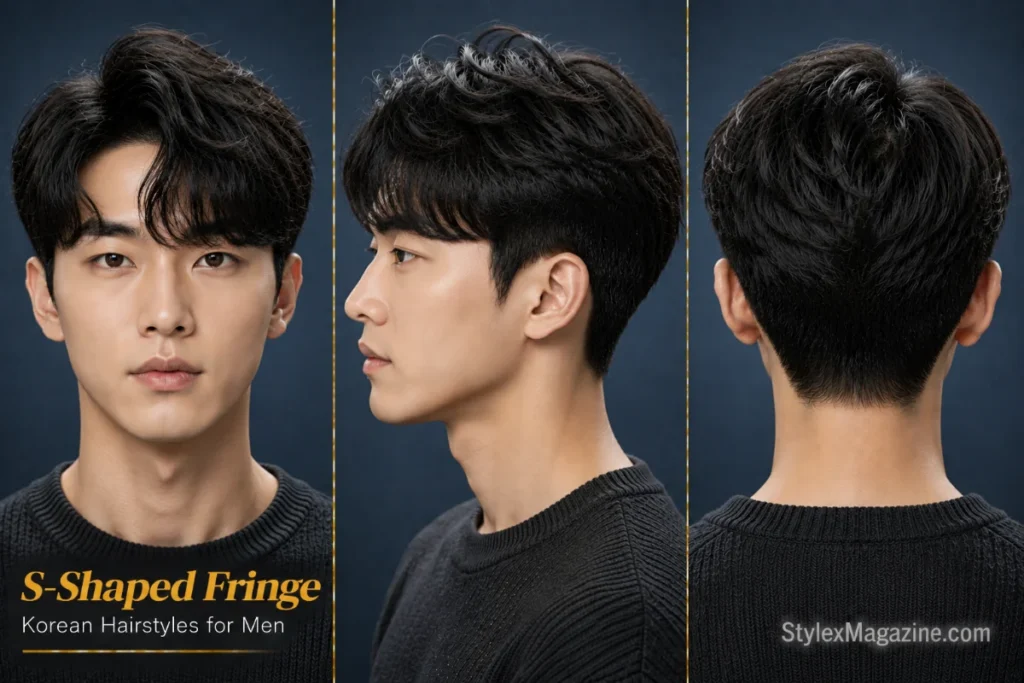
The fringe curves in an S-wave across the forehead two directional changes instead of comma hair’s single inward curl. More complex to achieve and maintain. Needs a perm or daily curling iron work at two points along the fringe. The horizontal wave movement adds visual width across the forehead. Show your barber the exact wave pattern you want “S-shaped” alone is too vague for consistent results.
Best for: Oblong, Oval | Hair type: Straight — needs perm or daily heat styling | Maintenance: Every 4 weeks — daily heat styling required
18. Side Swept Fringe
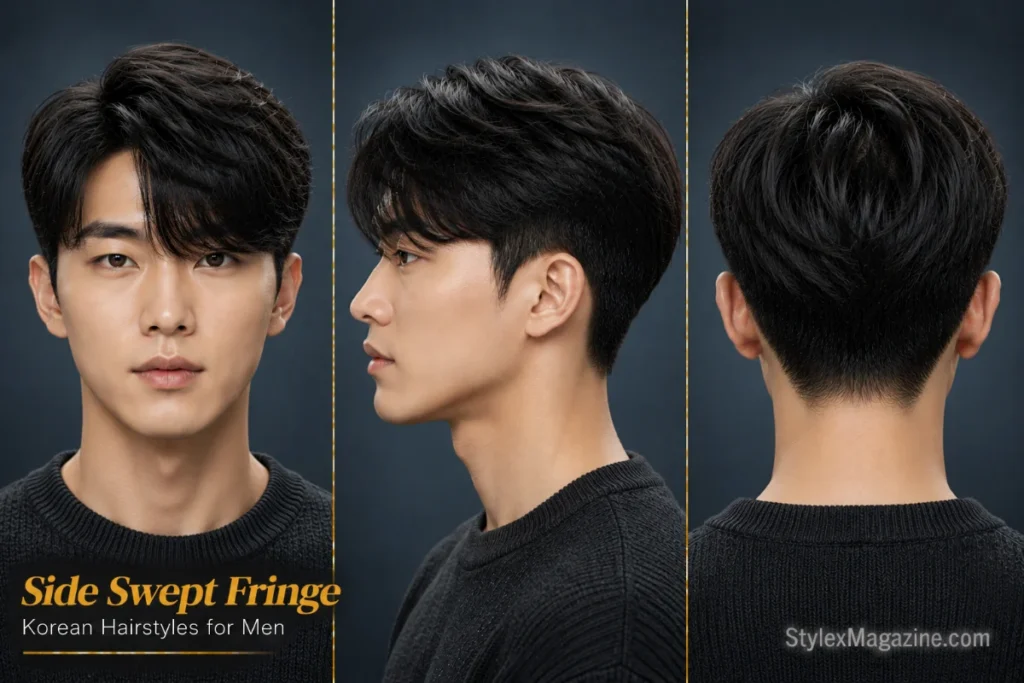
A longer fringe angled diagonally across the forehead, falling toward one eye. The easiest Korean fringe to maintain because gravity does most of the styling work blow-dry in the direction you want it to fall and leave it. The diagonal line creates asymmetry that slims and lengthens. No perm needed. Straight hair holds this direction naturally.
Best for: Round, Square | Hair type: Straight, any density | Maintenance: Every 4 weeks
19. Side Bangs
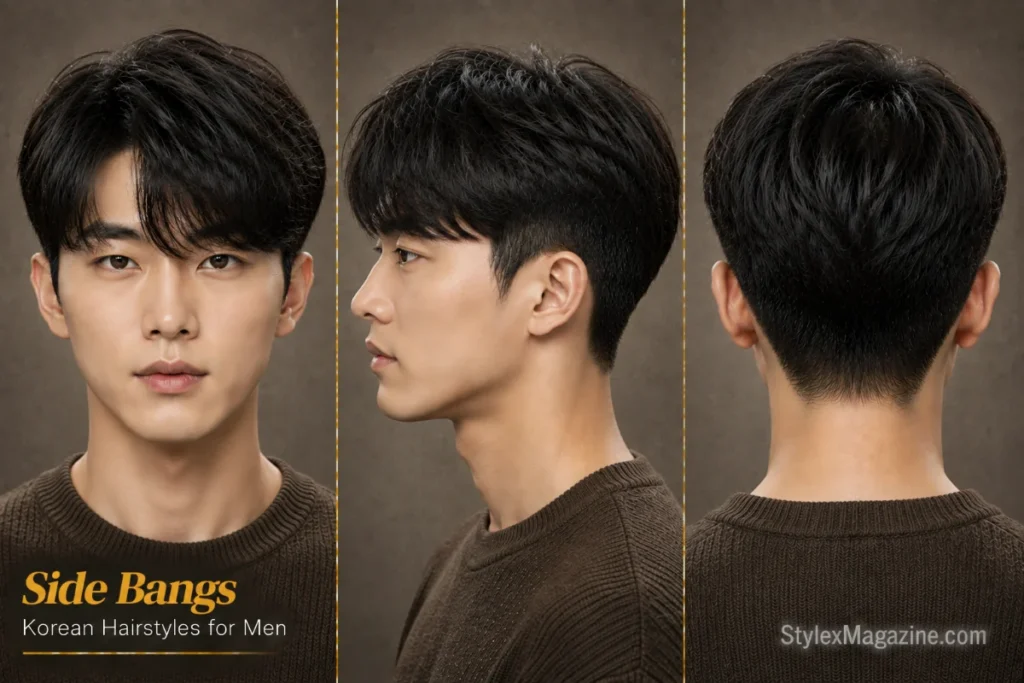
Medium-length fringe swept to one side, covering part of the forehead. Softer and shorter than a full side swept fringe side bangs sit above the eyebrow rather than falling past it. The partially covered forehead creates a slimming effect without the visual weight of long bangs. Style with a dime-sized amount of light wax worked through the fringe to hold direction.
Best for: Round, Square, Heart | Hair type: Straight, medium density | Maintenance: Every 3–4 weeks
20. Down Perm
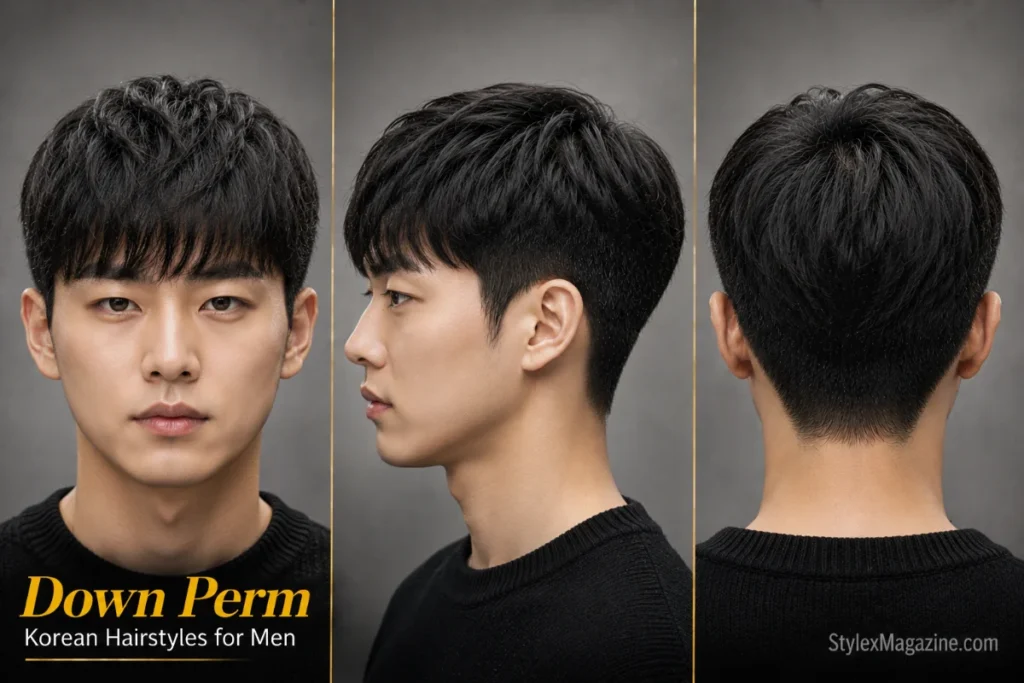
This is not a curling perm the down perm is a flattening treatment that pulls bulky side hair downward so it sits close to the head instead of sticking out. Korean men with thick, coarse hair that flares at the sides are the target audience. A perming serum restructures keratin bonds to reduce puffiness and create a sleeker profile. Flattened sides narrow the visual face width significantly. Re-perm every 2 to 3 months as the treatment fades.
Best for: Round, Square | Hair type: Thick, coarse, stiff specifically for hair that sticks out | Maintenance: Easy daily after perm — re-perm every 2–3 months
21. Messy Hair
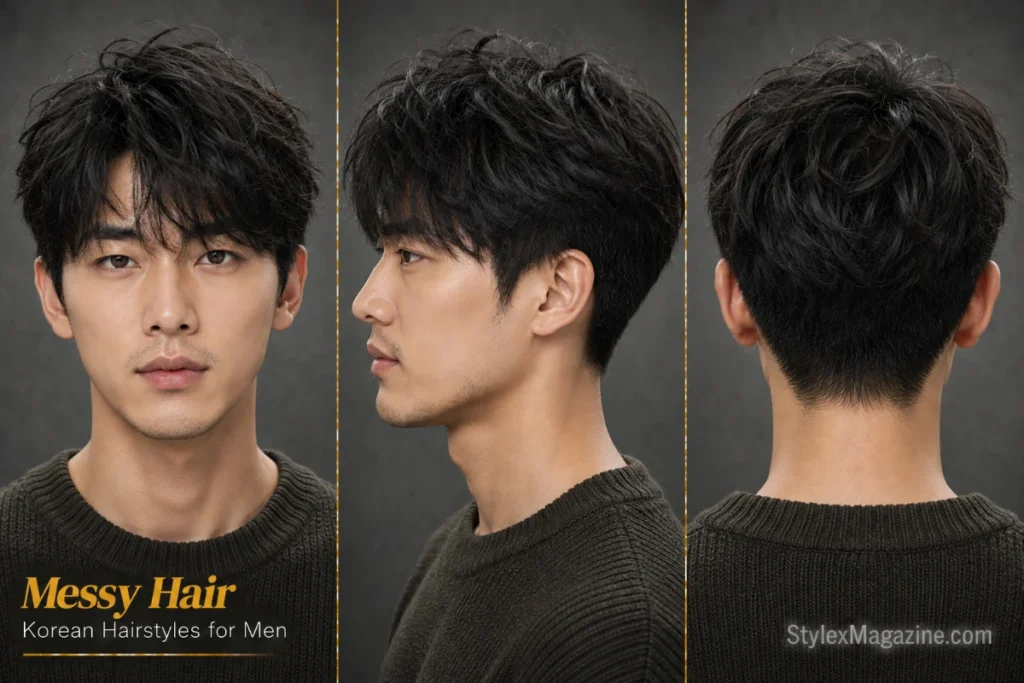
Deliberately tousled medium-length layers with no defined part or direction. The mistake most men make: using too much product. Korean messy hair should look like you ran your fingers through it once not like you spent 20 minutes building texture with wax. A pea-sized amount of light clay, scrunched through towel-dried hair, then air-dried. That’s the entire routine. The random direction broadens the frame and fills out narrow features.
Best for: Oval, Oblong | Hair type: Straight to wavy, medium to thick | Maintenance: Every 4–5 weeks
22. Bowl Cut
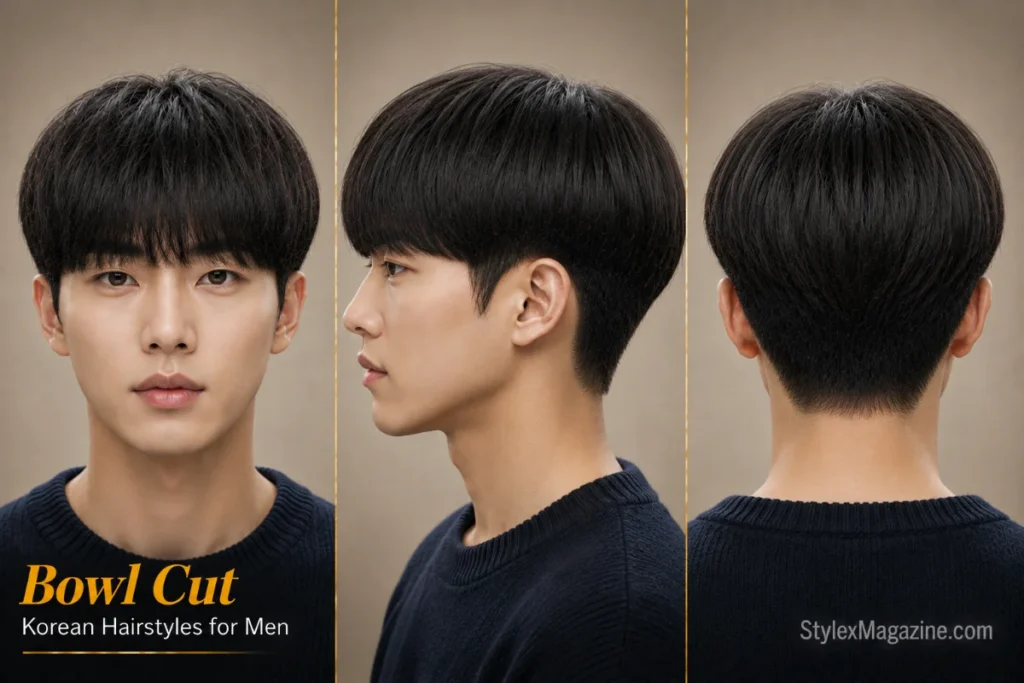
The 2026 Korean bowl cut is layered, textured, and in motion not the flat helmet from the 1990s. Internal layering gives the rounded shape depth and prevents the fringe from sitting flat. The sides are tapered or undercut rather than blunt. The rounded fringe shortens the face visually. Ask your barber for point cutting through the interior layers this creates softer ends and natural movement that a straight blunt cut cannot deliver.
Best for: Oblong, Oval | Hair type: Straight, thick preferred fine hair can look flat | Maintenance: Every 3–4 weeks shape trims to maintain the rounded silhouette
23. Korean Undercut
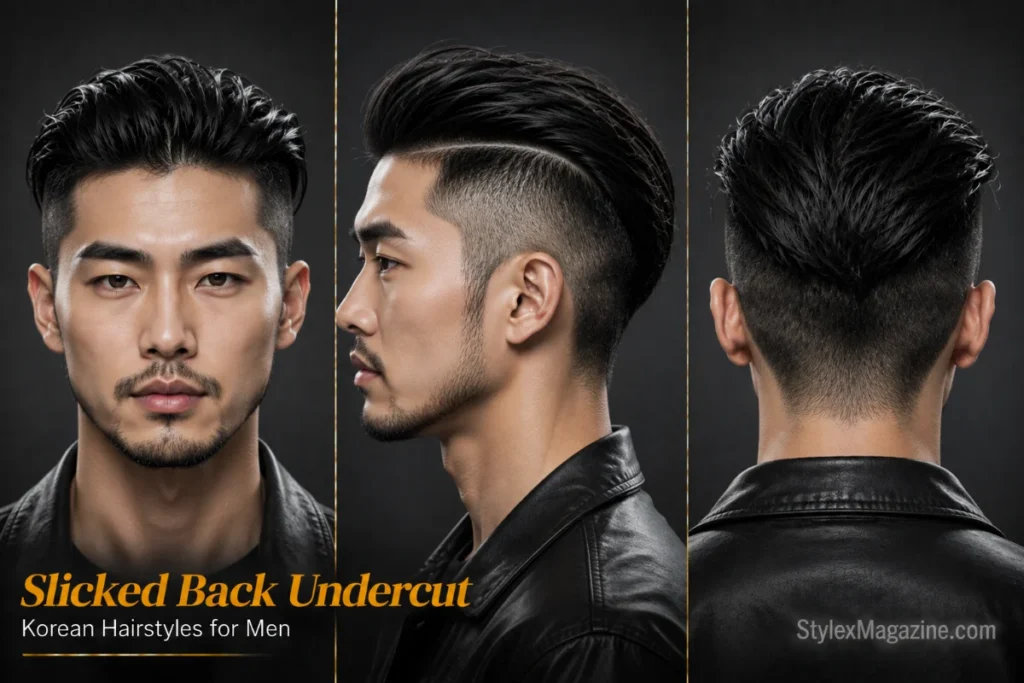
A sharper disconnection than a Two Block the sides are shaved or faded close to skin while the top stays long enough to style in multiple directions. The Korean undercut serves as a foundation cut, not a standalone style. The top can be pushed back, parted, forward-styled, or textured the undercut just provides the contrast underneath. The high contrast between shaved sides and longer top elongates the face.
Best for: Oval, Square | Hair type: Straight, medium to thick | Maintenance: Every 2–3 weeks for the sides
24. KPop Style
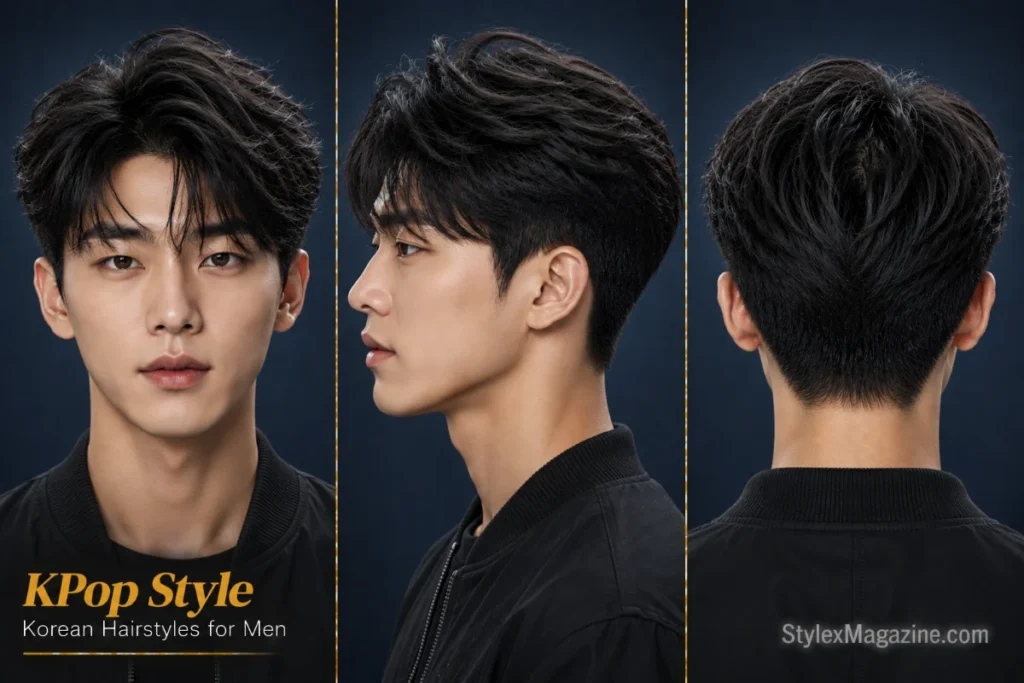
This is a styling approach, not a single cut. The base is usually a Two Block or layered cut, then blow-dried with significant root lift using a round brush. Matte clay or molding paste defines the fringe and holds the volume. K-pop idols achieve this look through professional blow-outs and often colored hair that adds visual dimension. At home, blow-dry upward at the roots for 30 seconds before directing the fringe into place. The lifted volume adds height and sharpens the overall silhouette.
Best for: Oval, Round | Hair type: Straight, any density — thick hair holds volume longer | Maintenance: Every 3–4 weeks — daily blow-dry styling
25. Wolf Cut
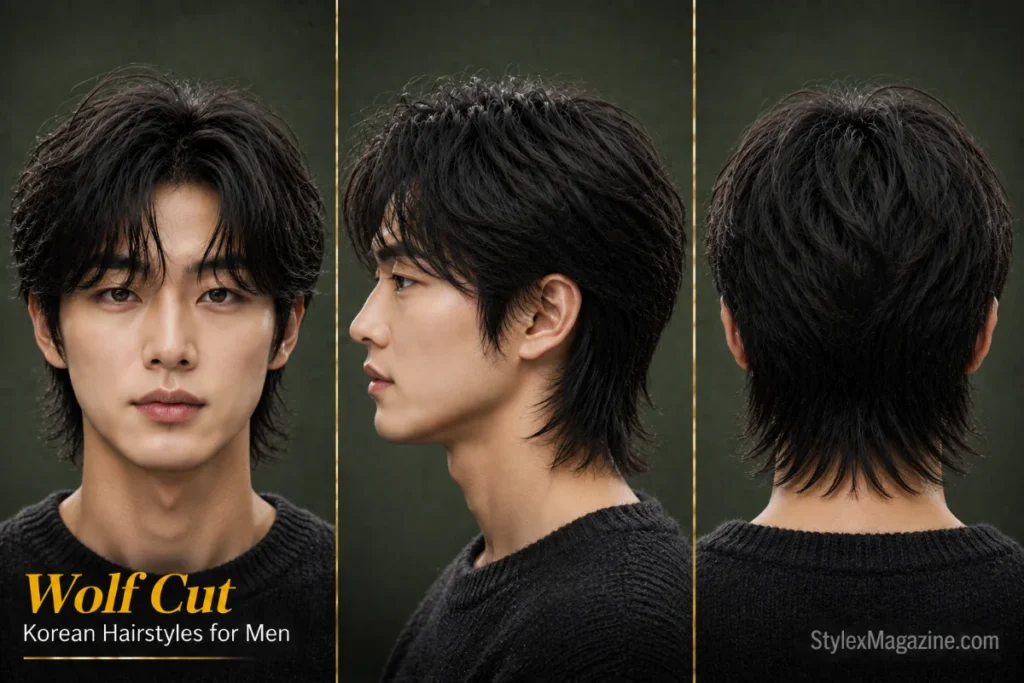
Soft choppy layers throughout, shorter on the crown, longer at the nape and sides. The Korean wolf cut is gentler than the Western version less mullet, more flow. Front layers frame the face while the longer back builds volume and shape. Blow-dry with fingers for texture, not a brush a brush smooths out the choppiness that makes this cut work. The layered fringe covers forehead length and keeps the silhouette dynamic. On thick straight hair, this cut breaks up density that the natural texture alone cannot.
Best for: Oblong, Oval | Hair type: Straight to wavy, any density | Maintenance: Every 5–6 weeks
26. Korean Mullet
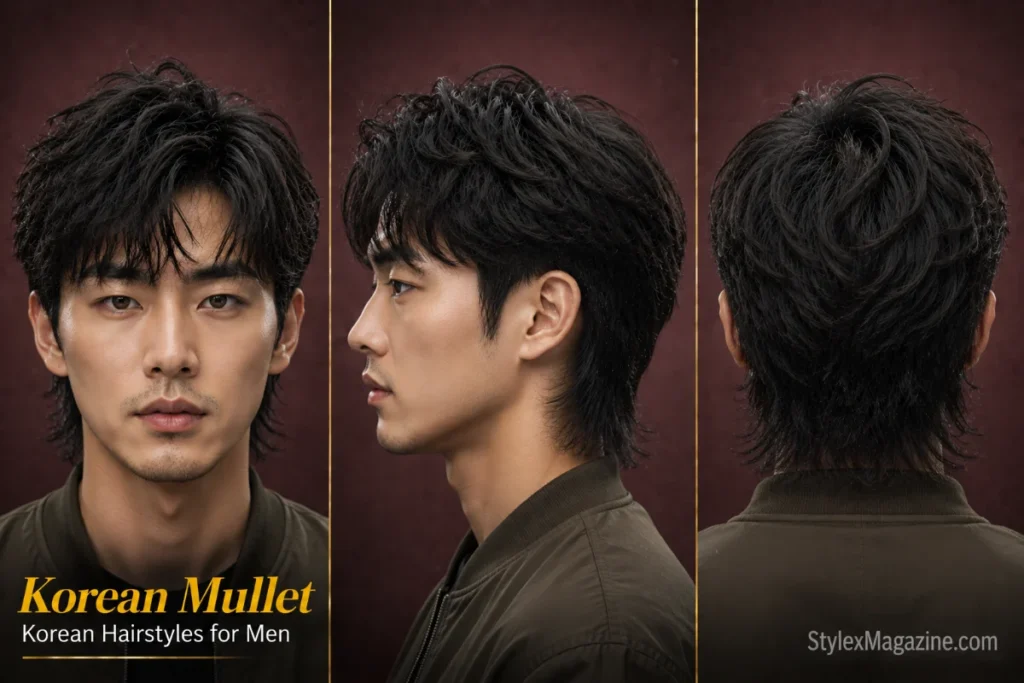
Short textured top, tight sides, longer feathered back the Korean mullet is styled in Two Block fashion with the back left longer rather than the traditional Western mullet’s uniform flow. The back should be feathered and layered, not blunt, to avoid bulk at the nape. The front stays short enough to maintain proportion while the back adds personality. One barber tip: ask for the back to stay above the collar line for the first cut. You can always grow longer, but starting too long creates weight before the shape is established.
Best for: Oval, Square | Hair type: Straight, medium to thick | Maintenance: Every 4–5 weeks
27. Shaggy Cut
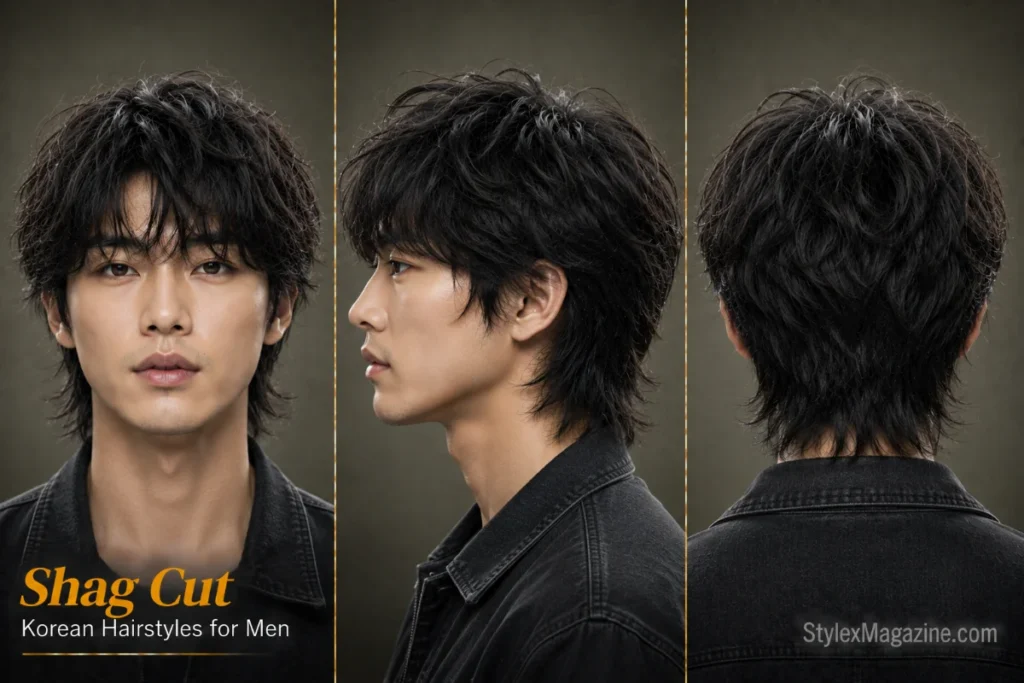
Uneven tousled layers with deliberate imperfection the Korean shag is messier than a layered cut but more controlled than a wolf cut. It works best on naturally wavy or thick hair because the texture provides built-in movement. On thin straight hair, a shaggy cut can look limp instead of textured. Sea salt spray builds the tousled body. The random layering breaks up angular features.
Best for: Oval, Square | Hair type: Wavy or thick straight thin straight hair lacks the volume | Maintenance: Every 5–6 weeks
28. Layered Cut
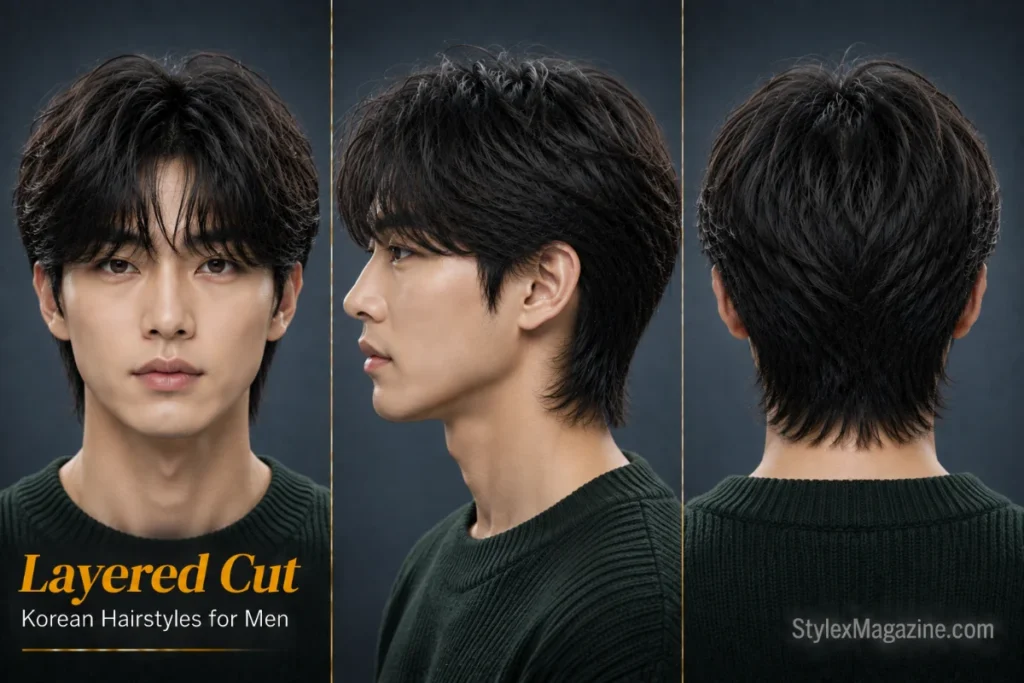
Soft flowing layers that taper gradually from crown to ends. Layers lighten thick Korean hair without sacrificing length each layer removes weight while preserving the overall shape. Ask your barber for point cutting at the ends it creates softer tips than blunt scissors. The graduated length adds vertical flow that elongates the frame. This pairs well with a soft taper on the sides for a polished finish.
Best for: Round, Oval | Hair type: Thick straight layers reduce bulk | Maintenance: Every 5–6 weeks
29. Flow Cut
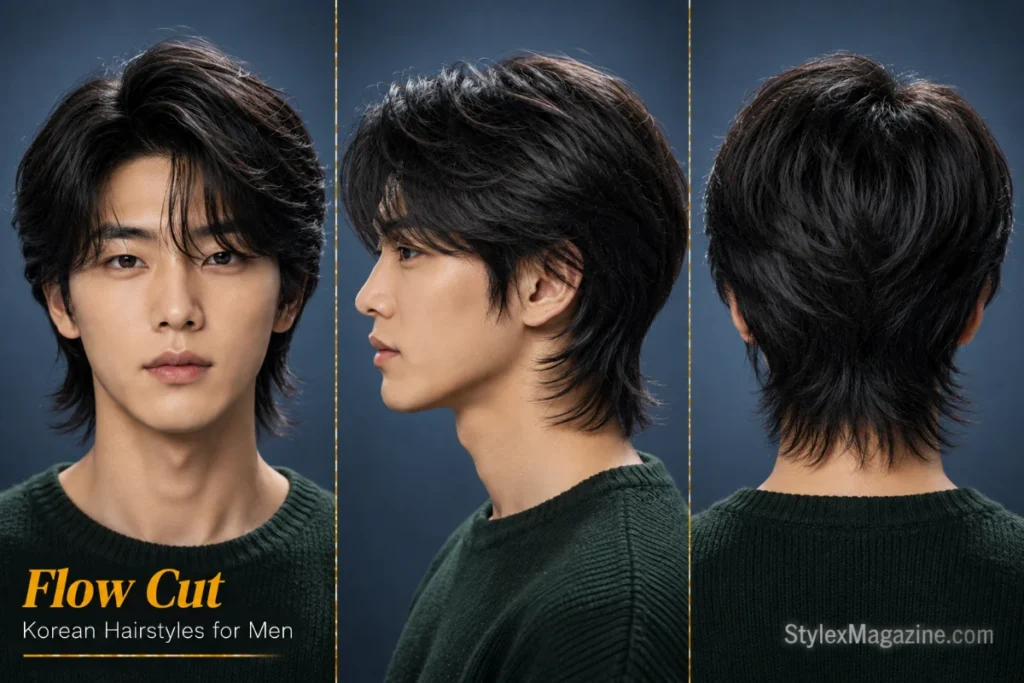
Face-framing layers that fall naturally around the cheekbones and jawline. The Korean flow cut features a slightly longer nape section than the Western version, adding fullness at the back. Blow-dry with medium heat, directing layers outward rather than straight down. Needs 5 to 6 inches minimum on top to achieve the intended drape.
Best for: Oval, Square | Hair type: Straight to wavy, medium to thick | Maintenance: Every 5–6 weeks
30. Long Bangs
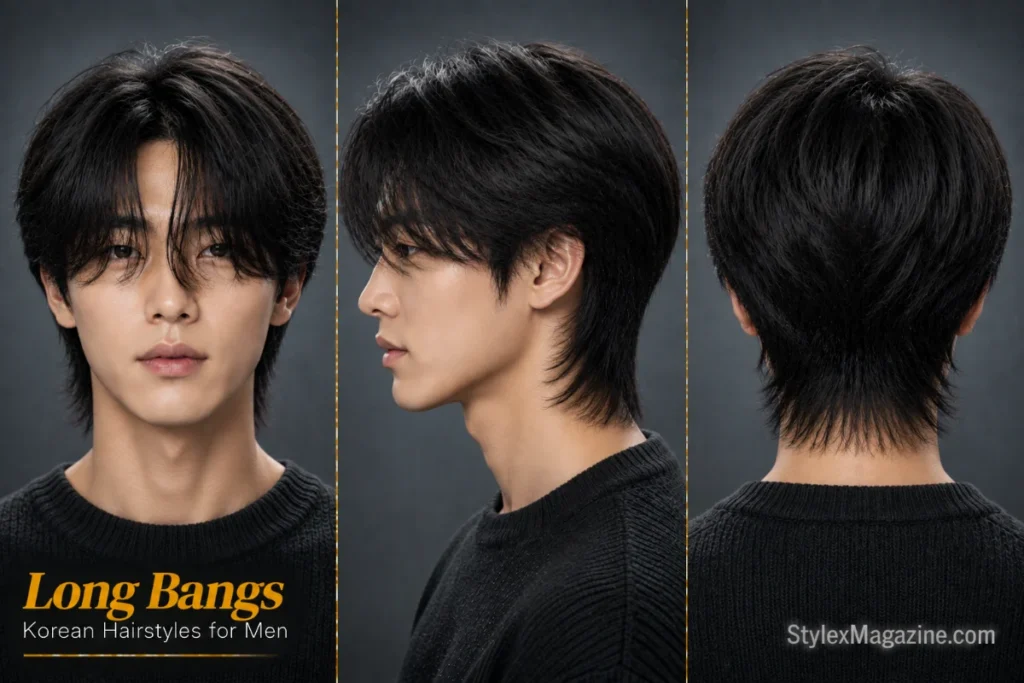
Extended fringe reaching below the eyes, framing the face from forehead to cheekbones. The drama is the point this is the K-drama heartthrob look. The long vertical lines slim and lengthen the face. The practical issue: peripheral vision. If you need full sight lines for work, driving, or sports, long bangs obstruct. Best for creative or casual settings where you can sweep them aside periodically.
Best for: Round, Square | Hair type: Straight, medium density thick hair creates too much forehead weight | Maintenance: Every 5–6 weeks
31. Bangs with Ponytail
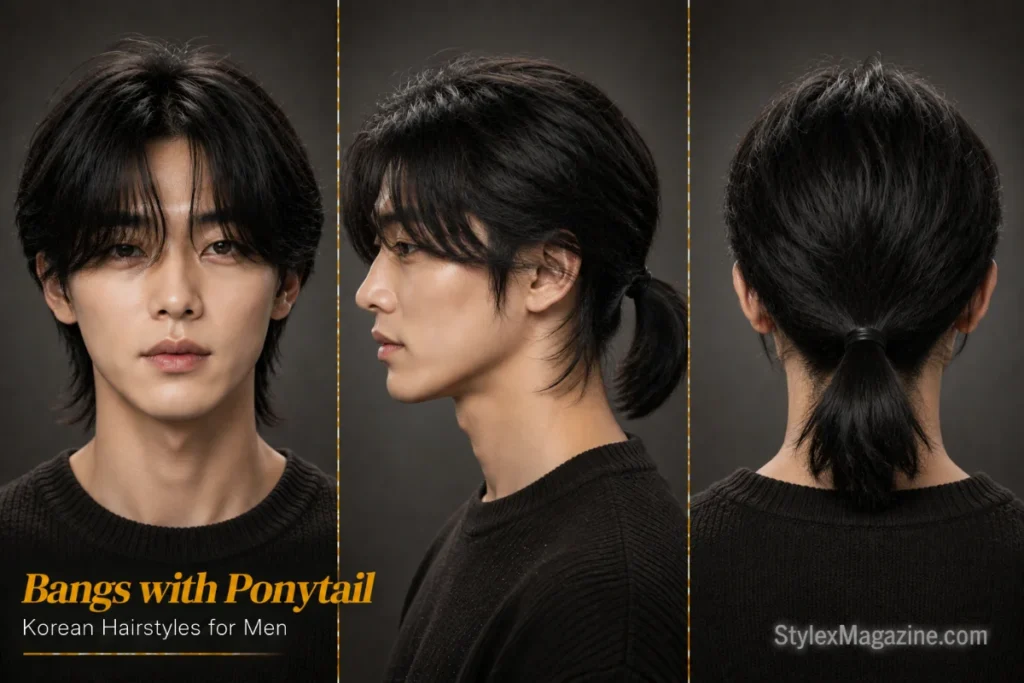
Soft fringe in front, mid-length hair tied into a low ponytail at the back. Needs at least 6 to 7 inches at the back to tie comfortably. Use a fabric hair tie, not rubber rubber snaps Asian hair at the tie point over time, causing breakage. The combination of exposed fringe and pulled-back length creates balanced proportions. The styling is minimal: shape the fringe with a blow-dryer, pull the rest back, and tie.
Best for: Oval | Hair type: Straight, thick enough to form a full ponytail | Maintenance: Every 6–8 weeks — shape trims for the fringe only
32. Slicked Back
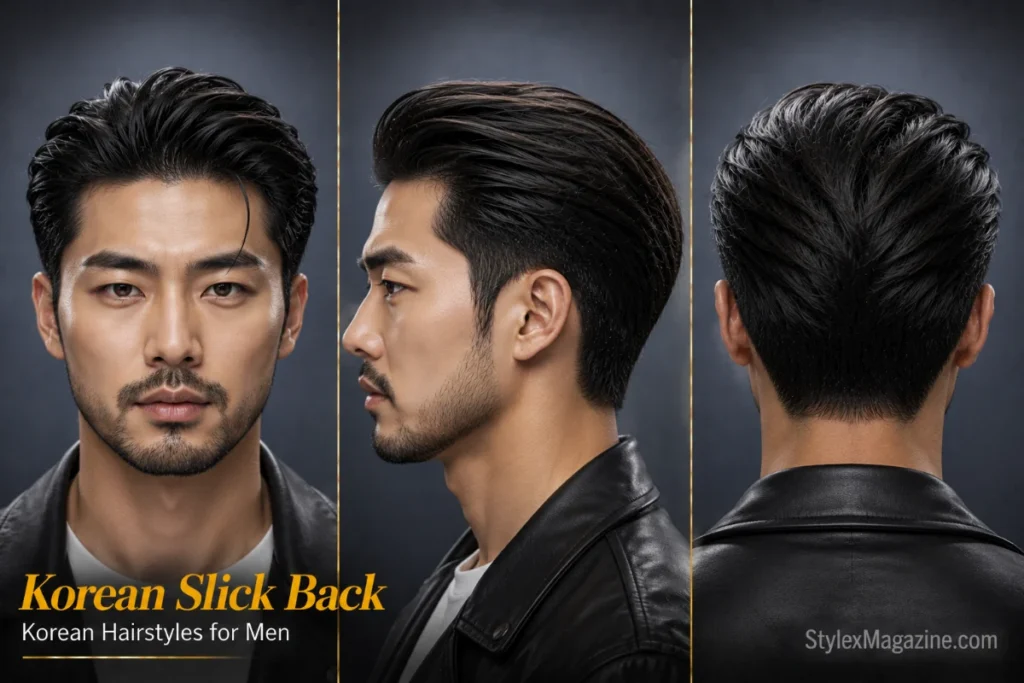
All hair swept backward off the forehead with volume at the crown. The Korean slicked back is looser than a Western pompadour think “pushed back with fingers” not “cemented with gel.” Light wax worked through damp hair, then blow-dried backward with a round brush. The fully exposed forehead works only when bone structure is balanced uneven proportions have nowhere to hide. If you have a slick back hairstyle preference already, the Korean version is the same foundation with a lighter, less structured finish.
Best for: Oval, Diamond | Hair type: Straight, thick fine hair collapses backward without enough hold | Maintenance: Every 4 weeks
33. Korean Perm (Wavy)
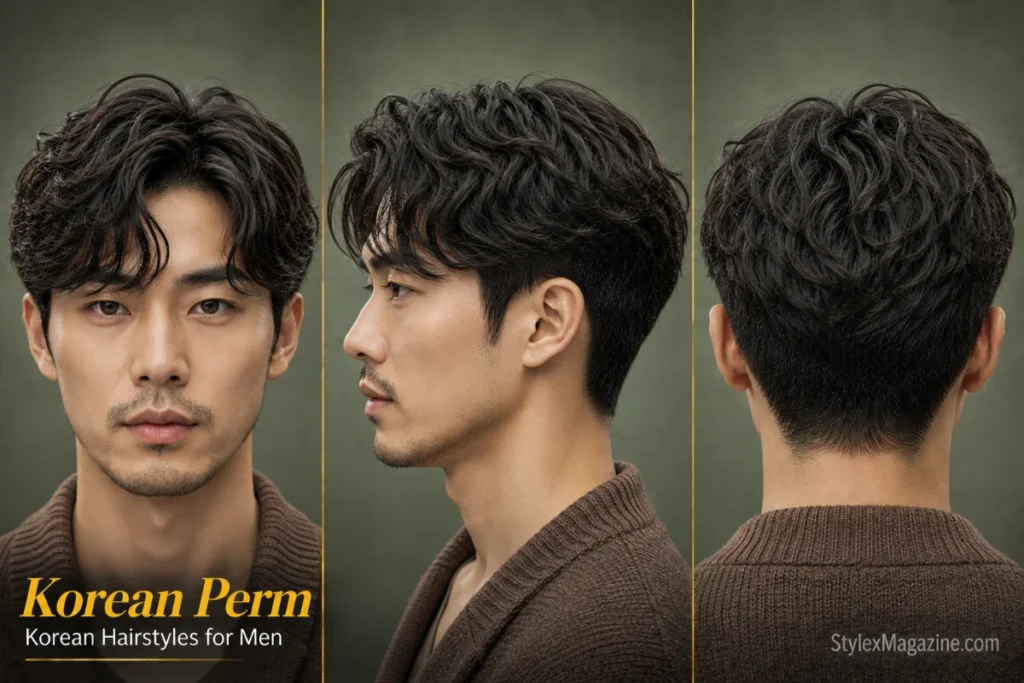
An all-over soft perm adding bounce, wave, and dimension to naturally straight hair. This is the most requested perm treatment in Korean salons it transforms flat, dense hair into textured, voluminous layers. The curls frame the face gently, creating movement that straight hair alone cannot achieve. Waves break up strong jaw lines and balance elongated proportions. Re-perm every 3 to 4 months as the curl pattern relaxes. For curly texture men who already have natural wave, a perm usually isn’t necessary a cut with the right layering achieves a similar effect.
Best for: Square, Oblong | Hair type: Straight the perm creates the wave | Maintenance: Medium daily — re-perm every 3–4 months
34. Shadow Perm
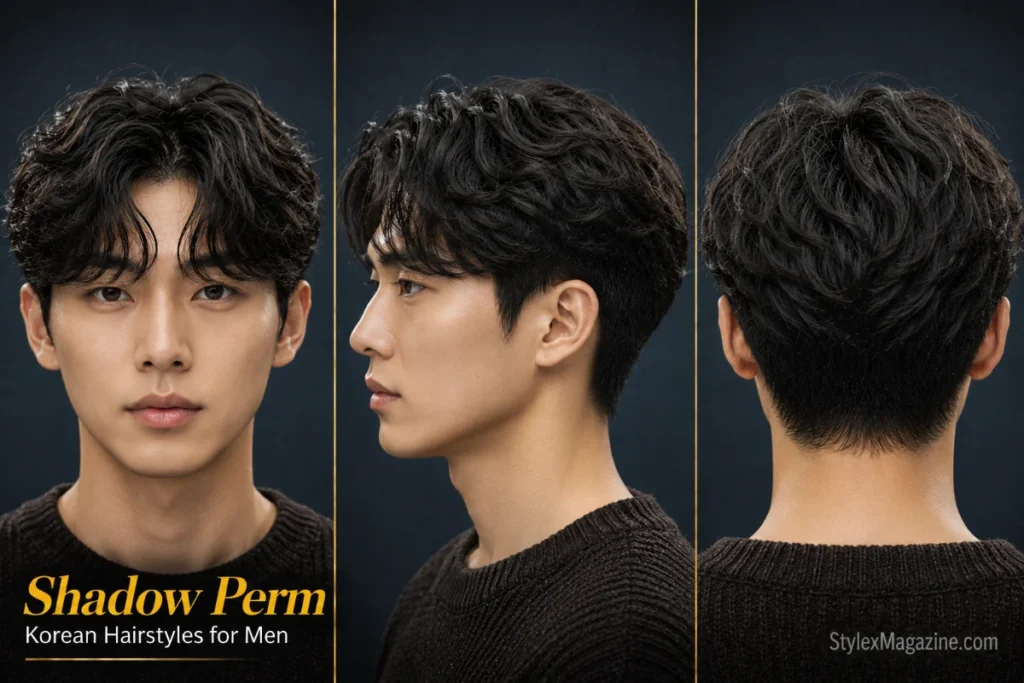
A dramatic voluminous fringe that “shadows” the forehead with curled, lifted hair. Needs 5 or more inches on top for the fringe to carry enough weight and volume to create the shadow effect. This is the boldest Korean perm option not subtle, not office-conservative. The voluminous top creates width at the forehead and softens the lower face. In my experience, men who want the shadow perm but have fine hair need to set realistic expectations fine strands lack the density for a true shadow effect.
Best for: Square, Oblong | Hair type: Thick straight fine hair won’t create enough volume | Maintenance: Medium — re-perm every 3 months, daily blow-dry to reshape
35. Leaf Perm
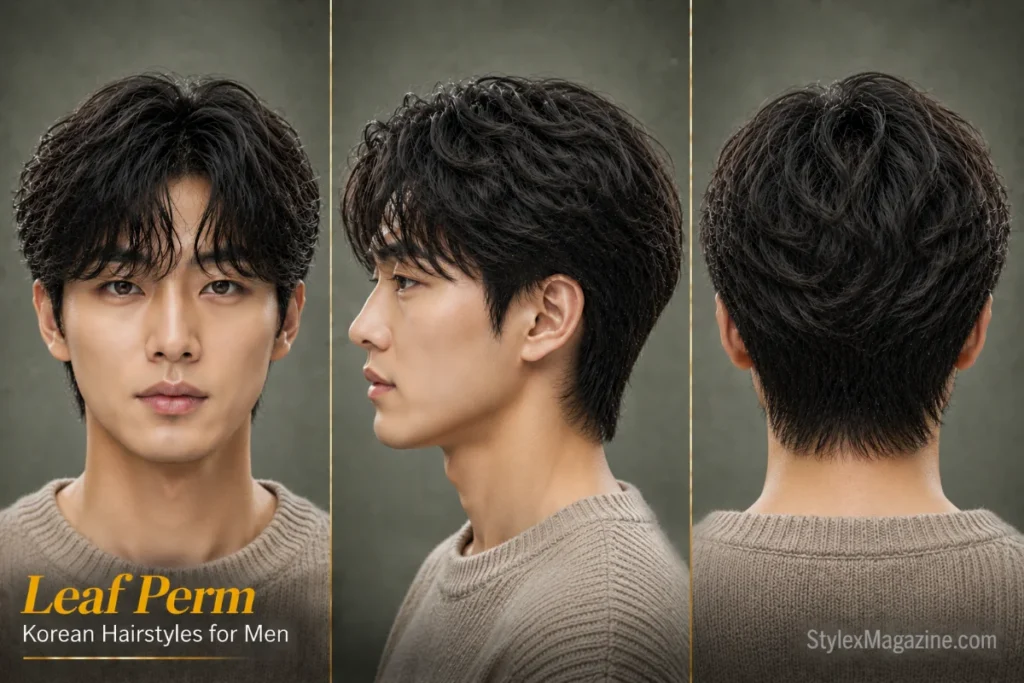
The newest perm trend in Korean salons. The leaf perm creates soft outward-and-inward waves that mimic the natural curve of a leaf less uniform than a standard perm, more organic. It strengthens the face-framing effect of any medium to long cut. The wave pattern broadens the upper face without stacking height. The leaf pattern sits best at 4 to 5 inches of top length, where the wave has room to form without weighing down.
Best for: Oblong, Oval | Hair type: Straight, medium to thick | Maintenance: Medium re-perm every 2–3 months
Which Korean Hairstyles Work for Short, Medium, and Long Hair?
Short (under 3 inches on top): Two Block, Caesar, Textured Crop, French Crop, Buzz Cut, Drop Fade, Taper Fade, Ivy League, Short Textured
Medium (3–5 inches on top): Comma Hair, Curtain, Middle Part, Side Part, Dandy Cut, See-Through Bangs, Textured Fringe, S-Shaped Fringe, Side Swept Fringe, Side Bangs, Down Perm, Messy Hair, Bowl Cut, Korean Undercut, KPop Style
Long (5+ inches on top): Wolf Cut, Korean Mullet, Shaggy Cut, Layered Cut, Flow Cut, Long Bangs, Bangs with Ponytail, Slicked Back, Korean Perm, Shadow Perm, Leaf Perm
A note on hair color: Many K-pop idols pair these cuts with ash brown, dark blonde, or platinum highlights. Color adds visual dimension to flat black hair and makes layering more visible. If you are considering color, lighten after the cut bleaching changes hair texture, and your barber needs to cut the final texture, not the pre-bleach version.
How Should You Ask Your Barber for a Korean Haircut?
Getting the right korean hairstyles for men starts before the clippers turn on. Bring a photo but don’t stop there. A photo shows the finished product, not the technical instructions your barber needs. Korean haircut terminology like “Two Block,” “Comma Hair,” or “Dandy Cut” may not translate at a barbershop outside Seoul. Here’s how to bridge the gap.
For a Two Block, ask for a disconnected undercut with 3 to 4 inches on top left forward. Specify that you want the weight line hidden, not blended — the point of a Two Block is a visible contrast between the blocks, not a graduated fade.
For the fringe, be specific about where it ends relative to your eyebrows or eyes. “I want the fringe at mid-forehead” is a clear instruction. “I want Korean bangs” is not. Also mention the direction forward, side-swept, or center-parted — and whether you need a perm to hold any curl shape.
For the sides, the distinction matters: Korean styles typically favor soft tapers over skin fades. If you want the K-drama look, say “taper to a #3 at the sideburns, no skin showing.” If you want a more modern Seoul street look, a low fade works — but specify “low fade, not mid or high.”
One thing I always tell clients: describe how you plan to style it daily. “I want to be able to push the top forward with my fingers and leave the house” gives a barber more useful information than any style name.
How to Style Korean Hairstyles?
Blow-drying is the foundation of every Korean men’s hairstyle. Not optional 90% of the volume, direction, and shape in a Korean cut comes from blow-drying technique, not product. Direct airflow upward at the roots for lift. Use a round brush to shape the fringe direction. Medium heat, not high high heat damages straight hair and causes frizziness that works against the clean Korean aesthetic.
Match the product to the style type. Matte clay or texture powder for short cuts these add grip and separation without shine. Light styling cream or soft wax for medium-length cuts like Comma Hair and Curtains hold without stiffness. Sea salt spray for long or wavy styles builds body and movement without weight. Avoid heavy gels across all Korean styles. Gel creates a wet, rigid finish that contradicts the natural texture Korean cuts rely on.
The fringe shapes the entire look. Whether it’s a comma curve, a straight Caesar line, or see-through wisps — spending 30 extra seconds on the fringe while blow-drying determines whether the style lands or falls flat. Shape the fringe last, after the rest of the hair is dry, so you can see the proportion clearly.
How to Maintain a Korean Hairstyle?
Trim frequency depends on the cut. Short styles like the Two Block, Caesar, and any fade-based cut need trimming every 2 to 3 weeks the sharp lines and short sides lose definition quickly. Medium styles like Comma Hair, Curtains, and the Dandy Cut hold shape for 4 to 5 weeks between cuts.
Long styles like the Wolf Cut, Flow, and Layered Cut can stretch 5 to 6 weeks. Perm-based styles need shape trims every 5 to 6 weeks and a re-perm every 2 to 4 months depending on the type.
Fringe styles need more frequent washing. See-through bangs, textured fringe, and comma hair sit directly on the forehead. Forehead oil transfers to the fringe within hours, causing it to clump and lose shape. Wash the fringe daily — even if you only wash the full head every 2 to 3 days.
Perm aftercare is non-negotiable. After any Korean perm treatment, wait 48 hours before washing. Use a hydrating conditioner to replace the moisture that the perming chemicals strip. Avoid brushing permed hair — finger-comb only. Tight headbands and hats compress the curl pattern and flatten the shape. A lightweight curl-enhancing cream applied to damp hair after each wash extends the perm’s lifespan between salon visits.
FAQ
Can I Get a Korean Haircut at a Regular Western Barbershop?
Yes. Most Western barbers know fades and tapers but may not recognize terms like Two Block or Dandy Cut. Translate into instructions they already understand “disconnected undercut, 4 inches on top, no blending at the weight line” communicates a Two Block without the name.
Will a Korean Perm Damage My Hair?
Korean perms use milder solutions than Western perms and target specific sections rather than the entire head. Post-perm dryness is the main concern sulfate-free shampoo and weekly deep conditioner offset most of it. Avoid perming already-bleached hair.
How Long Does It Take to Grow Into a Korean Hairstyle?
Starting from a buzz cut, most trending korean hairstyles male clients ask for — like Comma Hair or Curtains need 4 to 6 months. The awkward phase hits around month 2 to 3 when sides puff out but the top isn’t long enough to style. A down perm keeps sides flat while the top catches up.
Do Korean Hairstyles Work on Non-Asian Hair Types?
The structure works on any ethnicity, but the styling changes. Short hairstyles korean style barbers create rely on straight, dense hair for that clean silhouette — other hair types may need adjusted technique. Fine hair may need volumizing powder for root lift. Afro-textured hair can rock a Two Block foundation, but the top follows natural curl patterns rather than a straight fall.
How Do I Stop My Korean Fringe from Going Flat by Midday?
Texture powder at the roots before styling absorbs oil before it starts. Blow-dry the fringe on medium heat, then hit it with cold air to lock the shape. Carry a travel-size dry shampoo for a midday refresh.
What’s the Difference Between a Two Block and an Undercut?
A Two Block hides the weight line short meets long under the top layer, invisible when styled. An undercut exposes the disconnection with a visible shaved section. Two Block is more conservative; undercut is bolder. Both serve as base cuts styled forward, parted, or textured.

Other Articles
No Comment! Be the first one.