
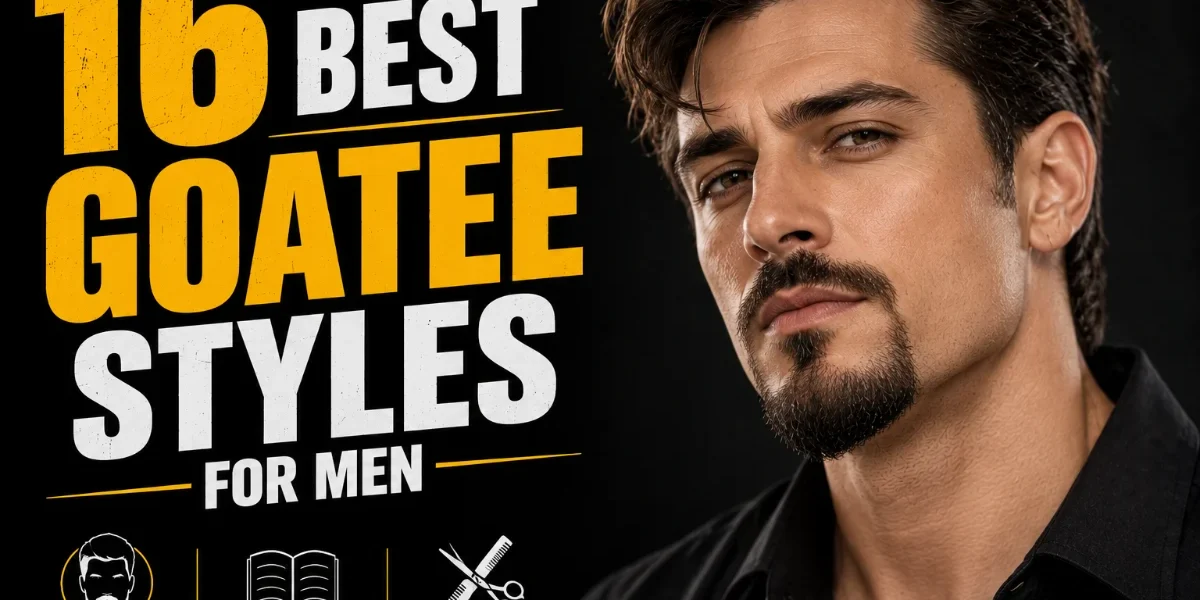

Quick Answer: A goatee is facial hair grown on the chin area, with the cheeks shaved clean. In its purest form, a goatee has no mustache. Add a connected mustache and it becomes a circle beard. Add a disconnected mustache and it becomes a Van Dyke. These 16 goatee types cover every variation worth growing, matched to face shape, with the barber script for each.
The goatee is the single best style for men whose cheeks never filled in. Rather than stretching thin growth across the whole face and hoping it looks intentional, you concentrate everything where the density already lives: the chin and the mouth area. The style gets its name from the tuft of hair on a goat’s chin, and it dates back to ancient Greece, where the god Pan was depicted with a pointed chin beard in sculpture and painting.
By the 1990s, it had crossed from counterculture into the mainstream. Bryan Cranston built Walter White’s entire transformation around a circle beard goatee. Johnny Depp wore a Van Dyke variation for a decade of press tours. Robert Downey Jr. made the Balbo part of the Tony Stark identity. Three decades later, the goatee has outlasted every grooming trend that tried to replace it.
In the chair, I shape more goatees than any other individual style. More than full beards, more than stubble. The reason is practical: most men grow strongest on the chin and upper lip. A goatee works with that biology instead of fighting it, and the style looks full and polished on men who could never pull off a traditional beard.
What Is a Goatee?
A goatee is facial hair grown on the chin, with the cheeks and neck shaved clean. In its strictest definition, a goatee has no mustache at all. In common usage, people call anything from a chin patch to a connected circle beard a “goatee,” so miscommunication at the barber chair happens constantly.
Here is how the goatee family breaks down:
- Pure goatee: Chin hair only. No mustache. The original definition. For all no-mustache variations, see beard styles without mustache.
- Circle beard (full goatee): Mustache connected to chin beard in a ring around the mouth.
- Van Dyke: Mustache and chin beard present but separated by bare skin. Covered in full in the Van Dyke beard guide.
- Extended goatee / Hollywoodian: Chin beard stretched along the jawline without sideburns.
- Anchor: Pointed chin beard with a soul patch and thin jaw trace, shaped like an anchor.
- Balbo: Floating mustache and a wide chin beard, no connection between them, no sideburns.
Every style on this page fits somewhere in this family tree. The differences come down to width, length, whether the mustache is included, and whether it connects to the chin.
What Are the Best Goatee Styles for Men?
Every style below includes length, face shape match, and what to tell your barber. The order runs from minimal to maximal coverage.
1. Soul Patch
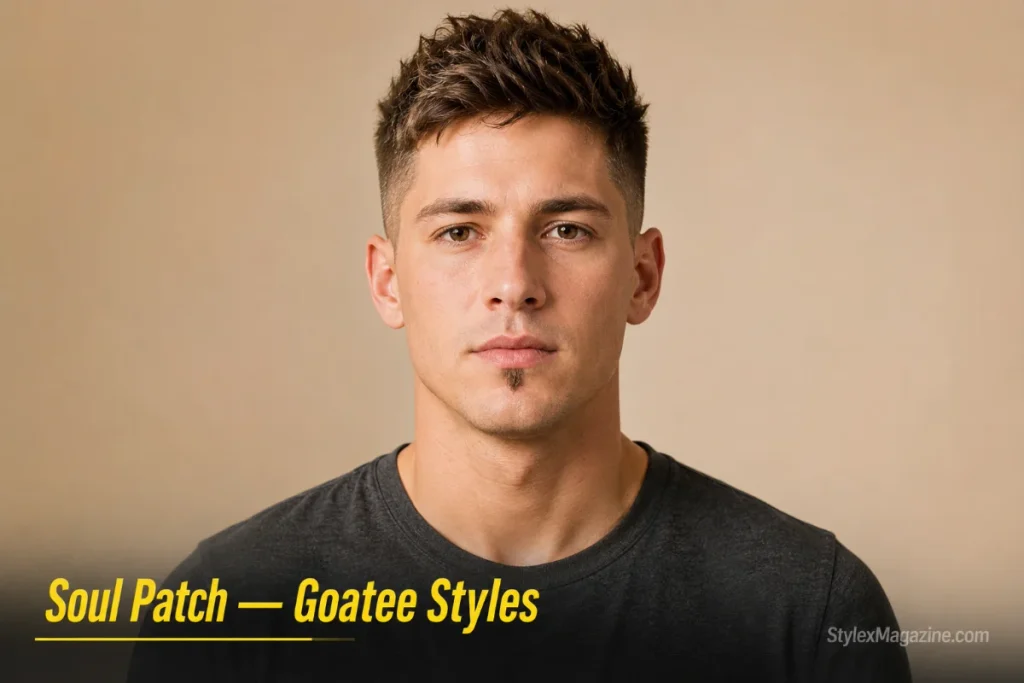
Styling tip: Thumbnail-sized, no wider | Hair type: All | Length: 5-10mm
A small tuft of hair directly below the lower lip, everything else shaved clean. The soul patch is the minimum viable goatee: one element, five minutes of grooming per week, zero chance of looking unkempt. Keep it thumbnail-sized or smaller. Let it widen and it loses all definition.
Best for: All face shapes. Men who want a touch of facial hair without commitment.
Tell your barber: “Soul patch only, thumbnail width, clean everywhere else.”
Maintenance: Trim weekly. Shave borders every 3-4 days.
2. Chin Puff
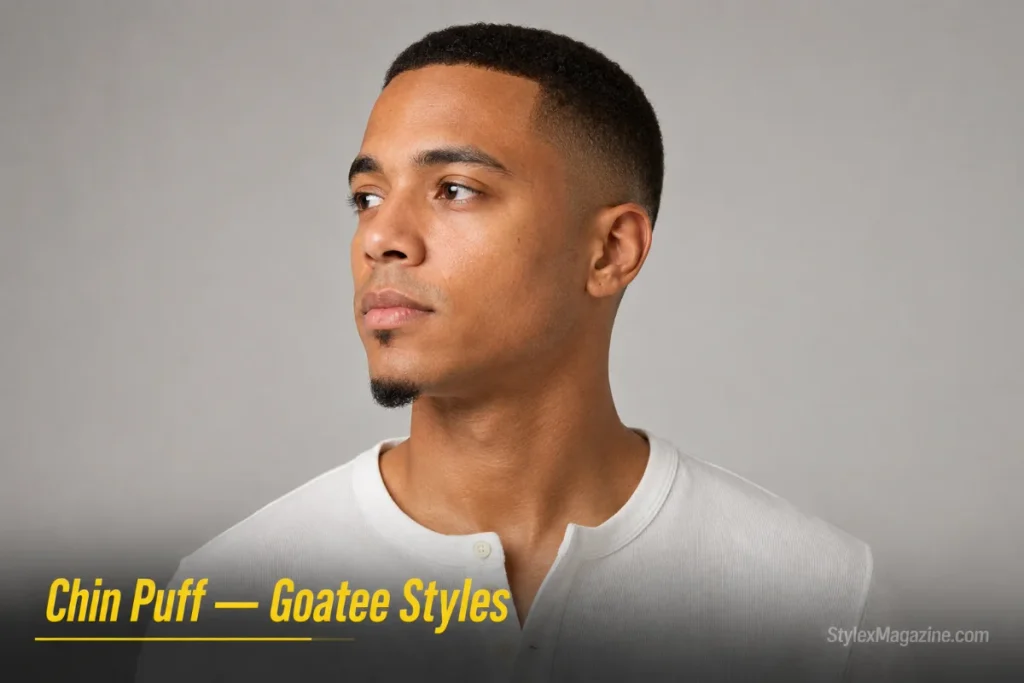
Styling tip: Centered on the chin tip | Hair type: All | Length: 5-15mm
A small, concentrated patch of hair on the point of the chin only. Narrower and lower than a petite goatee, the chin puff sits at the very tip where the jaw meets. No mustache, no lip coverage, just a single tuft at the lowest point. It works on men with strong chin growth but thin lip or jaw coverage, because you only need density in one small zone.
Best for: Square and diamond face shapes. Men with minimal facial hair growth.
Tell your barber: “Chin puff, small patch on the chin tip only, clean everywhere else.”
Maintenance: Trim weekly. Shave borders every 3-4 days.
3. Landing Strip
Styling tip: Quarter-inch width maximum | Hair type: All | Length: 5-10mm
A narrow vertical strip from the lower lip straight down to the chin. One clean line. The landing strip adds vertical emphasis without any width, making it strong for round faces that need lengthening. Keep the width at a quarter inch or narrower. Wider and it becomes a standard goatee.
Best for: Round and oval face shapes.
Tell your barber: “Landing strip, quarter-inch wide, lip to chin, clean everywhere else.”
Maintenance: Re-edge the sides every 2-3 days. Minimal time.
4. Classic (Pure) Goatee
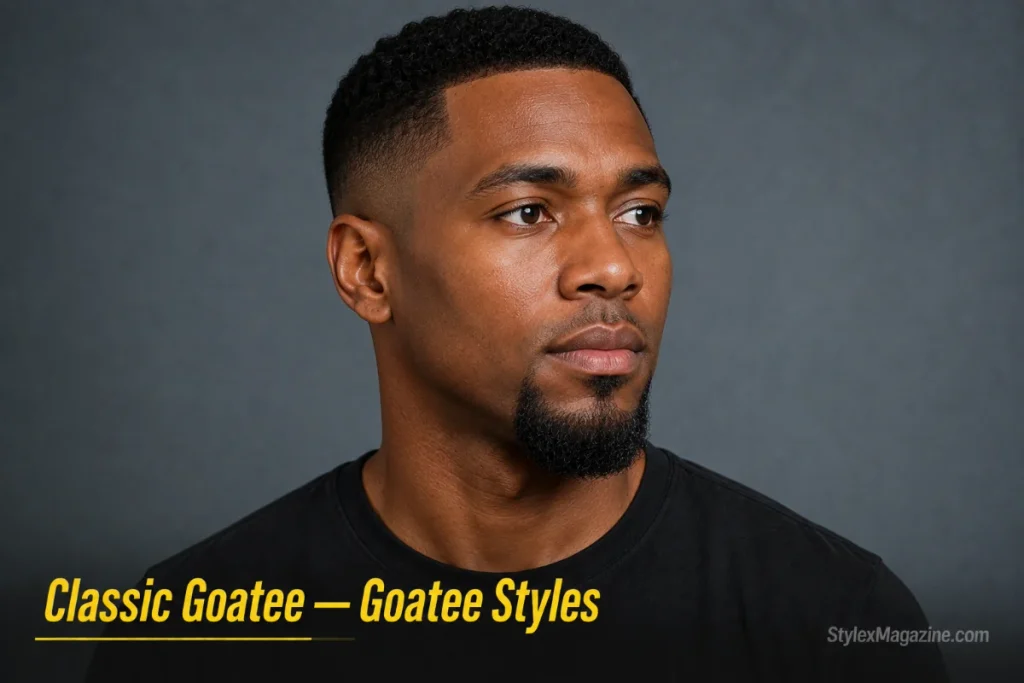
Celebrity: No single ambassador (the universal default) | Hair type: All | Length: Guard 2-4 (5-12mm)
Hair on the chin only, no mustache, cheeks clean. The definition of a goatee in its original form. The chin patch sits between the corners of the mouth and extends to just above the neckline. Every other goatee variation starts here, and it stands on its own for men who want clean definition without any complexity.
Best for: All face shapes. Round faces gain the most from the vertical chin emphasis.
Tell your barber: “Classic goatee, chin only, no mustache, guard 3, cheeks and lip clean.”
Maintenance: Cheek and lip shave every 2-3 days. Length trim weekly.
5. Petite Goatee
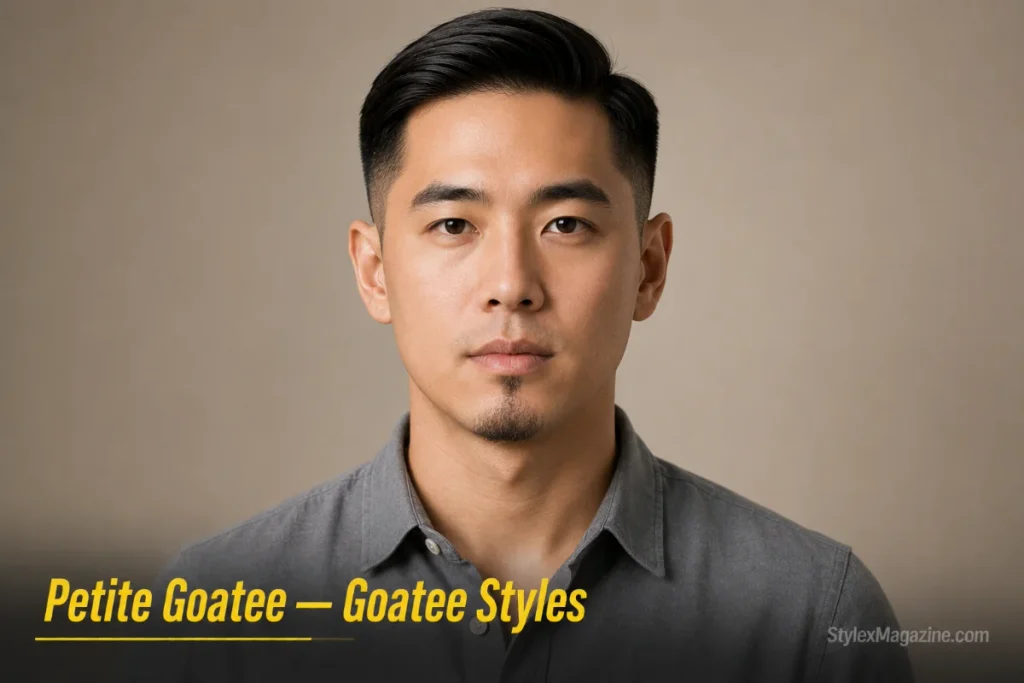
Styling tip: Smaller than you think | Hair type: All | Length: Guard 2-3 (5-10mm)
A smaller, tighter version of the classic: a neat patch centered on the chin rather than spanning its full width. The petite goatee is understated by design. Professional, subtle, and suited to men with smaller facial features who would be overwhelmed by a wider chin beard.
Best for: Oval and oblong face shapes. Smaller facial features. Corporate settings.
Tell your barber: “Petite goatee, small and centered, guard 2, cheeks clean, no mustache.”
Maintenance: Trim weekly. Edges every 3 days.
6. Stubble Goatee
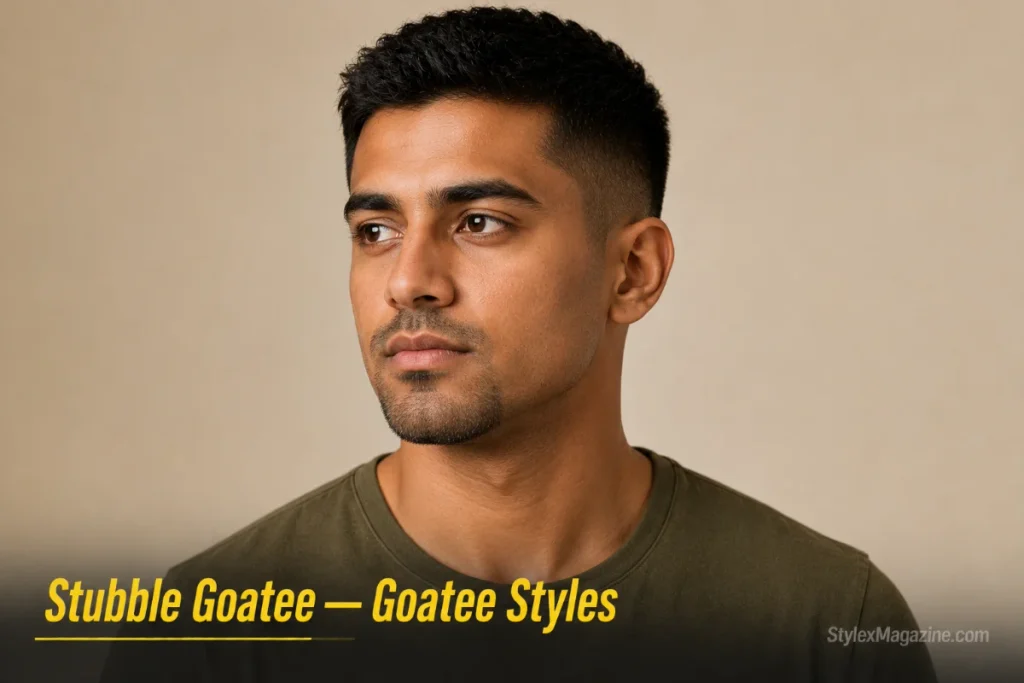
Styling tip: Let the edges stay soft | Hair type: All | Length: Guard 0.5-1 (2-4mm)
The goatee shape held at heavy stubble length with slightly softer edges. The lowest-commitment version that still shapes the chin. The stubble texture disguises thin spots and density gaps better than any longer version, making this the best entry point for men unsure whether a goatee will suit them.
Best for: All face shapes. Men testing the goatee for the first time. Patchy growers.
Tell your barber: “Stubble goatee, guard 1, soft edges, cheeks shaved.”
Maintenance: Trimmer every 3-4 days. Lowest commitment goatee.
7. Circle Beard (Full Goatee)
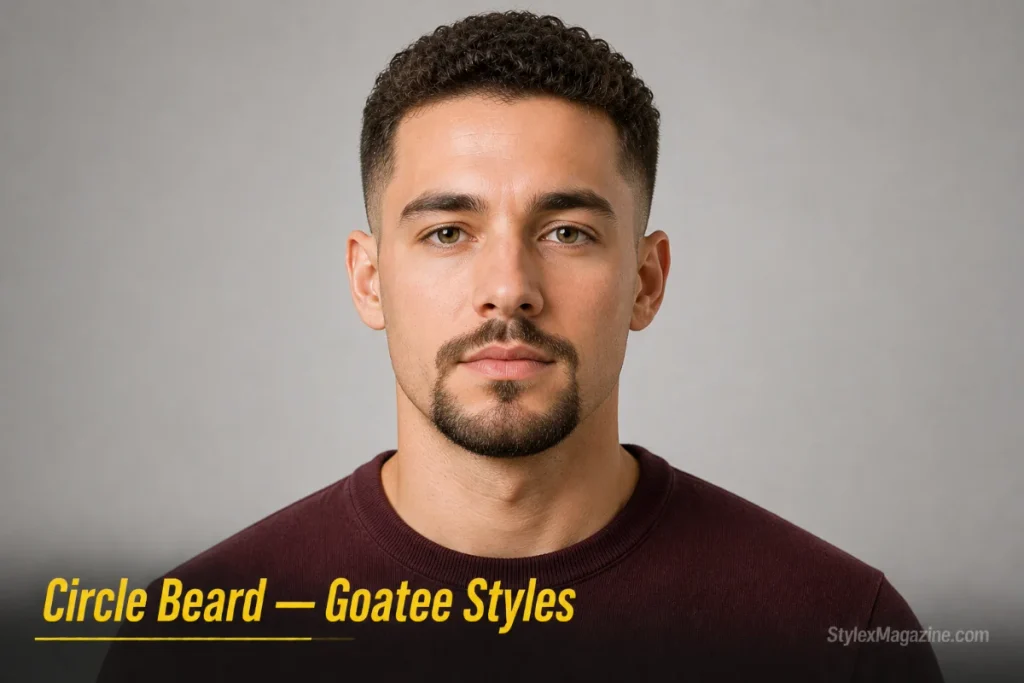
Celebrity: Bryan Cranston (Walter White) | Hair type: All | Length: Guard 3-4 (8-12mm)
The mustache connects to the chin beard in one continuous ring around the mouth. Technically a circle beard, but universally called a “goatee” in everyday conversation. The connection at the mouth corners is what separates this from a Van Dyke (which keeps them apart). The full goatee is the single most popular goatee variation worldwide.
Best for: Oval, square, and heart-shaped faces.
Tell your barber: “Full goatee, connected, circle shape, guard 3, cheeks clean.”
Maintenance: Trim weekly. Cheek shave every 2-3 days. Re-edge the ring every 3 days.
8. Pointed Goatee
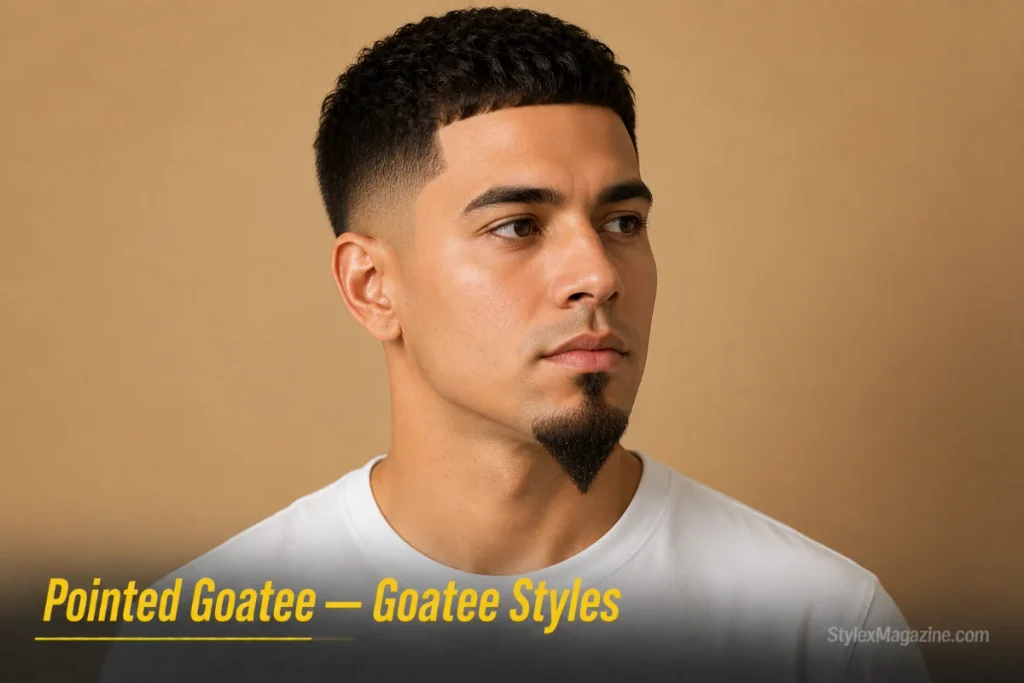
Hair type: Straight to wavy | Length: 1-2 inches chin
The chin beard sculpted into a sharp downward-pointing triangle. All the vertical emphasis of a standard goatee concentrated into a single point. Round-faced men benefit most because the point pulls the eye downward and lengthens the chin visually.
Work beard balm through the chin hair each morning and twist the tip to set the shape. Without product, the point spreads within hours.
Best for: Round and heart-shaped faces. Men who want maximum chin elongation.
Tell your barber: “Pointed goatee, sharp triangle at the chin, no mustache, cheeks clean.”
Maintenance: Daily balm at the point. Trim the triangle sides every 2 weeks.
9. Anchor Goatee
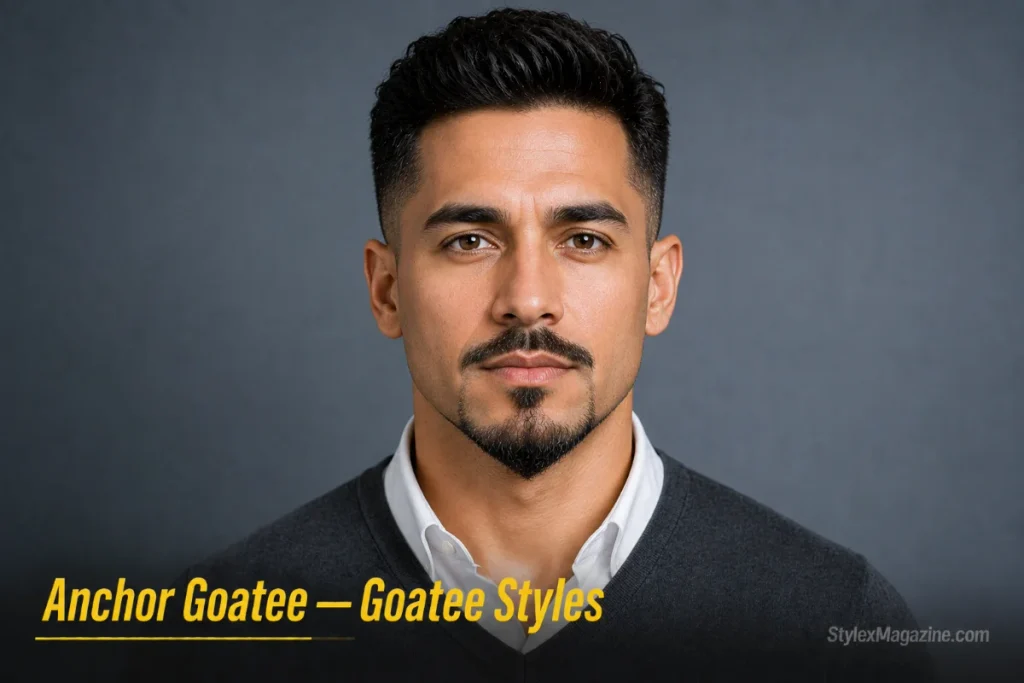
Celebrity: Robert Downey Jr. | Hair type: All | Length: Guard 3-4 (8-12mm)
A pointed chin section, a soul patch, and a thin trace along the jawline, shaped to resemble a ship’s anchor. Robert Downey Jr. built his Tony Stark persona around a version of this style. Three separate elements need individual edging every 2-3 days, making this the highest-maintenance goatee on this page.
Best for: Round and oval face shapes. Men with strong chin and jaw growth.
Tell your barber: “Anchor goatee, pointed chin, soul patch, thin jaw trace, detached mustache.”
Maintenance: Detail trimmer every 2-3 days. High commitment.
10. Extended Goatee (Hollywoodian)
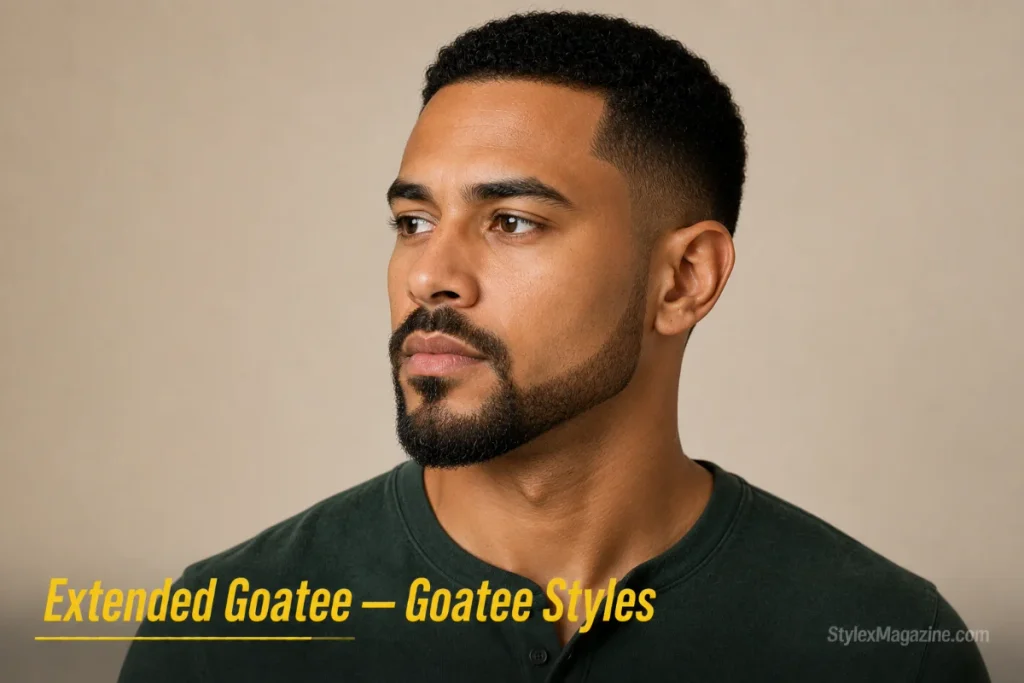
Celebrity: Leonardo DiCaprio | Hair type: All | Length: Guard 3-5 (8-15mm)
The chin beard stretched along the jawline toward the ears, stopping before the sideburns, with a connected mustache. Also called a Hollywoodian. More coverage and more jaw definition than a standard goatee, while keeping the upper cheeks open. Leonardo DiCaprio has worn this style at multiple premieres.
Best for: Round faces (adds jaw definition). Men who want more presence than a standard goatee.
Tell your barber: “Extended goatee, follow the jawline toward the ears, connected mustache, no sideburns, cheeks clean.”
Maintenance: Trim weekly. Cheek and sideburn shave every 2-3 days.
11. Balbo
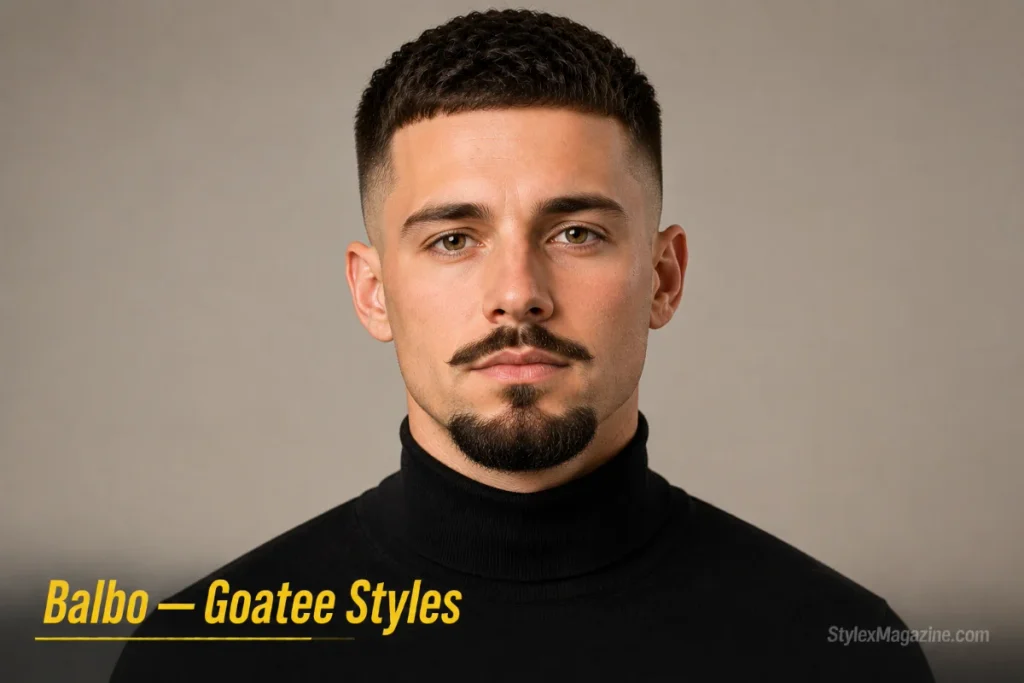
Celebrity: Robert Downey Jr. (Tony Stark) | Hair type: All | Length: Guard 3-4 (8-12mm)
A wide chin beard and a floating mustache that never touch, with no sideburns. Named after Italian aviator Italo Balbo. Robert Downey Jr.’s Iron Man look is the most recognized Balbo in popular culture. The wide chin section builds jaw definition that narrower goatee styles cannot match.
Grow a month of coverage first, then carve the Balbo out of it. The chin section wraps slightly toward the mouth corners but stops short of connecting to the mustache.
Best for: Oval and square face shapes. Men with soft jawlines who need definition.
Tell your barber: “Balbo, wide chin beard, floating mustache, no connection, no sideburns.”
Maintenance: Detail trimmer every 2-3 days. Barber shape every 3 weeks.
12. Disconnected Goatee
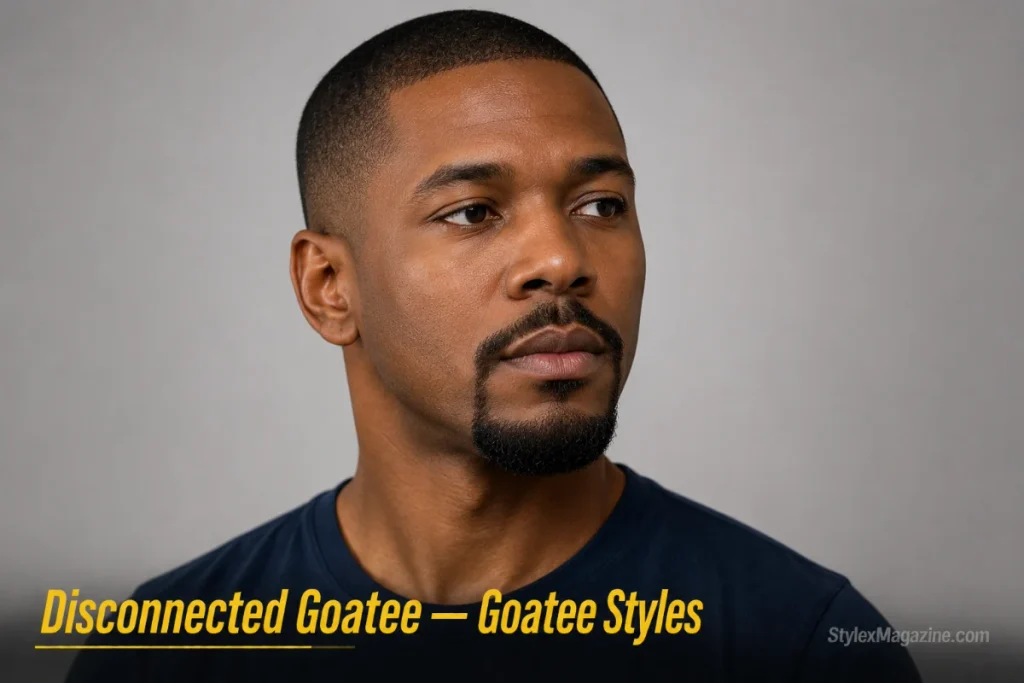
Styling tip: The gap is roughly a quarter inch | Hair type: All | Length: Guard 3-4 both elements
Mustache and chin beard both fully grown, but separated by a strip of bare skin at each mouth corner. Structurally, this is the same concept as a Van Dyke, but without the pointed chin shaping. The disconnect gives it a modern, clean look that a connected circle beard cannot match. For the full guide on pointed and styled disconnected variations, see the Van Dyke beard article.
Best for: All face shapes. Men who want the two-element look without the pointed Van Dyke chin.
Tell your barber: “Disconnected goatee, mustache and chin separate, quarter-inch gap, cheeks clean.”
Maintenance: Razor the gaps every 2-3 days.
13. Goatee with Handlebar Mustache
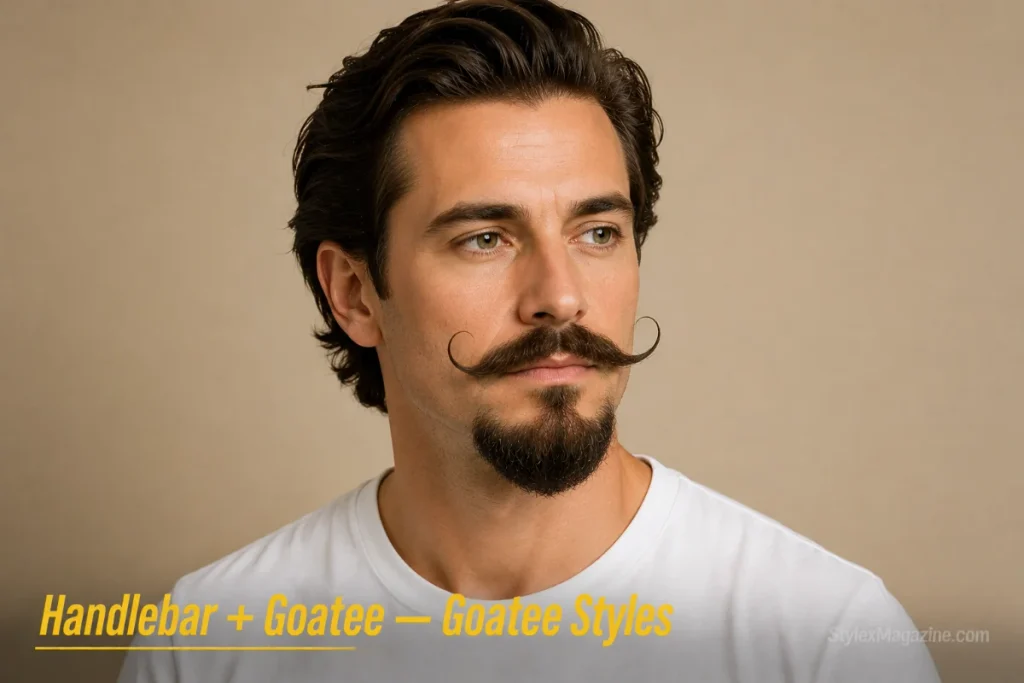
Celebrity: Frank Zappa (Zappa variation) | Hair type: Straight to wavy mustache | Length: 3+ inches mustache, 1-2 inches chin
A standard chin goatee paired with a handlebar mustache grown past the mouth corners and curled upward with wax. The handlebar becomes the focal point. The goatee grounds it. Expect 3-4 months before the mustache ends have enough length to curl, and 5-10 minutes of daily shaping with heated wax.
The Zappa variation (Frank Zappa’s signature) is a thick, wide mustache paired with a soul patch only, no chin beard.
Best for: Oval and oblong face shapes. Men committed to a statement style.
Tell your barber: “Goatee with handlebar, curled mustache, standard chin beard, cheeks clean.”
Maintenance: Daily wax and shape. Barber trim every 3-4 weeks. High maintenance.
14. Chin Strap Goatee
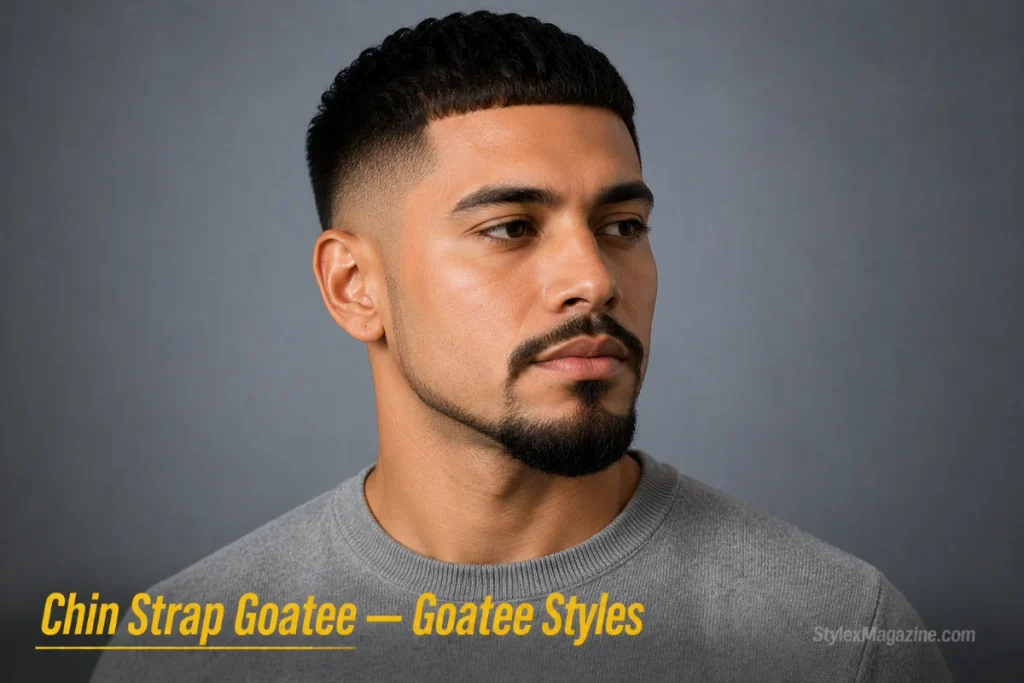
Styling tip: The strap should be thinner than the goatee | Hair type: All | Length: Guard 2-3 strap, guard 3-4 goatee
A goatee at the chin connected to a thin chin strap running along the jawline from ear to ear. The strap adds jawline structure that a standalone goatee cannot provide. The two elements need to be at different widths to avoid looking like a short boxed beard: keep the strap thinner than the goatee.
For the full guide on chin strap variations, widths, and face shape matching, see chin strap beard styles.
Best for: Round and oval face shapes.
Tell your barber: “Chin strap goatee, goatee at the chin, thin strap along the jaw, cheeks clean.”
Maintenance: Re-edge strap and goatee every 2-3 days.
15. Goatee for Black Men
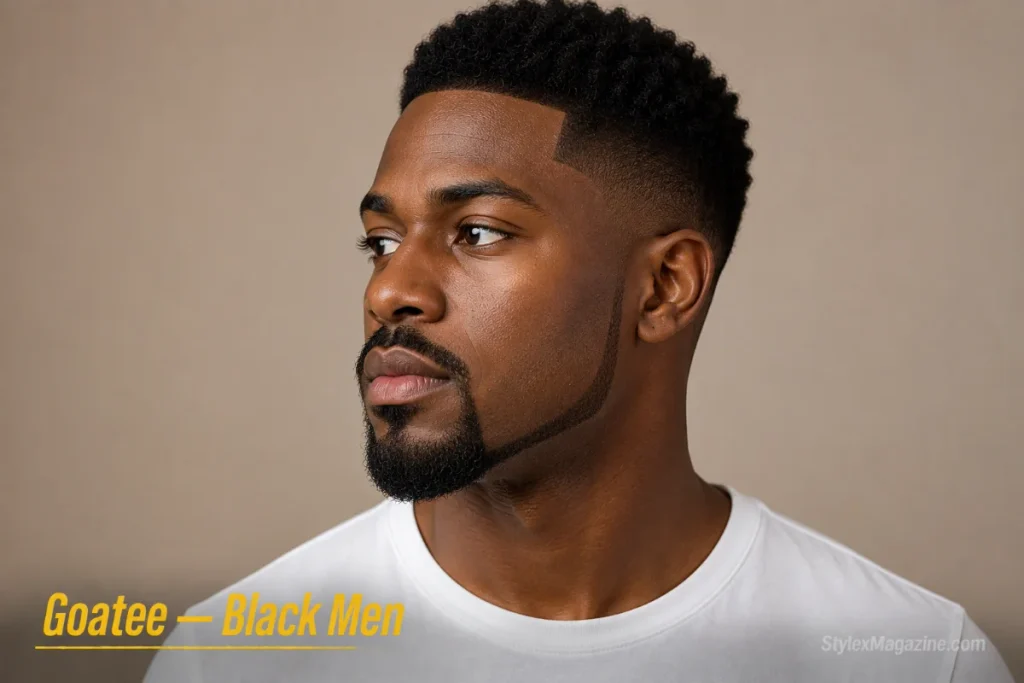
Styling tip: Moisture is non-negotiable | Hair type: Coily, 4A-4C | Length: Guard 2-4
Coily textures create naturally sharper goatee edges, but the clean-shaved cheeks need specific care. Razor bumps (pseudofolliculitis barbae) are more common with coily hair because tight curl patterns cause freshly shaved hairs to grow back into the skin. The cheeks get shaved every 2-3 days for any goatee style, putting those zones under repeated stress.
Use a single-blade razor or electric foil shaver on the cheeks. Shave with the grain. Apply a salicylic acid aftershave to prevent ingrowns. A line-up at the hairline connecting through the sideburns creates a framed, architectural look. For the full guide on coily textures and beard pairings, see fade haircuts for Black men.
Best for: All face shapes. Pairs well with a line-up, skin fade, or burst fade.
Tell your barber: “Goatee, sharp edges, line-up at the hairline, single-blade on the cheeks.”
Maintenance: Cheek shave every 2-3 days. Moisturize shaved areas daily.
16. Patchy-Friendly Goatee
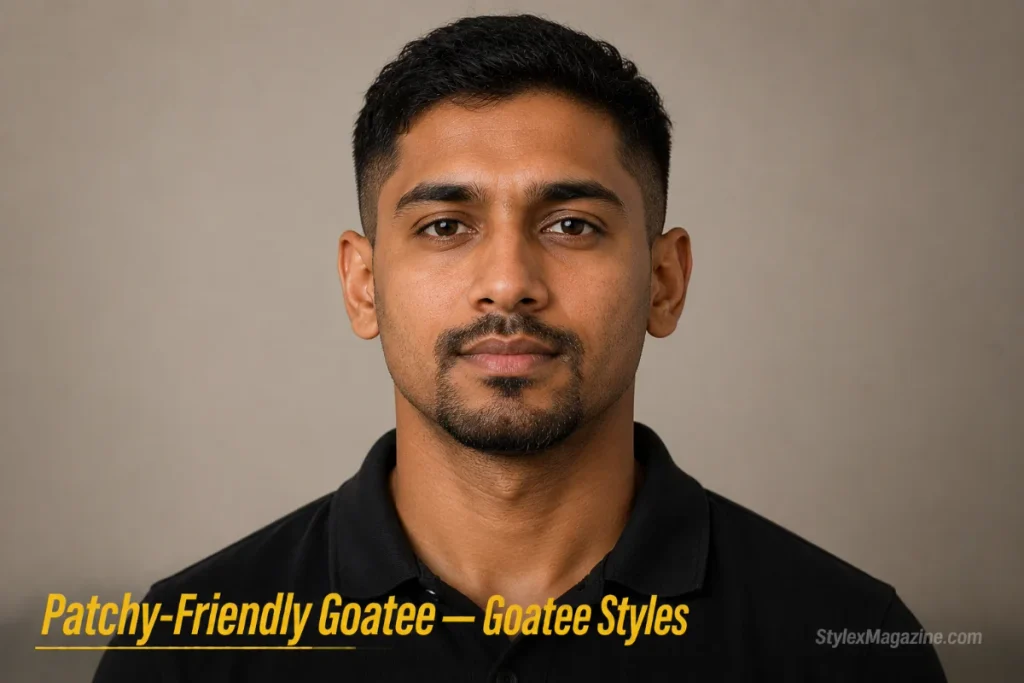
Styling tip: Stubble length hides thin spots | Hair type: All | Length: Guard 0.5-2 (2-6mm)
A goatee shaped around whatever your chin actually grows, kept at stubble length so density gaps blur into texture. The goatee is already the best style for patchy growth because it only needs the chin and lip, the two zones where nearly every man grows strongest. Keeping it short makes any thin areas disappear into the overall stubble texture.
If the chin itself has gaps, narrow the goatee to a landing strip or soul patch that covers only the densest zone. If the mustache is patchy, skip it entirely and wear a pure goatee with chin hair only. Work with your growth pattern, not against it.
Best for: All face shapes. Men with patchy or uneven growth.
Tell your barber: “Goatee, stubble length, shape it around where the hair grows thickest, soft edges.”
Maintenance: Trimmer every 3-4 days. Low commitment.
Which Goatee Fits Your Face Shape?
The goatee adds vertical emphasis to the chin by default. Every variation pulls the eye downward. That structural effect flatters round and wide faces and can work against already narrow or long faces unless the style adds horizontal width.
| Face Shape | Best Goatee Styles | Avoid |
|---|---|---|
| Round | Pointed, extended, anchor, landing strip | Very short or petite (too subtle to reshape) |
| Oval | Any variation | Nothing specific |
| Square | Circle beard, rounded, Balbo | Sharp pointed styles (over-sharpens angular features) |
| Oblong / Long | Circle beard, Balbo, short styles | Long pointed goatee, landing strip (adds more length) |
| Heart / Triangle | Classic, circle beard, extended | Narrow or pointed styles that taper the chin further |
| Diamond | Extended, Balbo, anchor | Petite or soul patch (too small for diamond proportions) |
How Do You Shape a Goatee?
Grow everything for 2-3 weeks, then carve the shape out of what you have. Trying to shape too early means guessing where your growth sits.
Step 1: Set the goatee width. Use a trimmer with no guard to draw two vertical lines from just outside each mouth corner, straight down. Everything outside those lines gets shaved.
Step 2: Shave the cheeks. Razor for the cleanest finish. Clear everything from the goatee border to the sideburn.
Step 3: Set the neckline. Two finger-widths above the Adam’s apple. Follow the natural crease under your jaw from that center point up toward the ears.
Step 4: Trim to length. Guard 3 (10mm) is a safe starting point for most styles.
Step 5: Choose your mustache status. Connected (circle beard), disconnected (Van Dyke family), or gone entirely (pure goatee). Shave accordingly.
Step 6: Check symmetry. Use your earlobes and mouth corners as reference points. Alternate sides to avoid drifting.
In my experience, the first shape always takes longer than expected. Have a barber set the initial lines, then maintain them at home. Once the template exists, upkeep is a five-minute job every other day.
What Haircuts Pair Best with a Goatee?
The goatee’s clean cheeks mirror well with clean, structured haircuts. The chin is doing all the facial hair work, so the haircut needs to frame the skull without competing.
| Haircut | Best Goatee Pairing | Why |
|---|---|---|
| Skin fade or high fade | Stubble, classic, anchor | Matched clean gradients, modern look |
| Mid fade | Circle beard, extended | Balanced proportion between head and jaw |
| Buzz cut | Stubble, classic, landing strip | Minimal head matches minimal beard |
| Slick back | Pointed, anchor, handlebar combo | Polished hair pairs with sculpted facial hair |
| Side part | Petite, circle beard, classic | Conservative, office-ready combination |
| Bald or shaved head | Classic, extended, anchor, Balbo | The goatee is the only feature, so commit to a fuller version |
For specific pairings, see fade haircut with beard, buzz cut with beard, and bald head with beard styles.
What Are the Most Common Goatee Mistakes?
1. Going too wide. The goatee should sit within the corners of the mouth. Extending it wider creates a short boxed beard, not a goatee. Use the mouth corners as boundary lines.
2. Setting the neckline at the jawline. The same mistake men make with full beards, and it strangles a goatee even harder. Two finger-widths above the Adam’s apple, following the jaw’s natural crease. A high neckline makes the chin piece look stuck on.
3. Letting the cheeks go. Three days of cheek stubble erases the goatee shape. The goatee only exists because the cheeks are clean. Skip a shave and the chin piece stops looking like a style and starts looking like unfinished growth.
4. Matching mustache and chin lengths when they should contrast. A circle beard needs matching lengths. A disconnected goatee or beardstache needs different lengths for the contrast to work. Decide which you are growing and commit to the proportions that style demands.
5. Forcing a style your growth does not support. If your chin grows patchy, a pointed goatee will expose the gaps. If your mustache never fills in, skip the circle beard and wear a pure goatee. The short beard or stubble covers more area with less density needed.
FAQs
How long does it take to grow a goatee?
Most men can shape a basic goatee after 2-3 weeks of growth. The stubble and soul patch versions are shapeable within 7-10 days. Fuller styles like the extended goatee or handlebar combination need 4-6 weeks for proper fullness. Because you are only growing the chin and mouth area, shaving the rest, the goatee fills in faster than a full beard at every stage.
Does a goatee suit every face shape?
The goatee family covers enough variations that some version works for every face shape. The principle is consistent: pointed and narrow goatees elongate the face (good for round, bad for long). Wider goatees like the Balbo and circle beard add horizontal structure (good for long, bad for wide). Match the shape to what your face needs.
Can you grow a goatee with patchy facial hair?
The goatee is the strongest option for patchy growth because it uses only the chin and lip, where most men grow densest. If even those areas are thin, keep the style at stubble length (2-4mm), where density gaps blur into texture. Narrow the goatee to just the densest zones if needed. A landing strip or soul patch works with almost any growth pattern.
Does a goatee look professional?
A goatee at guard 2-3 with clean edges is appropriate for nearly every professional setting. The petite, stubble, and classic variations are the safest for conservative workplaces. Consistency matters more than style choice: a sharp goatee Monday that is fuzzy Thursday undermines the professional effect. Daily cheek checks and weekly trims maintain it.
What is the difference between a goatee and a beard?
A goatee covers the chin only, with the cheeks shaved clean. A beard covers the full face from sideburn to sideburn. The goatee sits inside the beard family but requires much less facial hair. Men who cannot grow a full beard because of patchy cheeks, thin coverage, or genetics can often grow a full goatee without any density issues.

Other Articles
15 Best Mutton Chops Beard Styles in 2026
15 Best Van Dyke Beard Styles with Trim Guide (2026)

[…] and lip growth but patchy cheeks are built for goatees, Van Dykes, and anchor styles. The dedicated goatee styles guide and the short beard styles guide both cover patchy-friendly variations in […]