
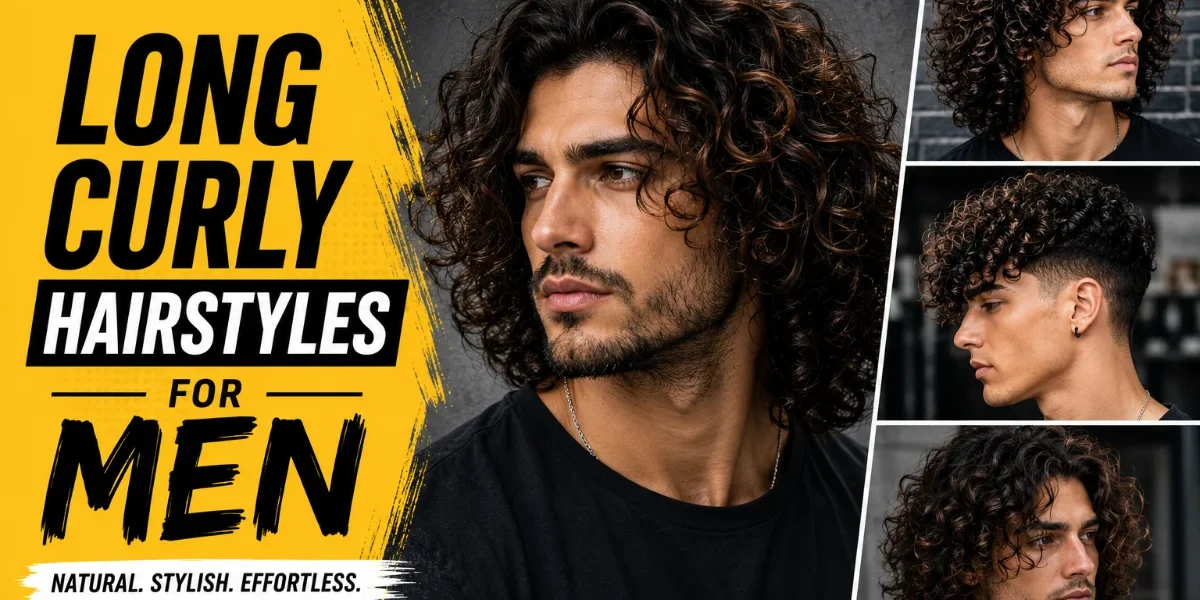

Quick Answer: The top long curly hairstyles for men are shoulder-length curls, the curly wolf cut, layered curls, the curly undercut, half-up half-down, and the free-flowing mane. Match your curl type and face shape to pick the right one — each style in this guide includes barber language, maintenance time, and face shape fit.
Long curly hair stands apart from every other men’s hair type. The volume is built in. The texture does half the styling work. But picking a random style from a gallery and hoping it suits you — that fails more often than it lands.
This guide breaks down 15+ styles with the specific curl type each one favours, the face shapes it complements, and the exact words to tell your barber. Every recommendation comes from hands-on barbering experience with curly-haired clients across wavy, coiled, and kinky textures. If you’re still deciding on length, the full curly hairstyles for men guide covers short and medium options too.
Best Long Curly Hairstyles for Men
Shoulder-Length Curls
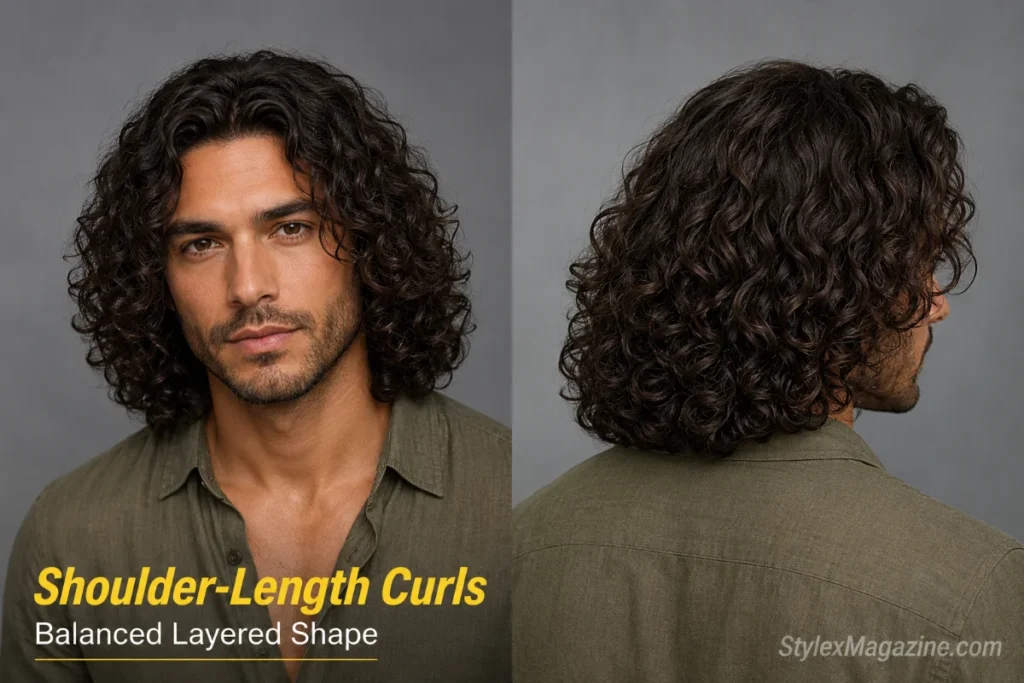
Shoulder-length is the ideal starting point for curly hair — enough length to show texture, enough control to avoid bulk. Layers prevent the triangle silhouette that heavy curls create when cut blunt. Penn Badgley’s shoulder-length look is the reference point here: thinned in the right places, full where it counts.
Best for: Type 2B–4A curls. Oval, square, and heart-shaped faces.
Maintenance: 5–10 minutes daily. Curl cream on damp hair, let it dry naturally.
Tell your barber: “Collarbone length with internal layers to remove weight. No thinning shears.”
Free-Flowing Mane
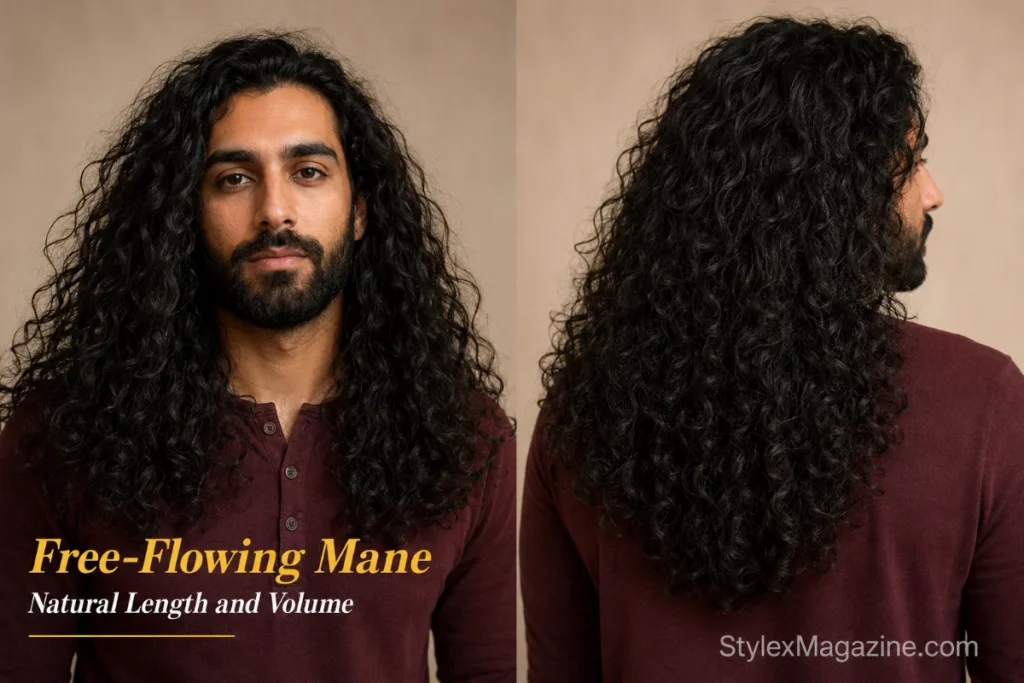
No structure, no product tricks — just length and natural fall. Kit Harington and Timothée Chalamet both wore this: curls past the shoulders, no layering, maximum volume. It hits hardest on Type 2C–3B curls with medium-to-thick density. Oval and oblong faces gain balance from the width curls provide.
Best for: Type 2C–3B curls. Oval and oblong faces.
Maintenance: Medium. Weekly deep conditioning and gentle detangling prevent matting.
Tell your barber: “One-length cut, no layers. Just clean the ends and remove split damage.”
Curly Wolf Cut
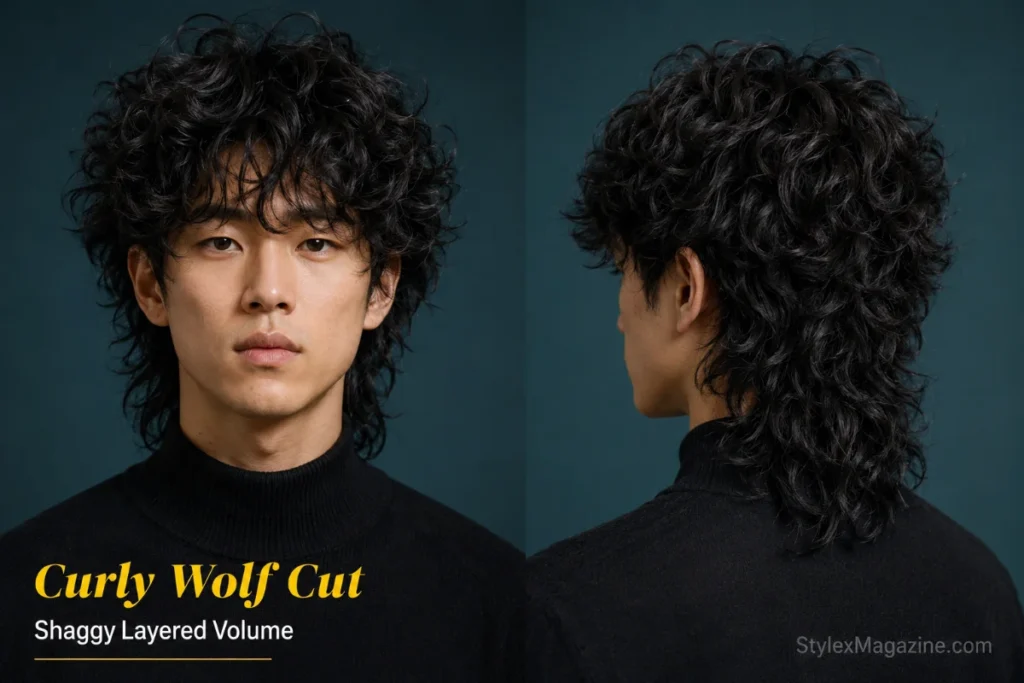
Heavy layers through the crown with longer hair falling toward the neck — a shaggy, disconnected shape that gains energy from curl texture. Thick Type 3A–3C curls give it the strongest visual impact. The volume sitting high makes it a natural fit for diamond, oval, and heart-shaped faces where a narrower chin needs balance.
Best for: Type 3A–3C thick curls. Diamond, oval, heart faces.
Maintenance: Medium. Mousse or lightweight curl spray keeps the layers separated.
Tell your barber: “Heavy layers from the crown forward, length past the collar at the back, disconnected sides.”
Curly Undercut
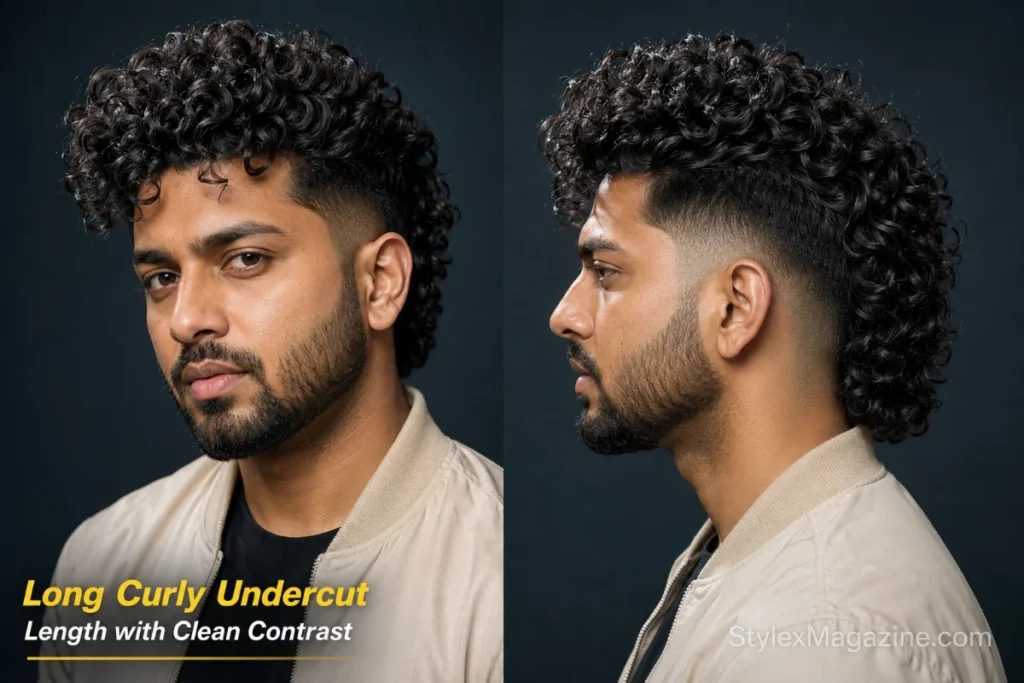
Short faded sides against long curls on top — clean contrast that gives structure without sacrificing texture. Dev Patel has worn variations of this for years. It demands Type 3A–3C curls with enough density to hold their shape against cropped sides. Round and square faces gain vertical emphasis from the height on top.
Best for: Type 3A–3C dense curls. Round and square faces.
Maintenance: Medium-high. Fade refresh every 3–4 weeks. Curl cream and diffusing on top.
Tell your barber: “Low fade on the sides, blend into 5+ inches on top, preserve the natural curl pattern.”
Middle-Parted Long Curls
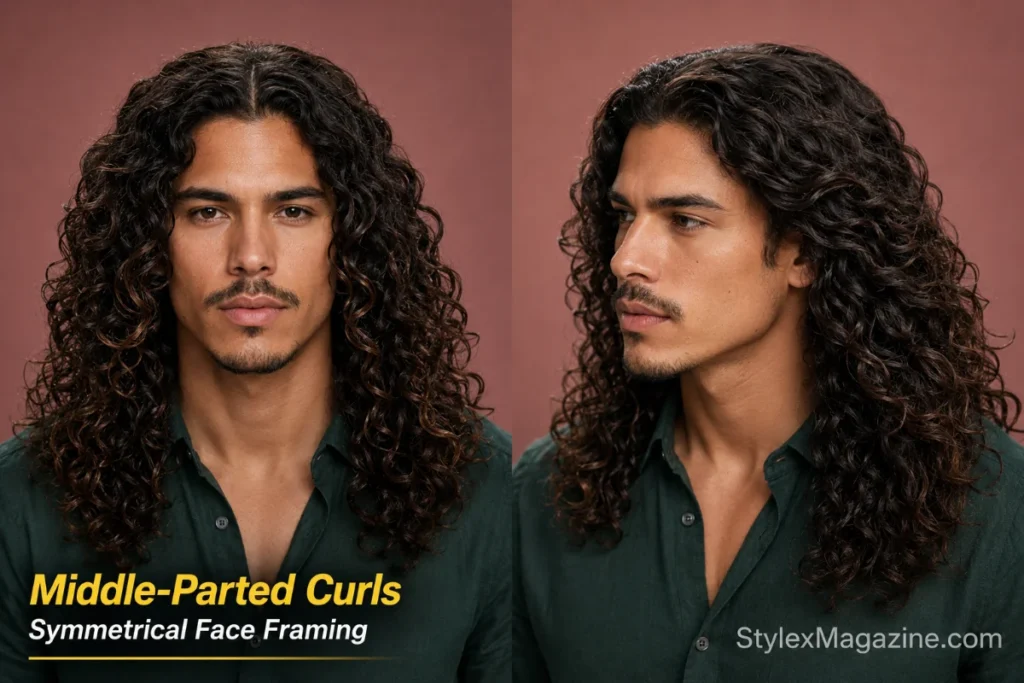
A center part with curls falling symmetrically frames the face and highlights bone structure. Aaron Taylor-Johnson’s swept-back center-parted curls are the benchmark — loose, hydrated, zero product stiffness. This needs Type 2C–3B curls at 8+ inches. Oval and square faces suit it well. Round faces should skip it — the symmetry amplifies width.
Best for: Type 2C–3B curls, 8+ inches. Oval, square faces.
Maintenance: Low. Leave-in conditioner, finger-part, let it dry.
Tell your barber: “Maintain length, add face-framing layers starting at the chin line.”
Voluminous Layered Curls
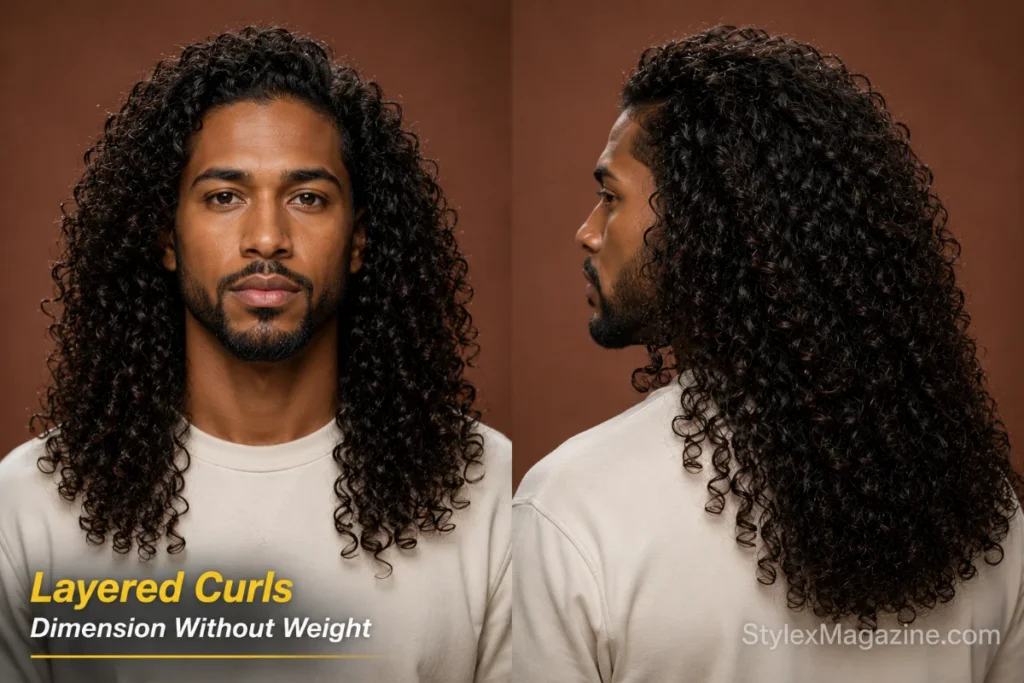
Layers stacked throughout the length give curly hair dimension without weight. Each layer lets individual curls spring into shape rather than clumping together. Thick Type 3A–3C curls respond best. The layers can be adjusted to any face shape — positioned near the jaw for round faces, near the crown for oblong.
Best for: Type 3A–3C thick curls. Adjustable to all face shapes.
Maintenance: Low-medium. Curl cream or foam scrunched into damp hair, then diffuse.
Tell your barber: “Long layers throughout, shortest layer at ear level, graduated down to the ends.”
Curly Shag
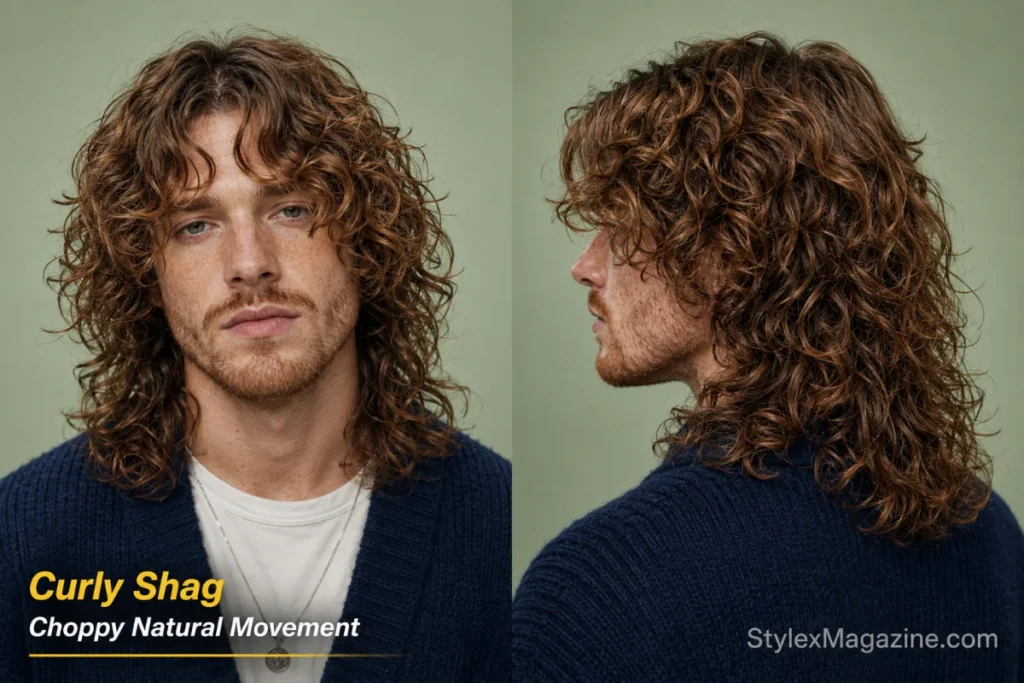
A modern version of the 70s shag — choppy layers with a soft fringe that moves with curls rather than fighting them. Fine-to-medium Type 2B–3B curls respond best because the layers add body that thicker hair already has. Heart and oval faces benefit from the fringe softening the forehead.
Best for: Type 2B–3B fine-to-medium curls. Heart and oval faces.
Maintenance: Low. Sea salt spray, let it dry. The cut handles the rest.
Tell your barber: “Choppy layers, curtain fringe at the cheekbones, textured — no blunt lines.”
Curly Man Bun
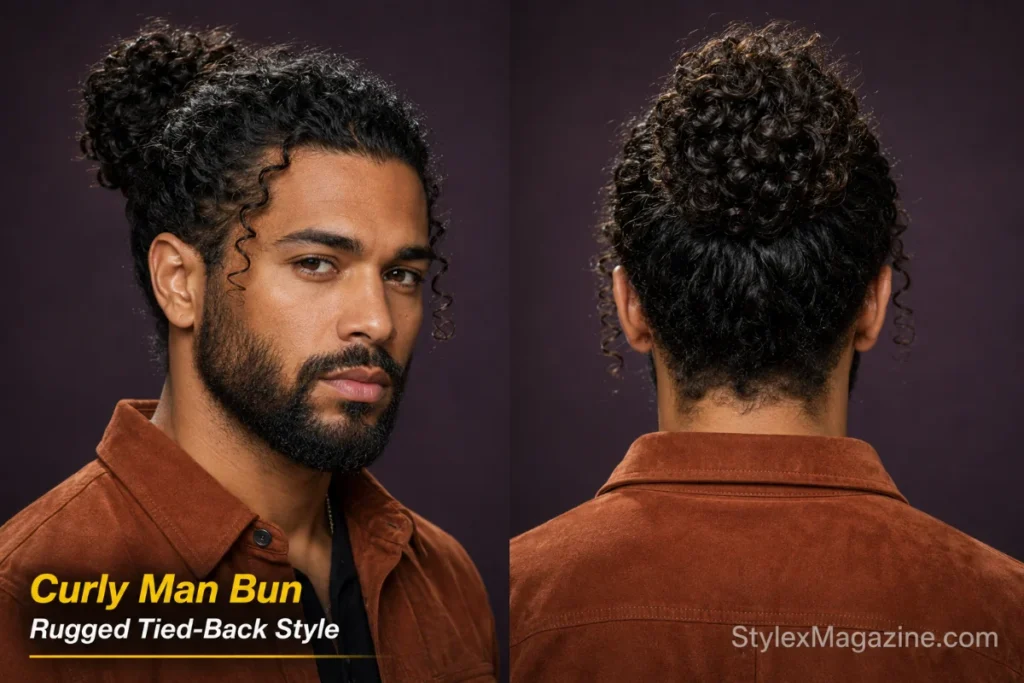
Gather curls into a bun at the crown or nape. Curly texture adds natural fullness to the bun shape in a way straight hair cannot match. Jason Momoa made this style iconic — rugged, low-effort, masculine. Any curl type at 10+ inches can pull it off. Pulling hair back exposes the full face, so it flatters every face shape.
Best for: All curl types, 10+ inches. All face shapes.
Maintenance: Very low day-to-day. The hair still needs regular washing and conditioning underneath.
Tell your barber: “Maintain length for a bun, clean the neckline and sideburns, shape the perimeter.”
Half-Up, Half-Down
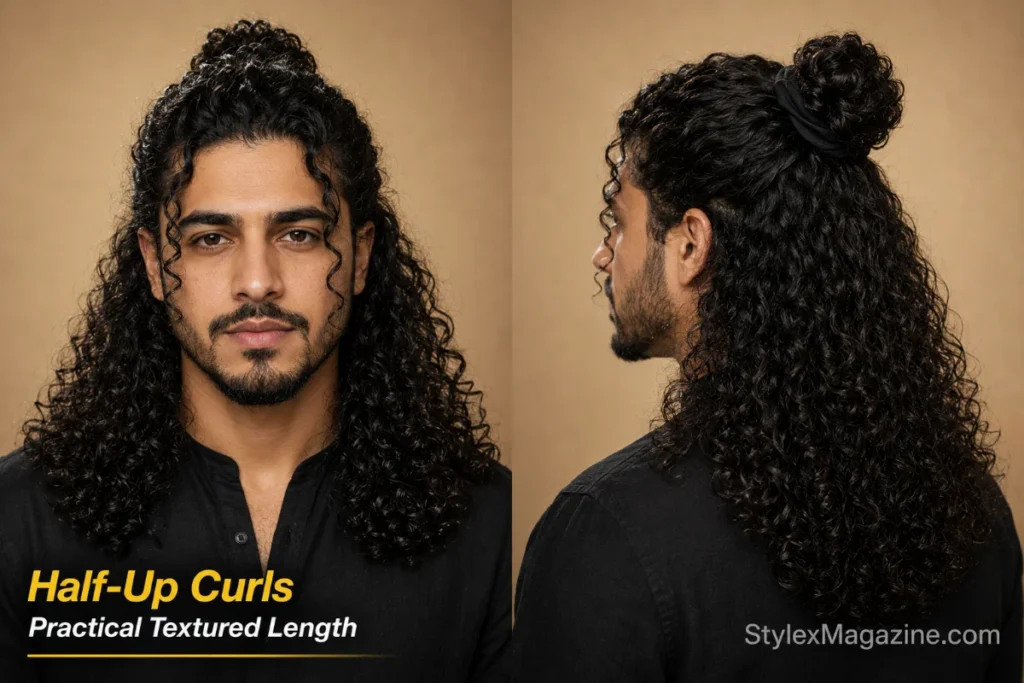
Top section pulled into a small bun or ponytail, the rest falling loose. Practical and textured — keeps hair off the face without hiding the curls. Any curl type at 8+ inches handles this. Round faces gain elongation from the height of the half-up section.
Best for: All curl types, 8+ inches. Especially round faces.
Maintenance: Very low. Soft elastic, leave-in conditioner.
Tell your barber: “Keep even length throughout so the half-up section blends when I release it.”
Curly Ponytail
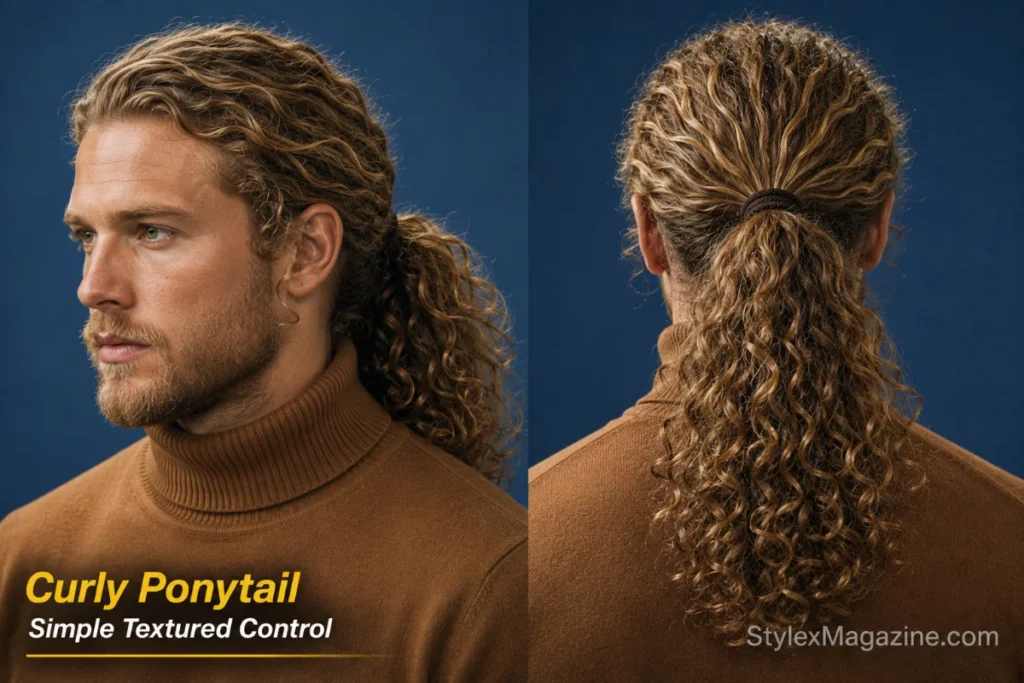
A low or mid-height ponytail on curly hair has more presence than on straight hair — the texture creates natural volume in the tail. Any curl type handles this. Square and oval faces suit it most. Use fabric-covered ties only — tight elastics cause breakage on curly hair, a point the Cleveland Clinic’s hair care guidance specifically flags.
Best for: All curl types. Square and oval faces.
Maintenance: Very low. Pull back and go.
Tell your barber: “Even out the length, remove split ends, keep the perimeter clean.”
Long Curly Fade
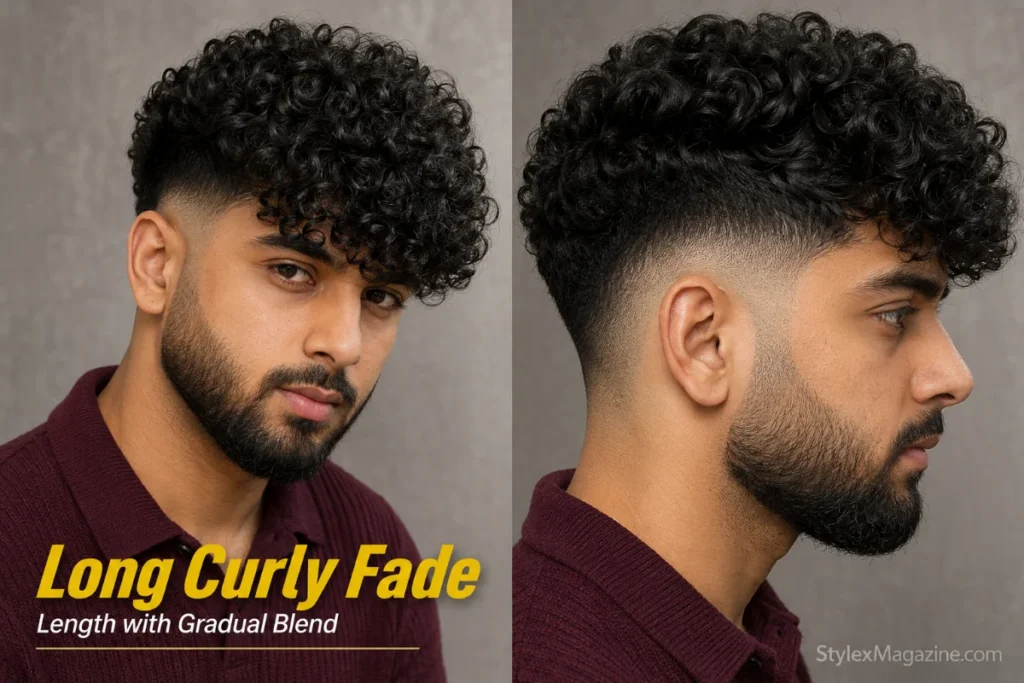
A gradual fade on the sides with long curls on top — more length preserved than a standard undercut. The fade starts low, blends mid-way, and keeps enough side hair for a natural transition. Type 3A–4A curls with dense volume carry this strongest. The fade line can sit higher or lower depending on face proportions.
Best for: Type 3A–4A dense curls. All face shapes (adjustable).
Maintenance: Medium-high. Fade refresh every 3–4 weeks.
Tell your barber: “Low skin fade, blend gradually, leave 6+ inches on top, follow the curl pattern.”
Twist Outs
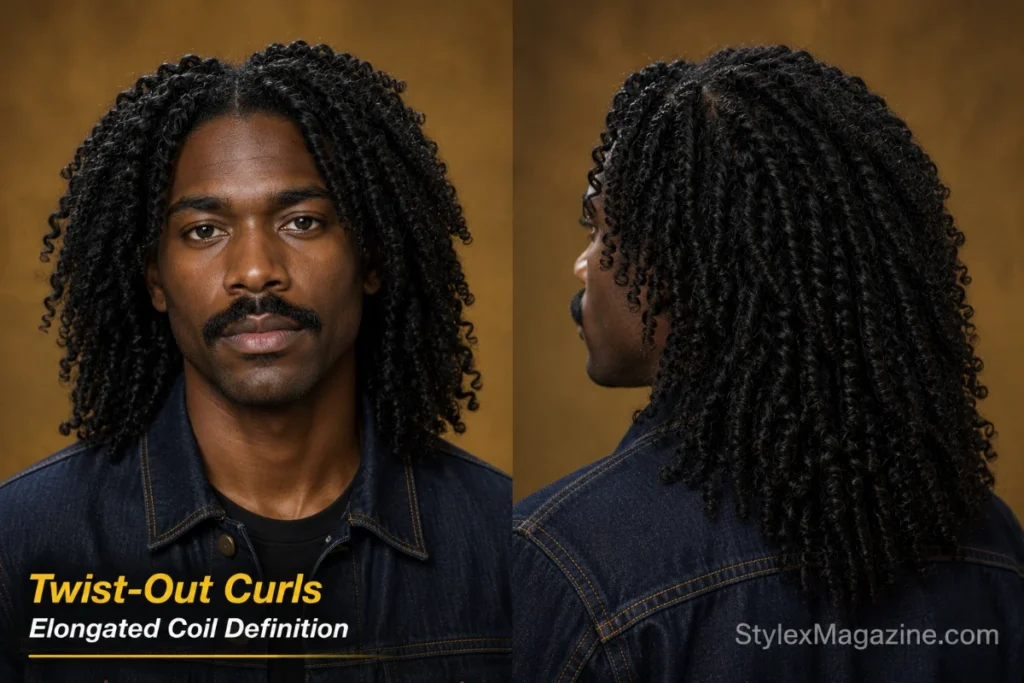
Section damp hair into twists, let them dry completely, then unravel for defined, elongated curls. This technique is purpose-built for Type 3C–4C coils where shrinkage hides real length. The twist out stretches curls and creates uniform definition that lasts 3–5 days with a satin bonnet or pillowcase overnight.
Best for: Type 3C–4C coils. All face shapes.
Maintenance: Medium. Twisting takes 20–30 minutes up front.
Tell your barber: “Even length all around, no layers — I style with twist outs and need uniform sections.”
Afro
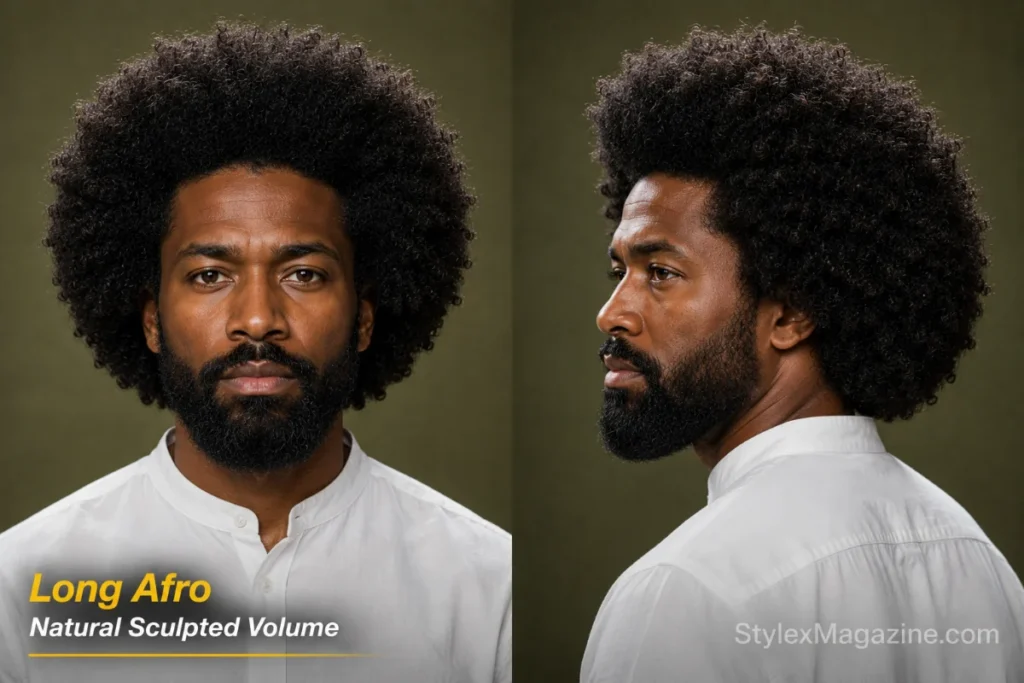
The afro celebrates natural volume and texture — worn rounded or sculpted with a pick. Lenny Kravitz is the long-standing reference. Type 4A–4C coils respond best. Oval and oblong faces gain width from the afro’s shape. Round faces should ask for slight tapering at the sides.
Best for: Type 4A–4C coils. Oval, oblong faces.
Maintenance: Medium. Daily moisture with leave-in conditioner or oil. Detangle with a wide-tooth comb only. Tell your barber: “Round out the shape, keep it symmetrical, clean the edges with a line-up.”
Slicked-Back Curls
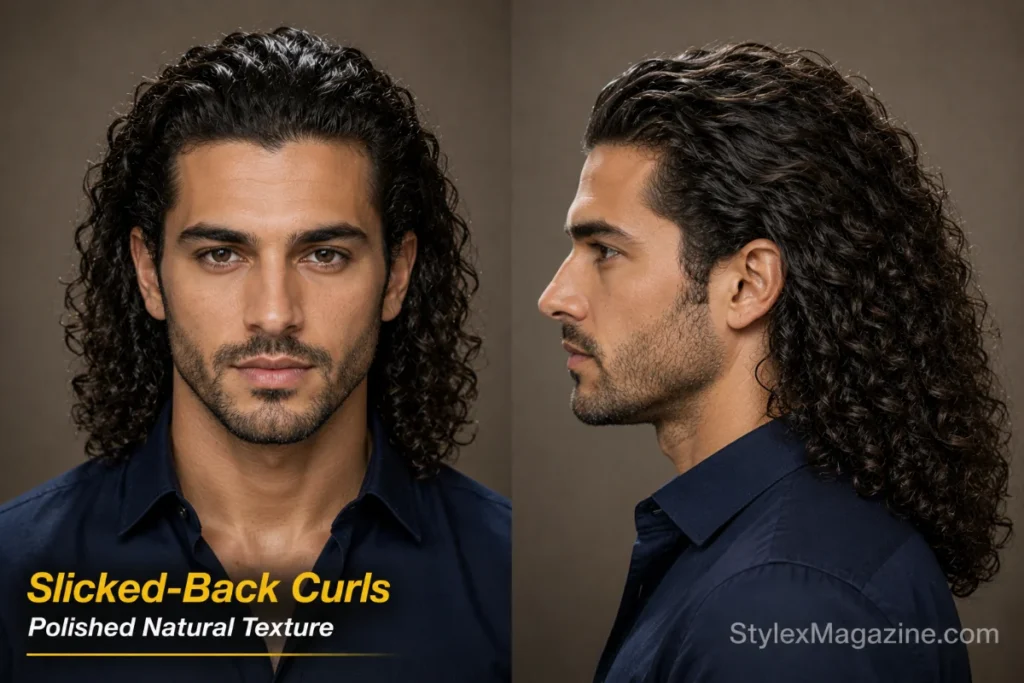
Apply a medium-hold gel or pomade and sweep curls back with your fingers — never a fine-tooth comb, which disrupts the curl pattern. Type 2B–3B curls at 8+ inches suit this. It gives a clean, formal finish. Oval and heart-shaped faces look sharpest with the swept-back framing. For more variations, see slick back hair options.
Best for: Type 2B–3B curls, 8+ inches. Oval, heart faces.
Maintenance: Low. 3–5 minutes of product application. Wash day resets.
Tell your barber: “Maintain length, keep the front slightly longer for the slick-back sweep.”
Curly Bob
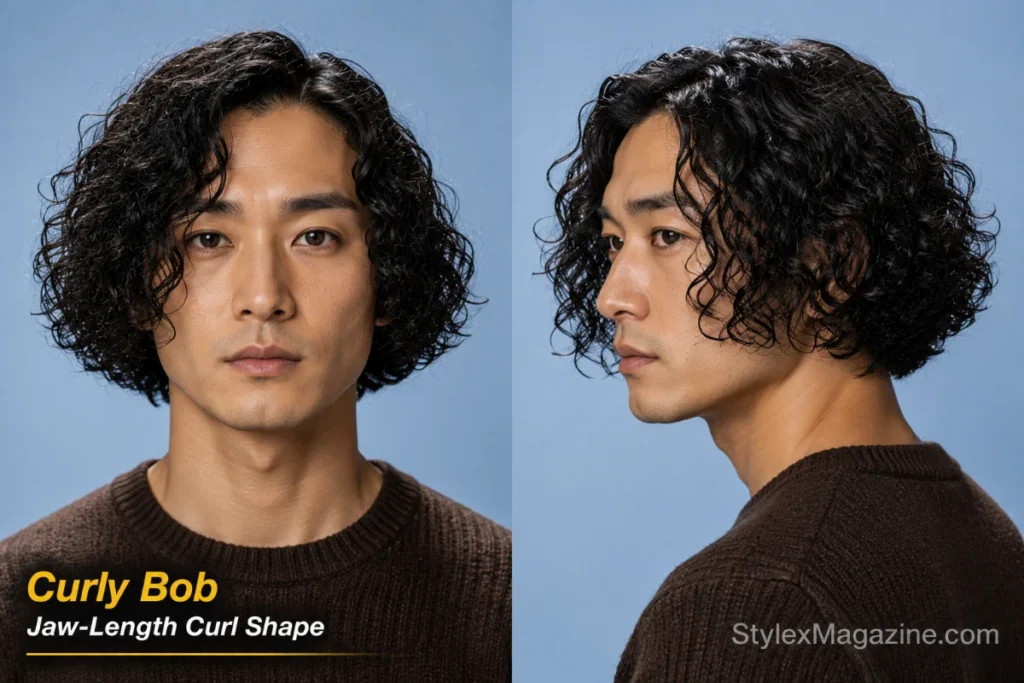
A chin-to-jawline cut that highlights curl density without the commitment of full length. Type 3A–3C curls define best at this length. Oval and heart-shaped faces benefit from the jaw-level framing. Most men skip this option, but it is one of the easiest long curly styles to maintain and style daily.
Best for: Type 3A–3C curls. Oval, heart faces.
Maintenance: Low-medium. Curl-defining cream, diffuse or let it dry naturally.
Tell your barber: “Chin-length bob, slight graduation at the back, weight line at the jaw.”
Curly Pompadour
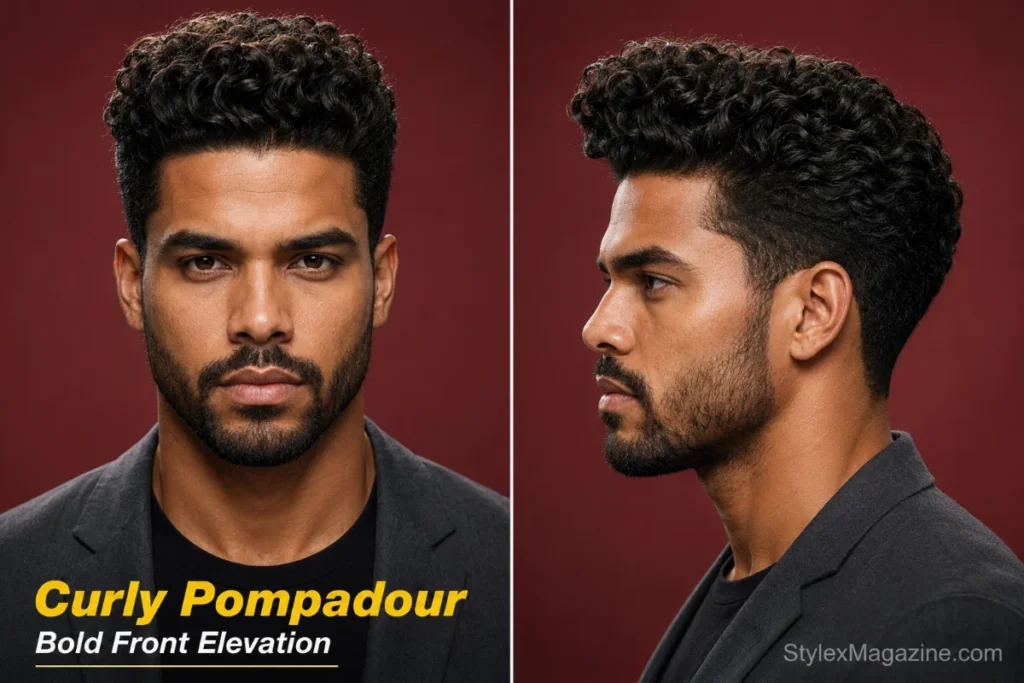
Curls swept upward and back from the forehead with volume concentrated at the front. Type 2C–3B curls with natural hold carry the lift. Oval and square faces suit it. The upward volume also elongates round faces. A bolder, dressier option than most styles on this list.
Best for: Type 2C–3B curls. Oval, square, round faces.
Maintenance: Medium-high. Diffuse while blow-drying, mousse or clay for hold, light-hold spray to set.
Tell your barber: “Keep the top 6+ inches, taper the sides, leave the front long enough to build the pompadour shape.”
How to Choose the Right Long Curly Style
A gallery only helps if you know which styles fit your hair. Curl type, face shape, and the time you realistically spend on your hair each morning all need to line up.
By curl type:
- Type 2B–2C (wavy): Shoulder-length curls, shag, middle part, slicked back, wolf cut
- Type 3A–3C (coiled): Undercut, layered curls, bob, pompadour, fade, wolf cut
- Type 4A–4C (kinky/coily): Afro, twist outs, free-flowing mane, man bun, ponytail
By face shape:
- Oval: Almost any style. Experiment freely.
- Round: Skip middle parts. Go for vertical volume — undercut, pompadour, half-up.
- Square: Curl volume softens angular jawlines. Shoulder-length, layered, and free-flowing styles all land well.
- Oblong: Add width with afros, voluminous layers, or side-parted styles. Skip anything that stacks height on top.
- Heart/Diamond: Wolf cut, shag, and face-framing layers balance a narrower chin.
What to Tell Your Barber
Most bad curly haircuts come from vague requests. Curly hair shrinks when it dries — a cut that looks right wet can sit 2–3 inches shorter once the curls bounce up. The American Academy of Dermatology recommends finding a stylist who cuts curly hair dry for this exact reason.
Key phrases that prevent mistakes:
- “Cut it dry so we see the actual length.”
- “No thinning shears — they cause frizz on curly hair.”
- “I want shape, not just shorter.”
- “Leave [specific number] inches on top.” Always state a number.
- “Follow my natural curl pattern — don’t cut against it.”
The most common mistake: Asking for “layers” without saying where. Layers placed wrong create a mushroom shape on curly hair. Always specify where the shortest layer should start — ear level, chin level, or crown.
How to Survive the Awkward Stage
Every man growing long curly hair hits a difficult stretch between 3 and 8 inches. Curls stick out sideways, refuse to lay flat, and look shorter than they actually are. This is temporary.
How to get through it:
- Use a headband or bandana to manage side volume during months 3–6.
- Ask your barber for a “shape-up, not a cut” — clean the neckline and sideburns without removing top length.
- Accept curl shrinkage. Type 3–4 curls can lose 50–75% of their stretched length to shrinkage. Your hair is longer than it appears.
- Skip the straightener. Heat damage during the growth phase weakens hair you have spent months growing.
- Condition aggressively. Longer curls lose moisture faster. A weekly deep conditioner keeps the hair flexible and reduces breakage.
Most men give up during this stretch. Six to eight months of patience gets the hair past the point where it sticks out — once it starts falling, styling gets dramatically easier.
FAQ
Does curl type change as hair gets longer?
Yes. The added weight stretches the curl pattern — Type 3B at 4 inches often loosens to 3A behaviour at 10+ inches.
How do I stop long curly hair from looking flat on top?
Clip the roots upward while drying, or diffuse with the nozzle aimed at the scalp. Avoid heavy oils near the roots — they pull volume down.
Does sleeping on wet curly hair damage it?
Yes. Wet curls flatten unevenly against the pillow and create frizz. Diffuse until 80% dry before bed, and always use a satin or silk pillowcase.
Can long curly hair look good tied up every day without damage?
Yes, but only with fabric-covered scrunchies or spiral coil ties. Thin elastics create tension points that snap curly hair over time.
What is the minimum length to start styling long curly hairstyles?
Six inches of actual curl length — not stretched length. Type 4 coils may need 8+ inches due to shrinkage before long styles become practical.

Other Articles
Curly Hairstyles for Men: Every Type & Style Explained
25 Best Short Curly Hairstyles for Men.
No Comment! Be the first one.