
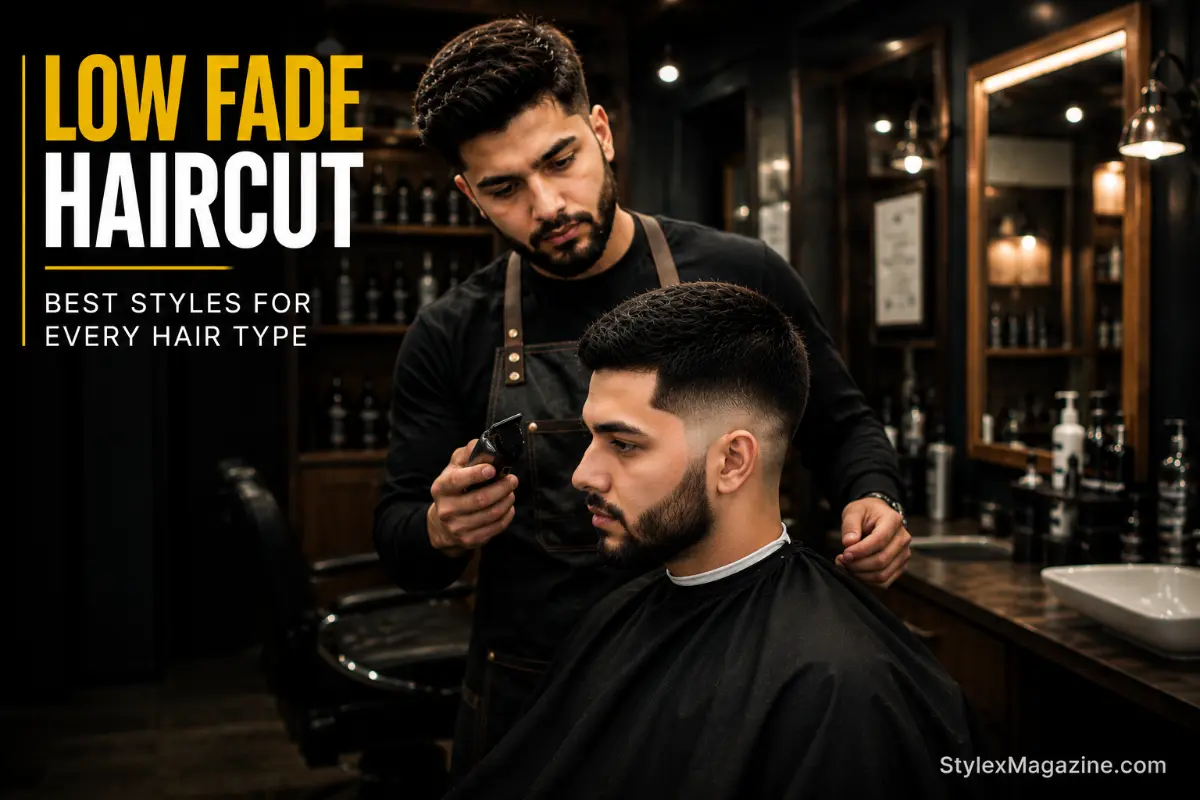

Quick Answer: A low fade starts just above the ear and blends shorter toward the neckline, with the shortest point sitting in the bottom third of the head. It suits every face shape, works on every hair type, and holds its shape at 3 to 4 weeks between cuts.
Below: 25 low fade styles broken down by variation, face shape, hair type, and the specific phrase to use in the barber’s chair for each one.
What Is a Low Fade Haircut?
A low fade is a barbering technique where the hair on the sides and back blends from longer on top to shorter toward the neckline, with the shortest point sitting just above the ear. The blend happens in the bottom third of the head, below where a mid fade would start and well below a high fade’s starting line.
The low fade can finish at different lengths at the base. A low skin fade goes all the way to bare skin. A low taper fade keeps some hair at the shortest point, never reaching skin. A low shadow fade stops at stubble. That range of finishes is why the low fade covers more ground than any other fade height. For a full breakdown of how fades, tapers, and skin fades differ as techniques, see fade haircuts for men.
I start most first-time fade clients on a low fade. The transition stays close to the natural hairline, so even if the blend is not perfect, it does not announce itself the way a higher fade would. Growth absorbs into the existing length between visits rather than creating a visible line.
What Are the Best 25 Low Fade Haircut Styles?
1. Classic Low Fade

Hair blends from full length on top down to a #1 or #2 guard at the base straight fade line just above the ear, even all the way around. The right starting point if you’ve never had a fade.
Best for: All face shapes. Office environments.
Tell your barber: “Classic low fade, just above the ear, blended clean number one at the base.”
Product: Matte paste a pea-sized amount worked through towel-dried hair gives hold without shine. Anything heavier weighs the top down.
Maintenance: Every 3 weeks.
2. Low Skin Fade

Same height as the classic but taken to bare skin at the base — #0 guard, straight razor finish. The sharpest result a low fade delivers.
On fine or thin hair, bare skin at the base exposes scalp on the sides. Below medium density, go with the taper or shadow fade instead.
Best for: Thick, dense hair.
Tell your barber: “Low skin fade — bald at the base, just above the ear, straight razor finish.”
Product: Lightweight pomade — keeps the top controlled with a slight sheen that matches the clean skin finish. Matte products look dull against bare skin.
Maintenance: Every 2 weeks.
3. Low Taper Fade

Hair shortens toward the neckline but always keeps some hair at the base — #1 or #1.5, never skin. New growth absorbs into the existing length no visible line as it grows out.
Best for: Fine or thin hair. Formal settings.
Tell your barber: “Low taper fade — keep some hair at the base, don’t go to skin, blend it natural.”
Product: Styling cream lightweight enough that fine hair doesn’t collapse, adds just enough control to hold direction without stiffness.
Maintenance: Every 3–4 weeks.
4. Low Drop Fade

From the sides it reads like a standard low fade. From the back, the fade line curves down behind the ear — adds shape to the silhouette without going higher up. Works with a skin finish or kept with hair at the base.
Best for: Curly and wavy hair. Men who want more shape without a bolder cut.
Tell your barber: “Low drop fade let the line curve down behind the ear at the back.”
Product: Sea salt spray on damp hair enhances the natural texture that drop fades are designed to showcase. Let it air dry rather than blow-drying flat.
Maintenance: Every 3 weeks.
5. Low Temp Fade

The fade focuses around the temples and hairline sharp at the front, longer at the back. The front stays clean without touching the back profile. Common with buzz cuts, textured afros, and lined-up styles.
Tell your barber: “Low temp fade sharp around the temples and hairline, keep the back longer.”
Product: Edge control balm around the hairline holds the sharp temple lines between cuts. Skip heavy gels that flake at the edges.
Maintenance: Every 2–3 weeks.
6. Shadow Fade

Stops at stubble rather than skin a gradient from darker at the base to lighter further up. Less contrast than a skin fade, more definition than a taper.
On tight curls and coily hair (Type 3B–4C), a hard skin line can look disconnected from the texture above. The gradient blend sits with dense hair rather than against it.
Best for: Tight curls, coily hair. Men who want definition without 2-week maintenance.
Tell your barber: “Shadow fade gradual blend, stop at stubble, don’t go to skin.”
Product: Curl cream defines the coil pattern on top without drying it out. The shadow blend already does the work on the sides, so product stays on top only.
Maintenance: Every 3 weeks.
7. Low Burst Fade

The fade curves around the ear in a semi-circular arc — the back stays longer than a standard low fade. The arc follows the head’s natural growth pattern, so curly and coily hair takes to it better than a straight-line fade. Full breakdown at the burst fade haircut guide.
Tell your barber: “Low burst fade around the ear — curved arc, leave more length at the back.”
Product: Matte clay — enough hold to define the texture contrast between the curved fade and the longer back section. Work it through dry hair from back to front.
Maintenance: Every 2–3 weeks.
8. Low Fade Haircut for Curly Hair

Curly hair shrinks once dry — a fade that sits at ear level when wet can ride noticeably higher once the hair contracts. Tell your barber the height you want based on your hair dry, not freshly washed. Scissor-over-comb gives more control over the curl-to-fade transition than clipper-only blending.
Best variations: Low drop fade and low burst fade — both follow the natural curl pattern.
Tell your barber: “Set the fade height based on how my hair looks dry — not wet.”
Product: Leave-in conditioner on the curls, nothing on the fade. Keeps curl definition intact and prevents frizz from blurring the transition line. A diffuser when blow-drying preserves the curl pattern better than direct heat.
Maintenance: Every 3 weeks.
9. Low Fade Crew Cut

Short even top slightly longer at the front, shorter toward the crown with a clean low fade on the sides. Little daily styling needed.
Best for: All face shapes. Professional settings.
Tell your barber: “Low fade on the sides, crew cut on top slightly longer at the front, tapered toward the crown.”
Product: A small amount of matte paste on the front section only just enough to push the slightly longer front upward. The rest holds its shape without product.
Maintenance: Every 3 weeks.
10. Low Fade Textured Crop

Short textured top, choppy layers, fringe pushed forward low fade sides. Falls into the same territory as messy hairstyles but with more structure from the fade. On thick hair, the crop removes weight on top while the fade keeps the sides from looking heavy.
Tell your barber: “Low fade on the sides, textured crop on top — point cut the fringe, not blunt.”
Product: Matte clay — work through dry hair and push forward with fingers for separation. The choppy layers need a dry-application product to hold individual strands apart rather than clumping them together.
Maintenance: Fade every 3 weeks. Top trim every 5–6 weeks.
11. Low Fade French Crop

Blunt fringe across the forehead, short top, low fade sides. More structured than the textured crop — the fringe is cut straight across. The horizontal fringe adds width, which works well on round and square face shapes.
Tell your barber: “Low fade on the sides, French crop on top blunt fringe, just above the eyebrows.”
Product: Matte paste pushed forward holds the blunt fringe in place without adding shine that would make the straight line look greasy. Apply to dry hair and press the fringe flat rather than finger-styling it.
Maintenance: Every 3 weeks.
12. Low Fade Pompadour

Volume swept back on top, clean low fade on the sides. Works with a modern textured finish or a classic slicked-back version.
Best for: Oval and oblong face shapes. Medium to thick hair on top.
Tell your barber: “Low fade on the sides leave at least 3 to 4 inches on top for the pompadour.”
Product: Medium-hold pomade for a classic slicked-back finish, or matte clay for a modern textured version. Blow-dry backward with a round brush first — the product locks in the direction, it doesn’t create it.
Maintenance: Every 3 weeks.
13. Low Fade Quiff

Volume pushed forward and up at the front — less height than a pompadour, more structure than a textured crop.
Best for: Oval, round, and square face shapes.
Tell your barber: “Low fade on the sides — leave 2.5 to 3 inches at the front for the quiff, shorter toward the crown.”
Product: Volume powder at the roots for lift, then matte clay on the lengths for hold. The powder creates the height; the clay keeps it there. Without the powder, the quiff collapses by midday on most hair types.
Maintenance: Every 3 weeks.
14. Low Fade Comb Over

Side-parted comb over with low fade sides. A hard part adds definition; no part keeps it softer.
Tell your barber: “Low fade on the sides, comb over on top — hard part on the left side at the temple.”
Product: Pomade or styling cream the comb over needs a product that allows the comb to glide through and set direction. Matte clay is too dry for a smooth part line. Apply to damp hair, comb into place, and let it set.
Maintenance: Every 3 weeks.
15. Low Fade with Beard

A low fade sits low enough to connect into a beard naturally. The barber blends the fade into the beard line at the sideburn called a connected fade — rather than leaving a hard gap. Most barbers default to a disconnected finish unless you ask specifically.
Tell your barber: “Connect the low fade into my beard blend the sideburn, no hard line between the fade and the beard.”
Product: Beard oil on the beard, matte paste on the hair two separate products for two separate textures. One product trying to do both leaves the beard greasy or the hair under-held.
Works best with: Full beards and short boxed beards.
16. Low Fade Buzz Cut

All-over short cut with a low fade on the sides. No daily styling. The fade gives enough structure to stop the buzz cut looking shapeless.
Tell your barber: “Low fade on the sides — number two or three on top, blended into the fade.”
Product: None needed for styling. A lightweight scalp moisturizer keeps the exposed skin on the fade healthy and prevents dryness from showing through the short cut.
Maintenance: Every 2–3 weeks.
17. Low Fade with Straight Hair

Straight hair produces the cleanest, sharpest fade lines of any hair type — the blend between skin and flat hair is precise. Grow-out shows faster though, because there’s no texture to absorb it.
Without texture on top the cut looks flat. Ask your barber to point cut the top section rather than cut it blunt.
Tell your barber: “Low fade on the sides — point cut the top, I want texture not a blunt finish.”
Product: Texture powder — adds grip and separation to straight hair that would otherwise lay flat. Sprinkle at the roots and work through with fingers. Avoids the wet-look finish that pomade gives straight hair, which can make it look thin.
Maintenance: Every 3 weeks.
18. Low Fade Mohawk

Strip of longer hair down the center, low fade on the sides. The sides stay fuller than they would with a higher fade the overall look is less aggressive, more textured than dramatic.
Tell your barber: “Low fade on the sides — leave a strip of length down the center, blend the edges of the strip into the fade.”
Product: Strong-hold matte clay the center strip needs enough hold to stand upright or stay directional without collapsing outward. Work it through dry hair and push upward from the roots. Avoid gel — it creates a wet, crunchy finish that fights the textured look.
Maintenance: Every 2–3 weeks.
19. Low Fade Edgar
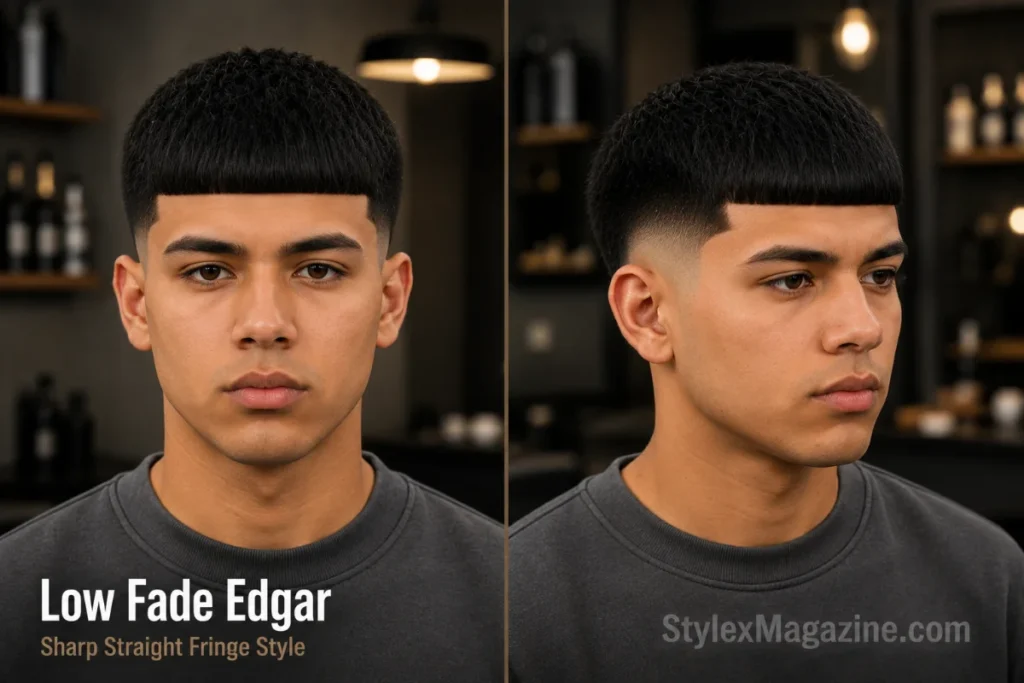
Blunt straight fringe cut across the forehead with a low fade on the sides the sharpest front line of any fade style. The fringe needs at least 2 inches to fall forward properly. Under that, it sticks up instead of laying flat.
The Edgar originated in Latin American barbershop culture and has crossed into mainstream trend lists since 2024. On thick straight hair, the fringe sits clean and precise. On wavy or curly hair, the blunt line softens not a flaw, but a different finish. Ask your barber to cut the fringe based on your natural texture, not against it.
Best for: Oval, square, and diamond face shapes. Thick or straight hair.
Tell your barber: “Low fade on the sides, Edgar fringe straight blunt line across the forehead, at least two inches of length on top.”
Product: Matte clay pushed forward holds the fringe flat without shine. Gel makes the blunt line look wet and stiff. Apply to dry hair and press the fringe down with your palm rather than combing it.
Maintenance: Every 2–3 weeks. The blunt fringe loses its sharp line fast.
20. Low Fade Blowout
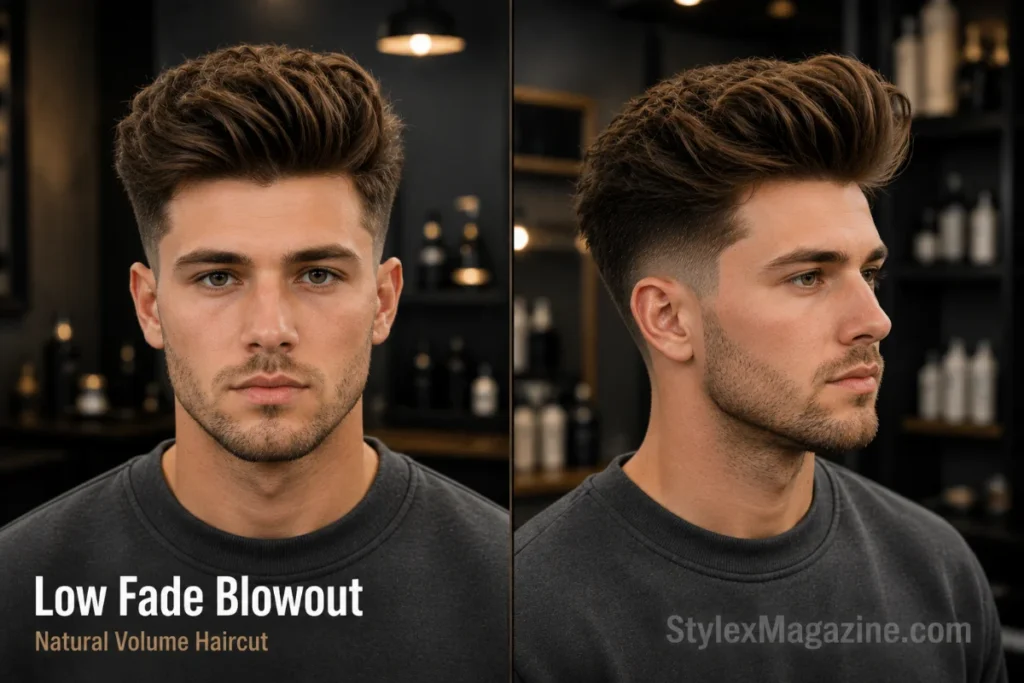
All the volume directed upward and outward from the roots a full, lifted shape on top with tight low fade sides. The blow-dry creates the structure; the product locks it in. Without blow-drying first, the blowout collapses within an hour.
Best for: Thick straight or wavy hair. Oval and round face shapes the height elongates.
Tell your barber: “Low fade on the sides — leave 3 to 4 inches on top, layer it so I can blow it out with volume.”
Product: Volume powder at the roots first, then medium-hold matte clay on the lengths. Blow-dry upward with a round brush before applying product. The powder gives the lift; the clay gives the hold.
Maintenance: Every 3 weeks.
21. Low Fade Mullet
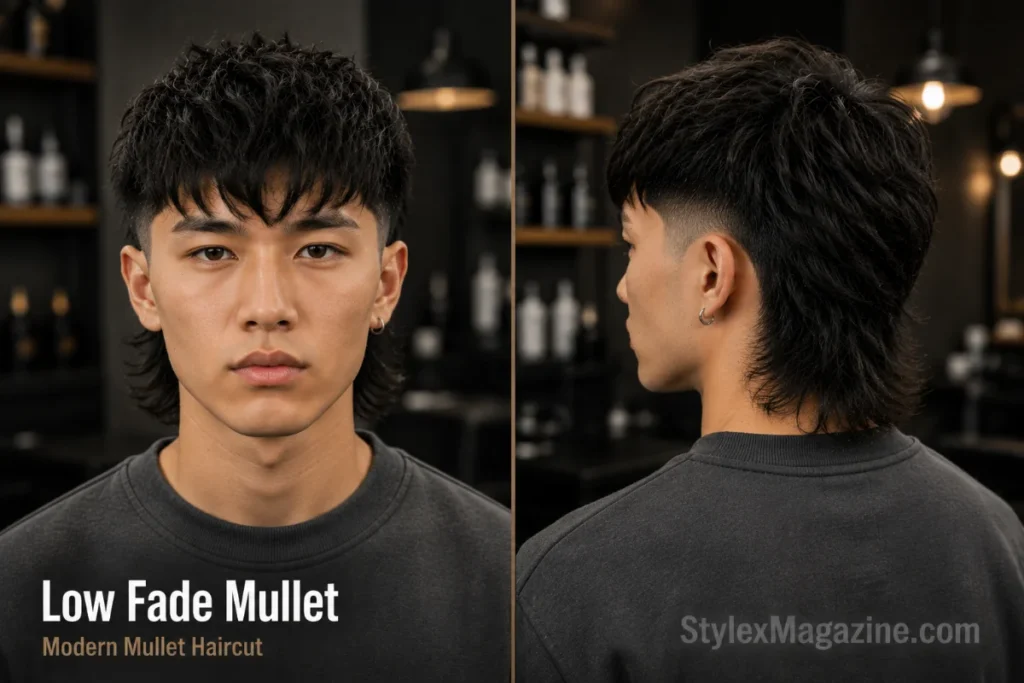
Short on the sides with a low fade, longer at the back the modern mullet keeps the party in the back and the business on the sides. The low fade version is less aggressive than a high fade mullet because the side transition stays subtle.
On straight hair, the back section flows. On wavy hair, it adds natural movement that works with the shape. On curly hair, the back bunches trim the back shorter than you think to account for shrinkage.
Best for: Oval and oblong face shapes. Wavy or straight hair.
Tell your barber: “Low fade on the sides keep the back 3 to 4 inches longer than the top, blend the fade into the longer back section.”
Product: Sea salt spray on the back section for texture, matte paste on the top for direction. Two products, two zones the back needs movement, the top needs control.
Maintenance: Fade every 3 weeks. Back trim every 5–6 weeks.
22. Low Fade Slick Back
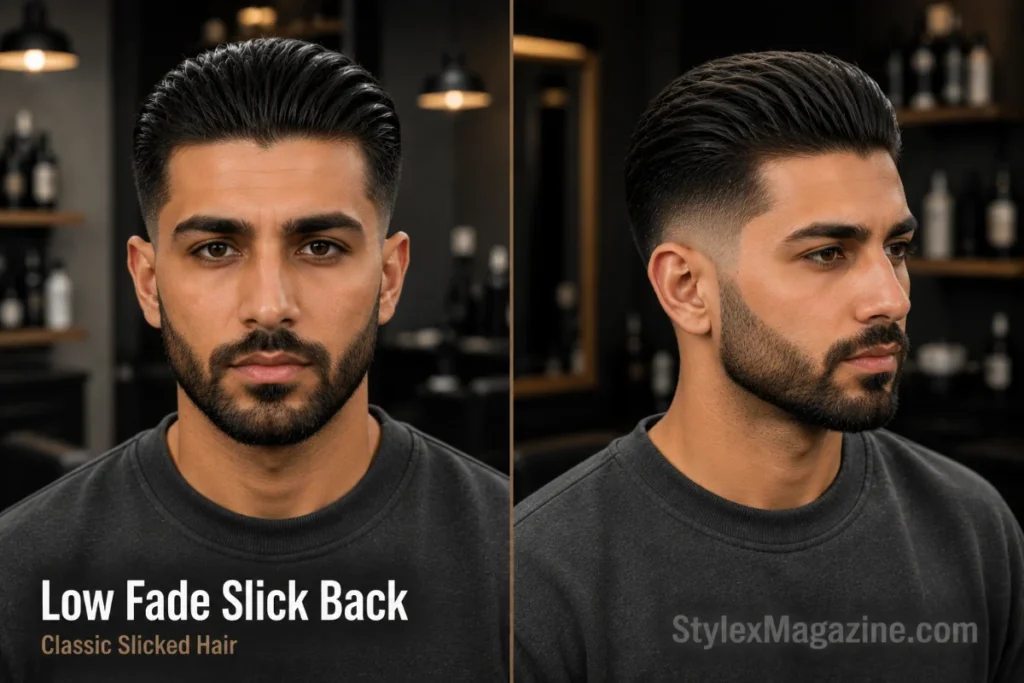
All the top hair combed straight back from the forehead smooth, controlled, no part line. The low fade tightens the sides so the backward direction dominates. Different from the comb over a slick back has no side part and no directional sweep.
Best for: Straight or slightly wavy hair. Oval, square, and diamond face shapes.
Tell your barber: “Low fade on the sides leave 3 to 4 inches on top, all one length, no layering. I’m slicking it straight back.”
Product: Medium-hold pomade for a classic finish with sheen, or matte paste for a modern textured slick back. Apply to damp hair, comb straight back with a fine-tooth comb, and let it set. Blow-drying backward before applying product gives it more staying power.
Maintenance: Every 3 weeks.
23. Low Fade with Design
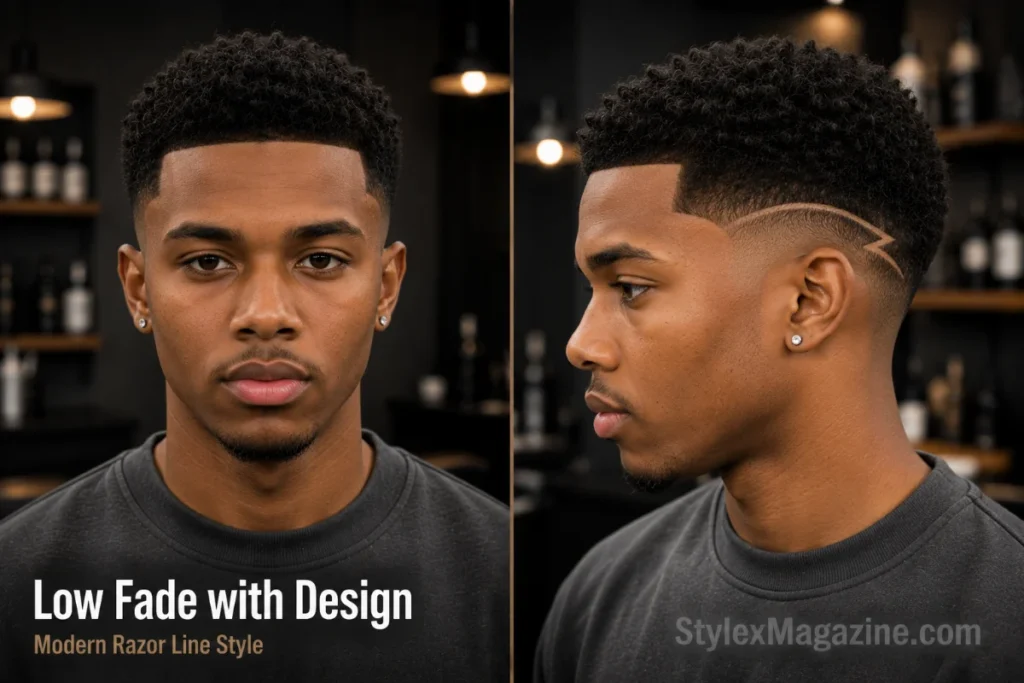
A low fade with a razor-etched line, geometric pattern, or shaved detail cut into the fade zone. The design sits in the transition area between the skin and the longer hair — the low placement keeps it subtle compared to a mid or high fade design.
The design lasts 7–10 days before new growth blurs the lines. If you want it sharp for a specific event, schedule the cut 1–2 days before — not a week out.
Best for: All face shapes. All hair types. Best visible on dark hair against lighter skin low contrast between hair and skin makes designs harder to spot.
Tell your barber: “Low fade on the sides with a line design — single straight line / geometric pattern / curved line behind the ear.” Specify the pattern you want or bring a photo. Vague requests get vague results.
Product: Whatever suits your top style the design sits in the fade zone and needs no product. Between cuts, a small electric trimmer can clean up the design edges at home.
Maintenance: Fade every 2–3 weeks. Design touch-up every 7–10 days if you want it sharp.
24. Low Fade Middle Part
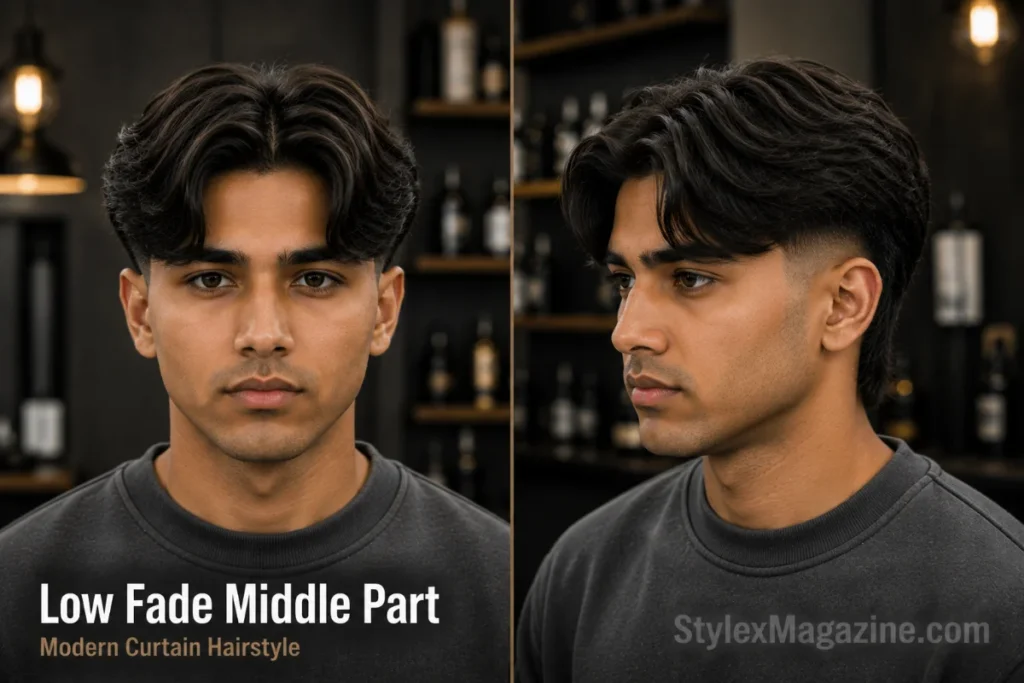
Hair parted down the center with both sides falling outward curtain-style — with a low fade keeping the sides tight below the falling hair. The middle part works best at 4–6 inches on top so both sides have enough weight to fall naturally rather than sticking outward.
On straight hair, the curtain falls clean. On wavy hair, it adds natural separation that looks intentional. On curly hair, the part line disappears under the curl pattern a different look, still workable, but not the classic curtain effect.
Best for: Oval and oblong face shapes. Straight or wavy hair with medium to thick density.
Tell your barber: “Low fade on the sides leave 4 to 6 inches on top, center part, let the sides fall like curtains over the fade.”
Product: Lightweight styling cream on damp hair guides the curtain direction without weighing it down. Blow-dry each side outward from the part. Heavy products flatten the curtain and kill the volume.
Maintenance: Every 3–4 weeks. The longer top grows out cleanly.
25. Low Fade Man Bun
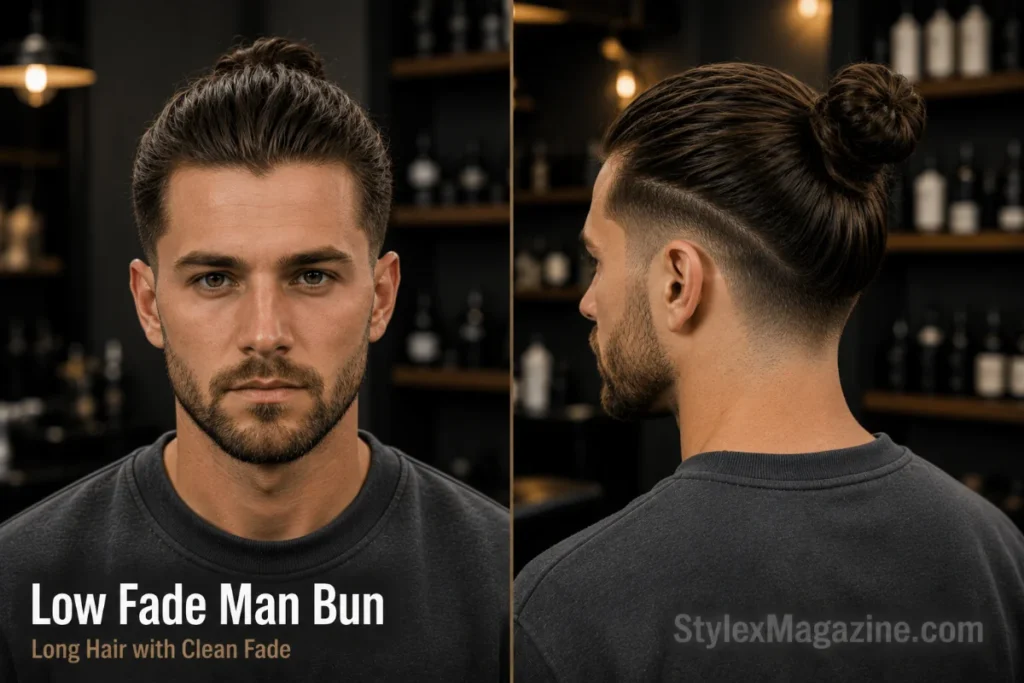
Enough length on top to pull back into a bun at the crown, low fade on the sides. The contrast between the tied-up top and faded sides is the sharpest version of the man bun cleaner than an all-over long style.
Minimum 6 inches on top to get a secure bun. Under that, hair slips out and the bun sits too flat. I tell clients growing toward this style to start with a low fade early — the sides stay clean while the top catches up over 4–6 months.
Best for: Oval and diamond face shapes. All hair types with enough length.
Tell your barber: “Low fade on the sides don’t touch the top, I’m growing it for a bun. Clean up the fade and neckline only.”
Product: Argan oil or a lightweight leave-in conditioner on the top section — keeps the longer hair healthy, reduces frizz, and makes tying it back smoother. Skip wax or clay they make the bun greasy and hard to hold with a tie.
Maintenance: Fade every 3 weeks. Top length maintained by skipping top trims.
How Does a Low Fade Compare to a Mid Fade?
The difference is where the shortest point starts — a low fade begins just above the ear, a mid fade starts at the temple. That 1–2 inch difference changes the entire feel of the cut.
A low fade keeps more hair on the sides. The blend is subtle, the contrast between top and sides is softer, and grow-out stays clean longer because there’s more length absorbing new growth. A mid fade exposes more scalp, creates sharper contrast, and needs a barber visit roughly a week sooner.
| Low Fade | Mid Fade | |
|---|---|---|
| Starts at | Just above the ear | Temple level |
| Contrast | Subtle | Moderate |
| Best for | All settings, including formal | Casual to semi-formal |
| Grow-out | Stays clean 3–4 weeks | Shows lines at 2–3 weeks |
| Maintenance | Every 3 weeks average | Every 2–3 weeks |
| Face shapes | All — especially round and oblong | Oval, square, diamond |
I recommend the low fade to clients who sit in office environments five days a week it never looks unkept at the three-week mark. The mid fade suits men who want more edge without going full high fade. If you’re choosing between the two, maintenance frequency is the deciding factor.
How Does a Low Fade Compare to a High Fade?
The high fade starts above the temples with bold contrast and needs fortnightly visits. The low fade is the opposite end of the spectrum: subtle, forgiving, and designed for 3-4 week cycles. The detailed comparison with maintenance timelines and face shape matches is in the low fade vs mid fade vs high fade breakdown.
What Is the Biggest Mistake Men Make with a Low Fade?
Cutting the top too short. The fade starts low, so the sides stay relatively full. Cut the top short as well and there’s no contrast left the cut flattens out. Keep at least 2 inches on top.
FAQ
What is a low fade haircut?
Hair on the sides and back blended shorter toward the neckline, starting just above the ear. Most of the side hair stays visible — clean structure without bold contrast.
How long does a low fade last?
Low taper fade: 3–4 weeks. Classic, drop, or shadow fade: 3 weeks. Skin fade or temp fade: 2 weeks.
Can curly hair get a low fade?
Yes — but tell your barber to cut based on your dry hair height, not wet. Curls shrink when they dry, which can push the fade line higher than intended.
What clipper guard is used for a low fade?
A #1 or #2 at the base for a classic low fade. A #0 plus straight razor for a skin fade.
Is a low fade good for thick hair?
Yes. Thick hair handles high contrast well — a low skin fade on dense hair gives the sharpest finish.

Other Articles


No Comment! Be the first one.