
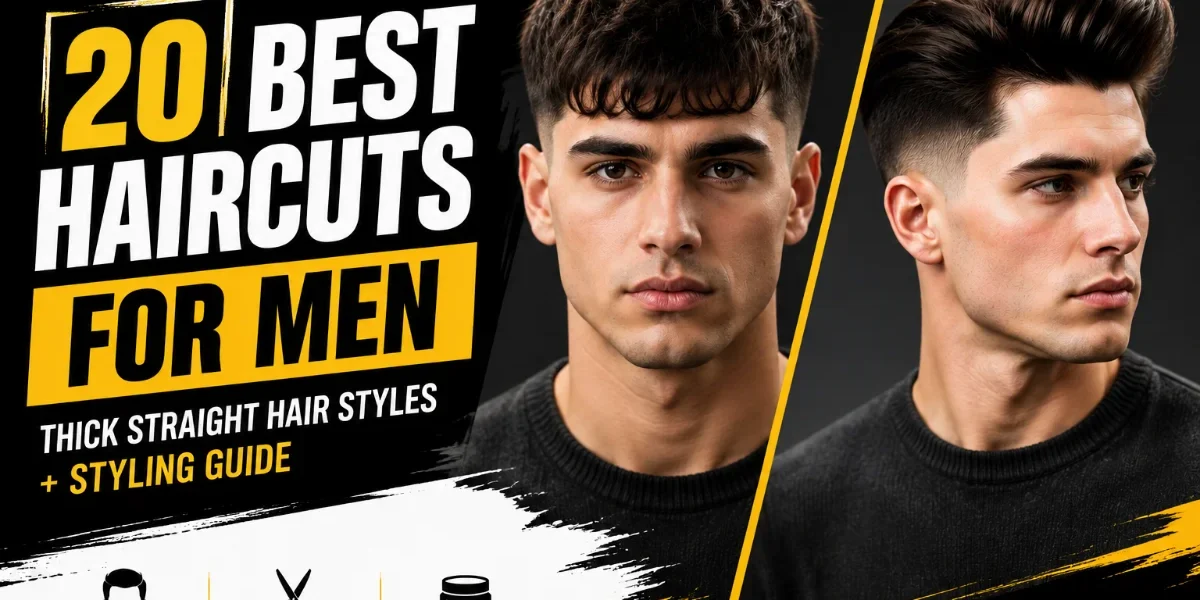

Quick Answer: The best thick straight hair haircuts for men include the textured crop, French crop, side part, and modern quiff. Each style removes bulk through layering or texturing while keeping enough length to style. Choose based on your face shape and daily styling time.
What Makes Thick Straight Hair Different?
Thick straight hair has a higher strand density per square centimetre than medium or fine types. Each individual strand also has a wider diameter, which means more volume at the root and less natural movement at the ends.
This combination creates two specific challenges. First, bulk builds up fast, especially around the sides and back. A haircut that looks sharp on day one can feel heavy and shapeless within three weeks. Second, thick straight strands resist direction. They tend to stick outward rather than lying flat, which makes certain styles harder to hold without the right cut underneath.
The advantage is density. Thick straight hair holds structure better than any other type once the weight is distributed correctly. Layering, texturing, and thinning at the right points turn that raw volume into clean shape without sacrificing fullness on top. If you are still exploring which cuts work on straight hair in general, our complete guide to hairstyles for men with straight hair covers 35 options across every length and face shape.
According to the American Academy of Dermatology, the average head carries roughly 100,000 hair follicles. People with thick hair often sit well above that number, which explains why standard one-length cuts feel heavy within weeks.
20 Best Thick Straight Hair Haircuts for Men
1. Textured Crop
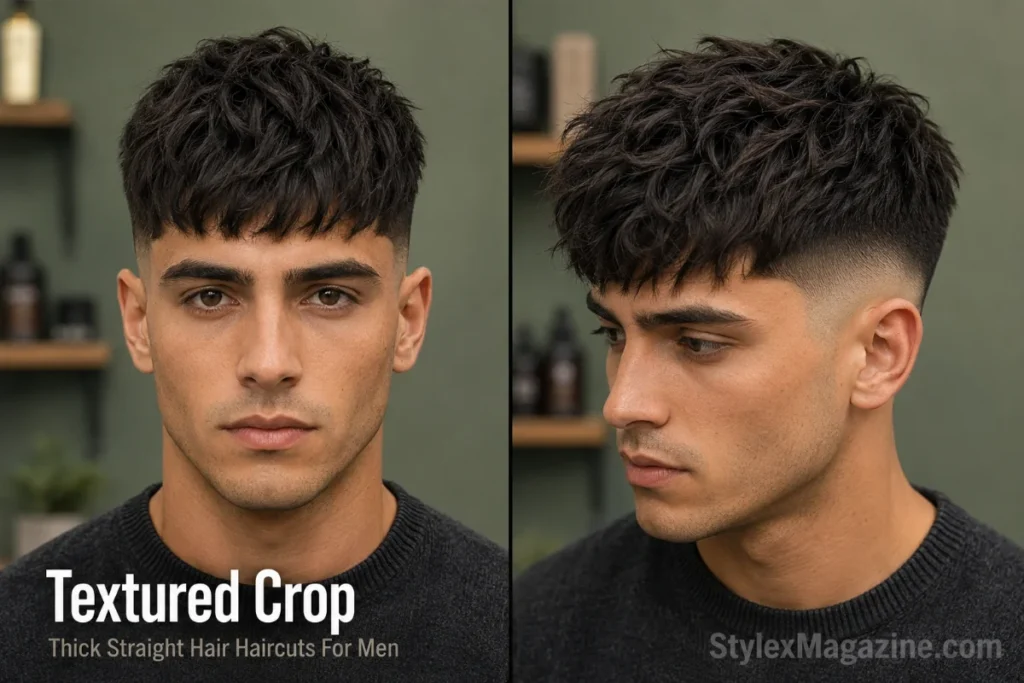
Key Characteristics: Short on the sides (skin fade or taper), 2–3 inches on top with choppy, point-cut layers.
Best Face Shapes: Oval, square, heart
Best Hair Textures: Thick straight, thick wavy
The textured crop is the most requested style I cut on thick-haired clients. The short, chopped layers on top remove bulk without losing coverage, and the disconnection from the faded sides keeps the shape clean for 4–5 weeks. Ask your barber to point-cut the top rather than blunt-cut that single detail prevents the helmet look.
What to Tell Your Barber: Ask for a mid or high skin fade on the sides with a textured, point-cut crop on top. Specify 2–3 inches of length and ask them to remove weight through the interior.
2. French Crop
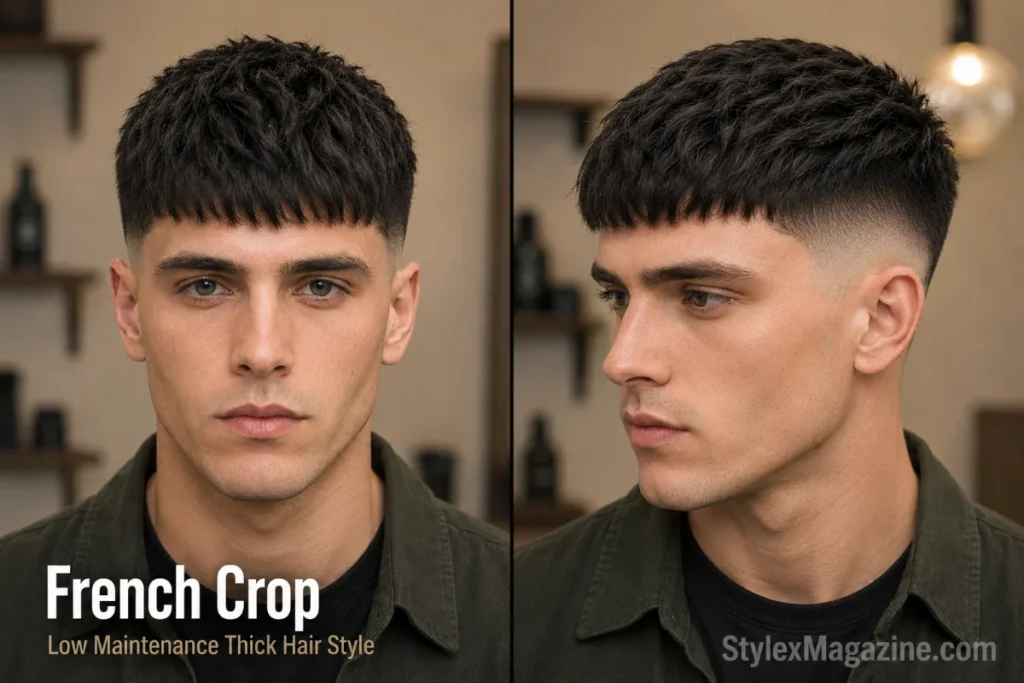
Key Characteristics: Similar to the textured crop but with a defined, forward-falling fringe. Taper or fade on the sides, 2–4 inches on top.
Best Face Shapes: Oval, oblong, diamond
Best Hair Textures: Thick straight
The French crop works particularly well on thick straight hair because the fringe uses that natural density as an advantage. The forward direction means gravity does most of the styling work. I recommend this for anyone who wants a low-maintenance cut that still looks intentional.
What to Tell Your Barber: Ask for a French crop with a textured fringe, tapered sides, and point-cut layers through the top. Mention you want the fringe to sit just above your eyebrows.
3. Side Part
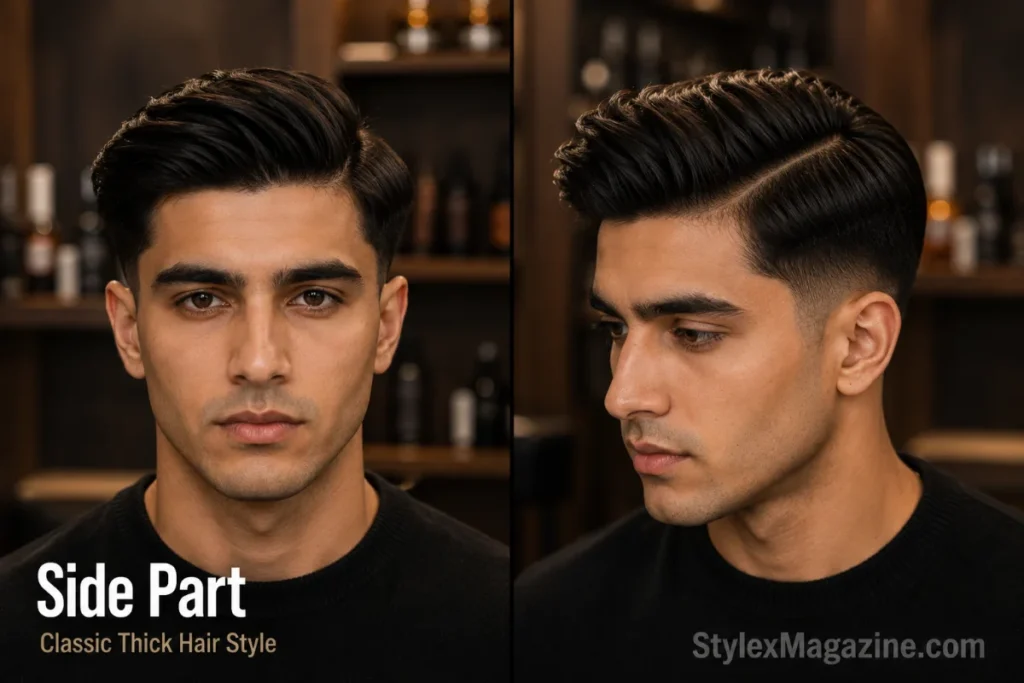
Key Characteristics: Classic structure with a defined parting line, 3–4 inches on top, tapered or low-faded sides.
Best Face Shapes: Oval, round, heart
Best Hair Textures: Thick straight, medium straight
The side part remains one of the cleanest options for thick straight hair. The parting line creates a natural channel that directs volume away from the centre, which prevents the top from looking too bulky. A matte pomade keeps the shape without the slicked-back shine that ages this cut.
What to Tell Your Barber: Ask for a classic side part with a tapered low fade. Request 3–4 inches on top with the part on your dominant side. Ask them to thin the interior if your hair is especially dense.
4. Modern Quiff
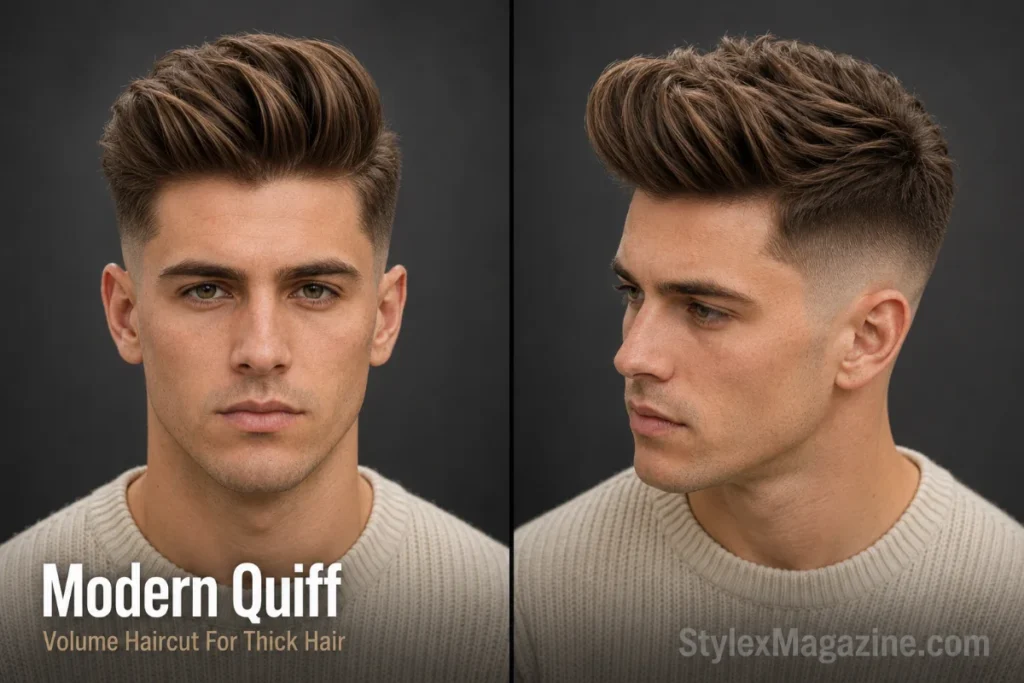
Key Characteristics: Volume-driven style with 3–5 inches on top, graduated length toward the back, and a mid to high fade on the sides.
Best Face Shapes: Round, square, diamond
Best Hair Textures: Thick straight, thick wavy
Thick straight hair was built for the quiff. The density holds the front volume without collapsing by midday, which is a problem thinner-haired men constantly fight. The key is getting the graduation right — the length should decrease steadily from front to crown, not drop off suddenly.
What to Tell Your Barber: Ask for a modern quiff with a high fade, 4–5 inches at the front tapering to 2 inches at the crown. Request texturing through the top to prevent heaviness.
5. Pompadour
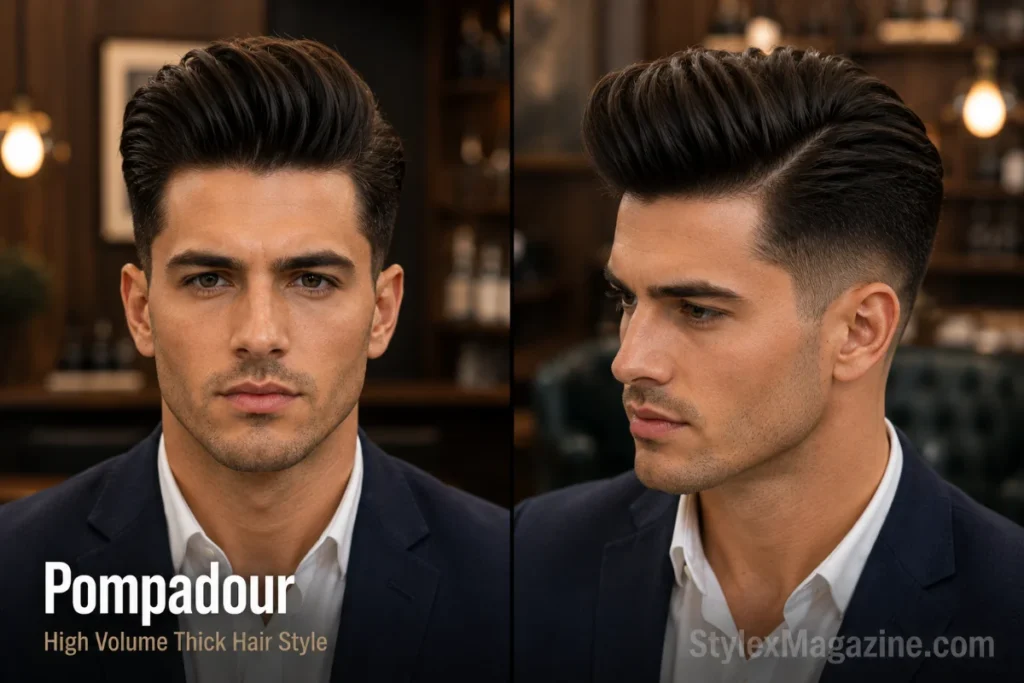
Key Characteristics: Swept-back volume at the front, 4–6 inches on top, tight fade or taper on the sides.
Best Face Shapes: Oval, oblong, square
Best Hair Textures: Thick straight
The pompadour needs thick hair to work properly. Without enough density, the front section deflates within an hour. Thick straight strands hold the lift all day with just a blow-dry and a medium-hold product. Keep the sides tight to emphasise the height contrast.
What to Tell Your Barber: Ask for a pompadour with a mid skin fade on the sides. Request 4–6 inches at the front, gradually decreasing toward the back. Ask for internal layering so the top section is not too heavy to style upward.
6. Slick Back
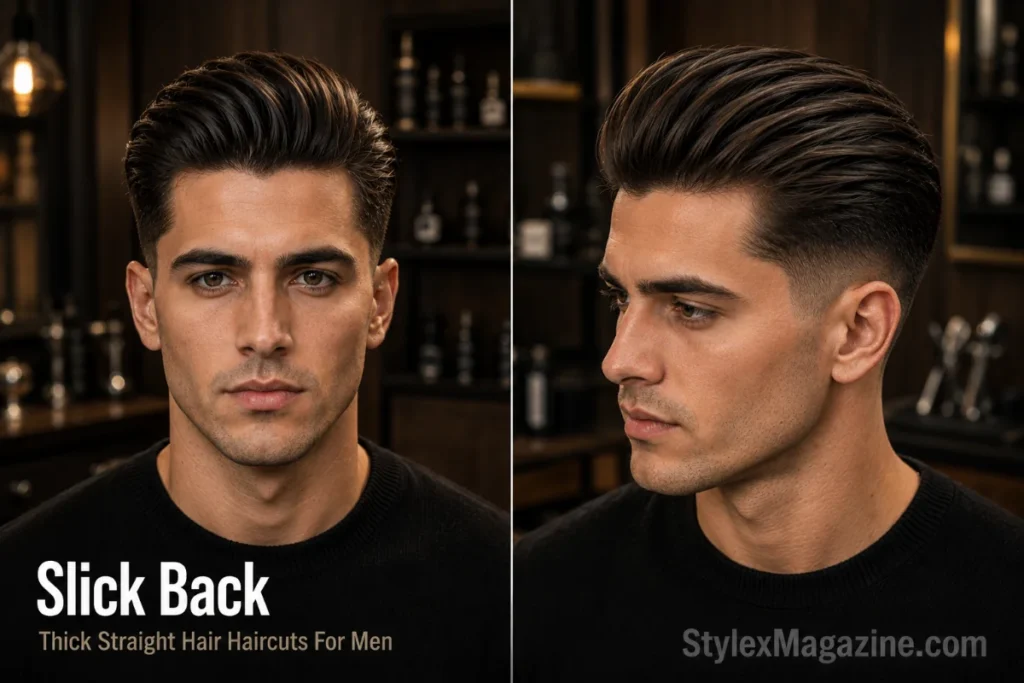
Key Characteristics: All hair swept backward from the forehead, 3–5 inches on top, low fade or taper.
Best Face Shapes: Oval, diamond, heart
Best Hair Textures: Thick straight
The slick back on thick straight hair creates a dense, sculpted look that thinner hair cannot replicate. The fullness at the back of the crown where fine-haired men get flat spots stays rounded and full. Use a high-shine pomade for the traditional look or a matte clay for a modern version.
What to Tell Your Barber: Ask for a slick back with a low taper on the sides, 4–5 inches on top, and ask your barber to keep the weight at the crown for natural fullness when swept back.
7. Buzz Cut
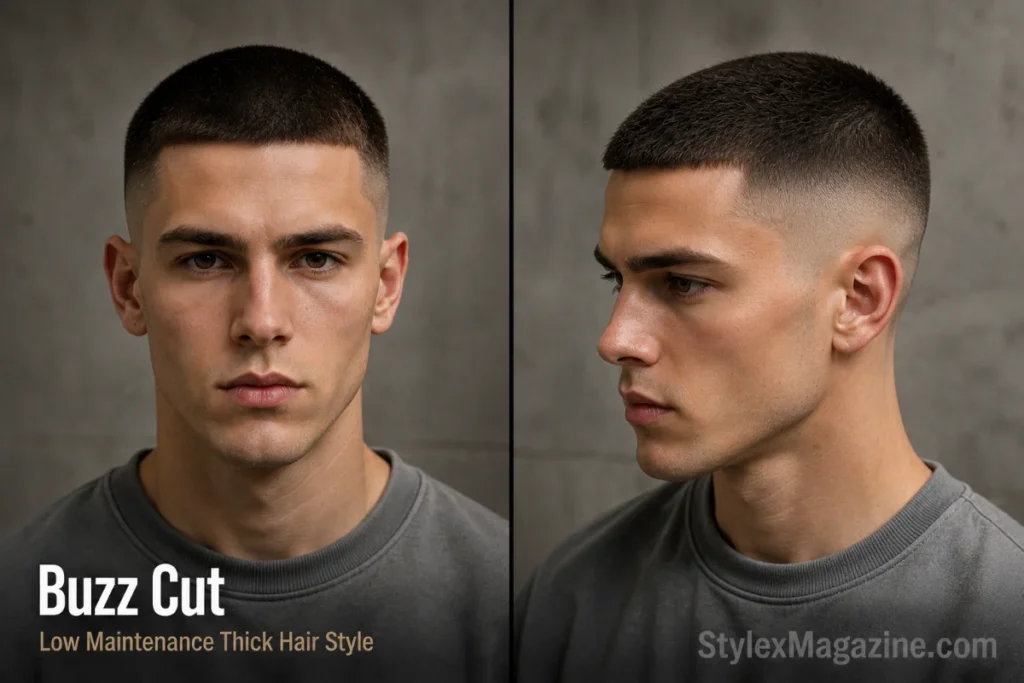
Key Characteristics: Uniform short length all over (grade 1–3) or with a slight fade on the sides.
Best Face Shapes: Oval, square, diamond
Best Hair Textures: All hair types
The buzz cut eliminates every thick-hair problem in one appointment. No bulk, no styling, no products. For thick-haired men who are tired of fighting their hair every morning, this is the reset. Adding a skin fade on the sides gives it more shape than a uniform buzz.
What to Tell Your Barber: Ask for a buzz cut at grade 2 on top with a skin fade on the sides. If you want slightly more length, go grade 3 on top.
8. Crew Cut
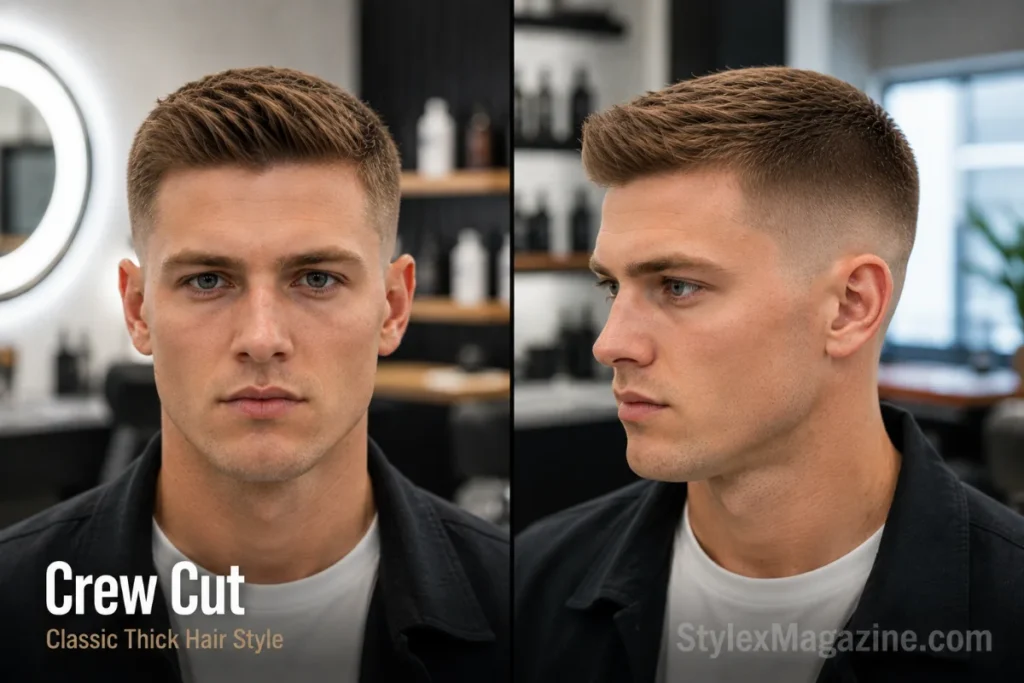
Key Characteristics: Short and graduated slightly longer at the front (1–2 inches), faded or tapered sides.
Best Face Shapes: Oval, round, square
Best Hair Textures: Thick straight, thick wavy
The crew cut is a step up from the buzz with just enough length at the front to style. On thick hair, that front section holds a slight lift without product, which gives it more character than it has on finer types. This cut needs a trim every 3 weeks to stay sharp.
What to Tell Your Barber: Ask for a crew cut with a mid fade on the sides, about 1.5 inches at the front tapering to half an inch at the crown.
9. Ivy League
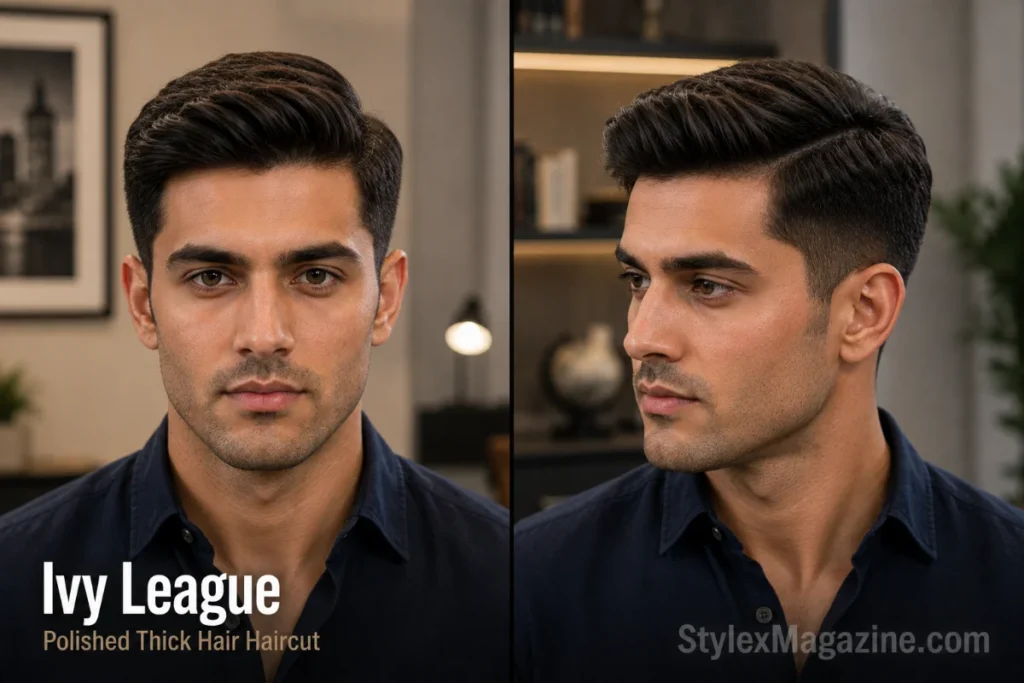
Key Characteristics: A longer crew cut with 2–3 inches on top, enough to part or brush to one side. Tapered sides.
Best Face Shapes: Oval, oblong, heart
Best Hair Textures: Thick straight, medium straight
The Ivy League gives thick-haired men the polish of a side part without the maintenance of longer styles. The top is long enough to direct with a comb and short enough that it does not need a blow-dry. I cut this frequently on clients who work in formal settings but want minimal morning routine.
What to Tell Your Barber: Ask for an Ivy League with a tapered side, 2.5 inches on top, blended into the sides with no hard disconnection.
10. Undercut
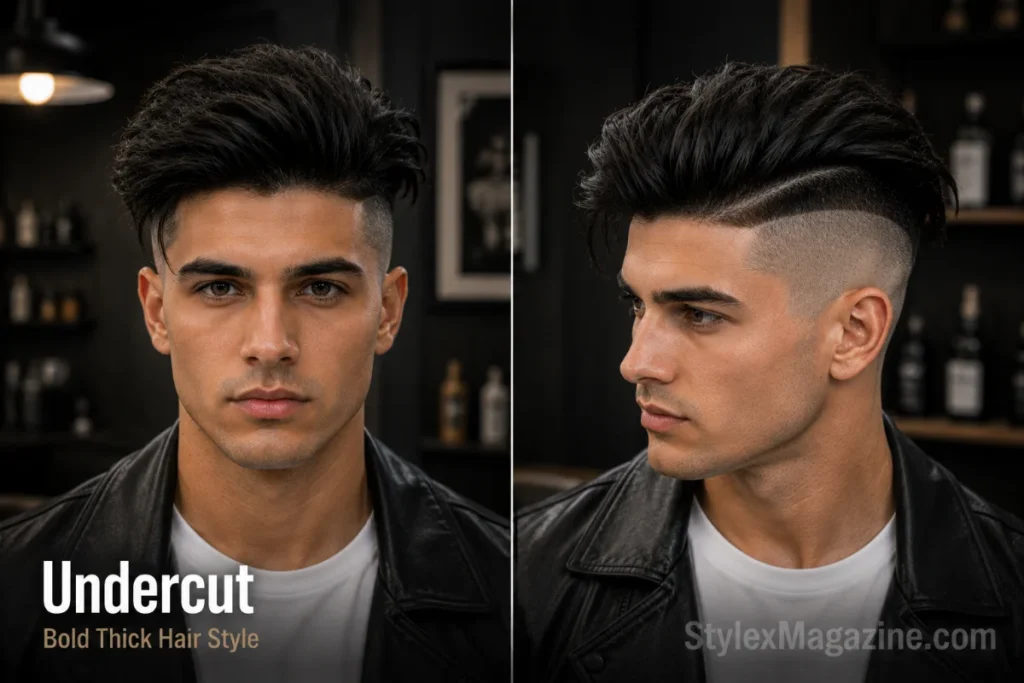
Key Characteristics: Strong disconnection between the top (3–6 inches) and the shaved or closely clipped sides.
Best Face Shapes: Oval, square, round
Best Hair Textures: Thick straight, thick wavy
The undercut removes all the side bulk in one move. On thick straight hair, this creates a dramatic contrast between the full top and the clean sides. The disconnection means zero blending, so it grows out less gracefully than a fade plan for appointments every 3–4 weeks.
What to Tell Your Barber: Ask for an undercut with the sides at grade 1 or 2, disconnected from the top. Keep 4–5 inches on top and ask for texturing through the ends.
11. Taper Fade
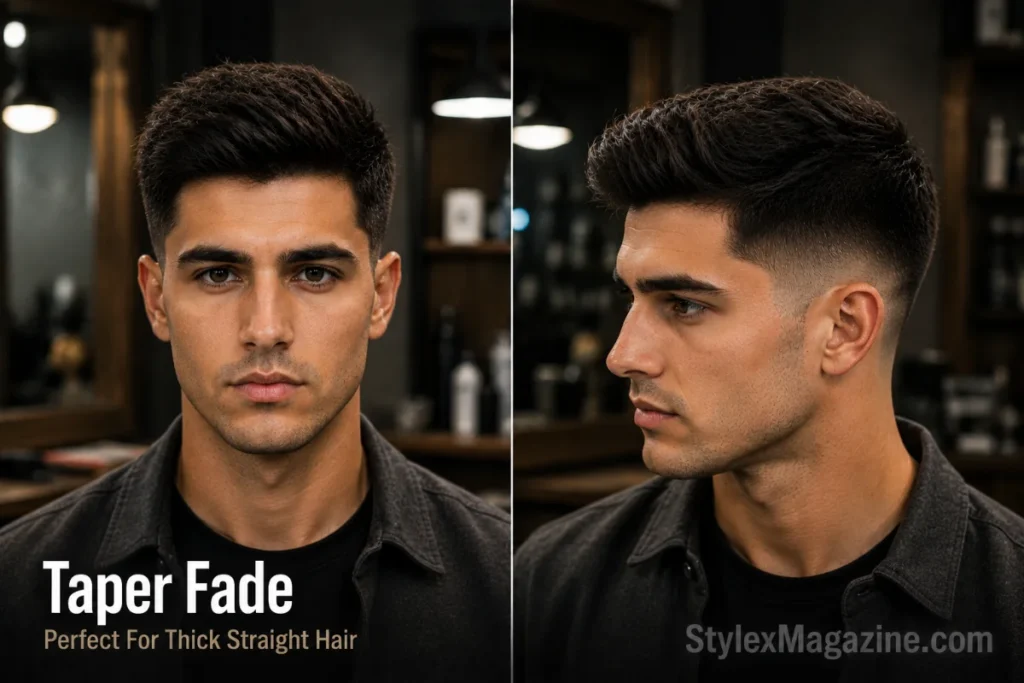
Key Characteristics: Gradual length decrease from the top down through the sides and back. Works with any top length from 2–5 inches.
Best Face Shapes: All face shapes
Best Hair Textures: All hair types
The taper fade is less a specific haircut and more a side treatment that makes almost any thick-hair style work better. The gradual transition prevents the sides from looking blocky — the number one complaint thick-haired men have after a basic scissor cut. I add a taper fade to roughly 70% of the thick-hair cuts I do.
What to Tell Your Barber: Ask for a taper fade starting at grade 0 at the hairline, blending into the length on top. Specify whether you want a low, mid, or high taper depending on how much contrast you want.
12. Caesar Cut
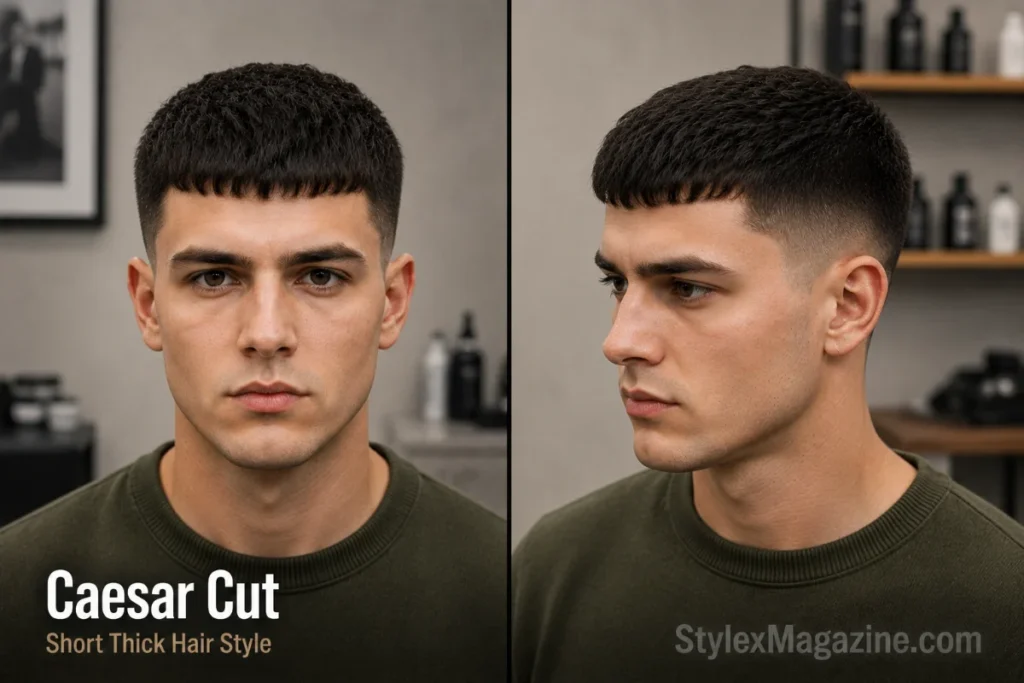
Key Characteristics: Short, uniform length on top (1–2 inches) with a short, horizontal fringe. Tapered or faded sides.
Best Face Shapes: Oval, round, square
Best Hair Textures: Thick straight
The Caesar cut keeps thick straight hair contained without removing too much length. The short fringe sits flat against the forehead, which prevents the top from sticking upward a common thick-hair frustration at shorter lengths. This is one of the easiest styles to maintain at home between cuts.
What to Tell Your Barber: Ask for a Caesar cut with 1.5 inches on top, a straight-cut fringe at the front, and a low taper on the sides.
13. Angular Fringe
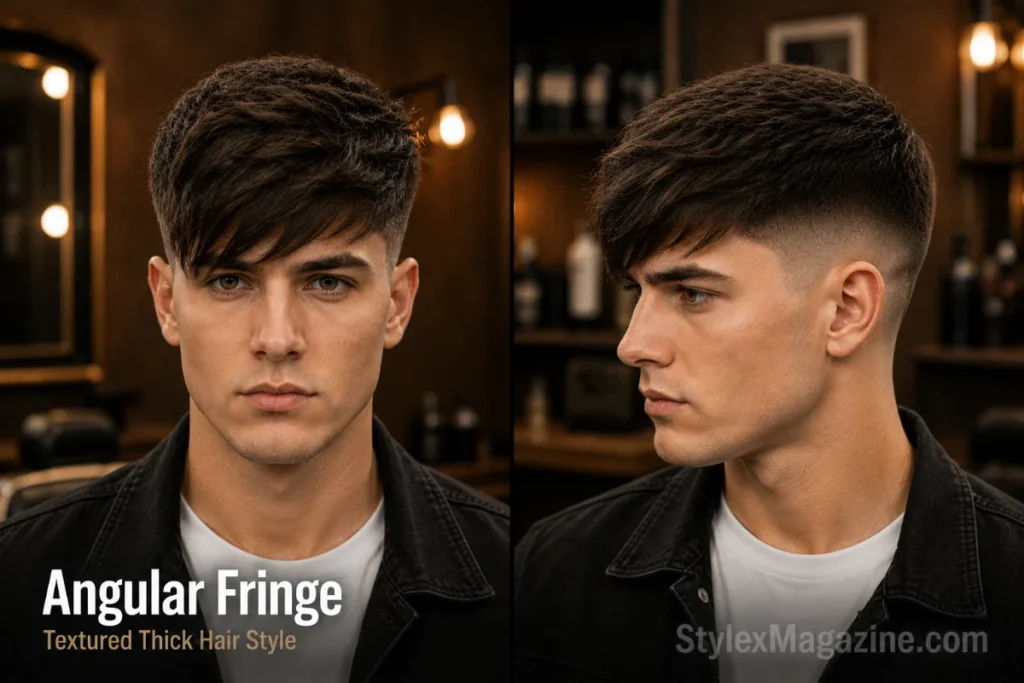
Key Characteristics: Longer fringe (3–4 inches) swept diagonally across the forehead, shorter sides with a fade or taper.
Best Face Shapes: Round, square, heart
Best Hair Textures: Thick straight, medium straight
The angular fringe uses thick hair’s density to create a strong diagonal line across the forehead. On fine hair, this fringe looks sparse and wispy. On thick straight hair, it forms a solid, intentional shape. The asymmetry also breaks up the roundness that thick-haired men sometimes get on top.
What to Tell Your Barber: Ask for an angular fringe with 3–4 inches swept to one side, a mid fade on the sides, and texturing through the fringe to prevent heaviness.
14. Messy Top with Fade
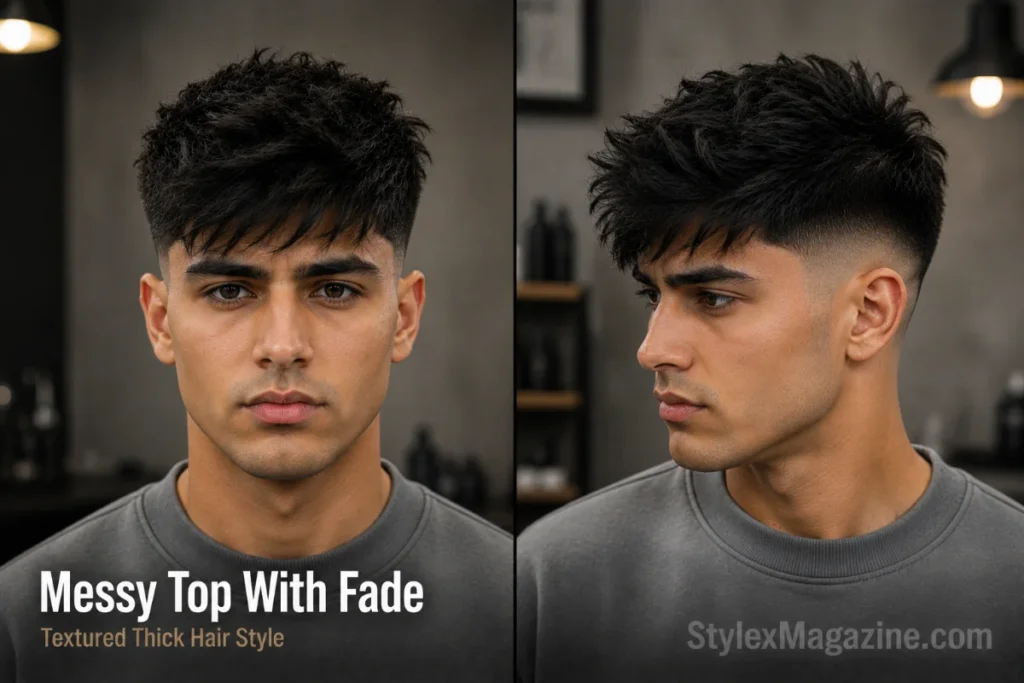
Key Characteristics: 3–4 inches on top styled with deliberate texture and movement, paired with a mid or high fade.
Best Face Shapes: Oval, round, diamond
Best Hair Textures: Thick straight, thick wavy
This style leans into the natural volume of thick hair rather than fighting it. The top is left intentionally imperfect — pushed in different directions with a matte product while the faded sides keep the overall shape controlled. It works best on men who want a style that looks effortless rather than polished.
What to Tell Your Barber: Ask for a messy, textured top with a high skin fade. Request point-cutting through the top and ask your barber to leave enough length to create movement.
15. Classic Taper
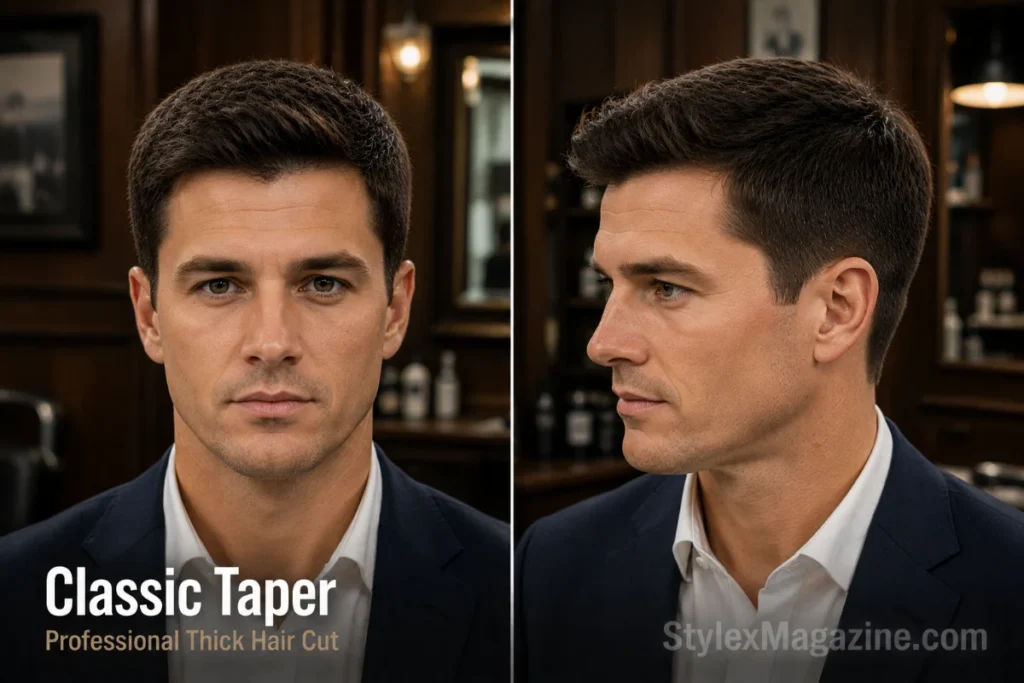
Key Characteristics: Traditional barbershop cut with 2–3 inches on top and a gradual taper down the sides and back. No skin showing.
Best Face Shapes: All face shapes
Best Hair Textures: Thick straight, medium straight
The classic taper is the safest option for thick-haired men who want a clean, professional look without any trend risk. No skin showing on the sides means it grows out gracefully and only needs a trim every 4–5 weeks. Bobby Gordon, senior barber at East London’s Barber & Co, recommends this cut as the baseline for any thick-haired man who has never had a proper consultation — ‘Start here and adjust from this point rather than chasing a trend that might not suit your head shape.’
What to Tell Your Barber: Ask for a classic taper with 2.5 inches on top, scissor-cut sides blended gradually into the neckline. No clippers on the sides.
16. Textured Mid-Length (Trending 2026)
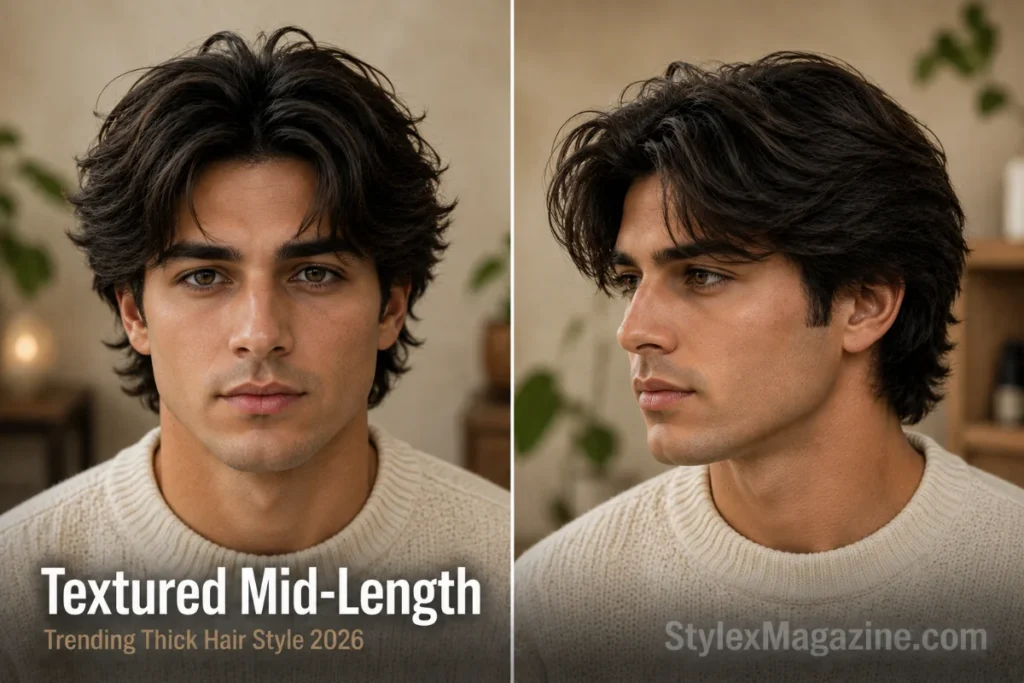
Key Characteristics: 4–6 inches all over with heavy texturing and layering. Minimal fade — natural sides kept longer.
Best Face Shapes: Oval, oblong, diamond
Best Hair Textures: Thick straight, thick wavy
The mid-length textured style is gaining traction in 2026 as men move away from ultra-short fades. On thick straight hair, the layers prevent the weight from pooling at the ends, which is the main reason longer styles fail on this hair type. This needs a blow-dry and a sea salt spray to look its best.
What to Tell Your Barber: Ask for a textured mid-length cut with internal layering, no fade on the sides, and the ends point-cut for movement. Specify 5 inches minimum on top.
17. Curtain Fringe (Trending 2026)
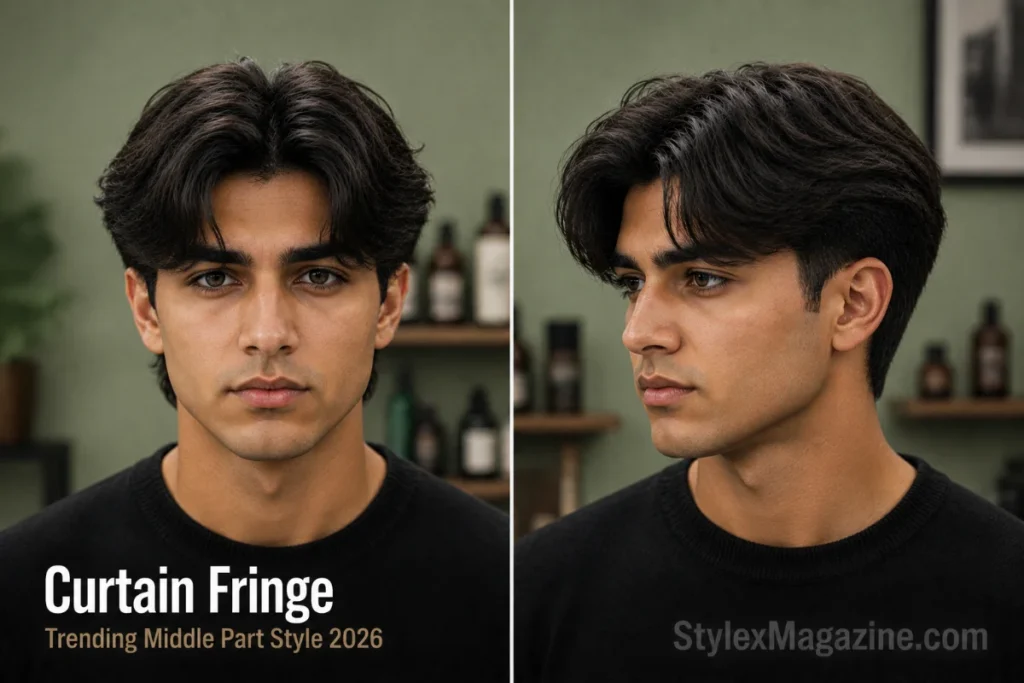
Key Characteristics: Centre-parted fringe that falls to either side of the forehead, 4–5 inches on top, tapered sides.
Best Face Shapes: Oval, round, heart
Best Hair Textures: Thick straight
The curtain fringe has moved from a Gen Z trend into mainstream barbershops in 2026. Thick straight hair gives the fringe the density it needs to split cleanly down the centre without gaps. The parting holds naturally after a few weeks of training the hair with a blow-dryer.
What to Tell Your Barber: Ask for a curtain fringe with 4–5 inches at the front, centre-parted, with a low taper on the sides. Request face-framing layers around the temples.
18. Burst Fade with Textured Top (Trending 2026)
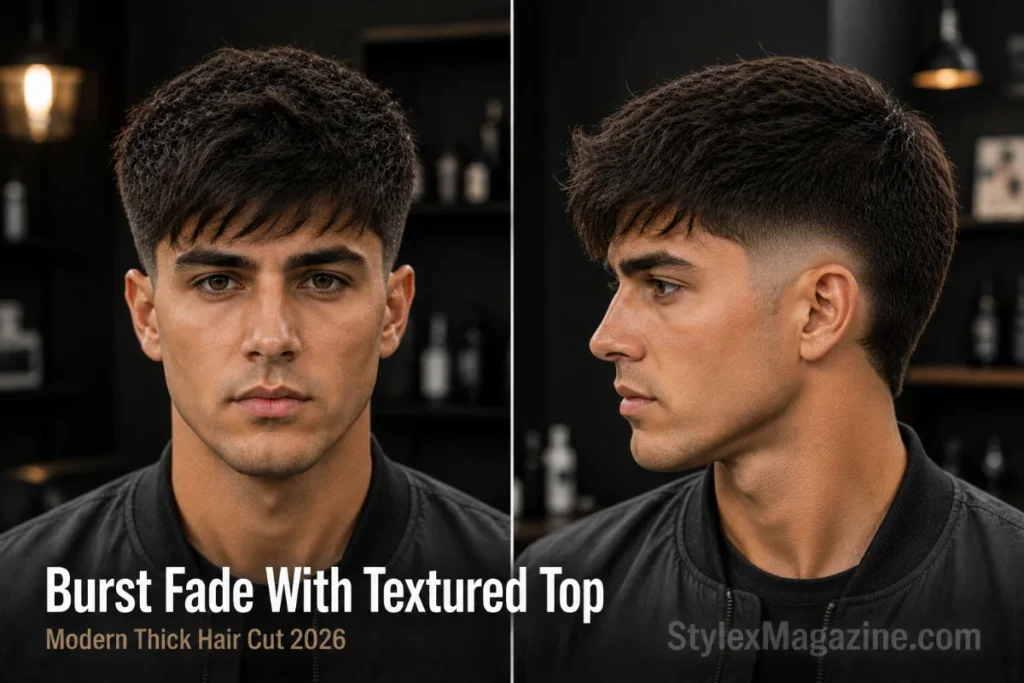
Key Characteristics: Rounded fade behind the ear (burst shape) with a textured, finger-styled top, 3–4 inches.
Best Face Shapes: Round, oval, square
Best Hair Textures: Thick straight, thick wavy
The burst fade adds curve to the sides instead of the standard straight-line fade. On thick hair, this rounded transition looks smoother because the density fills in any patchiness that thinner hair shows around the ear. The textured top keeps it casual and modern.
What to Tell Your Barber: Ask for a burst fade behind the ears with a textured top at 3–4 inches. Request point-cutting on top and ask for the burst to fade to skin behind the ear.
19. Modern Mullet (Trending 2026)
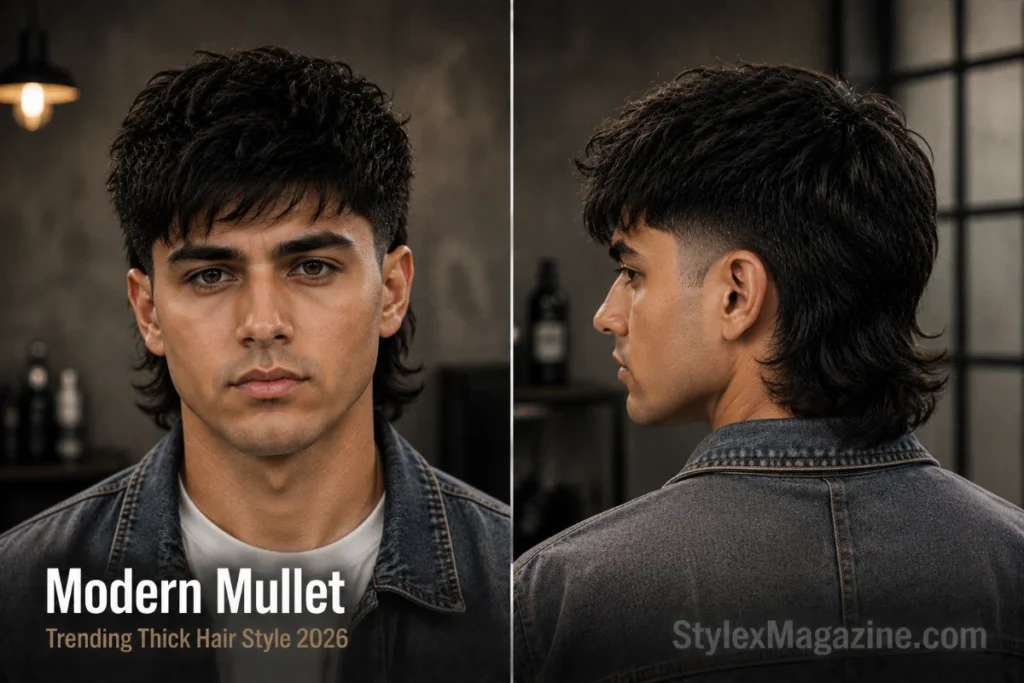
Key Characteristics: Short to medium on top and sides, longer at the back (4–6 inches). Often paired with a taper or fade.
Best Face Shapes: Oval, diamond, oblong
Best Hair Textures: Thick straight, thick wavy
The modern mullet has been building momentum since 2024 and remains strong in 2026. Thick straight hair gives the back section the weight and movement it needs — fine hair tends to look thin and stringy at the mullet length. Keep the top textured and the sides faded to separate this from the 1980s version.
What to Tell Your Barber: Ask for a modern mullet with a mid fade on the sides, textured crop length on top, and 5–6 inches at the back. Request layering through the back to prevent it from looking blocky.
20. Disconnected Pompadour (Trending 2026)
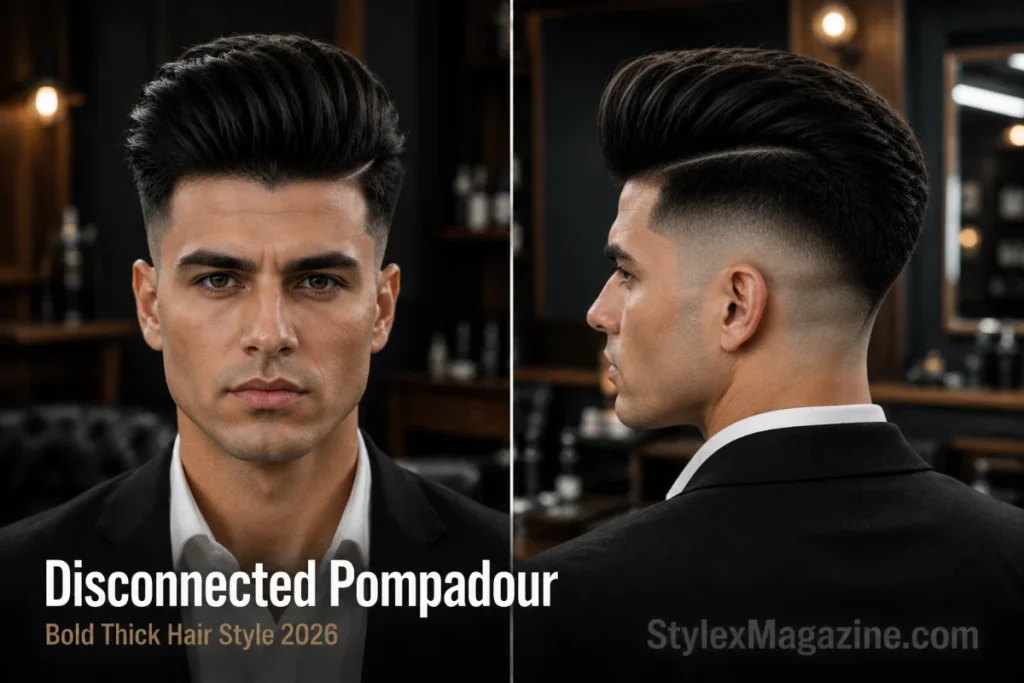
Key Characteristics: High-volume pompadour on top (4–6 inches) with a sharp, disconnected undercut on the sides.
Best Face Shapes: Oval, square, round
Best Hair Textures: Thick straight
The disconnected pompadour takes the classic pompadour and adds a hard line between the top and sides. Thick straight hair holds the pompadour volume without needing excessive product — a blow-dry and a medium-hold clay is enough. This style demands clean sides, so budget for barber visits every 2–3 weeks.
What to Tell Your Barber: Ask for a disconnected pompadour with a high skin fade, hard part on one side, and 5 inches at the front swept upward and back. Ask for internal texturing to keep the top manageable.
Which Thick Hair Haircut Suits Your Face Shape?
Oval Face
Most styles work. The balanced proportions mean you can go short, medium, or long without disrupting your face shape. Best picks: textured crop, quiff, side part, pompadour.
Round Face
Add height on top and keep the sides tight. Avoid styles that add width around the ears. Best picks: modern quiff, pompadour, angular fringe, undercut.
Square Face
Soften the strong jawline with textured, less structured styles. Avoid very short, boxy cuts that emphasise the angular jaw. Best picks: textured crop, messy top, French crop, curtain fringe.
Oblong Face
Add width and avoid excessive height. A fringe shortens a long face visually. Best picks: French crop, Caesar cut, classic taper, curtain fringe.
Heart Face
Balance a wider forehead and narrower chin. Medium-length styles with volume at the sides work well. Best picks: side part, slick back, Ivy League, angular fringe.
Diamond Face
Widen the forehead and chin area visually. Fringes and textured tops add balance. Best picks: French crop, textured crop, angular fringe, curtain fringe.
How to Style Thick Straight Hair: Step-by-Step?
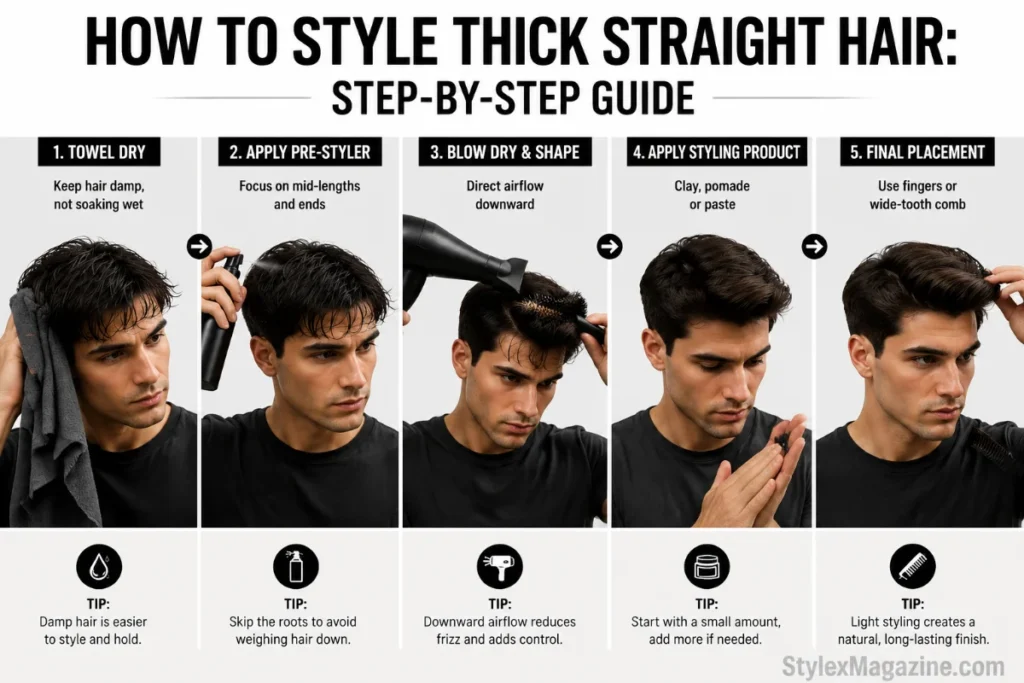
Step 1: Wash your hair and towel-dry until it is damp — not dripping, not dry. Roughly 70% dry is the target.
Step 2: Apply a pre-styler (heat protectant or volumising spray) from mid-shaft to ends. Skip the roots — product at the roots weighs thick hair down.
Step 3: Blow-dry using a concentrator nozzle. Point the airflow downward along the hair shaft, not against it. Use a round brush to direct the front section into your desired shape.
Step 4: Once fully dry, take a small amount of your finishing product (clay, pomade, or paste — see product section below). Rub it between your palms until it is evenly distributed, then work it through the hair from back to front.
Step 5: Use your fingers or a wide-tooth comb for final placement. Avoid fine-tooth combs on thick hair — they create drag and static.
Best Product Types for Thick Straight Hair
Matte Clay: Medium to strong hold with no shine. Best for textured crops, messy tops, and quiffs. Apply to towel-dried or dry hair. Thick hair needs roughly a thumbnail-sized amount.
Medium-Hold Pomade: Flexible hold with a natural sheen. Works for side parts, pompadours, and slick backs. Choose water-based over oil-based — it washes out in one shampoo.
Sea Salt Spray: Adds texture and grip to mid-length and longer styles. Spray onto damp hair before blow-drying. Gives thick straight hair the movement it naturally lacks.
Heat Protectant Spray: Essential before any blow-drying. Thick hair needs regular heat styling, so this prevents long-term dryness and breakage. Apply to damp hair before picking up the dryer.
Texturising Paste: Light hold with a dry finish. Good for natural, finger-styled looks. Works best on cuts with internal layering where you want pieces to separate.
Barber Language: What to Say for Thick Hair
Thick hair needs specific instructions beyond “short on the sides, longer on top.” Here are the phrases that get better results:
- “Thin out the interior” — Tells the barber to remove bulk from inside the cut, not just shape the outline.
- “Point-cut the top” — Creates textured, piece-y ends instead of blunt, heavy ones.
- “Blend the weight line” — Prevents a hard shelf where the top meets the sides.
- “Feather razor the ends” — Bobby Gordon recommends this for thick straight hair — it removes weight from the tips without shortening the overall length.
- “Take the sides down to a [grade number] fade” — Be specific about how short you want the sides. “Short” means different things to different barbers.
- “Leave length to style” — If you plan to quiff, pompadour, or brush back, make sure your barber knows. They will adjust the internal layering to support that direction.
How Often Should You Get a Thick Straight Hair Haircut?
Thick straight hair grows at the standard rate — roughly half an inch per month — but it shows growth faster because the density amplifies every millimetre. Faded styles need a trim every 2–3 weeks to stay sharp. Tapered and longer styles last 4–5 weeks before they lose their shape.
If you are growing out a shorter style, resist the urge to skip appointments entirely. A “maintenance trim” every 5–6 weeks — where the barber cleans the neckline and sides without touching the top — keeps the grow-out looking intentional rather than neglected.
5 Mistakes to Avoid With Thick Straight Hair
Cutting on Wet Hair Without Checking Dry Shape
Thick straight hair shrinks less than curly types, but the weight distribution changes completely when dry. A cut that looks balanced on wet hair can look top-heavy once dry. Ask your barber to check the shape after rough-drying before doing final adjustments.
Ignoring Cowlicks During the Cut
Thick hair makes cowlicks more visible, not less. A cowlick at the crown will push through any style if the barber does not account for it. Point out your cowlick pattern before the cut starts.
Loading Product at the Roots
Applying product directly to the roots flattens thick hair and makes it look greasy faster. Start at the mid-shaft and ends, then use whatever remains on your palms for the roots.
Trimming Your Own Fringe Between Appointments
Home fringe trims on thick straight hair almost always go wrong. The density makes it difficult to cut a straight line without professional shears and tension control. One bad cut creates a blunt shelf that takes weeks to grow out.
Using a Fine-Tooth Comb on Tangled Hair
Thick straight hair tangles at the nape and behind the ears. Pulling a fine-tooth comb through these tangles snaps strands and creates frizz. Use a wide-tooth comb or detangling brush, starting from the ends and working upward.
Frequently Asked Questions
How fast does thick straight hair grow?
Thick straight hair grows at the same rate as other types — roughly half an inch (1.25 cm) per month. It appears to grow faster because the density makes new length more visible. At that rate, growing from a buzz cut to a quiff-ready length (4 inches) takes about 8 months.
How do I grow out a fade on thick straight hair?
The awkward stage hits around weeks 3–5 when the sides start pushing outward. Use a matte clay to press the sides down, and book a maintenance trim to clean up the neckline and ear area without touching the top. The sides will blend naturally once they reach about 1.5 inches.
Does thick straight hair work with a beard?
Yes — thick hair and a full beard create a balanced, proportional look. Keep the beard edges clean and defined to contrast the hair’s density. If your hair is faded on the sides, blending the fade into the beard line creates a seamless transition.
Is air-drying or blow-drying better for thick straight hair?
Blow-drying gives you more control over direction and volume. Air-drying works for textured, casual styles but limits your ability to add lift or sweep the hair in a specific direction. For anything structured — quiffs, pompadours, side parts — blow-drying is necessary.
Can thick straight hair be thinned out permanently?
No. Thinning shears and razors reduce bulk temporarily, but the hair grows back at its original thickness within one growth cycle (4–6 weeks). Regular thinning at each haircut appointment is the only way to maintain reduced bulk.
What pillow material is best for thick straight hair?
Silk or satin pillowcases reduce friction, which means less frizz and fewer tangles in the morning. Cotton pillowcases create friction that roughs up the hair cuticle overnight — noticeable on thick hair because the volume amplifies any frizz.
Should I wash thick straight hair every day?
No. Thick straight hair does best with washing every 2–3 days. Daily washing strips natural oils that keep the strands smooth and manageable. On non-wash days, rinse with water and apply a lightweight conditioner to the ends only.
Can I get a middle part with thick straight hair?
Yes — thick straight hair is one of the best types for a middle part because the density creates a full, even curtain on both sides. Train the part with a blow-dryer for 1–2 weeks, and use a light pomade to keep the sides in place. See our middle part hairstyles for men guide for the full process.

Other Articles
27 Best Haircuts For Men With Thin Straight Hair (2026)
How to Get a Middle Part Haircut? Step-by-Step Guide
No Comment! Be the first one.