
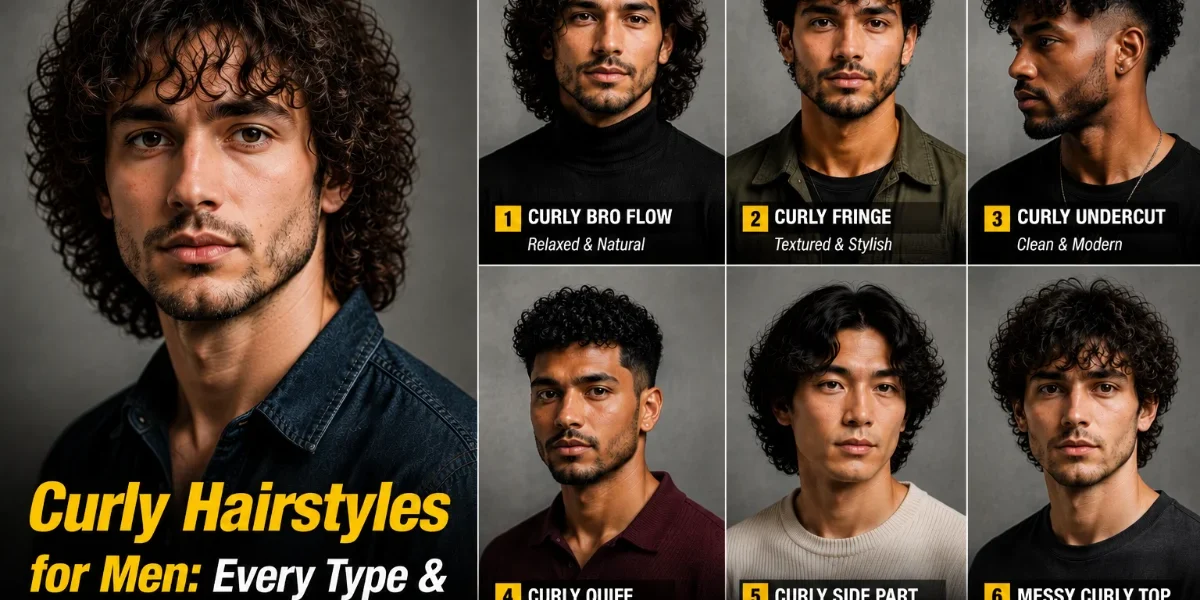

The best curly hairstyles depend on curl type and face shape. Short styles like the textured crop need minimal upkeep. Medium styles like the shag offer the widest range. Long styles need consistent care.
Most men with curly hair pick a style from a photo and hope for the best. That approach fails because a cut designed for loose 2C waves collapses on tight 4A coils — and a style built for dense coils looks shapeless on fine waves.
This guide covers short, medium, and long curly styles — organised by what actually works for each curl type and face shape.
How Do You Identify Your Curl Type?
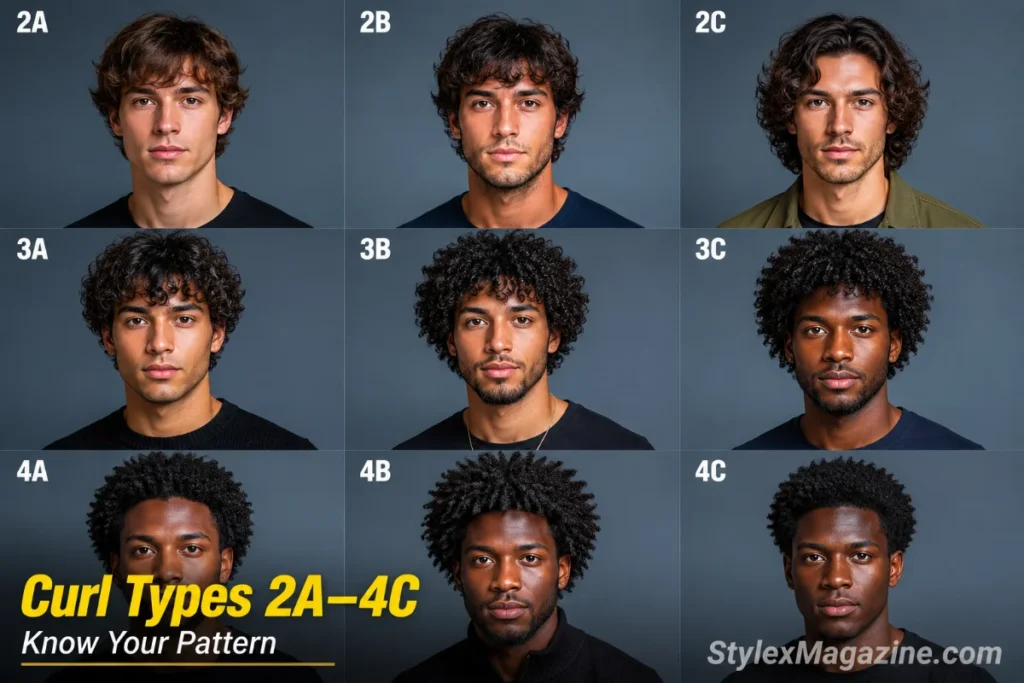
Every curly haircut decision starts here. The Andre Walker classification system breaks curly hair into three main types, each with sub-categories that determine how a style holds, how much shrinkage to expect, and what products actually work.
Type 2 — Wavy. Loose S-shaped bends that lay relatively flat against the head. Sub-types range from barely-there waves (2A) to defined S-curves with moderate volume (2C). Shrinkage is minimal — roughly 10–15%. These curls respond best to lightweight products like sea salt spray or a light curl cream. Anything heavier flattens the wave.
Type 3 — Curly. Springy spirals that stand away from the head with real bounce. 3A curls are loose corkscrews, 3B curls are tighter ringlets, and 3C curls are dense spirals with significant volume. Shrinkage ranges from 20% on 3A hair to 45% on 3C. Medium-weight curl creams and defining gels hold the pattern without weighing it down.
Type 4 — Coily. Tight coils and Z-shaped patterns with the most shrinkage of any hair type — 50–75% of stretched length, according to research published in the Proceedings of the Royal Society B. 4A curls are defined coils, 4B are Z-patterns, and 4C are the tightest. These curls need heavier moisture — curl butters, moisturising gels, and leave-in treatments.
How to check yours: Wash with a sulfate-free shampoo, condition, apply a light leave-in, and air dry without touching. The pattern that forms naturally is your curl type.
What Are the Best Short Curly Styles for Men?
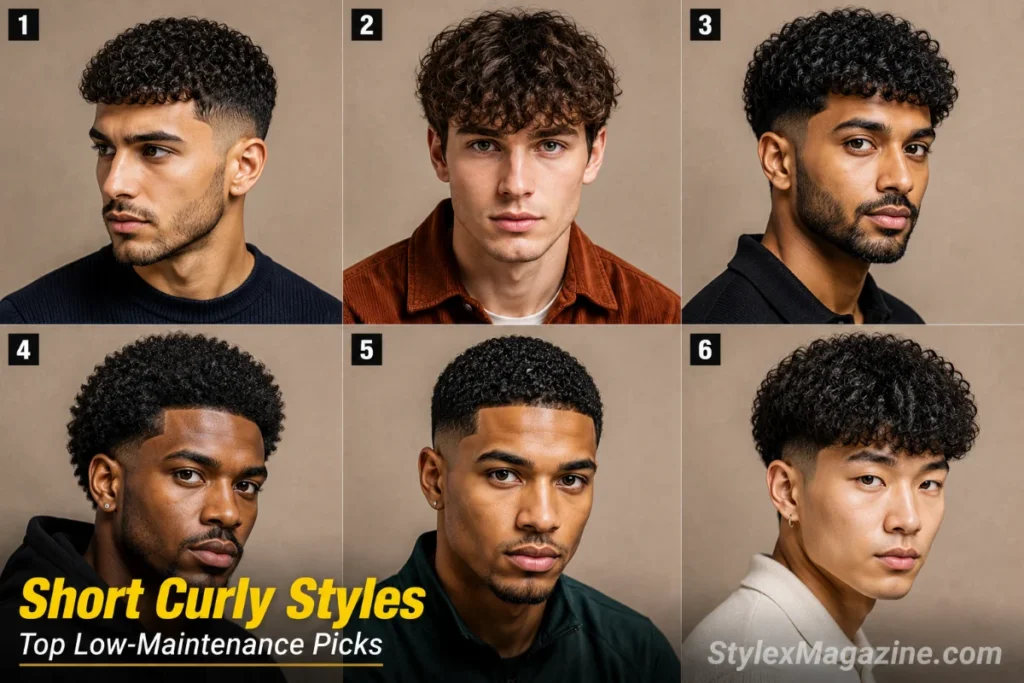
The textured crop and curly fade are the two strongest options for men who want curl definition without a daily routine. Short curly cuts keep hair under 3 inches on top — the cut does nearly all the work, and product is optional on most.
Textured Crop — Short on the sides with defined curls kept slightly longer on top. Suits Type 3A–3C curls and oval or round faces. Trim every 4–5 weeks.
Curly Fringe — Curls fall forward onto the forehead while the sides stay tapered or faded. Timothée Chalamet made this the most-searched curly style for two years straight. Hides a high hairline and flatters heart and oval faces. Best on Type 2C–3B curls.
Low Fade With Curls — A low fade starting just above the ear that blends into fuller curls on top. Works across all curl types and grows out cleanly between appointments.
Short Curly Afro — Even length all around, picked out for shape, with a clean edge-up. The defining short style for Type 4A–4C coils. Daily moisture with a leave-in conditioner is non-negotiable — afro-textured hair dries out faster than any other type.
Curly Buzz Cut — Clipped to a uniform short length that still shows the curl pattern underneath. Lowest maintenance option available. On 4A–4C coils, the texture stays visible even at a quarter inch.
Broccoli Cut — Dense curls shaped into a rounded silhouette with faded sides. The breakout style of 2025 that carried into 2026. Requires springy 3A–3C curls with real density to hold the shape.
For the full breakdown of 25+ short styles organised by curl type — including barber scripts, face shape matching, and celebrity references for each — read the complete short curly hairstyles guide.
What Are the Best Medium-Length Curly Hairstyles for Men?
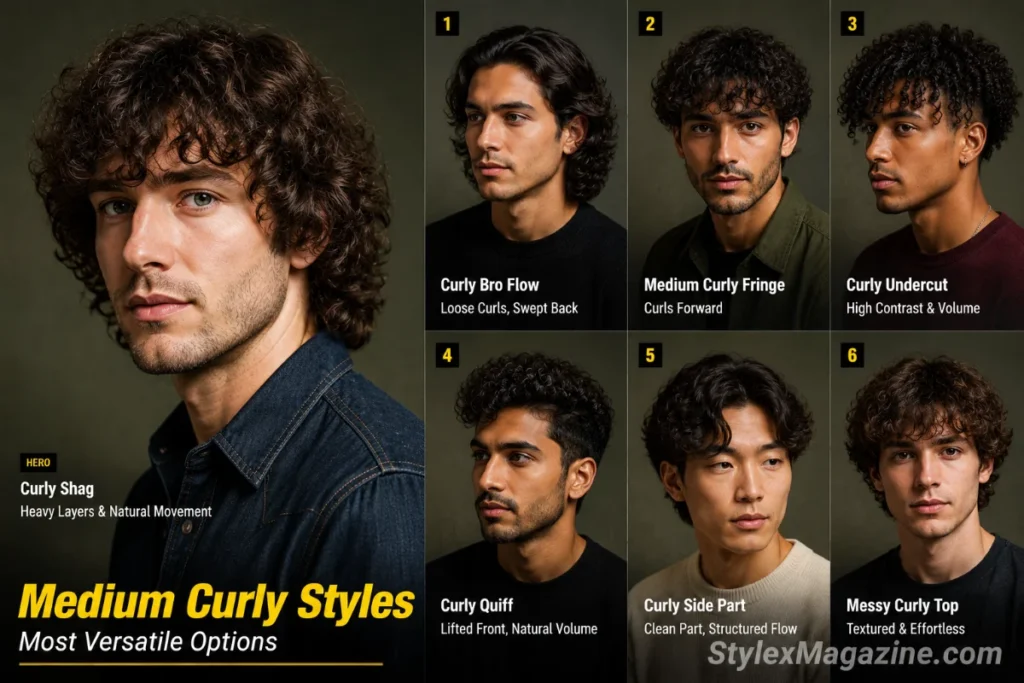
The curly shag and messy curly top are the two most requested medium-length styles in 2026 — and the easiest to maintain. Medium-length curly hair sits between 3 and 5 inches on top. Long enough to show full curl definition, short enough to manage without a multi-step routine.
Curly Shag
Heavy layers through the crown with longer length at the nape — choppy, textured, and built to move. The shag adds visible body to fine or thin curls because the layers create dimension that one-length cuts cannot. Type 2C–3B curls carry it best. Heart and oval faces benefit from the fringe softening the forehead.
Tell your barber: “Modern shag — heavy layers on the crown, keep length at the nape, no razor cutting, blunt ends.”
Maintenance: Low. Sea salt spray, air dry. Trim every 5–6 weeks.
Curly Bro Flow
Four to five inches of curl swept back from the face with almost no product — holds shape through weight, not scissors. The sides stay at natural length with no fade. Type 2 and loose Type 3 curls suit this. Tight coils spring forward rather than flowing back.
Tell your barber: “Bro flow — weight-balanced, no fade, keep the sides natural length, everything swept back.”
Maintenance: Very low. Shampoo, condition, comb back with fingers, air dry. Trim every 6–8 weeks.
Curly Fringe (Medium Length)
A longer version of the short curly fringe — 3–4 inches of curl falling forward across the forehead with tapered or faded sides. The forward movement draws attention toward the eyes and away from a receding hairline or wide forehead. Type 3A–3C curls hold the fringe shape with enough spring to sit without flopping.
Tell your barber: “Leave the front two inches longer than the crown so the fringe falls naturally. Cut dry.” Maintenance: Low-medium. Curl cream, diffuse the fringe forward. Trim every 4–5 weeks.
Curly Undercut
Disconnected contrast — buzzed or faded sides against full curls on top with no blending. It suits oblong and square faces because the hard horizontal line at the disconnection adds width. Type 3B–4A curls with real density carry it strongest.
Tell your barber: “Undercut on the sides — number two guard. Leave the top natural, three inches minimum. No blending.”
Maintenance: Medium. The regrowth line shows faster than a fade. Trim every 3–4 weeks.
Curly Quiff
Longer curls on top styled upward and back, with shorter tapered sides. The quiff adds height and elongates round and square faces. Kit Harington wore variations of this throughout his career. Medium-hold mousse on damp hair, diffuse upward, shape with fingers.
Tell your barber: “Keep about three inches on top, taper the sides and back. Cut it so it holds volume at the front.”
Maintenance: Medium. Needs product and diffusing. Trim every 4–5 weeks.
Curly Side Part
A defined part with curls on top and tapered sides. The part introduces structure to an otherwise relaxed texture. For men with oblong faces, the side part breaks up vertical length and adds width — a benefit most other medium curly styles miss. Type 2C–3B curls hold the part cleanly.
Tell your barber: “Part on the left side, scissor cut the top with enough length to hold the curl, taper the sides.”
Maintenance: Low. Leave-in conditioner, comb the part in, air dry. Trim every 4–5 weeks.
Messy Curly Top
The deliberate-bedhead style — curls left to fall naturally on the crown with tapered sides for balance. Jeremy Allen White in “The Bear” turned this into a search trend that has not slowed down. The less product and touching, the better it holds. Any curl type, any face shape.
Tell your barber: “Scissor cut on top, keep the natural texture, light taper on the sides — no hard lines.” Maintenance: Very low. Sea salt spray on damp hair, hands off. Trim every 5–6 weeks.
What Are the Best Long Curly Styles for Men?
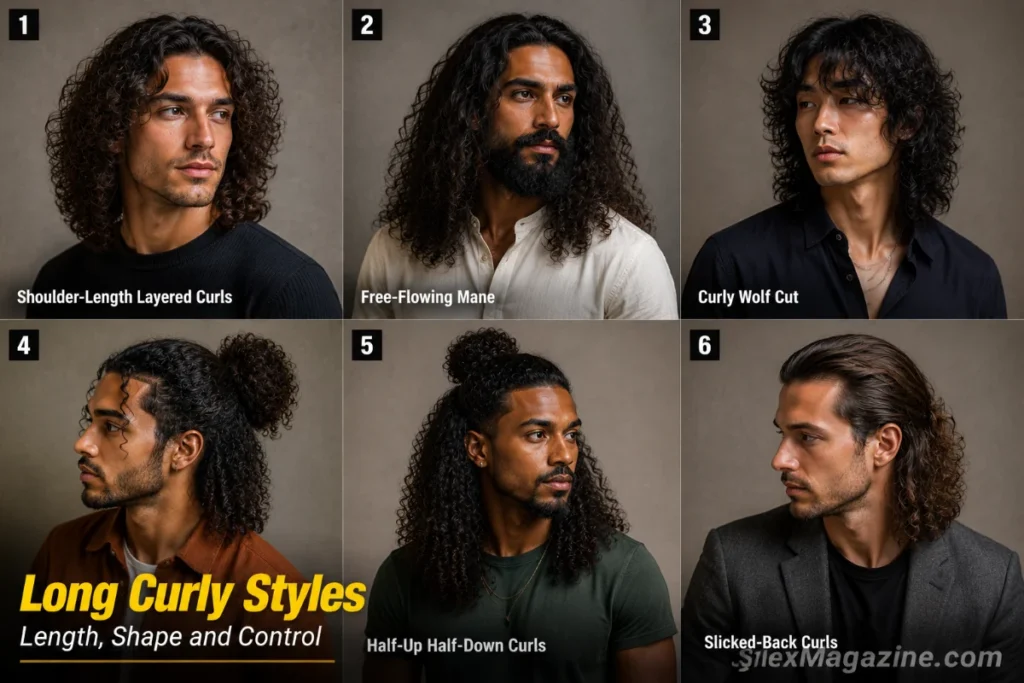
Shoulder-length curls with layers are the safest long option — they prevent the triangle shape that one-length cuts create on curly hair. Long curly hair starts at 6 inches and extends past the shoulders. If curls are dry or damaged, the length exposes it.
Shoulder-Length Curls — Enough length for texture and movement, enough control to avoid bulk. Layers prevent the triangle shape that heavy curls create when cut blunt. Suits all curl types.
Free-Flowing Mane — No structure, no layering, just length and natural fall. Type 2C–3B curls with medium-to-thick density respond best. Oval and oblong faces gain balance from the width curls provide. Needs consistent deep conditioning.
Curly Wolf Cut — Heavy layers through the crown with longer hair at the nape — shaggy, disconnected, and a top request in barbershops through 2026. Thick Type 3A–3C curls give it the most impact. Diamond, oval, and heart faces.
Curly Man Bun — Gather curls into a bun at the crown or nape. Curly texture adds natural fullness to the bun that straight hair cannot match. Any curl type at 10+ inches. Very low daily maintenance but the hair underneath still needs regular care.
Half-Up, Half-Down — Top section pulled up, rest falling loose. Practical and textured. Suits round faces especially — the height from the half-up section elongates.
Slicked-Back Curls — Medium-hold gel or pomade, curls swept back with fingers. Clean and formal. Type 2B–3B at 8+ inches. Oval and heart faces look sharpest.
The complete long curly hairstyles guide breaks down 15+ styles with barber scripts, curl type matching, maintenance times, and an awkward stage survival section for men currently growing their curls out.
How Do Short, Medium, and Long Curly Styles Compare?
| Short (Under 3″) | Medium (3–5″) | Long (6″+) | |
|---|---|---|---|
| Best curl types | All — 2A through 4C | 2C–4A carry the widest range | 2C–3C best; 4A+ needs significant care |
| Daily styling time | 0–2 minutes | 3–8 minutes | 10–20 minutes |
| Product needed | Optional on most | Curl cream or sea salt spray | Leave-in + cream + gel layered |
| Trim frequency | Every 3–5 weeks | Every 4–6 weeks | Every 6–8 weeks |
| Best for first-timers | ✅ Lowest commitment | ✅ Most room to experiment | ❌ Requires grow-out patience |
| Grows out cleanly | Yes — fades need upkeep | Yes | Awkward stage at 3–5 months |
How Do Fades Work With Curly Hair?
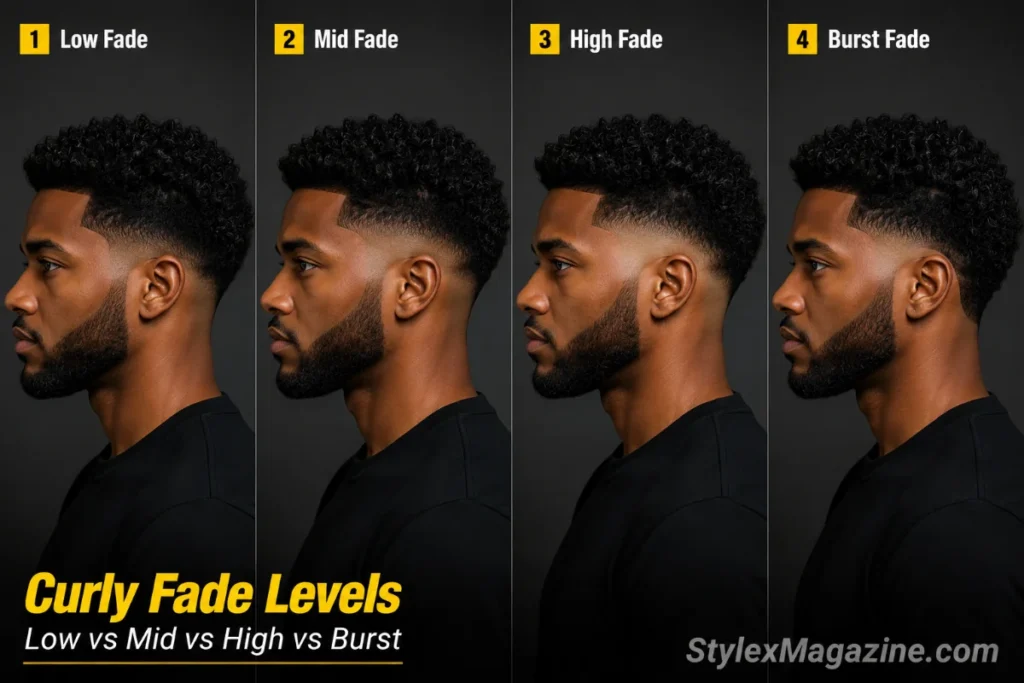
Fades and curly hair are a natural pairing — the cropped sides create contrast that makes curl texture on top stand out. The key is matching the fade level to the volume you carry on top.
Low fade — Starts just above the ear. The softest option. Keeps enough side hair that the transition into the curls feels gradual. Best for men trying a fade for the first time, and the one that grows out most cleanly between appointments.
Mid fade — Starts at the temple line. Removes enough side weight to slim round faces. Stronger contrast than a low fade without the sharpness of a high. Most barbers recommend this as the default for medium curly styles.
High fade — Starts above the temples, sometimes at the parietal ridge. Maximum contrast. Only worth doing if you refresh every 1–2 weeks — the high transition line shows regrowth fastest. Strong visual impact on dense Type 3C–4C coils. The high fade paired with defined coils on top remains the most requested curly style for Black men — the contrast between skin-tight sides and natural texture creates a clean, sharp silhouette.
Burst fade — Curves around the ear in a semicircle rather than running horizontally. On curly hair, the curved line follows the growth pattern and produces a rounder, more organic shape. The burst fade guide covers the full range of how this pairs with curly texture.
The 2025–2026 trend has shifted toward lower, softer fades that let the curl volume lead rather than the fade.
Which Curly Style Suits Your Face Shape?
Oval faces have the fewest restrictions — triangle and oblong faces need the most careful pairing. Use this table to narrow your options before committing.
| Face Shape | Best Styles | Avoid |
|---|---|---|
| Oval | Almost any style. Textured crop, shag, bro flow, shoulder-length, afro | No restrictions |
| Round | Styles that add height — quiff, high-top fade, pompadour, half-up, undercut | Middle parts, one-length styles that sit flat |
| Square | Softer textures — shoulder-length, layered curls, low fade, messy top | Overly geometric cuts that compete with the jawline |
| Oblong | Styles that add width — afro, side part, voluminous layers | Anything stacking height on top without side volume |
| Heart | Wolf cut, shag, curtain fringe, face-framing layers | Slicked-back styles that expose a narrow chin |
| Diamond | Curly fringe, textured crop, shag, medium-length curls with volume at the sides | Short buzz cuts that emphasise wide cheekbones |
| Triangle | Curly quiff, high fade with curls, styles adding volume on top | Heavy side volume that widens the jawline further |
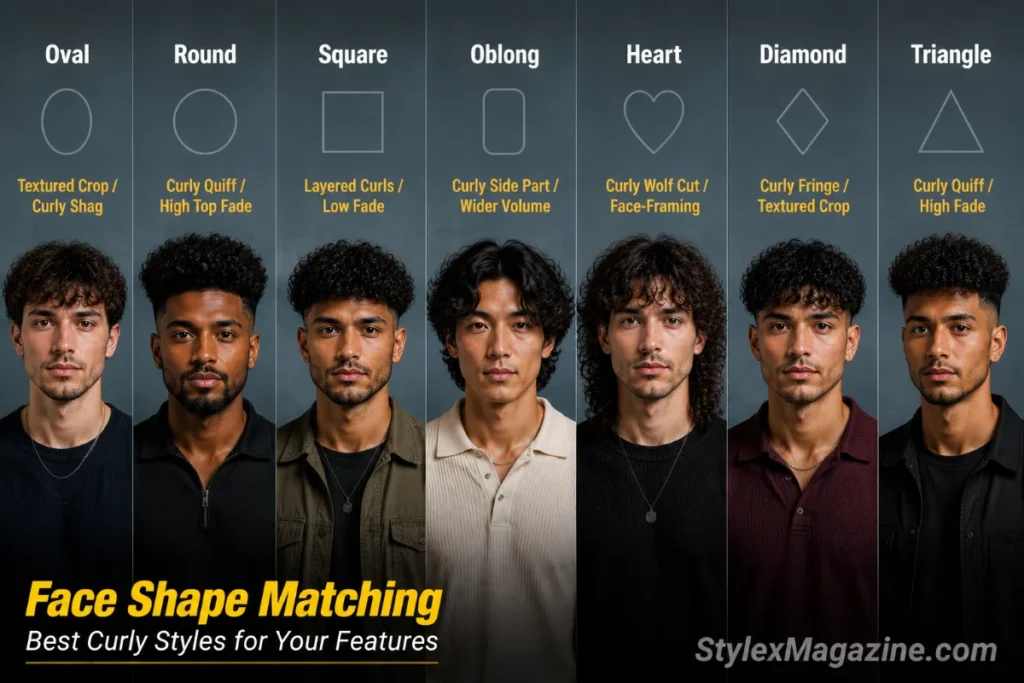
For a deeper breakdown of which cuts suit specific face shapes — including barber scripts and celebrity examples — read the face shape haircuts guide.
What Should You Tell Your Barber About Curly Hair?
Most bad curly haircuts happen because the client says “shorter” and the barber takes length off evenly. Curly hair needs sculpting — removing weight in specific spots while keeping volume in others.
Five things to communicate every visit:
“Cut it dry, or check the shape dry before I leave.” Wet curly hair hangs 2–4 inches longer than it sits when dry. The American Academy of Dermatology recommends seeking a stylist experienced with curly hair texture — and dry cutting is the single clearest sign of that experience.
“No thinning shears.” Thinning shears on curly hair create uneven wispy sections that frizz on contact with humidity. Point cutting achieves the same weight removal without destroying the curl edge.
“I want shape, not just shorter.” State what you want the cut to DO — add height, reduce bulk at the sides, frame the face — not just how much to remove.
“Leave it longer than you think.” Build in room for shrinkage. Two inches of visible dry curl might require two and a half inches of wet length depending on your pattern.
“Follow my curl pattern, not against it.” Layers cut with the curl direction reduce bulk cleanly. Layers cut against it create flyaways.
What Are the Most Common Curly Hair Mistakes to Avoid?
Using thinning shears is the single most damaging mistake a barber can make on curly hair. Beyond the chair, most problems come from home care and product choices.
Cutting wet without a dry check. Curly hair shrinks 15–75% depending on type. A cut that looks balanced wet can sit lopsided once it dries and springs up. Always confirm the final shape on dry hair before leaving the chair.
Over-washing. Shampooing daily strips the natural oils curly hair depends on for moisture and definition. Two to three washes per week with a sulfate-free formula is the limit for most curl types. A 2025 study in Cosmetics (MDPI) confirmed that routine washing and heat styling significantly increase porosity in textured hair — making it harder to retain moisture with each wash (Mantuan Gasparin et al., 2025).
Wrong product weight for curl type. Type 2 waves drown under heavy curl butters — they go flat and greasy within hours. Type 4 coils flake and dry out under lightweight sprays that cannot lock in enough moisture. Match the product weight to the curl density, not the brand’s marketing.
Touching curls while they dry. Every time you run fingers through half-dry curls, you break the gel cast forming around each strand. That broken cast turns into frizz. Apply product to soaking wet hair, then hands off until fully dry.
Sleeping on cotton pillowcases. Cotton friction roughs up the hair cuticle overnight, causing frizz that undoes a day’s worth of styling. A satin or silk pillowcase eliminates this. For longer styles, a loose pineapple (gathering curls at the top of the head with a soft scrunchie) preserves shape until morning.
How Do You Maintain Curly Hair Between Cuts?
Wash less, condition more — that single habit fixes 80% of curly hair problems. Two to three washes per week with a sulfate-free shampoo. Condition every time — apply to the ends, not the scalp.
Match product weight to curl type. Type 2 waves: sea salt spray or lightweight cream. Type 3 spirals: medium curl cream under a defining gel. Type 4 coils: heavier butter or moisturising gel.
Protect the curl overnight. Sleep on a satin or silk pillowcase. For longer styles, a loose pineapple preserves shape until morning.
Trim schedule by style category:
| Style Type | Trim Frequency |
|---|---|
| High or skin fades | Every 1–2 weeks |
| Mid fades and short cuts | Every 3–4 weeks |
| Medium-length styles | Every 4–6 weeks |
| Long curly styles | Every 6–8 weeks (light dusting every 6 weeks to prevent split ends) |
FAQ’s
How do you know if your barber understands curly hair?
Ask one question: “Do you cut curly hair dry or wet?” A barber who answers “wet” without mentioning a dry check is not experienced with curl shrinkage.
How often should you change your curly hairstyle?
Most men find a style that suits their curl type and stick with it for 6–12 months. Switching too frequently means you never learn the product routine or grow into the cut properly. The exception is seasonal — shorter in summer for heat and humidity, slightly longer in winter when dry air increases frizz.
How do you stop curly hair from frizzing in humidity?
A leave-in conditioner seals the cuticle and prevents dry curls from absorbing moisture unevenly. Apply to damp hair after every wash, lock it in with a lightweight gel, and do not touch your hair once it dries.
Is curly hair harder to cut than straight hair?
Yes. Curly hair shrinks when dry, sits at different tensions across the head, and changes shape depending on product and technique. Always confirm your barber has experience with curly textures before sitting down.
Can you switch between curly styles without a new haircut?
Yes, if the base cut supports it. A medium-length taper with 3–4 inches on top can be worn as a messy top, a side part, a quiff, or swept back — all from the same cut using different products and drying techniques.

18 Best Middle Part Hairstyles for Men (2026)
15 Best Long Curly Hairstyles for Men.
No Comment! Be the first one.